INTRODUCTION
A number of studies indicate that people with life-threatening diseases may benefit from early palliative care (PC) (Mazanec et al., Reference Mazanec, Daly and Pitorak2009; Temel et al., Reference Temel, Greer and Muzikansky2010; Dalgaard, Reference Dalgaard2010; Murray et al., Reference Murray, Kendall and Boyd2005). When patients are not identified in timely fashion, the consequences may include inadequate alleviation of symptoms, unexpected emergency admissions, and unplanned institutional death. Patients and their families are denied the opportunity to consider their future on an informed basis, to plan their final time, and to prepare for death (Fischer et al., Reference Fischer, Gozansky and Sauaia2006; Murtagh et al., Reference Murtagh, Preston and Higginson2004; Thoonsen et al., Reference Thoonsen, Groot and Engels2011).
In 2002, The World Health Organization (WHO) emphasized that PC should be available to everyone affected by a life-threatening disease, and that measures should be initiated early on in the illness trajectory alongside treatment to prolong life (World Health Organization, 2002; Radbruch & Payne, Reference Radbruch and Payne2009). Even though the debate on these objectives has been going on for quite some time, they have only been implemented to a limited extent in practice (Seymour, Reference Seymour2012; Thoonsen et al., Reference Thoonsen, Groot and Engels2011). In the first instance, this means that there are inequalities in access to PC (Seymour, Reference Seymour2012). Traditionally, the target group for PC was cancer patients with advanced disease and a short remaining lifespan (Clark & Seymour, Reference Clark and Seymour1999; Murtagh et al., Reference Murtagh, Preston and Higginson2004; Mazanec et al., Reference Mazanec, Daly and Pitorak2009; Seymour, Reference Seymour2012). Patients with chronic progressive diseases still have limited access to PC. In addition, there are indications that PC is often initiated late in the trajectory (Albert, Reference Albert2008; Dalgaard et al., Reference Dalgaard, Thorsell and Delmar2010; Gaertner et al., Reference Gaertner, Wolf and Scheicht2010a; Thomas et al., Reference Thomas2011; Iley, Reference Iley2012).
Early identification of palliative trajectories presents a number of challenges. For one thing, there is no consensus among professionals on when the palliative trajectory begins. The assessment criteria may, for example, be based on the curability of the disease, prognosis, expected remaining lifespan, palliative needs, or a combination of these factors (Department of Health, 2008; Lynn, Reference Lynn2005; Murray et al., Reference Murray, Kendall and Boyd2005; Thomas et al., Reference Thomas2011).
Another issue is that the unpredictable trajectory of the disease may be a challenge. Although various diseases follow a typical course, individual illness trajectories come with a certain amount of unpredictability. Malignant diseases usually have a more predictable progression than nonmalignant ones (Fischer et al., Reference Fischer, Gozansky and Sauaia2006; Murtagh et al., Reference Murtagh, Preston and Higginson2004). It can therefore be difficult to decide when PC is appropriate for patients with nonmalignant diseases. This unpredictability can also affect how patients and relatives experience the trajectory. They may have experienced periods of severe disease followed by dramatic improvements (Murtagh et al., Reference Murtagh, Preston and Higginson2004). It can thus be difficult to know whether a deterioration of the disease is temporary. This unpredictability can also affect the efforts of healthcare professionals. The excessively optimistic assessment of a patient's life prospects by doctors and a lack of attention on the part of healthcare professionals to decisive changes in the patient's condition can mean that palliative trajectories are not identified in time (Murtagh et al., Reference Murtagh, Preston and Higginson2004; Dalgaard et al., Reference Dalgaard, Thorsell and Delmar2010).
A third issue is that open communication about palliative treatment aims can be a challenge. Healthcare professionals may be reticent about inviting patients and their families to an explicit open discussion on the subject, partly because they find it difficult and partly because they are afraid of taking away their hope (Dalgaard et al., Reference Dalgaard, Thorsell and Delmar2010). Respect for patients' and families' coping strategies can also mean that an open discussion about PC may be inappropriate, particularly during the early phase of a palliative trajectory (Murray et al., Reference Murray, Kendall and Boyd2005).
The question is how in practice to overcome the challenges that come with early identification of the need for PC. A number of experts maintain that we should nevertheless try, since early identification of the need for PC is a precondition for timely and adequate PC (Murtagh et al., Reference Murtagh, Preston and Higginson2004; Lynn, Reference Lynn2005; Murray et al., Reference Murray, Kendall and Boyd2005; Thomas, Reference Thomas2010; Reference Thomas2011; Thoonsen et al., Reference Thoonsen, Groot and Engels2011). There is a need for more knowledge as to how palliative trajectories can be identified and the challenges overcome.
The aim of our study was to draw up a systematic literature review on the best evidence of methods for early identification (EI) of palliative trajectories for life-threateningly ill patients with malignant and nonmalignant diseases, and to identify preconditions for early integration of general PC in hospitals and the outcomes for patients and relatives. Based on knowledge of the varied progression of diseases and assumptions of inequality in access to palliative measures, the study population included patients with cancer, congestive heart failure (CHF), and chronic obstructive pulmonary disease (COPD).
METHODS
This systematic review was synthesized from the best evidence available. In September 2012, a comprehensive literature search was undertaken of the Cochrane Library, PubMed, EMBASE, CINAHL, PsychINFO, and SveMed+ databases, as well as relevant international websites covering the period 2002 to 2012. Inclusion criteria were: peer-reviewed articles and evidence-based clinical guidelines, written in English, Danish, Norwegian, and Swedish; reporting studies of adult patients with cancer, CHF, and COPD in Western locations (United States, Canada, Australia, New Zealand, and European Union [EU] countries), with a focus on general PC in hospitals.
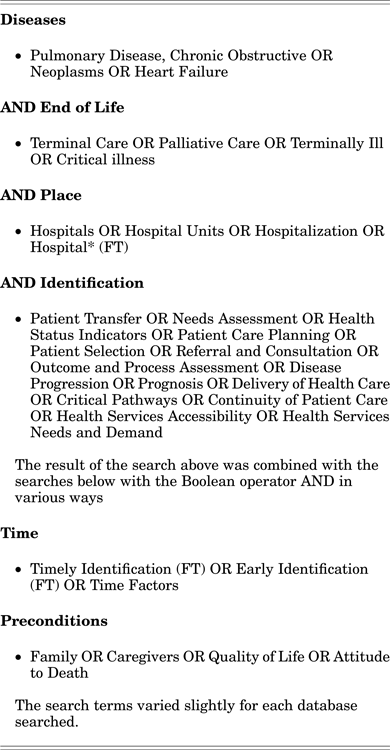
Devising a search strategy was very challenging due to the lack of MeSH (medical subject heading) terms for this topic area. Our librarian developed the search strategy together with the research team. Table 1 summarizes the search terms employed. Given the diffuse search terms involved, this generated 2,369 titles. The titles and abstracts were screened to exclude articles that were clearly not pertinent. After removal of duplications, 97 papers were read in full, 34 of which met the inclusion criteria. Further hand searches were undertaken by screening the reference lists and citations of included papers (which yielded 13 papers), and international websites were screened for evidence-based clinical guidelines (yielding 8 guidelines). A total of 55 papers met the study criteria (Fig. 1 outlines this process). Finally, each paper was assessed regarding its methodological standard and validity. Checklists based on objective criteria were employed to increase the transparency and reproducibility of the assessment. For assessment of quantitative studies and systematic reviews, checklists based on the method for evaluating research and guideline evidence (MERGE) were utilized (Sundhedsstyrelsen, 2004). Qualitative methods were assessed using the Critical Appraisal Skills Programme (Critical Appraisal Skills Programme (CASP) (2010)). Clinical guidelines followed the Appraisal and Guidelines for Research & Evaluation (AGREE) instrument (AGREE Collaboration, 2003), which is an internationally recognized instrument for critical assessment of clinical guidelines. Papers of low methodological quality (few or no criteria met), as well as clinical guidelines that could not be recommended according to AGREE (or where there was doubt as to whether or not they could be recommended), were excluded (n = 11). A number of “systematic reviews” were classified as “reviews” due to a lack of systematic approach. The final sample included 44 papers.
Selection of papers.

Summary of search strategy
Our review addressed different objectives, best answered with different methods. Due to the heterogeneity of the sample, the papers included were not rated according to evidence hierarchies (Polit & Beck, Reference Polit and Beck2008). In our study, best evidence was based on findings from methodologically appropriate and valid systematic reviews (6), quantitative (14) and qualitative (6) studies, reviews (9), and evidence-based clinical guidelines (9).
RESULTS
The final sample of 44 reviewed papers is summarized in Tables 2–7 according to primary focus. The results can be categorized as follows: methods specific for cancer, CHF, and COPD; general methods for EI of palliative illness trajectories; preconditions for early integration of general PC in hospitals; and outcomes. The main categories are presented below.
Methods for early identification of palliative trajectories in cancer
PC = palliative care; PCST = PC hospital support team; SOP = standard operating procedures; EAPC = European Association of Palliative Care.
Methods for early identification of palliative trajectories in CHF
CHF = congestive heart failure; PC = palliative care; EoLC = end-of-life care; ESAS = the Edmonton Symptom Assessment Scale; PPS = the Palliative Performance Scale; KCCQ = the Kansas City Cardiomyopathy Questionnaire; NYHA = the New York Heart Association Functional Class; SHFM = Seattle Heart Failure Model; ESC = European Society of Cardiology; NIH = National Institutes of Health.
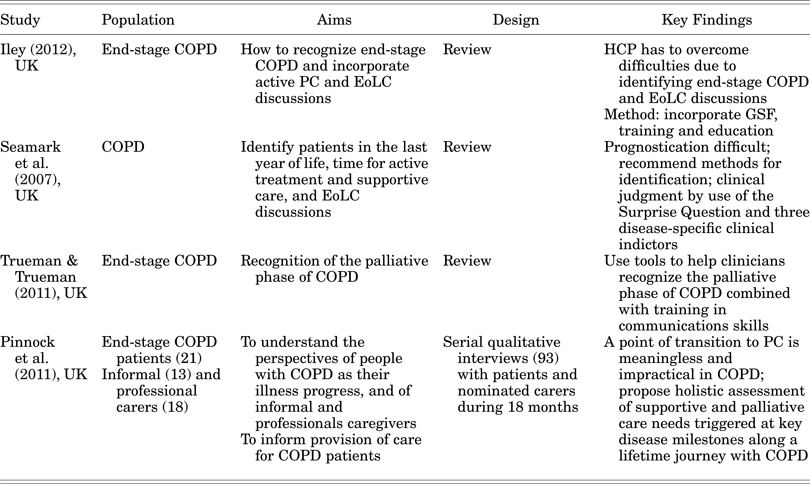
Methods for early identification of palliative trajectories in COPD
COPD = chronic obstructive pulmonary disease; UK= United Kingdom; PC = palliative care; EoLC = end-of-life care discussions; HCP = healthcare professional; GSF = Golden Standards Framework.
General methods for early identification of palliative trajectories

UK = United Kingdom; EoL = end of life; PC = palliative care; CHF = chronic heart failure; COPD = chronic obstructive pulmonary disease; PIG = prognostic indicator guidance; GSF = golden standards framework; CAPC = Center to Advance Palliative Care; PC = palliative care.
Preconditions for early integration of palliative trajectories in cancer, CHF, and COPD
UK = United Kingdom; CHF = chronic heart failure; COPD = chronic obstructive pulmonary disease; HCP = healthcare professionals; EoLC = end-of-life care; PC = palliative care; COPD = chronic obstructive pulmonary disease; NYHA = the New York Heart Association functional class; ACP = advanced care planning.
Outcome of early integration of palliative trajectories for patients and relatives
NSCLC = non-small-cell lung cancer; PC = palliative care; EoLC = end-of-life; RCT = randomized controlled trial; QoL = quality of life; EoL = end-of-life care.
Methods for Early Identification of Palliative Trajectories in Cancer Patients (see Table 2)
Prognostication of Advanced Cancer
Historically, prognostication has been of great importance in identification of palliative trajectories, as the palliative target group was confined to those with incurable illness and a short expected remaining lifespan (World Health Organization, 1990). Prognostication is not explicitly linked to EI of palliative trajectories, but rather with clinical decision making, discussions about therapeutic interventions and quality of life (QoL), and a patient-centered ethical approach to enhance autonomy and help families to make informed choices (Maltoni et al., Reference Maltoni, Caraceni and Brunelli2005; Glare & Sinclair, Reference Glare and Sinclair2008; Trajkovic-Vidakovic et al., Reference Trajkovic-Vidakovic, de Graeff and Voest2012).
Prognostication can be based on clinical prediction of survival (CPS), prognostic scores, prognostic indicators, biological parameters, and psychological coping. CPS is a useful and valid tool, but it should be combined with other prognostic factors due to variation in the accuracy of physicians' judgments (Maltoni et al., Reference Maltoni, Caraceni and Brunelli2005; Gripp et al., Reference Gripp, Moeller and Bölke2007; Glare & Sinclair, Reference Glare and Sinclair2008; Trajkovic-Vidakovic et al., Reference Trajkovic-Vidakovic, de Graeff and Voest2012).
Typically, prognostic scores focus on statistical median survival data, with little relevance to the individual patient (Glare & Sinclair, Reference Glare and Sinclair2008). However, clinicians can use prognostic scores to prepare a general prognosis and CPS to refine an individual prognosis (Maltoni et al., Reference Maltoni, Caraceni and Brunelli2005; Glare & Sinclair, Reference Glare and Sinclair2008). The two most validated and used scales, the Palliative Prognostic Index (PPI) and the Palliative Prognostic Score (PaP), are especially useful in predicting short-term survival (<3 months) and therefore less relevant for EI (Glare & Sinclair, Reference Glare and Sinclair2008; Trajkovic-Vidakovic et al., Reference Trajkovic-Vidakovic, de Graeff and Voest2012). Prognostic scores are available that are useful for predicting survival of greater than three months (Glare & Sinclair, Reference Glare and Sinclair2008). A full discussion of these issues is beyond the scope of the present paper.
Clinicians can employ patient-related prognostic indicators and a number of clinical signs and symptoms that have proved to be associated with life expectancy. There is strong evidence for performance status, clinical symptoms associated with cancer anorexia–cachexia syndrome, dyspnea, and delirium (Maltoni et al., Reference Maltoni, Caraceni and Brunelli2005). However, these indicators are especially relevant for terminal pathways (survival <3 months). Performance status, nutritional status, dyspnea, confusion, and abnormal laboratory tests (leukocytosis, lymphocytopenia, and elevated C-reactive protein [CRP] levels) are more important in advanced cancer (Maltoni et al., Reference Maltoni, Caraceni and Brunelli2005; Glare & Sinclair, Reference Glare and Sinclair2008). Prognostication in less advanced cancer is typically based on tumor-related indicators (Maltoni et al., Reference Maltoni, Caraceni and Brunelli2005; Gripp et al., Reference Gripp, Moeller and Bölke2007; Trajkovic-Vidakovic et al., Reference Trajkovic-Vidakovic, de Graeff and Voest2012).
Trajkovic-Vidakovic and colleagues (Reference Trajkovic-Vidakovic, de Graeff and Voest2012) described the prognostic meaning of symptoms in relation to three progressive stages of the palliative phase: (1) disease-directed (advanced cancer, predicted survival 3–12 months); (2) symptom-oriented (far advanced, predicted survival <3 months), and (3) terminal (death imminent). There appeared to be important differences between those relevant to disease-directed and symptom-oriented palliation. Confusion, dyspnea, and fatigue were less relevant in disease-directed palliation.
The prognostic capacity of subjective indicators such as QoL or other psychological parameters is somewhat contradictory but relevant in earlier stages of the disease (Maltoni et al., Reference Maltoni, Caraceni and Brunelli2005). Gripp et al. (Reference Gripp, Moeller and Bölke2007) studied how CPS, objective prognostic indicators, and psychological coping relate to survival. They found a strong impact of psychological distress, namely, depression and anxiety, on survival. Their conclusion was that self-reported emotional distress may improve prognostic accuracy.
Diagnosis-Specific Clinical Assessment
A German research group examined how early integration (EI) of PC can be implemented in routine cancer care (Gaertner et al., Reference Gaertner, Wolf and Scheicht2010a; Reference Gaertner, Wuerstlein and Klein2011a; Reference Gaertner, Wolf and Frechen2012) and concluded that identifying the expected survival time of a specific patient is problematic, and that the use of symptom burden as the only trigger for integration of PC may lead to excessively late PC referrals. They advocated that clinical assessment be based on diagnosis-specific clinical guidelines (Gaertner et al., Reference Gaertner, Wolf and Ostgathe2010b; Reference Gaertner, Wolf and Hallek2011b) and that palliative care be integrated when the therapeutic options for each disease are no longer curative (i.e., life-threatening, incurable and progressive disease). They have defined diagnosis- and stage-specific points at which PC should be integrated into the clinical pathway of 19 hemato-oncological malignancies.
Clinical Holistic Screening
The National Comprehensive Cancer Network (NCCN) developed guidelines to facilitate the integration of PC for cancer patients during their last year of life (National Comprehensive Cancer Network, 2011). They recommended screening procedures based on specific clinical situations: uncontrolled symptoms; moderate to severe distress related to cancer diagnosis and/or therapy; serious comorbid physical and psychosocial conditions; life expectancy greater than 12 months based on objective prognostic indicators (poor performance status, CNS metastasis, delirium, superior vena cava syndrome, spinal cord compression, cachexia, malignant effusions, liver failure, kidney failure, or other comorbid conditions); patient/family concerns about the course of the disease and decision making; and when the patient/family requests PC. They suggested that palliative care should be integrated into general oncology care when patients meet at least one screening criterion.
Methods for Early Identification of Palliative Trajectories in CHF Patients (see Table 3)
Prognostication of End-Stage CHF
A number of prognostic approaches to EI of palliative trajectories in CHF patients have been described. There is a review linking the identification of end-stage CHF and the timing for PC (Albert, Reference Albert2008). Palliative care begins when a person is diagnosed with a life-threatening or debilitating condition. It is difficult to know when CHF will become debilitating, but no single marker has been found to be more useful than objective and subjective clinical assessment based on prognostic indicators such as poor outcome indicators, activities of daily living, impaired nutrition, and New York Heart Association (NYHA) functional status IV (Albert, Reference Albert2008).
Prognostic scores can be employed to predict survival (Levy et al., Reference Levy, Mozaffarian and Linker2006; Rector et al., Reference Rector, Ringwala and Ringwala2006; James et al., Reference James, Offer and Wilson2010). The Seattle Heart Failure Model (SHFM) provides an accurate estimate of 1-, 2-, and 3-year survival with the use of clinical and pharmacological devices and laboratory variables (Levy et al., Reference Levy, Mozaffarian and Linker2006, p. 1426). Use of the SHFM in individual clinical situations is not explicitly linked to early identification of palliative trajectories. A model has been developed and validated among outpatients, but it was validated within a cohort of 214 inpatients to determine whether the SHFM could identify patients with a lifespan of less than 1.5 years who might benefit from PC (James et al., Reference James, Offer and Wilson2010). Nevertheless, this model fell short of providing an accurate measure of life expectancy when used in this fashion.
Validation of a risk score for dying within one year of admission for CHF based on vital clinical signs, laboratory tests, and comorbidity also indicates that prediction of individual deaths is far from perfect (Rector et al., Reference Rector, Ringwala and Ringwala2006).
One study compared patients' subjective self-assessment of life expectancy with model predictions using the SHFM (Allen et al., Reference Allen, Yager and Jonsson, Funk2008). Patients tend to overestimate life expectancy regardless of the objective severity of their heart failure. Guidelines developed by the European Society of Cardiology (ESC) recommend a combination of objective indicators and clinical judgment (Task Force for the Diagnosis…, 2008; 2012; Jaarsma et al., Reference Jaarsma, Beattie and Ryder2009). The ESC describes the characteristic trajectory for progressive CHF in three stages: (1) chronic disease management (NYHA l-III), (2) supportive and palliative care phase (NYHA III-IV), and (3) terminal care phase (Jaarsma et al., Reference Jaarsma, Beattie and Ryder2009). PC is relevant in stages 2 and 3, and should be introduced during stage 2. The ESC has also identified points on the CHF trajectory that could act as triggers for PC discussions. These triggers are based on clinical, biological, and functional factors and clinical judgment: frequent admission to hospital or other serious episodes of decompensating despite optimized treatment; heart transplantation and mechanical circulatory support ruled out; chronically poor QoL with NYHA class IV symptoms; cardiac cachexia/low serum albumin; dependence in most activities of daily living; and clinically judged to be close to the end of life (Task Force for the Diagnosis…, 2012).
Integrated Approach
An integrated approach combines identification of patients with advanced CHF and care needs (Zambroski, Reference Zambroski2006). The rationale is that patients with advanced CHF must be provided with PC concurrently with life-prolonging intervention, as sudden death can occur at any time, during any phase. Advanced CHF can be identified by adopting the National Institutes of Health (NIH) criteria to define end of life. First, the person must have (a) chronic disease(s) as well as symptoms or functional impairment that persist(s) or fluctuate(s). Second, there must be symptoms or impairments that result from the underlying irreversible disease that require formal or informal care and that can lead to death. Patients meeting these criteria must receive palliative care.
Symptom Assessment
A study by Ezekowitz and colleagues (Reference Ezekowitz, Thai and Hodnefield2011) links clinician- and patient-assessed symptoms and palliative care needs. The principal objective was to assess the utility of PC questionnaires (the Edmonton Symptom Assessment Scale [ESAS] or the Palliative Performance Scale [PPS]) as a supplement to CHF-validated questionnaires (the Kansas City Cardiomyopathy Questionnaire [KCCQ] or The New York Heart Association [NYHA] Functional Class), as traditional CHF scores alone have not proved clinically useful. This study could not confirm that the PPS or the ESAS was the ideal questionnaire for identifying patients requiring PC. The PPS and ESAS may serve as useful screening questionnaires for symptoms not captured in traditional CHF questionnaires.
Methods for Early Identification of Palliative Trajectories in COPD Patients (see Table 4)
Prognostication of End-Stage COPD
Predicting the prognosis in COPD is difficult due to the uncertain illness trajectory (Seamark et al., Reference Seamark, Seamark and Halpin2007; Trueman & Trueman, Reference Trueman and Trueman2011; Iley, Reference Iley2012). Three papers linked timely transition to PC and end-stage COPD, defined as patients with severe COPD entering the final 12 months of life (Seamark et al., Reference Seamark, Seamark and Halpin2007; Trueman & Trueman, Reference Trueman and Trueman2011; Iley, Reference Iley2012). Despite differences, the papers all recommended a combination of CPS and the use of prognostic indicators. To define end-stage COPD, clinicians are recommended to make a clinical holistic assessment by posing the “Surprise Question”: “Would I be surprised if my patient were to die in the next 12 months?” With patients for whom the answer is “no,” the time has come to initiate PC.
Different prognostic indicators may support CPS. Two papers recommended the use of disease-specific prognostic indicators associated with rapid decline and worsening health status: severely impaired respiratory function (decline in FEV1, dependence on oxygen therapy, severe dyspnea at rest); frequent exacerbations (frequent hospital admissions, ICU stay); severe comorbidity; increasing age, weight loss; and reduced activities of daily living (Seamark et al., Reference Seamark, Seamark and Halpin2007; Trueman & Trueman, Reference Trueman and Trueman2011). Iley (Reference Iley2012) recommended adoption of GSF Prognostic Indicator Guidance (PIG), which recommends use of both general and disease-specific indicators of decline and increasing needs.
Holistic Needs Assessment
The findings from one qualitative study (Pinnock et al., Reference Pinnock, Kendall and Murray2011) challenge current assumptions about the transition to palliative care. The policy of identifying a timepoint for transition to PC is meaningless and impractical in COPD. COPD is a condition with no coherent story and an unanticipated end, and the policy has little resonance for people with COPD or their clinicians. Rather than looking for a transition point to switch to PC, their findings propose linking a holistic assessment of palliative care needs with milestones throughout the patient's journey. Suitable milestones might be: diagnosis, retirement on medical grounds, starting long-term oxygen, hospital admission for an exacerbation, or a positive answer to the Surprise Question.
General Methods for Early Identification of Palliative Trajectories (seeTable 5)
Illness Trajectories of Functional Decline and Related Needs
There have been developments in our knowledge of how functional decline and related needs differ among different types of progressive illness (Lunney et al., Reference Lunney, Lynn and Foley2003; Murray et al., Reference Murray, Kendall and Boyd2005). Cancer trajectories are characterized by steady progression and usually a clear terminal phase; organ failure trajectories (COPD and CHF) are characterized by gradual decline, punctuated by episodes of acute deterioration and some recovery, and sometimes more sudden, seemingly unexpected death (Murray et al., Reference Murray, Kendall and Boyd2005). The rationale is that patients with typical illness trajectories and their carers seem to have common patterns of experiences, symptoms, and needs as the illness progresses.
Integrated Tools
The PIG is an integrated tool based on prediction of survival rate and course of decline and increasing needs (Thomas, Reference Thomas2010; Thomas et al., 2011). It aims to assist clinicians in identifying adults who are likely to die within the next 12 months and who may need additional palliative support. The PIG recommends that clinicians employ three steps in the process: (1) the Surprise Question, (2) general indicators of decline, and (3) disease-specific clinical indicators of decline (Thomas et al., 2011). The answer to the Surprise Question is an intuitive holistic assessment based on clinical experience and a range of clinical, social, and other factors that give the whole picture of deterioration. If clinicians are still in doubt, they may use general indicators of decline and increasing needs, based on functional, clinical, therapeutic, and/or biological indicators (Thomas et al., 2011). To support the assessment, clinicians may employ functional assessment tools (the Barthel Index, the PULSE “screening” assessment, or the Karnofksy Performance Status Score). If still in doubt, clinicians may utilize disease-specific clinical indicators developed for a range of diseases, including cancer and organ failure (COPD and CHF). Clinical indicators for cancer focus on indicators of rapid or predictable decline; clinical indicators for COPD and CHF focus on indicators of erratic decline (Thomas et al., 2011). If the answer is “yes” to one or more of the indicators, the process is completed with a needs-based code indicating the remaining lifespan, the actual clinical situation (described as “stable,” “unstable/advanced disease,” “deteriorating,” or “dying”), and an individual needs assessment.
The Supportive and Palliative Care Indicators Tool (SPICT), very similar to the PIG (Highet et al., Reference Highet, Crawford and Murray2012), is a guide for identifying people at risk of dying within the next 12 months. Like the PIG, it recommends indicators to assess the current and future needs of patients and families. However, the indicators are inverted, starting with general clinical indicators of decline, followed by disease-specific clinical indicators of advanced conditions, and, finally, the Surprise Question.
The Supportive Care Pathway (SCP) is an integrated care pathway based on elements from evidence-based national (United Kingdom) guidelines (Main et al., Reference Main, Whittle and Treml2006). One reason why the pathway is called the Supportive Care Pathway is that the generalist staff tend to associate palliative care with terminal care. The entry criteria to the pathway are: patients with a life-limiting illness, admitted to hospital following an acute episode, and not expected to survive the next 12 months. No formal evaluations have yet been conducted to assess outcomes for the SCP.
The Centre to Advance Palliative Care (CAPC) has developed a screening assessment tool to identify patients at high risk for unmet palliative needs in hospitals (Weissman & Meier, Reference Weissman and Meier2011). Its starting point is identification of patients with any potentially life-limiting or life-threatening disease, disorder, or condition. The screening assessment tool is divided into two checklists: (1) criteria designed for screening at the time of admission to hospital, and (2) criteria designed for daily rounds. Each checklist is divided into primary and secondary criteria to facilitate ease of implementation. The primary criteria are limited to the most important indicators, global in nature, and to be used as the minimum expected standard of care. The primary criteria at hospital admission are: the Surprise Question, frequent admissions, admission prompted by physical or psychological symptoms that are difficult to control, complex care requirement, and decline in function. Primary criteria for daily rounds are: the Surprise Question, physical or psychological symptoms that are difficult to control, intensive care unit stay (>7 days), lack of care goals, disagreement or uncertainty between the patient and staff, and/or family concern. The secondary criteria are more specific and comprehensive in scope and include physical, psychosocial, and spiritual indicators.
Prognostic Score
The CARING criteria are a simple set of objective prognostic screening criteria applied at the time of hospital admission to identify patients who have a high likelihood of death within one year and who therefore may benefit from palliative care (Fischer et al., Reference Fischer, Gozansky and Sauaia2006). The criteria for predicting one-year mortality are: cancer as a primary diagnosis, admissions (≥2) to the hospital during the past year for a chronic illness, residence in a nursing home, intensive care unit admission with multiple organ failure, and noncancer hospice guidelines (≥2 NHPCO criteria). Fischer and colleagues found that the CARING criteria were highly predictive of death at one year in the hospitalized veteran population at the time of hospital admission.
Preconditions for Early Integration of Palliative Care (seeTable 6)
There are methods available to help clinicians identify patients eligible for palliative care. However, various barriers in clinical practice need to be overcome if early integration of PC is to succeed (Boyd & Murray, Reference Boyd and Murray2010; Thomas et al., 2011). Our review has identified a number of barriers that have a decisive impact on early integration of PC: disease-, staff-, user-, and organization-specific, often with inherent interacting factors documented in cancer, CHF, and COPD populations.
Cancer
Staff-specific: It is an important precondition for the provision of quality PC that the transition to the palliative phase is identified and explicitly communicated to patient and family (Dalgaard et al., Reference Dalgaard, Thorsell and Delmar2010). Others highlight formulation and communication about prognosis as a precondition (Maltoni et al., Reference Maltoni, Caraceni and Brunelli2005; Glare & Sinclair, Reference Glare and Sinclair2008). Communicating prognostic information should be part of a therapeutic alliance with the patient (Maltoni et al., Reference Maltoni, Caraceni and Brunelli2005). However, physicians are described as barriers to formulation and communication of prognosis due to poor prognostic skills, avoidance, and a reluctant approach (Glare & Sinclair, Reference Glare and Sinclair2008). Cultivating physicians' subjective judgment skills in formulating and communicating prognostic information is crucial to overcoming barriers of prognostication.
The implementation of the “early integration approach” is highly dependent on the staff perception (or misconception) about PC, which is often mistaken for “terminal care” (Gaertner et al., Reference Gaertner, Wolf and Scheicht2010a; Reference Gaertner, Wolf and Hallek2011b). Thus, it is important to ensure that the staff attitude toward, and culture of, palliative care become an integral part of patient care.
Organization-specific: There is an urgent need to facilitate institutionalization of the “early integration approach” (Gaertner et al., Reference Gaertner, Wolf and Hallek2011b). Gaertner and coworkers (Reference Gaertner, Wolf and Hallek2011b; Reference Gaertner, Wolf and Frechen2012) developed concise definitions of palliative care assignments and infrastructure for institutionalization of the “early integration approach.”
CHF
Disease-specific: The most commonly cited barrier to providing PC is the unpredictable illness trajectory and prognostic uncertainty of advanced CHF (Zambroski, Reference Zambroski2006; Boyd et al., Reference Boyd, Worth and Kendall2009; Green et al., Reference Green, Gardiner and Gott2010; Selman et al., Reference Selman, Harding and Beynon2007). Another barrier is the public perception of CHF as benign compared to cancer (Albert, Reference Albert2008; Selman et al., Reference Selman, Harding and Beynon2007).
User-specific: The public perception of CHF as benign may lead to misconceptions at the individual level (Albert, Reference Albert2008; Selman et al., Reference Selman, Harding and Beynon2007). These misconceptions may decrease the threat and burden to patients and families and provide hope for the future, but they may lead to fear and anxiety when symptoms worsen despite treatment.
Staff-specific: Inadequate communication surrounding the transition to PC is a frequently reported barrier (Green et al., Reference Green, Gardiner and Gott2010; Barclay et al., Reference Barclay, Momen and Case-Upton2011; Selman et al., Reference Selman, Harding and Beynon2007). The consequence is that end-of-life-care (EoLC) discussions rarely take place at all. The communication challenges are considerable. The unpredictable illness trajectory of CHF, prognostic uncertainty, high risk of sudden death, and compromised patient understanding of their poor prognosis are described as significant barriers to effective communication. In turn, both healthcare professionals and patients hold diverse attitudes towards EoLC discussions in terms of preferences, timing, and content. Lack of adequate communication skills, an unwillingness to disclose sensitive information, ethical challenges due to prognostic uncertainty, different patient preferences, and poor patient understanding underline the need for training professionals in EoLC communication so that they might interact with patients effectively. To overcome barriers of unpredictability, there is a need to shift to a paradigm of blending active (disease-modifying) treatment and palliative care (Zambroski, Reference Zambroski2006).
Organization-specific: Interdisciplinary cooperation is of great importance in CHF (Albert, Reference Albert2008; Green et al., Reference Green, Gardiner and Gott2010). Collaborative initiatives such as referral criteria, care pathways, and interdisciplinary education are recommended to facilitate collaboration and enhance the mutual understanding of CHF symptom management and PC between cardiac staff and PC clinicians.
COPD
Disease-specific: The greatest challenge to the provision of PC in COPD is prognostic uncertainty due to the unpredictable illness trajectory and unexpected death due to acute exacerbation (Seamark et al., Reference Seamark, Seamark and Halpin2007; Spathis & Booth, Reference Spathis and Booth2008; Pinnock et al., Reference Pinnock, Kendall and Murray2011, Momen et al., Reference Momen, Hadfield and Kuhn2012; Iley, Reference Iley2012).
User-specific: Misconceptions about both COPD and PC abound and are important barriers. It is a sobering thought that patients and caregivers generally fail to appreciate that COPD is a life-threatening disease (Spathis & Booth, Reference Spathis and Booth2008). COPD is described as a “way of life” rather than an “illness” that disrupts life (Pinnock et al., Reference Pinnock, Kendall and Murray2011). In our death-denying culture, PC can be misunderstood as a sign of “giving up” or that death is imminent (Spathis & Booth, Reference Spathis and Booth2008; Iley, Reference Iley2012). Thus, discussions about prognosis may be avoided by patients and family.
Staff-specific: Prognostication in COPD is difficult, and prognostic uncertainty may lead to “prognostic paralysis” (Seamark et al., Reference Seamark, Seamark and Halpin2007). Healthcare professionals need to overcome these barriers to prognostic uncertainty in order to provide early PC. To overcome the challenges caused by the unpredictable illness trajectory, improved prognostication and communication skills are needed (Spathis & Booth, Reference Spathis and Booth2008). Inadequate communication surrounding transitions to PC is a frequently reported barrier (Knauft et al., Reference Knauft, Nielsen and Engelberg2005; Green et al., Reference Green, Gardiner and Gott2010; Barclay et al., Reference Barclay, Momen and Case-Upton2011; Momen et al., Reference Momen, Hadfield and Kuhn2012; Selman et al., Reference Selman, Harding and Beynon2007). The unpredictable illness trajectory of COPD, prognostic uncertainty, high risk of sudden death, and compromised patient understanding of the poor prognosis are significant barriers to effective and timely communication (Green et al., Reference Green, Gardiner and Gott2010; Barclay et al., Reference Barclay, Momen and Case-Upton2011, Selman et al., Reference Selman, Harding and Beynon2007). Furthermore, these barriers foster uncertainty regarding individual patient attitudes, preferences, and the timing of EoLC discussions. Additionally, healthcare professionals do not identify EoLC discussions as their responsibility, and many find it difficult to discuss sensitive subjects such as poor prognosis and palliative care (Iley, Reference Iley2012). The consequence is that discussions about EoLC are rare in COPD (Knauft et al., Reference Knauft, Nielsen and Engelberg2005; Momen et al., Reference Momen, Hadfield and Kuhn2012). Good communication skills are a prerequisite to sensitive EoLC discussions, and adequate training in the breaking of bad news is seen as particularly important (Spathis & Booth, Reference Spathis and Booth2008; Momen et al., Reference Momen, Hadfield and Kuhn2012). Staff perceptions of palliative culture are also highlighted as a barrier. A paradigm shift from a disease-oriented approach to a patient-centered PC approach is central to delivery of quality PC (Spathis & Booth, Reference Spathis and Booth2008).
Organization-specific: Limited resources are mentioned as significant barriers to delivery of PC (Spathis & Booth, Reference Spathis and Booth2008). In particular, interdisciplinary training and education are called for. Respiratory specialists require training in the skills of PC, and PC specialists need more information about the management of nonmalignant disease.
Outcomes for Patients and Relatives (seeTable 7)
This section deals with the outcome of early integration of palliative care as it affects patients and relatives. Many studies have reported a positive correlation between early integration and high-quality PC (Murray et al., Reference Murray, Kendall and Boyd2005; Boyd & Murray, Reference Boyd and Murray2010; Thomas et al., 2011). However, there is sparse evidence supporting such statements, and the evidence includes only cancer populations.
A study among patients with newly diagnosed metastatic non-small-cell lung cancer (NSCLC) demonstrated that early integration of PC led to significant improvements in both quality of life (QoL) and mood, and prolonged survival by approximately two months (Temel et al., Reference Temel, Greer and Muzikansky2010). It was hypothesized that improvements in QoL and depressed mood may account for the observed survival benefit. The study concluded that early integration of PC with standard oncology for patients with NSCLC may result in better symptom management, leading to prolonged survival and better QoL.
Another study explored NSCLC patients' understanding of the prognosis and goals of cancer therapy, the effect of early PC on patients' illness perception, and the impact of medical decision making at the end of life (Temel et al., Reference Temel, Greer and Admane2011). Many patients with newly diagnosed metastatic NSCLC held inaccurate perceptions of their prognoses. However, early PC was found to significantly improve patients' understanding of prognosis over time, and changes of perception were significantly linked to treatment decisions and less aggressive end-of-life care.
A study examined the association between EoLC discussions with physicians and the medical care patients with advanced cancer receive near death, patients' psychological distress, quality of life near death, and caregiver bereavement (Wright et al., Reference Wright, Zhang and Ray2008). EoLC discussions were found to be significantly associated with less aggressive medical care near death and earlier hospice referrals, leading to better QoL near death. Better QoL near death was associated with better QoL among surviving caregivers, who experienced less regret and showed improvements in self-reported health, physical functioning, mental health, and overall QoL during the bereavement period. Despite physicians' concern that EoLC discussions may cause psychological harm, the study reported no evidence that these discussions were significantly associated with increased emotional distress or psychiatric disorders. Instead, the worst outcomes were seen in patients who did not report having EoLC discussions.
DISCUSSION
This systematic review has identified a number of disease-specific and general methods for early identification of patients with cancer, CHF, and COPD who may benefit from early palliative care. However, a number of interacting disease-, staff-, user-, and organization-specific barriers need to be overcome if early integration of PC is to succeed. Early integration of PC may lead to better symptom management, prolonged survival, and better quality of life. However, the outcome of early integration of PC has only been examined in cancer populations and among cancer patients receiving specialized PC. We now summarize and discuss the methods for early identification, preconditions, and outcomes.
Disease-Specific Methods
In cancer populations, disease-specific methods for EI of palliative trajectories include the prognostication of advanced cancer, diagnosis-specific clinical assessment, and clinical holistic screening. Despite variation in the accuracy of physicians' judgment, all papers recommend that CPS be combined with prognostic scores, prognostic indicators, and/or biological parameters—all objective indicators of patient-related physical symptoms. The prognostic capacity of patient-reported subjective indicators as psychological distress is uncertain. Prognostic indicators have different meaning and relevance in terminal, far-advanced, advanced, and less-advanced disease. Palliative trajectories have been identified using prognostic factors relevant for advanced cancer (life expectancy 3–12 months). The controversy about confusion and dyspnea has also been identified.
Gaertner et al. (Reference Gaertner, Wolf and Hallek2011b) recommended diagnosis and stage-specific objective clinical criteria to identify patients with incurable, progressive, and life-limiting disease. Their criteria included tumor-related indicators typical for less-advanced disease, indicating earlier identification of palliative trajectories than recommended above. However, the criteria still remain to be evaluated in larger and diverse cancer populations.
The NCCN guidelines recommend screening based on more extensive and holistic screening criteria, which include individual clinical judgment, objective prognostic indicators, and physical and psychosocial symptom burden or needs.
In CHF populations, disease-specific methods for EI of palliative trajectories include prognostication, an integrated approach, and symptom assessment. Prognostication in CHF focuses on identifying end-stage CHF patients who could benefit from PC. One review recommended subjective and objective clinical assessment based on prognostic factors as the best methods so far. Other studies focused on prognostic tools to predict survival on the basis of objective variables. However, such models fall short of predicting individual end-stage CHF. Patient-predicted self-assessment of life expectancy is not superior to model-predicted life expectancy. Studies of prognostication in CHF are calling for further validation in prospective studies within larger and more diverse populations to strengthen validity and generalizability. The European Society of Cardiology (ESC ) recommended a combination of objective criteria and clinical judgment as triggers for integration of palliative care for CHF patients with progressive disease (NYHA III-IV).
An integrated approach recommends integration of PC based on diagnosis of advanced CHF and care needs. This approach places greater emphasis on how the patient trajectory is displayed rather than exact prognostication and takes into account that sudden death can occur at any time, and during any phase. The use of an integrated approach in daily clinical practice is still to be evaluated.
The effectiveness of symptom assessment as an approach to early integration of PC is uncertain. The PPS and ESAS screening questionnaires may supplement traditional CHF questionnaires, but further validation is needed.
In COPD populations, specific methods for EI include prognostication of end-stage COPD and holistic needs assessment. Three papers linked the transition to PC and identification of end-stage COPD (life expectancy >12 months). Prognostication of end-stage COPD is based on clinical holistic assessment, supported by clinical prognostic indicators. Two papers recommended the use of disease-specific clinical indicators, while another recommended adoption of the PIG, which employs both general and disease-specific clinical indicators. The PIG is more extensive in scope and number of indicators than the methods recommending disease-specific indicators. Due to the known difficulties with prognostication of COPD, more formal evaluation of these methods is recommended.
A single qualitative study was critical to the policy of identifying the timepoint for transition to PC care, as this may lead to prognostic paralysis and excessively late referral. This paper proposed linking the holistic assessment of PC needs with key disease milestones throughout the patient's journey, but the implications for daily clinical practice are still to be investigated.
GENERAL METHODS
Three general methods have been described for identification of palliative trajectories: the trajectory approach, integrated tools, and a prognostic tool. Common to all three methods is an emphasis on prognostication based on an assessment of functional decline and related needs.
The trajectory approach combines patterns of functional decline and related needs related to different types of progressive illness. The trajectory approach gives a conceptual overview, but it may be less helpful with a specific individual patient due to interpatient variation in terms of rate of decline and progression, risk of sudden death, and comorbidity. More research is needed to help understand how insights offered by these trajectories can be translated into daily clinical practice. However, considering these trajectories may increase “professional awareness of dying” and lead to integration of palliative care at an earlier stage than would otherwise be the case. The trajectory approach relates to physical well-being. Trajectories related to the spiritual/existential, social, and psychological domains are not mapped. These domains may affect the illness trajectories and have different courses (Grant et al., Reference Grant, Murray and Sheikh2010):
Specific integrated screening tools are recommended: the PIG, SPICT, and SCP tool developed in the United Kingdom and the CAPC tool developed in the United States. The UK screening tools recommend prediction of survival (life expectancy >12 months) as a criterion for potential entry into a PC pathway. The PIG and SPICT tools are very similar. They recommend three triggers to assess the rate and course of decline and the increasing needs of patients and their families: holistic clinical expertise, and general- and disease-specific clinical indicators. The PIG tool is more extensive in scope than the SPICT tool, especially regarding clinical indicators. The main difference is that the SPICT tool inverts the triggers, an expression of clinical indicators having priority over clinical expertise. The SPICT tool is presented in a one-page format. Combined with fewer clinical indicators, it may be less complicated to use in daily clinical practice. Evaluation of the tool is in progress. The PIG has undergone extensive evaluation; however, its acceptance by patients and families has not yet been evaluated. The SCP is a holistic measure addressing all aspects of care, including pathway entry criteria. The SCP has not yet undergone formal evaluation, so that the effect of labeling a pathway “supportive” rather than “palliative” is uncertain.
The CASP tool is somewhat different from the UK tools. The CASP tool recommends identification of patients at high risk for unmet palliative care needs in hospitals. The target group for screening is patients with any potentially life-limiting or life-threatening disease, disorder, or condition—a broad and yet inclusive construct open to variable interpretation. The formulation of criteria for use at hospital admission and for daily rounds ensures continuous, dynamic screening. The criteria are a targeted assessment of care needs rather than functional decline assessed by the use of clinical indicators. Both primary and secondary criteria are holistic in scope, including assessment of the physical, psychosocial, and spiritual needs of the patient and family.
One study (Fischer et al., Reference Fischer, Gozansky and Sauaia2006) developed a screening tool called the CARING criteria, a predictor of one-year mortality, applied at the time of hospital admission and based on objective prognostic indicators. The CARING criteria were found to be highly predictive of death at one year in a hospitalized veteran population at the time of hospital admission; however, the veteran population is unique (98% male), and the results cannot be applied to a more diverse hospitalized population without further validation.
BARRIERS TO EARLY INTEGRATION OF PALLIATIVE CARE
For cancer, staff-specific barriers to early integration of PC are particularly highlighted. The poor prognostic skills of physicians and their reluctant attitude toward communication of prognostic information to patient and family, as well as staff misconceptions about PC as “terminal care,” are mentioned as important barriers for the “early integration approach.” The papers reviewed do not assign particular attention to disease- and user-specific factors.
For CHF and COPD, a number of similar disease-, staff-, and user-specific barriers form part of a mutually fortifying dynamic process, making it difficult to overcome the identified barriers. The following barriers are part of this process: unpredictable illness trajectory, risk of sudden death, prognostic uncertainty, the public perception of CHF and COPD as benign, compromised patient understanding of their poor prognosis, and a lack of effective communication about EoLC issues combined with a lack of adequate professional communication skills and unwillingness to disclose sensitive information. Interdisciplinary cooperation is of vital importance in enhancing cooperative work and mutual understanding of CHF/COPD symptom management and palliative care.
OUTCOME FOR PATIENTS AND RELATIVES
Two studies based on randomized controlled trials among patients with non-small-cell lung cancer carried out by Temel and coworkers (2010; 2011) concluded that early integration of PC with standard oncology may result in better symptom management, prolonged survival, better QoL, improved patient perception of prognosis, and less aggressive care at the end of life. However, these studies examined the effect of specialized PC, not general PC. Wright and colleagues (Reference Wright, Zhang and Ray2008) found that integration of PC combined with EoLC discussions among patients with advanced cancer and their caregivers was significantly associated with less aggressive medical care and better QoL near death, as well as better QoL among surviving caregivers.
STRENGTHS AND LIMITATIONS OF THE STUDY
To the best of our knowledge, the present study is the first systematic review to synthesize the literature concerning early integration of palliative care for patients with both malignant and nonmalignant diseases and their families. We consider it a strength that it was built around the best available knowledge in the area, scientific studies, reviews, and clinical guidelines. It provides an overview of the knowledge and recommendations established on the topic so far, indicating gaps and controversy in evidence-based knowledge, and areas of improvement to support implementation of the “early integration approach” in daily clinical practice.
However, the study does have its limitations. The implicit exclusion criteria may have created a publication bias. The scope of included populations and the aims of the study, combined with an intention to select a potentially workable and homogeneous sample, led to exclusion of non-Western locations and papers written in languages other than English (apart from those written in Scandinavian tongues). The search strategy covers the period from 2002, when WHO formulated the “early integration approach.” Thus, potential relevant papers dated before 2002 are not included. However, more of the papers included are built on knowledge acquired prior to 2002. The study focuses on general hospitals. We cannot exclude the possibility that there is relevant knowledge about early integration of PC in other settings, and in specialized PC relevant to hospitals.
While the search strategy was difficult to create, it appears to have been effective, as it was completed by searching the reference lists and citations of included papers. We attempted to reduce the selection bias through the use of objective, reproducible criteria to select relevant publications and assess their validity.
FUTURE DIRECTIONS
This review has identified some of the key issues important to early integration of general palliative care in hospitals for patients with cancer, CHF, and COPD. A number of disease-specific and general methods for EI of palliative trajectories have been identified. Prognostication of end-stage disease based on (holistic) clinical judgment, different prognostic factors, and/or care needs are the most frequently recommended methods for both malignant and nonmalignant disease. However, this review highlights the controversy and gaps in knowledge regarding methods for EI of palliative trajectories. There is disagreement as to when a palliative trajectory begins. The prognostic models typically take as the starting point when the patient has less than 12 months of life remaining. Others are critical of the use of definite timescales, as that may lead to referrals to PC being made too late. These models recommend referral criteria based on definitions of a potential palliative patient followed by symptom assessment or (holistic) needs assessment. This approach takes into account that PC for cancer patients may be relevant in less advanced stages and, in terms of CHF and COPD, takes into account the risk of sudden death, acute exacerbations, and illness experiences. So far, there is sparse evidence of methods to support this intention.
There is also disagreement about specific clinical indicators and prioritization of the disease-specific and general indicators of end-stage disease, indicating that no prognostic model presented in our review can be recommended for routine clinical use without further validation. However, the prognostic models are the best-evaluated instruments, compared to instruments based on holistic symptoms or needs assessment. There is an urgent need to develop and evaluate methods based on holistic symptom or needs assessment, as they are more inclusive in scope and criteria and may lead to earlier referral to PC than prognostic models.
The papers reviewed here typically report on referral criteria based on objective clinical indicators or physical functioning. Referral criteria based on subjective patient-reported indicators have not been extensively investigated. Very few methods include psychological, social, and existential factors and the perspective of relatives as referral criteria. These factors may be relevant indicators of early integration of PC.
We have identified a number of barriers to the “early integration approach,” most comprehensively regarding nonmalignant diseases. The early integration approach may cause growing tension between active management and the need to communicate an uncertain or poor prognosis. This is a double message that is difficult for clinicians to communicate and for patients and families to receive. There is an urgent need for training, education, and collaborative initiatives targeted at clinicians in order to overcome barriers and facilitate implementation of the “early integration approach” in daily clinical practice. Our review shows that acceptance of the “early integration approach” by patients and relatives varies widely. Thus, more research about this area is recommended.
The evidence on the effect of early integration of general palliative care in hospitals is sparse. So far, outcomes have been examined in particular in specific cancer populations and among lung cancer patients receiving specialized PC. Further research should be conducted on outcomes in cancer, COPD, and CHF populations to overcome gaps in knowledge and underpin changes in future clinical practice.