The atherosclerotic course begins at birth and considerable lesions in the coronary arteries may be apparent as early as the age of 25–30 years.Reference Tuzcu, Samir and Eralp 2 , Reference McGill, McMahan and Zieske 3 In a study of 760 young adults, aged 30–34, who underwent autopsy following death from non-cardiac causes, advanced coronary atherosclerotic lesions were found in 20% of men and 8% of women aged 30–34 years.Reference McGill, McMahan and Zieske 3 Concurrent autopsy findings revealed that 50% of individuals under the age of 34 had evidence of intimal atherosclerosis.Reference Strong, Malcom and McMahan 4 The reasons for such a brisk progression of atherosclerosis, leading to myocardial infarction at an early age, are still being investigated; however, Bajaj et alReference Bajaj, Shamoon and Gupta 5 have suggested that unique mechanisms may account for premature coronary disease in the young, which is not explained exclusively by the presence of a large number of risk factors.Reference Zimmerman, Cameron and Fisher 6
The primary objective of this literature review was to provide an understanding of ST-segment elevation myocardial infarction as it occurs in the paediatric population. We present the case of a previously healthy 16-year-old boy who presented with ST-segment elevation myocardial infarction without known risk factors. This clinical picture along with the provided overview of similarities and dissimilarities among younger and older patients presenting with acute myocardial infarction and consideration of risk factor profiles each support a clearer understanding of presentation and management in our teenage patients with chest pain.
Case report
A 16-year-old male with no past medical history presented with complaints of sudden onset mid-chest pain that began while sitting in a biology lecture, while at school that morning. The patient was subsequently transported via emergency medical services to the hospital. His pain was non-radiating and partially relieved with morphine. Family history was significant for obesity and hypertension, but no evidence of cardiac or coagulation disorders was found. He denied use of medications, smoking history, or use of illicit drugs.
On examination, his vital signs were stable. The patient’s body mass index was 32.1 (weight: 104 kg, height: 1.8 m) and the patient appeared diaphoretic, but otherwise the physical examination was unremarkable. His initial lipid panel was as follows: total cholesterol 216 mg/dl, high-density lipoproteins 24 mg/dl, low-density lipoproteins 159 mg/dl, and triglycerides 166 mg/dl. Glycated haemoglobin levels were measured at 5.5%, and inpatient blood glucose levels were within normal limits.
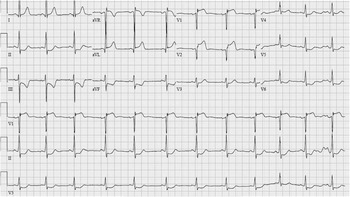
The initial assessment was focussed on both cardiac and non-cardiac causes of chest pain, given the patient’s age and absence of known cardiac risk factors before evaluation. Cardiac enzymes measured on presentation were remarkable for creatine kinase-MB, 2.8 ng/ml, and troponin I, 0.05 ng/ml; however, initial electrocardiogram revealed sinus rhythm at 71 beats/minute, normal axis, and ST elevation in leads V1 and V2 with reciprocal changes in V5 and V6 (Fig 1). Repeat measurement of cardiac enzymes 3 hours after initial presentation revealed creatine kinase-MB level of 579 ng/ml and troponin I level >100 mg/ml.
Initial electrocardiogram revealing ST elevation in leads V1 and V2 with reciprocal changes in V5 and V6.

Stat echocardiogram was performed at bedside and was found to demonstrate hypokinesis of the anterior wall and anteroseptal wall, extending into the apex. Ejection fraction was moderately depressed, estimated at 35–40% with no identifiable valvular abnormalities, thrombi, or pericardial effusion.
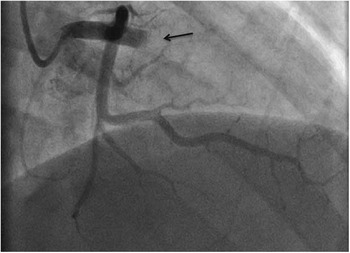
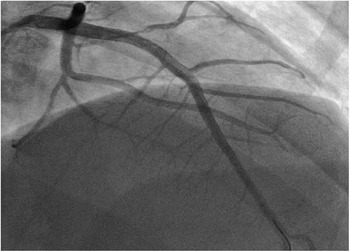
The patient was subsequently managed as a case of ST elevation myocardial infarction and taken for emergent coronary arteriography, which revealed 100% occlusion of the proximal portion of left anterior descending artery with no further disease identified (Fig 2). Percutaneous transluminal coronary angioplasty was performed with thrombectomy, whereas pathological analysis was not pursued. Bare-metal stenting of the left anterior descending artery was performed with optimal results, yielding 0% stenosis from an initial 100% stenotic lesion and thrombolysis in myocardial infarction grade 3 flow (Fig 3). He was then transferred to the coronary care unit for continued treatment with aspirin, prasugrel, carvedilol, simvastatin, and eptifibatide.
Coronary angiogram revealing 100% occlusion (arrow) of the left anterior descending coronary artery.

Post-intervention angiogram with normal flow in the left anterior descending.

Trans-oesophageal echocardiogram performed 48 hours following percutaneous coronary intervention revealed mildly depressed left ventricular systolic function with 50% ejection fraction and with residual wall motion abnormalities consistent with anterior wall myocardial infarction. These findings demonstrated considerable improvement in ejection fraction when compared with the initial echocardiogram findings and were negative for any findings suggestive of a thromboembolic source or intra-cardiac shunt. The patient was then transitioned to aspirin, prasugrel, β-blocker, and statin therapy.
He underwent an extensive workup to identify any underlying genetic or acquired abnormalities that might predispose to a hypercoaguable state. The genetic thrombophilia profile, including tests for lupus anticoagulant, anticardiolpin antibody, antithrombin III, Prothrombin 20210 gene mutation, Homocysteine levels, factor V Leiden mutation, factor VIII activity, proteins C and S deficiencies, and plasminogen activator inhibitor-1, was unrevealing. Antinuclear antibody and urine toxicology screen tests were also found to be negative.
He was discharged symptom free and was counselled extensively on weight reduction including diet and daily exercise, as dyslipidaemia and obesity were his only identifiable risk factors. This patient did not demonstrate many of the known factors for the development of coronary artery disease.
Discussion
This case highlights the need for considering acute myocardial infarction in the differential diagnosis in this subset of the population. This active, young man experienced an acute myocardial infarction with obesity as his only known risk factor. Nonetheless, risk factor screening guidelines and an understanding of the mechanism and disease course in this population each propel us towards the goal of identifying this diagnosis in the adolescent population. Acute myocardial infarction should be considered in patients with chest pain, regardless of age.
Current data indicate that between 2 and 10% of all patients hospitalised with acute myocardial infarction are <45 years of age,Reference Jalowiec and Hill 7 with autopsies revealing 50% of individuals <34 years of age having intimal atherosclerosis.Reference Strong, Malcom and McMahan 4 This small proportion represents an important group to examine for the purpose of risk factor modification and secondary prevention.Reference Doughty, Mehta and Bruckman 31 Although aetiological factors range from atherosclerosis, non-atherosclerotic coronary artery abnormalities, hypercoaguable states, and adverse drug effects, a thorough history is paramount to identify the underlying cause and to avoid misdiagnosis.Reference Vivo and Krim 8 These data identify the younger subset of the population upon which expanded research, including the consideration of earlier screening methods, would be useful; however, data on patients <45 years of age do not necessarily well represent the paediatric population.
The clinical presentation of acute myocardial infarction in younger populations may differ from that in older patients. Although chest pain was present in our patient, a staggering high proportion of young patients do not experience angina pectoris, and frequently the first manifestation of coronary artery disease is acute myocardial infarction. Klein et al34 found that young patients seldom experience angina pectoris before myocardial infarction, but that angina pectoris quickly progresses to acute myocardial infarction. In recent studies, only 12% of young ST elevation myocardial infarction patients experienced angina pectoris before ST elevation myocardial infarction, a significantly smaller percentage than in old ST elevation myocardial infarction patients. ST elevation myocardial infarction in young patients generally has no ischaemic pre-conditioning and occurs and progresses faster than it does in older patients.Reference Yunyun, Tong and Yingwu 10 Fournier et alReference Fournier, Cabezón and Cayuela 11 demonstrated that acute myocardial infarction and angina pectoris were the first ischaemic manifestations in 48 and 26% of all patients in this subset of the population. This emphasises the increased importance for pre-screening, given the high risk for developing unpredictable and morbid events.
Myocardial infarction in young adults can be divided broadly into two groups, those with angiographically normal coronary arteries and those with coronary artery disease of varying aetiology. There is a significant overlap in the pathophysiology between these two groups.
This discussion will serve to identify important risk factors that lead to the development of cardiovascular disease and review the literature of this subject matter.
Angiographically normal versus abnormal coronary arteries
Traditional atherosclerosis still appears to be the most common aetiology of acute myocardial infarction in young patients. In one study, over 80% of patients <45 years of age presenting with myocardial infarction were found to have atherosclerosis as the underlying cause.
Although this group is less likely to demonstrate severe and multi-vessel coronary obstruction compared with older adults, it did show a higher prevalence of non-obstructive (<70% stenosis) or single-vessel coronary artery disease.Reference Rathod, Jones and Gallagher 32 Spontaneous dissection has also shown some association with atherosclerotic plaque in an idiopathic group of patients, but the pathophysiological process behind this remains unclear. This particular dissection differs in the sense that it occurs within the media or between the media and adventitia. Other conditions associated with angiographically abnormal coronary arteries include aneurysms, ectasia, and anomalous origin of coronary arteries. Anomalous origins of coronary arteries have long been associated with angina and myocardial infarction. Coronary artery aneurysms, particularly in the young, are associated with Kawasaki’s disease, which manifests in childhood. Infectious aetiologies must also be considered in the differential. Myocarditis and pericarditis can frequently mimic clinical presentations of ST elevation myocardial infarction or acute myocardial infarction. Acute myocardial infarction with angiographically normal coronary arteries frequently involves an inciting event or combinations of processes leading to myocardial infarction. This type of presentation may be the result of coronary artery thrombosis, spasm, embolisation, or mixtures of these processes.
Obesity
Childhood obesity, now considered an epidemic, has become one of the most important global health problems of the 21st century. Obesity predisposes individuals to numerous short-term and long-term health hazards, including cardiovascular disease,Reference John, Wolfenstetter and Wenig 12 and has been noted to double the prevalence of cardiovascular disease in men and women less than the age of 50 years. In the Framingham Heart Study, among men and women under age 50 years of age, the incidence of cardiovascular disease was two times greater in men and almost 2.5 times greater in women in the most obese tertile compared with those in the leanest tertile.Reference Hubert, Feinleib, McNamara and Casteli 13
Lipid abnormalities
The prevalence of hyperlipidaemia in young patients with myocardial infarction ranges widely. Homozygous familial hypercholesterolaemia, which affects ~1 in 1 million persons in the United States, appears to have the most consistent relation with premature atherosclerosis and myocardial infarction. Premature coronary disease can also occur in patients with familial combined hyperlipidaemia, which affects 1 in 100 persons in the United States.Reference Farmer and Gotto 14 A particular series of 67 patients found that in the absence of other obvious risk factors for myocardial infarction hypercholesterolaemia is the most important one. In one study that included men under 45 years of age, low-density lipoprotein cholesterol level was the single strongest predictor of myocardial infarction.Reference Cremer, Nagel and Mann 15 Aggressive statin therapy has been shown to prevent both non-fatal and fatal atherosclerotic cardiovascular disease events. Primary and secondary prevention of atherosclerotic cardiovascular disease with statins can positively impact rising healthcare costs. Taylor et alReference Taylor, Huffman and Macedo 16 found that in a primary prevention setting in which individuals had no previous history of atherosclerotic cardiovascular disease events, but were at increased risk for atherosclerotic cardiovascular disease events, there was moderate evidence that statins reduced total mortality.
Family history
Family history has long been considered to be a key risk factor in identifying patients at risk for the development of premature coronary artery disease. Family history is particularly important and has a strong correlation with young patients presenting with acute myocardial infarction. Although there has been inconsistency regarding this subject area, the majority of published data agree with this finding.Reference Zimmerman, Cameron and Fisher 6 , Reference Warren, Thompson and Vieweg 17 Premature coronary artery disease is defined as the development of atherosclerotic cardiovascular disease or death from cardiovascular disease in a first-degree relative before the age of 55 in males or 65 in females, denoting a significant family history. This continues to serve as a major risk factor for myocardial infarction in the young. Siblings of a young patient with myocardial infarction have up to a 10-fold increased risk of developing coronary artery disease.Reference Cremer, Nagel and Mann 15 Studies of twins also indicate that early occurrence of myocardial infarction has a stronger genetic component than does late occurrence.Reference DeFaire, Friberg and Lundman 18 Although the direct mechanism for which positive family history contributes to myocardial infarction in the young is not known, it most certainly entails a combination of factors including inherited disorders of lipid metabolism, blood coagulation, and other genetic factors. It has been suggested that genetic factors are more likely to influence younger rather than older populations and may well contribute to diverse mechanisms responsible for instituting the foundation of culprit atherosclerotic lesions; however, the basis of this genetic susceptibility towards atherosclerosis remains unidentified as the genetic research continues.
Drugs
Among teenage patients, coronary spasm is principally related to illicit substances including cigarettes, alcohol, cocaine, marijuana, heroin, and amphetamines, which enhance endothelial dysfunction, sympathetic activity, and platelet aggregation when used alone or in combination.Reference El Menyar 19 Hormonal contraceptives also play a major role with regard to induction of coronary thrombosis in young females. Cigarette smoking continues to be the most common and dominant modifiable risk factor contributing to the development of cardiovascular disease in young myocardial infarction patients. Smoking adversely affects all phases of atherosclerosis given that it hastens the thrombotic process, instigates endothelial dysfunction, augments pro-inflammatory effects, and induces coronary vasoconstriction even in patients with normal coronary vasculature.Reference Williams, Restieaux and Low 20 Zimmerman et alReference Zimmerman, Cameron and Fisher 6 found that among acute myocardial infarction patients <40 years of age 73 to 90% reported a history of smoking.Reference Zimmerman, Cameron and Fisher 6
Cocaine is increasingly being recognised as a major risk factor, with one out of every four myocardial infarctions in people aged between 18 and 45 years being linked to cocaine use.Reference Quereshi, Suri, Gutermann and Hopkins 21 An array of potential mechanisms has been proposed to show the deleterious effects of cocaine use that might account for acute myocardial infarction. This drug causes transient arterial vasospasm associated with elevated heart rate and systolic blood pressure culminating into compromised coronary flow, which results in imbalance between oxygen demand and supply. Augmented thrombocyte aggregation stimulated by cocaine may be a direct factor triggering coronary artery thrombosis.Reference Patrizi, Pasceri, Sciahbasi, Summaria, Rosano and Lioy 33 Cocaine is notorious to bring about an unwarranted release of neurotransmitters ensuing into detrimental surges of norepinephrine and dopamine. Furthermore, cocaine is directly toxic to the myocardium, resulting in focal necrosis.Reference Amin, Gobelman and Buttrick 22
This chronic cardiovascular damage results in an increased risk for acute coronary syndromes as well as risks for diseases associated with ongoing myocardial cell death and atherosclerotic processes.Reference Stankowski, Kloner and Rezkalla 23 Although all risk factors contribute to the development of cardiovascular disease, combinations of these drugs are particularly troublesome and can induce a cascade of events including angina, tachyarrythmias, bradyarrhythmias, acute myocardial infarction, and sudden cardiac death.
Hypercoaguable states
Acquired or inherited hypercoaguability places individuals at an increased risk for thrombotic events. This may include high concentrations of fibrinogen, homocysteine, and tissue plasminogen activator antigens, which have all been independently linked to acute coronary events. Platelet abnormalities such as glycoprotein IIIa polypeptide polymorphism and primary thrombocytosis have also demonstrated adverse events leading to myocardial infarction in the young.Reference Choudhury and Marsh 24 Vasculitic disorders are another set of conditions that can lead to enhanced hypercoagulability. Pathogenetic mechanisms of systemic lupus erythematosus-related myocardial infarction include antiphospholipid antibody/inflammation-mediated thrombosis. This is particularly important in systemic lupus erythematosus, where the incidence of myocardial infarction in women with systemic lupus erythematosus aged 35–44 years is 50-fold higher compared with age-matched controls.Reference Manzi, Meilahn and Rairie 25 Multiple reports have also demonstrated the role of antiphospholipid antibody syndrome antibodies in accelerating the process of coronary atherosclerosis.Reference Maor, Fefer and Varon 26
Hypertension
Although a well-established risk factor, hypertension was less likely to be present in younger patients.Reference Hong, Cho and Hong 30 This observation is consistent with recent studies; however, consistent with angiographic data of coronary artery disease in the young showing a stronger predilection for single-vessel disease and in particular left main disease, hypertension is common in patients with left main coronary artery stenosis who are under the age of 45 years.
Diabetes mellitus
Timmer et alReference Timmer, Hoekstra and Nijsten 27 have shown that there is a significant correlation between haemoglobin A1c levels, an indicator of long-term glycaemic control, and the development and prognosis of coronary diseases; however, this correlation is less frequently seen in young patients. This may be simply due to less emphasis being placed on this patient population, and thus leading to a higher incidence of undetected diabetics or pre-diabetics. As pre-diabetic conditions can influence the course of ST elevation myocardial infarction, medical intervention in young people may help prevent ST elevation myocardial infarction. Multi-vessel disease is more likely to occur in young patients who have a history of diabetes.
Overall, young patients have a more favourable prognosis than older patients. The in-hospital mortality rate among young patients is ~1–6% compared with 8–22% in older patients. The incidence of cardiogenic shock, stroke, and left ventricular dysfunction is lower in young patients, probably accounting for their better outcome.Reference Choudhury and Marsh 24
Several previous studies have examined the use of percutaneous transluminal coronary angioplasty in younger populations, and, overall, they have found a high initial success rate with relatively few complications; however, it has been proposed that perhaps coronary atherosclerosis is a more aggressive disease in certain high-risk subsets of younger patients, leading to early myocardial infarction and the need for intervention.Reference Kofflard, de Jaegere and van Domburg 28
Sturzenhofecker et alReference Sturzenhofecker, Samek and Droste 29 in their follow-up angiograms of young myocardial infarction patients, demonstrated little progression of atherosclerosis in patients with single-vessel disease over an average of 3.5 years of follow-up (24 versus 37.7%). This finding was in contrast with the high frequency of progression in patients with multi-vessel disease. Regression of coronary artery disease occurred predominantly in the proximal left anterior descending artery. Whether this represents true regression or only re-canalisation is uncertain.
A primary objective of this review was to provide an overview of the similarities and dissimilarities among younger and older patients presenting with acute myocardial infarction with the expectation of using the information as an aid in primary and secondary preventions in the future. This literature review has highlighted certain characteristics in young adults with ST elevation myocardial infarction, including risk factor profile, pathophysiological mechanisms, clinical presentation, angiographic findings, and prognosis.
Conclusion
This study conveys the importance of considering acute myocardial infarction as part of the differential diagnosis in the adolescent population. Although myocardial infarction primarily occurs in patients older than 45 years, young men or women can suffer from myocardial infarction as well. Furthermore, this disease involves significant morbidity, psychological consequences, as well as societal devastation for the patient and family when it occurs at a young age.
The rarity of this clinical vignette proposes a challenge for both the patient and the treating physician; one must consider that even without known risk factors an adolescent patient may suffer from myocardial infarction. These patients have a different risk factor profile, clinical presentation, mechanism of disease, and prognosis than that of older patients. Each of these elements should be taken into consideration upon presentation of an adolescent with chest pain as well as in the approach to management.
This approach includes a detailed clinical history that covers evaluation of the main causes and risk factors discussed above. If there are ST-segment changes on screening electrocardiogram, it is important to obtain serial electrocardiograms and detect troponin levels. Lifestyle, family history, premature coronary disease, hypercoaguable states, and concurrent disease must be considered in all patients with suspected myocardial infarction in the adolescent population. With the lack of controlled trials to guide early treatment of myocardial infarction in this age group,Reference Osula, Bell and Hornung 1 an aggressive approach by risk factor modification should be emphasised.
We strongly stress the importance of including acute myocardial infarction in the differential diagnosis of adolescents presenting with chest pain as well as the necessity of secondary preventative measures in each of these patients.
Acknowledgement
The authors wish to thank Madruga M, Vivek D, Waldman A, Carlan S, Harris S and Wisler K.
Financial Support
This research received no specific grant from any funding agency, commercial, or not-for-profit sectors.