INTRODUCTION
The common octopus (Octopus vulgaris Cuvier, 1797) is the most important octopus species caught in the world (Guerra, Reference Guerra, Lang and Hochberg1997).
In recent years a decline of this species has been estimated worldwide (FAO, 2006, 2013) highlighting the need to develop an eco-sustainable fishery management approach. In this view, age and growth studies of wild populations are essential for assessment and management purposes (Perales-Raya et al., Reference Perales-Raya, Jurado-Ruzafa, Bartolomé, Duque, Nazaret Carrasco and Fraile-Nuez2014). While indirect ageing methods are generally considered not applicable for cephalopods (Semmens et al., Reference Semmens, Pecl, Villanueva, Jouffre, Sobrino, Wood and Rigby2004), different direct methods have been applied with Octopus vulgaris, based on the analysis of stylets (Barratt & Allcock, Reference Barratt and Allcock2010; Hermosilla et al., Reference Hermosilla, Rocha, Fiorito, González and Guerra2010), eye lens (Gonçalves, Reference Gonçalves1993) and beaks (e.g. Canali et al., Reference Canali, Ponte, Belcari, Rocha and Fiorito2011; Cuccu et al., Reference Cuccu, Mereu, Cau, Pesci and Cau2013a; Perales-Raya et al., Reference Perales-Raya, Jurado-Ruzafa, Bartolomé, Duque, Nazaret Carrasco and Fraile-Nuez2014). In addition, many studies have been carried out in captivity (e.g. Mangold & Boletzky, Reference Mangold and Boletzky1973; Smale & Buchan, Reference Smale and Buchan1981; Villanueva, Reference Villanueva1995) but only a few mark–recapture studies have been performed in the wild (Nagasawa et al., Reference Nagasawa, Takayanagi, Takami, Okutani, O'Dor and Kubodera1993; Domain et al., Reference Domain, Jouffré and Caverivière2000; Mereu et al., Reference Mereu, Masala, Maccioni, Stacca, Cau and Cuccu2010). Mark–recapture studies on octopus are rare due to the low retention rate of traditional tags and for the difficulty in tagging juveniles and then following them for the entire life cycle (Semmens et al., Reference Semmens, Pecl, Villanueva, Jouffre, Sobrino, Wood and Rigby2004).
Numerous tests in tanks, conducted to identify the appropriate tag for O. vulgaris, have shown that only Petersen discs and T-bar anchor tags, inserted at the base of the third left arm, can ensure satisfactory results (Taki, Reference Taki1941; Inoue et al., Reference Inoue, Hamaguchi and Li1953; Katayama & Morita, Reference Katayama and Morita1960; Domain et al., Reference Domain, Jouffré and Caverivière2000; Fuentes et al., Reference Fuentes, Otero, Moxica, Sánchez and Iglesias2006).
Until now, growth parameters using mark–recapture methodology have been estimated only for octopus specimens from Senegalese waters (Domain et al., Reference Domain, Jouffré and Caverivière2000), whilst for the Mediterranean Sea, a unique mark–recapture preliminary experiment has been carried out in Sardinian waters (Mereu et al., Reference Mereu, Masala, Maccioni, Stacca, Cau and Cuccu2010). The main goals of the present paper were dual: to identify the most appropriate external tagging technique for octopus between Petersen discs and T-bars, and to estimate growth parameters for small- to medium-sized Octopus vulgaris in the Mediterranean Sea using, for the first time, mark–recapture data collected in the wild.
MATERIALS AND METHODS
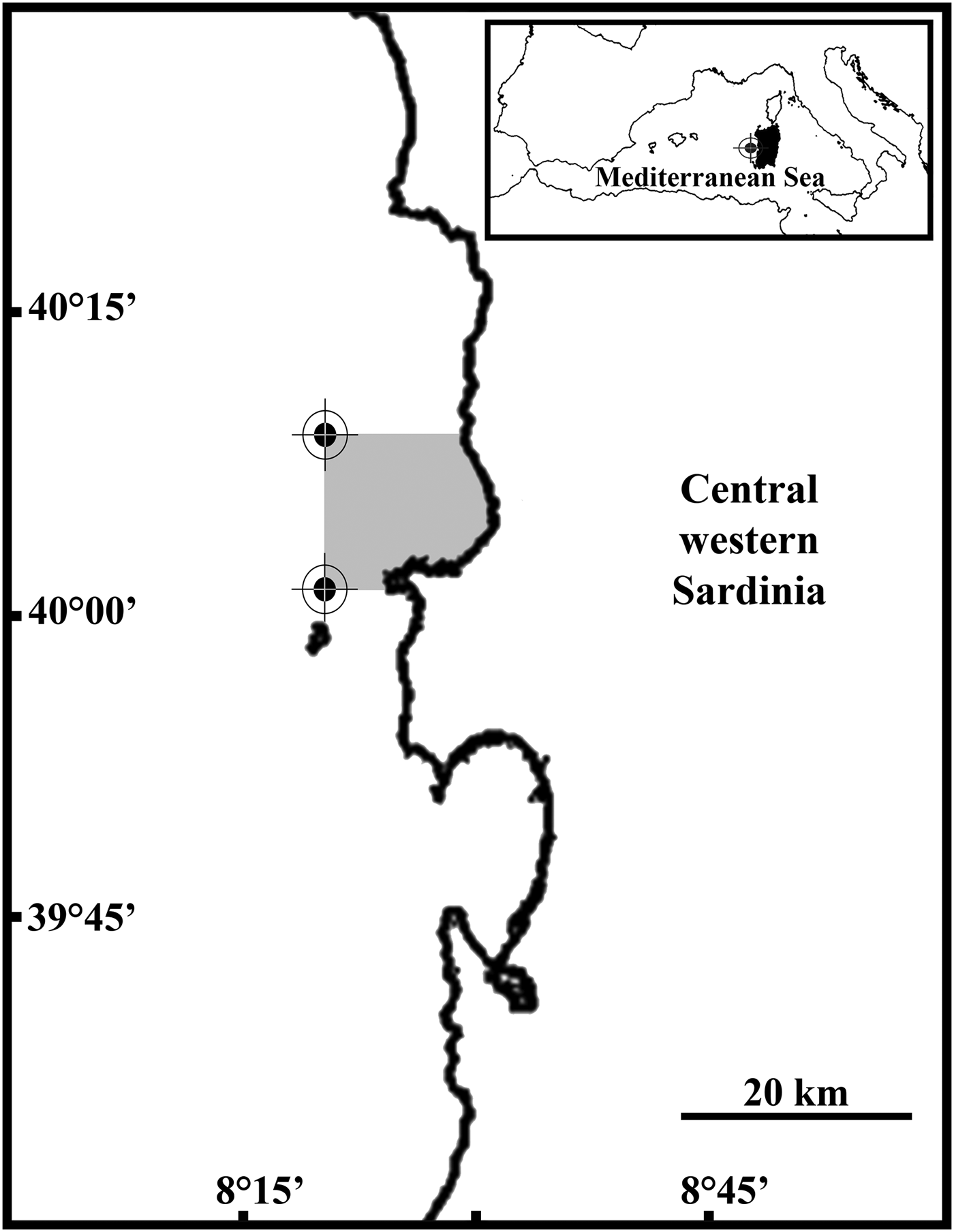
A wide tag–recapture project focused on Octopus vulgaris was carried out in Sardinia from 2008 to 2013 in an area of the central western Sardinian Sea (western Mediterranean Sea) (Figure 1). It was funded by the local regional administration and realized with the strict collaboration of researchers and fishermen. All the investigated animals were caught during the commercial octopus-fisheries season by traps, performed in spring–summer by two vessels at depths from 20 to 50 m.
Area of the mark–recapture investigation.

In order to identify the most suitable tag for Octopus vulgaris to be used in tag–recapture experiments, both Petersen discs and T-bar anchor tags were tested in a preliminary phase.
The Petersen discs (SCUBLA SNC; colour discs: yellow and white) consisted of two numbered discs (8 mm) joined by a nickel pin (76 mm), which can pierce any part of the body. Two other transparent discs of the same diameter reinforced both discs; the insertion of the tag was completely manual.
The T-bar anchor tags (Hallprint®; T-bar anchor tags – type TBA) were pieces of flexible T-shaped plastic. The short bar of the T (10 mm) was inserted into the animal's body and the longer bar (30 mm, white) bore an inscription that included the tag number, address and telephone number of the research institute. This tag was inserted with a gun produced by the same company.
Tagging and measurements were made on board the fishing vessels. Recaptures were obtained by the commercial fishery. In order to increase the success of the recaptures some posters describing the project were distributed and positioned in the recreational areas of the western Sardinian ports, and a reward was offered for each recapture returned.
In a preliminary phase from May to November 2008, 268 animals were tagged after having been anaesthetized according to Fuentes et al. (Reference Fuentes, Otero, Moxica, Sánchez and Iglesias2006) by immersion for 5 min in cold seawater (4–5°C), with the addition of a few drops of ethyl alcohol.
Petersen discs and T-bars were both applied at the base of the third left arm, in agreement with Domain et al. (Reference Domain, Jouffré and Caverivière2000) and Fuentes et al. (Reference Fuentes, Otero, Moxica, Sánchez and Iglesias2006). After the tagging, dorsal mantle length (ML, to the nearest mm), total weight (TW, to the nearest 1 g) and sex were recorded. Afterwards, the animals were maintained for about 1 h in a tank (with running seawater and an oxygenator) to monitor mortality and tag retention before they were released into the same fishing areas (Figure 1). For each recaptured specimen, ML, TW and the tag status (intact: tag in good condition with an identifiable code; damaged: tag broken, with code not identifiable; lost: absence of tag) were recorded; injuries produced by the tag and the healing process were also examined and annotated.
Handling and holding of animals took into account the ethical and welfare considerations reported by Moltschaniwskyj et al. (Reference Moltschaniwskyj, Hall, Lipinski, Marian, Nishiguchi, Sakai, Shulman, Sinclair, Sinn, Staudinger, Van Gelderen, Villanueva and Warnke2007).
From 2010 to 2013, a total of 1604 Octopus vulgaris were tagged with Petersen discs on the third left arm following the same procedure used in the preliminary phase of the experiment, also for anesthetization, measurements and checking on recaptured specimens.
The recapture rates (RR) were calculated as the percentage of the number of recaptured specimens with respect to the total number of tagged animals.
The daily growth rates (DGR), expressed in g day−1, were calculated as:
 $${\rm DGR} = {\rm \lpar T}{{\rm W}_{\rm T2}} - {\rm T}{{\rm W}_{\rm T1}}{\rm \rpar /DF}$$
where TWT1 and TWT2 were the weights at the tagging and recapture times, respectively, and DF (days of freedom) was the interval in days between the two weighings.
The method developed by Kaufmann (Reference Kaufmann1981) was used to analyse and adjust the models for growth curves from the capture–recapture data, as already used in other studies for the same species (Domain et al., Reference Domain, Jouffré and Caverivière2000) and for Octopus dofleini (Robinson & Hartwick, Reference Robinson and Hartwick1986). In order to determine the parameters of the growth curves, and to choose between different types of curves, instantaneous relative growth rates G were estimated by the equation:
 $$G = \lpar {\rm ln}\, {{\rm TW}_{\rm T2}} - {\rm ln}\, {{\rm TW}_{\rm T1}} \rpar {\rm /DF}$$
The graphic representation of G values distribution compared with the corresponding mean weight values for the considered interval DF (i.e. the geometric mean of the weight TWT1 and TWT2), enable the rapid determination of whether there is a relationship between the size and the growth rate. If no significant relationship exists, the growth equation is exponential and the mean of G is calculated and used as the only parameter needed for growth adjustment. Otherwise, the nature of the relationship is further explored to determine another type of growth curve (Domain et al., Reference Domain, Jouffré and Caverivière2000).
Only recaptures with positive G after at least 8 DF were used to calculate growth parameters, considering this is the time of healing of the wound caused by the tag insertion observed during the preliminary experiment, and this is the shortest time period in which we have observed changes in weight. For both sexes, Gs obtained in the different years were compared with the ANOVA analysis; values of the different years were combined to create the growth curves. For each sex and for the entire sample, the relative age (days) at T 0 time, corresponding to the smallest specimen of 30 g of weight, was estimated using the growth curves equations obtained. In order to plot the growth curves, the relative age (days) of the recaptures (TWT2) were computed through the application of the same equations mentioned above.
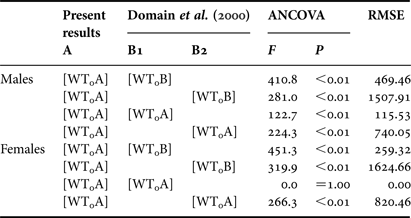
The ANCOVA and residual mean square error (RMSE) analyses were applied to compare the growth curves obtained in this study with those proposed by Domain et al. (Reference Domain, Jouffré and Caverivière2000) from Senegalese waters, here indicated as B1 (1997) and B2 (1998), respectively. The comparisons were also performed standardizing B1 and B2 at the weight at the relative age zero (WT0A) observed in this study.
RESULTS
Tag–recapture experiment in the wild
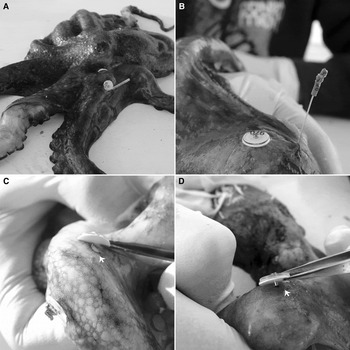
Before the release in the sea, no mortality was recorded on 148 males (145–660 g of TW) and 120 females (80–570 g of TW) tagged with both Petersen discs and T-bars (Figure 2A) in the preliminary phase. Overall, 22 males and 10 females were recaptured after 5–49 days at freedom (DF) (Table 1).
Octopus vulgaris: specimen tagged with both Petersen discs and T-bar (A), recaptured specimen with T-bar tag damaged (B), area of skin under the Petersen disc immediately after tagging (C) and at time of recapture (D).

Octopus vulgaris: details on the recaptures from the preliminary tagging experiment.

Petersen discs, except for one specimen in which the tag was lost, were all in an excellent condition. On the contrary, most of the T-bar tags were lost or damaged, and they did not allow identification of the specimen code (Figure 2B).
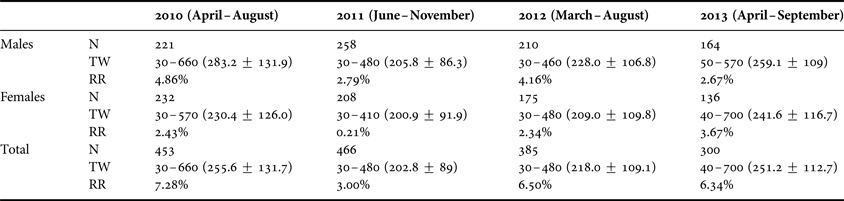
Unlike the Petersen discs, T-bar tags did not cause wounds on the animals. However, in all recaptures the injuries caused at the time of tagging by Petersen discs were already healed, even in the seven specimens recaptured after only 5 DF (Figure 2C, D). On the basis of these results, Petersen discs were chosen as suitable markers for Octopus vulgaris tagging–recapture experiments in the wild. From 2010 to 2013, a total of 853 Octopus vulgaris males (30–660 g of TW) and 751 females (30–700 g of TW) were tagged and released at sea (Table 2; Figure 1).
Octopus vulgaris: number of specimens tagged; sizes and recapture rates in the different surveys.

N, number of specimens tagged; TW, total weight; RR, recapture rate; value ± standard deviation in parentheses.
In particular, 72.2% of males and 76.8% of females were characterized by TW less than 300 g (i.e. the minimum landing size imposed by the local Sardinian legislation, regional decree no 22 of 17 July 2002).
Overall, 59 males and 32 females were recaptured after a minimum of 4 to a maximum of 63 DF. In all specimens, the tags were undamaged with an identifiable code, and the wounds caused by the nickel pin had healed.
Overall, the recapture rate (RR) was 5.67%, with higher RR values in males (2.67–4.86) than in females (0.21–3.67) in all surveyed years except for 2013 (Table 2).
Fifty-nine recaptures (31 males and 28 females), re-caught after 8–63 DF (mean ± standard deviation: 29 ± 14), displayed positive increments in weight with higher daily growth rates (DGR) and instantaneous relative growth rates (G) in females.
In particular in females after 8–63 DF, DGR and G mean values varied from 3.07 to 3.65 g day−1 and from 0.00888 to 0.01098, respectively; in males after 11–62 DF, DGR varied from 2.08 to 2.98 g day−1 and G from 0.00655 to 0.00956 (Table 3).
Octopus vulgaris: recapture rates, days at freedom, daily growth rates and specific growth rate of males and females with positive increments registered in the different surveys from 2010 to 2013.

RR, recapture rates; DF, days of freedom; DGR, daily growth rates; G, specific growth rate; mean value ± standard deviation in parentheses.
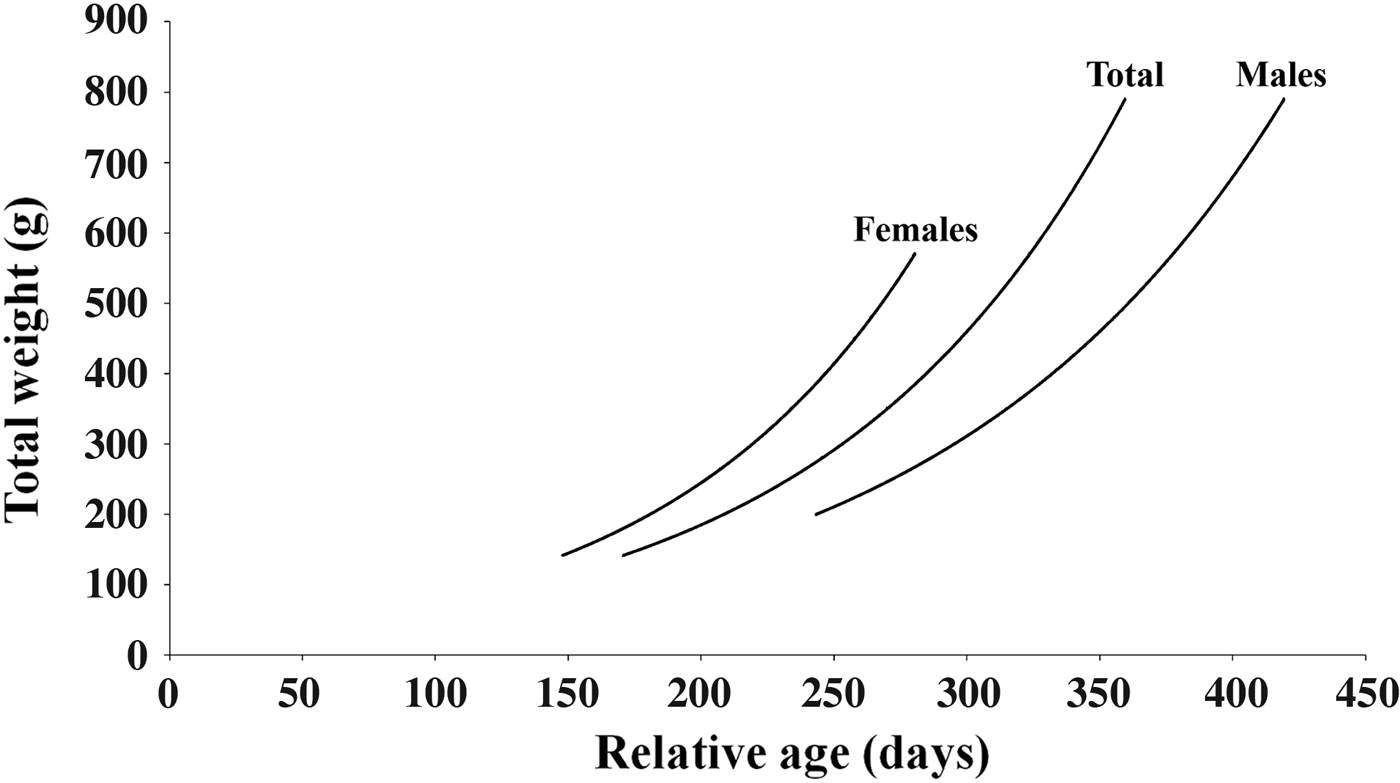
Gs were independent of the total weights in both sexes (P > 0.05), and no significant differences among growth rates in the different years were recorded for either males (ANOVA: F = 1,18 and P = 0.3352) or females (ANOVA: F = 0,40 and P = 0.7549). Consequently, for each sex, all Gs from the different surveys were combined to obtain the following relative exponential growth curves (Figure 3):
 $${{\rm TW}_{\rm males}} = {\rm exp}\, [0 .0079\, \lpar T + 430.53132\rpar]$$
 $${{\rm TW}_{\rm females}} = {\rm exp}\, [0 .0105\, \lpar T + 323.92359\rpar ]$$
Octopus vulgaris: exponential growth curves for males, females and both sexes (Total) obtained with the tag–recapture data.

For both sexes, the weight at the relative age zero was 30 g (weight of the smallest specimens of the sample). Even if the mean of Gs was bigger in females than males, no significant differences (ANOVA: F = 3,74 and P = 0.0581) were recorded between the two sexes; an exponential growth curve that includes both sexes was also calculated (Figure 3):
 $${{\rm TW}_{\rm both\, sexes}} = {\rm exp}\, [0 .0091\, \lpar T + 323 .92359\rpar ]$$
Comparison of the growth curves obtained with mark–recapture studies in the wild
Table 4 summarizes the results of the comparisons of the growth curves obtained for Octopus vulgaris with mark–recapture studies in the wild. The ANCOVA and RMSE analyses indicate that the curves obtained in the present paper are closer to the B1 (1997) curves from Domain et al. (Reference Domain, Jouffré and Caverivière2000), in particular for females (Table 4). After standardization at the weight of 30 g (our relative age zero), the ANCOVA analysis did not show differences for the female curves, and the RMSE value was equal to zero; similar results were obtained for the male curves (Table 4).
Octopus vulgaris: comparison of the growth curves obtained in this study (A) with those reported in the literature (B1 and B2) from other mark–recapture studies, for both sexes; WT0A and WT0B, weights at the relative age zero recorded respectively in this study and in Domain et al. (Reference Domain, Jouffré and Caverivière2000).

The weights at the relative age zero used in the curves are shown in brackets; RMSE, residual mean square error.
DISCUSSION
Mark–recapture studies in the wild represent useful tools to estimate growth, age and lifespan, and to increase information on the ecology and ethology of the species; unfortunately, until now only a few studies have been completed on cephalopod species (e.g. Ezzedine-Najai, Reference Ezzedine-Najai1997; Lipinski et al., Reference Lipinski, Hampton, Sauer and Augustyn1998; Sauer et al., Reference Sauer, Lipinski and Augustyn2000).
In particular, for the common octopus the vast majority of the literature is focused on the identification of suitable tagging methods. Taki (Reference Taki1941), Inoue et al. (Reference Inoue, Hamaguchi and Li1953), Katayama & Morita (Reference Katayama and Morita1960), Itami (Reference Itami1964) and Takeda et al. (Reference Takeda, Karata, Nakamoto, Nakano, Sakai, Itami, Sano, Nose, Mitsuo, Yahashi, Nakamura, Sakai, Hamano, Doi and Kawakami1981) tested tags made of pieces of sewn material, metal plaques, removal of suckers, heat burning, wires and colorant. Among these experiments, only trypan blue and burning produced acceptable results, but according to Itami (Reference Itami1964) the first method did not allow the identification of the specimens, while the second caused a high rate mortality, in particular in small specimens. Tsuchiya et al. (Reference Tsuchiya, Ikeda and Shimizu1986) examined the effectiveness of a wide range of external tags (anchor tag, dart tag, Petersen discs, fingerling tag, metal ring, nylon thread) and dyes (methylene blue, neutral red, erythrosine and saffranine T); the colorants were especially successful and had little influence on the marked animals, allowing a high recapture rate (27.9%).
As regards external marks, it is known that octopuses can make movements with their arms to remove their own tags or those of others (Tsuchiya et al., Reference Tsuchiya, Ikeda and Shimizu1986; Domain et al., Reference Domain, Jouffré and Caverivière2000; Fuentes et al., Reference Fuentes, Otero, Moxica, Sánchez and Iglesias2006). This behaviour could negatively influence the recapture rates, and consequently the success of the experiment. Despite this, until now, the use of external marks is the only method compatible with wild experiments carried out in fishing grounds within fishery management programmes. In this case, taking into account that mortality due to the tags doesn't seem to exist (Fuentes et al., Reference Fuentes, Otero, Moxica, Sánchez and Iglesias2006), the choice is limited only to the kind of tag to use, being easily recognizable by fishermen, and in which part of the body to insert it to minimize its loss.
Studies in tanks on the use of external tags identified Petersen discs and T-bars, inserted at the base of the third left arm, as the most persistent systems (Domain et al., Reference Domain, Jouffré and Caverivière2000; Fuentes et al., Reference Fuentes, Otero, Moxica, Sánchez and Iglesias2006).
On the basis of the above studies and our preliminary investigation, Petersen discs have been identified as the most suitable external tag to use in the mark–recapture experiments in Sardinian waters. Despite the laborious manual process to apply the tag and the injuries produced by it, its retention rate (about 97%) was much higher than that of T-bars (about 22%) and the healing process was fast, within a minimum of 5 days.
Within our experiment, made on specimens 74.4% of which weighed less of 300 g, the maximum persistence time obtained by the discs (63 days) was shorter than that recorded in captivity for tagged specimens of 500–1000 g of weight (3 months; Fuentes et al., Reference Fuentes, Otero, Moxica, Sánchez and Iglesias2006). This difference can be explained by the fact that, at sea, the tag could be lost or removed more easily, and also because its persistence could be inferior in small animals, affecting the recapture rates (RR in our 4-year investigation was 3–7.28%). Another factor that could have lowered the recapture rates could be that the mark–recapture experiments were carried out within the reproductive period of the species. It is known that during the reproductive season, mature females move inside dens, generally inaccessible to fishing gears, to spawn their eggs. This could explain the low percentage of females recaptured in general and, especially in 2011, when the tagging experiment started later than the other years and in coincidence with the peak of deposition.
Despite the limitations met, the mark–recapture experiment on Octopus vulgaris has allowed obtaining of the first growth results in the Mediterranean Sea, at least for small to medium specimens in the wild.
Previously, apart from the analogous experiment done in Senegalese waters (Domain et al., Reference Domain, Jouffré and Caverivière2000), numerous other studies on O. vulgaris growth have been conducted in captivity on specimens both in the Atlantic (e.g. Smale & Buchan, Reference Smale and Buchan1981; Chapela et al., Reference Chapela, González, Dawe, Rocha and Guerra2006) and the Mediterranean (e.g. Nixon, Reference Nixon1966; Mangold & Boletzky, Reference Mangold and Boletzky1973; Prato et al., Reference Prato, Portacci and Biandolino2010). Most of these studies reported a variable growth as a consequence of variation in temperature; for example Mangold & Boletzky (Reference Mangold and Boletzky1973) obtained different growth rates at 10°C (1.2–3.9 g day−1), 15°C (1.6–5.9 g day−1) and 20°C (6.2–23.6 g day−1) and Chapela et al. (Reference Chapela, González, Dawe, Rocha and Guerra2006) registered 8–18 and 19–26 g day−1 respectively in winter (13.4–14.2°C) and in summer (16.2–16.5°C). Moreover Nixon (Reference Nixon1966) and Smale & Buchan (Reference Smale and Buchan1981) recorded growth rates of 1.9–7.7 g day−1 (14–27°C) and 2.58–29.67 g day−1 (17–28°C), respectively. Prato et al. (Reference Prato, Portacci and Biandolino2010) highlighted how different foods could affect growth rates; they obtained mean growth rates varying from 7.57 ± 2.40 to 20.10 ± 1.17 g day−1 when testing five different diets. Aguado Giménez & García García (Reference Aguado Giménez and García García2002) observed that both diet and temperature affect O. vulgaris growth rates, showing that the optimum temperature for growth was 17.5 and 20°C for food intake while maximum food efficiency was achieved at a lower temperature (16.5°C).
Overall, considering the different methodologies used, it is very difficult to compare the mean growth rates of the present study (2.08–3.65 g day−1) with those available in the literature. As observed in previous studies, a high individual variability (0.96–9.09 g day−1) has been observed in Sardinian waters. Moreover, in accordance with the literature data (Smale & Buchan, Reference Smale and Buchan1981; Domain et al., Reference Domain, Jouffré and Caverivière2000), our results show higher growth rates in females than in males, even if the difference between the two sexes is not statistically significant.
Besides temperature and food availability, other factors such as gender, maturation, senescence and natural or tag injury can influence the growth process in O. vulgaris leading to null/negative growth rates and this could explain why ~35% of our recaptures had negative or zero Gs regardless of the days at freedom.
For these reasons, in this study, only specimens with positive G were considered to calculate the growth parameters of O. vulgaris. Moreover, an interval of 8 days of freedom was considered as the minimum time necessary to minimize the possible stress due to the tagging process and for change in weight to be recordable.
The octopus growth curves reported in this paper are different from those obtained by the indirect method i.e. modal progression analysis on size frequency (e.g. Guerra, Reference Guerra1979; Hatanaka, Reference Hatanaka1979) and by direct aquarium studies (e.g. Smale & Buchan, Reference Smale and Buchan1981; Prato et al., Reference Prato, Portacci and Biandolino2010). Semmens et al. (Reference Semmens, Pecl, Villanueva, Jouffre, Sobrino, Wood and Rigby2004) indicated that the first method is not suitable for cephalopods and the second one does not replicate the natural environment. As a mark–recapture experiment in the field the present study is comparable with the previous one done by the same methodology (Domain et al., Reference Domain, Jouffré and Caverivière2000).
In particular the comparison showed that curves reported by Domain et al. (Reference Domain, Jouffré and Caverivière2000) from the fieldwork in 1997 (called B1 in this paper) were closer to ours, in particular for females, differing only for the weight at the relative age zero, that was 50 g instead of our 30 g.
Although our sample was composed mainly of small specimens, we cannot exclude the presence of mature and spawning males; indeed in Sardinian waters these conditions could be reached by males at a minimum size of 195 and 203 g, respectively (Cuccu et al., Reference Cuccu, Mereu, Porcu, Follesa, Cau and Cau2013b). In this case, their presence in the recapture sample could have affected the male growth rate, considering that mature males expend a lot of energy searching for females to mate with (Hanlon & Messenger, Reference Hanlon and Messenger1996; Semmens et al., Reference Semmens, Pecl, Villanueva, Jouffre, Sobrino, Wood and Rigby2004; Cuccu et al., Reference Cuccu, Mereu, Cau, Pesci and Cau2013a, Reference Cuccu, Mereu, Porcu, Follesa, Cau and Caub), and that senescence is generally accompanied by a significant loss of weight (e.g. Tait, Reference Tait1986; Cuccu et al., Reference Cuccu, Mereu, Porcu, Follesa, Cau and Cau2013b).
Conversely, it is hardly plausible that female growth rates in the recaptures could have been influenced by the reproductive behaviour because the females reach sexual maturity at greater sizes and during spawning they become inaccessible to fishing.
These results suggest that, at least for males, it could be more appropriate to establish for each specimen the sexual maturity stage at the time of recapture, in order to exclude spawning and spent specimens from the growth curves calculation.
Overall, the investigation on Octopus vulgaris described in this paper, aside from confirming the objective difficulties that are encountered in the mark–recapture experiments, has increased the knowledge on tagging studies in the wild.
Albeit preliminary and with all the limitations that emerged within this study, these growth results on small–medium octopuses are the first for the Mediterranean Sea, and represent valid and basic information for future management fishing plans.
ACKNOWLEDGEMENTS
The present paper illustrates part of the results of the project ‘Metodi innovativi per l'incremento di produzione del polpo comune Octopus vulgaris e per la valorizzazione della biodiversità costiera in un'area CAMP della Sardegna Occidentale’ funded by the Regional Agency ‘Conservatoria delle Coste’ of the Autonomous Region of Sardinia – Italy. We thank Professor Angelo Cau for his valuable support in the course of the work and we extend our sincere gratitude to all the fishermen of the ‘Cooperative Su Pallosu’ for their cooperation.