Introduction
Given the glacial history of Antarctica over the Quaternary, the continental shelf around Antarctica contains a surprising and unusually rich benthic fauna (Dell Reference Dell1972, Clarke & Johnston Reference Clarke and Johnston2003, Barnes & Clarke Reference Barnes and Clarke2011). Immediately obvious from benthic images or sampling using dredges or corers, is the dominance of ophiuroids amongst many mega-faunal assemblages. Ophiuroids fill several different ecological niches. Some, such as Ophionotus victoriae Bell, 1902, are able to move relatively quickly across the substrate and either actively predate or scavenge a wide variety of bottom dwelling invertebrates (Fratt & Dearborn Reference Fratt and Dearborn1984). Astrotoma agassizi Lyman, 1875 attaches to branching octocorals or sponges using one arm and uses its other four arms to catch small crustaceans (usually copepods) and chaetognaths from the water column (Dearborn et al. Reference Dearborn, Ferrari and Edwards1986). Others, such as Ophiura (Ophiuroglypha) lymani Ljungman, 1871, appear to graze on benthic algae (Dahm Reference Dahm1999). In photographic stills and video taken from remote operating vehicles deployed in Antarctic waters, various ophiuroid species can be seen passively filter feeding on boulders, actively traversing soft sediments and attached to sponges and octocorals. Due to the high biomass and abundance of ophiuroids on the Antarctic continental shelf (Arntz et al. Reference Arntz, Brey and Gallardo1994, Griffiths et al. Reference Griffiths, Linse and Barnes2008) they must have significant roles in energy transfer, particularly in bentho-pelagic coupling (McClintock Reference McClintock1994).
As found in several other taxa, the spatial distribution of ophiuroids should provide some insight into their evolutionary history and the biogeography of the Antarctic fauna in general. The Antarctic ophiuroid fauna appears to be largely endemic (c. 40%) and circumpolar (Fell et al. Reference Fell, Holzinger and Sherraden1969). Smirnov (Reference Smirnov1994) examined a variety of possible biogeographical scenarios using Antarctic ophiuroids as a model and concluded that an Antarctic fauna, distinct from the surrounding continental shelf assemblages, can be divided into the four regions of South Georgia, Kerguelen, South Antilles (southern islands of the Scotia Arc and northern Antarctic Peninsula), and South Polar (high Antarctic) regions. These regions follow those of Fell et al. (Reference Fell, Holzinger and Sherraden1969), Hedgpeth (Reference Hedgpeth1970) and Dell (Reference Dell1972) (see fig. 15 in Clarke & Johnston Reference Clarke and Johnston2003). Fell et al. (Reference Fell, Holzinger and Sherraden1969) suggested that ophiuroid distributions are largely driven by temperature and depth - those species that are more tolerant to larger temperature ranges have been found at a greater range of latitudes, and those tolerant to larger depth ranges are able to disperse across deeper oceanic expanses. Reproductive and life history strategies also dictate the potential range of species distributions as species with a planktonic larval stage are more likely to disperse effectively compared to direct developing young. Fell et al. (Reference Fell, Holzinger and Sherraden1969) suggested the Antarctic Polar Front is a thermal barrier preventing many species from invading the Antarctic region from the north. They also suggest the west wind drift or Antarctic Circumpolar Current (ACC) as a mechanism for the dispersal of pelagic larvae or smaller species that may raft on kelp or other floating debris.
We collected and identified ophiuroids from three Antarctic expeditions on the RRS James Clark Ross funded by the Natural Environment Research Council via the British Antarctic Survey. These expeditions cover the Scotia, Bellingshausen and Amundsen seas. Here we present the data from the preliminary investigation into the diversity of ophiuroids collected from these areas.
Methods
Study area
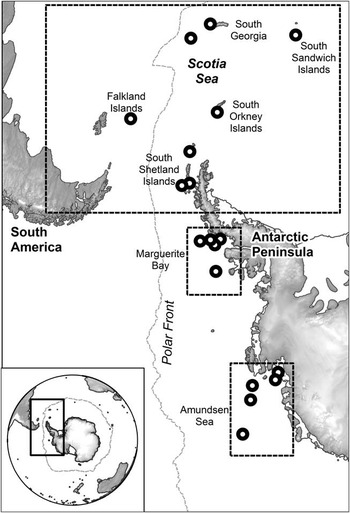
This study examines an extensive area of the West Antarctic sector of the Southern Ocean spanning 20 degrees of latitude (from Burdwood Bank at 54°S to Pine Island Bay at 74°S) and 90 degrees of longitude (from Marie Byrd Seamount at 118°W to Southern Thule at 27°W). Station locations are presented in Fig. 1.
Map of the West Antarctic sector of the Southern Ocean. The circles identify each sampling station. The dashed areas are the regions referred to in further figures.
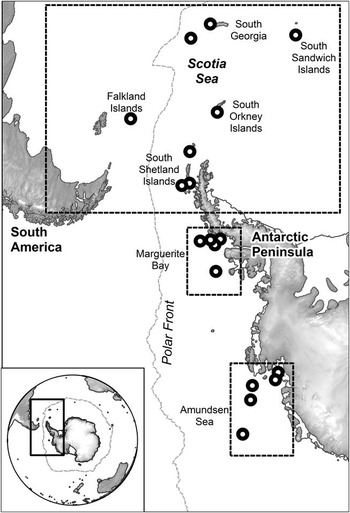
The BIOPEARL 1 expedition (Biodiversity dynamics: Phylogeography, Evolution and Radiation of Life, 2006) sampled stations from shelf and slope regions of the Scotia Sea islands. Samples were taken from Burdwood Bank, which is the south-eastern rise of the Patagonian Shelf, Shag Rocks, South Georgia, South Sandwich Islands - specifically around Southern Thule, South Orkney Islands and South Shetland Islands including Deception Island, Livingston Island and Elephant Island. Stations were at four different depths: 200 m, 500 m, 1000 m and 1500 m.
The BIOPEARL 2 expedition (2008) began sampling the Bellingshausen Sea near Charcot Island at shelf (500 m) and slope (1000 m and 1500 m) depth. Sampling continued on the continental shelf in the Amundsen Sea with several 500 m stations, then samples were taken in Pine Island Bay from the shelf and from the basin at depths to 1500 m. Final stations were taken across the shelf break (500 m, 1000 m and 1500 m) and at Marie Byrd Seamount (3200 m).
The BASWAP expedition (British Antarctic Survey West Antarctic Peninsula, 2009) was designed for fine-scale benthic sampling at differing spatial scales (1 km, 10 km, 100 km). Due to unusually heavy ice conditions stations were limited to the north of Marguerite Bay. All stations were at c. 500 m depth.
Sampling
Benthic samples were primarily collected using an Agassiz trawl (AGT) with a 2 m wide mouth and 1 cm2 inner mesh size. Time, position and depth of the AGT as it reached the sea floor and as it left the bottom was determined by cable tension. Some ophiuroids were identified from bottom trawls and epibenthic sledge (EBS) samples. The bottom trawl also had 1 cm2 mesh size. The EBS had epi- and supra-nets, both 100 x 33 cm with a 0.05 cm mesh and 0.03 cm mesh at the cod end. Samples were washed free of mud using seawater and sieved through 5, 1, 0.1 and 0.05 cm meshes. Animals were sorted to class, placed in pre-chilled ethanol (-20°C) and stored at 0°C. Upon arrival to the UK samples were stored at room temperature.
Identification of ophiuroids
Ophiuroids from each trawl were first sorted to morphotype. An image was recorded of each individual using a Leica M65 microscope with CCD camera attached. Taxonomic determinations made by RML were based on examination of external morphological characters and compared to original descriptions and reports of Lyman (Reference Lyman1882), Køehler (Reference Køehler1901, Reference Køehler1908, Reference Køehler1912, Reference Køehler1922, Reference Køehler1923), Hertz (Reference Hertz1927), Mortensen (Reference Mortensen1936), Fell (Reference Fell1961), Cherbonnier (Reference Cherbonnier1962), Bernasconi & D′Agostino (Reference Bernasconi and D'Agostino1974, Reference Bernasconi and D'Agostino1975, Reference Bernasconi and D'Agostino1978), Bartsch (Reference Bartsch1982), Paterson (Reference Paterson1985) and Yulin et al. (Reference Yulin, Song and Guotong1991). The systematics followed Smith et al. (Reference Smith, Paterson and Lafay1995). For the synonyms of the species see World Ophiuroid Database (Stöhr & O'Hara Reference Stöhr and O'Hara2012). Tissue samples were taken of each individual and stored for future molecular analyses.
Testing efficacy of sampling
In order to appreciate how representative and potentially reproducible our sampling was at each location we produced accumulation curves in PRIMER 6 and compared our catch composition to distribution data published in Hedgpeth (Reference Hedgpeth1969) and to the publicly available databases OBIS (http://www.iobis.org, accessed January 2012) and SCAR MarBIN (http://www.scarmarbin.be, accessed January 2012).
Results
In this study we report on over 5000 ophiuroid specimens collected from 104 trawls taken from slope and shelf depths around the West Antarctic region of the Southern Ocean. A complete list of the presence and absence of species at each station is available in Tables S1 & S2 (which can be found at http://dx.doi.org/10.1017/S0954102012000612). Table S1 lists the species in order of their occurrence from north to south, with weighting put on those species restricted to a northerly distribution. Table S2 lists the species from south to north with weighting put on those species restricted to a southerly distribution. In this way northern and southern boundaries are more easily visualized. Most individuals were determined to known species. Several distinct morphotypes were not attributed to a species due to unique characters, character ambiguity or unique character combinations. We use the term ″morphotype″ to indicate taxonomic units rather than ″species″ to avoid confusion between recognized or described species and sets of individuals that do not fit species descriptions. There were five unidentifiable morphotypes of Amphiura, three of Ophioplinthus, one of Ophiomusium, one of Ophiocten (probably Ophiocten ultimum Hertz, 1926 based on a photo of a holotype provided by Berlin Museum), and one of Ophiacantha. Seven families (67 morphotypes including 57 recognized species) were represented: the Ophiuridae (32 morphotypes, 28 recognized species), Amphiuridae (15 morphotypes, ten recognized species), Ophiacanthidae (eight morphotypes, seven recognized species), Gorgonocephalidae (five recognized species), Ophiolepididae (five morphotypes, four recognized species), Hemieuryalidae (one recognized species) and Ophiomyxidae (one recognized species). The most diverse genus was Amphiura (13 morphotypes, eight recognized species) followed by Ophioplinthus (12 morphotypes, nine recognized species). Ophiolimna antarctica Lyman, 1879 was the most widespread species as it was found in most regions, the only exception being South Sandwich Islands. Other species with a wide distribution that includes both sides of the Polar Front were A. agassizi and Amphiura belgicae Koehler, 1900.
Marguerite Bay, Amundsen Sea and South Orkney Island shelf localities each yielded 24 species. Marguerite Bay was extensively sampled during the JR230 BASWAP cruise with 39 AGTs. All but five species were collected elsewhere, the five collected exclusively from Marguerite Bay were Ophiocamax gigas Koehler, 1900, Ophioplinthus wallini Mortensen, 1925, Ophioplinthus aff relegata, Ophiacantha paramedea Hertz, 1926 and Amphiura sp. (morphotype 4).
The Amundsen Sea was the second most intensively sampled location with 37 AGTs on the shelf, shelf break and two deeper stations. There were five species collected exclusively from the Amundsen Sea. These were Amphiophiura antarctica Koehler, 1923, Ophiocten doederleini Hertz, 1926, Amphiura aff lymani, Ophiosteira bullivanti Fell, Reference Fell1961 and Ophiomastus bispinosus Mortensen, 1925.
The South Orkney Island shelf was sampled with only eight trawls (five AGTs, two bottom trawls and one EBS). Nine of the 24 morphotypes were collected only at this location. These were Astrohamma tuberculatum Koehler, 1923, Ophiura rouchi Koehler, 1912, Amphiura proposita Koehler, 1922, Amphiura sp2, Ophioplinthus relegata Koehler, 1922, Ophioplinthus olstadi Madsen, 1955, Ophioplinthus aff tuberosa, Ophiomusium australe Clark, 1928 and Ophiomusium sp.
Distribution by family
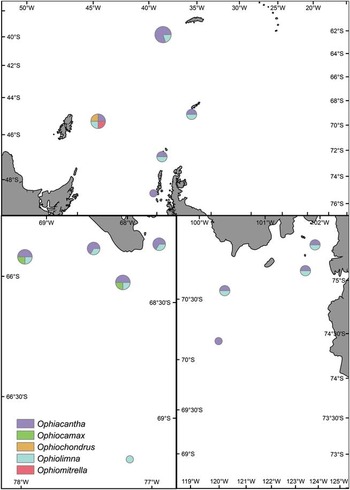
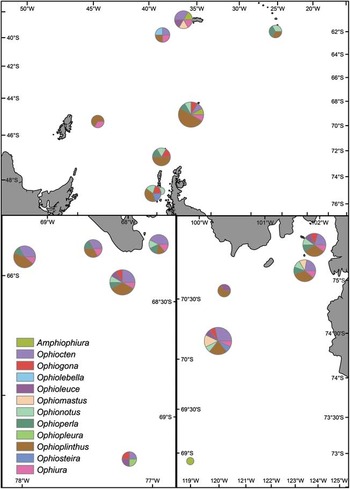
Ophiacanthidae and Hemieuryalidae (Fig. 2)
Of the four genera of Ophiacanthidae found in our samples, three were found on Burdwood Bank, three were found in Marguerite Bay and two found in all other regions (except the South Sandwich Islands and South Georgia where no Ophiacanthidae were recorded). Ophiacantha and Ophiolimna were present in all regions (except Southern Thule and South Georgia) with the highest species-richness (three morphotypes) for a single genus recorded for Ophiacantha from Shag Rocks. Ophiocamax was represented by a single species from two locations in Marguerite Bay. Hemieuryalidae was represented by a single species in the genus Ophiochondrus, found only amongst the Burdwood Bank samples.
Relative proportion of species in each genus of the families Ophiacanthidae (Ophiacantha, Ophiocamax, Ophiolimna and Ophiomitrella) and Hemieuryalidae (Ophiochondrus) from the Scotia Sea (top), Marguerite Bay (bottom left) and Amundsen Sea (bottom right).

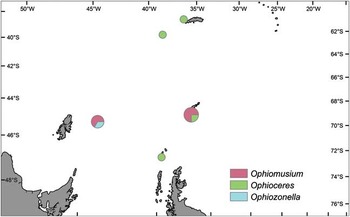
Ophiolepididae (Fig. 3)
Ophiozonella was only recorded from a single species at Burdwood Bank. Ophioceres was represented by a single species at each location in the Scotia Sea, south of the Polar Front. Ophiomusium was found both north and south of the Polar Front, with its highest diversity at the South Orkney Islands.
Relative proportion of species in each genus of the family Ophiolepididae from the Scotia Sea.

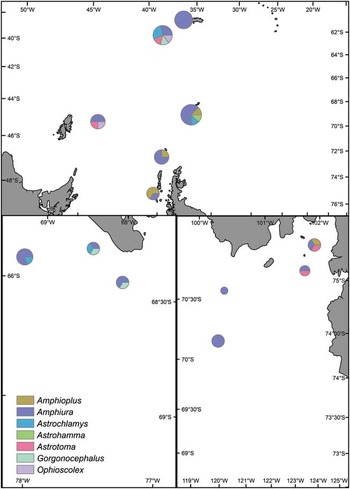
Ophiomyxidae, Amphiuridae and Gorgonocephalidae (Fig. 4)
The genus Amphiura was amongst the most speciose genera observed for any single region with six morphotypes recorded from South Georgia and five from the South Orkney Islands and was recorded in every sampled region except for the South Sandwich Islands. Amphioplus was represented at the South Orkney Islands, South Shetland Islands and the Amundsen Sea by either one or two species. The Gorgonocephalidae were found in most regions except for the South Sandwich Islands, South Shetland Islands and South Georgia. The greatest richness of Gorgonocephalidae was found at Shag Rocks (four species: two species of Astrochlamys, one species of Astrotoma and one species of Gorgonocephalus). Ophioscolex (Ophiomyxidae) were only found at the Burdwood Bank and Shag Rocks and were only represented by single species at each location.
Relative proportions of species in each genus of the families Amphiuridae (Amphioplus and Amphiura), Gorgonocephalidae (Astrochlamys, Astrohamma, Astrotoma and Gorgonocephalus) and Ophiomyxidae (Ophioscolex) from the Scotia Sea (top), Marguerite Bay (bottom left) and Amundsen Sea (bottom right).

Ophiuridae (Fig. 5)
Ophiuridae were the most diverse and speciose family of brittle stars collected and the only one represented at every sampling location. Ophioplinthus dominated the diversity of Ophiuroidea in most regions (only absent from South Georgia and the Amundsen Sea deep water site). Six morphotypes of Ophioplinthus were found at the South Orkney Islands. Of the other genera in this group, Ophiocten had a maximum diversity of four morphotypes at any single region (Amundsen Sea). The only genus found at the Amundsen Sea deep-water station, Amphiophiura, was also found at South Georgia and the South Orkney Islands but was only ever represented by a single species.
Relative proportions of species in each genus of the family Ophiuridae from the Scotia Sea (top), Marguerite Bay (bottom left) and Amundsen Sea (bottom right).

Northern and southern limits
Morphotypes found exclusively north of the Polar Front (here we use the northernmost position of the Polar Front which runs south of the Patagonian Shelf but turns north through a gap in the North Scotia Ridge to continue to the north of Shag Rocks and South Georgia, see Sokolov & Rintoul Reference Sokolov and Rintoul2009) were Amphiura eugeniae Ljungman, 1867, Ophioplinthus confragosa Lyman, 1878, Ophiochondrus stelliger Lyman, 1879, Ophiomitrella conferta Koehler, 1922, Ophiomusium constrictum Mortensen, Reference Mortensen1936, and Ophiozonella falklandica Mortensen, Reference Mortensen1936. The two species Ophiacantha vivipara Ljungman, 1870 and Ophioscolex nutrix Mortensen, Reference Mortensen1936 traverse the northern limit of the Polar Front but were not collected south of South Georgia.
Within the limit of our sampling, the shelf around South Georgia and Shag Rocks appeared to be the northern limit of 18 morphotypes, South Sandwich Islands were the northern limit of three morphotypes, South Orkney Islands were the limit of 15 morphotypes - nine of which were only collected from this region, the South Shetland Islands (including Elephant Island) were the most northerly site for four morphotypes, the Bellingshausen Sea (including Marguerite Bay) was the northerly limit for six morphotypes and five were found only in the Amundsen Sea.
Twenty four morphotypes were found on the high Antarctic continental shelf, ten morphotypes were found only as far south as the Bellingshausen Sea and Marguerite Bay, five morphotypes had their southern limit around the South Shetland Islands, 11 species had a southern limit at the South Orkney Islands shelf and the waters around Shag Rocks and South Georgia were the southernmost records for a further ten morphotypes.
Common and widely dispersed species collected exclusively south of the Polar Front were O. victoriae, Ophioperla koehleri Bell, 1908, Ophioplinthus gelida Koehler, 1901, Ophioleuce regulare Koehler, 1901, Ophiocten dubium Koehler, 1900, Amphiura algida Koehler, 1911 and Ophiomastus meridionalis Lyman, 1879.
Efficacy of sampling
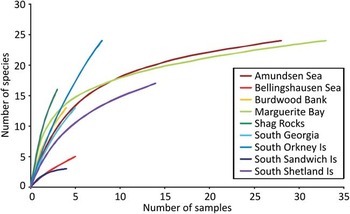
Accumulation curves indicate that our sampling was not sufficient to collect all species present in each locale (Fig. 6). As expected the two areas with the greatest sampling effort (Amundsen Sea and Marguerite Bay) had accumulation curves that were approaching asymptote. Comparing our records with the distribution records of Hedgpeth (Reference Hedgpeth1969) indicates that our data is limited by what we did not record, as in some cases northern and southern limits of the species we identified were substantially extended.
Accumulation curves indicating the sampling effort of each location and how this relates to the expected number of species at each location.

Discussion
Our sampling of the ophiuroids from the western Antarctic continental shelf and Scotia Arc has resulted in a large and diverse collection sorted to 67 morphotypes, 57 of which are recognized species. There are currently 126 species recognized from the Antarctic and sub-Antarctic regions (Stöhr et al. Reference Stöhr, O'Hara and Thuy2012) and it is clear that despite the relatively sparse sampling reported here we have collected a large proportion of the species previously described.
Some ophiuroid distributions seem to have northern or southern limits coincident with the location of the Polar Front supporting the idea that this is a barrier to many species as suggested by Fell et al. (Reference Fell, Holzinger and Sherraden1969). However, there is a degree of overlap between the northern species, which do have ranges that extend beyond the Polar Front, and more “Antarctic” species. The overlap occurs around Shag Rocks and South Georgia. This area has been suggested as a particularly important area to survey and monitor (Barnes et al. Reference Barnes, Griffiths and Kaiser2009, Reference Barnes, Collins, Brickle, Fretwell, Griffiths, Herbert, Hogg and Sands2011) as it is likely to be strongly affected by continuing global warming trends that may facilitate warm adapted species to move further south and restrict cold adapted species to more Antarctic areas.
Fell et al. (Reference Fell, Holzinger and Sherraden1969) suggested that depth and temperature tolerance are the main factors restricting the ranges of Antarctic ophiuroids, while the ACC promotes their dispersal. The ACC may also have a role as a barrier to specific dispersal, particular between the areas concerned with in this study. For example, whereas ACC facilitated dispersal is possible from the Patagonian Shelf to South Georgia, reciprocal dispersal against this current is considered extremely unlikely. Similarly, dispersal between the Antarctic Peninsula and the Patagonian Shelf seems unlikely unless it is via physically crawling across the deep sea or via a circumpolar dispersal (although eddies transporting cold water northwards and warm water southwards could carry larvae, see Clarke et al. Reference Clarke, Barnes and Hodgson2005). This is reflected in the assemblage of three species identified from the South Sandwich Islands. The three ophiuroid species that were found there (O. koehleri, O. gelida and O. victoriae) were among the most commonly collected from all Antarctic sites, but (at the South Sandwich Islands) are at the northern edge of their range. As the Polar Front is north of South Georgia it can hardly be invoked as the barrier to the spread of these species to South Georgia. Other possibilities include other fronts (such as the Southern Antarctic Circumpolar Current Front - SACCF), the inability of larvae or adults to reach this location or to survive the different conditions when they get there (Barnes et al. Reference Barnes, Peck and Morley2010).
If the ACC acts as a barrier to north–south species dispersal a reasonable expectation would be of a signal of species distribution discontinuities at the limits of the ACC boundary. The southern boundary of the ACC includes the shelf area around the South Orkney Islands, with the southern shelf area of this archipelago influenced by the Weddell Sea gyre (Orsi et al. Reference Orsi, Whitworth III and Nowlin1995). Interestingly according to our collection the South Orkney Island shelf region appears to be both a hotspot and a range limit for ophiuroids. Although the sampling effort around this area was comparatively low (cf. Marguerite Bay and Amundsen Sea), an equal number of morphotypes (24) were collected from each of these three areas (see Fig. 6). When compared to Fell et al. (Reference Fell, Holzinger and Sherraden1969) two of these singleton species (Ophiocten amitinum Lyman, 1878 and Amphiophiura rowetti Smith, 1923) were described as having a more northerly distribution, three others (A. tuberculatum, O. relegata and A. proposita) had a more southerly distribution, and four others (O. olstadi, O. rouchi, O. australe and Amphiura sp. morphotype 2) were not recorded. The accumulation curves (Fig. 6) clearly reflect that South Orkney Island shelf is probably much richer than our samples indicate. The Polar Front cannot be invoked as a barrier to these species dispersing further north or west to the South Sandwich Islands (although other frontal zones such as the SACCF may have similar dispersal inhibiting properties), rather a combination of dispersal stages (or lack of), inability to traverse deeper habitats (as suggested by Fell et al. (Reference Fell, Holzinger and Sherraden1969)) and the strong westerly currents of the ACC probably account for the South Orkney Islands as a northern limit for many of the ″Antarctic″ ophiuroid fauna. A thorough sampling of the South Orkney Islands, South Sandwich Islands and South Georgia shelf regions may provide support for either the current itself as a barrier, the physical properties of the SACCF, the life cycle characteristics of species present or thermal tolerances (see Barnes et al. Reference Barnes, Peck and Morley2010) being the primary force inhibiting dispersal north.
The most commonly sampled species in the current study was Ophiolimna antarctica and was represented at most localities, including at the geographical edges of the sampling range. Despite this very little is known about this species, but its broad distribution could be interpreted as evidence of a dispersing larvae phase. However, Mortensen (Reference Mortensen1936) suggested that it is a dioecious species with large eggs that he interpreted as indicating brooding young without a pelagic larval stage. Interestingly this species was not identified in two of the more recent studies of ophiuroids from the West Antarctica region (Dahm Reference Dahm1999, Manjón-Cabeza & Ramos Reference Manjón-Cabeza and Ramos2003). Given the prevalence of this species in our samples throughout the West Antarctica sector, and the intensive sampling from the two studies above in areas within or adjacent to our own sites, we find this rather surprising. Other authors have recorded this species from South Shetland Islands (Mortensen Reference Mortensen1936), the Ross Sea (Fell Reference Fell1961), East Antarctica locations (Hertz Reference Hertz1927), Heard and McDonald islands (O'Hara & Poore Reference O'Hara and Poore2000) and the Weddell Sea (Voss Reference Voss1988). Ophiolimna antarctica is, however, superficially similar to the species Ophiacantha antarctica Koehler, 1900, Ophiacantha pentactis Mortensen, Reference Mortensen1936 and Ophiocantha vivipara. Confusion in identification is possible with this and other groups of ophiuroids (in particular within the genus Ophioplinthus (Ophiurolepis, Theodoria)) and highlights the need for thorough and expert taxonomic appraisal, particularly before records are submitted to public databases such as SCAR MarBIN.
The only other taxon that was sampled at both the northern and southern localities of our range was A. agassizii. The wide distribution of this species across deep ocean and across the Polar Front suggests a dispersing life phase. Although A. agassizii is described as brooding (Monteiro & Tommasi Reference Monteiro and Tommasi1983, Hunter & Halanych Reference Hunter and Halanych2008) there is evidence of larval dispersal in this species around the Antarctic (Heimeier et al. Reference Heimeier, Lavery and Sewell2010). Both Hunter & Halanych (Reference Hunter and Halanych2008) and Heimeier et al. (Reference Heimeier, Lavery and Sewell2010) suggested that there are at least two cryptic species of A. agassizii, with molecular evidence (mtDNA haplotypes) indicating that those from the Patagonian Shelf, thus north of the Polar Front, are genetically distinct from those collected around the Antarctic continental shelf.
In each of the more diverse families there is at least one dominating cosmopolitan genus, e.g. Ophiuridae - Ophioplinthus (Fig. 5), Ophiacanthidae - Ophiacantha (Fig. 2), Amphiuridae - Amphiura (Fig. 4). Ophioplinthus is predominately an Antarctic genus with most species being Antarctic endemics with only a few examples of species existing around the coasts of the southern continents. This implies in situ radiation of this genus over timescales compatible with the isolation of Antarctica from the Gondwanan continents (i.e. tens of millions of years), and of some leakage out of Antarctica back to the warmer, more northerly shelf regions. Further molecular based phylogenetic studies are planned to test this hypothesis.
This preliminary, pattern based study provides a strong basis for future specific studies where we hope to elucidate taxonomic issues touched on here, strengthen the understanding of systematic relationships between ophiuroid groups, and, with additional collections from subsequent cruises, build a credible knowledge base from which to explore the ecological role of the various aspects of the ophiuroid assemblage and the evolutionary history of this group in the Southern Ocean.
Acknowledgements
We would like to thank the Captain and crew of the RRS James Clark Ross for their commitment to providing an excellent science platform. We would like to acknowledge Stefanie Kaiser, Jan Strugnell, Adrian Glover, Alexis Janosik, Terri Souster, Peter Enderlein, Alistair Newton, Daniel Smale, Jenny Rock, Anthony North and Matthew Brown for help sorting on the ship. Thanks also for the assistance of Andrew Cabrinovic of the Natural History Museum, London, for providing his time and resources to examine specimens. Similarly Dr Carsten Lueter of the Museum für Naturkunde, Leibniz-Institut für Evolution, Berlin, for providing images to assist with character diagnosis. We are grateful for the constructive feedback of Julian Gutt and an anonymous reviewer that have improved the manuscript. The curation and taxonomic work in this paper was supported by an Antarctic Science Bursary and a SynTax grant to CJS. This study is part of the British Antarctic Survey Polar Science for Planet Earth Programme funded by The Natural Environment Research Council.
Supplemental material
Two supplemental tables will be found at http://dx.doi.org/10.1017/S0954102012000612.