

The optimal extent of overseas involvement is ‘the oldest and most fundamental issue of American foreign policy’.Footnote 1 A spirited debate is taking place on restraint’s pros and cons.Footnote 2 However, neither side considers whether great powers are likely to practice restraint and whether there are any genuine instances to be found. Great powers are those states controlling the largest demographic, economic, and military capabilities, and which are perceived as bona fide members of the great power club. This article does not explore whether great powers exercise restraint in the sense of: balancing; multilateralism; isolationism; abnegation; status quo; retrenchment; or the command of the commons.Footnote 3 What it investigates instead is the practicality for a great power of the version of restraint currently recommended for the US.
From a theoretical viewpoint, this article adds value by testing a key prediction of great power behaviour. If restraint is the expected norm, then it should be found on at least a regular, even though not universal basis, in what great powers do. As Barry Posen writes: ‘not all states learn the lesson [of history] … but enough learning takes place to make violent, unlimited, expansionist policies the exception rather than the rule. Status quo policies are the rule rather than the exception.’Footnote 4 It is therefore legitimate to investigate whether such expectations are borne out. This is all the more warranted as, although its proponents are aware of the activism of great powers as a group, currently no one can specify the extent to which they actually practice restraint.Footnote 5
The article is also significant from a policy-relevance perspective. If great powers have a difficult time in following restraint, then it may be unreasonable to keep asking that the US should do so. If, conversely, restraint is confirmed as practical, then the finding will strengthen the position of its proponents by identifying models the US could emulate. The historical record is not an iron law for what great powers may do in the future. Therefore, this article does not argue that great power restraint is impossible. What it asks is how likely a great power, and the US in particular, is to practice the recommended grand strategy of restraint, given what great powers have done already. Thus, this article is probabilistic, not deterministic.
The article is organised as follows. Section One elaborates on the meaning of restraint, while distinguishing it from related concepts. Section Two undertakes a statistical investigation of whether great powers practiced restraint in the last two centuries. Section Three examines two seeming cases of restraint: Ming China’s decision to reverse its naval build-up in the fifteenth century; and Victorian Great Britain’s splendid isolation. The conclusion considers the findings’ implications for the US grand strategy debate.
What is restraint?
For all the voluminous literature concerning its desirability, the concept of restraint remains surprisingly undertheorised. However, an informal consensus exists among proponents in the US grand strategy debate as to what is meant by restraint. Since recommendations are based on this understanding, it is only this particular sense that is pertinent here. Accordingly, restraint designates the practice of self-control by a great power in its use of force and in its extension of commitments to foreign political actors. There are two notable elements to this definition.
First, restraint is understood exclusively as self-restraint, the product of self-imposed boundaries. Hence, restraint is dispositional, not situational.Footnote 6 As Kenneth Waltz writes, ‘[states] are free to do any fool thing they care to, but they are likely to be rewarded for behaviour that is responsive to systemic pressures and punished for behaviour that is not’, with restraint understood as the former, and assertiveness as the latter.Footnote 7 Restraint represents the standard optimal strategy for great powers in anarchy, regardless of the particulars of given situations they confront. While great powers are perfectly free to ignore restraint, they will pay the penalty for doing so. Therefore, restraint proponents nearly always portray expansive national interests as self-defeating due to counterbalancing, imperial overstretch, and resentment.Footnote 8
Second, there are two fundamental criteria of great power restraint. Posen introduces restraint as a concept that ‘advises us to look first at the elemental strengths of the United States, which makes it an easy country to defend. The United States thus has the luxury to be very discriminate in the commitments it makes and the wars it fights.’Footnote 9 Consequently, it is appropriate in order to check whether great powers practice restraint, to look primarily at the commitments they make and the wars they fight. Both criteria are necessary.
Restraint requires that great powers use military force sparingly and only in defence of their physical security from direct attack or from a major revision of the balance of power. For Posen, restraint imposes a stingier US attitude as to the use of force; for Stephen Walt, restraint means that the US uses force deliberately solely when key security interests are in jeopardy; for Eugene Gholz, Daryl Press, and Harvey Sapolsky, restraint supposes using force only if the most fundamental American interests, physical security and prosperity, are endangered. For Richard Betts, the US should use force less ambitiously, only for the protection of vital security interests. For Christopher Layne, restraint consists in a narrow definition of the interests for which the US would use force ‘in terms of defending the United States’ territorial integrity and preventing the rise of a Eurasian hegemon.’ For John J. Mearsheimer, restraint consists in refraining from intervening in overseas great power conflicts. The US should act ‘only when there is a potential hegemon in the region that the local great powers cannot contain by themselves’.Footnote 10 This amounts to a claim that a great power is not restrained if it uses force to augment its capabilities, boost its status, proselytise its values, or champion the interests of allies. Whenever a restrained great power employs force, it does so principally to defend itself or to prevent the balance of power from being overturned. These occasions are rare since considerable costs are attached to attacking a great power, and great powers seldom amass sufficient capabilities to mount a successful hegemonic run. Therefore, the first testing premise is that a restrained great power should be participating infrequently in wars and disputes.
Restraint also requires that a great power maintain few commitments for which it is ready to fight. Ideally, only the protection of its territory and political independence should be upheld. A restrained power refrains from extending pledges to come to the aid of foreign actors, and from giving substance to such pledges through the provision of military aid, especially through the stationing abroad of troops. Thus, Walt advises that the US withdraw from Europe and the Middle East, while it should continue to maintain capabilities in East Asia; Mearsheimer recommends a shift to an over-the-horizon stance which would maintain US alliances, but withdraw troops; while for Gholz, Press, and Sapolsky, the essence of restraint consists in ‘the disengagement of America’s military forces from around the world’. More recently, Gholz and Press have counselled political and military withdrawal from East Asia and Europe, but the maintenance of an over-the-horizon stance in the Gulf; Betts has advised retaining the commitment to NATO and to Japan and South Korea while practicing aloofness in regards to other states; Posen has counseled a pullback from Europe, East Asia, and the Middle East, as well as the distancing of the US from its current allies; while Layne has advocated the wholesale removal of troops and the termination of all alliances.Footnote 11
A restrained power fights only in defence of its core interests, that is, the defence of its own physical security and independence, not of those of other actors.Footnote 12 Thus, it foregoes foreign commitments, or restricts their application in order to prevent being dragged into unwanted wars. Once undertaken, commitments increase the likelihood that action will be taken to uphold them: they open the door to the potential exercise of force abroad. Hence, the second testing premise is that the number of security commitments of a great power is indicative of its restraint.
What restraint is not
Restraint does not refer to other actors checking, holding back, balancing, or constraining a great power; nor does it express a bond, restriction, or prohibition of its freedom of action.Footnote 13 Restraint is understood exclusively as self-restraint, not as the result of pressures from states, alliances, or institutions, which constrain a state to do what it would otherwise not do. In fact, its proponents warn that if the US will not implement restraint of its own accord, balancing by other powers will be the penalty. Therefore, restraint cannot be the same thing as balancing: the former should prevent the latter. Similarly, as Layne unequivocally writes, ‘to reduce others concerns about its power, the United States must practice self-restraint (which is different from choosing to be constrained by others by adopting a multilateral approach to grand strategy).’Footnote 14 Thus, restraint should not be confused with multilateralism, because institution or alliance restraint represents as well a restriction of freedom of action imposed by a state’s allies, whether by the threat to terminate the alliance, withhold support or contributions, or reciprocate.Footnote 15 Furthermore, multilateralism can undermine restraint by entrapment, or by the stronger partner dragging the weaker ally into conflict, as was the case in Kosovo, Iraq, and Afghanistan.Footnote 16
Restraint is not isolationism. Isolationism agrees with restraint on avoiding ‘entangling alliances’, but the two part ways regarding the admissible circumstances for using force.Footnote 17 For restraint, going to war abroad is necessary whenever the balance of power in another region is endangered critically, because, by adding the resources of the vanquished states to its own, a regional hegemon would then be in a position to mount a threat to the American continent. To this extent, for partisans of restraint, the emergence of a hegemon in another region is a threat to the security of the US territory and independence. For instance, Posen writes that ‘the United States has ensured that no single hegemonic power arises in Eurasia, unites its disparate states by the sword, commands its economies, and develops enough capacity to challenge the United States in its hemisphere.’Footnote 18
However, for isolationism, going to war in other regions is forbidden under any conceivable circumstances. This is due to the isolationist belief that even a victorious regional hegemon would not be able to threaten the US. America remains fundamentally secure, protected by two oceans, weaker neighbours to the South and to the North, a strong nuclear deterrent (since 1945), and a robust economy. To quote senator William Borah in 1939: ‘We need not be disturbed in the least about some half-baked, crazy, totalitarian theory taking possession of this country, or even attacking it. Our work is right here at home.’Footnote 19 For isolationism, the US is ‘strategically immune’ to security developments overseas ‘insofar as the challenger is incapable of making significant gains despite our not opposing him’. Therefore, ‘to venture beyond the lines within which we are immune’, which coincide with a perimeter covering the North American continent, ‘is unnecessary’.Footnote 20
This is why isolationists disagree with the need for the US to have fought both World Wars, become enmeshed in the Cold War, and gone on to combat nuclear proliferation and international terrorism.Footnote 21 By contrast, restraint proponents not only applaud US intervention against Germany, Japan, and the USSR, but also support re-engagement should another aspiring hegemon emerge.Footnote 22 Furthermore, they are strongly concerned about the danger posed by proliferation and by terrorism.Footnote 23
Restraint is not abnegation in the sense of great powers abstaining ‘from gains which they could probably have gotten’ or engaging in ‘denial of immediate self-interest’.Footnote 24 Assuming a spectrum of great power behaviour ranging from perfect benevolence to world dictatorship, the US would place as relatively benign. By contrast to Napoleonic France or Nazi Germany, the US has not sought to exert overwhelming control over its allies and partners’ domestic politics, has tolerated significant dissent in their foreign policy, and has refrained from looting their resources. As Dominique Moïsi observes, ‘never before has a country had as much power as the United States and used it, on the whole, with such moderation’.Footnote 25 However, restraint is not about a great power’s good behaviour or abstention from abuse, but about the extent of its international activism. A great power may combine abnegation in outlook with a significant amount of military and political activism abroad. For instance, in the Cold War, by contrast with the Soviet Union, the US treated its partners as allies, not as satellites. Yet, at the same time, Washington resorted to frequent military intervention overseas, and became committed to combatting communism worldwide.
Restraint is not status quo. A status quo power seeks to preserve a given capabilities distribution, an objective that goes beyond the minimalist goal of ensuring that no hegemon emerges. Any shift conferring advantage to a great power, not just a cataclysmic one, may constitute grounds for using force. Moreover, a status quo power may resort to military action incompatible with restraint in order to police the international order it champions against rule infringement. For a quarter of a century since the end of the Cold War, the US has been satisfied with the existing power distribution, yet has failed to show restraint, being at war longer than at any other time in its history.Footnote 26 Lastly, status quo allows a state to add incrementally to its power, provided that these changes do not upset substantially the existing power distribution.Footnote 27 Nevertheless, this is incompatible with restraint, because it incurs new commitments. Since 1989, the US has extended NATO into Eastern Europe and concluded multiple security partnerships in the Gulf. These actions have not affected unipolarity, yet they have opened the door to US military and political involvement in these regions.
Restraint is not retrenchment, despite the terms being used interchangeably. Retrenchment means redistributing and prioritising resources during political, economic, and military downturns.Footnote 28 However, while restraint is a grand strategy, retrenchment constitutes a tactic.Footnote 29 The difference is that grand strategy is a chain matching means and ends, while tactics refer to how resources/means are actually employed, or how they are redistributed or manoeuvred at an operational level. Accordingly, tactics are a subcomponent of grand strategy and do not play a role in selecting the objective to be accomplished. Retrenchment is a tactic because essentially it constitutes a manoeuvre, which makes sense only in light of an exogenous goal. In effect, retrenchment can be likened to the military tactic of retreat from the battlefield. It can be used either to fight another day or resume the offensive elsewhere (assertiveness) or as part of a larger, comprehensive pull back (restraint). Consequently, evidence of retrenchment is not necessarily evidence of restraint, because retrenchment may enable instead assertiveness. A grand strategy cannot be restrained if, even as it curtails commitments, it bids time for resuming activism. Similarly, restraint is incompatible with a great power abandoning assertiveness only in certain geographical areas, but pursuing it energetically elsewhere.
A recent discussion of retrenchment illustrates this distinction. While US policymakers tend to think of retrenchment as a ‘prelude for further renewal once America gets its house in order’, scholars prefer retrenchment to be permanent and the US to play ‘a role of a great power among many’.Footnote 30 Policymakers are contemplating shifting the bulk of American military resources towards East Asia: the so-called pivot. This is an instance of retrenchment as a tool for assertiveness. However, scholars have in mind a comprehensive pull-back from Europe and the Middle East, as well as a substantial watering down of commitments in East Asia. This is retrenchment as a tool for restraint. Consequently, the type of retrenchment can be told apart by using two criteria. First, is this a blanket pull-out from existing commitments, or are there commitments that are kept intact and bolstered? Second, are decision-makers endorsing a lasting policy of restraint, or are they biding their time before resuming the offensive? While conducting such testing is impractical in the quantitative section, there is explicit testing of these criteria in the Ming China case study.
Lastly, restraint is not identical to the command of the commons, or predominance in the air, sea, and space. A good deal of discussion of implementing restraint revolves around offshore balancing, implying a maritime focus.Footnote 31 Nevertheless, command of the commons is dual-purpose: it can be used to advance both restraint and assertiveness. The concept, traceable to Paul Kennedy and Alfred Thayer Mahan, involves more than ensuring freedom of navigation. The power enjoying command does not only use it defensively, to open and preserve the access to an international public good. It can also use it coercively, to close and prevent sea access to opponents. In fact, for Mahan, the command of the commons was ‘that overbearing power on the sea which drives the enemy’s flag from it, or allows it to appear only as a fugitive; and which, by controlling the great common closes the highways by which commerce moves to and from the enemy’s shores.’Footnote 32 This duality of purpose is acknowledged by Posen, who presents the command of the commons both as a key instrument enabling hegemony and as the military strategy best suited to implement restraint.Footnote 33 Further confirmation is that the continued command of the commons is supported by both proponents and opponents of restraint. The latter agree that emphasis should be shifted away from ground forces, but complement the command of the commons with the use of drone strikes, special operation forces, intelligence, surveillance and reconnaissance, selective weapon upgrades, and basing forces forward close to possible deployment theaters.Footnote 34 Therefore, the command of the commons is not a reliable test of a great power’s restraint.
Research design
In order to test if being a great power affects the propensity of a state for restraint, the article weighs both quantitative and qualitative evidence from 1815 to the 2000s concerning: (a) the involvement of great powers in wars and disputes; and (b) their alliances and dependencies.
The frequency of instances in which force is used and of commitments may vary considerably between great powers, according to differences in their capabilities, status, and length of tenure as a great power. Unsurprisingly, a dominant state (the US, Great Britain) is more active over a two-hundred-year span than the newest or weakest members of the great power club. Similarly, a state that has been a great power for only sixty years (China) or that ceases to be a great power after only eighty or one hundred years (Italy, Austria) is less active than one that has been uninterruptedly a great power for two centuries (Russia, France). Nevertheless, a lower level of use of force or of commitments relative to the frontrunners may not represent evidence of great power restraint, because a minor great power may still be more assertive than the average state. Therefore, it is important that great powers be compared to non-great powers, not only to each other.
Furthermore, if one were to consider great powers only as a group, the results might be affected by an inordinate activism of a few great powers that are responsible for the bulk of wars, disputes, alliances, and dependencies. Thus, although great powers may be responsible for the largest share of wars and commitments, there could still be frequent instances of great power restraint, in which individual great powers are able to use force and conclude commitments on par with most average states. However, if individual great powers are the states consistently topping the rankings when it comes to instances of use of force and commitments, with few or no non-great powers achieving similar levels of activism, this will provide evidence that being a great power inhibits restraint.
First, the article examines the Correlates of War (COW) data on interstate and extra-state wars and militarised interstate disputes (MIDs). The great power list is composed of: France (1815–2010); Great Britain (1815–2010); Germany/Prussia (1815–2010); Russia/Soviet Union (1815–2010); Austria (1815–1918); Italy (1860–1943); the United States (1898–2010); Japan (1905–2010); and China (1949–2010).Footnote 35 Restraint stands confirmed if great powers do not participate in substantially more wars and disputes than the majority of non-great powers; and if their resort to force occurs primarily for motives of self-defence or upholding the balance of power against would-be hegemons. Self-defence refers to the protection of the great power’s own territory and independence, but not to the protection of dependencies or allies. Admittedly, such instances are defensive since the great power suffers an attack against its interests, ideology, or reputation/status, but this is not restraint, since its own territory or independence is not directly at stake. As to balancing, the article takes into consideration instances of use of force aimed at preventing an actor from achieving global or regional hegemony. For balancing to be ascertained, there should be both a direct confrontation with the would-be hegemon, as well as a chance that the absence of intervention would result in significant power disequilibrium.
Second, the article explores the great powers’ commitments. The several types of commitments may be told apart according to the entity to which support is pledged: allies or dependents. In the former case, a great power concludes formal alliances through the signing of a written treaty between recognised members of the state system, detailing obligations for a given length of time. The article relies on Douglas Gibler’s International Military Alliances dataset. It subtracts non-aggression pacts, since these treaties pledge not to attack the other side instead of defending it, and considers only pacts of defence, pledging intervention to the side under attack by a third party; and ententes, a weaker commitment, in which states merely pledge consultation or cooperation in the event of hostilities.Footnote 36 In the latter case, a great power pledges support to dependencies: entities having no control over their foreign affairs, armed forces, or national institutions, or over their territory. These polities rely on the great power for decision-making, without being an integral part of its national territory. To assess the number of dependencies, the article utilises the COW ‘Territorial Change’ dataset, which is the nearest, if imperfect substitute to a comprehensive record. Restraint stands confirmed if great powers keep in place a number of foreign commitments similar to that of most non-great powers.
Third, the article discusses in-depth the cases of Ming China and of Victorian Britain, in order to test whether these powers were genuinely restrained. In each instance, there is a prevailing view in the former case from China historians, in the latter from International Relations scholars that the great power limited willingly its external involvement. Therefore, these are most-likely cases, which restraint should explain easily. Meanwhile, alternative explanations should have a tougher time accounting for the outcome.Footnote 37 The cases are selected based on the extreme value of each powers’s capabilities, since it is widely accepted that the margin of superiority enjoyed by the US vis-à-vis other great powers since the end of the Cold war is historically uncommon.Footnote 38 Both China and Britain were dominant, in the sense of being the strongest power in the system. Under the Ming, China contained an estimated third of the total global population; was the uncontested industrial leader in iron manufacturing output; and outnumbered its rivals with armies that averaged 100,000 troops, but could field up to one million (contemporary European armies could field at the most 50,000 soldiers). Meanwhile, by 1897, the British Empire contained a quarter of the world’s population at 444 million people; its share of world manufacturing output was almost double from 1860 to 1880 those of the next-in-line powers; and was ‘probably as powerful as the next three or four navies in actual fighting power’ after 1815.Footnote 39 Therefore, these cases have significant implications for whether the US, as the international number one, is likely to exercise restraint.
Wars and commitments
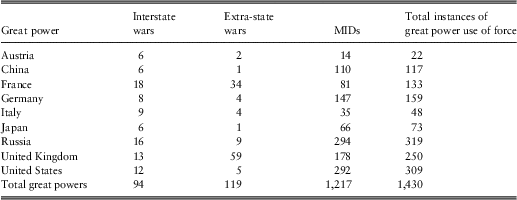
The findings show that, as a group, great powers account for the lion’s share of interstate (55 per cent) and extra-state (67 per cent) wars. In relation to MIDs, great powers account for 1,209 out of 2,586 disputes, or 46.7 per cent. However, individual great powers without exception resort to force more frequently than the majority of non-great powers, taking the most part in wars and disputes (see Table 1).
Great powers’ use of force, 1815–2010.
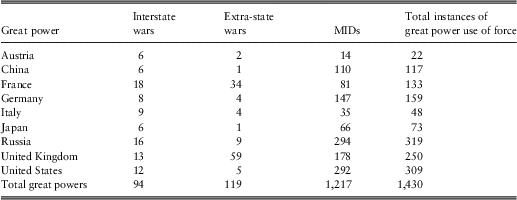
During their great power tenure, France participated in 18 interstate wars, Russia in 16, the UK in 13, the US in 12, Italy in 9, Germany in 8, and China, Japan, and Austria in 6. The only comparable figures for non-great powers come from Turkey with 13 participations and Spain with 6.Footnote 40 Great powers also represent the top participants in extra-state wars, with Great Britain and France accounting for most with 59, and 35, participations respectively. Meanwhile Russia participated in 9 such wars, the US and Italy in 5, Germany in 3, Japan and Austria in 2, and China in 1. The only non-great powers to make the list are Turkey that was involved in 14 instances, and Spain and Netherlands in 10 each. For disputes, great powers also dominate the participation list: Russia participated in 294 disputes; the US in 292; Great Britain in 178; Germany in 147; China in 110; France in 81; and Japan in 66. Only Turkey with 69 and Israel with 66 participations figure in the same bracket.Footnote 41
Provisos to keep in mind are that low figures in one category of use of force do not rule out high figures in another. China may have fought only one extra-state war, but was involved in 110 disputes in roughly sixty-odd years of being a great power, figuring in fifth place for total MID involvement. Meanwhile, Italy took part in only 35 disputes, but in its eight decades as a great power went to war against other states more often than Germany. Furthermore, individual great powers, except those with the shortest great power timespan, rank higher in their total instances of use of force than any non-great power actor. Turkey is the only non-great power to make the list of overall use of force ahead of Japan, Italy, and Austria; Israel, Spain, and India due to their greater participation in MIDs, but not in wars, are ahead of the latter two. These results contradict restraint’s expectation that there are great powers that employ force sparingly.
But do great powers use force for the ‘right’ reasons: balancing against hegemony and self-defence? Balancing arguably constituted the reason for great powers to use force to prevent Imperial and Nazi Germany from becoming dominant in the system, and Japan from becoming dominant in East Asia. Balancing may be also invoked in the Gulf War, in preventing Iraq from becoming dominant in the Middle East by adding the oil resources of Kuwait to its own and then by intimidating or conquering Saudi Arabia. However, there are no other clear instances. The Korean, Vietnam, and Crimean wars are all tenuous: in the first two the US and the USSR were not pitted against each other; in the latter a Russian victory would not have resulted in global or regional hegemony. Balancing cannot be invoked at all in the case of extra-state wars, since there was neither a direct confrontation against another great power, nor was there a likelihood that non-intervention would result in hegemony. Finally, in relation to disputes, it is fruitless to distinguish anti-hegemonic efforts from regular power adjustment tactics, such as demonstrations, threats, or limited use of force.
Few clear-cut examples are found for self-defence: two (the World Wars) in the 53 interstate and none in the 110 extra-state wars. Interstate defensive wars are not to be mistaken for self-defence wars. Lebow has identified 11 interstate wars out of 95 involving great powers as having been caused foremost by security concerns. With the exception of the World Wars, the other instances can be traced either to concerns over the preservation of a congenial regime (France’s war against Spain in 1823, the Soviet interventions in Hungary and Afghanistan); the security of allies and partners (the Gulf, Korean, and Vietnam wars); the acquisition of strategic territory (the Nomonhan, the Russo-Finish wars); or reputation (the ultimatum to the Taliban to surrender those responsible for 9/11).Footnote 42 There was no instance where the great power’s territory or political independence was ever at stake directly.Footnote 43 Meanwhile, although great powers were not extra-state war initiators in 50 per cent of instances, they cannot claim self-defence, as these wars were conducted for the retention of an imperial/colonial array, not for the survival of the great power itself.Footnote 44
Less information is available as to the great powers’ motives for participating in disputes, since the current coding of a state as revisionist vs non-revisionist and the lack of in-depth descriptions except for the most recent interval does not allow discrimination between self-defence and defensive motivations. However, there are reasons to believe that self-defence is likely to account at the most only partially for great power involvement in disputes, since available results code nearly half (43 per cent) of great power involvement as revisionist, to which defensive participation should also be added. To conclude, great powers hardly ever conform to the requirements of restraint in the sense of using force solely for the sake of self-defence and balancing as a last resort.
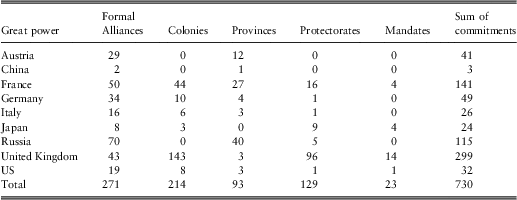
Concerning international commitments, the findings show great powers as a group as the quintessential guarantors, being almost twice more likely than average states to conclude an alliance or have a dependency in need for protection (see Table 2). Out of 204 alliance treaties from 1815, 85 per cent involved at least one great power.Footnote 45 Great powers account for 67 per cent of all colonies; for 74 per cent of all protectorates; and for 61 per cent of all mandates. But the findings also demonstrate that few, if any great powers resist the temptation to pledge military support to foreign political actors well beyond the strict requirements of their own physical security.
Great power commitments, 1815–2008.

The five states most heavily involved in the conclusion of alliances have all been great powers. The frontrunner is Russia, followed by France, Great Britain, Germany, and Austria. Meanwhile, the top colonisers, protectors, provincial overlords, or mandate-holders without exception have all been great powers – with Great Britain, accounting for the most, followed by France, Russia, and the US.Footnote 46
It could be objected that some great powers engage in few alliances, with the treaties numbers for Italy and the US being surpassed by Turkey (38), Romania, Bulgaria, and Poland (26), and with three other states (Yugoslavia, Czechoslovakia, and Greece) ranking ahead of China and Japan. Similarly, some great powers had a small number of dependencies, while non-great powers such as Spain, Portugal, and Turkey controlled a larger number of colonies and provinces.
However, these figures do not reflect the great powers’ total commitments. First, the number of treaties may be smaller than the number of allies, since multi-member alliances extend the pledge to all signatories. The US is the champion of such arrangements – examples being NATO with 28 members and the Rio Treaty with 36. Second, great powers with few commitments of one type, such as alliances, may undertake a multitude of other external pledges, such as having a large number of dependencies or partnerships, resulting in a larger number of overall commitments. This was the case for both Britain, as seen later, and for Italy and Japan, which are only surpassed in sum of commitments by Turkey, and are level with Romania, Bulgaria, and Poland. Third, the dataset also does not include, due to the difficulty of identification, the likely non-trivial number of informal alliances lacking a written treaty and/or concluded with a side which is not a recognised state.Footnote 47 This may be relevant in particular for post-Second World War US and for China. Fourth, the non-great powers having a larger number of dependencies than non-great powers were themselves former great powers (Spain, Portugal, and Turkey) that retained temporarily control over provinces and colonies after suffering demotion. Hence, while more research is required on measuring international commitments, so far, the evidence points against the expectations of restraint. Great powers unambiguously reject international detachment.
Ming China’s ephemeral naval mastery
In between 1405 and 1434, Ming China launched under the command of the eunuch Zheng He seven maritime expeditions reaching South India; South East Asia; the Persian Gulf and the Red Sea; and even the East Africa coast. The expeditions’ manifest goal was status: ‘display soldiers in strange lands in order to make manifest the wealth and power of the Middle Kingdom’. In other words, China sought to convince other polities to enter tribute relations acknowledging its supremacy.Footnote 48 This goal was met as an alleged thirty countries sent envoys and lavish gifts of gems, spices, fragrances, precious materials, and exotic animals.Footnote 49 Each expedition comprised around 250 ships and 27,000 soldiers. Historians often use as a comparison the Invincible Armada of 1588, which counted only 130 ships and 18,000 soldiers.Footnote 50 This was only a part of the Ming fleet, estimated to have numbered 3,500 ships.Footnote 51 Such naval mastery could have easily been translated into a Chinese political and commercial dominium stretching from Japan to East Africa. Had the Ming been so inclined, they could have established an imperial network predating, surpassing, and excluding those of the European powers.
However, after the death of their initiator, the Yongle Emperor, his successor suspended the expeditions. One last voyage was conducted under the Xuande Emperor in 1431, but only five years later the dynasty forbade the building of seafaring vessels. Tribute missions were interrupted and the requests of former tributaries for renewed interaction were rejected. China’s warships rotted at the anchor or were turned to civilian uses while the personnel deserted en masse. By the early 1500s, a province that had deployed a fleet of one hundred warships in 1448 could effectively count on only three operational vessels. By 1551, in the face of increased pirate raids, China outlawed sea voyages on a multimasted ship under penalty of death. Despite isolated efforts to fight pirates, China eventually opted to move the coastal population inland.Footnote 52 Therefore, here was an ostensibly dominant state that, nonetheless, chose to both spurn the external use of force and to disavow its nascent commitments. But was this an instance of authentic restraint?
At a first glance, there are grounds to interpret the Ming withdrawal from naval mastery as self-restraint. The conventional explanation consists in the ruling elite, composed of Confucian scholars, valuing moral self-cultivation over foreign expansion. For instance, Kennedy writes that ‘a key element in China’s retreat was the sheer conservatism of the Confucianist bureaucracy … the all-important officialdom was concerned to preserve and recapture the past, not to create a brighter future based upon overseas expansion and commerce’.Footnote 53 Ming China’s view of international affairs is said to have exhibited a ‘pacifist bias’, being permeated by the convictions that China played the part of the superior ruler governing by moral example; and that the use of force was ill-suited for ensuring harmonious relations.Footnote 54 For Confucians, ‘the worst policy would be to interrupt people from their normal life for the sake of invading other countries. Expansion of territory and accumulation of wealth were both tasks that would do just that.’Footnote 55 Hence, the expeditions could not help being at odds with Confucian orthodoxy as they ultimately relied upon coercion by going ‘in succession to the various foreign countries, proclaiming the edicts of the Son of Heaven and giving gifts to their rulers and chieftains. Those who did not submit were pacified by force.’Footnote 56 Unsurprisingly, the Confucians argued that the voyages brought no benefit to the state, being not only wasteful in lives and treasure, but also and, more importantly, failing to contribute to moral rectitude.Footnote 57
Nevertheless, this interpretation fails to capture the whole story of China’s withdrawal from the sea. The Ming official history writes that ‘from the time that [Zheng He] returned from the distant regions … the most urgent priorities have been different from those of the Yongle period.’Footnote 58 A Jesuit history of 1585 confirms a shift in the Ming’s hierarchy of foreign policy objectives. The Chinese, it reports, ‘have found [that] to go forth of their own kingdom to conquer others is the spoil and loss of much people and expenses of great treasures … so that in the meantime whilst they were occupied in their strange conquests their enemies the Tartarians and other kings … did trouble and invade them, doing great damage and harm … So they found it requisite for their quietness and profit to leave all they had got and gained out of their own kingdom, but specially such countries that were far off.’Footnote 59 This rival interpretation suggests that the Ming abandoned sea power in order to shift resources to address the Mongol peril.
The Ming had attained the throne in the wake of a civil war that had swept from power the Mongol Yuan dynasty. The expelled Mongols did not aim to renew their conquest of China, but rather to secure equitable terms for tribute, which would have allowed them to acquire foodstuffs and manufactures impossible to obtain in the steppe. In the absence of satisfactory conditions, they conducted raids into China. The Ming, however, rejected any formula that would not have acknowledged abundantly China’s superior status.Footnote 60 Consequently, the Ming led a succession of expeditions to pacify the Mongols. One such campaign in 1449 resulted in one of the greatest military disasters of all time. At the post station of Tumu, a Chinese army reported to have numbered half a million was annihilated, with perhaps half of the force being killed, including the empire’s chief civilian and military leaders, and the emperor being taken prisoner.Footnote 61
A consensus reigns among scholars that the disaster constituted a watershed for China, as it signalled the seriousness of the danger from the North. Frederick Mote writes that ‘if one event can be identified as a turning point and taken as a symbol in a long chain of consequences, it surely must be the T’u-mu incident of 1449’ and that ‘the northern frontier became the fixation, the virtual obsession of many Chinese statesmen throughout the mid and late Ming times.’ While there are no actual records documenting a decision, the concurrent pursuit of naval empire in the South was no longer sustainable in the context of resisting the Mongols. Hence, the gradual reorientation of the Ming strategy from South to the North, does not suggest self-restraint, but rather indicates retrenchment, or cutting down secondary commitments in order to reaffirm principal ones.Footnote 62 But was this retrenchment for restraint or retrenchment for renewal?
It could be argued that China’s reluctance after Tumu to undergo expeditions beyond the Great Wall against the Mongols is consistent with restraint, since it suggests a comprehensive pullback, not just a policy limited to naval matters. But the record of strategic debates over how to deal with the Mongol threat in the aftermath of Tumu indicates otherwise. The crux of the debate was whether China should have adopted a defensive posture or whether it should have taken again the offensive to the Mongols. A true partisan of restraint would have emphasised resorting to force only in self-defence. Instead, the debates were marked by preoccupation with the transient weakness of China: while officials agreed that an offensive campaign was highly desirable, they stumbled on the insufficiency of resources and decided to wait until conditions would be more favourable. As extensive scholarship argues, the influence of Confucian views over the Ming grand strategy appears to have been much overstated.Footnote 63 Contrary to traditional interpretations, China kept favouring assertiveness, even as it pulled back from the sea and built up the Great Wall. Defence through fortifications was a precondition to renewed assertiveness, while accommodation was rejected as both harmful to status and encouraging more raids. The planned offensive was eventually carried out by the successor dynasty, the Qing, who managed to conquer piecemeal the Mongols from the 1650s until 1758.Footnote 64 In light of this analysis, this is a case of retrenchment used for temporisation, hence for renewal, not for restraint.
British splendid isolation
The example of Great Britain carries considerable weight with proponents of restraint. They frequently recommend that the US should implement a British-inspired strategy of offshore balancing.Footnote 65 For instance, Mearsheimer praises Britain for staying out of continental disputes and intervening solely when there was a risk of emerging hegemony. Layne evokes Britain’s example of minding its own business and preserving only a negative interest in Europe: preventing continental hegemony. Even scholars otherwise non-involved in the US grand strategy debate portray Britain as restrained: ‘[Britain’s] primary interests on the European continent lay not in increasing its power and influence, but only in preventing any single state or combination of states from gaining control of a disproportionate amount of the resources on the continent … This is the classic role of the offshore balancer, which many attribute to the United States with respect to both Europe and Asia in the contemporary system.’Footnote 66
This interpretation seems superficially persuasive when considering Britain at the zenith of its power under Queen Victoria (1837–1901). Unlike other great powers, Britain never sought aggrandisement in Europe, and did not gain any significant real estate there. In nearly seven decades, Britain was involved in only one major war in Crimea against Russia, an action it justified on the grounds of preventing the upsetting of the balance of power in the Balkans. This reluctance in using force was complemented by a pronounced reticence towards formal alliances. From the aftermath of the Crimean War in 1856 and until the 1902 Anglo-Japanese treaty, Britain was the only great power (omitting the US from 1898) to face world politics without an ally. This stance eventually was dubbed as ‘splendid isolation’. Britain was not isolated through the devices of competitors, but by its own volition. Britain’s aloofness was splendid in the sense that squabbles over power and status on the continent that were life and death for the other great powers were beneath her, and, as such, not its business. To quote Disraeli: ‘the abstention of England from any unnecessary interference in the affairs of Europe is the consequence not of her decline of power, but of her increased strength. England is no longer a mere European power; she is the metropolis of a great maritime empire, extending to the boundaries of the farthest oceans.’Footnote 67 Hence, the requirements of restraint seemingly have been met.
But is Victorian offshore balancing authentic restraint? Undoubtedly, Britain was a status quo power. As Winston Churchill put it, Britain had got all it wanted in territory and its basic goal was to enjoy unmolested its vast and splendid possessions.Footnote 68 However, such a stance did not rule out assertiveness in non-European quarters. As one commentator writes: ‘there was not a single year in Queen Victoria’s long reign in which somewhere in the world her soldiers were not fighting for her or for her empire. From 1837 to 1901, in Asia, Africa, Arabia, and elsewhere, British troops were engaged in almost constant combat. It was the price of empire, of world leadership, and of national pride and it was paid, usually, without qualms or regrets or very much thought.’Footnote 69
Britain under Queen Victoria’s 63-year reign engaged in no fewer than 59 wars spanning the globe from India and Afghanistan to West, East, and South Africa, to the Middle East, and to New Zealand. It could be objected that these conflicts rarely met the criteria of serious military campaigns. Since Britain’s opponents were not recognised states, one might be tempted to dismiss them as justifiable exceptions to the rule of British restraint. However, these extra-state wars involved British armies numbering in thousands. Moreover, the British casualties were by no means trivial: Britain suffered more than 108,000 deaths in Queen Victoria’s small wars.Footnote 70 Besides, since the majority of the conflicts conducted by the US since the end of the Cold War have been precisely of the extra-state variety, against opponents such as al-Qaeda, the Taliban, the Iraqi insurgents, and the Islamic State, wars such as those fought in Iraq and Afghanistan play a significant part in contemporary recommendations of restraint. It is therefore untenable to support, on the one hand, restraint based on US transgressions in extra-state wars, and, on the other hand, to affirm British restraint despite its involvement in the very same type of conflict.
The justifications offered for British use of force in these conflicts also run against the rationales required by restraint. In 1896, a British colonel, Charles Edward Callwell, wrote a classic book on small wars, which he classified into three categories according to the main objective sought. These were: conquest and annexation; suppression of insurrection and lawlessness; and punitive expeditions. In the first case, the goal was to seize territory under the control of ‘some potentate’; in the second, it consisted of pacifying territory already conquered by repressing insurgents; in the third, it was to wipe out an insult, avenge a wrong, or overthrow preemptively a dangerous enemy.Footnote 71 None of these motivations for using force is compatible with restraint. Balance of power was never in play, because in none of these contexts, British non-intervention would have led to the regional or global hegemony of another great power. Moreover, none of the opponents constituted a direct threat either in terms of offensive power, aggregate power, or geographical proximity to the British homeland. Due to her insular position and her unrivalled supremacy at sea, Britain was likely more secure than at any other time in its history.
Restraint is also problematic from the point of view of British foreign commitments. If Britain did not pledge to protect allies, it assumed defence of dependencies abroad, of which it gained a staggering number under Queen Victoria. Britain’s empire acquired no fewer than 53 colonies and 89 protectorates, besides already extensive existing possessions in India, Canada, Australia, New Zealand, the Caribbean, Malta, Gibraltar, the Cape, and Singapore. By 1897, Britain was controlling a fourth of the earth’s surface and a corresponding share of the total world population. In only the first half of Queen Victoria’s reign, Britain’s colonial empire grew on average by 100,000 square miles a year. Between 1876 and 1909 alone, the empire increased by nearly one third.Footnote 72 Consequently, this huge area of more than 12 million square miles required constant defence both from enemies from without and from rebels from within. To quote Queen Victoria: ‘if we are to maintain our position as a first-rate power we must … be prepared for attacks and wars, somewhere or other CONTINUALLY.’Footnote 73 It follows that the more commitments Britain made, the more it was called upon to use force to uphold them.
Once a commitment had been undertaken, Britain found it hard to avoid providing support, since it could not risk abandoning colonists or sacrificing status/reputation. Worse, the decision was frequently of incurring additional commitments so to better defend current vulnerable spots, the so-called turbulent frontier dilemma. The problem replicated itself, because the new acquisition was in turn vulnerable and required further expansion to defend properly. Nowhere was this trend more pronounced than in securing the commercial route to India, which required the never-ending acquisition of bases in the Middle East, South Africa, Southeast Asia, and Africa’s interior. It is important to emphasise that these bases had little to do with any consideration of keeping the sea lanes open in order to contribute to Britain’s own defence. By contrast to natural chokepoints such as Gibraltar, Alexandria, Singapore, and the Cape of Good Hope that allowed or denied naval passage, the new bases ‘had little to offer and were in fact strategical liabilities … since they could not be defended by the Royal Navy alone’.Footnote 74 Thus, the empire ‘grew in spite of itself’.Footnote 75 The decision-makers in London could only marvel at this ceaseless incurring of unnecessary commitments. As Lord Palmerston put it, it was as if a man owned a house in London and one in York and felt he had to own all the inns on the way.Footnote 76 Nearly half a century later, Balfour confessed that while every discussion seemed to involve the protection of the gateways to India, each time those gateways were getting away further and further from India.Footnote 77 Consequently, it is difficult to interpret British foreign policy as restrained due to a shortage of commitments abroad – if anything, there was an oversupply.
Why restraint does not work for great powers
While space constraints do not allow extensive testing, the evidence supports the argument that great powers favour activism over restraint ‘under the pressure of three strongest motives: fear, honor, and interest’.Footnote 78
First, commanding large capabilities inhibits restraint, a phenomenon Waltz refers to as the ‘imperialism of great power’. Great powers have uniquely apt means to seize territorial, human, strategic, and economic resources, which can be converted into further military assets and influence. Moreover, great powers are cushioned against anarchy. Being able to do more than just look out for their day-to-day survival, they have enough resources to spare to seek gains. Finally, international anarchy abhors power vacuums. Just as in Arnold Wolfers’ metaphor of a spot opening up in the front row at the horse races that causes a scramble as spectators rush to fill it, opportunities arising from the weakness of other states will invite great powers to augment their capabilities further. As Waltz observes: ‘weakness invites control; strength tempts one to exercise it’.Footnote 79
Second, since in anarchy nothing prevents war from breaking out, great powers prepare for the worst case scenario and seek expansion as insurance against future attack.Footnote 80 Great powers that reject assertiveness pay the price by seeing their rivals prosper in their stead and become, as a result, larger threats. As Catherine the Great remarked as Poland was wiped from the map: ‘Who gains nothing, loses.’Footnote 81 Consequently, great powers are concerned both with annihilating threats and with increasing their power holdings so as to prevent opponents from increasing theirs at their expense.
Third, great powers seek to achieve and maintain status. Status or social rank is a path to obtaining material privileges and boosting security through establishing a reputation for resolve. However, status is also important for standalone psychological reasons. Human beings have an intrinsic stake into how their group, hence their state fares in relation to other groups.Footnote 82 To enjoy status, a state has to be acknowledged as superior by other states. For this to happen, the state must not only control extensive capabilities, but also fulfill the role expectations associated with being a great power. This comports taking on wide and far-ranging interests and responsibilities, and defending them whenever challenged. A state is acknowledged as a great power at least in part due to its proactive behaviour.Footnote 83 Therefore, if a great power fails to behave in ‘proper’ fashion, it runs the risk of ceasing to be perceived as a great power.
All the motives are detectable in the case studies. China pursued naval expansion to consolidate its status, bringing back sultans, kings, and ambassadors who acknowledged the Emperor as the Son of Heaven, and China as the centre of the universe.Footnote 84 China’s refusal to compromise with the Mongols both before and after Tumu was due on the one hand to the refusal to accept any diminishment in its superior status by admitting them as equals, and, on the other hand, to its security need to destroy them utterly as a source of threat. Meanwhile, Britain sought both to gain valuable territory (Sind, Punjab, Gwalior) and to deny such gains to European rivals by expanding first (Soudan, Egypt, Burma, and Afghanistan). Britain also sought to protect its dependencies from rebellions and local invasions by conquering or decisively defeating actual or potential aggressors (Ashanti, the Indian mutiny, South Africa, and New Zealand). Security was the constant driving force of the turbulent frontier dilemma: as new positions were gained, they required further annexations to guard them. Lastly, Britain punished opponents who had committed an affront against its honor or against its subjects (Ethiopia, the two Opium Wars, and the two Zulu Wars) in order to maintain its status as a world power that could not be challenged lightly.Footnote 85
Conclusion
The key finding is the remarkably low incidence of restraint in great power politics. To invoke Nicholas Spykman: ‘the number of cases in which a strong dynamic state … has set modest limits to its power aims has been very few indeed.’Footnote 86 Not only the statistical inquiry failed to locate support for restraint, but also it produced significant evidence that activism constitutes regular great power behaviour. There has not been any unambiguous instance in the last two hundred years in which a great power has managed to both refrain from using force for ends unrelated to its self-defence and balancing; and from extending pledges of military support to foreign political actors. Meanwhile, the two case studies suggest that instances in which dominant powers appear to limit voluntarily their international involvement may be misidentified as restraint, while constituting different policies, such as temporisation (China) or status quo (Britain). Accordingly, the findings yield a countervailing expectation about great power behaviour: restraint is not the rule, but what one expects not to see from a great power.
These findings should encourage further research on great power restraint. The present results can only be partial, as they do not include great powers’ informal commitments, or a qualitative examination of the motives determining great power involvement in disputes. Moreover, additional cases of seeming restraint by non-dominant great powers solicit examination. Potential candidates are the Soviet decision to end the Cold War, Japan’s and Germany’s post-Second World War foreign policy, or US interwar neutralism.
Another point deserving further investigation consists of the motives hindering great power restraint. While this article has hypothesised a triad of structural motives responsible for great power activism, additional testing of the strength of these motivations is warranted. In a first cut analysis, power gains and security concerns may not be sufficient conditions for assertiveness, although they may be necessary. To say that a great power behaves assertively because it is able to, offers an account of what allows a great power to behave assertively, but fails to provide a distinct driving motive of why it does so. As Wolfers suggests: ‘in the last analysis, it is the goals pursued by the actors and the way they go about pursuing them that determine whether and to what extent the potentialities for power struggle and war are realized.’Footnote 87 Meanwhile, invoking security so as to account for activism (‘the mightier a state is, the less likely it is that another state will attack it. Better to be Godzilla than Bambi’) opens up a paradox.Footnote 88 As their capabilities grow, great powers should fear aggression less, and, therefore, should have fewer incentives to be assertive. Moreover, as the evidence shows, the security of a great power’s own territory and independence is seldom at risk by comparison to the security of allies, partners, and dependencies.
To this extent, it may be fruitful to focus on exploring the one avenue left, that is to say the role of status in prompting great powers to choose activism over restraint. Accordingly, scholars could capitalise on the growing interest in the topics of status, honor, and reputation.Footnote 89 Preliminary research supports the view that status and prestige determined the US to reject restraint in the post-Cold War to a greater degree than alternative factors such as unrivaled capabilities, security concerns, the desire to spread liberal values, or domestic socioeconomic interests. Instead, the US showed a constant preoccupation with demonstrating it had ‘what it takes’ to be an effective world leader and with avoiding the perception of being weak-willed.Footnote 90
How do the findings apply to the US grand strategy debate? Beyond any exceptionalism, the quantitative evidence shows that the US has behaved since its emergence as a great power in 1898 very much in line with what great powers have done usually. Of course, it could be argued that change may be just around the corner, as a number of contextual factors may prompt a recalibration in favour of restraint. Conceivable candidates are the emergence of new forms of technology, changes in the nature of threats, new modes of warfare, or power shifts. However, assuming that these factors do have an impact on the US propensity to follow restraint, this effect should have been already detectable. All these variables were on display in the post-Cold War. This interval witnessed the onset of new forms of technology, primarily the Internet. The nature of threats shifted from world communism to rogue states, terrorism, nuclear proliferation, and global warming. New forms of warfare emerged from the revolution in military affairs to the spread of suicide terrorism. Furthermore, the post-Cold War marked the transition from bipolarity to unipolarity.
Nonetheless, despite that its foreign policy has suffered from murkiness, with multiple candidate strategies vying to succeed containment, the US has shown throughout the interval a distinct preference for assertiveness over restraint.Footnote 91 Not only the US has used force from 1990 to 2010 in more wars (6) and disputes (68) than any other great power, but also it has been uninterruptedly at war since 2001. Furthermore, an examination of the annual MIDs from 1993 to 2010, for which narratives exist, shows that the US has rarely become enmeshed in a dispute for self-defence. Only 9 MIDs, 13 per cent of the total are compatible with restraint (5 occasions of US vessels seized by another state or of a state trespassing in US waters; the responses to 9/11; the 1998 embassy bombings; and the 1993 Iraqi intelligence plot to assassinate President George H. W. Bush).Footnote 92 In terms of commitments, the US is providing security guarantees, explicitly or implicitly, to more than half of the world’s states.Footnote 93 There has been no significant increase in the post-Cold War in the numbers of instances of US use of force compatible with restraint, or a significant drop in overall US international involvement. Finally, economic decline may prompt retrenchment, but this does not necessarily mean the advent of restraint. As the US exits certain areas, it may continue to pursue vigorously commitments in other regions, or renew its global engagement once its economic prospects improve.
This article does not contest in the least that restraint as recommended might offer tangible benefits for the US. What it suggests is that, in light of the confirmed activist behaviour of great powers, restraint may not be a likely grand strategy for the US. To quote Harry S. Truman, ‘the best ideas in the world are of not benefit unless they are carried out’.Footnote 94 This does not mean that the grand strategy currently in place is optimal, but rather that possibly its greatest merit is that it is more in line with what great powers usually do.
Biographical information
Tudor Onea is a Research Fellow at the National University of Singapore. He is the author of US Foreign Policy in the Post-Cold War: Restraint versus Assertiveness from George H. W. Bush to Barack Obama (New York: Palgrave Macmillan, 2013).
Acknowledgements
I would like to thank in particular Benjamin Valentino for inspiring me to pursue this project. I would also like to thank for their excellent feedback and support William Wohlforth, Richard Ned Lebow, Ted Hopf, and John Schuessler, as well as the anonymous reviewers. This research was made possible by a fellowship provided by the Department of History and the Department of Political Science of the National University of Singapore.
Supplementary material
To view supplementary material for this article, please visit: https://doi.org/10.1017/eis.2016.15