Blackberry production in the United States of America is a small but valuable industry. In 2011, blackberry hectarage in the United States was 2,428 ha, with most of the production in Oregon, where fruit is used for processing markets (USDA-NASS 2014). North Carolina blackberry production is a relatively small industry with 164 ha in production, which contributes $7.2 million to the state economy annually (USDA-NASS 2014, Safley et al. Reference Safley, Baros, Fernandez and Ihnen2011). Blackberry production in North Carolina and other states in the southeastern United States is primarily for fresh market consumption. Fresh market berries can be sold at a higher price than blackberries used for processing, with estimated profits reaching $44,106 ha−1 for North Carolina growers (Safley et al. Reference Safley, Baros, Fernandez and Ihnen2011).
The cost of establishing a blackberry planting in North Carolina can be high (average $53,000 ha−1) as a result of the costs of specialized equipment (pruning equipment, airblast sprayers, cooling and storage facilities), plants, trellising, and labor (Safley et al. Reference Safley, Baros, Fernandez and Ihnen2011). Thus, growers are interested in maximizing the productivity of established plantings. Blackberry production in the southeastern United States consists of erect, thornless varieties grown on a V-trellis system (Fernandez et al. Reference Fernandez, Garcia and Lockwood2016). Plantings are typically established in rows, with a perennial grass groundcover between rows and a vegetation-free strip within the planted row. Fescue, including tall fescue ‘Kentucky 31’ and other turf-type tall fescues, is the most common groundcover, but some growers plant perennial ryegrass (Lolium perenne L.). Perennial grass planted between the rows provides a durable surface for equipment movement and prevents erosion in plantings that are on sloped terrain. Although perennial grasses between rows facilitate movement of equipment, the grasses can also compete with the shallow-rooted blackberry, with the main rooting zone concentrated within the top 30 to 45 cm of soil (Fernandez et al. Reference Fernandez, Garcia and Lockwood2016). The vegetation-free strip is managed using herbicides, with half of the strip width located on either side of the planted row. The current vegetation-free strip width (VFSW) recommendation in North Carolina is 1.2 m, however, VFSW varies considerably from farm to farm (Fernandez et al. Reference Fernandez, Garcia and Lockwood2016).
Various groundcover management practices have been reported to affect perennial fruit crop growth, yield, and fruit quality. In raspberry, perennial ryegrass reduced yield, cane length, and primocane diameter when compared to clean cultivation (Bowen and Freyman Reference Bowen and Freyman1995). In addition, reduction in yield, individual fruit weight, and floricane dry weight was observed when blackberry cultivars were grown in the presence of groundcover as compared to bare-ground conditions (Dixon and Strik Reference Dixon and Strik2016). Wine grape (Vitis vinifera L.) yield and vegetative growth were reduced when a groundcover of red fescue (Festuca rubra L.) was present (VFSW 0 m) as compared to a 0.85 m VFSW (Hatch et al. Reference Hatch, Hickey and Wolf2011). In other studies, cover crops had limited effects on plant growth yield and fruit quality. In wine grape, Italian ryegrass [Lolium perenne L. ssp. multiflorum (Lam.) Husnot] reduced number of berries per cluster but had no effect on total cluster weight, average berry weight, or fruit quality measures of titratable acidity (TA), pH, or soluble solids concentration (SSC) (Jordan et al. Reference Jordan, Bjorkman and Vanden Heuvel2016).
Despite a growing body of research on the effect of cover crops in perennial cropping systems, limited research has been conducted on the effect of VFSW in these systems. In Cabernet Franc wine grape, VFSW ≥0.6 m resulted in increased cluster weight, individual fruit weight, and shoot pruning weights (Basinger Reference Basinger2015). Previous VFSW research in blackberry indicated that VFSW can affect several growth, yield, and fruit quality parameters in newly established blackberry (Meyers et al. Reference Meyers, Jennings, Monks and Mitchem2014). However, the utility of VFSW in established blackberry plantings has not been researched, and could provide further insight into the effects of VFSW on biennial-bearing perennial blackberries. The objectives of this study were to determine the effect of VFSW on ‘Navaho’ blackberry vegetative growth, yield, and fruit quality parameters, identify the optimum VFSW for blackberry plantings in the southeastern United States, and provide practical groundcover management recommendations that can increase the productivity of blackberry plantings.
Materials and Methods
A field study was conducted in healthy 5-yr-old irrigated commercial Navaho (erect, thornless variety) blackberry in Kings Mountain, North Carolina (35.29°N, 81.37°W) in 2014 through 2015. Soil at the site was a Madison Bethlehem complex (fine, kaolinitic, thermic Typic Kanhapludults) with humic matter of 0.21% and soil pH 5.9. Prior to establishment of the study, the planting was managed with a 1.2 m (currently recommended in North Carolina) vegetation-free strip within the planted row, and a tall fescue groundcover between rows (Fernandez et al. Reference Fernandez, Garcia and Lockwood2016). The blackberry plants at the study location had been in full productive capacity for two years at the time the study was initiated and had yields consistent with the North Carolina average. The weather conditions during both years were appropriate for blackberry growth.
In fall 2013, Kentucky 31 tall fescue was seeded within the planted row where an established VFSW previously existed at 488kg ha−1, equivalent to a heavy lawn seeding rate, in an effort to match the established stand already between the planted rows. In spring 2014, VFSW treatments (0, 0.6, 0.9, 1.2, and 1.8 m) were established in a randomized complete block statistical design with four replications using paraquat (Gramoxone Inteon®, 1.12 kg ae ha−1, Syngenta Crop Protection, Inc., P.O. Box 18300, Greensboro, NC) plus terbacil (Sinbar® WDG, 1.79 kg ai ha−1, Tessenderlo Kerley, Inc., 2255 N. 44th Street, Phoenix, AZ). Half of each VFSW treatment was on each side of the planted row. Plots consisted of four plants with a single guard plant between plots and VFSW were maintained weed-free using paraquat during the growing season. Plants were spaced 1.2 m within the planted row and 3.6 m between rows. A fall application of paraquat plus simazine (Simazine® 4L, 2.24 kg ai ha−1, Drexel Chemical Company P.O. Box 13327, Memphis, TN) was used to keep each VFSW weed-free through the winter. A nonionic surfactant [Scanner®, 0.25% (v/v), Loveland Products, Inc., P.O. Box 1286, Greeley, CO] was included in all herbicide applications. All herbicides were applied using a CO2-pressurized backpack sprayer calibrated to deliver 187 L ha−1 with a single 8003EVS nozzle (Teejet® Technologies, 200 W. North Ave, Glendale Heights, IL) at 206 kPa. An inert blue dye was included in the spray solution to ensure proper coverage and avoid herbicide application higher than recommended rate when multiple passes were needed to cover the VFSW area.
Data collected on blackberry included primocane and floricane number, length, and diameter (15 cm above soil surface); individual fruit weight and fruit number; yield, fruit pH, SSC, and TA. After primocanes reached 20 to 30 cm above the top wire of the V-trellis, primocanes were tipped back to the trellis height (2 m) to promote development of lateral shoots on which fruit is produced. Tipping primocanes encourages the production of lateral shoots, and thickening of the primocane, to support fruit production the following year (Fernandez et al. Reference Fernandez, Garcia and Lockwood2016). Tipping increases yields, berry weights, and lateral number when compared to untipped canes, and is a common practice in commercial blackberry plantings (Strik et al. Reference Strik, Clark, Finn and Buller2012). After the final harvest of each season, floricanes were removed through a pruning event. Fruit was harvested weekly for five weeks from mid-June through late July. Twenty-five berries each of the “shiny black” and “dull black” stages of ripeness were harvested by hand and placed into half pint vented plastic clamshells to determine mean berry weight at each harvest (Perkins-Veazie et al. Reference Perkins-Veazie, Collins and Clark1996). Mean berry weight was averaged over the five harvests to determine the seasonal mean berry weight. All berries from each plant per plot were counted approximately 3 to 5 days prior to the first harvest and used to calculate fruit number per plant. The seasonal mean berry weight was multiplied by the total berry number per plot to calculate total berry yield per plot. To obtain cumulative yield and cumulative fruit number per plant, total yield and fruit number per plant from 2014 and 2015 were summed (Fisk et al. Reference Fisk, Parker and Mitchem2015). After harvest, fruit were placed into coolers containing frozen gel ice packs for 3 h to remove field heat during transit between the field site and Raleigh, NC. Fruit samples were then placed in a −20 C freezer and held until fruit were analyzed. In September 2014 and 2015, frozen blackberry samples were thawed to room temperature and then homogenized using a Polytron® PT 10-35 (Kinematica AG, Luzernerstrasse 147a, CH-6014 Littau-Luzern, Switzerland). Each homogenized sample was analyzed for SSC, TA (percent citric acid, v/v), and pH. SSC was determined by placing approximately 0.5 ml puree on the prism of a digital refractometer (Refracto 30px, Mettler Toledo, 1900 Polaris Parkway, Columbus, OH). The pH of each fruit sample was measured using a pH electrode (HI9125, Hannah Instruments, 584 Park East Drive, Woonsocket, RI) and pH meter (PHi 510, Beckman Coulter, Life Science Division Headquarters, 5350 Lakeview Parkway S Drive, Indianapolis IN) standardized to pH 4, 7, and 10. To measure TA, a 5-ml subsample of homogenized puree was placed in a 6-ml centrifuge tube and then put in the freezer at −20 C. In January of 2015 and 2016, the frozen homogenized subsamples were transported to the Plants for Human Health Institute, Kannapolis, NC. Subsamples were thawed to room temperature, at which time 2 g of blackberry puree was placed in 60 ml distilled water. Samples were titrated using an automated titrimeter (Metrohom 862 Compact Titrosampler, 6555 Pelican Creek Circle, Riverview, FL) to a pH of 8.2 using 0.1 N NaOH to determine percent citric acid (Meyers et al. Reference Meyers, Jennings, Monks and Mitchem2014).
Data collected in 2014 and 2015 were subjected to ANOVA using the PROC MIXED procedure (SAS 9.4, SAS Institute, Cary, NC). Replicate and replicate by treatment interaction were considered random effects. VFSW, year, and treatment by year interaction were considered fixed effects. To analyze for outliers, studentized residuals were plotted and outliers were omitted if a studentized residual score was greater than 3.5. To increase variance homogeneity, data for primocane number were square-root transformed for ANOVA. Means reported for primocane number are nontransformed. Linear and quadratic regressions were conducted for each dependent variable to determine the model of best fit for responses to VFSW. When treatment by year interactions were significant, as indicated by the ANOVA (P≤0.05), data were analyzed by year. Cumulative blackberry yield or cumulative fruit number per plant for VFSW were subjected to nonlinear regression and fitted to a four-parameter Gompertz model (SigmaPlot, Systat Software, Inc., San Jose, CA) with the use of Equation 1:
 $$y\,{\equals}\,\left. {y_{0} } \right|{\plus}\left| a \right./\left\{ {\left. {\rm 1} \right|{\plus}\left| {exp\left[ {{\minus}\left( {x{\minus}x_{0} } \right)/b} \right]} \right.} \right\},$$
where y is the predicted cumulative blackberry yield or cumulative fruit number per plant, x is VFSW, y 0 is the minimum value for y, a is the difference between the maximum and minimum values of y, x 0 is the VFSW giving 50% response, and b is the slope of the curve around x 0 .
Results and Discussion
Primocanes and Floricanes
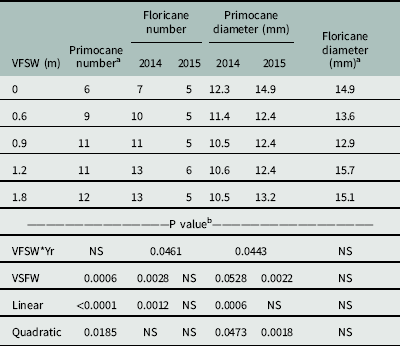
Primocane number increased linearly with increasing VFSW (Table 1). Primocane number per plant averaged 6 primocanes per plant at VFSW 0 m and increased to 12 primocanes per plant at VFSW 1.8 m. Floricane number per plant increased linearly with increasing VFSW and averaged 7 floricanes at VFSW 0 m, increasing to 13 per plant for VFSW 1.8 m in 2014. Floricane number was unaffected in 2015 by VFSW with 5 floricanes per plant in VFSW 0 m and 6 floricanes per plant for VFSW 1.8 m. The effect of VFSW on primocane length (data not shown) and diameter varied by year. Primocane length increased with increasing VFSW in 2014, but was not affected by VFSW in 2015. Primocane diameter decreased with increased VFSW and exhibited a linear response in 2014 with a 12.3 mm primocane diameter in VFSW 0 m and an average of 10.5 mm in VFSW ≥0.9 m (P=0.0528). In 2015, primocane diameter exhibited a quadratic response to VFSW (Table 1). Increased primocane diameter in VFSW 0 m may be due to decreased primocane number, which has been observed by others (Oliveira et al. Reference Oliveira, Oliveira and Monteiro2004). Increased primocane diameter in VFSW 1.8 m may be due to lower interference from ground vegetation that helps to increase the availability of water and nutrients to blackberry plants. Tan and Crabtree (Reference Tan and Crabtree1990) demonstrated increased availability of macro- and micronutrients in vineyards with VFSW 1.0 m when compared to vineyards with VFSW 0 m. In another vineyard study, soil volumetric water content was higher for VFSW of 2.4 when compared with plots with VFSW of 0 or 0.6 (NT Basinger, unpublished data). Increases in water and nutrient availability could allow for increased cane diameter due to tipping, to support the production of lateral shoots after the tipping event. Floricane length (data not shown) and diameter did not have a year by treatment interaction, thus were combined across years. These parameters were unaffected by VFSW treatments. Floricane number increased with increasing VFSW in 2014. However, the authors believe that lack of a treatment effect in 2015 was due to a floricane thinning event by the grower.
Combined or yearly means and P values of main effects for the effect of vegetation-free strip width (VFSW) on ‘Navaho’ blackberry vegetative growth, Kings Mountain, NC, in 2014 and 2015.

a Means reported are averaged over years.
b P values are significant if ≤0.05.
Cumulative Yield and Yield Components
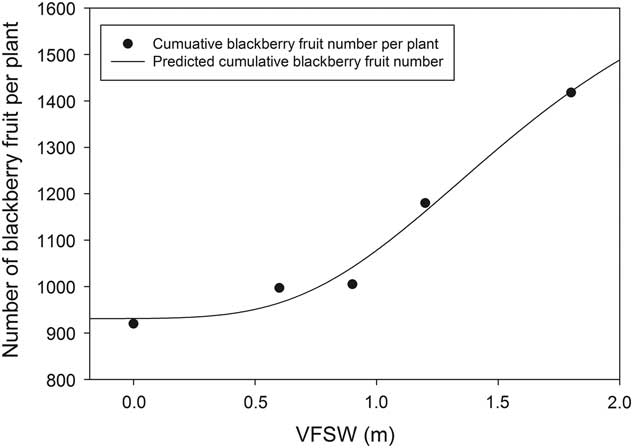
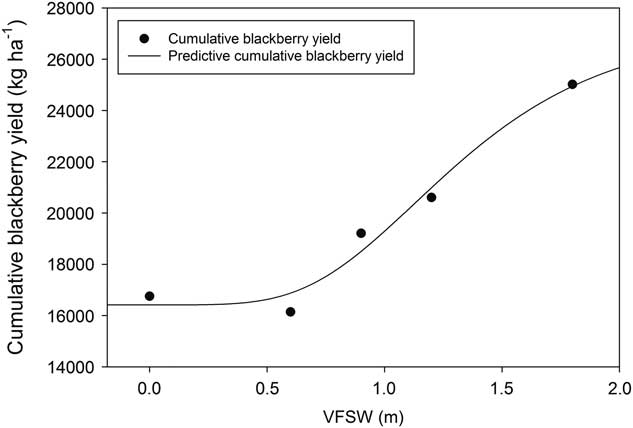
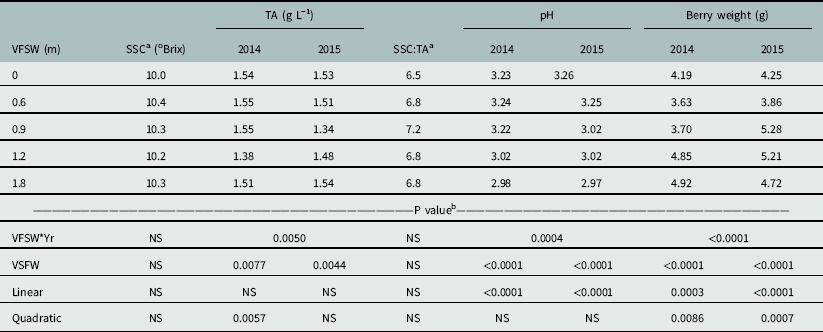
Treatment effect on berry weight varied by year. Berry weight was greatest in VFSW 1.2 and 1.8 m in 2014 and 0.9 and VFSW 1.2 m in 2015 and exhibited a linear response with increasing VFSW (Table 2). Increased berry weight was slightly greater in VFSW 0 m than in VFSW 0.6 and 0.9 m both years, likely due to decreased berry number (Figure 1), which has been observed in other perennial fruit crops (Link Reference Link2000). Year by treatment interaction for number of berries per plant was not significant, and years were combined. Average number of berries per plant across years was not affected by VFSW (data not shown). However, because of the biennial fruiting nature of blackberry, cumulative yield combined over the 2014 and 2015 seasons was used to quantify blackberry productivity. Cumulative yield for 2014 and 2015 showed yield reductions with decreasing VFSW (Figure 2). Yields were also reduced in established blackberry when weeds could establish season-long when compared to a weed-free treatment (Dixon et al. Reference Dixon, Strik, Valenzuela-Estrada and Bryla2015). Cumulative yield reductions in narrow VFSW may indicate that long-term maintenance of wide VFSW of 1.8 m could improve yield over the life of the planting.
Relative cumulative fruit number per plant increase as a function of increasing vegetation-free strip width (VFSW) in ‘Navaho’ blackberries grown in a commercial blackberry planting located in Kings Mountain, NC, in 2014 and 2015. Cumulative fruit number per plant was calculated by adding berry counts per plant of 2014 and 2015 and was fitted to a four-parameter Gompertz curve equation: y=y 0 + a/{1 + exp[−(x−x 0 )/b]}. Equation parameters for the given data are as follows, with standard errors in parentheses after each value: y 0 =930.82 (53.82); x 0=1.34 (0.67); a=794.03 (749.66); b=0.64(0.68), R 2 adj=0.93.

Relative cumulative yield increase as a function of increasing vegetation-free strip width (VFSW) in ‘Navaho’ blackberries grown in a commercial blackberry planting located in Kings Mountain, NC, in 2014 and 2015. Cumulative yield was calculated by adding berry yield of 2014 and 2015 and was fitted to a four-parameter Gompertz curve equation: y=y 0 + a/{1 + exp[−(x−x 0 )/b]}. Equation parameters for the given data are as follows, with standard errors in parentheses after each value: y 0 =16,413.16 (1,096.24); x 0 =1.13 (0.30); a=10,767.86 (6,075.76); b=0.46 (0.43), R 2 adj=0.90.

Combined or yearly means and P values of main effects for the effect of vegetation-free strip width (VFSW) on ‘Navaho’ blackberry fruit components, soluble solids concentration (SSC), titratable acidity (TA), SSC:TA ratio, pH, and individual berry weight, Kings Mountain, NC, in 2014 and 2015.

a Means reported are averaged over years.
b P values are significant if ≤0.05.
Fruit Composition
Berry SSC, TA and SSC:TA ratio were unaffected by VFSW in both years (Table 2). A year by treatment interaction for pH occurred, thus data were analyzed by year. In both 2014 and 2015, a strong linear effect of VFSW on pH was observed, in which pH decreased with increasing VFSW (Table 2).
Overall, blackberry vegetative growth was primarily impacted by VFSW effect on primocane number (R2=0.59). This finding is similar to previous research in established blackberry, where primocane numbers were reduced when weed densities were high as compared to blackberry managed weed-free (Dixon et al. Reference Dixon, Strik, Valenzuela-Estrada and Bryla2015). Increased water availability and nitrogen uptake could have contributed to increased vegetative growth. In a previous study, leaves of both blackberry primocanes and floricanes had reduced nitrogen levels in weedy plots, when compared to plots that were maintained weed-free using hand weeding or landscape fabric (Harkins et al. Reference Harkins and Strik2014).
The increases in primocane and floricane number have shown positive influences on yield in Rubus species, including blackberry, due to increases in fruit number and size (Cortell and Strik Reference Cortell and Strik1997; Gundersheim and Pitts Reference Gundersheim and Pritts1991). However, if primocane or floricane numbers are too high, cane thinning may be necessary to increase airflow within the canopy for insecticide and fungicide spray penetration and adequate airflow. Blackberry yield reduction from weed competition has been reported by others (Dixon and Strik Reference Dixon and Strik2016; Heiberg Reference Heiberg2002; Meyers et al. Reference Meyers, Jennings, Monks and Mitchem2014). Individual berry weight and yields were reduced in weedy plots when compared to plots with weed control using hand-weeding or landscape fabric (Dixon and Strik Reference Dixon and Strik2016). Individual berry weights are an important contributor to overall yield. Increased berry weight in 1.8 m VFSW would contribute to increased yields. A permanent groundcover (0 cm VFSW) in a raspberry planting resulted in lower yields and lower nitrogen concentration when compared to fields that were maintained weed-free through cultivation (Heiberg Reference Heiberg2002).
Blackberry fruit composition was only moderately affected by VFSW treatment in our study. Minimal effect of VFSW on fruit composition was also reported in newly established blackberry plantings (Meyers et al. Reference Meyers, Jennings, Monks and Mitchem2014). Previous research in mature blackberries and Vitis vinifera demonstrated that increased vegetative groundcover increased fruit SSC (Basinger Reference Basinger2015; Dixon et al. Reference Dixon, Strik, Valenzuela-Estrada and Bryla2015). In the present study, the only berry quality factor affected by VFSW was pH, which was consistent with ripe fruit pH values reported by others (Perkins-Veazie et al. Reference Perkins-Veazie, Clark, Huber and Baldwin2000). The authors believe that the increase in primocane number with increasing VFSW increases shading of fruit. Shading of fruit has been shown to affect fruit pH in other perennial fruit crops (Basile et al. Reference Basile, Caccavello, Giaccone and Forlani2015; Caravia et al. Reference Caravia, Collins, Petrie and Tyerman2016) and may explain the lower fruit pH with increasing VFSW and primocane number.
The current cost for weed control for North Carolina is estimated at $249 ha−1 for maintenance of a VFSW of 1.2 m (Safley et al. Reference Safley, Baros, Fernandez and Ihnen2011). Although not measured in this study, increasing VFSW would marginally increase weed management costs in a blackberry planting. However, the relatively modest increase in weed maintenance cost is justifiable due to the increase in productivity of plants within the 1.8 m VFSW, which has a cumulative yield 21% higher during the two-year study than that of plants grown with a VFSW of 1.2 m. The results from the present study suggest that increasing the VFSW from the current recommendation of 1.2 to 1.8 m can improve plant growth, maximize fruit size, and increase cumulative yield. The authors believe that, despite only having a single variety in this study, other erect thornless varieties utilizing the V-trellis system may also benefit from a VFSW of 1.8 m. Future research on the effect of VFSW should evaluate yield effects over the life of a planting under a wide range of growing regions, as well as include different varieties, groundcovers, row spacing, and production systems.
Acknowledgments
The authors would like to thank Ervin Lineberger at Lineberger’s Killdeer Farm for his collaboration and efforts to support this project. Thanks to Sam McGowen, Shawn Beam, Matt Bertucci, Grace Tuschak, and Matthew Waldschmidt for assistance with data collection and laboratory work. Special thanks to Dr. Penelope Perkins-Veazie and her laboratory staff for assistance in fruit analysis. The authors would also like to thank Dr. Cavell Brownie for her statistical expertise and assistance in data analysis.