


Introduction
Organic agriculture is regarded as one important approach to sustainable agriculture and has several positive impacts to rural environment in comparison with conventional farming. However, organic agriculture development is still limited in Taiwan and the major reason is lack of economic incentives to farmers. Hence, linkages between organic agriculture and other activities in rural areas should be investigated to increase the additional benefits of organic agriculture other than organic products themselves. Agritourism, an important element of the diverse activities in rural areas of Taiwan, may be a suitable activity to be connected with organic agriculture because, if the relationship between tourism and food production is symbiotic, both sectors can mutually benefit from each otherReference Telfer and Wall1. Socher and TschurtschenthalerReference Socher and Tschurtschenthaler2 categorize agriculture as having two separate but linked supply values for the tourism industry. The first is direct supply, which involves the sale of agricultural products to the industry. The second is indirect supply, which involves preservation and cultivation of the landscape which acts as a backdrop or tourism resource. In addition, AdamReference Adam3 has concluded that agritourism and entertainment farming, highly consumer-focused types of agriculture, may offer additional options for diversifications, adding stability to farm incomes.
However, which kind of agritourism activity is optimal to be linked with organic agriculture? Four types of relationships between organic agriculture and agritourism will be discussed first in this study. Eco-organic tourism, an agro-ecotourism activity advocated by the Food and Agriculture Organization (FAO) of the United NationsReference Scialabba and Williamson4, may be the first candidate because it is planned and managed according to the principles of ecotourism and may result in a relatively low impact compared to others. However, is such a linkage between organic agriculture and agro-ecotourism feasible in Taiwan? Can eco-organic tourism based on organic agriculture attract tourists and then generate economic benefits? Does it have other additional benefits for different sectors?
Chrshang Township in Taiwan is selected as an example to study the feasibility of various innovation activities based on organic agriculture and eco-organic tourism because its proportion of organically managed areas exceeds that in the rest of Taiwan. In addition, about 514,000 tourists visit Chrshang Township for rural recreation annually. First, the maximum willingness to pay (WTP), one approach of the contingent valuation method, will be employed to estimate potential revenues from eco-organic tourism in Chrshang Township and then the results can be compared with other economic activities. Furthermore, except for direct economic revenues from eco-organic tourism, the additional benefits to each of both sectors will also be investigated in this study when the relationship between food production (organic agriculture) and tourism (eco-organic tourism) is symbiotic.
Organic agriculture and agritourism in Taiwan
Organic agriculture is one of the most prominent forms of sustainable production. The literature states that organic agriculture has several positive impacts and organic agriculture is regarded to play an important role in sustainable development in rural areasReference Scialabba and Williamson4–Reference Schifferstein and Oude Ophuis10. In Taiwan, farmers started to adopt organic farming practices in the 1970s, but the growth rate is still slow. Up to now, only 0.3% (10.92 km2) of total agricultural area is managed according to organic farming guidelines11. Consequently, organic agriculture development is limited in Taiwan and the major reason is lack of economic incentives to farmersReference Huang-Tzeng12,Reference Chen13.
The symbiotic relationship between agriculture and tourism that can be found in agritourism (agrotourism) is a key element of environmentally and socially responsible tourism in rural areasReference Scialabba and Williamson4. With the decline in agriculture (for example, only 1.9% of GDP in 2001), the Council of Agriculture (COA) in Taiwan has tried to develop recreational activities in rural areas since 1988. All (369) country towns have created recreational activities related with agriculture, and 173 holiday farms have been established for tourism with the increasing demand of agritourism14. For most rural communities in Taiwan, agritourism is one of the important elements in their diversified economy. For some others, such as Ching-Chin, Chi-Chi and Shwei-Li in Nantou County, agritourism has become the primary economic endeavor which dominates community life and upon which the local area is dependent. However, the linkage between tourism and agricultural production is still weak and sometimes the relationship is in a conflict over competition for land, water resources, labor and capital in Taiwan's rural areasReference Kuo15. Moreover, various negative impacts to the rural environment have resulted from agritourism (especially mass agritourism activities)Reference Tou16.
Region of Study
Chrshang Township in Taitung County (located in the east of Taiwan) is selected to develop eco-organic tourism based on organic agriculture in this study, because people in the township are more interested in organic agriculture than others. It covers an area of 82.69 km2 with a population of 10,71517. The agricultural area amounts to 40.12 km2, 11% of which is managed according to organic farming guidelines17. This proportion of organically managed area exceeds that of the rest of Taiwan. Some local farmers have tried to adopt organic farming since 1994, and they have promoted this low-impact agriculture to other farmers with the aid of the active local non-government organization, Wan-An Village Development Association (established in 1993). At present, their organic products are all certified by the MOA (Mokich Okada International Association, established in Japan in 1935), which is the major organic products labeling system in Taiwan.
In addition, about 514,000 tourists visit Chrshang Township annually not only because of the beautiful landscape and wildlife resources, but also because of the attraction of ‘Chrshang Rice’ and ‘Chrshang Boxed Meal’. Due to the clean water, suitable soil and warm climate, rice cultivation in Chrshang is successful and famous among the Taiwanese, and its products (‘Chrshang Rice’ and ‘Chrshang Boxed Meal’) are well known.
Methods
The maximum WTP will be employed in this study in order to estimate potential revenues from eco-organic tourism. Methods available to assess the tourism value may be categorized as market based and non-market techniques. Non-market methods include indirect (travel cost) and direct (contingent valuation) measuresReference Bishop, Heberlein, Johnson and Johnson18. The maximum WTP, one approach of the contingent valuation method (CVM), employs hypothetical questions to elicit respondents' maximum WTP for a specified situationReference Bishop, Heberlein, Johnson and Johnson18,Reference Cummings, Ganderton and McGuckin19. Moreover, ‘the payment card’Reference Cameron and Huppert20,Reference Arin and Karmer21 format, such as the example question in Table 1 is used in this study. The CV question used in this survey provides a detailed description of the five hypothetical scenarios, which are based on the appropriate activities designed for Chrshang Township.
Question eliciting information on tourists' WTP use fee.
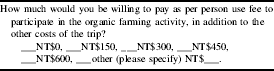
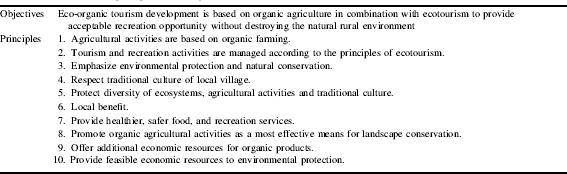
These five appropriate activities were designed according to the fundamental principles of eco-organic tourism, and the opinions of the local community. The fundamental principles for guiding the development of eco-organic tourism based on organic agriculture were established after the ad hoc committee meeting held by the local government of Chrshang Township in November 2003 (Table 2). In addition, three rounds of workshop meetings were held to collect the opinions of local people by the local government of Chrshang Township, with the aid of the Wan-An Village Development Association during January and February 2004. Diverse opinions were collected but some activities (such as horse riding) are unsuitable because their relationship with organic agriculture is weak.
The fundamental principles of eco-organic tourism.
A pilot survey of the maximum WTP was carried out among agritourism tourists at Chrshang Township during July and August 2004. The sampling population for the study was established as ‘tourists who visit Chrshang Township either directly or by the way’. Non-probability, convenience sampling was selected as the most appropriate way to access this population given the limited time and resources available for the survey implementation.
Results
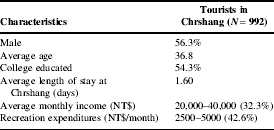
First, 992 effective questionnaires were gathered in the maximum WTP survey, and the main tourist characteristics are listed in Table 3. The survey results indicate that the study destination attracts highly educated tourists (college educated: 54.3%) and their average monthly income is about NT$20,000–40,000 (32.3%). The average length of the tourists' stay at Chrshang is 1.60 days and this may indicate that a demand exists for accommodation; hence, the local people may try to develop bed and breakfast (B&B) or inns. In addition, in this pilot survey 70% of total tourists attended eco-organic tourism activities.
Agritourism tourists sample characteristics.
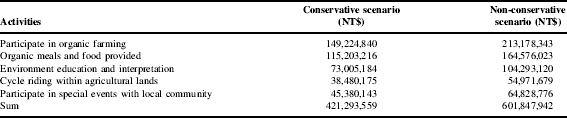
Finally, the maximum WTP of each hypothetical activity can be found in Table 4. The ‘participate in organic farming’ activity received the highest WTP value, while the ‘cycle routes within agricultural lands’ activity had the lowest value. This may because the ‘participate in organic farming’ activity is not easily found around Taiwan but bike riding activities are common and can be experienced in many destinations of Taiwan. The ‘organic meals and food provided’ activity also received higher values and this result may indicate that tourists would be willing to pay a higher price to have more wholesome and healthy food during the trip.
WTP of hypothetical activities.

Discussion
Eco-organic tourism may be the optimal activity to link organic agriculture with tourism
Agriculture and tourism have the potential to work together in a symbiotic relationship or just coexist in the rural areas. Four types of possible relationships between agriculture and tourism are listed in Table 5. In general, type A can be regarded as mass agritourism, and is the most popular type in rural areas around the world. However, because the intrinsic characteristic of type A is tourism, it often ignores the agriculture sector and may generate negative impacts to the rural environment. Several studies, such as Bryden (1973)Reference Bryden22 and Weaver (1988)Reference Weaver23, stress competition for the resources of land and labor between agricultural production and tourism.
Four types of relationships between agriculture and tourism.
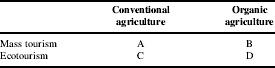
In order to conserve biodiversity, ecotourism is advocated to link with agriculture in rural areas. For example, the Convention on Biological Diversity (CBD) of the United Nations, often emphasized the linkages between ecotourism and agriculture: ‘ecotourism provides full and effective participation and viable income-generating opportunities for indigenous and local communities’ (Decision V/25, 4a). Types C and D are the potential activities based on ecotourism connected with agriculture and they are often named agro-ecotourism. While ecotourism is nature-based and agritourism is farm-based, agro-ecotourism is a combination of both. In general, the rural landscape, usually a combination of wild and agri-ecosystems, is the most important resource for ecotourism development except for national parks and protected areas. There are some successful examples in different countries to explain that agro-ecotourism can provide a strong economic incentive to small farmers to commit to biodiversity friendly agriculture managementReference Scialabba and Williamson4.
Eco-organic tourism (type D), may be the optimal activity to link organic agriculture with tourism because both organic agriculture and ecotourism are aimed at reducing the environmental impacts and contribute to natural conservation. People establish organic agriculture with a strong emotional commitment to nature, the environment, animal welfare and health, and similar land ethics can also be found in ecotourism. Hence, the negative impacts from eco-organic tourism to the rural environment may become relatively lower than other agritourism activities. If organic agriculture is connected with mass tourism (type B), the resource problems may pollute the rural environment and affect organic agriculture production. Furthermore, eco-organic tourism may attract more ecotourists and environmentalists than other agritourism activities because these visitors have a more ecocentric attitude towards nature and prefer businesses that are environmentally friendly. In addition, visitors are increasingly sensitive to quality, both in ecological and gastronomic terms, and this trend can favor organic farmers because they can easily meet these new tourists' demands with the connection between catering service with organic production.
A 1999 survey in Italy reported that eco-organic holiday farms performed the following activities: 35% arrange visits to nearby protected areas; 30% plan naturalistic didactical activities; 24% set up didactical and demonstrative laboratories on organic agriculture and the environment; and 11% offer visitors instruments and equipment for the observation of fauna and flora24. Several studies in the European Union have demonstrated the ability of organic agriculture to create attractive landscapes and activities for tourismReference Scialabba and Williamson4. Eco-organic farm practices and activities which benefit the environment while rewarding farmers include: accommodation in buildings renovated according to ecological architecture, on-farm consumption or selling of organic foods and beverages, educational programmes and training (e.g. organic gardening, compost making, wild herb collection and drying, traditional food and beverage processing), and sensitizing guests on the rational use of natural resources.
The potential revenues from eco-organic tourism in Chrshang Township
According to the findings of this study, tourists prefer to participate in organic farming among the five hypothetical activities when they visit Chrshang Township and are willing to pay NT$415.02. This may be because many tourists who come from urban areas lack the opportunity to participate in organic farming activities; hence, they prefer to attend organic agriculture activities such as insect scratching, undergoing a more rural tourism experience. ‘Organic meals and food provided’ is the second activity that can attract tourists and the average WTP is NT$320.40. It indicates that meals made from local organic products are welcome by tourists although the price of organic meals is higher than that of common meals. The meals that are provided to tourists on their eco-organic trip may be named ‘organic meals’ and ‘green treasures’, emphasizing that all materials are organic products and cultivated by local farmers. In addition, in order to emphasize ‘good for health,’ a dietician can design these organic meals, and the issue about nutrition balance can also be taken into account.
In addition, appreciation of the environment education and interpretation activity by tourists is also high since the content of environmental education and interpretation in eco-organic tourism is abundant and diverse. The content is not restricted to the natural environment, which is often emphasized by ecotourism in the protected areas; community history, traditional lifestyle, traditional events and other cultural materials can also be included. Furthermore, the concepts of sustainable agriculture, and the agricultural procedures of organic farming, may become the main contents of environment education and they can become other interesting issues for interpretation.
Cycle riding within agricultural lands is another innovation activity and seems feasible in Chrshang Township since cycle tourism is a popular activity in Taiwan and farmers in Chrshang Township agree the cycle routes that are established around their private lands. However, the WTP of ‘cycle riding within agricultural lands’ is about NT$107.02 per tourist, the lowest one among the hypothetical activities. This may be because tourists lack expectations about cycle riding since it is a common activity around Taiwan. Regardless, cycle riding may generate additional benefits to the local community because bicycle rent may be another economic income for local people. Hence, the local government has planned to establish some cycle routes within agricultural lands and develop the cycle networks to connect different viewpoints within the rural areas. The WTP of ‘participate in special events with local community’ is about NT$126.21 per tourist, and it also shows a lower value than that expected. In fact, this activity cannot only be assessed in terms of direct economic benefit. The self-confidence of local people, traditional culture preservation, and different cultural experiences shared with tourists can also be contributed to such an activity.
According to the accounted data of the local government17, the annual number of tourists is 513,658. This number of total visitors is used as a non-conservative scenario, while a conservative scenario assumes that 70% of total tourists will attend eco-organic tourism activities, according to the findings of this study. If the average WTP elicited in this survey at Chrshang is instituted as the entrance fee or activity charge (assuming that the WTP distribution of our sample represents the WTP distribution of the agritourism population visiting Chrshang), the potential annual revenues can be estimated (Table 6). The total annual revenue under a conservative scenario is about NT$421,293,559, which assumes each activity receives 70% of total tourists.
Estimates of total potential annual revenues from various activities.
Although agritourism has been developed in Chrshang, the economic benefit cannot be calculated because the essential data are not available. In addition, the current agritourism activities are mass tourism type and external tour operators often organize them as package products. Most of the economic benefit is directly to the tour company, and the rest of the revenues cannot contribute significantly to local economy. In contrast, rice production is the major contributor to the local economy of Chrshang now and it is clear that the revenue of rice production affects the income levels of farmers and local people. Hence, the economic benefit of rice production is calculated as a control for comparison in this study.
The annual revenue of rice production is calculated under three different situations: (1) assuming rice production in Chrshang is all from conventional farming; (2) assuming rice production in Chrshang is all from organic farming; and (3) real rice production in Chrshang. The annual revenues of rice production would be NT$19,077,000–28,615,500 (Table 7).
Comparison of annual revenues from eco-organic tourism with other activities.
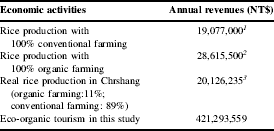
1 12,718 (tons yr−1)×1500 (NT$ ton−1)=19,077,000 (NT$).
2 12,718 (tons yr−1)×75%×3000 (NT$ ton−1)=28,615,500 (NT$).
3 19,077,000×89%+28,615,500×11%=20,126,235 (NT$).
In comparison, the annual revenue from eco-organic tourism is the most potential economic activity to the local community and will be 20 times that of the rice production. Moreover, if organic agriculture is connected ideally with eco-organic tourism in Chrshang; i.e. rice production in Chrshang is all from organic farming, together with the eco-organic tourism activities proposed here, the sum of annual revenue could reach NT$449,909,059.
Additional benefits from eco-organic tourism
In addition to the potential revenue from eco-organic tourism mentioned above, such linkages between organic agriculture and agro-ecotourism may form a symbiotic relationship and both sectors can mutually benefit from each other. Under linkages between organic agriculture and agro-ecotourism, various benefits may be generated to several sectors such as agriculture, food, tourism and local community. According to the experts' opinions in this study, the direct and indirect benefits to organic agriculture from such linkages are summarized in Table 8.
Additional benefits from eco-organic tourism.

In general, doubt about organic products reduces the willingness of consumers to buy organic products from supermarketsReference Bellegem and Eijis25,Reference Nilsson, Tuncer and Thidell26. Such linkages can provide consumers the opportunity to understand the specific organic method of production, and then customers may increase their confidence in organic products. In addition, the relationship between producer and consumer can become a one-step relationship instead of the complex network relationship and reduce the difficulties among various sectors in a network relationship under such linkages. First, tourists can buy organic products directly from farmers during their trip, generating additional income to organic farmers. According to the findings of this study, 90% of tourists want to buy organic products directly during their trip. Secondly, tourists who have experienced eco-organic tourism may start to buy organic products in their daily life. For example, in this study 78% of tourists after their trip continue to buy organic products from Chrshang by telephone order.
Moreover, organic agriculture, together with eco-organic tourism may also contribute several positive efforts to agritourism or rural tourism development, listed in Table 8. For example, expanding the backward economic linkages by increasing the amount of local food used in the tourism industry since food represents approximately one-third of all tourists' expendituresReference Belisle27.
Conclusions
In general, organic agriculture can generate several positive impacts to the ecological, social and economic environment and is regarded as having a dominant influence in the rural environment. However, organic agriculture development is limited in Taiwan and the major reason is that the relationship between the organic producer and the consumer is a complex network and many difficulties decrease the willingness of the producer to farm organically. Hence, one approach to link organic agriculture with agro-ecotourism is proposed in this study, in order to increase the additional benefits of organic agriculture except for organic products themselves.
Eco-organic tourism, one type of agro-ecotourism, may be the optimal choice to be connected with organic agriculture because both of them are concerned about nature conservation, environmental protection and sustainable development. Other agritourism activities will act like mass tourism and may result in negative impacts to the rural environment and even affect the organic production. In comparison, eco-organic tourism based on the principles of ecotourism will limit the development scale of tourism and the number of tourists would be more environmentally friendly.
According to the findings of this study, the linkage between organic agriculture and agro-ecotourism is feasible and eco-organic tourism activities based on organic agriculture can attract tourists. Under a conservative scenario, the total annual revenue from eco-organic tourism is about NT$421,293,559, which is about 20 times that of the rice production in the study area. Moreover, the sum of the annual revenue will reach NT$449,909,059, which is the economic value of organic rice production added to the economic value of tourism.
In addition to the direct economic value of eco-organic tourism, there are other additional benefits by which both sectors can mutually benefit from each other. In brief, the following main additional benefits could be found under the linkage between organic agriculture and agro-ecotourism: (1) it can create an additional value of organic agriculture (in particular, the recreational value); (2) organic agriculture is not only commodities and goods production, it can become one important service economy and even create experience economyReference Pine and Gilmore28 within the tourism industry; (3) people can understand what organic agriculture is and increase their confidence and reliability in organic products; (4) it can establish a one-step relationship between the organic producer and consumer and reduce the difficulties among various sectors in the network relationship; and (5) local food supply can be connected with demands in the tourism industry (in particular, organic products).
In summary, organic agriculture can become an attractive tourism resource and attract tourists to visit rural areas, and eco-organic tourism can generate more economic benefits than organic production itself. Consequently, the value of organic agriculture is not only within the commodities and goods economy. Organic agriculture has potential to become an important sector in service economy and experience economy when it is connected with the tourism industry.
Acknowledgements
The authors would like to thank the support of Wan-An Village Development Association, Chrshang Township Government, and organic farmers in Chrshang.


