





1. Introduction
The language of men and women has been an extensively discussed subject for centuries, the latter being given mainly prescriptive attention in the English-speaking world since as early as the seventeenth century and stretching well into the mid 1800s. In Richard Brathwaite’s The English Gentlewoman (1631), a manual of conduct for young aristocratic women, respectable ladies were supposed to practise modesty not only in their appearance and recreations, but also in their speech, which was best when scarce or non-existent: ‘especially, when either men are in presence, or ancient Matrons, to whom she owes a ciuill reuerence, it will become her to tip her tongue with silence’ (BraithwaiteReference Brathwaite1631: 89). On the other hand, certain topics were considered appropriate only for male debate: ‘To discourse of State-matters, will not become your auditory: nor to dispute of high poynts of Diuinity, will it sort well with women of your quality’ (Braithwaite Reference Brathwaite1631: 89–90). A century later, in his Émile, Rousseau (1762) expressed his sincere doubts as to whether women were capable of abstract reasoning. The idea of silence being the best adornment of a lady persisted in the eighteenth century and gained strength in the nineteenth (Morgan Reference Morgan1994; Todd Reference Todd and Todd1996; Bérenguier Reference Bérenguier2011; Dahmer Reference Dahmer2016), whereas certain restrictions applied in female conversation – such as to women gossiping, being opinionated and imposing, or discussing politics and other subjects considered ‘male’, as well as on using slang, swearing or profanity (Lakoff Reference Lakoff1973; Kramer Reference Kramer1975; Hoff Reference Hoff1996) – managed to survive until the early to mid twentieth century.
Based largely on the social norms of the time, Lakoff’s (Reference Lakoff1973) pioneering article, entitled ‘Language and women’s place’, attempted to offer a description of women’s speech through a glance at language as a historical tool of women’s oppression (Eckert & McConnell-Ginet Reference Eckert and McConnell-Ginet2003: 38), leading the way to a number of sociolinguistic studies comparing the speech of men and women (Dubois & Crouch Reference Dubois and Crouch1975; Tannen Reference Tannen1990; Mills Reference Mills1992; Gordon Reference Gordon1997, and many more). Romaine (Reference Romaine1996: 117) mentions certain generalisations that may be drawn from research on this subject, such as women’s apparent tendency to use language to prioritise cooperation and community relationships, in contrast to men, who use it to assert dominance and control. Likewise, it has also been affirmed that women’s language is less detached and more personal, tentative and narrative than men’s, while men are more informational, abstract and direct, and use more persuasive strategies in their speech (Lakoff Reference Lakoff1990; Biber & Burges Reference Biber and Burges2000; Argamon et al. Reference Argamon, Koppel, Fine and Shimoni2003). The tendency towards abstractness and elaboration in male discourse is also confirmed from a diachronic perspective in Geisler’s (Reference Geisler2003) multidimensional study of nineteenth-century letters, which also reveals that letters written by female authors show more involvement (but also a certain degree of persuasiveness) than those written by men. And yet, in a further comparative study of scientific and non-scientific women’s nineteenth-century prose (Crespo Reference Crespo, Moskowich, Crespo, Puente-Castelo and Monaco2019), texts written by female historians came out as more impersonal and objective than those written by non-scientist women, thus apparently following the general trend of the (evolving) scientific writing of the late modern period (Halliday Reference Halliday and Ghadessy1988; Taavitsainen Reference Taavitsainen and Fernández1994; Atkinson Reference Atkinson1999), which at that time was still predominantly male.
The present study intends to compare the language of male and female nineteenth-century historians and life scientists in order to, firstly, detect and measure the levels of abstract reasoning and elaboration in their writings, and, secondly, to see to what extent their speech reflects the metalinguistic comments of their time, mentioned above (Morgan Reference Morgan1994; Todd Reference Todd and Todd1996; Bérenguier Reference Bérenguier2011; Dahmer Reference Dahmer2016). If the scientific register has often been described as rather abstract and impersonal (Bazerman Reference Bazerman1988; Hyland Reference Hyland1998; Gotti Reference Gotti2003), large-scale multidimensional studies (Biber Reference Biber1988; Conrad Reference Conrad1996; Gray Reference Gray2011; Monaco Reference Monaco2017) have demonstrated that certain linguistic features, such as passive constructions, conjuncts and certain adverbial subordinators, as well as nominalisations and attributive adjectives, are typically found in academic prose, thus making it more abstract. Considering the institutionalised prejudice against women scientists (or against women in general) that characterised the whole modern period (see Schiebinger Reference Schiebinger1987; Trouille Reference Trouille1997; Herrero Reference Herrero2007), our aim is to analyse texts written by female scientists in order to find out whether they reach the same level of abstraction in their writings as their male colleagues, and whether their writings adjust to the rather strict metalinguistic frame where women’s speech was supposed to fit during that period. To this end, we are using data from the Coruña Corpus of English Scientific Writing (Moskowich & Crespo Reference Moskowich, Crespo and Guerra2007; Crespo & Moskowich Reference Crespo and Moskowich2020), a diachronic corpus of scientific texts published between 1700 and 1900, arranged in different subcorpora, each subcorpus corresponding to a specific scientific discipline. On this occasion, we will be looking at texts from nineteenth-century history and life sciences, using Monaco’s (Reference Monaco2017) multidimensional analysis as a methodological basis and a reference – specifically, its Dimension 3, characterised by the presence of passive constructions and nominalisations, as well as other elements that contribute to discourse elaboration and abstract reasoning. The ultimate goal of this article is to spot subregister variation, by applying variables such as scientific discipline, sex of the author and genre, in an attempt both to unveil differences between male and female scientific discourse, and to determine how nineteenth-century historians and life scientists conceived certain genres that were used for the transmission of science, and how their choices reflected specifically men’s and women’s metalinguistic strategies in addressing different types of audience – that is, those faced by male and female scientists, respectively.
Section 2 offers a glimpse of the situation of women who tried to devote their lives to science over the course of the late modern period, reflecting on how it shaped their discourse specifically within nineteenth-century scientific prose. The corpus and the methodological steps used in this study are also described in section 3, while results are discussed in section 4, offering also an overview of the situation of women who tried to devote their lives to science over the course of the late modern period, reflecting on how it shaped their discourse specifically within nineteenth-century scientific prose. This is followed by some preliminary conclusions in section 5.
2. The situation of women scientists in the late modern period
The attitude towards women in the eighteenth and nineteenth centuries described in the Introduction was inherited from medieval times, based on a presumed superiority of men over women (Torralbo Caballero Reference Caballero and de Dios2010; Moskowich Reference Moskowich2013), and combined with a firmly established belief that women belonged in the household and were thus mentally and physically incompatible with performing intellectual activities or assuming leading roles in the public sphere (Trouille Reference Trouille1997; Moskowich & Monaco Reference Moskowich, Monaco, Gotti and Giannoni2014). Science was, therefore, conceived as a purely male activity, and, even though it had been partially accessible to women through convents and guilds in the Middle Ages (Schiebinger Reference Schiebinger1987), the growing concentration of science in universities and academies from the late seventeenth century onwards did not contribute to women being welcome in the scientific communities. In the 1700s, only a few women with access to education and fearless enough to defy the patriarchal prejudice against their intellectual qualities – such as Margaret Cavendish, or Mary Wollstonecraft, along with a few others – raised their voices to claim their rights as human beings and firmly condemn their unfair treatment (Barker-Benfield Reference Barker-Benfield1992; Moskowich Reference Moskowich2013).
The professionalisation of scientific practice in the nineteenth century made it even harder for women to play an active role in science, especially under the Victorian moral code, which entailed their almost exclusive dedication to their spouses and children. All in all, certain roles such as that of governess were, nevertheless, encouraged, and served as an excuse for many learned women to dedicate their lives to research, especially botany, which was approved as suitable entertainment for a lady (Shteir Reference Shteir1990). This was not the case with astronomy, where women would have to engage in hardly respectable activities, such as watching the stars on their own in the middle of the night (Herrero Reference Herrero2007), nor with philosophy, which encouraged women to delve into matters that, according to the gender ideologies of the time, lay beyond their understanding. It may, therefore, not be surprising that the scientific discipline where we can find most female authors in the late modern period is that of life sciences, with well-known botanists and zoologists such as Mary Jacson, Almira Lincoln, Anne Pratt, Elizabeth Agassiz, or Phebe Lankester. Conversely, Margaret Bryan and Agnes Mary Clerke remain the only female stars within a vibrant constellation of male astronomers between 1700 and 1800.
In this study we will be looking at texts written by male and female life scientists and historians from the nineteenth century. In the Coruña Corpus of English Scientific Writing (see section 3), history has revealed itself as another scientific discipline where women are comparatively more frequent, precisely in the 1800s. Our aim is to measure to what extent women use abstract reasoning in their writings, compared to their male colleagues, by also looking at variation through the lens of scientific discipline and genre, and to find out how they conceive the genres through which they chose to transmit their knowledge and whether they challenge the metalinguistic restrictions of their time through their choice of genre (and levels of abstraction). The corpus and methodology are described in the following section.
3. Corpus and methodology
The material used in this study is extracted from the Coruña Corpus of English Scientific Writing (hereafter CC), corresponding to the nineteenth-century parts of two of its subcorpora: the Corpus of History English Texts (CHET; see Moskowich et al. Reference Moskowich, Crespo, Puente-Castelo and Monaco2019a, Reference Moskowich, Lareo, Sandino and Barreiro2019b) and the Corpus of English Life Sciences Texts (CELiST; see Lareo et al. Reference Lareo, Monaco, Esteve-Ramos and Moskowich2020, Moskowich et al. Reference Moskowich, Lareo and Rioboó2021). Each nineteenth-century subcorpus contains twenty texts, which makes it forty in total.
The CC allows the study of variation and change in Late Modern English scientific register, that is, between 1700 and 1900, a period when scientific English was constantly evolving (Moskowich & Crespo Reference Moskowich, Crespo and Guerra2007; Crespo & Moskowich Reference Crespo and Moskowich2020). Each subcorpus in the CC contains text samples of c. 10,000 words, belonging to a particular scientific discipline, with two samples (or c. 20,000 words) per decade, and, accordingly, twenty samples (or c. 200,000 words) per century. All the authors included in the CC were native speakers of English, educated in different English-speaking places (such as England, Scotland, Ireland, or the USA). Texts are thus labelled in the metadata according to the authors’ respective place of education and biological sex, and also to their genre (i.e. treatise, essay, article, lecture, etc.), which is usually stated by the authors themselves either in the title or in the preface to a work.
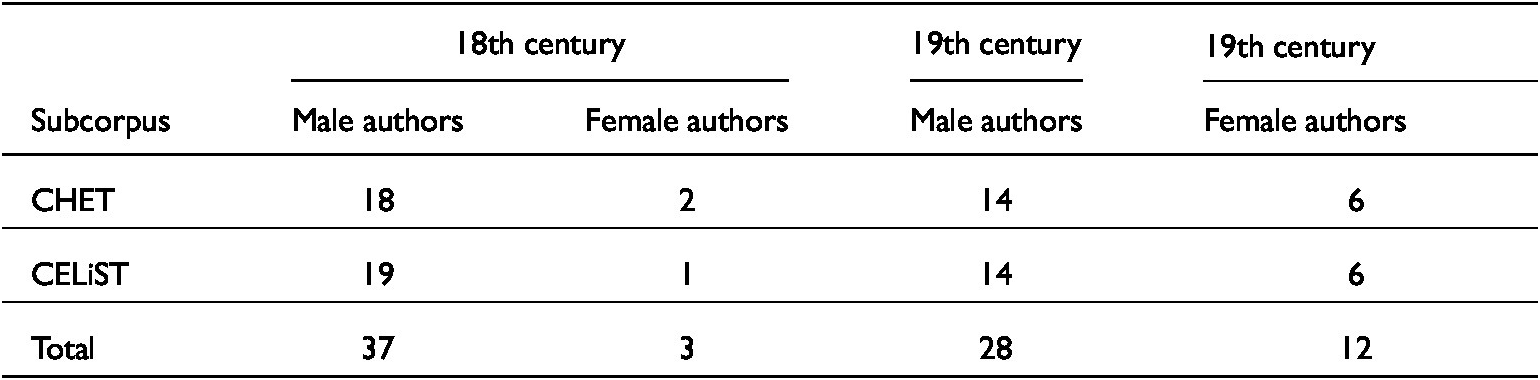
The distribution of texts per sex of the author and per century in CHET (history) and CELiST (life sciences) is shown in table 1, whereas the distribution of words per genre in each of the abovementioned corpora is detailed in figures 1 and 2, respectively:
Distribution of texts per sex of the author and per century in CHET and CELiST (total N texts per subcorpus: 40; total N texts per century: 20)

Table 1. Long description
The table is organized into six columns. The first column lists the subcorpus, followed by two columns for the 18th century (Male and Female authors) and two columns for the 19th century (Male and Female authors).
* Row 1, C H E T: 18 male and 2 female authors in the 18th century; 14 male and 6 female authors in the 19th century.
* Row 2, C E L i S T: 19 male and 1 female author in the 18th century; 14 male and 6 female authors in the 19th century.
* Row 3, Total: 37 male and 3 female authors in the 18th century; 28 male and 12 female authors in the 19th century.
The total number of texts per subcorpus is 40, and the total number of texts per century is 20.
Number of words per genre in nineteenth-century CHET

Number of words per genre in nineteenth-century CELiST

As can be seen in table 1, the CC does not contain many female historians and life scientists in its eighteenth-century part, which potentially makes a comparative analysis of their texts and those of their male colleagues rather tricky: hence our decision to exclude the eighteenth-century part of CHET and CELiST from this study. In relation to the distribution of genres in the nineteenth-century parts of each subcorpus (figures 1 and 2), it appears that treatises are the most frequent genre both in CHET and CELiST, comprising around two-thirds of the former and more than half of the latter. Other genres, by contrast, are more evenly distributed among the rest of the texts in each case, articles corresponding to only one sample in both scientific disciplines, and the same happens with the only dictionary in CHET. In this study we will be looking at both the sex of the author and the genre variables in order to spot differences between men’s and women’s discourse in the two aforementioned subcorpora of the CC. Likewise, we aim to detect to what extent the genre of a text may be playing a role in those differences, in the light of the linguistic characteristics of the texts that represent that genre.
As for the methodology, in this study we are using Biber’s (Reference Biber1988) Multidimensional Analysis, a technique initially designed to explain the fundamental differences between English speech and writing through an analysis of a large number of spoken and written texts, and which has been replicated and celebrated among variationists ever since. The method is essentially based on the use of factor analysis, a multivariate statistical technique that transforms a large number of variables (in this case, lexical and grammatical features) into a much smaller set of variables, or factors. In studies following Biber’s (Reference Biber1988) methodology, each factor results from the frequent co-occurrence of some linguistic features in the different texts of the corpus analysed, due to the fact that co-occurring linguistic features share an underlying communicative function. Additionally, each of the factors usually returns two complementary sets of features, called ‘positive’ and ‘negative’ (in that they present positive and negative loadings on the factor), and having communicative functions that are in binary opposition (e.g. involved vs informational; narrative vs non-narrative; elaborate vs spontaneous, etc.). Each factor is thus considered a ‘dimension’ of variation, named according to the communicative function conveyed by its features, and each text, in turn, takes a position on the factor and has its own factor score which reflects its unique co-occurrence patterns, and this is how a text can be labelled as more (or less) informational, elaborate, narrative and so on, depending on its score for each dimension. As texts belong to different registers and subregisters, individual registers and subregisters can also be characterised with regard to each factor, or dimension of variation.
The five dimensions of variation that resulted from Biber’s (Reference Biber1988) initial multidimensional analysis were the following: (i) informational vs involved production; (ii) narrative vs non-narrative concerns; (iii) explicit vs situation-dependent reference; (iv) overt expression of persuasion; and (v) abstract vs non-abstract style. These dimensions have served as a reference for many variation studies which replicated this five-dimensional model on different, specialised corpora (e.g. Atkinson Reference Atkinson1999; Biber & Finegan Reference Biber and Finegan1989, Reference Biber, Finegan, Conrad and Biber2001), but they have also inspired other multidimensional analyses that yielded their own, different dimensions of variation (e.g. Lee Reference Lee1999; Conrad Reference Conrad, Conrad and Biber2001; Gray Reference Gray2011; Grieve Reference Grieve2016, or Monaco Reference Monaco2017, among others). Monaco (Reference Monaco2017) analysed three subcorpora of the CC: CETA (the Corpus of English Texts on Astronomy; see Moskowich & Crespo Reference Moskowich, Lareo, Rioboó and Crespo2012), CEPhiT (the Corpus of English Philosophy Texts; see Moskowich et al. Reference Moskowich, Rioboó, Lareo and Crespo2016a, Reference Moskowich, Rioboó, Lareo and Crespo2016b), and CELiST (see above), and the analysis yielded four dimensions of variation in this subset of Late Modern scientific English: (i) involved/persuasive vs impersonal style; (ii) argumentative vs descriptive focus; (iii) elaborate vs non-elaborate discourse; and (iv) narrative vs non-narrative discourse.
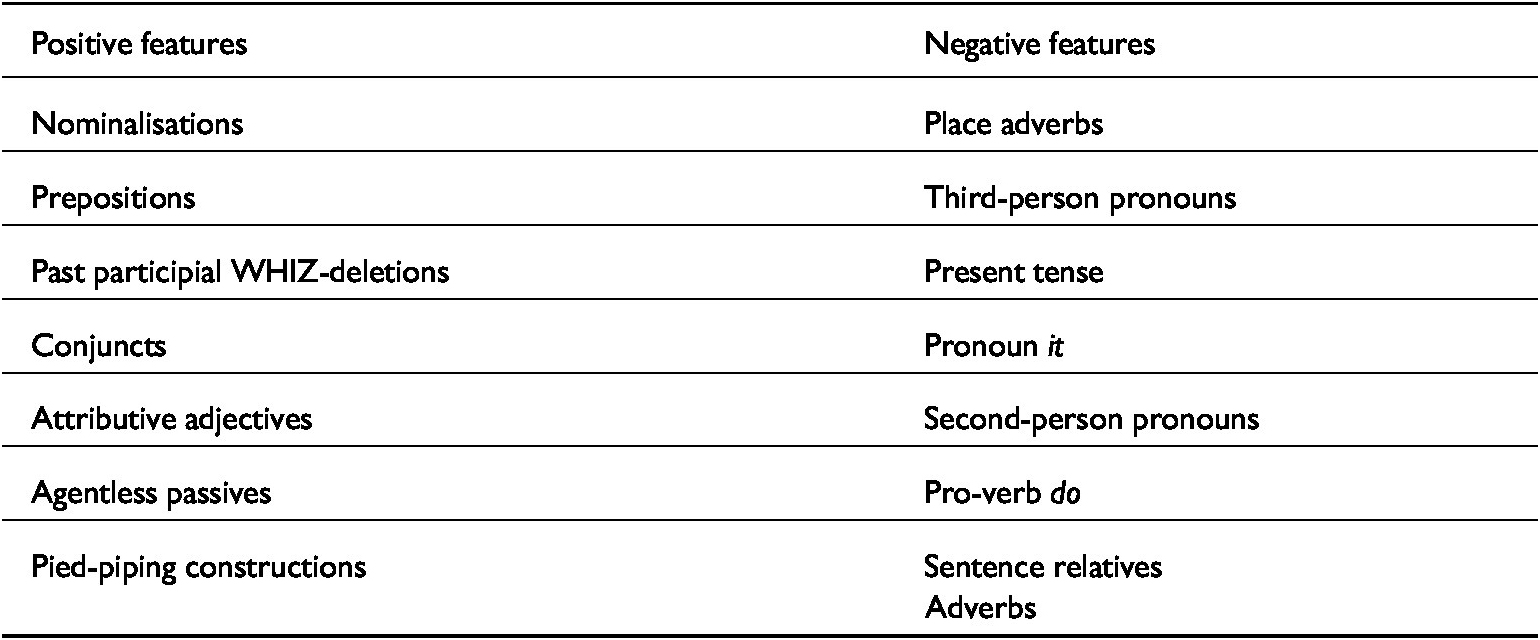
The present study is partially based on Monaco (Reference Monaco2017), focusing on Dimension 3: elaborate/abstract reasoning vs spontaneous production (hereafter D3). This dimension has two subsets of linguistic features with opposing communicative functions, listed in table 2. Positive features (i.e. those with positive loadings on the factor that originated this dimension) include nominalisations, prepositions, past participial WHIZ-deletions (or past participle clauses), conjuncts, attributive adjectives, agentless passives and so-called pied-piping constructions, all of which terms – as well as those in the negative subset – were borrowed from Biber (Reference Biber1988), who, in turn, borrowed them from Quirk et al. (Reference Quirk, Greenbaum, Leech and Svartvik1985). All these linguistic features tend to present strong co-occurrence patterns in some of the texts of the corpus and contribute to conveying a more abstract and elaborate discourse. In contrast, negative features (i.e. those with negative loadings on that factor) include place adverbs, general adverbs, second- and third-person pronouns, present tense, pronoun it, pro-verb do and sentence relatives, all, or most, of which tend to appear together in other texts from the corpus and contribute to a much more spontaneous and tangible type of discourse.
Positive and negative features for Dimension 3 (Monaco Reference Monaco2017) ‘Elaborate/abstract reasoning vs spontaneous production’

Table 2. Long description
The table is divided into two columns.
The left column is titled Positive features and contains the following seven items:
* Nominalisations
* Prepositions
* Past participial W H I Z-deletions
* Conjuncts
* Attributive adjectives
* Agentless passives
* Pied-piping constructions
The right column is titled Negative features and contains the following seven items:
* Place adverbs
* Third person pronouns
* Present tense
* Pronoun it
* Second-person pronouns
* Pro-verb do
* Sentence relatives and Adverbs
While the factor scores for CELiST were already calculated in the reference study (Monaco Reference Monaco2017), positive and negative D3 features were separately identified for CHETFootnote 1 using the Coruña Corpus Tool (hereafter CCT; see Parapar & Moskowich Reference Parapar and Moskowich2007) and CQPWeb (Hardie Reference Hardie2012, Reference Hardie, Moskowich, Camiña, Lareo and Crespo2016). Frequencies for each linguistic feature were then normalised per 1,000 words and standardised to a mean score of 0.0 and a standard deviation of 1.0 in order to obtain standard scores, or z-scores, by using the following formula:Footnote 2

After that, standard scores of positive and negative features were added up for each text in order to obtain dimension scores whereby a text can be characterised with regard to a particular dimension – in this case D3 – as contributing more, or less, to either elaborate and abstract reasoning (i.e. those with positive scores) or spontaneous production (i.e. those with negative scores). Texts with positive dimension scores present stronger co-occurrence patterns of positive features and are therefore more elaborate and abstract, while those with negative dimension scores present a dense concentration of negative features, which contributes towards a more spontaneous, ad hoc style. Finally, a dimension score was also calculated for each of the different subsets of texts, according to the different variables used in this study: scientific discipline, sex of the author and genre. Thus, each subregister could be characterised with respect to D3 along the abstract/elaborate-spontaneous continuum. Results are discussed in what follows.
4. Results and discussion
4.1. By scientific discipline
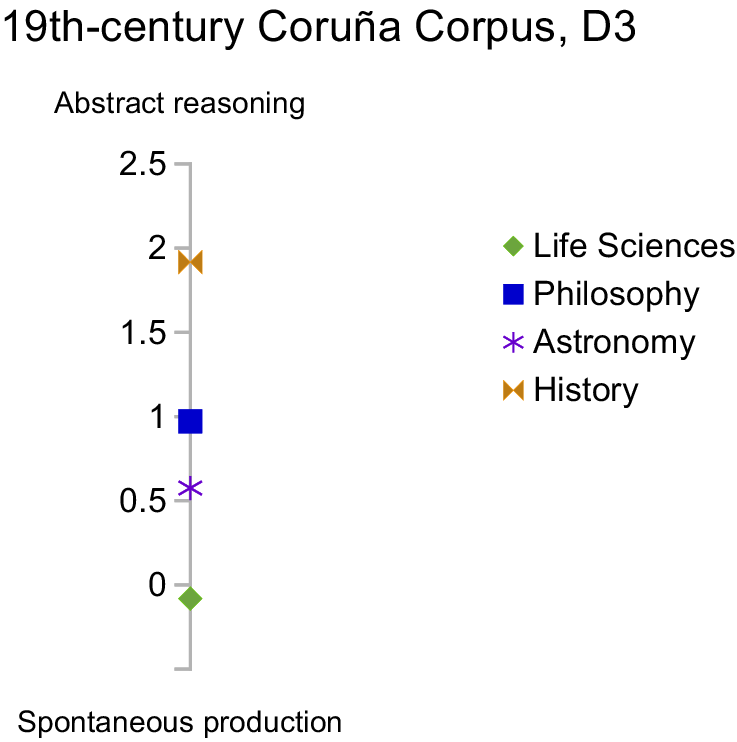
Figure 3 plots mean D3 scores for three scientific disciplines analysed in Monaco (Reference Monaco2017) – philosophy (CEPhiT), astronomy (CETA) and life sciences (CELiST) – and history (CHET) in the nineteenth century, with history leading the group as presenting the most abstract and elaborate kind of discourse with a positive score of 1.9, and life sciences containing the most spontaneous one, with a negative score of -0.1. Philosophy and astronomy occupy more moderate, intermediate positions, both tending towards the abstract side with positive scores, standing 1 and 0.6 scores above the reference corpus mean for this dimension (that is, 0.0), respectively. Despite these differences, the fact that three of the four scientific disciplines present positive scores, and that the remaining one – life sciences – stays very close to the reference corpus mean, is another proof that the scientific register is characterised by a more or less abstract and elaborate type of discourse (Biber Reference Biber1988; Atkinson Reference Atkinson1999; Conrad Reference Conrad1996; Gray Reference Gray2011).
Mean scores for four scientific disciplines (philosophy, astronomy, life sciences and history) as represented by four subcorpora from the CC, in the nineteenth century, along Dimension 3 ‘Elaborate/abstract reasoning vs spontaneous production’

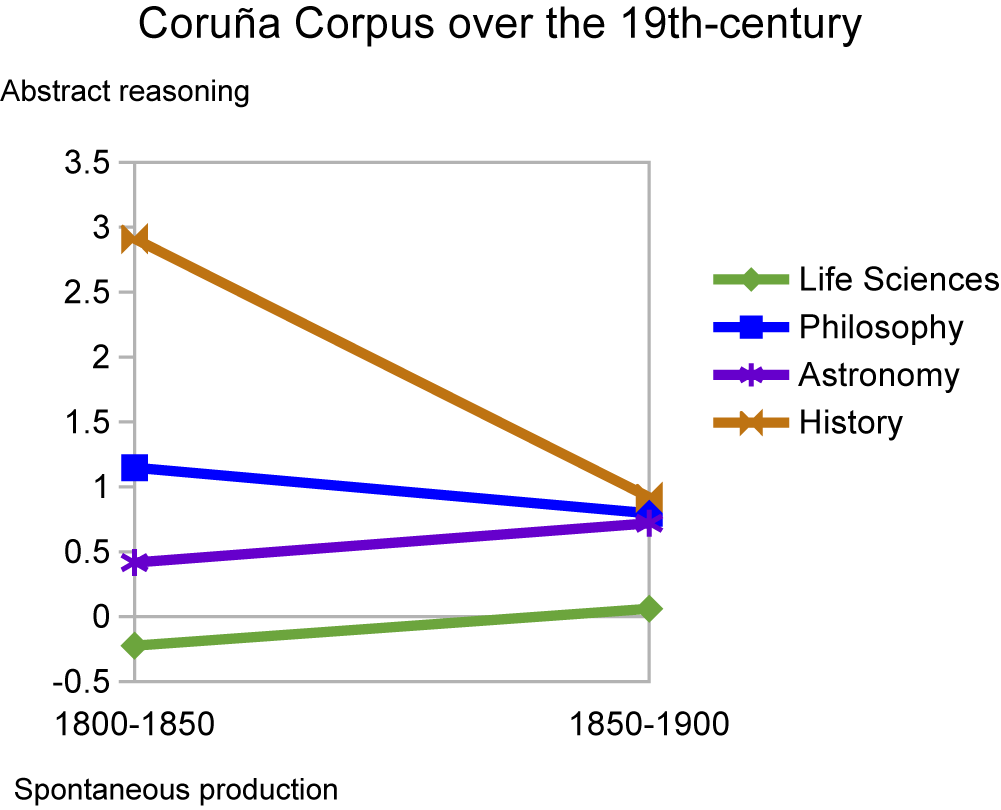
Figure 4 shows that the differences among D3 scores are even more marked in the period between 1800 and 1850, but become considerably smaller, especially in the case of the three scientific disciplines presenting positive scores, during the period included between 1850 and 1900. Thus, if in the first half of the nineteenth century history presented a relatively high positive score of 2.9, by the end of the century it drops to 1.0, while philosophy, much more moderate already in the beginning, shifts from 1.2 to 0.9, apparently becoming only slightly less’abstract’. Astronomy, conversely, gains abstraction and elaboration, going from 0.4 to 0.8, and so do life sciences, rising 0.1 above the mean corpus score. This may not be surprising, as scientific discourse is still very much evolving during the nineteenth century, slowly moving towards adopting a standard style, largely common to different scientific subregisters.
Mean scores for four scientific disciplines (philosophy, astronomy, life sciences and history) as represented by four subcorpora from the CC, in the first and second half of the nineteenth century, along Dimension 3 ‘Elaborate/abstract reasoning vs spontaneous production’

Figure 4. Long description
The line graph features an X-axis representing two time periods: 1800-1850 and 1850-1900. The Y-axis ranges from -0.5 to 3.5, with the top labeled Abstract reasoning and the bottom labeled Spontaneous production. Four data series are plotted:
* History (brown line with X markers): Shows a sharp linear decrease from a mean score of approximately 2.9 in the first half of the century to approximately 0.9 in the second half.
* Philosophy (blue line with square markers): Shows a slight linear decrease from approximately 1.1 to 0.8.
* Astronomy (purple line with asterisk markers): Shows a slight linear increase from approximately 0.4 to 0.7.
* Life Sciences (green line with diamond markers): Shows a slight linear increase from approximately -0.2 to 0.1.
By the period 1850-1900, the scores for History, Philosophy, and Astronomy converge between 0.7 and 0.9, while Life Sciences remains the lowest near 0.
Examples (1) and (2) are extracts of history texts, belonging to the first and second halves of the nineteenth century, respectively:
(1) After a long debate on the subject, the last description of persons were obliged reluctantly to accede to a measure which they thought promised nothing but delay or disgrace. By a kind of necessary compromise, a most humble and loyal petition directly to the king of Great Britain, was again agreed to by the delegated powers of the United States. At the same time , it was stipulated by all parties, that military preparations should be made, and an army raised without farther hesitation. A decided majority in congress, voted, that twenty thousand men should be immediately equipped and supported at the expense of the United States of America. (CHET, 1805 Warren)
(2) Here let us pause and bring our thoughts to bear upon the fragments into which this daring band was broken. First of all , the tragical fate of those in ‘the Griffin’ arrests our attention. As she was the first to spread her tiny sails and trim her slender yards to the breezes of Michigan, so she was the first to be engulfed within its waters. The gorgeous steamboat, with her peopled decks, often passes the spot where she sunk, but how few of all the multitudes that crowd them have heard of her fate. (CHET, 1884 Breese)
Example (1), being an extract of a treatise dating from 1805, shows a high concentration of passive structures (underlined) and nominalisations (in bold), many of the latter preceded by an attributive adjective (in italics), and a noticeable scarcity of personal pronouns and active voice, all of which contribute to an elaborate, informationally dense and rather abstract type of language. Example (2), in turn, belongs to a text published in 1884 and has a much lower presence of passive structures and attributive adjectives, while also incorporating negative D3 features (in small caps), such as adverbials, third-person pronouns ( bolded out ) and a few verbs in the present tense, transmitting a more ad hoc kind of discourse through a description of the fate of a ship.
By contrast, examples (3) and (4) correspond to the life sciences subcorpus, the former belonging to the beginning and the latter to the end of the 1800s:
(3) It is wonderful to see with what peculiar care the parent birds select the food for their young until they are four or five days old. For the most part it is purely animal, but not an atom even of that is suffered to go into the nestling’s stomach, that is not perfectly adapted to the tender state of its digestive powers. While the swift is feeding on small beetles that have hard crustaceous wings, and whose habitations are the air, its nestlings are fed in their early state with gnats. The sparrow, a granivorous bird, feeds its young for several days after they are hatched, with the softest insects only, now and then introducing a little coarse sand, smooth on the surface, to inure the stomach, as I suppose, to bear the same kind of substances in a more rugged state, which will shortly be required. (CELiST, 1824 Jenner)
(4) All young follicles are nearly alike, but as they grow older they exhibit various modifications in the different groups. They retain their simplest condition as a flat epithelial layer in most osseous fish and Amphibia. In most other forms the cells become at some period columnar, and are generally arranged in two or more layers. There is formed externally to the epithelium a delicate membrane the membrana propria folliculi which is in its turn enclosed in a vascular connective tissue sheath. (CELiST, 1880, Balfour)
Despite the fact that figure 4 shows a small rise in the abstract direction in the second part of the nineteenth century, there seems to be little difference between the two examples above. Both of them contain a high concentration of negative D3 features, with most of their verbs in the present tense and a number of third-person pronouns and adverbs, along with an occasional appearance of the pronoun it, as well as a contrasting low presence of passive structures and an almost total absence of nominalisations. All of these features create a tangible, dynamic and spontaneous kind of discourse, used in descriptions of living processes or living creatures, as in examples (3) and (4), respectively.
Having thus seen the distribution of four scientific disciplines from the Coruña Corpus along D3 in the 1800s, we will now proceed to compare nineteenth-century history and life sciences through the lens of the sex of the author variable.
4.2. By scientific discipline and sex of the author
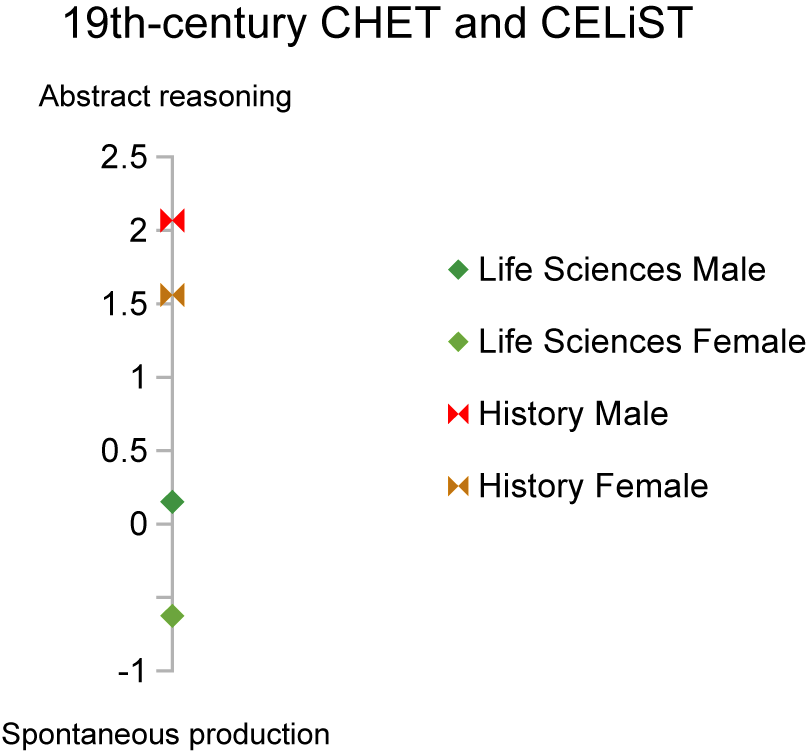
Figure 5 plots mean D3 scores for history and life sciences texts from the Coruña Corpus (CHET and CELiST, respectively), written by male and female authors in the nineteenth century:
Mean scores for texts written by male and female authors on two scientific disciplines (history and life sciences) in the nineteenth century along Dimension 3 ‘Elaborate/abstract reasoning vs spontaneous production’

While it was apparent from figures 3 and 4 that history and life sciences appear on opposite ends of the ‘elaborate/abstract vs spontaneous’ dimension, figure 5 also shows separation by sex in each discipline, with female authors presenting lower scores than their male colleagues in both cases. Thus, in history, texts written both by male and female authors have positive mean scores (2.1 and 1.6, respectively), whereas life sciences texts, concentrated on the lower end of the scale, present scores of 0.2 for texts written by men and -0.6 for those written by women. These findings might be seen as confirmatory of the speculations on men’s and women’s language mentioned earlier in the Introduction, drawn from both synchronic and diachronic studies (Lakoff Reference Lakoff1990; Biber & Burges Reference Biber and Burges2000; Geisler Reference Geisler2003; Argamon et al. Reference Argamon, Koppel, Fine and Shimoni2003), all of which show women as having a lesser tendency towards abstract reasoning than men. This said, we might also want to take our data with caution, since, while we are comparing texts written by male and female authors in the CC, we are at the same time comparing different genres, which is also likely to be a relevant variable in the study.
In the following paragraphs, the genre category will be looked at in combination with the sex of the author variable in nineteenth-century CHET and CELiST.
4.3. By scientific discipline, sex of the author and genre
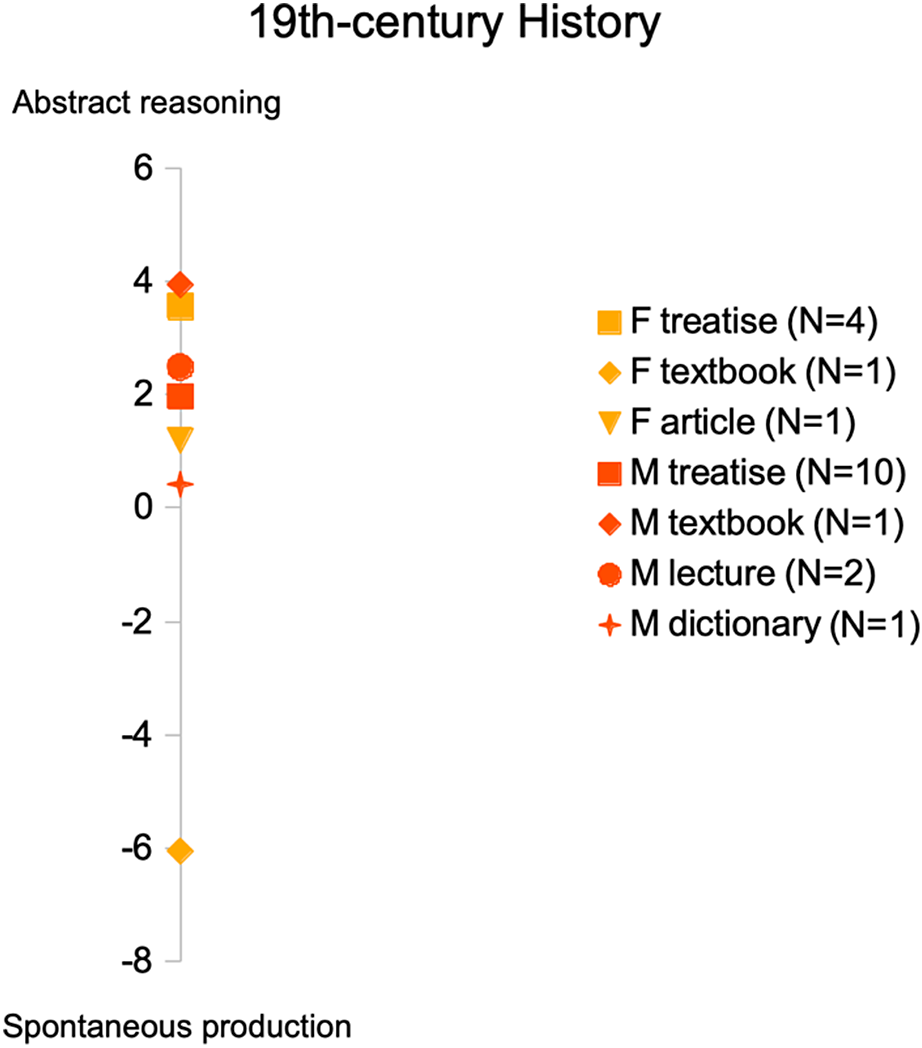
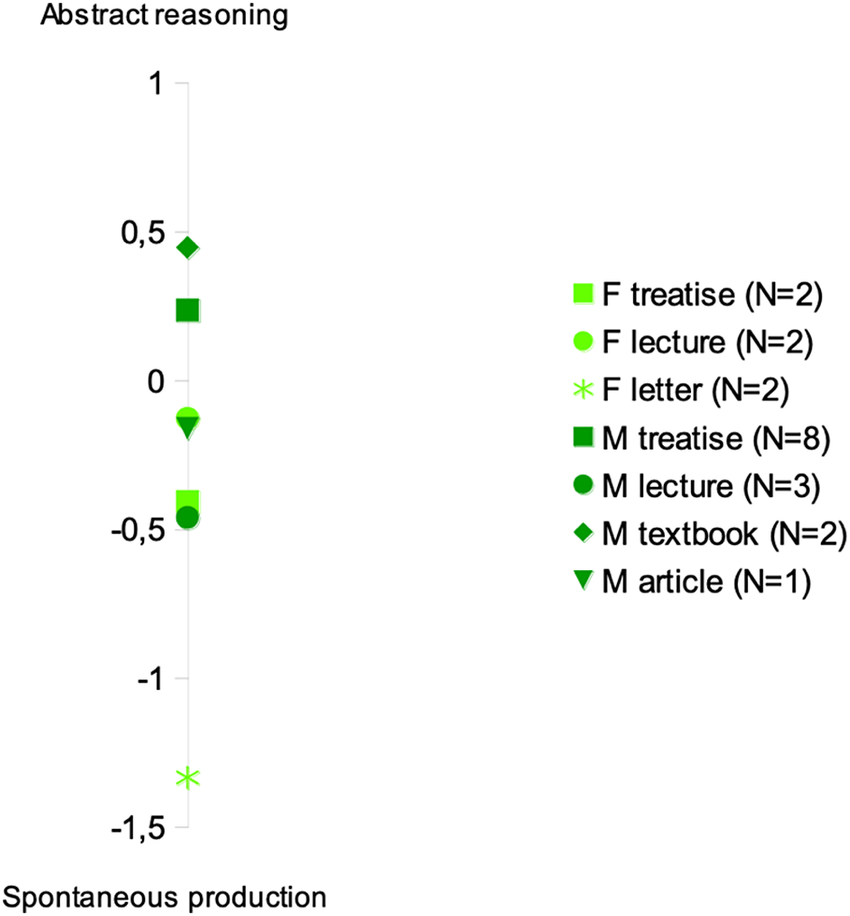
Figures 6 and 7 plot individual D3 scores for each genre, distinguishing between those genres containing texts written by male authors and those written by female ones, in nineteenth-century history and life sciences subcorpora of the CC, respectively. Both CHET and CELiST contain five genres, but not all of them are represented equally, nor does each genre contain texts written by both sexes.
Mean scores for nineteenth-century history texts (CHET), written by male and female authors, and belonging to five genres, along Dimension 3 ‘Elaborate/abstract reasoning vs spontaneous production’

Figure 6. Long description
The vertical axis ranges from 6 at the top, labeled Abstract reasoning, to -8 at the bottom, labeled Spontaneous production. Data points are clustered between 4 and 0, with one outlier at -6.
Legend and data points from highest to lowest value:
* F textbook (N=1): Yellow diamond at approximately 3.9.
* F treatise (N=4): Yellow square at approximately 3.5.
* M textbook (N=1): Orange diamond at approximately 2.5.
* M lecture (N=2): Orange circle at approximately 2.4.
* M treatise (N=10): Orange square at approximately 2.0.
* F article (N=1): Yellow inverted triangle at approximately 1.2.
* M dictionary (N=1): Orange plus sign at approximately 0.4.
* F textbook (N=1): Yellow diamond outlier at -6.0.
Mean scores for nineteenth-century life sciences texts (CELiST), written by male and female authors, and belonging to five genres, along Dimension 3 ‘Elaborate/abstract reasoning vs spontaneous production’

Figure 7. Long description
A vertical axis represents Dimension 3. The top pole is labeled Abstract reasoning and the bottom pole is labeled Spontaneous production. The numerical scale ranges from 1 at the top to negative 1,5 at the bottom in increments of 0,5.
Data points are plotted along this central vertical line using various green symbols.
Legend items from top to bottom include
* F treatise (N=2) represented by a light green square.
* F lecture (N=2) represented by a light green circle.
* F letter (N=2) represented by a light green asterisk.
* M treatise (N=8) represented by a dark green square.
* M lecture (N=3) represented by a dark green circle.
* M textbook (N=2) represented by a dark green diamond.
* M article (N=1) represented by a dark green downward pointing triangle.
Data distribution from top to bottom
* M textbook is highest at approximately 0,45.
* M treatise is at approximately 0,25.
* F treatise and M article are clustered near negative 0,1.
* F lecture and M lecture are clustered near negative 0,4.
* F letter is the lowest outlier at negative 1,35.
In the history subcorpus (figure 6), only treatises (of which 10 are written by male, and 4 by female authors) and textbooks (one for each category) can be compared directly, whereas the rest of the genres are represented either only by men (lecture, dictionary) or by women (article).
If we compare those genres with texts written by both men and women, we will notice that the biggest difference seems to be in the male and female textbooks, concentrated on opposite parts of the axis, the former with a positive score of 4.0 and the latter with a negative score of -6.0. Interpretations should be cautious here, since we are dealing with a genre represented by only one text in each case, and rather than being due to either variable – sex of the author, or genre – it might be likewise due to author-related idiosyncrasy. However, if we bear in mind that Victorian women were encouraged to teach younger generations, it is also plausible that a textbook written by a female historian in the middle of the 1800s might have been directed at a less educated audience, such as young women or even children, whereby it is written in a more tangible, spontaneous style than a textbook written by men, and aimed at men. Examples (5) and (6) illustrate the male and the female textbook samples, respectively:
(5) The effects of the Norman conquest were felt not only in England but also in Scotland, where, though the descendants of Kenneth II. still ruled as kings, many Norman families settled and became the leading nobility of the kingdom. Under the first Norman kings of England, too, the connection between England and Ireland became much more close than it had been before; Norman and English armies being sent over to subdue the Irish chiefs, and annex parts of Ireland to the English crown. (CHET, 1855 Masson; textbook, M)
(6) We may pity him , as he suffered at last in a good cause, but it is impossible to forget that he was only undergoing the same punishment which he had himself inflicted upon others. Soon after the death of Theramenes, the thirty tyrants were freed from another of their enemies, Alcibiades, who did not return to Athens after its fall, as many other exiles did. The tyrants were suspicious of him , and sentenced him to banishment. Not thinking himself safe in Europe, Alcibiades crossed over to Asia, and took refuge with one of the great Persian satraps. (CHET, 1857 Sewell; textbook, F)
If we go back to figure 6, we will see that the other directly comparable genre in the history subcorpus is the treatise, which, thanks to the number of samples per sex, appears to be more reliable than the textbook genre in terms of results. Thus, both male and female treatises have positive scores, but the mean score for treatises written by women (3.8) is over 1.5 points higher than that for treatises written by men (2.0), the former thus surpassing the latter in terms of abstract reasoning and discourse elaboration. These results appear to suggest that female historians may have used abstraction as a metalinguistic strategy in order to assert their authority in a field dominated by men. All in all, examples (7) and (8), from female treatises, and example (9), from a male treatise, show a similar density of passive structures and nominalisations, as well as of attributive adjectives, with, perhaps, a slightly more marked presence of third-person pronouns (i.e. negative features) in example (9):
(7) Lines of circumvallation had been formed from Mystic river to Roxbury and Dorchester. But, notwithstanding the appearance of strength, the collection of numbers, and the hostile disposition of both parties, nothing of consequence was attempted by either, after the action of the seventeenth of June, during the remainder of Gage’s administration. This inactivity was heavily censured by the more ardent spirits both within and without the camp; it was thought disgraceful on the one side, nor would it have been less dishonourable on the other, had not their inability from the causes just mentioned prevented more vigorous movements. (CHET, 1805 Warren; treatise, F)
(8) The following day, Monday, February 28th, the king was invested with the Order of St. Esprit with great pomp and solemnity in the cathedral of Chartres by the bishop. It was remarked with pleasure that his majesty pronounced the oath to live and die in the communion of the Holy Catholic and Apostolic Church with great fervour and emphasis. King Henry had now fulfilled all the conditions which could be demanded by his subjects before they tendered their full recognition of his kingly rights. (CHET, 1860 Freer; treatise, F)
(9) The renown obtained by Madame de la Peltrie had excited many a youthful imagination. The prestige and honours conferred on her , had equally their share in appealing to the more personal sentiments of ambition and vanity which so many of us conceal even from ourselves. Carried away by these feelings, the young girl felt that it was her vocation to join this expedition, to devote her strength, her life, to the advancement of its cause. She came to Paris and so expressed herself to Pre Lalemant. By his influence her wishes received attention. (CHET, 1887 Kingsford; treatise, M)
Figure 7, in turn, shows the picture of nineteenth-century life sciences, where the directly comparable genres are, once more, treatise – this time, with only two samples belonging to female, and as many as ten to male authors – and lecture, of which three samples are written by men and two by women. As for the other genres, letters are represented by women only, and the textbook and the article, by men.
Let us first look at treatises, which, in the case of those written by men, have a mean positive score of 0.2, while those written by women present a negative score of -0.4. As was previously shown in figure 5, the overall mean male and female scores for nineteenth-century life sciences are both below the reference corpus mean (that is, below 0.0), which characterises the discourse of CELiST as comparatively more ad hoc and spontaneous than CHET, which is more abstract and elaborate. Here, in figure 7, it appears quite clear that treatise, a genre in this subcorpus represented mostly by men (with a total of eight samples), tends towards a more abstract style, as opposed to the two samples authored by women, which show very few abstraction features, as represented in examples (10) and (11), respectively:
(10) The explanation is manifest on the theory of the natural selection of successive slight modifications, each modification being profitable in some way to the modified form, but often affecting by correlation of growth other parts of the organisation. In changes of this nature, there will be little or no tendency to modify the original pattern, or to transpose parts. The bones of a limb might be shortened and widened to any extent, and become gradually enveloped in thick membrane, so as to serve as a fin… (CELiST, 1859 Darwin; treatise, M)
(11) THIS plant is one of the most beautiful of our wild-flowers. It belongs to the family Boraginaceae, and is known by its showy flowers, having an irregular and unequal margin, and a sort of bell-shaped figure. The red or purple spots and hairs are very remarkable. The corolla is at first of a reddish-purple colour, turning afterwards bright blue; so that there are constantly flowers of both colours to be seen at once. The whole plant is covered with stiff, spreading, almost prickly hairs. The root-leaves are stalked and spreading, but often withered away at the time of flowering. (CELiST, 1879 Lankester; treatise, F)
Example (10), belonging to nineteenth-century naturalist Charles Darwin, presents a great number of nominalisations (and, in general, has a high nominal density) and its few verbs are mostly passivised, dealing with certain concepts of biology that were new at that time (e.g. natural selection, correlation of growth). Conversely, Example (11) is rich in adjectives, both attributive and predicative, but contains simpler nouns (e.g. spots, hairs, colour, leaves, etc.), being devoted to a detailed, yet rather down-to-earth description of a flower. In light of these two examples, illustrative as they are of the distribution of treatises per sex of the author along D3 in figure 7, it might not be unreasonable to deduce that the life sciences treatises written by female botanists in the nineteenth century may have been, once more, directed to women and children – as, according to Shteir (Reference Shteir1990), women were encouraged to study and teach botany. On the other hand, nineteenth-century women scientists often concentrated their efforts into instructing those who could not access formal education (Perl Reference Perl1979; Holmes Reference Holmes2010) and resorted to treatises ‘of an instructional character’ for this purpose (Moskowich Reference Moskowich2013: 473). Thus, it is likely that these female treatises were aimed at a non-specialised audience, presumably illiterate in more complex matters of biology, and, therefore, required a discourse that would not be too elaborate or too abstract for that audience to understand.
Lectures, however, present a different situation. Both the male and the female lecture have negative mean scores (of -0.5 and -0.2, respectively), with the latter showing more abstract features than the former, as can be seem in examples (12) and (13), respectively – even though the differences here are minor:
(12) Hitherto, we have been clearing our way through difficulties, and overcoming obstacles; first, we were obliged to learn to analyze plants according to the strict rules of botanical science; next to examine the organs of plants, with their anatomy and physiology; we then investigated the principles of classification, as exhibited both in the natural and artificial methods, and followed the arrangements of plants as presented in these different methods. The language of botany is now familiar to you , and you may enjoy the pleasant reflection, that by your own industry and application, you have elevated your mind to that state, in which it may with little farther effort enjoy the pleasant views of the vegetable kingdom which now present themselves . (CELiST, 1832 Lincoln; lecture)
(13) You may take a plant which has single flowers, and by dealing with the soil, and nourishment, and so on, you may by-and-by convert single flowers into double flowers, and make thorns shoot out into branches. You may thicken or make various modifications in the shape of the fruit. In animals, too, you may produce analogous changes in this way, as in the case of that deep bronze colour which persons rarely lose after having passed any length of time in tropical countries. You may also alter the development of the muscles very much, by dint of training; all the world knows that exercise has a great effect in this way; we always expect to find the arm of a blacksmith hard and wiry, and possessing a large development of the brachial muscles. (CELiST, 1863 Huxley; lecture)
The main difference between examples (12) and (13) seems to lie in the fact that passive structures are completely absent from the latter, which resorts instead to second-person pronouns (also present in example (12), but to a lesser extent), as well as to active verbs in the present tense. Conversely, the recurrent use of second-person pronouns – or ’dialogic you’ – in lectures is not surprising, since this genre was conceived to be written in order to be delivered in front of an audience (Seoane Reference Seoane and Moskowich2016; Crespo & Moskowich Reference Crespo and Moskowich2024), and the use of the present tense seems more naturally suitable than passive structures in this context.
Finally, although the epistolary genre does not have any male representation in nineteenth-century CELiST, it is worth mentioning here that letters in the late modern period used to have an instructional character, and were thus chosen by women as a genre that was closer to the reader, with an implicit degree of intimacy between reader and writer (Earle Reference Earle1999; Crespo & Moskowich Reference Crespo and Moskowich2016), presumably addressed to a family member – a niece, a young cousin – and used essentially as an authorised excuse for the transmission of knowledge among a female younger generation.
Example (14) illustrates this format:
(14) But, though you are so familiar with their general appearance, I doubt whether you know much of their habits of life, or of the way in which they are made. You know that they move about, but you do not know what organs they have to serve them as legs; you know, if you have ever watched them when alive, that their lower side is covered with all sorts of appendages seeming to be in active motion, but you do not know what office these appendages have to perform; you take it for granted that they eat, but you do not know where their mouth is, and I think you could not tell me whether they have any eyes or not. (CELiST, 1859 Agassiz; letter, F)
As shown through the excerpt above, the letter – which in nineteenth-century life sciences has a mean D3 score of -1.3, standing at the lowest end of the ’abstraction’ scale (see figure 7) – indeed appears to contain very little abstract reasoning and, instead, is rich in discursive markers of intimacy, such as first- and second-person pronouns, combined with verbs in a way that they indicate a relationship with the addressee: I doubt whether you know much of their habits …, you do not know …, you take it for granted …, I think you could, etc., thus contributing to a spontaneous, non-elaborate type of discourse.
It seems, thus, that genre may be a relevant variable when comparing certain nineteenth-century scientific disciplines, such as history and life sciences. Specifically, whether a genre is used by a male or a female author seems to point to certain metalinguistic choices, and may thus be considered a clue to interpret how certain genres may have been conceived by Late Modern English-speaking scientists themselves. While our findings would initially appear to confirm the characterisation of women’s discourse as less abstract than men’s (Lakoff Reference Lakoff1990; Biber & Burges Reference Biber and Burges2000; Geisler Reference Geisler2003; Argamon et al. Reference Argamon, Koppel, Fine and Shimoni2003), the genre variable appears to show a much more detailed picture, specific for each scientific discipline.
5. Concluding remarks
In this study, we have analysed a total of 40 history and life sciences texts from the Coruña Corpus, CHET and CELiST, written by men and women in the nineteenth century, by applying Biber’s (Reference Biber1988) technique and using Monaco’s (Reference Monaco2017) multidimensional analysis of three subcorpora of the Coruña Corpus – CETA, CEPhiT and CELiST – as a reference, focusing on Dimension 3 ‘Elaborate/abstract reasoning vs spontaneous production’. In the first part of the analysis, we have looked at nineteenth-century CHET with respect to the three aforementioned subcorpora along the dimension, whereby history revealed itself as the discipline with the most abstraction features, followed by philosophy, astronomy and life sciences, the latter standing out as presenting a non-abstract and more spontaneous type of discourse.
In a second part of the study, we have compared texts written by men and women in nineteenth-century CHET (history) and CELiST (life sciences) with respect to Dimension 3. The analysis revealed that texts written by men are more elaborate and abstract than those written by women in both scientific disciplines, apparently confirming the findings of earlier studies (Lakoff Reference Lakoff1990; Biber & Burges Reference Biber and Burges2000; Geisler Reference Geisler2003; Argamon et al. Reference Argamon, Koppel, Fine and Shimoni2003), and seemingly justifying Rousseau’s historically famous prejudice that women were essentially incapable of abstract reasoning (Trouille Reference Trouille1997).
All in all, despite these initial findings, a third part of our analysis, in which the genre variable has been applied, reveals that genre is crucial when looking at variation in scientific discourse (as had already been demonstrated in Biber & Gray (Reference Biber and Gray2013) in the case of subregisters), and that sex of the author and genre should go hand in hand in order to offer a fuller picture when looking at variation in different scientific disciplines. Thus, we have seen that, in the case of history, both men and women appear to conceive the genre treatise as a formal means of transmitting knowledge, characterised by an elaborate and relatively abstract type of discourse, and even more so in the case of treatises written by female authors. This linguistic choice may be regarded as a metalinguistic strategy used by female historians to claim authority in a male-dominated field. Conversely, while male historians also appear to use textbooks as a genre for the instruction of a more learned, specialised audience, it seems plausible that women might have used them for the instruction of other women and children, since the samples in nineteenth-century CHET appear to be very different with respect to D3. However, these results should be taken with caution, since, in this case, we have only one sample for each sex in CHET.
On the other hand, in the case of life sciences, only men appear to use the genre treatise as intended for a specialised audience, whereas women – mostly botanists – seem to resort to the so-called instructional treatises, addressed, once more, to other women and children, using a much more ad hoc, spontaneous register. As for lectures by men and women, it is the latter that have more abstract features in life sciences, while both appear to reflect a rather spontaneous and interactive kind of discourse, typical of a genre that was used in both writing and speaking in public. Finally, letters were also considered in the equation as a genre chosen by women for instruction in life sciences, which transmitted a more intimate type of discourse, thus establishing a closer rapport with the audience (presumably female and younger).
These findings not only challenge the generalisations about female writing mentioned earlier, but also suggest that, in some cases, men and women chose their metalinguistic strategies by shaping their genres and discourse specifically for the audiences to whom they addressed their writings. Using a more or less elaborate, abstract, or spontaneous type of discourse according to their audience suggests flexibility, rather than rigidity, even if their choices were, in all likelihood, stemming from (and largely restricted by) the social conventions of the time. Further studies combining the genre and sex of the author variables may unveil new and interesting variation patterns across other scientific disciplines in the late modern period, so crucial in the development of scientific English and its different genres.
Acknowledgements
This research is supported by Grant PID2022-136500NB-I00 funded by MICIU/AEI /10.13039/501100011033 and by FEDER, UE.



 Open access

