INTRODUCTION
When I was first excavating at Calakmul, Mexico, appreciating the intensity of the night sky was one of the benefits of working in an area without electricity, in fact out-of-sight of any artificial lights. In the evening after dinner, we would hike back into the ruins to climb Temple II, the highest Maya pyramid in the region at about 45 meters or 148 feet from the ground surface to its summit. The stars were dazzling. In all directions, the jungle canopy below us was black. There were no nearby towns, cities, or modern roads to provide ambient light in this remote area of the Peten jungle. Shooting stars and constellations were so bright that it was as though we were experiencing what Jodie Foster experienced when she visited a whole new galaxy, in her role as Dr. Ellie Arroway in the film Contact. Heavenly bodies seemed close enough to touch. How wonderful that such extraordinarily dramatic exploration can even happen here on earth in our own solar system.
Contemplating how the starry sky looked to our predecessors, the reader must take into consideration the importance of translating the motions of heavenly bodies as the principal method of telling time, as do the authors of this Special Section, “Mesoamerican Cultural Astronomy and the Calendar.” Studying the role of social, religious, and political issues in nature or natural science, archaeoastronomy or cultural astronomy describes the study of contemporary and ancient peoples’ conception of astronomy (Aveni Reference Aveni2014:187, Reference Aveni2015). The starry sky was one of the most vibrant and active vistas at night in a world yet to be illuminated by electric lights. Much as people in our own society now use television, computer, or tablet screens, the night skyscape was universally viewed as a principal canvas for storytelling, myth, navigation, and scientific discovery, as seen through the lens of particular cultural and social, political, or religious perspectives.
As ancient Mesoamerican people slowly cleared lands for horticulture, drawing back the jungle canopy to reveal the sky as effectively as a theater curtain frames a stage, timing planting and harvesting gradually became preeminent. A number of scholars have hypothesized that it was then, about 2000 b.c., that calendars were invented by the Olmec, epi-Olmec, or Izapans somewhere around 92°–96°W longitude, covering the Isthmus of Tehuantepec and adjacent regions of eastern Veracruz, Tabasco, Oaxaca, and western Chiapas, Mexico, and part of the Pacific Piedmont in coastal Guatemala (Rice Reference Rice2007:9). Of the 60 or so calendars that were invented in pre-Columbian Mesoamerica, Gossen (Reference Gossen1974:217) reports that about 56 communities still used versions of these calendars into modern times. Miles (Reference Miles and Tax1952:273–275) identified nearly 90 communities still using calendars in the mid-twentieth century. Included in this group are 34 from the Chuj, Ixil, Jakaltec (Popti), Mam, and Poqomchi’ of western Guatemala (Weeks et al. Reference Weeks, Sachse and Prager2009:6), where the calendars feature yearbearers, 365-day counts with 18 20-day months, presumably one five-day month, and 13 numbers. In east central Guatemala (Weeks et al. Reference Weeks, Sachse and Prager2009:6), 23 Mam, Awakateko, K'iche or Kaqchikel, and Poqomchi’ or Q'eqchi’ villages have 260-day count calendars with 20 named days and 13 numbers. In areas where the entire 260-day count is no longer used, the people retained the 20 named days and used these as a substitute for the whole 260-day period (Miles Reference Miles and Tax1952, Reference Miles1957).
Some archaeologists believe that a sizable number of pre-Columbian archaeological sites record horizon-based features designed for viewing environmental time indicators used in calendars, which is a testable hypothesis (Aveni et al. Reference Aveni, Dowd and Vining2003; Dowd and Milbrath Reference Dowd and Milbrath2015; Freidel et al. Reference Freidel, Chase, Dowd and Murdock2017; Sánchez and Šprajc Reference Nava, Francisco and Šprajc2015; Šprajc Reference Šprajc, Boccas, Broda and Pereira2004; see also Brumfiel Reference Brumfiel2011 on time technologies, Schiffer Reference Schiffer2013 for archaeological approaches to scientific discovery, or Silva and Campion Reference Silva and Campion2015 for information on the sky in archaeology worldwide). Examples where such hypotheses have been investigated include: Abaj Takalik, Arroyo Negro, Baking Pot, Balakbal, Cahal Pech, Cahal Pichik, Calakmul, Caracol, Cenote, El Mirador, Hatzcab Ceel, Ixkun, Ixtutz, Kabah, Kaminaljuyu, Naachtun, Nakbe, Nakum, Naranjo, Oxpemal, Pacbitun, Rio Bec II, Santa Rosa Xtampak, Tayasal, Tikal, Uaxactun, Uxul, Wakna (Güiro), Xunantunich, Yaxha, and other sites where the Maya used architecture as markers for tracking or commemorating certain solar and other astral or planetary movements (Aveni et al. Reference Aveni, Dowd and Vining2003:Table 1).
The authors of this Special Section tease out information about the processes involved with astronomical observation for the purpose of implementing or updating calendars in Mesoamerica. Studying preserved writing on folding-screen codices made of fig or mulberry tree bark paper; inscriptions on stone monuments and portable artifacts; archaeological remains with distinctive alignments, i.e., orientations with sunrise or sunset; and light and shadow effects (hierophanies), they investigate the specific means and recording methods for calendar development. Such methods include mathematical models for commensurating astronomical intervals and the use of written almanacs for weather prediction and planting instruction, anchored in real time with historical phenomena such as eclipses. Eclipses punctuated calendrical time in the way periods and commas structure sentences. The following brief discussion on the sequence and timing of calendar developments in Mesoamerica provides a background to the issues and themes covered in the Special Section resulting from our Society for American Archaeology (SAA) session.
CYCLES OF DEATH AND REBIRTH IN MESOAMERICAN ASTRONOMY
The cycles of death and rebirth in Mesoamerican astronomy were visualized in relation with the sinking and rising movements of heavenly bodies, such as the stars, planets, the sun, and the moon, in turn metaphorically linked to subsistence and metaphysics: harvest/planting, hunt/foraging, sacrifice/renewal, and death-on-earth/afterlife (or continuity/durability through bloodlines). The last were perhaps imagined to be like ancestral deity jewels as sky lunations, originally discussed by Cases Martín (Reference Cases Martín2013) in his presentation in our 2013 SAA session.
If one were to speculate that complex hunting and gathering groups in Mesoamerica might have developed the very first calendars, where did such inventions occur? The first evidence known for the earliest examples of calendar inscriptions appears among the epi-Olmec of the Isthmus of Tehuantepec at a time when horticulture and agriculture were already established in the region. Around 1900–1400 b.c., or the Early Preclassic period (2000–1000 b.c.) in the Maya lowlands and adjacent regions, it is probable that different semi-sedentary or mobile groups competed for territories or forged a precarious détente, given that their land and resource needs may have been in some ways complementary. By the 1500 b.c., evidence of forest clearance, Zea mays pollen in sediments, and increased soil erosion is documented in the Lake Petén Itzá and Salpetén basins (Rosenmeier et al. Reference Rosenmeier, Hodell, Brenner, Curtis and Guilderson2002; Hodell et al. Reference Hodell, Anselmetti, Brenner and Ariztegui2006; Mueller et al. Reference Mueller, Islebe, Hillesheim, Grzesik, Anselmetti, Ariztegui, Brenner, Curtis, Hodell and Venz2009:138–139; Rice Reference Rice2014). At present, data specifically documenting a mix of forager and horticulturalist populations are sparse. Nevertheless, some scholars have suggested that sedentary and mobile groups in the southern lowland region may have shared territory at Ceibal and other areas of the lowland Pasión region of present-day Guatemala (Inomata et al. Reference Inomata, MacLellan, Triadan, Munson, Burham, Aoyama, Nasu, Pinzón and Yonemobu2015).
It was not until about 300 b.c. in the Late Preclassic period (350 b.c.–a.d. 225) that more established sedentary communities, displaying burials in house floors, for example, became common, but it is possible that semi- or even fully sedentary populations coexisted alongside complex mobile hunter-fisher-gatherer groups for a long period of time. These were probably groups who combined strategies of mobility during one season, most likely the dry season, with increased sedentism during the wet season, when cultivating domesticates was an option. Seasonal variation in degrees of mobility and attention to scheduling of wild plant or animal harvests is well known in other regions in the world among hunting, fishing, and gathering populations (Dowd Reference Dowd1998).
Potential loci for very early temporary wooden house structure preservation are submerged former lakeshore edges in the southern lowlands, such as in the Belize lake region, or around Lake Petén-Itza or other lakes in Guatemala, where water levels alternately rose or fell over time. Comparisons may be made with well-preserved underwater European lakeside settlements in Europe, such as those in the Three Lakes region of western Switzerland covering the Bienne, Morat, and Neuchâtel lakes (Hafner and Schlichtherle Reference Hafner, Schlichtherle, Petzet and Ziesemer2006–2007:175). Evidence from Caobal and Altar de Sacrificios, where Real 2 (850–800 b.c.) or Real 3 (800–700 b.c.) phase postholes have been found, suggest that post-in-ground or raised residential structures on posts may have been among the earliest nonpermanent housing styles (Inomata et al. Reference Inomata, MacLellan, Triadan, Munson, Burham, Aoyama, Nasu, Pinzón and Yonemobu2015:4271). Andrews (Reference Andrews1968:39) excavated permanent houses that he described as “a simple cluster of one-room usually apsidal huts walled with mud and crude stones plastered over with lime” at the earliest levels at Dzibilchaltun, Mexico, with an uncalibrated 14C date of 975 ± 340 BP.
Calendars may have also emerged before truly sedentary societies or contemporaneous with the presumed development of communal or monumental architecture such as E-Groups. Monumental constructions such as the E-Group-type architectural complex at Ceibal, presently the earliest known example in the Maya lowlands dated to ca. 950 b.c., may have served to unite groups with disparate modes of subsistence through seasonal gatherings for market exchange and seasonal ritual (Inomata et al. Reference Inomata, MacLellan, Triadan, Munson, Burham, Aoyama, Nasu, Pinzón and Yonemobu2015:4268). While growing maize and other crops became a key scheduling factor in calendars over time, scheduling other natural resources, what I am calling “eco-astronomy,” also may have played an important role, as supported by data Vail presents in her article for this Special Section.
Milbrath also documents real-time events anchoring the 260-day seasonal almanac to an agricultural scheduling pattern, events that may have tethered a seasonal almanac, commensurating with or complementing the 260-day almanac. Or perhaps these events were connected to a 365-day Haab, which may have been tied to a broader forager/horticultural scheduling pattern, one less strictly linked to a maize growth cycle. If the 260-day Tzolkin calendar was associated with rituals leading up to a 105-day corn-growing season (Stross Reference Stross1994), the 365-day Haab calendar may have been associated with a more diverse annual or seasonal round for generalized wild resource collection. According to a number of scholars, the 260-day count is a calendar unique to Mesoamerica, made up of 13 numbered coefficients and 20 named day signs (13 × 20 = 260); is base 20 or vigesimal, rather than base 10 or decimal; and the 365-day count approximates the solar calendar year (18 × 20 + 5 = 365; Aldana y Villalobos and Barnhart Reference Aldana y Villalobos and Barnhart2014:vii; Caso Reference Caso1947; Iwaniszewski Reference Iwaniszewski, Šprajc and Pehani2013; Lounsbury Reference Lounsbury and Coulston-Gillespie1978; Roys Reference Roys1967[1933]; Satterthwaite Reference Satterthwaite and Willey1965). For the Haab, or 365-day count, the 18 months were “seated” on a first unnumbered day followed by a count through coefficients of one to 19 in the Postclassic, or in the Classic rendered zero to 19 for the 20 days of each month with the final shorter five-day Wayeb period (“seating” through four, or written zero to four). Because the 365-day count or Haab did not incorporate a leap day, it slipped through the seasons during the Maya Classic Period (a.d. 600–900).
The merger of farming and foraging adaptations is subtly shown in the differing Haab and Tzolkin calendars that persisted long after the dominance of agriculture in the region took place. It would seem that the contributors of this Special Section are establishing a new and intriguing research theme in Mesoamerican archaeology, one that has fascinating ramifications for calendar development in the region, linking different modes of subsistence that may have coexisted for much longer than anthropologists have previously assumed.
These calendars could have developed long before they were codified in writing for social control of history. Hunting and agriculture modes of subsistence can be connected with calendrics and astronomy to provide a glimpse into the time periods well predating the Postclassic (a.d. 900–1519) or Late Postclassic (a.d. 1300–1519) in Mesoamerica, periods that Milbrath, Vail, and Justeson cover in their treatments of codical texts and images. A recapitulation of some key Mesoamerican calendar innovations is presented below.
REVIEW OF THE TIMING OF MESOAMERICAN CALENDAR DEVELOPMENTS
By the Middle Preclassic period (1000–350 b.c.) or more specifically 600–300 b.c., and the transition into the Late Preclassic period, calendars and written texts existed in Veracruz, seen in early Olmec Tzolkin dates on La Venta's Stela 13 (Justeson Reference Justeson and Aveni1989:79; Lacadena Reference Lacadena2009; Milbrath Reference Milbrath, Freidel, Chase, Dowd and Murdock2017a; Rice Reference Rice2007:45; Stuart Reference Stuart2011:36–37). These abbreviated references assume that the reader is knowledgeable about the context, both temporal and linguistic. Early texts that provide absolute, or close to absolute, dates within an error range of about 104 years (±52 years), include yearbearers in the 52-year cycle from the Maya lowlands and Oaxaca (Marcus Reference Marcus1992:38–41, 95; Milbrath Reference Milbrath, Freidel, Chase, Dowd and Murdock2017a:100; Prem Reference Prem, Heizer and Graham1971:119; Stuart Reference Stuart2011:38).
The yearbearers are the four named days within the 260-day calendar that could co-occur with the first day of the 365-day calendar to begin, bear, or carry the year (Rice Reference Rice2007:32). These can be dated in ca. 300 b.c., and also appear in Early Classic period (a.d. 225–600) Maya texts, e.g., the newly discovered Stela 1 at El Achiotal, tenatively dated by Stuart (quoted in Romey Reference Romey2015) to date to a.d. November 22, 418 according to the calendar round glyphs in cartouches on the back of the monument that also identify the king as a Ku'hul Chatan Winik, glossed “Holy Chatan Person” (David Freidel, personal communication 2015); and later in the Maya region among the contemporary Quiche, as discussed above. Also, as mentioned above, by modern times the lack of standardization in calendars across various regions is apparent.
Standardization may have been relatively infrequent given the changing nature of calendar revision and reinterpretation in different geographic spheres; when standardization occurred it may have been effected by agent-based religious institutionalization involving highly skilled individuals whose influence was broadened and reinforced by state-level religious institutions. By 255 b.c., more clearly articulated absolute dates were possibly expressed by the Maya long count, but the long count was fully developed by a.d. 300 (Giron-Abregon Reference Giron-Abrego2013:9–10; Milbrath Reference Milbrath, Freidel, Chase, Dowd and Murdock2017a:101).
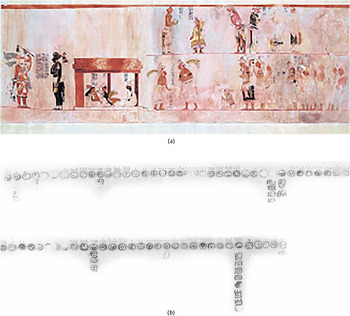
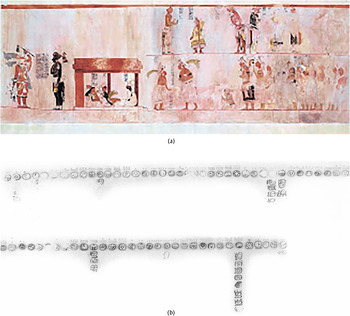
Some highlights in the development of Mesoamerican calendars and writing include: (1) in 594 b.c. at Monte Albán, Mexico, a calendar round date is shown on Stela 12; (2) the first use of the Maya long count on an in situ monument, Stela 29 at Tikal, Guatemala, in a.d. 292; (3) the earliest period ending stelae, Stelae 18 and 19, dating to a.d. 357, at Uaxactun, Guatemala, along with a uniform system of recording eclipses; and (4) the Venus calendar is formally instituted in a.d. 934 (Aveni Reference Aveni2002:205; Justeson Reference Justeson and Aveni1989:87–88; Rice Reference Rice2007:173, Table 8.1). Somewhat analogous to the Postclassic almanac on pages 12b–18b in the Madrid Codex, a 260-day sequence was recorded inside Uaxactun's Structure B-VIII as part of a painted mural (Morley Reference Morley1946; Smith Reference Smith1950:Figure 1).
A 260-day calendar forms the basal register of the mural from Uaxactun Structure B-VIII West Wall Room 7. (a) Reproduced courtesy of the Peabody Museum of Archaeology and Ethnology, Harvard University. (b) Illustrated by Antonio Tejeda F. (after Smith Reference Smith1950).
CONTENTS OF THE SPECIAL SECTION
There are significant issues that are still unresolved with regard to calendar development in the New World, and several of the authors in this Special Section have productively investigated these in recent years. The following description of the articles in the Special Section by Milbrath, Justeson, Vail, Pineda de Carías, Rivera, Cristina Argueta, Dowd, Aveni and Carrasco, and ending with Aveni's synthesis based upon his discussant comments at the meeting. These authors address aspects of the calendar, architectural planning, and cultural astronomy in Mesoamerica with specific emphasis on the Maya, the Epi-Olmec, and Teotihuacanos.
DEATH
In previous studies, Justeson (Reference Justeson and Aveni1989:87–88; H. Bricker and V. Bricker Reference Bricker and Bricker2011; V. Bricker and H. Bricker Reference Bricker, Bricker, Dowd and Milbrath2015) explores the long history of eclipse cycles and predictions in Mesoamerica. For example, records of eclipses began in the Late Preclassic period, as is known from the hieroglyphic text on the La Mojarra Stela 1. Justeson's theoretical and empirical use of a “thought experiment” to replicate Maya models and their relationships to observational records brings mathematics, linguistics, and astronomy together in a manner compatible with Western deductive scientific reasoning and culturally sensitive to Maya values. Justeson is expanding on work done by other scholars who are interested in a Maya point of view (Berkitt Reference Berkitt, Weeks, Sachse and Prager2009; Weeks et al. Reference Weeks, Sachse and Prager2009:162–175). He is also building on a recently published companion study that was published in Dowd and Milbrath (Reference Dowd and Milbrath2015). In many respects, Justeson's article in this Special Section is a sequel because he is also investigating the commensurate properties of time cycles that provided clues to upcoming eclipse events. He shows the length of the eclipse table in the Dresden Codex had a precedent in a previously unrecognized eclipse family of 88 months. An eclipse family is a sequence of eclipse dates or stations appearing at 88-month intervals, be it lunar or solar. As he explains it, the 88-month time span connects neatly to both the 260-day divinatory calendar and to the Babylonian Saros cycle of 223 months segmented into 47-, 41-, 47-, 41-, and 47-month intervals. According to Justeson (Reference Justeson2017), sequential stations in eclipse families occur every 405 months, the same time span shown in one full pass through the Dresden Codex Eclipse table. These pre-Columbian efforts to predict and record eclipses, which threatened the sun, can be viewed as a form of mitigating its death. Commensuration principles, having an aesthetic component that mathematicians must have admired for reasons of patterned symmetrical elegance, also helped predict cyclic repetition and by extension rebirth after death. These periodic patterns of natural cycles Justeson notes are observable and predictable, and their key characteristics were recorded and celebrated in the day-to-day ritual activities of the Maya people. Moreover, Justeson's work speaks eloquently to support Indigenous scientific methods developed independently in the Americas prior to contact with European explorers.
Venus is the star of Vail's article, “Venus Lore in the Postclassic Maya Codices: Deity Manifestations of the Morning and Evening Star.” Rising in the east as Morning Star, Venus is a hunter and a warrior. Setting in the west as Evening Star, Venus may be linked with scorpions and with the God M, connected to merchants and trading. Chaac, who carries a spear tipped with K'awil, apparently is identified with both morning and evening phases of Venus. While Milbrath is exploring agricultural-astronomy records in the codices, or “agro-astronomy,” Vail explores hunting-astronomy records in the codices, or “eco-astronomy.” Vail examines the real time scheduling of more mobile activities – hunting, warfare, or trading – in ways that are similar to the recording or codification in almanac format of planting cycles and the weather patterns or seasonal scheduling necessary for agricultural pursuits. Remnants of hunting-and-gathering lifestyles were retained by the Maya, and wild game hunting, such as for deer, required another schedule for planting, tending, and harvesting plants, principally during the “off-season” or for the November through May dry season rather, than the June through October rainy season with a one-to-two week dry period during the canicula in August. Because some hunting was done for the purpose of securing sacrificial offerings, rather than for subsistence per se, the pairing of warfare, where human sacrificial subjects were procured, and hunting, where animals for sacrifice were captured, is closer conceptually that it may seem at first glance. These non-agricultural mobile activities also appear to be grouped together under the guiding movements of Venus in the sky, as the agricultural examples are connected to the Sun. Perhaps these were tied to a day/night dichotomy, where the Sun rules the day and either the Moon or Venus lead nighttime activities, or those closely associated with dawn and dusk, as is typical of hunting and fishing. Besides having differing seasonal implications for scheduling, these two categories of activities may have had contrasting sets of social relationships, in other words, different cultural groups may have carried them out. Thus, even though hunting and sacrifice meant death, with death comes rebirth.
REBIRTH
Milbrath focuses on Venus, solar eclipses, and the interpretation of Venus cycles in the Dresden, Madrid, and Borgia codices, painted books that also seem to emphasize eclipse imagery dating to the Postclassic period, integrated cycles that have a precedent dating at least as far back as a.d. 143 on Stela 1 at La Mojarra, Mexico (Milbrath Reference Milbrath1999, Reference Milbrath2013). In discussing pages 11–18 of the Madrid Codex almanac, Milbrath (Reference Milbrath2017b:494) states: “Inspired by the work of the Brickers (Reference Bricker and Bricker2011), my 2016 publication proposed a new model, arguing that the almanac on Madrid pages 12b–18b records visible eclipse events in the fifteenth century and these were combined with observations of Venus, an association also seen in the narrative sequence on Codex Borgia 29–46 (Milbrath Reference Milbrath2013).” Milbrath explicitly links the Maya Chicchan serpent in the Madrid almanac with Venus, and identifies this serpent and its multiple manifestations as counterparts for the Maya god Kukulcan and Quetzalcoatl, the central Mexican Venus god. In the Madrid Codex, the Chicchan serpents are related to the fertility aspect of Venus and seem to serve as symbols heralding the rainy season. As Milbrath points out, the Madrid Tzolkin almanac with a 260-day count describes the period beginning the agricultural cycle in February and closing with the harvest in October, followed by a 105-day period where agricultural activities are not emphasized, a pattern documented in contemporary Maya practices, as noted in this article. In the Madrid Codex, an “in extenso” almanac may have been used to measure the agricultural cycle, but also apparently was expanded for longer periods of time to incorporate eclipse records. The almanac may have been used to track Venus positions in relation to visible solar eclipse events over a span of 56 years between a.d. 1452 and 1508, that is, 76 iterations of 260 days, as opposed to a shortened cycle of only a single 260-day growing season. The almanac originally may record an eclipse pair visible in Yucatan, with one eclipse in June of a.d. 1452 around the summer solstice followed by another eclipse in the same year on the winter solstice. This year also was a time when Venus was visible as the Evening Star throughout the span of the agricultural cycle, from February through October. This coincidence may have inspired the creation of an almanac used to track Venus intervals in relation to the eclipse dates. Milbrath's work augments and contextualizes identifications of earlier water serpents and representations of water serpent impersonators that have also described for the Classic period Maya (Closs et al. Reference Closs, Aveni and Crowley1984:226; Coltman Reference Coltman2015:15–30). Solstice events, eclipses, Venus appearances, and Chicchan serpents associated with the rainy season are linked with the agricultural cycle so important in subsistence environments.
In “Stela D: A Sundial at Copan, Honduras,” Pineda de Carías, Rivera, and Argueta analyze stairway changes next to Stela D at Copan, Honduras, that, when used around mid- a.d. 700 (Late Classic period). The stairway exhibited light and shadow hierophanies more precisely correlated with time indicators that could have been used for initiating ceremonies in that public space. The Maya apparently employed natural light to illuminate the presumed ritual activities on the stairway, recalling hierophanies on the El Castillo stairway in Chichen Itza, Mexico, and in the Structure IVc doorway at Calakmul, Mexico (Dowd and Milbrath Reference Dowd and Milbrath2015:48–49, 54). The modifications to Copan's Main Plaza constitute an “event” or structural transformation with the addition of new design elements that coincided with a new ruler coming into power (Kelly and Brown Reference Kelly, Brown, Creekmore and Fisher2014:297; Sewell Reference Sewell2005). Copan's radial structure (No. 4, or 10L-4), modified during Waxaklajuun Ubaah Ka'awiil's reign between a.d. 695–738, may have a connection with the ritual use of the plaza. Pinenda de Carías et al.'s article provides a possible scenario for the use of Stela D and the structures around it as permanent solar markers for the ceremonial public space with the effects of the light and shadow that continually displayed the yearly solar calendar. According to the authors, this is a message that the ruler also reinforced with the serpent bodies adorning Stela D. I would also suggest a connection between the Stela D serpent depictions and the use of Chicchan serpents, as Milbrath has interpreted them in the Madrid Codex. The Copan examples all lack the rattles, or what Milbrath considers Pleiades symbols, possibly implying rainy season associations. As light bathes the architectural elements in Copan's central plaza, resulting cycles of sunlight and shadow effects during the day and the annual cycle imply birth, growth, and connections with ancestors (Ashmore Reference Ashmore1991; Ashmore and Sabloff Reference Ashmore, Sabloff and Tejo2000, Reference Ashmore and Sabloff2002; Landau Reference Landau2015). Perhaps there is also a connection iconographically with the serpents framing the doorway of Temple 22. Each occupies a northern position with respect to the adjacent plaza space. Looking forward to other ways of approaching this type of three- or four-dimensional problem in the future, a possible technique for exploring architectural/astronomical reconstructions has been described and demonstrated by several researchers using computer gaming platforms (Dowd Reference Dowd2015; Frischer and Fillwalk Reference Frischer, Fillwalk, Guidi and Addison2012; Zotti Reference Zotti2014). Very soon, virtual reality will provide a new medium for reconstructing archaeological scenarios, showing astronomical phenomena as viewed through Maya cityscapes. The subjects Pineda de Carías, Dowd, and colleagues address are appropriate for this methodology and could eventually contribute to its future applications.
Dowd, Aveni, and Carrasco provide data on Calakmul's Group E-type complex and its orientations and functions in “Solar Observatory or Allegory? Calakmul's Group E-type Complex Form and Function.” This article demonstrates some important details about how Calakmul's Group E was laid out, and offers a rationale for interpreting the Calakmul E-Group as a functional nonwestern observatory in addition to having overarching religious ritual purposes for community gatherings, festivals, or ceremonies on or about day 60 in the Tzolkin if the central orientation is a reliable guide. Visible cycles of light and seasonal time connected to solar movement signal rebirth. This metaphor is one that resonates with not only agricultural ideals but also with the goals of political rulers, and with the activities of professional priests or religious specialists, as has recently been discussed in a forthcoming volume on Maya E-Groups (Dowd Reference Dowd, Freidel, Chase, Dowd and Murdock2017). The Dowd et al. article touches on the subject of finding out if real-time observation in E-Group architecture was used to standardize the 260-day or the 365-day calendars in certain times and places, and whether state-level religious institutions facilitated such periods of standardization. Scholars debating the use of E-Group-type architecture in the Maya region, either as observatories or as ritual spaces, occasionally ignore that such functions were not mutually exclusive because calendar development and astronomical observation went hand in hand with ritual. Furthermore, periods of relative standardization in both architectural settings and in calendar cycles may have heralded the emergence of complex social institutions in the Mesoamerica. Greater specialization and person-hours devoted to problem solving brought dynamic innovation, while incorporating standardization to some degree. In this context, it would be interesting to know more about the range of sociopolitical complexity associated with astronomical orientation in monumental architecture of the Maya lowland region. Observing the sun's passage at the horizon during sunset and sunrise was related to metaphors of cyclic death and rebirth, both in nature and culture, and thus formed the armature of the calendar system.
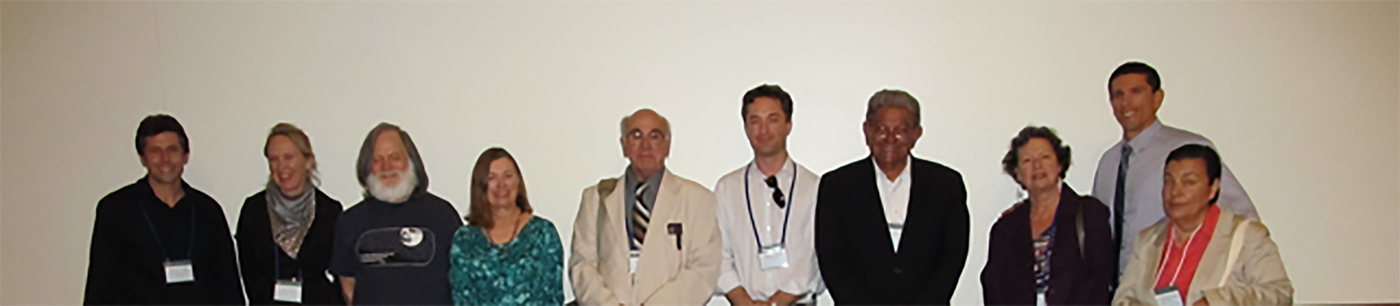
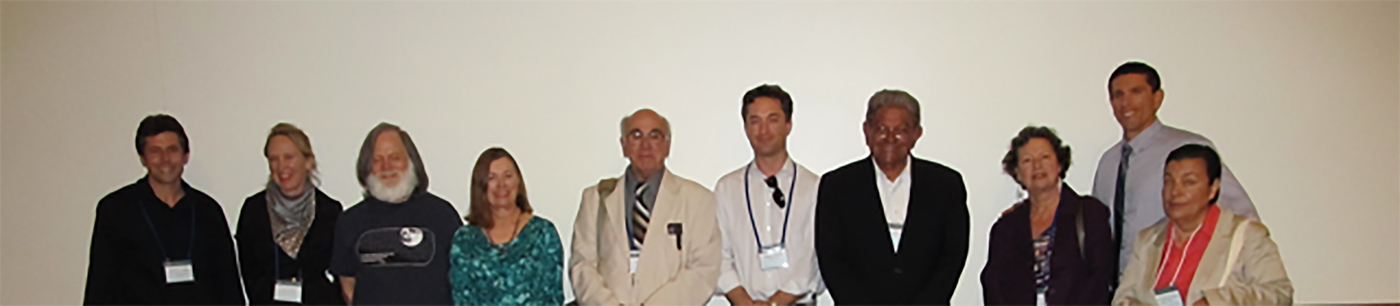
Aveni synthesizes the contributions of these scholars in a concluding essay based on his discussant commentary for the original symposium on which this Special Section is based (Figure 2). In this essay, Aveni shows how cultural astronomers have become indispensible in the overall scheme of explaining early astronomical practice in the context of Maya sites and records as well as those of other cultures. Aveni's essay, “An Overview of ‘Mesoamerican Cultural Astronomy and the Calendar,'” makes important contributions to the study of cultural astronomy, and his interdisciplinary efforts have been recognized with the 2013 Fryxell Award for Interdisciplinary Research in Archaeology, Earth Sciences.
2013 Fryxell Award Committee-Sponsored SAA Symposium Participants. From left to right: David Carballo, Anne S. Dowd, John Justeson, Susan Milbrath, Anthony F. Aveni, Benjamin Vining, Marcos Carías Zapata, Lorraine Aveni, Ethan Cole, and María Cristina Pineda de Carías. Not pictured: Juan Ignacio Cases Martin, Kristin Landau, and Gary Urton.
FUTURE RESEARCH DIRECTIONS
To summarize, the authors of the Special Section articles emphasize future research directions, including the relationship between groups whose maize cultivation alongside other domesticates created conditions favorable for settling down, with mobile hunting, fishing, and gathering populations that may have used horticulture as part of their seasonal subsistence strategies tied to an annual seasonal round. Other directions for future research seem worthy of additional study and specifically relate to the theme of cyclic death and rebirth. Two examples are described below.
The first involves exploring connections of informal folk day-counting using actual or analogic ancestral bones, with more formal written recordings of the passage of time using a long count. Among the future research directions that may be intriguing to pursue is whether new information about time keeping, prophecy, and genealogy may be obtained by analyzing inscribed bones found in Maya burials to see if some are ancestral bones of the interred individual. Freidel and Rich (Reference Freidel, Rich, Dowd and Milbrath2015; see also Brown Reference Brown and Aveni2015 for ideas about curated objects as sacra) have suggested that bone sticks and tokens were counting devices for divination and sortilege, or casting of a handful of seeds to interpret the past, present, or future. The inscribed bones found in Burial 116 at Tikal, buried with the king (Coe and Kerr Reference Coe and Kerr1998:140; Fitzsimmons and Shimada Reference Fitzsimmons and Shimada2011:56; Maholy-Nagy and Coe Reference Maholy-Nagy and Coe2008; Trik Reference Trik1963:15), could be studied to learn if any of these human bones could have been his ancestors' bones. A more explicit connection may have existed between the idea and the practice of appealing to ancestors for direction in rites of prophecy. Maya daykeepers may have sought guidance from their ancestors in a literal as well as a figurative sense. Hard tissue deoxyribonucleic acid (DNA) testing might link curated sacred human bones to their pre-Columbian descendants. Understanding whose bones were used for prophecy or divination and curated in sacred bundles could provide a deeper understanding of the significance of Mesoamerican calendars and astronomy, for land tenure in an agricultural society, and the risks associated with crop production in a highly populated zone with noncontiguous landholdings created environmental as well as social challenges (McAnany Reference McAnany2013). The idea of death and rebirth was central to lineage continuity or dominance and control by rulers whose right to rule was inherited. Additional research into the DNA makeup of the bones in archaeological contexts might shed light on kin group composition, and, if burials are found dating to relatively early Real 2 or 3 phases, give information on bone strontium levels known to vary with quantities of maize consumption.
The second potential direction for future research pertains to learning more about how dynasties manipulated the architectural site to strengthen a specific goal, smoothed the transitions in a dynastic succession, or promoted new initiatives in a reign (Dowd Reference Dowd2015; Peterson Reference Peterson2011). An example of political strategy expressed in architectural space-time is described for pre-Columbian Peru in South America by Nair (Reference Nair and Aveni2015:119), who asks how ancient people, like the Inca, animated landscapes above and below ground to give them transformational properties with regard to time and space, i.e., the Quechua notion of pacha combining both place and time? They used stone, a sacred material, and connected it to natural stone outcrops as a way to underscore the importance of the ruler and his family's ties to the land. Specifically, Pachacuti used a naturalistic augmented stone construction style at Machu Picchu, his royal residence, to suggest that newly conquered lands were part of a logical and sacred legacy, when in fact these lands were recently acquired. As his father designed Machu Picchu to persuade audiences that he belonged in his new role, the son, Topa Inca, designed Chinchero to convince audiences that a new interpretation of succession should be accepted, installing a secondary wife in a setting more appropriate for that of his sister and principal wife. Nair (Reference Nair and Aveni2015:125–126) suggests that one ruler looked back to an ancient past even though he was a new conqueror, while the other looked forward into the future to give support to the son he planned would succeed him. In addition to the immediate royal history, astronomical, agricultural, and ritual time though processional circuits in these architectural contexts traced historical dynastic events as in a series of royal pilgrimages. Power over these and other kinds of circulation though space and in time became paramount to Inca rulers. For the rulers and administrators, planned space saved time. For the people under the rulers’ control, ease of access was denied to them. Instead steep slopes and difficult stairways created a sense of unease and distance; access to a space was most definitely restricted by prolonging the time it took to get there. In this way, power or class differences were amplified. Not only living things died and were reborn, but also cities fell into ruin and were rebuilt. Urban designs were constructed according to certain principles, as people moved through them they cycled through different phases or states, and came to contain, animate, and signify patterns of lived experiences. These patterns, codified in calendars and interpreted in the fluidity of political machinations, are part of what archaeologists must interpret.
In the articles that follow this essay, a recurring theme is how calendars and architecture provided a working armature for subsistence and ritual activities that functioned in real-time and actual space (Ashmore Reference Ashmore2015:293; Aveni Reference Aveni1999; Bricker Reference Bricker2001; Bricker and Bricker Reference Bricker and Bricker2011). For the Maya peoples living in these tropical environments, one can easily imagine how the sun was perceived to have died at sunset and become reborn at sunrise. Conversely, the moon, bright stars, and planets could be seen to die at dawn and become reborn in the evening. These phenomena may have been analogies with the cyclic or repeating nature of Mesoamerican calendars, seasons, life spans, subsistence or agricultural patterns of harvest and regrowth, and, by extension, a means of justifying and explaining dynastic succession in terms of death, rebirth, metaphors for cultural disjunction and its continuity.
This Special Section concludes the 2012 and 2013 SAA symposia and resulting publications honoring Anthony Aveni. Milbrath and I (Dowd and Milbrath Reference Dowd and Milbrath2015) put together publications from the first symposium in 2012, published as Cosmology, Calendars, and Horizon-based Astronomy in Ancient Mesoamerica. Sponsored by the Fryxell Award Committee, the second symposium in 2013 resulted in a Special Section in the Cambridge Archaeological Journal (Dowd Reference Dowd2015). The present Ancient Mesoamerica set comprises the remaining group of articles. I thank my colleagues in these endeavors and urge readers to peruse the above-mentioned publications as a related collection of journal articles and book chapters on cultural astronomy.
RESUMEN
“Astronomía Cultural y el Calendario en Mesoamérica” es una Sección Especial que incluye artículos que exploran porciones de Mesoamérica donde astronomía y calendarios fueron estudiados por las poblaciones indígenas. Estudiosos reconocidos por su trabajo innovador en astronomía, tales como Aveni y también Pineda de Carías, Rivera y Argueta consideran los temas que caen bajo la rúbrica de Astronomía Cultural. Epigrafistas o expertos en la escritura jeroglífica, como Justeson y Vail, tratan de manera explícita con temas relacionados con el desarrollo del calendario. Un historiadora del arte, Milbrath, contribuye en el significado de temas astronómicos y calendaricos usando documentos importantes incorporando ambos imágenes y textos. Mientras que una arqueóloga, Dowd, y un arquitecto, Carrasco discuten los complejos arquitectónicos con una orientación significativa basada en la astronomía horizontal. Esta rica colección interdisciplinaria de artículos presenta los nuevos descubrimientos que entretejen la astronomía y la medición del tiempo, y conmemora la conducta ritual de los ciclos de muerte y renacimiento entre los mayas que vivían entre 225 y 1519 d.C. en lo que es ahora Honduras, Belize, Mexico, y Guatemala.
ACKNOWLEDGMENTS
Several of the articles included in this Special Section were first presented at the 78th Society for American Archaeology (SAA) Annual Meeting in Honolulu, Hawaii, on April 5, 2013, those by Aveni, Justeson, Milbrath, and Pineda de Carías et al. The SAA symposium, “2013 Fryxell Symposium: Papers in Honor of Anthony F. Aveni,” was sponsored by the Fryxell Award Committee and organized as well as chaired by Dowd. Professors Wendy Ashmore, University of California, Davis; Gary Urton, Harvard University; and Anthony F. Aveni, Colgate University, were the discussants. This symposium recognized the accomplishments for which Aveni won the 2013 Fryxell Award for Interdisciplinary Research in Archaeology, Earth Sciences. Other papers in this symposium (by Ashmore, Broda, Landau, and Vining) were published in the Cambridge Archaeological Journal Special Section, “Cosmovision in New World Ritual Landscapes,” which Dowd (Reference Dowd2015) guest edited. Professor Justeson assisted with coordination and selecting the journals for submitting the two groups of papers. Drs. Anthony Aveni, Boyd Dixon, and Susan Milbrath helpfully commented on a draft of this essay. Ms. Eloisa Pollack ably translated the abstract from English into Spanish.