If your opponent is an immoral monster, what do you do when you can’t destroy him? You can’t ignore him and you can’t negotiate with him…
Anonymous, Yugoslavia, 1993
Much of the 20th century’s history is defined by a myriad of midcentury global warfare brought on by the sociopathic leadership of Hitler, Mussolini, Stalin, and the like-minded military despots that they supported in Japan and Spain. The postwar 1945 United Nations Charter and additional international humanitarian law and the Geneva Convention documents, while focused on attempts to end future cross-border conflicts, also gave birth to an unprecedented Cold War stalemate that lasted until 1989. The Marshall Plan and similar efforts to bring back a hasty democratic rebirth to the major World War II powers of Germany and Japan did not take place within countries of the former Soviet Union. The sudden unleashing of totalitarian control by the then crumbling Soviet Union led, in the 1990s, to a torrential succession of unique post–Cold War complex socio-politico-economic nation-state disruptions that often resulted in internal war, high levels of violence, and forced migration of large populations.Reference David 1 Many nation-states suffered unprecedented public health and humanitarian catastrophes, wanton violations of international humanitarian law, massive corruption, suspension of the rule of law, massacre, and genocide. The international community, primarily handcuffed by claims of “national sovereignty,” struggled to find a legal precedence to intervene to protect and assist innocent civilians and vulnerable populations.
Some post–Cold War conflicts were true expressions of independence and freedom following years of repression, whereas others were attempts to sustain dictatorial control over populations. The rise of emerging warlords, dictators, and rogue state leaders who were focused on promoting internal despotism and the collapse of democratic behavior took hold despite the myriad of peace initiatives supported by the international community. Unrighteous actions were taken in the name of sovereignty that were instead focused on the consolidation of powers and riches and occurred at the expense of humanity, basic human rights, and common law. The contemporary buildup of armies in the free world had its inherent checks and balances to weed out the mentally disturbed and the most unsavory of personality disorders. However, the end of the Cold War was the “perfect storm” of chaotic circumstances that either perpetuated those in power or gave birth to unprecedented opportunities for individuals, many of whom evidenced various degrees of antisocial behaviors, to take advantage of the power vacuum to seek leadership roles in some of the most vulnerable and lawless countries of the world. Incompetent leaders, unlike at any time in history, were often assured tenure by the easy availability of sophisticated lethal weaponry in large numbers and the ready access to eager followers fueled by massive numbers of bored, unemployed, disadvantaged, and disaffected youth looking for a cause in life. For example, Hitler, after a humiliating defeat in World War I, promised the postwar German population living in poverty and severe unemployment a guaranteed peace with Russia, France, and England and an improved economy. The latter came quickly but primarily through the buildup of one of the strongest armies ever seen in the world. The population savored the rapid turnaround in the quality of life and turned a blind eye to how such individual wealth and pride in their country was restored. It is a very human-based failing that, both in peace and in conflict, individuals and populations risk being swept up by the seductive promises, charisma, and confidence projected by those imposing themselves on a vulnerable population during critical vacuums of leadership and order. In particular, once in power, a leader with an antisocial personality disorder (ASPD) thrives on continuing conflict and never seeks peace. Most compelling are the negative consequences on humanitarian efforts, diplomacy, and refugee and displaced populations that occur when protracted levels of conflict and war persist.
This article (1) describes the characteristics of narcissism in society, which at its most pathological level drives the destructive behaviors seen in ASPD; (2) describes how ASPD has managed to play a major role in prolonging post–Cold War conflicts and wars in both the late 20th and into the early 21st centuries and has led to predictable failures; (3) discusses what countermeasures are available or could be enhanced; and (4) provides both field-level examples and recommendations of how decision-makers and international organizations, by incorporating an improved knowledge base of ASPD, may improve ways of mitigating the prolonged impact of these offenders on vulnerable populations.
UNDERSTANDING NARCISSISM
Narcissistic Personality Disorder
Narcissism is evident in every human being, especially in children and young adolescents in whom some degree of “vanity and excessive self-focus” are both normal and necessary in the development of the dependent-to-independent self.Reference Behary and Siegel 2 By the end of adolescence, humans take steps into adulthood where autonomy and independence are expected accomplishments. Any continuation of narcissistic tendencies and behaviors may lead to “trouble in relationships”Reference Behary and Siegel 2 but terms referred to as “simple or healthy narcissism” are not considered a mental illness. However, those with an “enduring pattern of experience and inner behavior that deviates markedly from the expectations of the individual’s culture” 3 are referred to as the narcissistic personality disorder (NPD) in the 5th Edition of the Diagnostic and Statistical Manual of Mental Disorders (DSM-V) and describes major impairments in: 3
-
∙ “self-functioning,” in particular identity (excessive reference to others for self-definition and regulation of self-esteem, exaggerated and vacillation of self-appraisal) and self-direction (goal-setting based on gaining approval from others, seeing oneself as exceptional, unaware of own motivations) and
-
∙ “interpersonal functioning,” in particular empathy (impaired ability to recognize the feelings of others) and intimacy (largely superficial, little interests in others, need for personal gain).
In the modern-day world, a functional level of narcissism is found without concomitant injury to one’s personality and occurs in some of societies’ most prolific, charming, greedy, and yet admired business and technology tycoons, where the incidence among CEOs is conserved at about 4%,Reference Ronson 4 and larger-than-life sports and political figures. Behary writes of “the covert narcissist who can hide behind a façade of morally upstanding servitude” and “hungers for glorified recognition.”Reference Behary and Siegel 2 Yet, even in these daily business encounters, Kets de Vries and Miller caution that “narcissistic traits counteract the creative contribution that typically intelligent, ambitious, capable, and gifted individuals can make to an organization” and “that narcissistic leaders preserve close connections with associates who are compliant and will act on the leader’s orders, thrusting more truthful and consequently, essential employees to the sidelines.”Reference Kets De Vries and Miller 5
Lasswell saw the healthy mind as flexible with the ability to vary its responses depending upon its immediate environment. By contrast he saw the pathological mind as fixed.Reference Lasswell 6 While narcissists are often perceived as being above average, witty, captivating, skillfully deceptive and convincing, intelligent, and extremely capable of finding the weaknesses in people, getting their way is often accomplished with disarming glib and flippant responses or explanations, lies, fabrications, or bluffs and even abrupt and direct threats when questioned about their facts. Most can identify a time when they met or worked with individuals with NPD or reading of such traits among historical figures, such as Louis XV of France, who is known for his self-centeredness, lack of empathy, and diplomatic, military, and economic failures. Historian Jerome Blum described the king as “a perpetual adolescent called to do a man’s job.”Reference Blum, Cameron and Barnes 7 Narcissistic entitlements have toppled the careers of many politicians and other public figures who, once elected to a high office, experience an unbridled sense of aggrandizement and at times personally threaten those who they see as obstacles to their power and authority. Those with NPD will see themselves as God’s chosen people or at least having god-like powers that excuse whatever faults other humans may be judging them by.
NPDs are masters at presenting themselves as heroes with high morals and philosophy, including falsely charming their way into humanitarian organizations, lavishing in the praise and the impression it made on others while contributing nothing to the organization itself. Interestingly, they are intolerable of the moral side of liberal thinking yet may savor relationships with those with less black and white views, especially if they are perceived as having social status. However, while they are appreciated by many as being “smart,” they are not “bright.” Their concrete black-or-white view of the world and their place in it belies a lack of reflection, perception, observation, intuition, and feelings and an absence of abstract reasoning utilizing judgment, conceptualization, and generalization in their thinking and decisions.
Antisocial Personality Disorder
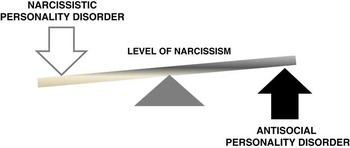
Where narcissistic behavior has become both a concern to society and to one’s self, it can be illustrated as behaviors depicted as fluctuating across a wide spectrum (Figure 1). While we may encounter people every day with lesser degrees of narcissism-driven behaviors that may be nothing more than annoying and labeled as NPD (on the left), those who evidence more severe and pathological degrees of narcissistic behavior and actions (on the right) do cause problems for every society. The DSM-V no longer includes a separate diagnostic category for malignant narcissism, psychopaths, or sociopaths. These terms have been eliminated and incorporated under ASPD. 3 Importantly, it must be understood that pathological levels of narcissism and narcissistic behavior are the major driving force for the degree of pathology, witnessed or practiced, and that is considered so aberrant and abhorrent in society. Not to confuse the readership or offend the DSM-V efforts, this article will refer to levels of “pathological narcissism” to highlight particularly violent behaviors that can negatively impact large populations and lead to some of the most violent of internal conflicts and wars.
The Spectral Influence of Narcissism.

While my experience and that of others would suggest that in practice the degree of narcissistic behavior in NPD remains somewhat stable over time, the potential for an abrupt worsening of narcissistically driven behavior is always present and may shift along the spectrum to ASPD. Underlying this potential are frequent outbursts and abrupt rages that last until they get their way. For example, those with a pattern of narcissistic embellishments that for many years did not change can resort to violence and even murder when challenged later in life by disclosure of their behavior or marital indiscretions that threaten loss of personal fame and status if revealed.
Despite its severity and impact on individuals and society, peer reviewed studies of ASPD are lacking. The incidence of ASPD is generally considered to be 0.6–4% in the general population, with a higher proportion of males to females and similarly recognizable in all cultures and societies giving evidence for genetic causes.Reference Coid, Yang and Ullrich 8 , Reference Thompson, Ramos and Willett 9 Both NPD and ASPD coexist with other disorders such as bipolar disease, major depressions, and borderline personality disorder. Today, the terms ASPD, sociopathy, and psychopathy are often used interchangeably in the peer-reviewed literature. The debate continues among practitioners and researchers in psychiatry, psychology, and the social sciences as to the origins and validity of personality disorders (nature versus nurture) in general.
The most crucial facets of ASPD, those of impulsive externalization, callous aggression, narcissistic entitlement, and boldness are captured well in features considered central to psychopathology. For example, the case of Lance Armstrong and the public exposure of his long-term lies and fabrications revealed his narcissistic inability to make sincere apologies or to admit to additional evidence against him, suggesting that his “sincerity” was both flawed and conditional and that his moral judgment capacity remains seriously impaired.Reference Avob and Thornton 10 Additional studies support that those with ASPD have certain deficits that might affect their moral understanding and consequently their “moral responsibility” for their actions.Reference Malatesti 11 , Reference Elliot 12 This has become a debatable issue in the “rights” under the law that psychopaths may argue in their own defense.Reference Levy 13 Despite interest in the possibility of ASPD being amenable to treatment, others assert that it is “singularly treatment resistant,” arguing that ASPD is a “global disorder in an individual’s worldview, including his social and moral outlook” and “unlikely treatable.”Reference Maibom 14 Nor does one change with age. Post writes of Libya’s Qaddafi as “a highly narcissistic leader consumed by dreams of glory” who did not mellow with age and “found it inconceivable that his people were not grateful to him, and when he said that his people loved him, he believed it.”Reference Post 15
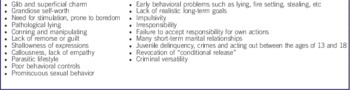
Hare developed the Psychopath’s Check List, Revised, which lists the qualities considered the gold standard for ASPD in the criminal court system (Table 1).Reference Hare 16 This list supports the consensus that persons with ASPD are without conscience; are without true remorse for the things they have done, the people they have hurt, or the laws they break; and have no motivation to change. Jurists assessing the guilt of persons with ASPD in court cases view them as being responsible for their own actions, as highly dominant, self-focused, capable of determining right from wrong, and “lacking in remorse and empathy”Reference Smith, Edens, Clark and Rulseh 17 , Reference Edens, Davis and Fernandez-Smith 18 and placed importance on how they perceived the behavioral degree of the ASPD offender based on measures of “boldness”Reference Edens, Clark and Smith 19 - Reference Lilienfield, Waldman and Landfield 21 (ie, social dominance and fearlessness, intelligence, violence potential, and perceptions that the ASPD offender was “evil”).Reference Edens, Clark and Smith 19
Narcissistic Qualities Seen in Antisocial Personality Disorder Court Evaluations

Those with ASPD have no personal or social conscience. At the same time, they will never accept responsibility and will project blame for failures on others. While appreciated as fearless, confident, and ruthless and focused when assuming their leadership role, they are basically incompetent. Failing to govern, substituting deviousness and deception for the lack of competence, obsessing over power, perpetuating fraud, and gaming the system becomes their own “theology.”Reference Cousins 22 One observer summarized that persons with ASPD “view social manipulation as their special talent, and by riding the backs of those they manipulate a sociopath can accomplish quite a bit.” 23
ASPD IN MODERN DAY CONFLICTS AND WAR
“Bad Leaders” and Other Culprits
With the end of the Cold War and the lessening threat of any looming international war, many began to recognize a major sea change among the emerging leadership coming out of the previously suppressed societies. Some cases proved terrifying. In his 1997 Internal War: Causes and Cures, Steven David cautioned that the “main actors” emerging from the internal conflicts and wars “range from government directed modern armies to roving bands of youths.”Reference David 24 The contexts, he states, “vary from one of tight central control to situations of total absence of authority” and included “revolutions, insurrections, insurgencies, terrorist campaigns, and mass slaughter.”Reference David 24 Ten years later David’s influential 2007 study “On Civil War” confirmed that 95% of armed conflicts between 1995 and 2005 occurred within countries rather than between them, citing weak governments, ethnic hatreds, religious fanaticism, and economic corruption and collapse, which he predicted would “continue to plague countries for many years to come.”Reference David 1 Gurr hypothesizes that the “potential for collective political violence varies strongly with the intensity and scope of relative deprivation,” adding that “the culture must at least accept, if not approve, violent action as a means to an end.”Reference Gurr 25 Gurr’s studies divided political violence intoReference Gurr 25 :
-
∙ Turmoil (spontaneous, unorganized riots and local rebellions),
-
∙ Conspiracy (organized political violence that does not involve large numbers of participants, such as assassinations and coups), and
-
∙ Internal war (organized political violence with widespread involvement whose aim is to topple the government).
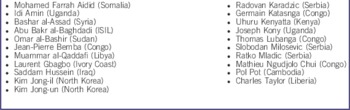
Posen argues that anarchy groups, even though they lack many of the “attributes of statehood,” fear for their security in the same way as nation-states do.Reference David 24 , Reference Posen 26 Indeed, whereas ASPD leadership thrives on conflict, for them conflict is a welcomed game that they eagerly anticipate and foment, and where the massive arsenals of both defensive and offensive weaponry is done to intimidate. Table 2 provides a limited list of world leaders whose varied antisocial and markedly narcissistically driven behaviors have been of particular concerns (eg, from chemical weapons use, ethnic and religious cleansing, forced migration, and mass murder).
Late 20th and Early 21st Century World Leaders Who Have Demonstrated Major Antisocial Behaviors

One could appreciate a pattern where, in the absence of reason and order, the opportunistic sociopath would enter—first as a savior then as a despot, or as common criminals claiming to be patriots. With previous governance and parties to power no longer trusted or acceptable, it has left a vacuum of leadership and a ‘staggering array’ of untenable root causes that would scare off even the most qualified leaders.Reference David 24 These “failed states” (a popular descriptive term in the 21st century) became ripe targets. David writes that it only takes a “small number of rebels to confront weak regimes,” describing “individuals or small groups of determined troublemakers that impose its will on others” with the “sheer joy of engaging in violence,” to terrorize the populace and plunge a nation into violent disorder.Reference David 24 He adds that “warlords in Somalia and Liberia owed their position and prosperity to the perpetuation of internal wars they understandably have little desire to see ended.”Reference David 24 Once in the position of power, for many, the descent into deeper pathology may be beyond their ability to resist—even their followers can become pathologically dependent.Reference David 24 , Reference Rankin 27
Hans Enzensberger cautions “that it may be pointless to look for a rational cause at all. Violence is an end in itself and civil wars are rages about nothing at all” or fought for the “sheer pleasure of killing,” adding that “civil war is a convenient label for instances of internecine strife whose causes we only dimly understand.”Reference David 24 , Reference Enzensberger 28 Brown sees the “Solbodan Milosevic’s of the world” as “bad leaders“ in that they “exacerbate hatreds as their own ends” and “incite others to attack in order to solidify their hold on power.”Reference David 24 Most troubling, he argues, is that internal wars are simply a means of “perpetuating themselves in power.”Reference Brown 29 Licklider concludes that it is difficult or impossible to stop these wars, citing that between 1940 and 1990 only 20% of civil wars were resolved compared with 55% of cross-border wars.Reference Licklider 30 , Reference Licklider 31
A person with ASPD’s threshold for inciting widespread civic violence is usually low. Most of the emerging leadership is unknown beyond the country’s borders, happening without any process of debate or persuasion or efforts to bring seasoned outsiders to one’s cause.Reference David 1 With easy access to worldwide communications, they can easily obtain immediate publicity and generate thousands of followers (eg, Baghdadi and ISIL [Islamic State]). Accurate data are lacking but evidence suggests that many new recruits for ISIL and those responsible for the deadly attacks in Paris are “hybrids between Jihad and a common criminal” with a long history of petty crimes and prison time.Reference Ward 32 There is so much we do not know about the psychological framework of the Paris attackers but their boldness and seemingly unfazed narcissistic behavior during the attacks are compatible with ASPD as was the “selfie-like” initiated video recording of the final attack by the hostage taker at the Kosher Market.
Transfer of Individual ASPD to the Culture
Pettman suggests that while the observed abnormality and dysfunction pertains only to individuals inextricably linked to power, their sustainability depends on their narcissistic ability to transfer that pathological thinking to key political communities or even to an entire culture.Reference Pettman 33 In Kolsto’s 2007 study, “The ‘Narcissism of Minor Differences’ Theory: Can It Explain Ethnic Conflict?”,Reference Kolsto 34 he uses the Yugoslavia breakup to explain that, in many ethnic conflicts and civil wars in the 20th century, the cultural differences between the warring groups were very small. He explains Milosevic’s sociopathic “genius” was to seize upon the minor differences between the Yugoslav ethnic groups and “expand the identity gap between them,” thus creating new boundaries between what were previously seen as weak differences justifying their mutual hostility and violence.Reference Kolsto 34 As an example, he cites the Rwanda slaughter which was undertaken by less than 10% of the Hutu male population who were genetically identical to the Tutsi but separated artificially “by social class” by their previous Belgian colony masters.Reference Kolsto 34 It must be noted that while political and religious differences could not be wider between Palestinians and Israelis, their genetic DNA is identical.
Cultural acceptance of the hatreds perpetuated by ASPD beliefs and behaviors of the leader equals another person’s narcissism and has great attraction for those who have renounced part of their own, giving the ASPD leader pleasure to dominate, control, and take from those around him.Reference Kolsto 34 While they typically reward their followers to sustain allegiance, such leaders are intent on iron-fisted control, relying on well-honed manipulative skills while ruthlessly exploiting or targeting others. For example, Saddam Hussein was known for publically encouraging critical feedback from his military staff, only to then assassinate those who did, summarily eliminating those who he thought might become disenchanted future rivals. There is rarely anything to stop them.
Religion and ASPD
The chronic smoldering risk factors within the countries and regions in peril have not improved. Historically, the large majority of internal and close regional wars evolve from conflicts over whose god is the real god. The PEW Research Center studies show that the share of countries with a high or very high level of social hostilities involving religion has reached a 6-year high, with 29% of countries having a high or very high level of government restrictions on religion. 35 Forty-seven percent of countries report abuse by private individuals or groups in society for acts as offensive or threatening to the majority faith. Worldwide harassment and deliberate targeting of Jews, either by government or social groups, has reached a 7-year high. 35
ASPD leaders, because of their pathological levels of narcissism, are convinced they have the right to rule and will be successful in obtaining their narcissistic goals. ASPD-driven narcissism has found a convenient and immediate outlet in today’s conflict-ridden world, one that provides unprecedented opportunities for the most charismatic of antisocial narcissists to proclaim their long-awaited fantasies of power which are often messianic in nature (eg, Abu Bakar Shekau of Boko Haram, Joseph Kony of Uganda). ISIS is one of the most glaring examples of such hardened religious-based ruthlessness tied to ASPD narcissistic leadership traits influencing current geopolitical discourse.
Impact of ASPD Behaviors on Humanitarian Efforts
Some see a direct correlation between the rise of ASPD leadership and the fall in opportunities for humanitarianism. Persons with ASPD would normally abhor the presence of any humanitarians in the countries in which they claim power. One can safely assume that those leaders listed in Table 2 are not aware of the Geneva Convention, International Humanitarian Law, or the International Convention Against the Taking of Hostages (Hostages Convention) and would choose to ignore them if they did. The Hostages Convention acknowledges that many “terrorists do not care for international law prohibitions which get in the way of violently attaining their political goals.”Reference Saul 36 The propensity of ASPD leaders to think in black or white terms translates to “anyone not under their complete control is the enemy.” The deficits of ASPD leaders in regard to understanding moral requirements, fake altruism, and lack of genuine concern and empathy for the interests of others questions their appreciation of what humanitarian motives and actions are or what they might entail.Reference Malatesti 11 , Reference Judge and Bono 37 A measure of the blatant disregard of humanitarian aid efforts, practiced under humanitarian principles of neutrality, universality, impartiality, and independence protected by the Geneva Convention, can be seen in the rising number of acts of violence (bodily assault, explosives, kidnapping, and shootings) and a marked increase in hostage-taking of humanitarian workers. Today, more humanitarians are killed or injured than United Nations (UN) Peacekeepers. 38 There must be a wake-up call for those seeking to provide humanitarian aid in these environments that an arbitrary deprivation of liberty exists and any civilian will be detained under the paranoia of a sociopath who interprets this act as an imperative of reasoned security.
How Common is ASPD Among Perpetrators of National Conflicts?
It is unknown what the incidence of ASPD in leadership might be in post–Cold War countries. However, there is no scarcity of recorded horrific antisocial behavior arising from ASPD leadership during major cross-border wars of the 20th century and there is always fear history will repeat itself. The Nuremberg and Tokyo trials indicted hundreds of World War II Nazi and Japanese prisoners, including over 20 physicians accused of human experimentation and mass murder. 39 In July 1998, 120 countries adopted the Rome Statute, the legal basis for establishing the permanent International Criminal Court (ICC), which went into force in 2002. The ICC is an independent court that tries persons “accused of the most serious crimes of international concern, namely genocide, crimes against humanity and war crimes.” 40 Today, the ICC is “based on a treaty effective as of May 2013 and joined by 122 countries,” the seat of which is at The Hague. Any nation-state which is party to the Rome Statue can request an investigation, but an investigation also may come from nonparticipating nation-states and the UN. 40 Following the argument of this paper on the importance of recognizing ASPD in world leaders, it is possible that the number of ICC investigations can serve as a ‘soft’ ballpark measure. Currently, those publically indicted by the ICC with arrests number 36, with additional warrants for 28 and summonses for 8. 40 As of January 2015, 95 Rwandans have been indicted for genocide and crimes against humanity with 36 serving prison sentences. 41
One group’s despots are another group’s patriots. Critics of the involvement of the United States in Iraq after 9/11 suggest that the actual aim of terrorists on 9/11 was to provoke the United States “armed to the teeth with weapons” into a military overreaction or a “narcissistic collusion with an enemy” by involving the United States in “a war wherever and however possible.”Reference Wirth 42 What frustrated the Bush administration was that Osama bin Laden never cared about territory, only in promoting his ideology; he was treacherous but invisible. But Saddam did care about territory, and the speculation is that the United States went to war with a convenient despot who had no relationship with 9/11, a war that many including the UN were against.Reference Wirth 42 This argument is the basis of the 2012 Kuala Lumpur War Crimes Commission sending the names of George W. Bush, Richard B. Cheney, Donald H. Rumsfeld, and their legal advisors to the ICC for war crimes in both Iraq and AfghanistanReference Ridley 43 ; an additional 2014 complaint to the court has focused on British actions in Iraq. 44 As of this writing, a UN 4-member commission has reported to the General Assembly on alleged war criminals in Syria that include President Bashar al-Assad.Reference Lederer 45
Today, the ICC is reviewing complaints from 139 countries with 9 being open investigations. The only continent to face prosecutions has been Africa, suggesting bias; however, atrocities in other regions are now being heavily investigated and expected to lead to prosecutions. 46 While these numbers provide some credence to the extent of individual and collective cases of ASPD that have made it before the Court, without wider country participation and appreciation of the true nature of unconstrained pathological narcissism, the numbers will remain underreported and under prosecuted and refugee flows will continue to escalate.
COUNTERMEASURES
Sovereignty and the R2P Doctrine
Sovereignty is taken to mean “the possession of absolute authority within a bounded territorial space” or a “fixed authority with a settled population that possesses a monopoly on the use of force.”Reference Brahm 47 Article 2(7) of the UN Charter states, “Nothing should authorize intervention in matters essentially within the domestic jurisdiction of any State,” the downside of which “came to a head in the post–Cold War era of the 1990s” in the international response to the “series of conscience-shocking man-made catastrophes that erupted.”Reference Evans 48 While situations warranted intervention, “the international community reacted erratically, incompletely, counterproductively or not at all.”Reference Brahm 47 When mediation, early warning mechanisms, economic sanctions, and UN Chapter VII powers fail, only military intervention to protect a county’s citizens from mass atrocities is available. Under the UN Security Council authority and the “Responsibility to Protect” (R2P) doctrine, sovereignty is “not an absolute right and this determination is forfeited when nation-states” fail to protect their populations from “genocide, war crimes, ethnic cleansing and crimes against humanity” and that the “international community” has a responsibility to intervene through coercive measures such as economic sanctions and with military intervention as a last resort. 49 Military intervention remains controversial with nation-states arguing that it is an infringement on sovereignty while others argue that it is the only viable option when other measures fail.Reference Brahm 47
Proper Labeling
It is both concerning and curious that these “bad leaders” are not properly referred to or named as having ASPD when the diagnosis is clear. For the most part these individuals have discernible character disorders not mental illness per se including psychoses. Where there is definitive assurance that comorbidity is not a factor (eg, narcissistic borderline) and where the evidence based on observed behaviors is firm, there is no alternative character diagnosis. While there is no hesitation to refer to such persons as having ASPD (or as sociopaths/psychopaths) in community or state courts or to deal expeditiously with the options under the professional diagnosis that the court has before it, the failure to do so within international law and its court system stems from the determination that it is unethical for a psychiatrist to offer a professional opinion unless he or she has concluded an examination of that individual and has authorization to do so. Subsequently, psychiatric profiles commissioned by the US government are used by intelligence agencies to “provide assistance to foreign policy officials, conducting summit meetings and other high-level negotiations with foreign leaders, as well as to assist in dealing with political-military crises,” issues all directly tied to national security and determined as “necessary in some cases, ethical and contributing to the national welfare.”Reference Post 50 Inability to properly deal with intractable ASPD behaviors in a timely manner provides the chronic offenders an enduring protective blanket or status deserved only for national and international public figures with long, respected, and properly earned careers in the service of the people. Rotberg, who spends much time describing the criminal behaviors that contribute to state failure or collapse, states that “anomic behaviors become the norm,” anomic normally being defined as lack of purpose, identity, or ethical values in a person or in a society.Reference Rotberg 51 This best describes a character disorder of ASPD. Resistance to labeling international offenders as having a character disorder such as ASPD is confusing and unacceptable with ramifications that can be lethal. Proper labeling would cease negotiations from going in the improper direction and prevent international decision-makers from reaching false hopes or claims as to the anticipated outcomes of their diplomacy. If in doubt, the international courts should argue the evidence of the case before a panel of independent mental health professionals.
During the Cold War and up to the middle 1990s, the large majority of refugees fleeing repression were from the Soviet Union and Southeast Asia. However, the current post–Cold War response to protracted refugee and internally displaced situations stands in stark contrast. The UN High Commissioner for Refugees argues that protracted refugee situations stem from “political impasses” and the result of political action and inaction, both in the country of origin (the persecution and violence that led to flight) and in the countries of asylum. 52 Nearly two-thirds of the 30 major refugee situations in the world today are protracted refugee situations. Admittedly, they “endure because of ongoing problems in the country of origin” which stagnate because the leadership has no interest in protecting those at risk or resolving the situation, solutions of which “do not exist in the foreseeable future.” Aside from the humanitarian problems, protracted displacement situations often lead to a number of political, security, and destabilizing concerns for the accepting countries and the region where the average stay of those in “extended and chronic displacement is now approaching 20 years,” 52 with no relief in sight.
FIELD-BASED EXAMPLES
Failure to acknowledge the dangers of denying the importance of ASPD in key areas of the world and not incorporating this diagnosis and information in both short- and long-term strategies is risky. While the ramifications of ASPD behavior on individuals within every community are high, little attention has been given to the impact ASPD continues to make on major vulnerable populations and ultimately nation-state, regional, and global security. In an attempt to demonstrate how the issues described in this article actually play out in real life, several examples are illustrated to better link ASPD behaviors to actual field-based scenarios.
-
∙ In 1992 Somalia, frustrations surfaced in the US diplomatic corps over the traditional State Department attempts to negotiate with General Mohamed Farrah Aidid. Negotiators became increasingly despondent when any hope of success gleaned during the daily meetings was trashed a few hours later during Aidid’s afternoon radio announcements. Traditional US State Department methodology that favored diplomatic, logical thinking; established customs; and nonadversarial bargaining (“Getting to YES: Negotiating Agreement Without Giving In”) were insufficient strategies that would not work with Aidid’s recognized psychopathology. After the behaviors that persons with ASPD exhibit were detailed to the diplomatic corps, Aidid’s lying pattern was disclosed and the direction of negotiations markedly changed.
-
∙ In the former Yugoslav Republic, the Serbs, Croats, and Muslims grew up, played, and lived in “relative harmony” together in the same neighborhood and schools, acknowledging that they frequently did not know the religion of a close neighbor nor did they care. In the wake of Tito’s death with the collapse of authority, Slobodan Milosevic and his Serbian henchmen took control in the failing communist state. Expatriate nongovernmental humanitarian workers immediately recognized the unprecedented and serious implications of Milosevic’s declaration requiring each citizen to declare an ethnic allegiance, fomenting hidden hatreds and eventually fueling ancient feuds turning “friends and neighbors into crazed killers.”Reference David 24 Even today there remain harsh reminders of narcissism gone wrong where one can see unscathed beautiful wood-framed homes with characteristic orange terra-cotta tiled roofs immediately next to the rubble of a once similar and now destroyed home belonging to a former neighbor of another religion.
-
∙ In 1995, the Dayton Agreement was proposed to cease the military confrontation and finally put an end to the 3.5 year war in the former Yugoslavia. Many seasoned professionals in the international and humanitarian communities who were well aware of Milosevic’s psychopathology adamantly objected to him being lavished in the role of a willing diplomat in Dayton, Ohio, warning that they knew of his psychopathic history and that he would not keep his word. These warnings were not heeded by the international leadership. While there were many who praised the language of the agreement, others cited major criticisms that the agreement failed to meet its objectives. But true to his ASPD nature, Milosevic invaded Kosovo, was later indicted for war crimes in the ICC, and died in prison. One can only speculate on what might have been the outcome if much earlier interventions, based on the collective and predictive knowledge of Milosevic’s ASPD behaviors, were considered.
-
∙ Knowledge of the ASPD profile of an adversary and experience gained over time in negotiations is valuable. General Wesley Clark writes that after many hours of negotiations with Milosevic, he knew when he was lying (having trained himself not to blink), recognized specific individual patterns of behavior that occurred when Milosevic had not thought out his lies ahead of time, and even learned to do a skillful imitation of Milosevic when he predictably tried to con Westerners about his innocence of war crimes.Reference Loescher and Milner 53
-
∙ After the 1991 Persian Gulf War, Saddam Hussein suppressed the Kurdish rebellion in the north of Iraq leading to the massacres of the Kurdish population and the fleeing of a half a million Iraqi-Kurds from their northern cities to the border of Turkey and Iran. A small team of the Federation of International Red Cross and Red Crescent Society (IFRC) members were sent to Baghdad to negotiate with Saddam Hussein with the intent to peaceably return the Kurds to their homes. The negotiations went poorly and appeared to go nowhere. With prior knowledge of Saddam’s highly narcissistic ASPD profile, the team suggested that “With all that has happened (a veiled acknowledgement that his regime had lost the war) would Saddam not wish to be recognized by the world as a humanitarian?” A buzz of interest prevailed and, soon after, arrangements were completed to bring an Iraqi IFRC delegation across the UN-protected border to meet with newly arrived UN negotiators. Unfortunately, this too eventually led nowhere.
-
∙ Vladimir Putin’s patterns of contemptuous behavior toward both national political rivals and international leaders are most worrisome. During the Cold War years as head of the KGB in East Germany he investigated Angela Merkel revealing her fear of dogs. In their first meeting years later when he was Russia’s president and she Germany’s chancellor, he purposely brought large dogs to the meeting to intimidate her. What might be one person’s example of a political coup or advantage is another’s cause for concern of a possible sociopathic pattern that might anticipate conditions that create more serious threats, misjudgments, and untoward destructive military actions.
-
∙ A more profound but legitimate example of narcissism on the world stage for readers to ponder comes from H.D.S. Greenway, a journalist with The Boston Globe. He reported in 2004 from observations gleaned from the famed annual Davos meeting of world leaders, corporate giants, and Nobel Prize winners that concentrating on military solutions to address the root causes of terrorism and constantly “trumpeting American exceptionalism” seemed to many “a desire to make the world over in America’s image.” This led to one delegate, an American, to describe the United States in terms of the clinical descriptions of a narcissistic personality, suggesting that “in terms of current events, the diagnosis might at times be applicable to nations as well as individuals.” 54
DISCUSSION AND RECOMMENDATIONS
The major goal of this opinion piece was to provide a multidisciplinary avenue where ASPD behaviors among the world’s political realm are better investigated, scrutinized, assessed, and deliberated by decision-makers at every level. Psychoanalytically informed observations and formulations extend our understanding of world affairs, especially the destructive and irrational historic and current events and their perpetrators. World leaders with ASPD have a capacity to internalize both aggressive and sadistic features of themselves that allows a paranoid stance against external influences and that makes them unwilling to internalize the meanings of their aggression, a point that must be understood by every diplomat and international legal body.Reference Goldner-Vukow and Moore 55 Previous studies and assessments of the psychological profile of leaders and the gauging of their functional level of moral-abstract reasoning need to be incorporated into the diplomatic process of decision-making. While there are detailed profiles of the psychopathology of Hitler, Stalin, Kim Jong-il, Mao Tse-tung,Milosevic, and Saddam Hussein, there is little or nothing available on today’s tyrants.Reference Post 50 , Reference Goldner-Vukow and Moore 55 – Reference McConochie 65 Rosenthal and Pittinsky acknowledge that study of narcissistic leaders is “inherently limited in scope” and call for “incorporation of narcissism into the field of leadership studies.”Reference Rosenthal and Pittinsky 66
Better understanding of narcissism-driven behaviors and the failures of traditional diplomacy is crucial in identifying those psychological characteristics that may limit governance capacity during times of conflict, transition to peace, and the adherence to a peace process or agreement. Close examination of leadership, especially those who demonstrate narcissistic personality organization, who inflame entitlement ideology, who have a demonstrated propensity for intimidation and violence, and who object to free and open dialogue and elections, is a crucial first step that should generate further investigation and direct preventive strategies. When these behaviors become worrisome, diplomatic communications may be scored for integrative complexity processing.Reference Suedfeld and Tetlock 67 Although not specifically utilized in sociopathic-driven “leadership” behaviors, one might find supportive evidence through patterns of narcissism, false claims, threats, rages, and marked rigidity in speeches and messages.
There are many multidisciplinary opportunities to study the prevalence of narcissistic-based decisions, missteps, successes, and outcomes for populations at risk and the activities necessary to find ways to better anticipate, mitigate, and manage the predictable consequences. In truth, traditional negotiations with ASPD leaders are a waste of time. Pettman emphasizes that it is not enough to tell these leaders to behave differently or to change their behavior. Because of the subconscious nature of the motives involved, “a more radical intervention is required than the rationalistic requirement that people recognize the need to do something different.”Reference Pettman 33 Conventional diplomacy, negotiation, and mediation approaches to conflict fail in these situations, in part for the same reasons that traditional approaches to psychological intervention in ASPD fail in everyday life. Failure to do so favors the uncompromising demands of the rogue leadership over the requirements of the population and thwarts consideration of more realistic and necessary, but controversial and politically risky, options to enforce peace.
Meanwhile, systematic use of psychodynamic data concerning leaders and their decision-making patterns and processes should be expanded, shared, and discussed at the highest diplomatic levels before determining the best actions for engagement and negotiations. Traditional diplomatic models used to evaluate political leadership, especially their economic, legal, and military frameworks, are insufficient and limited in developing strategies for dealing with conflict or prolonged war. ASPD cannot be reasoned with. It is difficult for diplomats to both grasp and understand the importance of an adversary’s pathological narcissism and to separate tried and true diplomatic trials from the raw reality, both uncomfortable but real, that comes with ASPD. It is ironic that responsible world leaders are rarely, if ever, heard to exclaim that failures in diplomacy are due to a country’s tragic leadership being under the control of someone with ASPD.
ASPD leadership needs to be managed as both a global security and strategic priority. One of the greatest opportunities to quell this sociopathic pattern globally is found in the potential of the ICC. Whereas the ICC has become a “high-profile institution on the world stage -- central to nearly every call for international justice for the most serious crimes,” 68 provisions to properly investigate and prosecute these offenders under the ICC fall painfully short of what must be optimized and expanded. Just the recognition of ASPD and its inclusion in the debate and management options does force certain imperatives and excludes others that are useless. Recognition of ASPD should be a leading tool for debate among diplomats, security personnel, and others who engage in negotiations and discussions at the transnational and international level. Additionally, the ICC remains hamstrung by the overdue ratification of the court by the United States, China, Pakistan, Israel, Indonesia, Sudan, Turkey, and India—without which the moral integrity of the world is shamefully insufficient, hypocritical, and tarnished. Only one Arab country, Jordan, is a signatory. 68 Most importantly, exploring the variations and severity of narcissistic behaviors and the interactions between leaders and the population they govern may help to anticipate the conditions in which social forces collide to create destructive acts, even genocide. International decision-makers must be prepared to recommend military intervention and force when necessary to thwart the highly predictable narcissistically driven objectives of leaders with ASPD.