INTRODUCTION
Herbaceous ecosystems dominated by therophytous, geophytous, hemicryptophytous and chaemephytous species (Poaceae) < 1 m in height (Lacoste & Salanon Reference Lacoste and Salanon1969; Ozenda Reference Ozenda1995), represent more than 25% of the Earth's landscapes (Henwood Reference Henwood1998), and are both flora and fauna rich habitats. In the Mediterranean Basin, from Turkey to Spain and Northern Morocco, herbaceous ecosystems are species-rich steppe formations (Buisson et al. Reference Buisson, Dutoit and Wolff2004) generally found on oligotrophic soils, having evolved through extensive traditional human management for centuries and/or millennia (Quézel & Médail Reference Quézel and Médail2003). More recently, herbaceous ecosystems have drastically reduced in extent throughout the world (Jacobs et al. Reference Jacobs, Kingston and Jacobs1999), particularly in the Mediterranean basin, owing to housing and industrial development and cultivation intensification (Willems & Bic Reference Willems and Bic1998; Poschlod & WallisDeVries Reference Poschlod and WallisDeVries2002; Dutoit et al. Reference Dutoit, Buisson, Roche and Alard2003). While much is known about the effects of agricultural changes on vegetation (in Mediterranean ecosystems: Grove & Rackham Reference Grove and Rackham2001; Römermann et al. Reference Römermann, Dutoit, Poschlod and Buisson2005; elsewhere: Austrheim & Olsson Reference Austerheim and Olsson1999[0]) and spontaneous regeneration after abandonment (in Mediterranean ecosystems: Bonet Reference Bonet2004; elsewhere: Wells et al. Reference Wells, Sheail, Ball and Ward1976), very few studies have focused on insect communities, particularly their regeneration after land-use changes (Good Reference Good1999; Moretti et al. Reference Moretti, Duelli and Obrist2006; Woodcock et al. Reference Woodcock, Edwards, Lawson, Westbury, Brook, Harris, Brown and Mortimer2008).
In most areas, remaining dry grassland fragments occur as islands in a sea of intensively farmed or industrialized land. Remnant patches of semi-natural ecosystems constitute a potential source of species for the colonization of abandoned plots, particularly if they are adjacent to one another (Hendrickx et al. Reference Hendrickx, Maelfait, Van Wingerden, Schweiger, Speelmans, Aviron, Augenstein, Billeter, Bailey, Bukacek, Burel, Diekötter, Dirksen, Herzog, Liira, Roubalova, Vandomme and Bugter2007). Plant and animal colonization processes on the margins of abandoned plots adjacent to remnant patches of undisturbed vegetation need to be studied (Wilson & Aebischer Reference Wilson and Aebischer1995), particularly in Mediterranean and dry areas, where drought greatly slows recovery processes (Blondel & Aronson Reference Blondel and Aronson1999; Buisson et al. Reference Buisson, Dutoit, Torre, Römermann and Poschlod2006; Fadda et al. Reference Fadda, Orgeas, Ponel, Buisson, Torre and Dutoit2007). Colonization processes on field margins are highly dependent on the degree of isolation of the plot, surrounding land uses and the dispersal ability of concerned species (Hendrickx et al. Reference Hendrickx, Maelfait, Van Wingerden, Schweiger, Speelmans, Aviron, Augenstein, Billeter, Bailey, Bukacek, Burel, Diekötter, Dirksen, Herzog, Liira, Roubalova, Vandomme and Bugter2007). There is little information on the dispersal ability of dry grassland Coleoptera onto former arable fields (Mortimer et al. Reference Mortimer, Booth, Harris and Brown2002). In large winter cereal fields, diversity and density of carabids decrease from the boundary habitat towards the field interior (Saska et al. Reference Saska, Vodde, Heijerman, Westerman and Van DerWerf2007), but other field types are unstudied and the relationship between field margins and fallow-lands established after crop abandonment is unknown.
Beetles (Coleoptera) are important in successional studies because they represent 40% of the known world insect diversity, include a high proportion of rare or endangered species (Erwin Reference Erwin, Wilson and Peter1988; Stork Reference Stork1991) and occupy almost all types of available habitats and all trophic levels (Crowson Reference Crowson1981; Koch Reference Koch1989a, Reference Kochb, Reference Koch1992). Moreover, insect communities are very sensitive to ecological changes (Eyre et al. Reference Eyre, Rushton, Luff, Ball, Foster and Topping1986) and are thus good indicators of anthropogenic disturbances (Erwin Reference Erwin, Reaka-Kudla, Wilson and Wilson1997; Orgeas & Andersen Reference Orgeas and Andersen2001; Sieren & Fischer Reference Sieren and Fischer2002) and of restoration and management success (Mortimer et al. Reference Mortimer, Hollier and Brown1998).
In the plain of La Crau in southern France (12 000 ha), climate, edaphic constraints and traditional extensive sheep grazing since the Neolithic period (7000 bp) have contributed to the formation of a Mediterranean steppe ecosystem. Human activities considerably modified and fragmented this area (Etienne et al. Reference Etienne, Aronson and Le Floc'h1998) in the 20th century. This area is a good site at which to study the impacts of land-use changes because the cultivation of melons and cereals from 1965 to 1985 reduced the overall area of the steppe by 1500 ha (to 10 500 ha) (Römermann et al. Reference Römermann, Dutoit, Poschlod and Buisson2005). La Crau is the only steppe ecosystem in France and has many similarities in structure and ecological processes to other Mediterranean steppe-like formations, such as the herbaceous component of dehesas in Spain (3 million ha), the herbaceous component of montados in Portugal (700 000 ha) and other steppes of North Africa and the Eastern Mediterranean (Grove & Rackham Reference Grove and Rackham2001).
In the Nature Reserve of Peau de Meau (160 ha), in the central part of La Crau, cultivated plots were successively abandoned between 1972 and 1985. The current structure and composition of the vegetation which colonized the field after abandonment differ considerably from those of the semi-natural steppe, being mainly composed of ruderal species and consistently poorer in species than the steppe (Buisson & Dutoit Reference Buisson and Dutoit2004; Römermann et al. Reference Römermann, Dutoit, Poschlod and Buisson2005). Steppe vegetation recolonization on the margins of formerly cultivated plots is extremely slow; > 20 years after abandonment, less than 60% of steppe plant species had colonized only a few metres on plot margins (Buisson et al. Reference Buisson, Dutoit, Torre, Römermann and Poschlod2006). Ground-active beetle community composition and structure have also been modified in the centre of these formerly cultivated plots (Fadda et al. Reference Fadda, Orgeas, Ponel, Buisson, Torre and Dutoit2007).
With the goal of understanding spatial colonization processes on field margins, this paper aims to determine whether notable changes in the composition, richness and diversity of ground-active beetle communities are observable on the margins of degraded areas adjacent to a large area of semi-natural steppe (6500 ha). We consider recolonization patterns and their implications for the biological management and/or ecological restoration of formerly cultivated plots.
MATERIAL AND METHODS
The study area
The plain of La Crau (Southern France) is the former delta of the Durance River, c. 50 km north-west of Marseille. The region has a Mediterranean climate, with long hot summers, mild winters (mean annual temperature 15 °C) and maximal rainfall in spring and autumn (550 mm per year), with marked interannual variation (see Buisson & Dutoit Reference Buisson and Dutoit2006 for details). The substratum is 5–40 m thick; at the top of this layer is an impermeable conglomerate composed of a calcareous matrix and a mixture of calcareous and silicious stones, which makes groundwater inaccessible to the vegetation (Devaux et al. Reference Devaux, Archiloque, Borel, Bourrelly and Louis-Palluel1983). Grazing maintains the vegetation as a steppe formation, which is currently overgrazed. This steppe hosts a species-rich vegetation characterized by both calcicolous and silicicolous plant species, including locally rare species (Devaux et al. Reference Devaux, Archiloque, Borel, Bourrelly and Louis-Palluel1983).
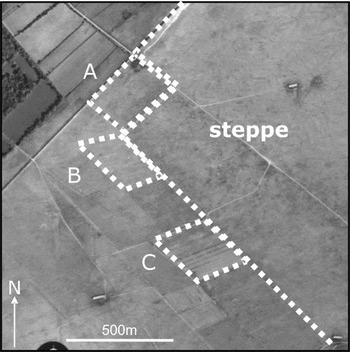
Three formerly cultivated plots (A, B and C) each c. 5 ha in area were selected within the Nature Reserve of Peau de Meau (43° 33′ E, 4° 50′ N), located in the central part of La Crau. The three plots were adjacent to one large remnant patch (6500 ha) of uncultivated steppe (Fig. 1) in order to avoid confounding changes in plant species composition of steppe patches within the plain (Devaux et al. Reference Devaux, Archiloque, Borel, Bourrelly and Louis-Palluel1983). All plots were currently managed by sheep grazing only. The plots were all cultivated for melons first and then for cereals (see details in Buisson & Dutoit Reference Buisson and Dutoit2004). These types of cultivation are representative of disturbances in this area (20% of the original steppe area) and in the Mediterranean basin as a whole (Römermann et al. Reference Römermann, Dutoit, Poschlod and Buisson2005).
Aerial photograph (Institut Geographique National [France] 1986) of Nature Reserve Peau de Meau with location of the three formerly cultivated plots A, B and C and the steppe.

Sampling
Beetles were sampled on the margin of each formerly cultivated plot on three 10 m long transects, set perpendicular to the plot boundary with the steppe and 10 m distant from each other (see Buisson et al. Reference Buisson, Dutoit, Torre, Römermann and Poschlod2006 for details on this experimental set-up). Along these transects, 11 pitfall traps (50 mm × 110 mm plastic containers, half-filled with preservative liquid glycol) were buried flush with the soil surface one metre apart (i.e. 99 traps, 33 per abandoned plot).
The sampling was continuous throughout 204 days April–November 2001, traps being checked and replaced 13 times. Adult beetle species were sorted to morphospecies (Oliver & Beattie Reference Oliver and Beattie1996) and then identified to species or the closest taxonomic level using the laboratory reference collection. Taxonomic nomenclature followed Fauna Europea (2004). Environmental variables measured included vegetation richness, per cent cover of the dominant steppe plant species Brachypodium retusum (Pers.) P. Beauv (Poaceae) and Thymus vulgaris L. (Lamiaceae), and per cent cover of stones, bare ground and vegetation in the area surrounding each trap (10 sub-quadrats of 40 cm × 40 cm).
Statistical analysis
We summed all traps sampled at the same spot across all sampling dates. In order to compare the three formerly cultivated plots, we summed the three traps located at the same distance from the boundary for each plot (resulting in a global reduced matrix [33 samples × all species]; based on Fadda et al. Reference Fadda, Orgeas, Ponel, Buisson, Torre and Dutoit2007).
We performed detrended correspondence analysis (DCA) applying the ‘down-weighting of rare species’ option (Canoco 4.5) on this global reduced matrix in order to describe the beetle composition of the formerly cultivated plots. We undertook Kruskal-Wallis tests followed by Mann-Whitney U tests (Statistica 6.0; Statsoft France 2004) on abundance and richness data.
In order to analyse differences with distance from boundaries, each formerly cultivated plot was considered separately, resulting in three matrices [33 traps × species of formerly cultivated plot]. We performed three canonical correspondence analyses applying the ‘down-weighting of rare species’ option (Canoco 4.5) with environmental measurements as covariables. We carried out Kruskal-Wallis tests on abundance and richness data among distances. We compared abundances of the species having a total abundance ≥ 20 among distances from the edge. Then we verified whether any species progressively appeared or disappeared along the distance gradient from the steppe boundary. We tested changes with Spearman rank tests for each formerly cultivated plot, relative abundances with distance (Statistica 6.0; Statsoft France 2004).
We analysed differences in species composition between the steppe and the three formerly cultivated plots with the Sørensen index (presence/absence data) using the 2j/(R1 + R2) formula, where R1 and R2 are species richness in compared areas 1 and 2, and j is the number of species occurring in both areas 1 and 2 (Legendre & Legendre Reference Legendre and Legendre1998). We calculated the Sørensen indexes for each distance from the boundaries and for each formerly cultivated plot and compared with reference species lists (Fadda et al. Reference Fadda, Orgeas, Ponel, Buisson, Torre and Dutoit2007) from the centre of the steppe and from the centre of each formerly cultivated plot. We tested changes with increasing distance with Spearman rank tests (Statistica 6.0; Statsoft France 2004).
RESULTS
A total of 2305 individuals belonging to 32 families and 126 species were captured (Appendix 1, see Supplementary material at URL http://www.ncl.ac.uk/icef/EC_Supplement.htm). The dominant species were Asida sericea (Olivier) (Tenebrionidae, 1100 individuals, 47.7% of total abundance) and Longitarsus succineus (Chrysomelidae (Foudras) 142 individuals, 6.1% of total abundance). Only 17 species had an abundance ≥ 20 (Acinopus picipes (Olivier), Dinodes decipens (L. Dufour), Poecilus sericeus Fischer von Waldheim [Carabidae]; Protaetia oblonga (Gory & Percheron) [Cetoniidae]; Dibolia cryptocephala (Koch), Longitarsus obliteratoides Gruev, Longitarsus succineus (Foudras), Timarcha tenebricosa (Fabricius) [Chrysomelidae); Scymnus frontalis (Fabricius) [Coccinelidae]; Coniocleonus nigrosuturatus (Goeze), Pseudocleonus cinereus (Panzer) [Curculionidae]; Ptomaphagus sericatus (Chaudoir) [Leiodidae]; Pelochrus pallidulus (Erichson) [Malachiidae]; Onthophagus emarginatus Mulsant & Godart, Onthophagus furcatus (Fabricius) [Scarabaeidae]; Ocypus ophthalmicus (Scopoli) [Staphylinidae] and Asida sericea (Olivier) [Tenebrionidae]).
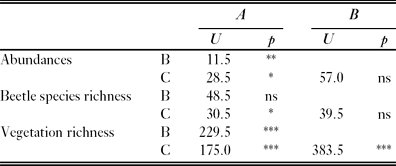
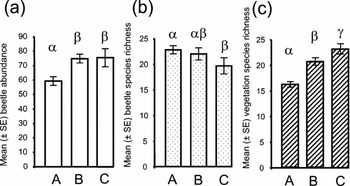
In plot A, 628 individuals were captured in total, which was significantly less than on plots B or C, with respectively 823 and 830 individuals captured (Table 1). However, plot A had greater species richness (89 species) than B (81 species) or C (77 species) (Fig. 2; Table 1). Of the 39 species found in all three formerly cultivated plot margins, 30 were found in the steppe (Fadda et al. Reference Fadda, Orgeas, Ponel, Buisson, Torre and Dutoit2007). Plot C had the greatest vegetation species richness and plot A the lowest (Fig. 2; Table 1).
Results of Mann Whitney tests on beetle abundance, beetle richness and vegetation richness data for formerly cultivated plots A, B and C (* = p < 0.05; ** = p < 0.01; *** = p < 0.001; ns = not significant).

Mean (± SE) (a) abundance, (b) species richness of beetles (n = 11) and (c) vegetation richness per 4 m2 plot (α, β and γ indicate similar groupings based on Mann-Whitney U tests).

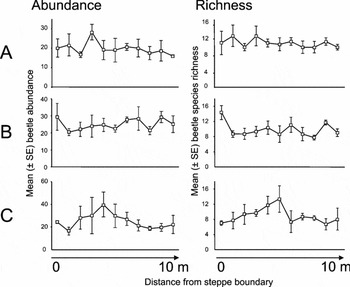
Axes 1 and 2 of the DCA of the reduced matrix (28.4%) discriminated among the three plots (Fig. 3). Axis 1 also separated the points of plot A further from the boundary (8, 9 and 10 m) from those closer to the boundary. There were no significant peaks or consistent increases or decreases in total beetle abundance or species richness with increasing distance from boundaries on any of the three plots (Fig. 4).
Detrended correspondence analysis ordinations of (a) samples (3-summed-traps), where numbers correspond to distance from boundary, and (b) beetle species where only species contributing more than 1% (i.e. 25 species) are included. Species abbreviations: Acpi = Acinopus picipes, Amru = Amphimallon ruficorne, Asse = Asida sericea, Brbi = Bruchidius bimaculatus, Coni = Coniocleonus nigrosuturatus, Dicr = Dibolia cryptocephala, Dide = Dinodes decipens, Docr = Donus crinitus, Enpi = Enicopus pilosus, Loob = Longitarsus obliteratoides, Losu = Longitarsus succineus, Mosp = Mordellidae (G. sp.), Ocob = Ocypus obscuroaenus schatzmayri, Ocop = Ocypus ophtalmicus, Onme = Onthophagus emarginatus, Onfu = Onthophagus furcatus, Pepa = Pelochrus pallidulus, Pose = Poecilus sericeus, Prob = Protaecia oblonga, Psci = Pseudocleonus cinereus, Ptse = Ptomaphagus sericatus, Scfr = Scymnus frontalis, Seim = Sepedophilus immaculatus, Tite = Timarcha tenebricosa and Xael = Xantholinus elegans.

Plots of mean (± SE) abundances and richness against distance from boundaries for each formerly cultivated plot.

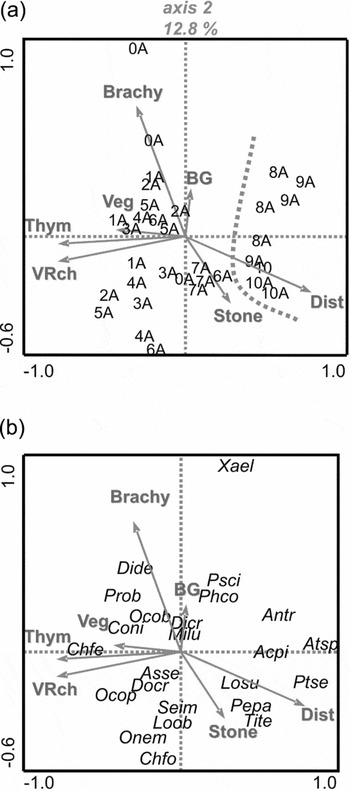
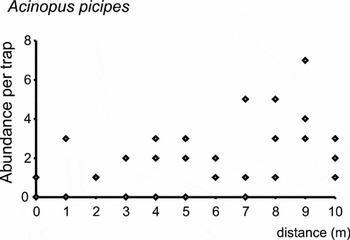
In plot A exclusively, axis 1 of the CCA (32.1%, Fig. 5) discriminated points closer to the boundary, with species such as Conicleonus nigrosuturatus, Dinodes decipens and Asida sericea, correlated with higher Brachypodium and Thymus cover, from points further from the boundary (8, 9 and 10 m), with species such as Acinopus picipes, Microlestes luctuosus Holdhaus in Apfelbeck (Carabidae) and Atheta sp. (Staphylinidae). Sørensen indices indicating similarity with steppe species decreased with distance from the boundary (R = −0.78; p < 0.01). Out of all species having an abundance ≥ 20, only Acinopus picipes abundances significantly increased with increasing distance from the boundary (R = 0.54; p < 0.01; Fig. 6).
Canonical correspondence analysis ordination of plot A data, of (a) samples (numbers correspond to distance from boundary), and (b) beetle species (only species contributing > 1%, i.e. 25 species, are included). Species abbreviations: Acpi = Acinopus picipes, Antr = Anthicus tristis, Asse = Asida sericea, Atsp = Atheta sp., Chfe = Chrysolina femoralis, Chfo = Cholovocera formicaria, Coni = Coniocleonus nigrosuturatus, Dicr = Dibolia cryptocephala, Dide = Dinodes decipens, Docr = Donus crinitus, Loob = Longitarsus obliteratoides, Losu = Longitarsus succineus, Milu = Microlestes luctuosus, Ocob = Ocypus obscuroaenus schatzmayri, Ocop = Ocypus ophtalmicus, Onme = Onthophagus emarginatus, Pepa = Pelochrus pallidulus, Phco = Phalacrus corruscus, Prob = Protaecia oblonga, Ptse = Ptomaphagus sericatus, Seim = Sepedophilus immaculatus, Tite = Timarcha tenebricosa and Xael = Xantholinus elegans. Covariables: BG = % bare ground cover; Brachy = % Brachypodium retusum cover; Dist = Distance from steppe boundaries in m.; stone = % stone cover; Thym = % Thymus vulgaris cover; Veg = % cover other vegetal species; VRch = vegetation richness.

Plot of Acinopus picipes abundances against distance from steppe boundary on plot A. (Spearman R = 0.54; p < 0.01).

DISCUSSION
To develop recommendations for the biological management and/or ecological restoration of former cultivated plots, we studied the spatial colonization processes of beetles on field margins. We found that distance from boundaries did not have any consistent influence on abundance, richness or diversity of beetles on any plot. Margins thus neither possessed an edge effect (Odum Reference Odum1971; Yahner Reference Yahner1988) where beetle species richness would be greater than those of the two adjacent ecosystems (Magura et al. Reference Magura, Thóthmérész and Molnár2001; Magura Reference Magura2002), nor constituted an ecotone (Frochot Reference Frochot1987) where beetle species not found in the two adjacent ecosystems would appear (Asteraki et al. Reference Asteraki, Hanks and Clements1995). We were unable to identify any pattern of ground beetle communities on the margins (as observed by Kotze & Samways Reference Kotze and Samways2001) in plots B and C.
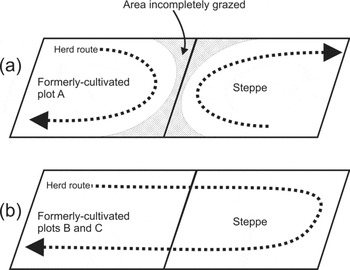
However, we also found that, for plot A alone, beetle composition changed with distance. The composition of the beetle community seemed to be more similar to that of the steppe closer to the boundary than that further away. As no loss or gain of species was observed, many steppe species disappeared (for example Coniocleonus nigrosuturatus and Bioplanes meridionalis) and were replaced by species more typical of formerly cultivated plots (for example Endomia tenuicolis, Cordicomus instabilis or Acinopus picipes) with increasing distance. This margin therefore constituted an ecocline, defined as a gradient of progressive species appearances and disappearances (Van der Maarel Reference Van Der Maarel1976; Gourov et al. Reference Gourov, Godron and Loshchev1999a, Reference Gourov, Godron and Loshchevb; Dutoit et al. Reference Dutoit, Buisson, Gerbaud, Roche and Tatoni2007). This ecocline is attributable to changes in plant species composition with increasing distance from boundaries; the plot A margin was characterized by the most visible gradient of T. vulgaris and B. retusum, mainly found 0–2 m from the boundary. Moreover, a complete study of the vegetation has shown that steppe species progressively disappear with increasing distance from the boundary while arable weeds become more common (Buisson et al. Reference Buisson, Dutoit, Torre, Römermann and Poschlod2006). Arable weeds are attractive for beetles (Fadda et al. Reference Fadda, Orgeas, Ponel, Buisson, Torre and Dutoit2007), as they provide food (seeds, herbivorous insects or invertebrates) and may act as a sink (Saska et al. Reference Saska, Vodde, Heijerman, Westerman and Van DerWerf2007) for nearby steppe beetle species. Since the steppe and formerly cultivated plots are grazed, the vegetation gradient may be due to a grazing gradient (Woodcock et al. Reference Woodcock, Pywell, Roy, Rose and Bell2005a). Plot A and the steppe do not belong to the same owner, resulting in a less grazed area at their boundary because shepherds modify the sheep access route to avoid grazing on their neighbour's land (Fig. 7) and this leads to a gradient of sheep grazing pressure (Dureau & Bonnefon Reference Dureau and Bonnefon1998).
Impact of herd route on grazing intensity when (a) two plots belong to different owners (plot A and steppe) and (b) two plots belong to the same owner (adapted from Dureau & Bonnefon Reference Dureau and Bonnefon1998).

We also noted that the margin of the plot with the lowest vegetation richness (plot A; Buisson et al. Reference Buisson, Dutoit, Torre, Römermann and Poschlod2006) had the highest beetle species richness of all three plots. Conversely, the margin of the plot with the highest vegetation richness (plot C) had the lowest beetle species richness. These results differ from observations in Northern Europe grasslands of a positive relationship between vegetation richness and beetle species richness (Buse Reference Buse1988). In this study, vegetation richness could not be the factor explaining beetle species richness, supporting the importance of vegetation composition (Perner et. al Reference Perner, Wytrykush, Kahmen, Buchmann, Egerer, Creutzburg, Odat, Audorff and Weisser2005; Woodcock et al. Reference Woodcock, Pywell, Roy, Rose and Bell2005a; Fadda et al. Reference Fadda, Orgeas, Ponel, Buisson, Torre and Dutoit2007).
Spontaneous colonization of beetle community
The two most abundant beetle species on the steppe were Poecilus sericeus and Asida sericea (Fadda et al. Reference Fadda, Orgeas, Ponel, Buisson, Torre and Dutoit2007) and these two species occurred in all formerly cultivated plots both in the centres and at the margins. These species disperse in similar ways, are brachypterous and move only along the ground, although Poecilus seems to be more active and move more rapidly than Asida (S. Fadda, personal observation 2005). As these two species do not have peaks of abundance at the margins, their populations had homogeneous densities across the whole plots whatever the vegetation composition or structure. These species may thus have recolonized the degraded plots in the early years following abandonment of cultivation. However, their abundance differed: Asida sericea was less abundant in all formerly cultivated plots than in the steppe and Poecilus sericeus was only less abundant on plot A (Fadda et al. Reference Fadda, Orgeas, Ponel, Buisson, Torre and Dutoit2007). Former cultivation has modified habitats and created new conditions less favourable for these two typical steppe beetle species. Moreover, the responses of the two populations differed from one formerly cultivated plot to another, highlighting the complexity of factors influencing beetle distributions. The environmental variables we tested do not explain these differences and further studies on the influence of the landscape matrix immediately after abandonment of cultivation are necessary. The rove-beetle Ocypus ophtalmicus was the only abundant species occurring in all margins and centres of formerly cultivated plots and steppe in the same proportion; changes in habitat wrought by cultivation do not seem to have affected its distribution.
Fadda et al. (Reference Fadda, Orgeas, Ponel, Buisson, Torre and Dutoit2007) found only few individuals of many weevils (such as Limobius borealis, Donus crinitus and Cycloderes canescens) were found in the steppe, while they were found in greater quantity in formerly cultivated plots. They occur on the margins of formerly cultivated plots with no particular variation of abundance with distance and at the same densities as on the plots. These weevils are phytophagous insects with narrow host-plant tolerances (one plant species or genus; Hoffmann Reference Hoffmann1950, Reference Hoffmann1954), are already present in steppe and have the highest occurrence in the formerly cultivated plots (Buisson & Dutoit Reference Buisson and Dutoit2004). Formerly cultivated plots have created new habitats where a few common steppe plant species (for example Plantago spp., Erodium spp. and Lobularia maritima) have become established and spread, phytophagous beetles following their host-plants. In contrast, phytophagous beetles were absent when their host plants did not become established or when few individuals colonized formerly cultivated plots. Because species responded differently on margins, understanding the causes of spatial variation in active-ground beetles at the species level is important before agricultural landscape can be successfully manipulated in order to restore the functional diversity of the former arable plots.
CONCLUSIONS
More than 20 years after cultivation abandonment, all the most common steppe beetle species, mainly saprophagous and predator species, had recolonized formerly cultivated plots, albeit at a lower density than in the steppe, because they are less habitat-specialized than phytophagous species (Buse Reference Buse1988). An adjacent steppe patch is insufficient for complete auto-restoration of steppe beetle communities on the formerly cultivated plots even at the margins while habitat quality remains less favourable in these modified areas, notably with respect to many abiotic factors affecting predator or saprophagous species, and vegetation structure and composition for phytophagous species (Eyre Reference Eyre2006).
Here, restoration measures could accelerate processes. The first possibility, as observed in plot A, would be to decrease grazing pressure on the margins between former cultivated plots and remnant patches of steppe (Fig. 7a). The aim of reorganizing grazing routes would be to create vegetation gradients which may generate ecoclines (Woodcock et al. Reference Woodcock, Pywell, Roy, Rose and Bell2005a). Another option is to restore habitat quality to its prior state using the adjacent steppe as a reference, replacing the 50% stone cover removed for cultivation (Buisson Reference Buisson2006) and combining this stone cover restoration with varying sheep grazing levels, which influence both abiotic and biotic factors in the steppe (Bourrelly et al. Reference Bourrelly, Borel, Devaux, Louis-Palluel and Archiloque1983). Stone cover restoration has already been successfully used in the re-establishment of the two structuring plant species, Brachypodium retusum and Thymus vulgaris, in the absence of grazing during the initial years after plant reintroduction (Buisson Reference Buisson2006). Seed mixtures have already been sowed to restore Coleoptera assemblages in dry grasslands or field margins on arable farms (Mortimer et al. Reference Mortimer, Booth, Harris and Brown2002; Woodcock et al. Reference Woodcock, Westbury, Potts, Harris and Brown2005b). However these experiments are too recent to draw definitive conclusions as to their success and, in the long-term, an appropriate grazing management regime is required to support the restoration of Coleoptera assemblages of dry grasslands (Woodcock et al. Reference Woodcock, Pywell, Roy, Rose and Bell2005a).
ACKNOWLEDGEMENTS
We thank the Conservatoire-Etudes des Ecosystèmes de Provence and the Eco-Musée de Crau for allowing us access to the Nature Reserve of Peau de Meau, Michel Cornet for the identification of Staphylinidae, and Pascal Campagne, Frédéric Guiter, Frédéric Médail, Daniel Pavon and Marjorie Sweetko for their contributions to the draft manuscript.