Introduction
A common pattern in tests of human memory performance is the serial position curve, especially when memory is tested immediately after learning: performance is typically better for stimuli learned either at the beginning (primacy) or at the end (recency) of a study list, as compared to the middle (e.g. Murdock, Reference Murdock1962). The serial position curve assumes a particular shape for immediate-free recall tasks in individuals with Alzheimer's disease (AD), who present a reduction of the primacy effect, while the recency effect is intact or exaggerated (e.g. Foldi et al., Reference Foldi, Brickman, Schaefer and Knutelska2003). However, when testing delayed performance, individuals with AD tend to show the most pronounced deficit at the recency position (Carlesimo et al., Reference Carlesimo, Sabbadini, Fadda and Caltagirone1995). Based on this discrepancy, Bruno et al. (Reference Bruno, Reichert and Pomara2016) proposed that the ratio between immediate and delayed recency, i.e. the recency ratio (Rr), may measure cognitive decline. In particular, they proposed that higher ratios presented a pattern of enhanced immediate recency followed by loss of information after a time delay.
Although the exact neurocognitive mechanisms underlying the link between higher Rr scores and potential cognitive impairment are not entirely clear at this stage, Bruno et al. (Reference Bruno, Reichert and Pomara2016) have proposed that individuals suffering consistent and severe loss of long-term memory and consolidation ability (e.g. individuals with dementia presumably due to AD) may rely more frequently on short-term memory processes, which, even if impaired, tend to be comparatively spared. Therefore, this long-to-short shift, possibly a compensatory mechanism, would naturally result in a pattern of performance consistent with higher Rr scores. To test this hypothesis, Bruno et al. examined whether Rr predicted changes in generalized cognitive ability (measured with the Mini-Mental State Examination, or MMSE; Folstein et al., Reference Folstein, Folstein and McHugh1975) over two subsequent visits, from a cognitively healthy baseline. They observed that higher baseline Rr scores were correlated with more subsequent cognitive decline, and that decliners presented high immediate recency recall combined with a substantial drop in recency performance after a delay.
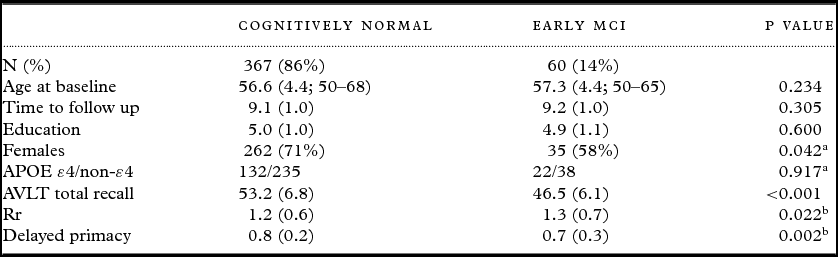
The present paper set out to confirm previous findings by testing whether Rr was associated with a subsequent diagnosis of early (preclinical) Mild Cognitive Impairment (early MCI; Koscik et al., Reference Koscik2016). The study was carried out over an average follow-up time of just over nine years (see Table 1), and all participants were cognitively intact at baseline. We anticipated that higher baseline Rr scores would predict greater risk of an early MCI diagnosis at the follow-up visit. To isolate the effects of Rr, we also controlled for total recall and delayed primacy effects (Bruno et al., Reference Bruno, Reiss, Petkova, Sidtis and Pomara2013).
Demographics

N = number of participants included in the analysis who either remained cognitively normal at follow up, or converted to early MCI; Age in years (mean, standard deviation, and range); Time to follow up in years (mean and standard deviation); Education level (median and range; from 1=8th grade or less to 6=post-graduate); Gender (number of females and percentage); APOE ε4; AVLT total recall score at baseline (mean and standard deviation); Rr score at baseline (mean and standard deviation); and delayed primacy score at baseline (mean and standard deviation). Tests are t-tests unless specified.
aχ 2 test was used; bMann–Whitney test was used.
Methods
Participants
Individuals were recruited as part of the Wisconsin Registry of Alzheimer Prevention (WRAP; Sager et al., Reference Sager, Hermann and La Rue2005). WRAP is a longitudinal study of participants who were middle-aged and free of clinical MCI or dementia at their baseline visit; participants complete follow-up visits, typically after two-to-four year intervals. Inclusion criteria for this study were that participants at baseline were not diagnosed by consensus conference as having any form of cognitive impairment (see the Cognitive Status section for details). Additionally, all participants were native English speakers, aged 50 years or over at baseline and had returned for follow up, receiving a consensus conference diagnosis classifying them as either cognitively normal or early MCI. Our final sample consisted of 427 participants, including 60 participants who converted to early MCI at follow up. The study was approved by the Health Sciences institutional review board of the University of Wisconsin-Madison, and the Faculty of Science Ethics committee at Liverpool Hope University.
Procedure
WRAP study procedures have been previously described in detail (e.g. Sager et al., Reference Sager, Hermann and La Rue2005). In brief, each visit included a neuropsychological test battery, and a series of self-report questionnaires on health history and lifestyle. In addition, blood was drawn for APOE genotyping (the procedure is described by Engelman et al. (Reference Engelman2013)). The neuropsychological test battery included the Rey Auditory Verbal Learning Test (AVLT), where participants are read a list of 15 unrelated words before being asked to freely recall the items immediately (trial 1; i.e. the immediate recall trial). After the first learning trial, the same process is repeated four more times with the same words. Subsequently, a new list is read (interference), and participants once again are asked to recall the original 15-word list. After a 20–25 min delay, participants are retested for their memory of the original word list (delayed recall trial). The same word list was used at all visits.
Cognitive Status
WRAP adopts a two-tiered consensus conference method to classify individuals in terms of their cognitive status. The first tier of review includes applying an algorithm that identifies cases where impairment may be present; and the second tier includes a team review of those flagged by the algorithm. Specifically, WRAP participant visits are reviewed at a consensus case conference if they meet one or more of the following criteria: (1) the participant is performing 1.5 SDs below the mean on factor scores or individual measures of memory, executive function, language, working memory, or attention (Koscik et al., Reference Koscik2014; Clark et al., 2016); (2) cognitive performance on one or more tests fell below values used in other studies as cut-points for clinical MCI diagnoses (e.g. WMS-R Logical Memory II, Wechsler, 1987: story A score <9: AD Neuroimaging Initiative, Petersen et al., Reference Petersen2010); or (3) an abnormal informant report indicating subjective cognitive or functional decline. Consensus diagnoses of cognitively normal, early MCI, clinical MCI, dementia, and impaired-not-MCI are determined for each visit by a research team including physicians, clinical neuropsychologists, and clinical nurse practitioners based on review of cognitive, medical history, lifestyle, subjective cognitive complaints, and informant data (Koscik et al., Reference Koscik2016). The status of early MCI was developed to identify individuals in the cohort who exhibit lower than expected objective performance in one or more cognitive domains relative to internal robust norms but do not report subjective cognitive complaints or clinical deficits. This experimental construct is thought to represent a phenotype of early cognitive decline expected to precede a clinical diagnosis of MCI. For the purposes of the present study, only individuals categorized as either cognitively normal or early MCI were included in the analysis. The exclusion of individuals with more severe classifications (e.g. dementia) was motivated by the desire to determine whether Rr was sensitive to the initial stages of disease progression and thus may be a potentially useful tool for early detection.
Serial Positions
Primacy and recency were defined as the first and last four items on the study list, respectively. Rr was calculated by dividing the recency scores in the immediate recall trial, Trial 1 of the AVLT, by the corresponding scores in the delayed recall trial of the same test. An Rr score was calculated for each participant from the baseline visit data. A correction also was applied ((immediate recency score + 1)/(delayed recency score + 1)) to avoid missing data due to zero scores. Of note, this correction is different from the one used previously (Bruno et al., Reference Bruno, Reichert and Pomara2016; Reference Bruno2017), since the original correction was found to generate paradoxical results.
Statistical Analysis
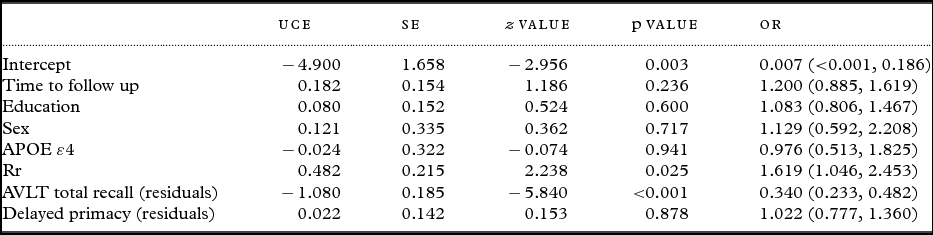
For the analysis, we performed a logistic regression with a binary outcome: the outcome was consensus diagnosis status at the follow-up visit, binarized to cognitively normal versus early MCI. We chose two time points for the analysis: baseline and a follow-up visit that took place at least seven years later. All participants were cognitively intact at baseline and either remained the same or converted to early MCI at follow up. Predictors were level of education (on a scale from 1, indicating 8th grade or less, to 6, indicating post-graduate studies); sex; APOE ε4 status; time between baseline and follow up; Rr; delayed primacy (using primacy performance in the delayed trial); and total recall. To avoid issues of multi-collinearity, total recall was quantified here as the standardized residuals of total recall performance regressed over Rr; in turn, delayed primacy was similarly regressed over the total recall residuals and Rr together. Analyses were carried out in R version 3.2.3 (R Core Team, 2016), and SPSS 23 and 24.
Results
Table 1 reports means and standard deviations for the demographic variables, and memory scores. To confirm the suspicion of multi-collinearity, we ran bivariate correlations between Rr, total recall, and delayed primacy. Rr was significantly correlated with both total recall (r = −0.249, p < 0.001) and delayed primacy (r = −0.256, p < 0.001), which were in turn mutually correlated (r = 0.465, p < 0.001). These correlations were analogous using Spearman's ρ.
The analysis yielded two significant predictors: total recall (z value = −5.840, p < 0.001), indicating that greater total recall was associated with lower risk of conversion to early MCI; and Rr (z value = 2.238, p = 0.025), confirming the prediction that higher Rr scores are linked with greater risk of early MCI (other predictors, p's > 0.24). Table 2 reports all regression results, including odds ratios. Of note, for every unit change in baseline Rr, the odds of an early MCI classification later on increase (or decrease) by approximately 62%.
Output of the logistic regression analysis

UCE = unstandardized coefficient estimate; SE = standard error; OR = odds ratios (confidence intervals: 2.5%, 97.5%).
For the purposes of identifying potentially useful Rr cut-off points for clinical screening purposes, we note that whereas only 20% of early MCI converters (12/60) had an Rr score above 1.65, 85% of non-converters had an Rr score below 1.65 (308/367) – for a positive predictive value of 17%, and a negative predictive value of 87%. In contrast, 82% of converters had an Rr score at 1 or greater (49/60), but only 34% of non-converters had an Rr score below 1 (123/367) – for a positive predictive value of 17%, and a negative predictive value of 92%.
Discussion
In this paper, we aimed to expand on a previous report by Bruno et al. (Reference Bruno, Reichert and Pomara2016) by examining serial position ratios in conjunction with diagnosis of early MCI. With binomial regression analysis, we found that the probability of receiving a diagnosis of early MCI was higher when the Rr score also was higher. Rr is based on recency performance, which focuses on memory for only the most recently presented information. At the immediate trial, this information has been presented only seconds prior, whereas in the delayed trial, 15–20 min have elapsed. Therefore, a high Rr score, and generally a score above 1, indicates that the person remembers comparatively more items immediately after learning than they do after a delay. Higher scores are suggestive of more forgetting over time as compared to lower scores, but such scores are considered in the context of a stronger performance in the immediate task. Bruno et al. (Reference Bruno, Reichert and Pomara2016) have argued that shifting the emphasis from long-term retention (delayed performance) to short-term memory ability (immediate performance), particularly when evaluating recency performance, may be indicative of a compensatory mechanism whereby increased long-term forgetting, presumably due to a loss of consolidation ability, leads to enhanced short-term memory processing. Therefore, paradoxically, improved performance at immediate recall is likely to fit into a negative cognitive profile signaling impending risk of cognitive decline, as our results suggest. Some evidence supporting this account comes from a recent report by Bruno et al. (Reference Bruno2017) showing that Rr, but no other measure of memory in the study, was associated with levels of glutamate in the cerebrospinal fluid of a group of individuals with late-life major depression. Glutamate, the principal excitatory neurotransmitter in the brain, is implicated in long-term potentiation and the formation of long-lasting, consolidated memories. Specifically, consistent with the notion that a compensatory mechanism may emerge when cognitive ability deteriorates, Bruno et al. (Reference Bruno2017) showed that whereas delayed recency increased when higher levels of glutamate were detected, the opposite was true for immediate recency; in other words, individuals whose glutamate levels were found to be higher appeared to rely less on short-term memory processing and more on long-term processing. More evidence is needed to elucidate this point, including whether this mechanism may be automatic or deliberate.
Despite the fact that baseline Rr was predictive or early MCI risk at follow up, we noted that the baseline total AVLT score yielded a stronger effect. This finding is not surprising because, although not exclusively, evaluation of broad AVLT categories is employed as part of the diagnostic process (see cognitive status), whereas Rr, albeit derived from the same test, is not. Nevertheless, Rr was shown to provide a predicting value for early MCI conversion above and beyond that of total AVLT. More importantly, in our view, is the fact that Rr may be narrowing in on specific mnestic processes that are affected in AD, as opposed to the AVLT total recall score, which, as is a less specific index of memory performance, would likely include a number of different mnestic processes that could be affected by a host of different pathologies. Moving forward, it would be helpful to identify areas in which Rr may provide unique contributions to early detection and diagnosis of neurodegenerative disorders, including differential diagnosis of dementia types.
Delayed primacy performance was not predictive of early MCI conversion in this study. This finding may appear to contradict previous reports suggesting that delayed primacy was sensitive to subsequent cognitive decline (Bruno et al., Reference Bruno, Reiss, Petkova, Sidtis and Pomara2013), much like Rr. However, as noted, we employed in the analysis the residuals of delayed primacy regressed on Rr and the residuals of total recall. Therefore, in this instance, delayed primacy was only used as a control variable, and may not have been fairly represented. To confirm this point, we re-ran the analysis by replacing Rr with delayed primacy, and replacing the standardized residuals of total recall calculated from regressing total recall on Rr by the standardized residuals of total recall calculated from regressing total recall on delayed primacy, and further by adding standardized residuals of Rr calculated from delayed primacy and the residuals of total recall. The results show that delayed primacy is also predictive of early MCI conversion (unstandardized coefficient = −0.546, SE = 0.163, z value = −3.354, p < 0.001), when controlling for total recall and Rr with an odds ratio of 0.579 (2.5–97.5% CIs = 0.420–0.797). Further research is needed to elucidate the different predictive values and underlying mechanisms of both primacy and recency recall performance.
All in all, our results suggest that serial position markers offer predictive value for the early identification of early MCI, independently from traditional neuropsychological measures of memory ability, such as total recall, and can therefore add to the array of cognitive markers for studies of neurodegenerative disorders. In this respect, we believe that researchers working on developing databases of AD biomarkers should consider including serial position values to their variables.
Conflicts of interest
None.
Description of author's roles
DB provided the concept, analyzed the data, and wrote the paper; RLK and JLW provided feedback on the paper, and on the statistical analysis in particular; NP helped developing the concept; and SCJ provided input on the clinical procedures, in addition to overseeing WRAP.
Acknowledgments
We wish to thank the WRAP study team for their data collection efforts and the WRAP participants for their dedication to the study. WRAP is supported by NIA grant R01AG27161 (SCJ). WRAP is also supported by the Clinical and Translational Science Award (CTSA) program, through the NIH National Center for Advancing Translational Sciences (NCATS), grant UL1TR000427. The content is solely the responsibility of the authors and does not necessarily represent the official views of the NIH.