

Homelessness has been described as a complex problem that manifests out of such multifaceted issues as poverty, family violence, drug addiction and crime (Brown, Keast, Waterhouse, & Murphy, Reference Brown, Keast, Waterhouse and Murphy2009). In Australia, on Census night 2011, 25% of the 105,237 individuals found to be homeless were Aboriginal and Torres Strait Islander people, and yet Indigenous Australians represent only 2.5% of the total population (Australian Bureau of Statistics, 2011). Between 2008–2009, 66% of the 34,000 Indigenous people seeking support from the Australian Supported Accommodation Assistance Program (SAAP) were women and almost half of those women were accompanied by children (see Australian Institute of Health and Welfare [AIHW], 2011). Clearly this complex homeless problem impacts to a greater degree, per head of population, on Indigenous women than others in the Australian community.
Specific information relating to Indigenous women's homelessness in the literature is sparse. Indeed, this lack of attention to the distinct needs of Aboriginal women and their children may continue to marginalise them and entrench inequities in service delivery (Aboriginal and Torres Strait Islander Social Justice Commissioner [ATSISJC], 2005). It is assumed that Indigenous women in Australia have access to either services designed for Indigenous people in general, or services designed for women only. However, there are very few services or policies designed specifically for Indigenous women, who, while experiencing many of the same gender based disadvantages as other women, also face unique challenges based on ethnicity and systematic racism (ATSISJC, 2005).
Two specific studies published to date, targeting Australian Indigenous women's homelessness, reveal some of the fundamental challenges faced by Indigenous women when seeking housing support. One case study based in a Tennant Creek (Northern Territory) women's refuge (provided for Aboriginal women) noted that domestic violence, increased by stress from overcrowding, was the key reason women had become homeless initially (Memmott, Nash, Baffour, & Greenop, Reference Memmott, Nash, Baffour and Greenop2013). This is in line with other research in non-indigenous populations. For example, the Australian Institute of Health and Welfare (AIHW, 2013) found that the most common reason for Australian women's homelessness was domestic violence. In the case of Indigenous women, however, it is even more concerning as figures show that these women experience both domestic violence and homelessness at much higher rates (AIHW, 2013; Chamberlain & MacKenzie, Reference Chamberlain and MacKenzie2008).
Another study of Indigenous women who were released from Western Australia prisons into homelessness found that chronic homelessness was inter-related and interconnected with recidivism (Mokaraka & Scott, Reference Mokaraka and Scott2012). Mokaraka and Scott (Reference Mokaraka and Scott2012) found that having children in care, being in care themselves as children, experiencing domestic violence, a long history of trauma and abuse, or drug use all contributed to the homelessness cycle. A further complicating factor was the obligation to provide housing to family members, which indicated delicate tenancy arrangements and led to overcrowding thus increasing risk of homelessness. Custodial release was found to be a key factor in Indigenous homelessness, with many women unable to secure housing upon release (Baldry & McClausland, Reference Baldry and McCausland2009; Lawrie, Reference Lawrie2003; Mokaraka & Scott, Reference Mokaraka and Scott2012).
Aboriginal women also face other disadvantages including higher rates of recidivism, mental health disorders, domestic and sexual violence, and homelessness, than their non-indigenous counterparts. Additionally, they have a higher number of dependent children than non-indigenous women and most have been traumatised by having been removed or having members of their family stolen as children (Baldry & McClausland, Reference Baldry and McCausland2009; Lawrie, Reference Lawrie2003). Thus Indigenous women's homelessness is a complex issue with a number of interacting factors contributing to the problem.
In the broader literature relating to all those who access SAAP homelessness services in Australia, a greater proportion of female clients identified as being an Indigenous Australian (66% female compared to 23% male) (AIHW, 2011). And, the most common reasons all Indigenous clients gave for seeking assistance were domestic or family violence (26%); time out from family/other situation (10.5%) and relationship/family breakdown (9%). Other common reasons included accommodation, overcrowding and financial issues (AIHW, 2011). Domestic violence generally is considered the ‘biggest driver of homelessness’ in Australia (Heaven, Reference Heaven2009).
Further complicating this picture of homelessness for Indigenous Australians is the task of gathering accurate data. For example, locating people described as ‘rough sleepers’ can be problematic (Memmott & Nash, Reference Memmott and Nash2012); the cultural perceptions and definitions of homelessness for Indigenous people may differ from non-Indigenous people (see Australian Bureau of Statistics [ABS], 2014); and the pathways into homelessness for Indigenous people may also differ (Memmott & Chambers, Reference Memmott and Chambers2010).
Considering all of the complexities of understanding Indigenous homelessness, especially for Indigenous women, this study sought clarification from the service providers responsible for assisting homeless Indigenous women, as to why Indigenous women were presenting to their services.
Methods
To ascertain the perceptions of service providers working with homeless Indigenous women, five homelessness service provider agencies were approached from Cairns and Mount Isa respectively and agreed to participate in this study. Client service officers who worked directly with homeless Indigenous women were identified by each agency and a short survey was made available to those officers. Depending on their preference, respondents completed the survey on-line or were provided with a printed copy and a reply paid return envelope. Included in the survey were questions that referred to, for example, reasons for presentation; services provided; referral information; which home communities the women were relocating from; whether there were peak periods of Indigenous women presenting to homelessness services; whether children were presenting with the women; how well they were coping with homelessness; and if there were any perceived unmet needs. The survey was largely qualitative, allowing participants to expand on themes and/or to introduce new information for consideration.
In analysing the survey responses, thematic analysis was used to produce categories and themes derived from words and phrases used by the service providers in response to the survey's questions. Themes represent patterns in responses and meaningful topics in relation to the research question (Braun & Clarke, Reference Braun and Clarke2006). Thus the most salient issues are extracted from the responses by using thematic analysis (Joffe, Reference Joffe, Harper and Thompson2011).
Results
All respondents to the survey were female, aged from 25 to 58 years (N = 9, M = 39), with a period of employment in homelessness from between 18 months and 8 years. Respondents worked for the following agencies: Mission Australia (Cairns); Cairns Women's Centre; Tablelands Women's Support Service; The Salvation Army (Mount Isa); and the Family and Neighbourhood Centre (Mount Isa).
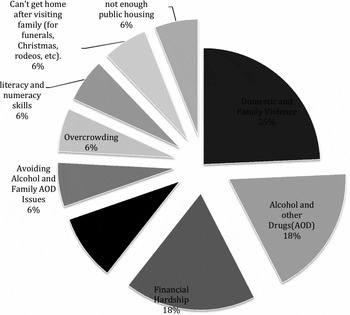
In response to the service providers’ views as to why Indigenous women presented to their services, the following themes emerged.
Service providers’ views (by relative representation) on why Indigenous women present to homelessness services.

Domestic violence
Domestic and family violence was the most common primary reason cited by service providers for Indigenous women seeking homelessness services. Open-ended responses included:
Considering our DV work, we sometimes see women for a few times before she can make the break. They usually need the support of other Indigenous women to help with their children and share with. (SP_4)
In many cases they are advised to (leave home) either by police, hospital etc. I often find that if women are told they need to relocate they are unhappy and want to return. They miss family and friends. Why are we making women relocate when they would rather not? They should be encouraging them to stay in their home (housing is hard to secure). Securing DVO’s, safety plans, changing locks etc. – it makes no sense for women and children to be held accountable for someone else's behaviour. (SP_4)
We also see children of old clients coming in who are now grown and have children of their own. Unfortunately, some clients take a long time to ultimately break the cycle of violence and if they don't have the support from family/friends and an ongoing support worker it is very difficult. (SP_4)
In the case of domestic and family violence, they will often disclose that they have left several times before, so maybe they are used to it. . . I had one client who lived with a DV perpetrator for years. He would beat her until he wore himself out, and sometimes she would present with concussion, and very obvious injuries especially on her left temple. The police wouldn't do anything and maintained that she had to leave town, but she wouldn’t. She eventually caught him having sex with another woman and stabbed him a number of times, although he didn't die. She was off to prison last time I saw her, but I never found out what happened to her. I think the injustice of it affected me. (SP_6)
Many have social supports fractured due to DV and family situations. (SP_4)
Some women have suffered horrendous injuries. (SP_1)
Our clients have their own amazing story. Many of them are around leaving family and domestic violence where they have suffered. (SP_1)
Financial Hardship
Financial hardship was the second most frequently stated reason why Indigenous women were seeking assistance from service providers (tied with Alcohol & Other Drugs as outlined below). A scarcity of affordable short-term and long-term private and public housing appears to further compound the problem of financial hardship, particularly when women present with children. Financial problems were often tied with financial illiteracy. The service providers shared the following insights:
(Financial problems) when children increase in age and parents are changed from Parenting Payments to Newstart. (SP_7)
Financial Counselling, more affordable housing and less waiting lists. To financially include Indigenous women/children into society and to be able to support themselves in affordable housing. It is longer term because of lack of finances and affordable housing. (SP_7)
Being financially illiterate, and no choice for housing. Too expensive. Yes, getting out of the cycle of poverty is getting harder and people just keep going around and around on the roundabout. Shelters, Department of Human Services payments. More accommodation and more financial assistance. (SP_7)
Alcohol and Other Drugs
Alcohol problems, rather than other drugs, were cited as often as financial hardship as a reason for seeking assistance. Some providers referred to Indigenous women's own alcohol use; most referred to partners and family members; while others referred to general problematic levels of drinking. One service provider referred to substance misuse, rather than alcohol use. Further detail regarding alcohol and other drug use were not provided by the service providers.
Other Reasons for Seeking Housing Assistance
Homelessness service providers shared more detailed information about barriers associated with the private rental accommodation that can act to prevent Indigenous women from finding somewhere to live. Those barriers included: prejudice and racism of real estate agents; the need for more public housing; avoiding financial and alcohol management plans; overcrowding; insufficient literacy and numeracy skills; an inability to return to their home communities and transport issues. The service providers elaborated on these issues as per the comments below. Prejudice and racism were cited as influencing the approaches adopted by some real estate agencies. Some illustrative examples included:
Judgments from real estate agents. (SP_2)
Prejudice and racial treatment by real estate agencies. (SP_4)
Limited success in securing housing through real estates if they identify as living in supported crisis accommodation. We have real estates that refuse to register women, so they are unable to apply for any housing that this real estate has available to rent. No reason is required to be provided. (SP_2)
An owner would prefer to rent to women and three children than women and six. (SP_2)
Private rental market is too high in costs and availability for many Indigenous women is blocked by real estate agents.. . . . . . . I have a woman with 6 children who has been unable to find a private rental due to the number of children she has and the fact that she is Indigenous. Many real estate agents and landlords will not rent to an Indigenous woman with a large family. Yet she is reliable with her rent and looks after the children and transitional house very well. (SP_4)
Some service providers indicated that the Northern Territory Intervention contributed to some women leaving their home communities and becoming homeless. Comments included:
Avoiding alcohol management plans and income management in their home communities. (SP_6)
Fleeing income management and alcohol management plans as well as to access better health and education services for their families. (SP_6)
Avoiding alcohol management plans and issues, family breakdown. (SP_6)
Overcrowding (‘saying no to family = less overcrowding’) was also provided as a reason for women seeking homelessness services. Overcrowding was seen to compound tenancy, financial and family problems, eventually leading to homelessness for some women.
Too many women are living in overcrowded situations, too many are putting their tenancies at risk by having family stay with them, and many are very stressed when they can't get visitors to leave or to contribute to the household. I had one woman here last week trying to sneakily get her power cut off, in the hope that with no fan or air conditioner, TV or computer, her family members would just leave. (SP_6)
Insufficient literacy and numeracy skills were also seen as problematic for some.
A further reason for women becoming homeless was identified as the inability to return home after visiting family, attending social events or dealing with difficult business and transport issues.
Show time, Rodeo time and after Christmas when they come to Mount Isa to stay with family and outstay their welcome. (SP_5)
Unable to afford to get home after an experience with the legal or health systems or visiting family for funerals or events such as Christmas or the rodeo. (SP_6)
Transport is a huge problem. There is no public transport and women who do have their own cars but are travelling to very remote areas can have problems financing their trip. (Our service) does not have a way to provide cash to women going places where there are no supermarkets and only very small independent petrol stations. (SP_6)
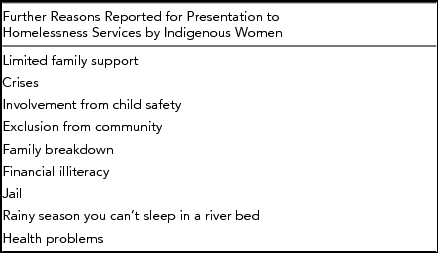
Other less commonly cited reasons for Indigenous women to present to homelessness services are outlined in Table 1.
Further reasons provided by services providers for why women present to homelessness services.
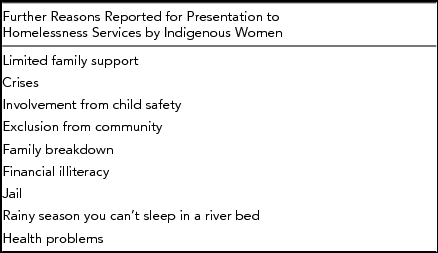
Service providers’ comments relating to issues in Table 1 above included:
Our Indigenous clients are used to having other ‘family’ to help them look after their children so they sometimes struggle with having to be responsible for their care 24/7. (SP_11)
The local shelters are almost always full. (SP_6)
Rainy seasons are probably the most serious as people like to stay dry and they cannot stay in the riverbed when there are flash floods. (SP_6)
Community Origins
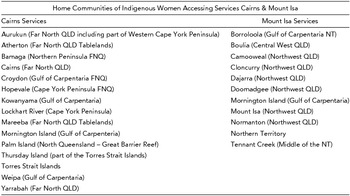
The homelessness service providers also shared data on the home communities from which Indigenous women originated prior to accessing their services in both Cairns and Mount Isa. Table 2 below illustrates this information.
Home Communities of Indigenous Women Accessing Homelessness Services in Cairns and Mount Isa.

Unmet Needs
Various needs of the Indigenous women were deemed by the homelessness service officers to be unmet. Those unmet needs included: education (as a key need to foster self-reliance – including financial counselling, living skills and relationship skills); a culturally sensitive workforce; language needs (e.g. plain language information sheets – or in Creole (Torres Strait) or Kriol (Aboriginal); and greater access to Recognised Entities (Aboriginal and Torres Strait Islander organisations or individuals mandated and funded to provide advice about child protection issues). The suggestion of plain language information sheets was accompanied by a recommendation of producing these in Creole or Kriol. As noted by one of the investigators though, while many Indigenous people can speak this language, it is unusual for them to be able to read or write it, thus plain English texts would appear to be preferable.
Children Presenting with Homeless Indigenous Women
Service providers were also asked about children coming in contact with homelessness services. Both service providers in Mount Isa and Cairns reported that while Indigenous mothers who accessed their services may have up to seven dependents, some of the children had been removed by the Department of Child Safety or were living elsewhere with family. It was stated that when Indigenous women accessed the homelessness services, many would have between two and three children in their care at that time.
Most that drop into the service that are homeless have had their children removed. (SP_2)
Mostly they have two or three with them, some have up to 5 or 6 children but those are in the Child Safety system. (SP_6)
Services provided for children ranged from the provision of toys, activities and meals to crisis accommodation. Additionally, some service providers offered intensive family support to mothers including financial assistance, education about maintenance of tenancy and parenting skills, and relationship mediation. When asked about what specific services were required for women with children, different opinions were offered by service providers based in Mount Isa and Cairns. Some of the needs mentioned in Cairns were increased accommodation options for mothers with children; counselling for children; childcare and training in parenting and living skills.
In contrast, the service providers in Mount Isa reported that there were no additional services required in Mount Isa for mothers with children. Some comments suggested that the community service sector is already very large in Mount Isa and clients often ‘service shop’. Service providers felt that homelessness was only a symptom of problems and that unless the actual causes were addressed by the individuals, the cycle of homelessness would continue. Nonetheless, the need for more accommodation and financial assistance was stated. Also, a need for safe transport options for mothers with children was raised, which is a significant concern considering the remote locations which families travel to and from in the Mount Isa area.
The service providers were also asked how well children cope with homelessness. Most providers spoke unequivocally about how resilient the children are. While it was considered a time of uncertainty, they felt that the children seemed to adapt well to the situation and few showed signs of distress. It was mentioned that for many of them, the nomadic life was normal and they were excited to get a new house. One service provider commented that staff tried to encourage children to see their situation as an adventure.
Indigenous children in our service have been very resilient and adapted well to staff and group living situations. (SP_11)
Children are very resilient and get excited when they get a new house. (SP_1)
Only a few negative statements were made about how children cope with their circumstances. Some comments revealed that children lack an understanding of boundaries, which was seen as problematic when living with others in crisis accommodation. Also, children's behaviour was reported to be affected negatively when they do not attend school and when other children from their community are in the same area.
0–7 dependents. Usually 2 - 4 children. Very difficult. When mum is already stressed it is harder to cope with demands of children. This would be a time of uncertainty for children. Hard for an adult let alone children. (SP_7)
The biggest issues for them is caring for property and staying out of other clients’ units. (SP_11)
(Children don't do) as well when there are other community kids around. Depends too if they attend school. (SP_4)
The service providers also stated which other services Indigenous women who are homeless were most commonly referred to. Those services addressed needs such as housing, advocacy, legal assistance, protection from domestic and family violence and education.
Discussion
This research aimed to explore causes of homelessness in Indigenous women in Far North and North West Queensland and to understand barriers and enablers for improving housing outcomes. Of particular interest was perceptions of why Indigenous women present to homelessness services in the Cairns and Mount Isa area, which communities they travel from and what services are provided. Based on service provider stakeholders’ perspectives, a multifaceted picture emerged with many factors leading to, and perpetuating, homelessness.
Domestic Violence (DV)
The most commonly mentioned reason for Indigenous women to access homelessness services was the exposure to domestic and family violence with 25% of service provider respondents listing this as a primary reason. This finding corresponds with prior research results although it must be noted that respondents in this project were service providers and not Indigenous homeless women and so these figures could be an over or underestimation of women's experiences. However, as the AIHW (2013) reported comparable figures with 22% of women stating DV as the primary reason for homelessness and Memmott et al.'s (Reference Memmott, Nash, Baffour and Greenop2013) found 25% of respondents listed DV as the main reason for homelessness, it is reasonable to assume these numbers are a good estimation.
Some service providers commented that women would return to their community if there were family support available but usually women are moving into emergency accommodation in Mount Isa and Cairns. The fact that women who face domestic and family violence end up leaving their home and their community highlights the vulnerabilities and systemic disadvantages some women and their children encounter. Being forced to leave one's home to escape violence results in deteriorating housing options, possible loss of belongings, inability to maintain work and loss of social networks. Interventions aimed at ending domestic and family violence should support Indigenous women to stay in their homes safely if they choose this option or find alternate safe accommodation immediately.
Safe at Home models incorporate collaboration with criminal justice and community services to ensure families can stay in their home if it is safe to do so (Burton, Reference Burton2011). Case studies of programmes in Australia have found that this model is effective when legal, welfare and housing policy and practices are well integrated and partnerships are strong between agencies (Edwards, Reference Edwards2011; Spinney, Reference Spinney2012). Information about this model in action can be accessed via the ‘Safe at Home: Staying Home, Leaving Violence’ initiative sponsored, in part, by the Victorian Government (see www.safeathome.org.au). Such programmes would be a welcome addition to many communities that currently find themselves with no such resources.
Financial Hardship and AODs
Financial hardship and alcohol and other drugs were mentioned with equal frequency (18% each). Again, similar results reported elsewhere support the detrimental effect of financial difficulties and alcohol and other drugs on the risk of becoming homeless (AIHW, 2013; Memmot et al., Reference Memmott, Nash, Baffour and Greenop2013). Clearly financial hardship is a precipitating factor leading to homelessness as well as an obstacle in finding and maintaining a tenancy after having become homeless. Some of the services provided to Indigenous homeless women aim to improve financial literacy, however, affordable housing for large families and assistance with bond payments, emergency relief and food vouchers should also be a priority to reduce financial stresses.
Another area of concern is the lack of affordable housing available and the racial discrimination that Indigenous women face when applying for housing. Not only are service providers reporting an apparent lack of housing and long waiting lists, it seems that Indigenous women are also faced with prejudice and racial discrimination from real estate agents, who will not accept applications for rental properties from Indigenous women, particularly if they have a large number of children. The need for public housing with a larger number of bedrooms was also identified as an unmet need. Any policies designed to reduce barriers for Indigenous women to receive and maintain adequate housing need to address the systemic unfairness of the current rental market.
Cultural Dynamics
Cultural dynamics contributing to Indigenous women being at risk of becoming homeless also emerged. Family and kinship responsibilities play an important role in the lives of Indigenous women. However, in relation to housing outcomes, such culturally driven values may place women at risk. Not being able to reject relatives who are visiting may lead to overcrowding, an increased risk of family violence and damage to property or other disturbances which in turn jeopardise the tenancy agreement. Additionally, the physical health of families may be affected with an increased risk of infectious diseases due to crowded living conditions (Pholeros, Reference Pholeros2010). Several service providers have confirmed that this is a concern for many of the women who access their services. There also seems to be peak periods when families move and overcrowding becomes an issue resulting in Indigenous women presenting to homelessness services more often in summer (after Christmas and during the wet season) and again when local events occur (for example rodeos).
Strategies to increase housing options should consider cultural traditions of looking after family and creating housing that can accommodate this need. The issue of overcrowding may not be able to be eliminated, but the negative impact of crowded living conditions can be reduced by making available houses with more bedrooms. Outside areas such as a verandah and yard space could be developed to provide additional living spaces when relatives do visit (Pholeros, Reference Pholeros2010). Funds directed at creating new housing should also include resources for regular maintenance programmes to ensure functionality of new and existing housing, particularly of washing and cooking facilities. Sustainable housing policies must consider sound infrastructure such as electricity, sanitation, water and waste disposal, which may be particularly affected in overcrowded housing and, if faulty, may lead to poor health outcomes (Department of Families, Housing, Community Services and Indigenous Affairs, 2010).
Children and Homelessness
Many homeless Indigenous women have dependent children to care for which adds to their needs. Nationally, 36% of people accessing Supported Accommodation Assistance Programs (SAAP) are children; and over 86% of these are under the age of 12 years (Aldemir, Reference Aldemir2009). The current research suggests that many of the children of Indigenous women presenting to homelessness services have been placed into the child safety system. The children presenting to the homelessness services with their mothers are seen by service providers as coping well. However, periods of homelessness clearly interrupt schooling and may lead to poorer educational outcomes, predisposing children to future disadvantage (Aldemir, Reference Aldemir2009; Vostanis, Grattan & Cumella, Reference Vostanis, Grattan and Cumella1998). Furthermore, children's long-term emotional and physical development may be affected by their experiences. Indeed, the experience of homelessness and family violence can become a defining feature in a child's life (Aldemir, Reference Aldemir2009). Research of intergenerational homelessness found that early experiences of homelessness may be linked to adult homelessness (Flatau, Conroy, Spooner, Edwars, Eardley & Forbes, Reference Flatau, Conroy, Spooner, Edwards, Eardley and Forbes2013). Children should be recognised as clients in their own right and their needs during this difficult time should be addressed by community and homelessness services (Tually, Faulkner, Cutler & Slatter, Reference Tually, Faulkner, Cutler and Slatter2009). To break the cycle of homelessness, resilience and competence should be fostered in children who have lived through homelessness or are at risk of experiencing homelessness.
Conclusion
These factors are all interconnected and cyclical in nature. Some service providers did mention that if the roots of the problem were not solved, their clients would continue accessing the homelessness services. The homelessness situation was regarded as a long-term problem for Indigenous women accessing the services with many reportedly having accessed the services numerous times before. Women who become homeless as a result of domestic violence may return to their home several times and cycle in and out of homelessness (Department of Families, Housing, Community Services and Indigenous Affairs, 2010). Thus a long term sustainable solution needs to provide in community services that tackle domestic violence, overcrowding, financial literacy and drug and alcohol dependence to prevent the cycle of homelessness.
While domestic and family violence, financial difficulties and substance abuse may be the main driving forces of homelessness found in the current survey, service providers also mentioned many underlying issues. The variety of needs is reflected in the large scope of services and referrals provided by homelessness services in Mount Isa and Cairns. Some of the services provided to homeless Indigenous women aim at strengthening the skills and capabilities of the individual in the long term, while others provide emergency relief. It is critical to note that homeless women's needs are not reduced to housing only (Murray, Reference Murray2009) and are different to men's needs (Nunan, Reference Nunan2009). These factors need to be considered and treated in a holistic way.
Limitations of the Study and Further Research
The current study focused on perspectives of service providers. The figures reported are a snapshot of clients accessing their services and are not representative of the total population of homeless women in the Far North and West Queensland area. Additionally the qualitative nature of the research provides an insight into the experiences of homeless Indigenous women as witnessed by staff of the service providers. The strength of qualitative data lies in the ability to give an account of the participants’ viewpoints, however, it is important to note that these experiences may be told differently by Indigenous women who experience homelessness first-hand.
The number of staff who responded to the online survey is small and consists of all female staff, which may have influenced the responses. The service providers are from the Cairns and Mount Isa region and the clients who access their services are travelling from as far away as the Cape York Peninsula, the Torres Strait Islands, the Gulf of Carpentaria and the Northern Territory. While this research is limited to this area, it is suggested that the reported themes would not be unique only to Indigenous women living in the Far North and North West Queensland.
Future research could examine the longitudinal data on patterns of homelessness for Indigenous women and continue to track the outcomes of programmes that initiate the ‘Safe at Home’ model and other related intervention strategies to verify their effectiveness. To break the cycle of homelessness, effective solutions must be found to keeping women and children safe in their homes, to ensure they are not forced to leave their community home lands and, thus, become vulnerable to homelessness, financial stress and social isolation.
As this study has indicated, the key reasons for women to access homelessness services are exposure to domestic and family violence, financial difficulties and alcohol and drugs, which is consistent with prior research findings. Some of the other reasons reported by service providers were racism by real estate agents, shortage of affordable public housing, overcrowding and financial illiteracy. It became clear that many of these factors are interconnected and cyclical, perpetuating the issue of homelessness. Women in remote locations are particularly vulnerable when exposed to some of the risk factors and require specialist services to stay in their home communities if it is safe to do so.
Many of the services provided do not only address the current issue of homelessness by providing emergency relief and accommodation but also attend to underlying issues by offering financial literacy training, living skills and relationship counselling. The range of referral services in both Cairns and Mount Isa is very broad and ranges from assistance with housing, advocacy, legal matters, protection from domestic and family violence and education.
A holistic approach with targeted collaboration between agencies on behalf of Indigenous homeless women would be advantageous to enhance housing outcomes for those women and to ensure efficient service delivery instead of over-delivery. In particular, the Safe at Home model encourages co-operation between police, legal and welfare agencies to support women remaining safely in their homes. Services like the Homelessness Hub and HCAP go some way toward providing a coordinated service for people who find themselves homeless. However, such organisations do not include police and legal agencies. The expansion of these organisations could greatly improve outcomes for Indigenous women. The current situation indicates that government policies have not had a long-term impact on domestic violence and homelessness for Indigenous women in the Far North and West Queensland regions.
Overall, the themes reported by homelessness service providers circle around the root causes of domestic and family violence, financial hardship and substance abuse. Policies and processes to reduce figures of homelessness experienced by Aboriginal and Torres Strait Islander persons need to address these core issues in a culturally appropriate way with involvement from Indigenous key stakeholders. Furthermore, efforts should be directed to prevent perpetuating factors of repeated homelessness. This may result in the sustainable reduction of homelessness rates and positive long-term outcomes for Indigenous women.
Acknowledgements
The researchers gratefully acknowledge the Mercy Foundation for assisting with funding for this study, and the homeless service providers from Cairns and Mount Isa who participated in this research.
Declaration of Conflict of Interest
None.