Located off the southern tip of the Malay Peninsula, Singapore is a small island country, measuring approximately 275 square miles. 1 However, Singapore houses a population of around 5.69 million people as of 2020, making Singapore the third most densely populated country in the world. 2 A major disaster can easily inflict extensive destruction to her infrastructure and produce a mass casualty event. In recent years, she has experienced disasters, such as the structural collapse of Nicoll highway and the Tuas factory explosion; as well as pandemics, such as the severe acute respiratory syndrome (SARS) epidemic in 2003, H1N1 in 2009, and more recently, the coronavirus disease 2019 (COVID-19) pandemic. Reference Lai, Tan, Sawada and Oum3
In Singapore, there are 3 medical schools – Yong Loo Lin School of Medicine (YLLSOM), situated within the National University of Singapore (NUS); Lee Kong Chian School of Medicine (LKCSOM), situated within the Nanyang Technological University (NTU); and Duke-NUS Medical School. Although the current medical school curriculum covers a broad range of specialties, it does not include exposure to disaster training. The only exception would be that of Duke-NUS Medical School – in which students can volunteer to join a student interest group, known as the Duke-NUS Disaster Volunteer Corps (DVC), under the supervision of emergency physicians from the Department of Emergency Medicine, Singapore General Hospital, established since 2019. Reference Ponampalam, Pong and Wong4
The current level of emergency preparedness among local medical students has never been studied.
Objective
The objectives of this study are to evaluate the current level of knowledge in emergency preparedness among local medical students, as well as to find out more about their attitudes and perceptions toward incorporating disaster medicine into the medical school curriculum.
Methods
A cross-sectional study was conducted across all 3 medical schools in Singapore between March 6, 2020, and February 20, 2021. A self-administered questionnaire, by means of the online Google Forms™ application, was used to collect data from participants.
Before the study was conducted, approval and exemption was obtained from Singhealth Centralised Institution Review Board. Participation was anonymous, and no identifiers were collected.
The study sample included all enrolled students at YLLSOM, LKCSOM, and Duke-NUS Medical School, for the academic year of 2020/2021. Email correspondences were sent to their individual school-affiliated email addresses. The content of the email included an explanatory paragraph on the study, followed by a hyperlink to the study questionnaire hosted on Google Forms™.
The questionnaire was adapted from the Emergency Preparedness Information Questionnaire (EPIQ) developed by Wisconsin Health Alert Network, to assess nurses’ self-reported familiarity with emergency preparedness, in 2004. Reference Garbutt, Peltier and Fitzpatrick5 The EPIQ has since been externally validated and is widely used to survey health-care professionals. The study questionnaire is divided into 4 sections. The first section focused on the participants’ demographics, including age, gender, school, and year of study. The second section assessed the participants’ knowledge about disaster medicine and emergency preparedness through the 44-item EPIQ. The 44-item EPIQ assesses familiarity through 10 dimensions of emergency preparedness; namely (1) detection of and response to an event, (2) the incident command system and your role within it, (3) ethical issues in triage, (4) epidemiology and surveillance, (5) isolation and quarantine principles, (6) decontamination principles, (7) communication and connectivity, (8) psychological issues, (9) special populations, and (10) assessing critical resources. Each item contains a statement, through which participants report their familiarity on a Likert scale of 1 to 5, where 1 is not familiar and 5 is most familiar. This section ends with a statement on their overall familiarity with response to a large-scale emergency event. The third section focused on their attitudes toward adopting disaster medicine into the medical school curriculum. The fourth section focused on their perceptions regarding adequacy of exposure to disaster medicine in school and their ability to contribute during a disaster scenario.
Data were collated and analyzed using Microsoft Excel®. Descriptive statistics in percentages and mean with standard deviation were used to represent the findings. The analysis of variance (ANOVA) test was used for data that had ≥ 3 categories for comparison, and the 2-tailed t-test was used for data with 2 categories for comparison. For all tests, P-value < 0.05 was considered statistically significant.
Results
The questionnaire was distributed to 2475 enrolled students in all 3 medical schools in Singapore, for the academic year of 2020/2021. A total of 635 responses (25.7%) were collected.
In terms of the demographic characteristics of respondents, the majority (86.3%) were between the ages of 20 and 29 years old, with fairly even representation of females (48.0%) and males (52.0%). There were more respondents from YLLSOM (47.7%) and LCKSOM (39.8%) due to their larger school sizes and student cohorts per year, as compared with Duke-NUS Medical School. Students from year 1 to year 5 were represented with a larger percentage of students being from year 3 to year 5 (23.6%, 23.5%, 27.7%), as compared with year 1 and year 2 (15.1%, 10.1%). Overall, 88.7% of the respondents stated that they did not have any prior exposure to disaster medicine.
The mean score for overall familiarity with response to large-scale emergency event was 1.50 ± 0.74. The highest mean score was for all domains, was 1.87 ± 0.74, which lies between “not familiar” to “somewhat familiar” on the 5-point Likert scale. This mean score was for the domain of “Ethical issues in triage.” The respondents were least familiar with “The Incident Command System and your role within it” in which the mean score was 1.39 ± 0.80.
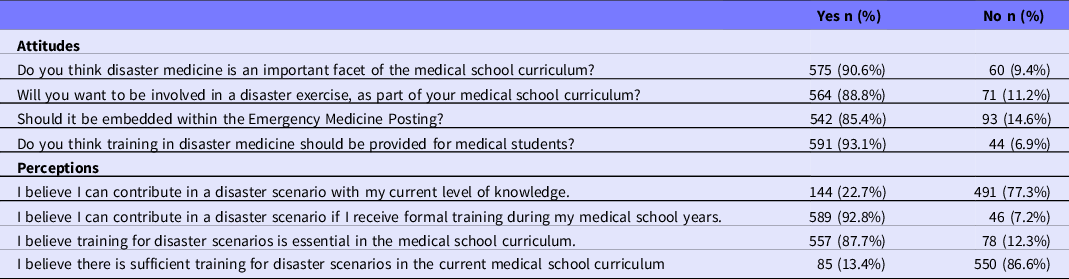
Table 1 shows the respondents’ attitudes toward disaster medicine. With regard to their attitudes, 90.6% of the respondents think that disaster medicine is an important facet of medical school curriculum, 93.1% agree that disaster medicine training should be provided for medical students, and 88.8% are keen to be involved in a disaster exercise as part of their school curriculum.
Respondents’ attitudes and perceptions toward disaster medicine

An analysis of their perceptions, also shown in Table 1, demonstrates that 77.3% of respondents do not believe that they can contribute in a disaster scenario with their current level of knowledge, however, 92.8% believe that, if they were to receive formal training during their medical school years, they will be able to contribute in a disaster scenario. With regard to incorporating disaster medicine into their medical school curriculum, 87.7% believe that this is essential, while 86.6% believe there is insufficient training currently.
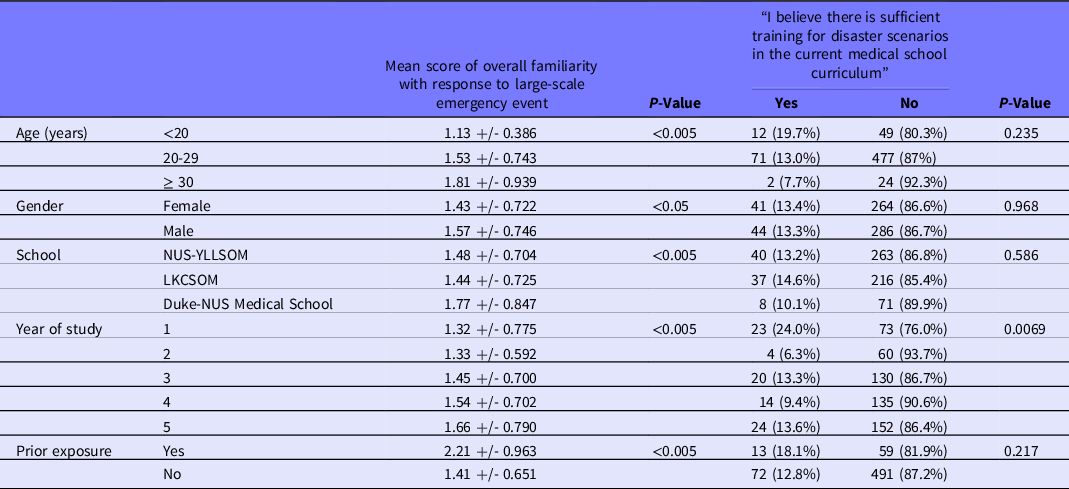
A cross-analysis of the mean scores for overall familiarity with response to large-scale emergency event and the various demographic characteristics of the respondents was also performed and is shown in Table 2. Respondents aged ≥ 30 y, male gender, students from Duke-NUS Medical School, in progressive advancing years of medical school or had prior exposure to disaster medicine were shown to have higher mean scores, which reached statistical significance. A cross-analysis of the responses to the question “I believe there is sufficient training for disaster scenarios in the current medical school curriculum” was also performed against the various demographic characteristics, to find out which group of students may have answered “yes,” as at the point of the study, there was no formal training for response to disaster scenarios in the curriculum. This result is reflected in Table 2 as well. Only the year of study reached statistical significance, and on closer inspection, a significant proportion of this subset who believed that there is sufficient training in the curriculum, belong to year 1 students.
Cross-analysis of demographic characteristics against knowledge and perception

Discussion
Findings from this study indicate that knowledge across all domains of emergency preparedness, among medical students in Singapore, is uniformly poor. This is not unexpected as disaster medicine is currently not incorporated into the local curriculum. In Singapore, formal disaster medicine training is only mandatory for residents in the emergency medicine residency program as part of their post-graduate specialization certification.
From the cross-analysis in Table 2, disaster medicine knowledge was shown to increase slightly with age and years of medical schooling, likely due to greater chance of being opportunistically exposed to disaster medicine, particularly during emergency medicine postings conducted between years 3 and 5. However, even so, the mean scores of year 5 students were only marginally better than those of year 1 students. Male students had marginally better scores, compared with females, and this may be related to a small proportion of male students having served National Service – the national policy mandated by statutory law that requires all male Singaporean citizens to serve a period of compulsory service in the defence forces, before enrollment in medical school. Most of the male students usually opt to defer their National Service until after completion of housemanship. More significantly, the study shows that medical students with prior exposure to facets of disaster medicine, such as being a volunteer in humanitarian organizations such as Singapore Red Cross or St. John Singapore, and respondents from Duke-NUS Medical School, the only medical school in Singapore to have a disaster volunteer corp, both achieved higher mean scores. This demonstrates that it is never too early to start acquainting medical students with the principles of emergency preparedness with resultant knowledge retention. This is consistent with international studies showing that training medical students improves knowledge outcomes. Reference Kaji, Coates and Fung6–Reference Barrimah, Adam and Al-Mohaimeed8
The statistically significant result from cross-analysis of the responses to the question “I believe there is sufficient training for disaster scenarios in the current medical school curriculum” against the year of study, showed that year 1 students were more likely to have answered “yes” to this. This may be so, as they perceive that disaster medicine will be covered in the later years of their medical school. This may have skewed the results to this question.
Last, as a result of overall poor familiarity with the principles of emergency preparedness, most respondents appear to lack the confidence to contribute in a disaster scenario with their current level of knowledge. However, an overwhelming majority display a generally positive attitude toward being trained in disaster medicine and participating in disaster exercises during their medical school years. More importantly, most of them believe in having formal training during their medical school years and believe that, if they were to receive formal training, they will be able to contribute effectively in a disaster scenario. This is an encouraging result. The findings of this study are widely consistent with many studies such as that of a recent systemic review of 37 studies, published in 2020. Reference Byrne, Ashcroft and Alexander9,Reference Mortelmans, Bouman and Gaakeer10
Limitations
There were 2 main limitations in this study. First, the response rate for the survey is 25.7%. This may bring up concerns that the sample population is not reflective of the true situation. However, as the total number of enrolled students is made available, the sample size required for a 95% confidence level with 5% margin of error is calculated to be 333. Our total response of 635 returns surpasses this calculated sample size.
Second, the survey is self-administered, which may affect the accuracy of the data due to factors such as language difficulties, time constraints, and peer pressure. To mitigate this, the survey was administered in English, the teaching language in all 3 medical schools, and the email correspondence gave an approximate length of time required to complete the survey and no identifiers were collected during the process.
Conclusions
In conclusion, it is evident that regardless of age, school, year of study, gender or prior exposure, the overall familiarity of medical students toward emergency preparedness remains poor in Singapore—a heavily built-up country with a high population density and propensity for serious loss of human lives in the event of a disaster. However, it is encouraging to note that, despite the lack of familiarity, there is still an overall positive attitude toward disaster medicine. Medical students recognize it as an important facet of medical school curriculum and are keen to be involved in further training. The results of this study can be used as a roadmap for formulating a strategic plan directed at incorporating aspects of disaster medicine into the local school curriculum. This will arm a significant group of future health-care professionals with the confidence to respond to an emergency, when the need arises.
Author contributions
Seow Shuen Nicole Rachel Cheng: Conceptualising, Data curation, Writing; Jonathan Shen You Ng: Data curation; Kim Yao Ong: Data curation; Zhi Kuan Kenneth Loi: Data curation; Yu Xian Lei: Data curation; Xiang Yi Wong: Data curation; Li Juan Joy Quah: Writing, reviewing, and supervision.