

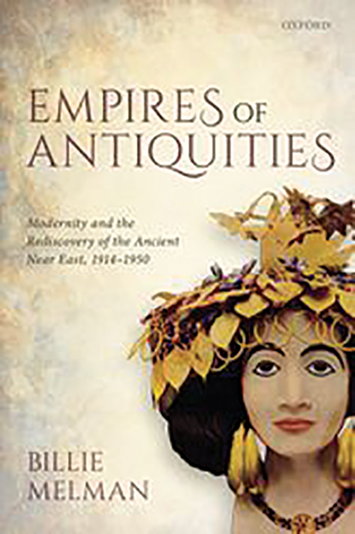
Billie Melman's exploration of the “regime of antiquities” (p. 9) and the internationalisation of the (material) past offers an important contribution to a wide range of fields, including the history of the interwar period, the history of archaeology and mandate politics and mechanised technology. By linking her extensive reading to research on modernity, media histories, and literary and cultural studies, the author has rightly identified the early twentieth century as a crucial period for the development of archaeology in the South-west Asian/North African (SWANA) region and the importance of the past in the construction of modernity. Over ten chapters Melman surveys excavations at Jerusalem, Lachish and Mount Carmel/Wadi al-Mughara in Palestine, Ur and Tell el-Arpachiyah in Iraq, and Tell el-Amarna, Alexandria and Siwa in Egypt, thus covering an archaeological time span from the Lower Palaeolithic to the Graeco-Roman period. Connecting archaeology to mandate and post-imperial politics, the author draws important parallels between the (re-)imagination of the past and modernity, and the crucial role played by archaeologists in that process. In providing a broad overview of three countries and thousands of years of human history, Melman offers an important synthesis of archaeological research that moves beyond the often narrow sub-disciplinary histories of biblical, Ancient Near Eastern or Egyptian archaeology.
But what the narrative gains in painting a broader picture, it loses in the fine grain. Melman is most comfortable writing about the Palestinian context and her discussion of Jerusalem, Lachish and Mount Carmel and the intricacies of mandate administration and politics profit from her close reading of archival sources. The chapters on Iraq, focusing mainly on Ur and its excavator Charles Leonard Woolley, however, are less convincing, particularly the attempt to characterise the excavations at Ur as biblical archaeology. Melman cites Woolley's personal background to explain his publicising of the site as the birthplace of Abraham. While it is true that Woolley emphasised this biblical connection in his popular books, newspaper articles and radio talks, closer reading of his scholarly publications demonstrates a lack of focus on the Bible, revealing Woolley's popular writing strategy for what it was: a way to engage the public with his work rather than a personal belief.
In the three final chapters on Egypt we are treated first to an overview of the effect of the discovery of the tomb of Tutankhamun on interwar culture. Despite the promise to move beyond Tutmania, however, other excavations and projects receive only brief treatment; for example, the connection between modern urbanity, technology and the short-lived city of Tell el-Amarna does not receive the attention it deserves, and radio lectures are cited without reference to schedules, programmes or articles in The Radio Times or The Listener. The sections on the exploration of the Western Desert and the Oasis of Siwa in particular lack a coherent timeline, jumping back and forth between the interwar and post-war periods, making it difficult to follow changes or continuities from 1914–1950.
Melman's focus is firmly on reception of the past as evidenced by popular accounts (broadly defined). The use of these popular sources, however, sometimes lacks focus and clear reasoning. Newspaper and magazine articles are quoted abundantly throughout the book and demonstrate the author's extensive and wide-ranging research. Yet the material is used selectively and with little discussion of authors’ or editors’ motives. It is often unclear who exactly authored articles or reports that appeared in the press, wrote travelogues or “archaeobiographies” (p. 17), and why Melman has chosen to cite one particular publication over another.
Throughout the book, the terms Near East, Middle East and Mashriq are used interchangeably and without a clear definition of terms. All of these terms can cover a wide region, sometimes stretching from northern Africa to Afghanistan. As the case studies focus on archaeological sites in the mandates of Palestine and Transjordan, Iraq, and Egypt, it is not clear how Melman's discussion applies to the wider region.
Overall, this book demonstrates the author's considerable research skills and her eminently readable style, but the reader may be left wishing for more detailed discussion of a narrower range of topics. Issues of gender and race in the practice of archaeology, in archaeological interpretations of the past, and in interwar culture of the various countries (including Britain) are only hinted at, along with the modernisation of archaeological fieldwork methods. The latter experienced important advances in the interwar years precisely because mandate administration provided Western archaeologists with such privileged access to a vast empire of antiquities. The strength of Melman's volume lies in her elucidation of the entangled and manifold connections between archaeology, imperial and colonial politics and modernity. The result is an important contribution to understanding the complexity of the internationalisation of the material past and the role of archaeology in that process.


