Introduction
The magnetostatic interactions of neighboring magnetic nanoparticles can be tuned by their separation distance and magnetic moment. Since each ferro- or ferrimagnetic particle has some degree of spin polarization, interesting magnetic field and temperature-dependent electrical resistance effects may be observed if there is electron transport between particles. Reference Black, Murray, Sandstrom and Sun1
Recent achievements in tuning interparticle separations with short ligand molecules have led to improved control over interparticle tunnel resistance, Reference Talapin, Lee, Kovalenko and Shevchenko2 which may enable the preparation of sensitive magnetoresistive sensors made of colloidal magnetic nanoparticle films. With the fast development of printed electronics, these advances in nanoparticle-based magnetoresistive devices might lead to simple preparation methods of printable magneto-electronic devices, such as magnetic sensors, Reference Karnaushenko, Makarov, Yan, Streubel and Schmidt3 as alternatives to magneto-resistive or Hall effect devices prepared by expensive vacuum deposition techniques. Reference Parkin4,Reference Freitas, Cardoso, Martins, Martins, Loureiro, Amaral, Chaves, Cardoso, Fonseca, Sebastião, Pannetier-Lecoeure and Fermone5
Until 15 years ago, studies of the physical properties of colloidal single domain magnetic particles were limited to measurements of magnetization or magnetic susceptibility of nanoparticle ensembles. Fundamental questions regarding equilibrium versus non-equilibrium (spin-glass-like) dynamics, including aging and memory effects, attracted much scientific interest for a general understanding of non-equilibrium systems with slow dynamics, Reference Sasaki, Jonsson and Takayama6–Reference Hansen, Jonsson, Nordblad and Svedlindh9 but those studies were limited by broad particle size and interparticle separation distributions.
This article describes magneto-transport experiments carried out on magnetic nanoparticle assemblies and shows how nanoscale electron transport studies in close-packed magnetite nanoparticle arrays may reveal temperature and magnetic field dependent single- or few-particle magnetization dynamics in such arrays. The discussion here is limited to colloidal ferro-/ferrimagnetic nanoparticles coated with organic surfactant molecules that control the interparticle spacing in close-packed arrays. These are the only systems in which various parameters, such as particle diameter, interparticle separation, and number of particle layers, can be well controlled separately. The finite and insulating separation between the nanoparticles makes the short-range (exponentially decaying) electronic exchange interactions between neighboring nanoparticles insignificant. The exchange interaction is the driving force for nearest-neighbor magnetic spin-spin alignment in ferromagnetic materials.
Ensemble measurements of magnetic nanoparticle magnetization dynamics
For close-packed nanoparticles consisting of low-anisotropy phases such as Fe3O4 and ε-Co, the dipole-dipole magnetostatic interaction energy may exceed the individual particle anisotropy energy barrier by up to an order of magnitude, and significant differences in magnetic properties would be found between close-packed arrays, where interparticle separation is much smaller than particle size, and isolated particle measurements. For example, in ∼8 nm magnetite nanoparticles, the blocking temperature (T b, also see the Introductory article in this issue) shifts from ∼50 K for isolated particles to ∼150–200 K for a close-packed array. Reference Taub, Tsukernik and Markovich10
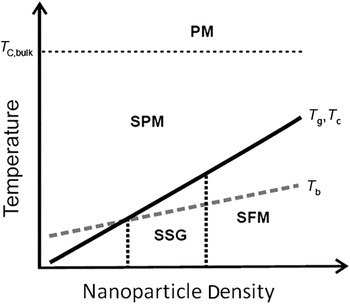
Upon cooling from a superparamagnetic (SPM) state at high temperature, strongly interacting magnetic nanoparticle arrays may assume new magnetic states, such as super-ferromagnetic (SFM), where the magnetic moments of the particles form ordered domains and develop hysteresis, or superspin glass (SSG), where glass-like properties, such as spin frustration, slow dynamics, aging, and memory effects can be observed (see Figure 1 ). Reference Bedanta and Kleemann11 The dimensionality of such arrays may also affect the magnetic properties. Reference Faure, Wetterskog, Gunnarsson, Josten, Hermann, Bruckel, Wenzel Andreasen, Meneau, Meyer, Lyubartsev, Bergstrom, Salazar-Alvareza and Svedlindh12,Reference Bedanta, Eimuller, Kleemann, Rhensius, Stromberg, Amaladass, Cardoso and Freitas13,Reference Yamamoto, Majetich, McCartney, Sachan, Yamamuro and Hirayama16 The tentative phase diagram in Figure 1 shows interacting magnetic nanoparticles as a function of their interaction strength. Magnetic nanoparticle arrays were studied by a variety of techniques such as magnetometry; neutron scattering; Reference Majetich and Sachan14 special electron microscopy techniques such as Lorentz microscopy Reference Yamamoto, Hogg, Yamamuro, Hirayama and Majetich15 and electron holography; Reference Yamamoto, Majetich, McCartney, Sachan, Yamamuro and Hirayama16 and other magnetic imaging techniques Reference Bedanta, Eimuller, Kleemann, Rhensius, Stromberg, Amaladass, Cardoso and Freitas17 as a function of temperature, magnetic field, or structural order. Observations of SSG behavior have been claimed for nanoparticle systems with an intermediate strength of dipolar interactions. The particles’ magnetic moments freeze collectively into a spin glass phase below a glass transition temperature, T g . On increasing the particle density and, hence, the interaction between the particles, collective ferromagnetic-like correlations lead to a SFM phase with presumably different properties from those of a SSG.
Schematic phase diagram, transition temperature versus nanoparticle array density, with paramagnetic (PM), superparamagnetic (SPM), superspin glass (SSG), and superferromagnetic (SFM) phases. Relevant lines are the blocking temperature of the individual particles, T b , and the collective transition line (i.e., the glass transition, T g) or SFM transition temperature, T c. T C,bulk is the bulk ferromagnet Curie temperature. Adapted with permission from Reference 11. © 2009 IOP Publishing.

In SPM systems, the exponential dependence of magnetization relaxation time on particle volume causes small-sized polydispersity to significantly smear T b and makes the temperature dependence of magnetization relaxation times look like a spin-glass (superposition of magnetization decays with a large spread of relaxation times) even when it is not glassy. Hence, the distinction between a glass-like state and a dipolar interaction governed ferromagnetic-like state is not simple, and often, magnetization and susceptibility data are not enough to conclusively determine which phase is obtained, in particular with respect to magnetization dynamics. These ambiguities call for experiments to obtain more information on the magnetization behavior of strongly interacting magnetic nanocrystal arrays, preferably with single nanoparticle resolution.
Magnetic field-dependent electron transport in magnetic nanocrystal arrays
The first step toward the measurement of local magnetization dynamics in magnetic nanoparticle arrays is establishing spin-polarized electron transport at such arrays; in other words, demonstrating magnetoresistance (MR) in the nanoparticle arrays. In particular, magnetite has been discussed as a half-metal and is supposed to be a highly spin-polarized conductor. Reference Fonin, Dedkov, Pentcheva, Rüdiger and Güntherodt18 This property, together with its low magneto-crystalline anisotropy, makes it ideal for studying the dipolar SSG and SFM phases through magneto-transport measurements in magnetite nanocrystal arrays with particle sizes on the order of 10 nm or less.
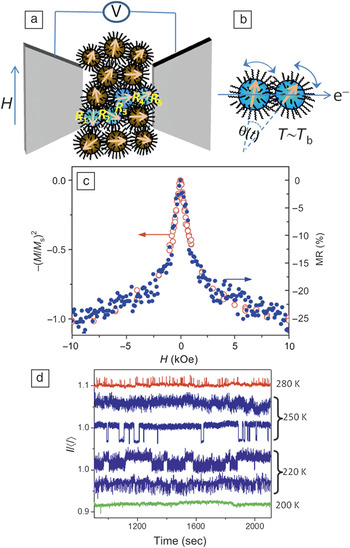
To study localized magneto-transport properties over a small number of nanocrystals, nanoscale electrodes with small gaps need to be used, as depicted in Figure 2 a. Such nanoscale magneto-transport experiments in close-packed arrays of colloidal magnetic nanoparticles began with the work of Black et al. on ε-Co nanoparticle arrays. Reference Black, Murray, Sandstrom and Sun1 To achieve measurable tunnel currents at low temperatures, the separation between the nanoparticles must be reduced. The electrically insulating oleic acid coating of any conducting nanoparticle produces separation distances of ∼2–4 nm, which are too large to obtain measurable currents. Reducing this separation by various thermal or chemical treatments to <1 nm allows for electron transport measurements in such arrays. The exponential sensitivity of the tunnel rate to interparticle separation and barrier height causes thermally activated transport to occur over a small subset of percolating pathways through the arrays, as portrayed by the blue nanoparticle path in Figure 2a. Moreover, along the percolating path, the various tunnel junction resistances connected in series are also non-uniform and may have a wide distribution of values. Thus, there is a high probability that in a nanoscale section of a magnetic nanoparticle array, such as the one sketched in Figure 2a, there will be only one (or very few) junction(s) that dominate the overall resistance.
(a) Schematic nanoscale tunnel junction where a small finite number of close-packed colloidal magnetic nanoparticles coated with insulating organic surfactant contribute to the conduction between the electrodes. The blue particles are connected in a percolating electron transport path. The values of interparticle resistances R 1 –R 5 may vary over many orders of magnitude. The brown particles are characterized by interparticle resistances that are larger than those indicated and thus not participating in the conducting network. (b) In a particular interparticle junction, when the temperature (T) is tuned near the blocking temperature (T b), the individual particle magnetizations may fluctuate at different rates, and the relative angle between the orientations (θ) would fluctuate with time (t), changing the interparticle tunnel rate. (c) Magnetoresistance (MR, filled circles) and normalized squared magnetization value (M Reference Talapin, Lee, Kovalenko and Shevchenko2 , open circles) as a function of magnetic field (H) near T b (220 K) for a nanoscale junction patterned in a magnetite nanocrystal array. The fit between MR and M Reference Talapin, Lee, Kovalenko and Shevchenko2 is predicted by the simple tunnel magnetoresistance model of Reference 40. Reproduced with permission from Reference 10. © 2009 Elsevier. (d) Current (I) versus time traces measured at such a junction at several temperatures under a zero external magnetic field normalized to the average current (⟨I⟩) and shifted for clarity. Reproduced with permission from Reference 32. © 2010 IOP Publishing. Note: M s, saturation magnetization.

The maximal MR achievable in magnetic nanoparticle arrays should obey predictions for tunnel MR (TMR) between pairs of ferromagnetic electrodes or nanoparticles. Julliere’s model describes an idealized case of tunneling between two ferromagnetic electrodes (or nanoparticles) with spin-state conservation of the tunneling electrons Reference Wang, Yue, Shi, Shi, Hu, Du and Wu19 in a uniaxial system (magnetization aligned along a single axis):
 $$TMR = {{{G_{AP}} - {G_P}} \over {{G_{AP}}}} = {{2{P^2}} \over {1 - {P^2}}}$$
,
where G AP and G P are the tunnel conductances when the two electrodes (particles) have anti-parallel and parallel magnetizations, respectively, and P is the spin-polarization level of the material. In the case of magnetic nanoparticle arrays, it is clear that this is only a limiting case where the parallel configuration can be achieved with a saturating field, and anti-parallel alignment would be favored in zero field. Since a major part of the electron transport is thermally activated, Reference Zeng, Black, Sandstrom, Rice, Murray and Sun20 the TMR may be less than the Julliere model prediction.
Several groups have observed MR effects in close-packed Fe3O4 and Fe nanoparticle arrays, Reference Zeng, Black, Sandstrom, Rice, Murray and Sun20–Reference Lekshmi, Buonsanti, Nobile, Rinaldi, Cozzoli and Maruccio25 but most found P values that were significantly lower than that for an ideal half-metal (P = 100%). In some cases, annealing brought the particles into contact and drastically changed the electron transport mode. Taub et al. obtained a field dependence of MR, which follows the square of the magnetization (MR(H)∝M(H) Reference Talapin, Lee, Kovalenko and Shevchenko2 , where M is the magnetization, and H is the magnetic field (see Figure 2c), Reference Zeng, Black, Sandstrom, Rice, Murray and Sun20 as expected from the TMR model of Inoue and Maekawa for relatively low P values (<50%), which allows for non-collinear magnetization orientations of the electrodes (particles). Reference Inoue and Maekawa26 This model uses a Langevin function to describe moment alignment of the SPM nanoparticles as a function of field and temperature. An additional interesting aspect of nanoscale magneto-transport measurements of Fe3O4 nanocrystals is the observation of the Verwey metal-insulator transition, which is a combined electronic-structural transition, and its mechanism is still under debate after nearly 80 years. Reference Waltz27 Poddar et al. Reference Poddar, Fried and Markovich28 and other research groups Reference Lee, Fursina, Mayo, Yavuz, Colvin, Sofin, Shvets and Natelson29,Reference Ingvarsson, Xiao, Parkin, Gallagher, Grinstein and Koch30 have observed this transition through electron transport measurements in magnetite nanostructures.
Magneto-transport experiments in close-packed magnetic nanoparticle arrays have thus shown that with sufficiently narrow tunnel barriers between nanoparticles, the MR behavior is that of model TMR between partially spin-polarized SPM electrodes.
Temporal fluctuations of MR in nanoparticle-based tunnel junctions
In cases where a single nanoparticle pair dominates the TMR behavior, the resistance of the device will depend on the local characteristics of the junction, such as the size of the particles and the local fields acting on each particle by the dipoles of the neighboring particles, as well as the temperature and external field. Near T b the magnetic moment directions of the nanoparticles in the dominating junction become unstable over the experimental time scale, and θ (the angle between particle moments, see Figure 2b) may vary over time. Within a certain temperature range, magnetization jumps may occur between two energy minima, which will cause the MR and the current to fluctuate between two levels within this array domain. The frequency range in such experiments can be quite broad, from a high frequency limit dependent on the junction RC (R = resistance and C = capacitance) characteristics (typically between kHz and MHz) down to mHz and below. Frequency analysis of a telegraphic current noise pattern should have a Lorentzian line shape in the frequency domain, which is characteristic of the dynamics of transitions between two discrete energy levels. Lorentzian noise was observed in TMR junctions made of bulk electrodes, Reference Ingvarsson, Xiao, Parkin, Gallagher, Grinstein and Koch30 as well as cobalt nanoparticle arrays. Reference Woods, Kirtley, Sun and Koch31
Telegraphic current noise was observed in magnetite nanocrystal arrays cooled to around T b (Figure 2d). Reference Taub and Markovich32 At temperatures far from T b (∼230 K), the current noise (at constant bias voltage) looked random, and its amplitude diminished relative to the current fluctuations around T b . Around T b, the noise pattern was often discrete and telegraphic (two level). In such cases, the frequency response fitted a Lorentzian line shape. Application of a moderate magnetic field diminishes the telegraphic noise, similar to the effect of reducing the temperature. In isolated uniaxial magnetic particles, Reference Stoner and Wohlfarth33 the potential well asymmetry across the anisotropy axis increases with applied magnetic field, and the switching rate is reduced.
Current fluctuations in variable temperature scanning probe tunnel junctions
The best resolution possible for local electron transport probing of nanostructures is by scanning probe techniques. Spin-polarized scanning tunneling microscopy (SP STM) is the magnetic microscopy technique with the highest spatial resolution (single atoms) and has been widely applied to epitaxial atomic layers of ferromagnetic materials. Reference Pratzer, Elmers, Bode, Pietzsch, Kubetzka and Wiesendanger34 It relies on a ferromagnetic (or antiferromagnetic) tip emitting spin-polarized electrons, which have different tunneling probabilities to regions with different magnetization orientations. In these regions, the spin-dependent density of states has spatial variation. This is expressed as small height differences between domains of different magnetization orientations. SP STM has provided magnetization maps with atomic resolution for atomic layer islands of ferromagnetic Reference Wachowiak, Wiebe, Bode, Pietzsch, Morgenstern and Wiesendanger35,Reference Rusponi, Weiss, Cren, Epple and Brune36 and antiferromagnetic materials. Reference Heinze, Bode, Kubetzka, Pietzsch, Nie, Blugel and Wiesendanger37 But, it does not work for colloidal magnetic nanoparticle films deposited over conducting substrates due to the large variations in the tunnel resistance (R S) between the particles and the substrate that mask the tunneling rate differences arising from varying particle moment orientations.
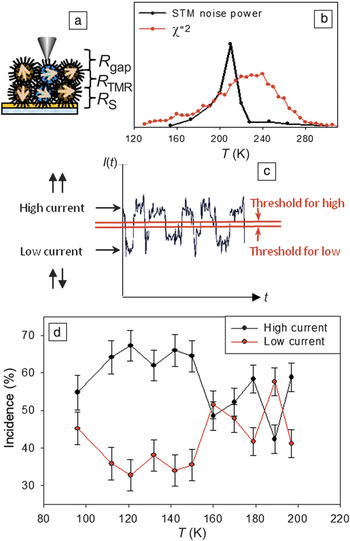
However, non-SP STM can also probe local magnetization dynamics in close-packed arrays of magnetic nanoparticles if the tip emits unpolarized electrons, but their paths cross at least two magnetic nanocrystals, as shown in Figure 3 a. When the temperature is tuned to ∼T b , where magnetization switching slows down to frequencies suitable for standard STM electronics (up to ∼100 kHz), and if at least one of the particles switches magnetization with respect to the other particles along the electron path, then changes in the interparticle tunnel rate within the experimental time scale should occur. The spin-dependent tunnel resistance fluctuations must be significant relative to the total tunnel resistance determining the STM current. This dictates that the tip must be very close to the top particle (tip-nanoparticle tunneling resistance, R gap, is minimal, typically <1 Å) and the nanoparticle-substrate resistance (R S) is relatively small (ideally not more than several MΩ). Alternatively, a conductive atomic force microscope (AFM) tip may be used as the top contact. This was recently done in a related experiment, where spin-torque transfer in small magnetic multilayer pillars was induced by passing current from an AFM tip. Reference Evarts, Cao, Ricketts, Rizzo, Bain and Majetich38 Current induced magnetization switching in atomic monolayer islands of Fe atoms was also demonstrated using SP STM, Reference Krause, Berbil-Bautista, Herzog, Bode and Wiesendanger39 as well as thermal switching of such non-interacting islands. Reference Krause, Herzog, Stapelfeldt, Berbil-Bautista, Bode, Vedmedenko and Wiesendanger40
(a) The (non-superparamagnetic) scanning tunneling microscopy (STM) setup that enables local measurements of magnetization dynamics around the blocking temperature, T b, where R TMR, inter-nanoparticle tunneling resistance, is a significant part of the total tunnel resistance (R gap+R TMR+R S), where R gap is the tip-nanoparticle tunneling resistance, and R S is nanoparticle-substrate tunneling resistance. (b) A comparison between the square of the AC magnetic susceptibility data (χ″ Reference Talapin, Lee, Kovalenko and Shevchenko2 ) to the STM current power noise spectral density plotted as a function of temperature (T). Both measured on the same close-packed magnetite nanocrystal array at 100 Hz. (c) A sample of a current versus time (I(t)) curve measured near T b over the magnetite nanocrystal array. The plot displays telegraph noise together with thresholds set for data binarization. (d) The temperature-dependent relative incidence of high- and low-current states measured on the magnetite nanoparticle array. Each data point is the average of hundreds of curves. The experimental data presented demonstrate that the temperature-dependent magnetization dynamics of single (or few) magnetic nanoparticles can be measured using regular variable temperature STM, and new physical information could be deduced from the analysis of the telegraph noise patterns. Reproduced with permission from Reference 41. © 2009 American Physical Society.

Once the above resistance conditions are met, the tunnel current fluctuations can reflect magnetization switching events at the location where the STM tip lands. Indeed, recent experiments with magnetite nanoparticle films have shown that when 2–3 nanoparticle thick layers are measured close to T b, local tunnel current fluctuations larger than the baseline current noise can be observed, and this noise peaks very close to the AC susceptibility peak for the whole nanoparticle film (Figure 3b). Reference Tirosh, Tsukerman, Taub, Majetich and Markovich41 This noise in the tunnel current often appears as a discrete bi- (telegraphic) or multi-level current pattern (Figure 3c), which can be analyzed using various statistical methods, such as finding up- and down-level lifetime distributions or calculating their time autocorrelation function. Reference Tirosh, Tsukerman, Taub, Majetich and Markovich41,Reference Jiang, Nowak, Scott, Johnson, Slaughter, Sun and Dave42 Where the I(t) curves exhibited two-level noise patterns, an algorithm was developed to identify the two levels and count the total time spent by the system at the low and high current levels. A highly simplified view may regard the high current level as the particular switching particle being at relatively parallel magnetization orientation with respect to the neighboring particle(s) and the low level as being at a relatively anti-parallel orientation. The plot of the relative times spent at low and high current levels as a function of temperature (Figure 3d) can be roughly divided into two regions with a “critical” temperature, T c′ which seems to occur about 50–60 K below the T b , identified from the peak at the susceptibility measurements. Above this T c′, high and low current levels occur at roughly equal probabilities, while below this temperature, the high current level occurs with significantly higher probability (60–70%). At the low temperature range, there is also a finite remanent magnetization. Those two effects may signify the formation of an SFM state.
Summary and outlook
The preliminary results on nanoscale current fluctuations observed in close-packed magnetite nanoparticle arrays presented previously demonstrate the large potential of temperature and field-dependent local magneto-transport measurements as a tool to study the magnetization dynamics for small clusters of magnetic nanoparticles with strong dipolar interactions. Higher signal-to-noise ratios and a broader frequency range would enable deeper statistical analysis of the current fluctuations and the time scales of the magnetization fluctuations. This could lead to unambiguous identification of phases such as super-ferromagnetic or super-spin-glass and perhaps to the formulation of more accurate functional forms describing the dependence of the magnetization relaxation times on temperature near the superparamagnet-to-super-spin-glass or the superparamagnet-to-superferromagnet transitions.
Recent advances in synthesis technology to produce uniform close-packed arrays of colloidal nanocrystals of different types and, in particular, making use of new methods developed to enhance interparticle electronic coupling in semiconductor quantum dot arrays, may lead to enhanced magnetoresistance values in magnetic nanoparticle arrays, also at room temperature. This may open new horizons for application of these systems in printed electronics, such as printed magnetoresistive sensors.
Acknowledgments
This work was supported by the US–Israel Bi-National Science Foundation Grant No. 2010137. The author is grateful to Sara Majetich for many valuable discussions.