The overuse of antibiotics can lead to Clostridioides difficile infection (CDI), allergic reactions, and antibiotic-resistant organisms. Among older adults residing in nursing homes, the annual prevalence of antimicrobial use ranges from 40% to 79%. Reference Benoit, Nsa and Richards1,Reference Wu, Langford, Daneman, Friedrich and Garber2 Much of this use is unnecessary, especially for treatment of common infections such as urinary tract infections (UTIs). Reference Nicolle, Bentley, Garibaldi, Neuhaus and Smith3-Reference Sloane, Kistler, Reed, Weber, Ward and Zimmerman5
Antibiotic prescribing in a nursing home is influenced by many factors such as the clinical uncertainties in evaluating frail residents and those with cognitive impairments, lack of on-site assessment prior to prescribing, and pressure from nurses and families to treat with antibiotics. Reference Sloane, Huslage, Kistler and Zimmerman6 The Centers for Disease Control and Prevention (CDC) developed antibiotic stewardship guidance to optimize antibiotic use in healthcare facilities. The 7 core elements of this program include leadership commitment; identifying a person accountable for leading the program; involving a person with drug expertise; development and implementation of interventions; measuring antibiotic use and providing feedback; and education of clinical staff, residents, and families. 7
In 2016, a hospital-based team (HBT) comprising 2 members with antibiotic stewardship expertise, concluded a 5-year, grant-funded, collaborative project to optimize antibiotic use and reduce CDI in 9 nursing homes in Monroe County, New York, in collaboration with a nursing home medical-director advisory group. The team provided education, analyzed data, and provided feedback on antibiotic use, and they developed treatment guidelines focusing on alternatives to quinolone use for common infections. Each nursing home formed an antibiotic stewardship program (ASP) team and identified a champion to lead the program. The project resulted in a 39% decrease in fluoroquinolone monthly days of therapy rate and an 18% decrease in the quarterly CDI rate. Reference Felsen, Dodds Ashley and Barney8 Despite the successful implementation of the project, ASP champions voiced concerns about the long-term sustainability of the program without the HBT’s support.
Because sustainability of any quality-improvement project requires integrating practices into daily operations, Reference Shelton, Cooper and Stirman9 following our 5-year collaborative project, Reference Felsen, Dodds Ashley and Barney8 we sought to understand the factors that influence the sustainability of ASPs. We examined the experiences and perceptions of clinical and administrative staff across the collaborative nursing homes, and we utilized a sustainability framework Reference Shelton, Cooper and Stirman9 to inform policies and practices for sustainability and to provide specific recommendations for ASP sustainability in nursing homes.
Methods
Study setting, design, and participants
Using a qualitative descriptive research design, Reference Sandelowski10 we conducted 57 semistructured interviews with 48 employees across the hierarchical structures of these 9 nursing homes. The nursing homes varied in size (range, 120–566 beds) and intensity of care they provided (eg, some included postacute or ventilator beds). The leadership and the antibiotic stewardship champions at the nursing homes, along with the HBT, identified potential study participants, all of whom agreed to participate and provided written informed consent. We included participants with varying job functions as well as those who were part of the implementation project. The University of Rochester’s Institutional Review Board approved this study.
Data collection
Over a 6-month period, interviews were conducted at the nursing homes with senior leadership (20 minutes per interview) and with other staff (up to 60 minutes per interview) by a team member with qualitative research expertise (S.S.). We interviewed 9 staff twice to gather additional information. The interviews covered their understanding of, experience with, and perceptions of ASP implementation and sustainability.
Data analysis
All interviews were audio recorded, deidentified, transcribed verbatim, and managed using ATLAS.ti qualitative data analysis software. 11 We chose an integrated sustainability framework Reference Shelton, Cooper and Stirman9 to guide the analysis, and we developed codes within 5 categories: (1) ASP characteristics, (2) ASP champion and team characteristics, (3) processes, (4) inner contextual factors, and (5) outer contextual factors (Table 1). Also, 3 team members (S.S., G.D., and C.F.) coded 5 transcripts together, resolved differences by consensus, and developed a codebook. Thereafter, 1 member (S.S.) coded the remaining transcripts. Two team members (S.S. and C.R.S.) completed the analyses and identified themes that were discussed and agreed upon by the team. Attention to rigor and validity were maintained through memos, audit trail, and peer review.
Antibiotic Stewardship Sustainability: Categories and Codes

Note. ASP, antibiotic stewardship; HBT, hospital-based team.
Results
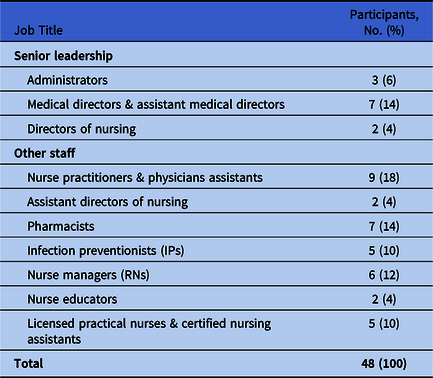
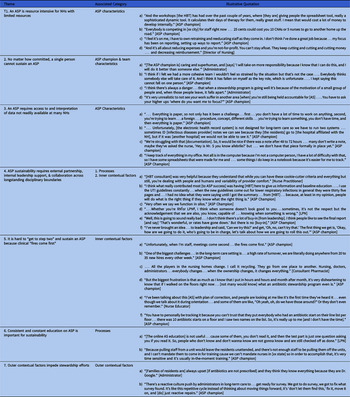
Participants included 12 senior leaders and 36 “other staff” (Table 2). ASP champions who led the program were either infection preventionists (IPs) or pharmacists. The 7 themes identified illustrate how complex internal and external factors of nursing-home operations influence ASP sustainability (Table 3).
Participant Characteristics

Note. IP, infection preventionist; RN, registered nurse.
Themes, Associated Categories, and Quotations That Exemplify Themes

Note. ASP, antibiotic stewardship program; NHs, nursing homes; HBT, hospital-based team; IP, infection preventionist; CNA, certified nursing assistant; RN, registered nurse; LPN, licensed practical nurse.
Theme 1. An ASP is resource intensive for nursing homes with limited resources
Despite support from the HBT (Table 3, T1 Qa), participants felt that an ASP was resource intensive with inadequate staff, time, and financial resources dedicated to stewardship functions. Champions were overwhelmed by the additional antibiotic stewardship duties and felt that “… it’s kind of a piece of everyone’s job, but nobody has the time for it.” Champions with clinical duties had to juggle their time between resident care and antibiotic stewardship. Staffing shortages (Table 3, T1, Qb) further decreased the time champions needed to devote to antibiotic stewardship activities, partially due to the need to provide antibiotic stewardship training to the constant influx of new staff (Table 3, T1 Qc). Financial constraints (Table 3, T1, Qd) made it difficult to reimburse consultant pharmacists for any additional time needed to analyze antibiotic use data as one pharmacist noted, “[the nursing homes] don’t want to pay me for what I [can] do.” With constrained resources of staff, time, and finances, the champions were concerned that without the HBT’s support there would be “no one to pick up the pieces.”
Theme 2. No matter how committed, a single person cannot sustain an ASP
Initially, based on the HBT’s recommendations, ASP teams comprised medical directors, directors of nursing, IPs, and pharmacists. Over time, due to competing priorities and staff turnover, nursing homes shifted the responsibility to the ASP champion. Although all champions were motivated and committed (Table 3, T3 Qa), the enormity of the task and the inability to maintain a cohesive team was overwhelming (Table 3, T3 Qb), resulting in “a lot of 10- to 12-hour days” and work on weekends. Sustaining the program single-handedly was challenging because “you give your 150% … but you’re one person.” This led to some leaving the job, further jeopardizing the program (Table 3, T3 Qc). ASP champions often had multiple responsibilities (eg, assistant director of nursing, infection preventionist, and nurse educator), and with staffing shortages, they also cared for residents (Table 3, T2 Qd). A champion who left her job said, “I feel like it’s making [me] a scapegoat. Because state [regulators] walk in, education’s lacking, I’m in charge of education. IP’s lacking, I’m in charge of IP. Staffing’s lacking, I’m the one (in charge).” Although motivated, with innumerable responsibilities, the champions felt that they could not sustain an ASP alone.
Theme 3. An ASP requires access to and interpretation of data not readily available at many nursing homes
During the implementation project, the HBT provided detailed antibiotic data summaries and interpretation and created tracking tools to enable nursing home staff to independently tabulate their data when the partnership ended. However, participants felt that the antibiotic stewardship was “data driven,” and that the lack of an in-house electronic health record (EHR) system limited their access to data. Gathering hand-written information from medical charts was time-consuming and labor intensive (Table 3, T3 Qa). For consulting pharmacists, lack of an EHR was challenging because they didn’t “have all the information … 99% of the time there’s a diagnosis” without any other indicators for an antibiotic. Access to records from other healthcare facilities where nursing home residents were treated was also limited (Table 3, T3 Qb). Champions created new forms for data collection that were later abandoned because providers did not have time to complete them (Table 3, T3 Qc). Some ASP champions struggled with the use of electronic data and maintained both electronic and paper systems to keep track of the data (Table 3, T3 Qd). Additionally, once data were collected, the ASP champion’s level of comfort with data analyses varied. One participant stated: “Nobody is doing a thing with it. They have no clue what to do with the information.” To sustain the ASP, champions needed access to real-time antibiotic use data and the technology and personnel to interpret and act on the data.
Theme 4. ASP sustainability requires external partnership, internal leadership support, and collaboration across longstanding disciplinary boundaries
Participants reported that internal and external partnerships as well as explicit leadership support were critical for sustainability. The partnership with the HBT was valued because the HBT understood the complex conditions of residents and provided clear and concise guidelines that could be used readily (Table 3, T4 Qa, Qb). ASP champions worried that without this partnership, the program would “very much struggle … because there is no help to do so,” and they would have to rely on internal collaborations and explicit leadership support for sustainability.
However, rigid internal interprofessional boundaries and the lack of communication (Table 3, T4 Qc) made collaboration challenging because “they’re very regimented: this is a nursing issue, this is a pharmacy issue, this is a medical issue.” For the champions to cross these boundaries without a good reason was unacceptable. Boundaries were seen as restrictive even by licensed practical nurses (LPNs) who felt that their clinical judgement was ignored and that they were not partners in promoting antibiotic stewardship (Table 3, T4 Qd). Nevertheless, these boundaries could be crossed with tangible and explicit leadership support. For example, a pharmacist said, “We can suggest … a pathway, but we really need the support of the medical director to actually support it.” All members of the nursing home leadership had signed letters of support for the ASP, but some champions felt there was not enough buy-in and that antibiotic stewardship could not be a “grassroots operation … the right thing has to be done from above” (Table 3, T4 Qe). Champions who perceived explicit leadership support felt that they were able to better execute their responsibilities (Table 3, T4 Qf).
Theme 5. It is hard to “get to step two” and sustain an ASP because clinical “fires come first”
Urgent resident care needs always took precedence over ASP tasks (Table 3, T5 Qa). These “clinical fires” were routine because of inadequate staffing that was perceived as a 2-fold problem: too few staff (Table 3, T5 Qb) and too few newly hired frontline nurses with the skills to care for residents with complex needs. Temporary, “agency nurses” were perceived as lacking the skills to care for residents because “How do you teach people to care? Long-term care [is] not attractive to work in [and with poor pay] the turnover is constant.” At some nursing homes, turnover existed at all levels of the organization, making it difficult to promote antibiotic stewardship efforts (Table 3, T5 Qc). Many nursing home employees did not know about the ASP (Table 3, T5 Qd), nor did they remember the elements of antibiotic stewardship (Table 3, T5 Qe). Urgent medical needs and inadequate staffing made it hard for the champions to “ever get to step 2” of sustaining the program because, with high turnover, they needed to constantly re-educate staff. Additionally, caring for residents with complex medical conditions sometimes meant that antibiotics were started “a little bit more empirically … [because] we’ve seen people go septic so fast over and over and over again,” and sometimes antibiotic start dates were not documented on time (Table 3, T5 Qf).
Theme 6. Consistent and constant education on ASP is important for sustainability
Though the champions and medical directors at the nursing homes received antibiotic stewardship education and training from the HBT, the education of other nursing home personnel was fragmented. With high turnover, ASP teams were reconfigured frequently and the primary responsibility for antibiotic stewardship education often defaulted to the champions who were constantly “re-educating” new staff. In some nursing homes, education was fragmented because a variety of personnel (medical directors, champions, nurse educators, IPs, and nurse managers) provided antibiotic stewardship education in silos. A nurse educator at one nursing home stated, “The medical department I think does their own [antibiotic stewardship] education … but we have not been involved in their education.” The provider at the same facility said, “I’m not sure what’s done in orientation … the nursing orientation, I am from medical; we do it, you know, on a case-by-case basis.” At one nursing home, both the champion and the nurse educator created antibiotic stewardship education modules for staff in parallel and did not know what or when the other provided antibiotic stewardship education. Furthermore, formal antibiotic stewardship education formats varied from new hire orientation to in-service and online modules. Some participants felt that online training was ineffective because they only had to indicate that they completed the module (Table 3, T6 Qa). Champions felt that the education of frontline staff (LPNs and certified nursing assistant [CNAs]) was important because “they’re face to face with the residents” and knew them well. The more dramatically they presented a resident’s change in condition to their manager, the more likely a call was made to a provider who would then order an antibiotic. Despite this, frontline staff were rarely prioritized for formal antibiotic stewardship education and often learned about antibiotic stewardship through overheard conversations on the units. However, providing formal antibiotic stewardship education was also challenging because they usually could not leave their resident-care responsibilities to attend educational sessions (Table 3, T6 Qb) because, as a nurse educator stated, “Do you want them to care for the residents, or do you want them to do the education? They need to do both.”
Theme 7. Outer contextual factors impede stewardship efforts
Through the collaborative efforts of the HBT and the nursing home medical directors, the prescribing behaviors of in-house providers changed and led to reductions in the overall use of antibiotics and fluoroquinolones. However, outside entities, such as emergency departments (ED) and “on-call” providers, were perceived as impeding antibiotic stewardship efforts. A resident’s visit to the ED “resets everything you have tried to do. [Though] there’s no indication, [if] they go to the ED … [they] are diagnosed with a UTI and return with antibiotic prescriptions.” Some medical directors provided antibiotic stewardship education to external “on-call” providers who did not have antibiotic stewardship training. External specialists, like urologists or dentists, also posed challenges because they customarily prescribed prophylactic antibiotics. Similarly, families of residents exerted pressure for antibiotic prescriptions (Table 3, T7 Qa) because “[they] will not stop until they get a urine [analysis].” Lastly, the innumerable nursing-home regulations, including the mandated ASP, were burdensome because “setting up a regulation and then not putting resources behind it, is probably one of the biggest issues.” ASP champions spent much of their already depleted time and personnel in completing regulatory documentation and answering questions from regulators (Table 3, T7 Qb), and they felt that regulations fostered a “reactive culture” and undermined ASP sustainability.
Discussion
Antibiotic stewardship is complex and requires the input of multiple professionals across hierarchical structures Reference Lorencatto, Charani, Sevdalis, Tarrant and Davey12 in which internal social norms may privilege some voices over others. Reference Szymczak13 Our study provides insight into the multifactorial aspects of ASP sustainability and describes the collective perceptions of a diverse range of nursing home staff. By situating our findings within a sustainability framework (Table 1) that focuses on examining internal and external contextual factors, processes, characteristics of the ASP, and the antibiotic stewardship champion and antibiotic stewardship team, we present both the challenges as well as our recommendations for practices to foster ASP sustainability in nursing homes.
We found that many previously reported constraints on implementation of ASPs in nursing homes Reference Wu, Langford, Daneman, Friedrich and Garber2,Reference Carter, Montpetite and Jump14-Reference Katz, Gurses, Tamma, Cosgrove, Miller and Jump19 had an impact on sustainability as well. Inadequate staffing and high staff turnover rates, particularly among nurses, Reference Collier and Harrington20-Reference Stone, Herzig, Agarwal, Pogorzelska-Maziarz and Dick23 affects sustainability and the quality of resident care Reference Collier and Harrington20 because nurses are often the only professionals on site 24 hours per day. Reference Fleming, Bradley, Cullinan and Byrne24-Reference Sloane, Zimmerman and Ward26 Furthermore, medically fragile residents make diagnostic processes challenging, Reference Crnich, Jump, Trautner, Sloane and Mody21,Reference Fleming, Bradley, Cullinan and Byrne24,Reference McElligott, Welham, Pop-Vicas, Taylor and Crnich27,Reference Nace, Drinka and Crnich28 and our participants struggled to sustain and balance antibiotic stewardship with the clinical uncertainties of the population. These inner contextual factors along with external factors, such as regulations and pressure from families and residents to prescribe antibiotics, Reference Chambers, MacFarlane and Zvonar15,Reference Kohut, Keller and Linder29,Reference Kullar, Yang, Grein and Murthy30 affected ASP sustainability in nursing homes.
Similarly, the limited access to resources including time, personnel, and funds, Reference Pakyz, Moczygemba, VanderWielen, Edmond, Stevens and Kuzel22,Reference Giuliano, Binienda, Kale-Pradhan and Fakih31 hindered the implementation and sustainability of ASPs. Reference Fu, Mantell, Stone and Agarwal32 During the collaborative project, the HBT provided many of these resources, mitigating some antibiotic stewardship–related costs for nursing homes. However, after the project ended, ASP sustainability was in jeopardy. Additionally, because antibiotic stewardship is data driven, a lack of access and skills to analyze data hampered sustainability. In hospitals, EHRs and clinical decision-support systems for antibiotic stewardship data are associated with a reduction of use of broad-spectrum antibiotics. Reference Bremmer, Trienski, Walsh and Moffa33 Lacking EHRs and support systems for antibiotic stewardship, champions could not efficiently manage and analyze antibiotic stewardship data without the support of the HBT.
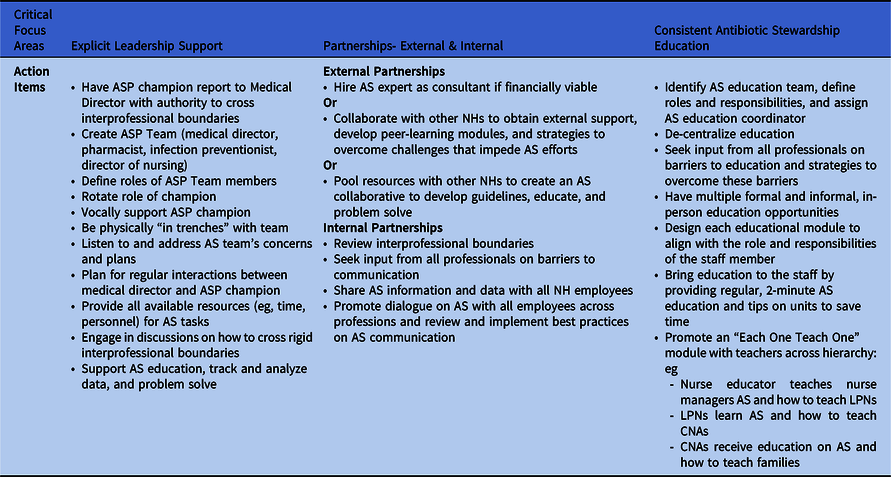
Although leadership support is key to ASP implementation, Reference Carter, Montpetite and Jump14,Reference Pakyz, Moczygemba, VanderWielen, Edmond, Stevens and Kuzel22,Reference Manning and Pogorzelska-Maziarz34 it is critical for sustainability. For our participants, explicit leadership support was evidenced by active and consistent engagement in antibiotic stewardship, by vocal support of stewardship efforts, and by being visibly “in the trenches” with staff. Similarly, while rigid professional boundaries and hierarchical structures harm antibiotic prescribing practices during ASP implementation, Reference Broom, Broom, Kirby, Plage and Adams35 our participants felt that, for sustainability, nurses and prescribing providers in particular must have collaborative relationships. Equally important was the need for an external partnership with a professional with antibiotic stewardship expertise to guide education, to develop collaborative treatment guidelines, to assist with interpretation of antibiotic usage data, and to provide pharmacy expertise. Lastly, we found that antibiotic stewardship education for all staff based on their responsibilities was important Reference Wu, Langford, Daneman, Friedrich and Garber2,Reference Katz, Gurses, Tamma, Cosgrove, Miller and Jump19,Reference Sloane, Zimmerman and Ward26 and needed to be guided by a collaborative educational plan developed by an antibiotic stewardship education team. We recommend that nursing homes with an established ASP can sustain them by prioritizing 3 critical areas: (1) explicit, ongoing leadership support, (2) partnerships with an external antibiotic stewardship expert and fostering internal interprofessional collaborations, and (3) consistent education and training for all staff, despite the constraints on nursing homes and the complex interactions between the factors impacting ASP sustainability. We describe in detail the necessary practices that would enable nursing homes to foster ASP sustainability in Table 4.
Critical Focus Areas for Sustainability of Antibiotic Stewardship in Nursing Homes

Note. ASP, antibiotic stewardship program; AS, antibiotic stewardship; LPN, licensed practical nurse; CNA, certified nursing assistant.
Our study has several limitations. First, we performed interviews in 9 not-for-profit nursing homes in upstate New York that were involved in a collaborative project. Findings may not apply to nursing homes that are for-profit or in other regions. Second, despite concerted efforts, we recruited only 1 participant from 1 of the nursing homes because of high staff turnover and competing priorities.
Despite these limitations, we have identified the threats to ASP sustainability, and we have provided focused recommendations to nursing homes in 3 critical areas. We believe that sustainability cannot be an afterthought and needs to be integrated into the design of ASPs. Future research should target how ASPs in nursing homes with limited resources can be both implemented and sustained over time.
Acknowledgments
We thank all participants and members of the Rochester Nursing Home Collaborative. We thank Margaret Kearney, PhD, RN, FAAN, Professor Emerita, University of Rochester School of Nursing, whose insights provided valuable peer-review and added to the rigor of the study.
Financial support
No financial support was provided relevant to this article.
Conflicts of interest
All authors report no conflicts of interest relevant to this article.