Eimuntas Nekrošius passed away suddenly on 20 November 2018 in Vilnius. The artistic path of the Lithuanian director ended, by a twist of fate, with two performances in the National Theatre Warsaw. It was a symbolic conclusion to the thirty-year cultural relationship between Lithuania and Poland since the fall of the Iron Curtain. This article aims to present how Nekrošius's theatrical work affected reciprocal Polish–Lithuanian cultural relations in the context of historical occurrences that ambivalently determined contacts between neighbour states and nations. I consider the great history of the Polish–Lithuanian Commonwealth established in the sixteenth century; this Jagiellonian empire also brought several post-colonial side effects to subsequent ages. Its spectacular fall at the end of the eighteenth century resulted in a shared experience of enslavement to the Russian Empire that lasted until independence was regained in 1918. In the case of the Polish nation, this experience of enslavement was deepened by the fact of partition between three world powers – the Russian, Prussian and Austro-Hungarian Empires. The interwar period of independence turned out to be conflictual for both newly reborn states. The international crisis reached its peak in 1922 during the so-called Żeligowski mutiny. As a result, Vilnius, the historical capital of Lithuania, was incorporated into the Second Polish Republic. In the period following the Second World War and the post-war dependence on the Soviet empire of the Soviet Socialist Republic of Lithuania versus the Polish People's Republic as a satellite state, international dialogue was frozen for decades.
This extremely brief presentation of the Polish–Lithuanian common historical experience seems necessary as an introduction to the current topic. The age of empire described in Eric Hobsbawm's seminal book affected the development of Polish and Lithuanian national identities,Footnote 1 particularly in the dimension of nationalistic tendencies, as specific reactions to an intensely felt political weakness. Suppose one wants to understand contemporary Poland and especially the Polish right-wing government's recent clumsy policy toward institutions of the European Union. In that case, instead of a bunch of press reports, one can read Adam Mickiewicz's romantic drama Forefathers’ Eve (Dziady), which Eimuntas Nekrošius staged perfectly in Warsaw as part of celebrations devoted to the 250th anniversary of the establishment of the first Polish National Theatre. This article reflects upon the transnational, reciprocal relationships of these nations, and their resistance to attempts to wipe them from the political and military maps of Europe. Furthermore, it opens up the possibility of tracing how purely national institutions could transform into transnational dialogue platforms. The fragmentary, unchronological composition of Mickiewicz's Forefathers’ Eve is bonded together by the impressive figure of a romantic hero who transforms from anonymous revenant into the lover Gustav, becoming, in the end, an imprisoned poet, Conrad, who challenges the omnipotence of God in the name of subaltern Poles.
The core problem of Mickiewicz's drama – an attempt to interpret the history of enslavement in categories of Christian martyrdom and messianic mission of the Polish people, and more, the creation of drama as a scenario endowed with the transformative power of performance that resembles the efficacy of religious rituals – provokes the implementation of notions from the field of post-colonial and transnational studies. Especially fitting are the notions of ‘subaltern agency’ (coined by Antonio Gramsci and employed by Gayatri Spivak in her seminal monograph A Critique of Postcolonial Reason: Toward a History of the Vanishing Point) and the ‘cosmopolitan subject’ (analysed by Yana Meerzon in her book Performance, Subjectivity, Cosmopolitanism). These two concepts establish two poles of social reality through which compulsive oscillating forces determine people.Footnote 2
The subaltern agency defines the pole of fringe groups who are still pushed out of legal structures, deprived of the right to citizenship, suffering even the lack of a right to speak. Being subaltern means, according to Spivak, something more than being oppressed. Subaltern agency embraces the state of extreme – social, political and geographical – exclusion from the hierarchy of power in an imperial colony or empire's homeland itself. One of Spivak's subaltern role models, ‘women from the South’, is Rani Gulani of Sirmur, a ‘good wife’ (Sati), who is recorded as one of the self-immolated widows in colonial India,Footnote 3 and is
a figure who intended to be retrieved, who wrote with her body. It is as if she attempted to ‘speak’ across death by rendering her body graphematic. In the archives, Rani Gulari emerges only on call, when needed, as coerced agent/instrument/witness for the colonialism of capital. She is the ‘purer’ figure of fadeout. This woman tried to join uncoerced intending (male) agents of anti-colonialism … The woman in this section tried to be decisive in extremis, yet lost herself in the undecidable womanspace of justice. She ‘spoke,’ but women did not, do not, ‘hear’ her.Footnote 4
Spivak's way of thinking denotes the interminable struggle about giving fringe, non-Western groups of people the right to transform from non-subjects to the position of sovereign agents. The political situation of Poles suffering through the partitions of their state in the nineteenth century – I argue here – was similar to Spivak's subaltern subjects. Even if they were not excluded to the same extent, they felt subaltern, not having the right to speak in their mother language, not having the right to make independent political decisions. Of course, there occurred noticeable differences between aristocratic elites and peasants, cosmopolitan noblemen and underprivileged indigenous locals. However, Mickiewicz, who represented rather cultural elites, recognized and thematized in his essential dramatic work the general mood of nineteenth-century Poles as non-subjects, whose inferiority complex resulted in messianic desires and ideas.
Although Yana Meerzon concentrates, in her study, on cosmopolitan theatre that allows the construction of ‘common spaces of the post-national and post-multicultural state’ in the age of late capitalism,Footnote 5 the notion of a cosmopolitan subject as a privileged citizen of the world, an agent of new nomadism, may be applicable to the description of nineteenth-century social reality. Adam Mickiewicz represents forerunners of post-capitalistic new nomads from this perspective, deeply rooted in Immanuel Kant's philosophical concept of cosmopolitanism. According to Meerzon,
New nomadism functions as a civic city, where diversities converge and interact … Marked by its cultural heterogeneity, the civic city serves as a model of the post-migrant society or new cosmopolitanism, emerging as an alternative scenario to the practices and mythologies of the nation-state. At the center of this construction is the hypermodern individual, someone perpetually on the move between work and leisure, rushed to produce and achieve, often switching languages and cultures, partners and values, driven by various commitments.Footnote 6
With Mickiewicz's cosmopolitanism, we step into the past because the Polish poet seems to be ‘old(-fashioned)’ – near to the Immanuel Kant's idea of cosmopolitan subject obliged to create a worldwide community committed to the same moral values. It also brings a direct contradiction between the universal tendency to serve the entirety of humanity and the messianic elevation of the one and only nation – Poles/Slavs as a collective Jesus Christ – within frames of one exclusive religion, Roman Catholic Christianity.
As a romantic poet, Adam Mickiewicz (1798–1855) belonged to the cosmopolitan community of artists, and as a Polish–Lithuanian immigrant, he never ceased to think about his duties towards the nation. His life was nomadic par excellence. He wandered through the territories of Europe and Asia all his life. He clearly exemplifies a transnational artist who initiated dialogue across boundaries that embraced local and universal loyalties and allegiances without considering them contradictory or provoking conflict.Footnote 7 From his early years spent in the Vilnius region, part of the Russian-partitioned territories of the former Grand Duchy of Lithuania, through the experience of banishment to central Russia as a participant in secret student organizations, to the diasporic community of the Polish Great Emigration in Paris, Mickiewicz was always a cultural cosmopolitan who worked ‘across languages, multiple modes of artistic and economic production, and politics’.Footnote 8 He became the first (and only, until the 1990s and Jerzy Grotowski's engagement) Polish professor at the Collège de France to deliver lectures on the history of Slavic literature, particularly the messianic mission of the Slavic nations. Furthermore, he finished his life by abandoning the poet's duties: he became a freedom fighter who participated in the Turkish campaign against the Russian Empire, and died in suspicious circumstances in Constantinople in 1855.
As a romantic artist, Mickiewicz contributed to the re-creation of the definitions of Polishness and national culture, as well as to the inception of Polish theatre. Reading his work today reveals still potent tensions between national and transnational tendencies. His Forefathers’ Eve is particularly full of such contradictions. It culminates in the messianic vision of Poland as a Christ of nations – dragged along by an ‘entire Europe’, sentenced to death by crucifixion in a pan-European theatre of cruelty in which France impersonates Pontius Pilate, the Austrian representative exacerbates the suffering with vinegar and the Prussian one with bitter bile, and the ‘Muscovite soldier’ stabs the Polish Messiah's body with a lance. This is to emphasize that the dramatic cycle starts with the retrieval of the old pagan, marginalized rituals, separate from the current Russian Empire and the former Polish–Lithuanian Commonwealth in favour of the illiterate peasant community. The peasant's ritual community represents all but ethnic Poles, although they speak Polish. They are Slavs discovered by the poet who claimed in his debut, Ballads and Romances (1822), that indigenous folk tales, songs, customs and rituals comprise the core of national culture. This idea of the quest for the deepest roots did not represent any nationalistic aspiration. It was transnational to the extent that nowadays three European nations can acknowledge Mickiewicz as their ‘national’ artist – Poland, Lithuania and Belarus. It appears extraordinary that the exact historical figure evokes the legacy of traditional, fringe communities and critical terms of transnational perspectives like migration, deterritorialization and territorial instability.
Furthermore, Adam Mickiewicz resembles the problematic examples of post-colonial self-appointed intellectuals who exploit the stories of subaltern natives to talk in their name but without their permission. Vernacular voices remain anonymous, obscured by the hegemonic voice of the great Polish poet who knows better how to polish their gauche expressions in Belarussian or Lithuanian, vocal and bodily performances which suffer a lack of poetic harmony or composition. bell hooks critiques this kind of hegemonic dominance of the poet/academic/investigator over the subaltern native informant as follows:
[There is] no need to hear your [native] voice when I can talk about you better than you can speak about yourself. No need to hear your voice. Only tell me about your pain. I want to know your story. And then I will tell it back to you in a new way. Tell it back to you in such a way that it has become mine, my own. Re-writing you, I write myself anew. I am still the author, authority. I am still [the] colonizer, the speaking subject, and you are now at the center of my talk.Footnote 9
Real proof of the maintenance of the hegemonic position is that the Polonized concept of Lithuania created by Mickiewicz causes no deeper concern to a Polish audience, for example when they read or listen to the apostrophe of his poem Pan Tadeusz:
This Polonized Lithuania supports a nostalgic image of Eastern Borderlands (Polish Kresy wschodnie) still present in contemporary Polish art – literature, theatre and cinema. Adam Mickiewicz established the most influential Polish performance scenario – Forefathers’ Eve – as a cultural project (according to Leszek Kolankiewicz) or the most powerful example of the theatre of (performative) transformation (according to Dariusz Kosiński),Footnote 12 but all the ‘ingredients’ were taken from Slavic pagan cultural rites performed in languages other than Polish, marginalized, and condemned by the hegemonic Enlightenment and Western cultural perspective. So there are a minimum of two levels here – the poet who takes the floor on behalf of Belarussian or Lithuanian subaltern peasants, and who then establishes the (trans)national platform to empower the entire Polish nation from a subaltern position within three hostile empires – Russian, Prussian and Austro-Hungarian. Equally significant is that Adam Mickiewicz's works preserved their rebellious potential after almost two hundred years from the date of publication. Despite the poet's manipulations, processes of polishing and translating into Polish, Eastern European subaltern voices can still be heard.
Eimuntas Nekrošius – the theatre of sensual metaphors
Yana Meerzon's postulate of ‘performing the divided self of a new cosmopolitanism’ on theatrical stages as a cultural ‘medicine’, healing the nation-state-oriented world from the temptation to segregate people of different origin, or to ‘clean out’ their hyphenated identities, inspires the latter part of this article devoted to the Lithuanian artist Eimuntas Nekrošius (1952–2018) and his staging of Forefathers’ Eve in Warsaw.Footnote 13 For many Polish generations in the last two hundred years, the author of Forefathers’ Eve has been ‘the voice from Lithuania’ primarily. This expression was equated with the romantic poet – the drama of the lyric wanderer in The Ackerman Steppe, the opening of the poetic cycle of Crimean Sonnets (Sonety krymskie, 1826). Experiencing solitude and ‘trauma of deterritorialization’ in the middle of a foreign (Muslim Crimean Tatar) neighbourhood,Footnote 14 the lyric hero gets an intense feeling of nostalgia: “W takiej ciszy – tak ucho natężam ciekawie, / Że słyszałbym głos z Litwy. – Jedźmy, nikt nie woła!”Footnote 15 “In silence like this – I am pricking up my ears, / So I could hear the voice from Lithuania. – Let us go. Nobody is calling” (my translation). Nekrošius's artistic activity in Poland – regular guest performances during international theatre festivals, concluding with the collaboration with the National Theatre Warsaw – deserve attention as an exemplification of the process of transnational rapprochement. Furthermore, this case study provokes questions: how can his typical emphasis on the vernacular (and peripheric) Lithuanian identity result in creating a cosmopolitan, transnationally comprehensible aesthetics of the theatre of sensual metaphors? How can the ostentatiously apolitical theatre bring such significant transnational benefits?
Eimuntas Nekrošius's artistic career consists of three stages: first, concentration on Russian literature and reflection on Soviet reality (1980–97); second, focus on Shakespearean tragedies and conquering European stages (1997–2003); and finally, a turn to Christian and metaphysical plays, at the peak of his career (2003–18).Footnote 16 However, Nekrošius remained committed to the aesthetics of theatre of sensual metaphors, which he invented as a young artist in the 1980s, throughout his life. The author's aesthetics of the theatre of sensual metaphors was situated far from the practice of political theatre as a virtual space for negotiating any transnational issues. It was instead from the very beginning a particular type of cosmopolitan theatre that interwove classical texts of European heritage with the convention of non-realistic acting that exposed the motoric capabilities of performers’ bodies and tight connections between bodily actions and manipulated objects. These objects were usually linked with ordinary Lithuanians’ rural life: wood, stone, water, ice blocks, metal sheet, aluminium buckets or milk cans. Thus several European dramatic artworks were used, embodied in everyday objects and transformed through the actors’ active metaphorization of the materials into the unique, fairy-tale-like world on the stage. Nekrošius's process always started from a free interpretation of staged plays, which allowed Hans-Thies Lehmann to classify him as one of the representatives of the post-dramatic theatre.Footnote 17
Nekrošius's theatre aesthetics were based on the general rule of ‘complex simplicity’ (Ramunė Marcinkevičiutė's term sudėtingas paprastumas).Footnote 18 The director's imaginative work consists of two stages:Footnote 19 first, a deep reading of a literary text in search of metaphors which could later be visualized and materialized onstage; second, propelling objects and actors’ bodies to create a symbolic scenic world which inspires the spectator's imagination endlessly and encourages them in the hermeneutic work. His approach relies on a variant of corporeal–performative acting – the convention in which the inner life of every character must be represented by gestures and motions of the actor's body in the theatrical space. This acting convention produces specific problems in perceiving the performance: the viewers who read/watched several theatrical performances of a given classic drama could feel the need for resistance to the director's intervention in the matter of the play; at the same time, they are obliged to learn a new theatrical language. Furthermore, the Lithuanian director makes the stage aesthetics more and more complex, not giving the audience time enough for its full comprehension. Many examples of this appear in Nekrošius's Hamlet. For instance, the protagonist enunciates his great monologue ‘To be or not to be’ standing in a white shirt made of paper under the metal chandelier made of melting ice cubes and burning wax candles. ‘The slings and arrows of outrageous fortune’ (Act 3, scene i, vv. 64–6) are cold water and stinging wax drops. The gradually destroyed paper shirt resembles numb patches of skin typical of leprosy. The use of the chandelier was inspired by the metaphorical description of the king's responsibility in Rosencrantz's statement:
Claudius smashes the chandelier in the Lithuanian performance, enraged by Hamlet's actions. Rosencrantz's words become reality.
Nekrošius follows all references concerning water, ice, steam, paper, fire, ash and synthesizes them into a general metaphor of continuous ‘dance of elements’. Ice symbolizes the innocence of a spiritual world; it is found in Hamlet's words to Ophelia: ‘be thou as chaste as ice, as pure as / snow’ (Act 3, scene i, vv. 147–8); wax occurs in Hamlet's dialogue with mother: ‘let virtue be as wax / And melt in her own fire’ (Act 3, scene iv, vv. 94–5). Here is also the oxymoronic coexistence of ice and fire: ‘Since frost itself as actively doth burn’ (v. 98). Ghosts appear material; pain becomes corporeal, metaphors visible, almost tactile. As Marcinkevičiutė claims,
The consistency of the artist's personality with his creative work is evidenced by one more fact: since staging Anton Chekhov's Uncle Vania in 1986, Nekrošius has worked only with classical texts. For more than thirty years, he staged texts by Gogol, Pushkin, Chekhov, Shakespeare, Dante, Goethe, Dostoyevsky, Kafka, or fragments of the Old Testament. Thirty years without contemporary drama! And this, even after the fall of Berlin Wall when European theatres focused on the so-called new-drama territories and relevant social studies.Footnote 20
Nekrošius's sensual metaphors used well-known plays to make his strategy visible to all spectators, as in jazz where a standard form creates variations.
Cosmopolitanism and cultural diplomacy behind the Iron Curtain
Nekrošius could call himself a child of empire. The Soviet Union allowed him to receive a high-quality education in the post-Stanislawski period, but the same empire imposed limitations on artistic collaborations and on the work of theatre-makers. Nekrošius's performance Pirosmani, Pirosmani at the Belgrade International Theatre Festival (BITEF) in 1984 was the first appearance of Lithunian theatre at any international festival.Footnote 21 For the same reason, most Polish theatre artists preferred visits to Western Europe; only a few even studied in the Soviet Union (Jerzy Grotowski and Jerzy Jarocki were among them). In these circumstances of limited freedom (of speech, travel and work), it was not conceivable to think about transnational cooperation. How could anybody think about transnational relationships if his pass had to be deposited in the nearest police office after finishing each overseas journey?
The first visit of Eimuntas Nekrošius in Poland occurred in the shadow of Soviet hegemonic cultural diplomacy, which, as Edgars Klivis claims, used to trigger reciprocal distrust.Footnote 22 In the 1980s, the Polish audience was unable to escape geopolitical associations. Although Nekrošius's theatre troupe benefited from Gorbachev's perestroika and glasnost, their first tour to Poland in 1986 failed due to the perception of the Lithuanian artists as representatives of Soviet oppression, following the imposition of martial law in December 1981. A few years later, the political atmosphere had changed but transnational dialogue had became more complex. The reborn Lithuania and Poland were forced to face historical issues of land and nation that had been suspended during the communist period. In the changing context of the 1980s, cherished notions of motherland and of territory re-emerged across the region.
The second visit of Nekrošius to Poland took place after 1989. It is hard to believe that the director of the Wilam Horzyca Theatre in Toruń, Krystyna Meissner, synchronized her operations with the political agenda of that age. On 27 May 1989, she decided to close the thirty-year-old regional theatre festival. The first partially free and democratic parliamentary election in Poland took place the following week. In December 1989, the Berlin Wall fell. The following year, Meissner organized a mini festival of Lithuanian master Jonas Vaitkus's performances. Forefathers’ Eve was among the four presentations. The first International Theatre Festival, Kontakt, took place in Toruń in the last week of May 1991. Meissner defined it as a site of ‘sewing Eastern and Western Europe together’, a realization of Arjun Appadurai's postulate to redefine interhuman and international relationships ‘that transcend specific territorial boundaries and identities’,Footnote 23 challenging apparently universal definitions of ethnic and national identities. Meissner consciously applied a transnational tool – a theatre festival. From the very beginning, Kontakt Festival functioned as a site of ‘systematic transnational assemblages of [artistic] production, taste transfer, pricing, and exhibition’.Footnote 24 It inspired many visiting troupes to invent their novel identities for new nation states.
From a transnational perspective, Mickiewicz's Forefathers’ Eve in the Lithuanian version by Jonas Vaitkus at the Warsaw National Theatre primarily represented a symbolic moment. Vaitkus brought the Lithuanian-language version to the stage that has been essential for Polish collective memory since its establishment in 1765. It was, naturally, a moment of giving the floor to the former partners in the noble Commonwealth. Poles had never acknowledged these partners to this extent on the level of their language and ethnic culture. Not to overemphasize things, politicians and ordinary citizens from both countries at that moment had other problems than going to the theatre.
Eimuntas Nekrošius's debut at the first Kontakt in 1992 continued this bottom-up policy of Polish–Lithuanian cultural rapprochement with The Square, a play
inspired by a true story about two people who fell in love through letters … The play … promoted the idea of the autonomy of theatre art; using simple theatrical means of expression, it opened up the power of the director's imagination and the theatrical metaphor as a space beyond words.Footnote 25
For the Polish audience in the 1990s, the salience of radio as a mass medium (the Voice of America, Radio Free Europe) and the experience of the Soviet Gulag were especially attractive after the abolition of state censorship. However, the real success of Nekrošius in Poland was related to his award-winning interpretations of classics by Russian authors (Pushkin's Little Tragedies, 1994; Chekhov's Three Sisters, 1995) and Shakespeare (Hamlet, 1997; Macbeth, 1999; Othello, 2001). His Hamlet also brought the prestigious Polish Konrad Swinarski Award, given by Teatr monthly for the first time to a non-Polish artist. However, Nekrošius was not engaged in any Polish theatre after the epic decade of the 1990s, working mainly in Western Europe and Russia. Yet the title of the interview published in 1998 in Teatr sounded promising: ‘I Would Like to Stage Dziady (Forefathers’ Eve)’.Footnote 26
Forefathers’ Eve in Warsaw
Nekrošius fulfilled this ambition in 2015. His theatrical approach challenged a substantial Polish theatrical tradition and the messianic usurpation in the period of academic discussion of Jan Sowa's dissertation Fantomowe ciało króla. Peryferyjne zmagania z nowoczesną formą (The King's Phantom Body. Peripheral Struggle with the Modern Form) devoted to the double colonial entanglement of Poles in the past (‘facing foreign colonization resembling that which Western European potencies did with societies and civilizations of Asia, Africa and South America, and on the debris of their own Eastern Borderlands’ colonial project executed by the First (Noble) Republic’).Footnote 27 Although Nekrošius did not follow this post-colonial perspective, he contributed to the polemical dialogue about the empowerment of virtual subalterns. First of all, these polemics were focused on the issue that national trauma of enslavement does not justify any reinforcement of nationalistic attitudes or false messianic consciousness.
Forefathers' Eve seems an ideal play for Nekrošius's theatre of sensual metaphors: a versed drama divided into four parts numbered not in the standard order, as a sign of the fragmentary character of the text. Forefathers’ Eve develops from an operatic version of a traditional folk rite devoted to the dead (Part Two), through an intimate drama including a fundamental dispute between a romantic lover of unclear ontological status (dead or alive, revenant or madman, serious performer or jester) and the Orthodox Priest representing both the authority of the church and Enlightenment reason (Part Four). The last part of the drama (Part Three) represents an epic panorama of the newest (at that time) Polish nineteenth-century history of enslavement and martyrdom interpreted in the light of messianism.
The text capacity, the number of issues and the heterogeneity of its theatrical form force every director to cut many scenes or select their fragments. Nekrošius did this with characteristic flippancy; he proposed the author's interpretation of the romantic drama, underlining an ironic and critical attitude. Many directors have practised ironic play with Mickiewicz's sublime assumption about Polish uniqueness in the past. In Jerzy Grotowski's performance, Gustav-Conrad (Zygmunt Molik) impersonated Jesus Christ, carrying a ridiculous broom instead of a holy cross (1961). Molik's Gustav-Conrad aspired to the hegemonic position from the existential state of subaltern weakness. It proved the efficiency of the ‘dialectic of derision and apotheosis’ within the aesthetics of Grotowski's poor theatre. The idea was
formulated by the renowned theatre critic Tadeusz Kudliński in his review of Forefathers Eve [Dziady] at the Theatre of 13 Rows in an attempt to comprehend the fascinating duplicity of play and grotesque, on the one hand, and danger and seriousness, on the other, which characterized, in Kudliński's view, this performance.Footnote 28
In Konrad Swinarski's performance, peasants smashing eggs disturbed Gustav-Conrad's Great Improvisation (1973). Swinarski used Brechtian V-Effekt to emphasize the gap between the messianic megalomania of elites and the utmost marginalization of peasants who do not listen to Conrad's plea and are not listened to by anyone (human or divine). Swinarski, who was born in a Silesian family with Polish and German roots, and assisted Bertolt Brecht at the Berliner Ensemble in 1955–7, also proposed a corporeal interpretation of Conrad's weakness. Jerzy Trela, impersonating Conrad in the Great Improvisation, suffered symptoms of epilepsy far beyond the classical interpretations of being possessed by Satan. Like Gayatri Spivak's cases of subaltern figures, Trela's Conrad represented an individual writing the history of marginalization with his body.
The tendency of critical theatre had returned by this point. Michał Zadara staged Mickiewicz's drama in toto (all preserved parts and poetic fragments within a performance that lasted fourteen hours, 2014). The protagonist urinated into a bucket before the Great Improvisation, and had buffoonish characteristics not befitting a messianic hero. The most complex pastiche and parody of Mickiewicz's romantic play was realized by Radosław Rychcik in the same year, containing multiple pop culture quotes. Guślarz (the leader of pagan peasants worshipping their dead) had Heath Ledger's Joker face. Ghosts of poor children resembled the twin girls from Stanley Kubrick's The Shining. The Great Improvisation was replaced by Martin Luther King's ‘I Have a Dream’ speech and the onscreen declamation quoted from Tadeusz Konwicki's movie Lava. All gestures in Rychcik's performance resembling Joseph Roach's surrogation served both the replacement of absent rebel leaders of the national community and exposure of the void deprived of hegemonic voices in contemporary Poland.Footnote 29
All the above-mentioned examples that represent Gustav-Conrad in his genuinely human weakness may also be interpreted as autothematic self-reflection on poetry's and theatre's social commitment. Even if theatre is not the most potent medium to solve transnational problems, antagonistic interests of nation states and minorities, diasporas or just individuals, it is still effective as a human medium. It is quite easy to complement Arjun Appadurai's five dimensions of global cultural flow (ethnoscapes, mediascapes, technoscapes, financescapes, ideoscapesFootnote 30) with theatre, and its cultural salience as a ‘memory machine’ (according to Marvin Carlson's termFootnote 31) or critical institution which enables artists and audiences to reread collective memories or traumas.
For Nekrošius, a Lithuanian challenging the Polish–Lithuanian vision of Mickiewicz in the presence of Polish spectators overwhelmed by the idea of Polish hegemony in the past, the Warsaw performance proved troublesome. However, he was able, to some extent, to acknowledge a shared history and tradition. First of all, Mickiewicz raised vernacular folklore to the status of national heritage (Polish, Lithuanian or Belarussian), and he upgraded the local persecution of Vilnius University students to the status of holy history. However, deep faith in ghosts remained the characteristic feature of Nekrošius's performance in the National Theatre Warsaw next to multiple hints of irony or criticism. According to the Catholic dogma of the Communion of Saints, profound belief in the communion of living and dead people made the Warsaw performance the next incarnation of Nekropolis.Footnote 32
The Warsaw performance takes place in Nekropolis, the City of the Dead. Having an ordinary dinner with the souls of people who have passed away constitutes the actual situation of the Slavic pagan ritual and the performance. It resembles the arrival of Commendatore invited to dinner by Don Giovanni in Wolfgang Amadeus Mozart's opera. Mickiewicz uses in his play a musical quote from Don Giovanni to create dramatic suspense: an orchestra in the Warsaw salon changes suddenly to Commendatore's aria spelling danger: the sudden death of the Doctor, a zealous servant of the Russian emperor, killed by a thunderbolt. Allusions to Mozart's opera in Nekrošius's performance become a starting point for establishing a chain of brilliant connotations, partly derived from Mickiewicz's text.Footnote 33 The director's imagination works systematically. According to the rules of his theatre of sensual metaphors, he discovers metaphors in the drama, then endeavours to materialize them, and in the end equips actors with objects which allow them to create chains of physical action onstage. These actions arranged as complex études express both energetic and motoric bodies of performers. The semiotic density of the theatrical work does not interfere with the high-quality energetic actors’ presence.
In the Warsaw performance, the central motif is a ‘man/statue of stone’. The director reveals in Forefathers’ Eve different in-text variants of the motif. These are the above-mentioned meeting of Don Giovanni with the ‘man of stone’ – Commendatore's monument; the silent Phantom, the Revenant with the frozen heart and more: the young man who ‘slowly grows into a stone’ finally ‘becomes a stone as a whole’, and Gustav during Maryla's wedding party (‘I am standing like a rock, saying no word’). The Lithuanian director associates these motifs with the cubistic statue of Adam Mickiewicz, Zbigniew Pronaszko's project inspired the words of Juliusz Słowacki, another Polish poet, about Mickiewicz: ‘You arose, a Lithuanian god, from a dark pinewood sacred site.’Footnote 34 A wooden mock-up statue was mounted in interwar Vilnius in 1924. In the Lithuanian director's performance, this cubistic giant object appears a few times onstage. Furthermore, Gustav-Conrad, impersonated by Grzegorz Małecki dressed in a large, heavy overcoat, resembles this stony/wooden statue. At the end of the Great Improvisation, devils build a sarcophagus made of books around his body. Ironically, the dead poet (at the zenith of his glory) signs autographs with a still-living hand. The director's imagination focuses on the chains of metaphoric association, a continuous transformation of living entities, man/animal-like/ghost/revenant, into the wooden/paper/stony/metal matter/statue/tomb/pagan idol, and vice versa. It creates a new materialistic impression, as always in Nekrošius's performances, of the pantheistic unity of all living beings and material objects on stage. Humans, animals, branches and stones represent all empowered agencies of the universe.
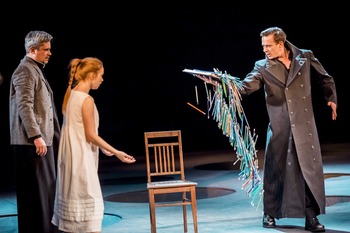
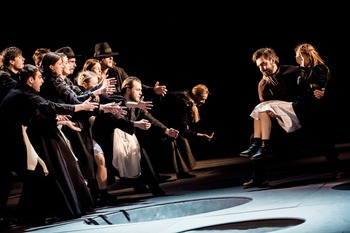
The next issue is the poet's use of ‘paper’: the romantic madman Gustav brings a book (instead of a cypress branch); lots of colourful pencils scatter from it (Fig. 1). All his inauthentic, poisoned knowledge of love arose from books. It corresponds with the image of Conrad's sarcophagus made of books (it was also the challenge of Hamlet's ‘Words, words, words’ which transmuted into ashes in Nekrošius's performance, 1996; and Faust's and Dante's disillusionment, 2006, 2012). Metal sheets allow angels to protect Conrad and the Priest Peter in safe capsules. The entire scenic world equipped with paper/metal/stone objects provokes discourse on an ambivalent messianic subjectivity – which appears weak because it still needs to be protected, but strong because of deep dreams about Great Polishness. According to Jacek Kopciński, the scenic world of Nekrošius's Forefathers’ Eve characterizes both growing menace and gestures of protection (Fig. 2). It is the universe created by the poet's hand, people's hands drawing mysterious signs in the air, hands of peasant's community fluttering in the invisible water, caring hands of angels and priests, mothers and lovers – the world of Christian charity.Footnote 35 At the same time the Christian prophecy of the Priest Peter seems problematic from the perspective of the false messianic consciousness of Poles, an invalid method of empowerment. Nekrošius attempts to challenge this exclusive messianic claim by evoking bird motifs in Mickiewicz's play: the almighty crow from the Small Improvisation and the bird-like perspective of the Priest Peter's prophetic vision. The Priest Peter (Mateusz Rusin) emerges as a stork, the holy bird of Poland, Lithuania and Belarus. A red pencil represents his bill. A white shirt symbolizes innocence, red socks and bill the colour of sacrifice – together the colours of the Polish national flag. However, the national bird of Poles is a white eagle. Thus, a stork represents Slavic and Lithuanian pagan tribes. The director's transnational gesture enlarges the community of chosen nations. Before the Christian era, the stork incarnated the pagan Slavic god Roda, a powerful guard circling the whole territory. The Priest Peter's prophetic vision implies the transnationalism of the divine plan concerning all Eastern European nations. Nekrošius extrapolates the exclusively Polish myth on the shared traumatic experience of Eastern Europeans subalterns, all nations ‘forgotten’ by God and history. At the same time, the viewer could perceive conversely an ironic rejection of this messianic usurpation of Poles.
Forefathers’ Eve directed by Eimuntas Nekrošius. A small wonder done by Gustav (Grzegorz Małecki) in the presence of the Priest (Piotr Grabowski) and the Child (Paulina Szostak), Photograph: Krzysztof Bieliński, the Artistic Archive of the National Theatre Warsaw.

Forefathers’ Eve directed by Eimuntas Nekrošius. Guślarz, the leader of a peasant community (Marcin Przybylski) saving the Soul (Paulina Szostak). Photograph: Krzysztof Bieliński, the Artistic Archive of the National Theatre Warsaw.

In contrast with all solemn tirades of messianic prophecy, some meagre Lithuanian visitors occur in the Warsaw salon. They speak Polish, unlike the aristocratic acolytes of the Russian tsar's commissar, who prefer French. They can offer only stories about the persecutions of the youth in Lithuania: unwanted stories for the higher society who fancy bucolic tales (according to the aphorism ‘we Slavic people love bucolic tales’). They are the unheard voices from Lithuania (not idealized by the director). They mope around the Warsaw salon, they beg, they do not fit the elegant company. One of Mickiewicz's figures enunciates the extremely peripheral position of poor relatives:
Unlike in many Polish performances, a powerful feminine agency appears in the Warsaw realization – the Virgin Mary impersonated by Wiktoria Gorodeckaja. In Polish theatrical tradition, this figure was a representation of man's heartbreak coupled with misogyny. The scenic presence of the Virgin performed by Gorodeckaja has nothing to do with the miserable figure resembling young Mickiewicz's lover Maryla Wereszczakówna who betrayed ideal romantic affection and married a wealthy count. Gorodeckaja's Virgin depicts a type of Gayatri Spivak's subaltern woman who is not ‘true’ enough and experiences bitter existential solitude. Nekrošius's performance is concluded not by the picture of lonely Conrad beginning his rudimentary journey to Siberia, but with the approval of the feminine challenge of desolation. Gorodeckaja performs a song of confidence that all creatures have twin beings: ‘In all of Nature that majestic whole / of flesh and spirit – each has a kindred soul.’Footnote 37 Following this path, Nekrošius reveals partly universal, partly transnational meanings of Mickiewicz's play deep-rooted in nineteenth-century pagan folklore and the collective imagination of Polish culture.
The last performance directed by Nekrošius was Witold Gombrowicz's Marriage. Gombrowicz (1904–69) became a patron of anti-romantic criticism for many Polish post-war artists who refused the conservative discourse of messianism and nationalistic patriotism. As a forced immigrant, he learned of the outbreak of the Second World War in 1939 during his transatlantic voyage to South America. He lived there until his death, having no chance to return to Poland. Published in 1948, the play Marriage has a transnational starting point: the protagonist Henry, a former Polish soldier in France during the war, dreams of coming home and meeting his parents as the Other. A separate article could develop the interpretation of how Eimuntas Nekrošius re-created Gombrowicz's play in the National Theatre in Warsaw.Footnote 38 Both performances in Warsaw based on Polish classics constitute a transnational gesture of the Lithuanian director within frames of his author's theatre of sensual metaphors that occurs as an apolitical phenomenon. There is a need to support this thesis with a longer explanation. Following Aristotle's notion of zoon politikon (the man who is, first of all, a social being), and Jacques Rancière's claim that every art is political, so that there is no reason to label any piece or discipline of art ‘political’, we can unravel the paradox of Nekrošius's theatre aesthetics. First, his two performances in Warsaw were passed over in silence by most theatre reviewers and researchers with regard to their engagement with Polish literature and history. In Gustav's Crypt,Footnote 39 Majchrowski has no separate chapter about Nekrošius's play, though the monograph's cover is a photograph from the Warsaw performance. How to comprehend the researcher's intentional or unintentional omission? It has much to do with Spivak's category of subaltern agency or Rancière's political dissensus. Theatre as both aesthetic and political space remains open for dissensus symptoms – questions that appeal for solution.
Dilip Gaonkar interprets the crucial issue through the lenses of Gayatri Spivak's theory. ‘Political dissensus’, he observes, ‘is not a discussion between speaking people who would confront their interests and values. It is a conflict about who speaks and who does not speak, about what has to be heard as the voice of pain and what has to be heard as an argument of justice.’ Rancière dwells on Aristotle's claim that ‘slaves understand language, but do not possess it’. A slave may register a wrong, blaberon, in a cry of pain, but that cry is bereft of reason. Someone else must speak, think and reason on her behalf. In a police order, or in a politics of police, only those with allotted stations and functions based on their alleged competencies and accreditations can speak and advance their interests and values in the name of the common. Those with no such allocation in the structured social body, the uncounted, ‘the part with no part’, cannot speak; if they speak, it is not heard; if heard, it is deemed unintelligible in the prevailing perceptual order. Such is the police distribution of the sensible.Footnote 40
Nekrošius's Forefathers’ Eve seemed to be – in the eyes of the Polish audience – just an aesthetic approach without any political claims. The justification of such apolitical aesthetics lies in the Soviet past. His artistic role at that time was similar to many Polish artists who worked in the Polish People's Republic before 1989. Everyone had to comply with the specific police order defined as ‘first and foremost an organization of “bodies” based on a communal distribution of the sensible, i.e., a system of coordinates defining modes of being, doing, making, and communicating that establishes the borders between the visible and the invisible, the audible and the inaudible, the sayable and the unsayable’.Footnote 41 Officially it was a police order that served the Soviet or Polish people; in fact, the gesture of depoliticization characterized it. As Slavoj Žižek claims, ‘the basic aim of anti-democratic politics always – and by definition – is and was depoliticization, i.e. the unconditional demand that “things should return to normal,” with each individual doing his or her particular job’.Footnote 42 In the case of communist Poland, it was an order of so-called ‘people's democracy’ – one was a legal citizen of the state; he/she had fundamental rights – freedom of speech, the right to vote and to learn, the duty to work – but one could not be involved in any political struggle against the authorities and the Party (the Polish United Workers’ Party). One did not even need to write an X on a ballot paper. It was enough to put the clean paper in a box in a polling station. Criticism was anti-state; the general rule of depoliticization was in force in every public institution or workplace – in factories, shipyards, schools and theatres.
Considering the police state of communist Poland, Grzegorz Niziołek's and Joanna Krakowska's regrets about the fear of politics typical of Polish mainstream theatre in the twentieth century are not quite comprehensible.Footnote 43 Both authors identify Polish contemporary theatre's inability to challenge the fundamental issues: class conflict, the hostility of Poles towards national minorities (e.g. Jews, Ukrainians), sexual revolution and counterculture, the political position of the Catholic Church.Footnote 44 Their profound synthesis of Polish theatrical life from 1945 until today lacks acknowledgement of two crucial facts: first, that Polish postwar theatre served the government and the Party with a depoliticizing programme: ‘all struggles between social classes, ethnic communities, including Jews or Ukrainians, gender groups and the relationships with the Church ARE ALREADY solved’. Second, the right to take the floor in political questions was reserved only for the Party's functionaries. It made the collaboration of artists with official institutions in Eastern European states schizophrenic. So Krakowska is correct only to some extent while stating about apolitical artists that such self-proclaimed apoliticality can often become the most meaningful political gesture of all: one of collaboration, as in the case of legal theatres with their entertainment repertoire under Nazi occupation; one of conformism or acquiescence in the Polish People's Republic; one of mistreatment of the public theatre's mission in the name of profit, post-1989 theatre being a case in point.Footnote 45
Such ‘self-proclaimed apoliticality’ could protect against censorship's interventions, bans on performance, arrests, trials, surveillance, bans on leaving the country or, on the other hand, forced emigration. Kazimierz Dejmek bitterly experienced that even a genuine communist, a member of the Party who declared celebrating with his Forefathers’ Eve the fiftieth anniversary of the Bolshevik Revolution, might be transformed into an object of the political game played by the audience, the Party and the secret service. Dejmek's performance became legendary, but the price was too high. His performance was banned after only eleven presentations; he was dismissed from the position of director of the National Theatre in Warsaw, his actors’ ensemble was dispersed, Warsaw students during the March 1968 riots were beaten with police batons and arrested, and then some of them were expelled from the university.
The pressure of politicization forced many Eastern European artists to create a kind of apolitical asylum in the theatre – a kind of aesthetic shelter. Eimuntas Nekrošius counts unarguably among them.
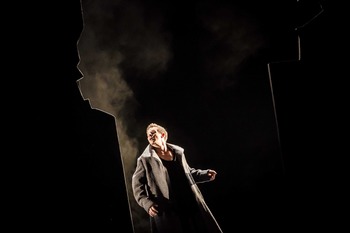
Nekrošius's mission in the National Theatre in Warsaw opened – metaphorically and performatively – the slit of dissensus. The cover of Majchrowski's book (mentioned above) depicts Conrad impersonated by Grzegorz Małecki with a slit resembling Mickiewicz's statue from interwar Vilnius (Fig. 3). The performance may be interpreted from a transnational perspective as a processual, consequent deconstruction of the Great Polish Poet. The deconstruction of the monumental Polish Hero, compared with bizarre figures of Lithuanians as poor relatives who enter the Warsaw salon uninvited, constitutes Nekrošius as a political subject – the transnational agent who transforms Polish–Lithuanian relationships, shifting it from the dimension of Soviet cultural diplomacy (read: forced friendship) to the transnational exchange distinguished by freedom and creativity. In Warsaw, Nekrošius did not just perform a national gesture. Not at all. The profound performance of empowering the entire Lithuanian people took place during Bloody Sunday on 13 January 1991 when Soviet special troops attacked the Vilnius Television Tower, then defended by hundreds of unarmed civilians. Over a dozen people died – shot dead or slammed by tanks, and several hundred were wounded. It was the performance of people's will to freedom, an unquestionable example of national aspirations, the voice of subalterns eventually heard worldwide. In contrast, Nekrošius's theatrical performances in Warsaw may be perceived as a transnational process of empowerment of Lithuanian subjects in the eyes of the Polish audience. The foreign agent extends the definition of the national theatre – from the theatre representing only Polish language, culture and people – to an institution of critical thinking and virtual dissensus appealing to all Polish/European citizens regardless of their national identity. This transnational confrontation activated the critical perception of the unique Eastern Borderlands’ discourse. To quote two of nine features of this discourse formulated by Bogusław Bakuła: one can observe in contemporary Polish culture examples of the ‘idealization of multiculturalism with Poland as a center and the only key term explaining that world [of Borderlands] in toto’; it provokes ‘avoiding the real, authentic contact with the Other (non-Polish) because of the barrier of apparent dialogue which means, in fact, a monologue of the superior Polishness’.Footnote 46
Forefathers’ Eve directed by Eimuntas Nekrošius. Gustav-Conrad (Grzegorz Małecki). In the background: the slit in the shape of the Adam Mickiewicz monument in interwar Vilnius. Photograph: Krzysztof Bieliński, the Artistic Archive of the National Theatre Warsaw.

Even though the theatre of sensual metaphors practised by Nekrošius was never self-defined as political, it intermediated all the time the Polish–Lithuanian path towards a cosmopolitan acknowledgement of the world's diversity triggered by global processes of voluntary or coercive mobility. In September 2021, there was a chance to watch in Vilnius Krystian Lupa's Austerlitz based on W. G. Sebald's novel (The State Youth Theatre), Grzegorz Jarzyna's Solaris, and the impressive, cosmopolitan Republic staged by Łukasz Twarkowski (both in the National Theatre) in a cinema transformed into a television studio vibrating with techno rhythms. Representatives of three generations of Polish theatre artists born in 1943, 1968 and 1983 appeared there, working together with Lithuanian performers on the challenges of the past (the Auschwitz syndrome) and the future (techno-community). Meanwhile, in the Cracow Słowacki Theatre, in Poland, Forefathers’ Eve interpreted by Maja Kleczewska in terms of subaltern Polish women (with Conrad impersonated by an actress) provoked the Ministry of Culture to withdraw the government's financial support for the theatre. In this way, Mickiewicz served again as an agent of dissensus, revealing the regression of the Polish state towards repressive policing, and the profound depoliticization of public institutions in the name of ‘superior Polishness’. This concept emerges yet again, messianic, like a phantom pain that lingers despite the empowerment of the former subalterns.