1. Introduction
The Second of Khordad Movement was a broad-based social movement seeking to overhaul the Islamic Republic, modernize its structures, rationalize its bureaucracy, and put in place a more accountable and responsive system of government (Ehteshami and Zweiri, Reference Ehteshami and Zweiri2007: 6). The movement developed as a result of the following developments:
-
1. Social and epistemological developments such as the spread of urbanization and higher education, expansion of mass media, and changes in people's value systems with regard to democracy (Rabiee, Reference Rabiee1380). These developments paved the way for the quantitative expansion and establishment of social authority in the expanding middle class, which supported the ideas of freedom and democracy.
-
2. The conservatives failed to adapt to these developments, and the new middle class was put under pressure in the years leading up to 23 May 1997 (the Second of Khordad). Bashirieh argued that the new middle class had economic, political, and ideological reasons for their growing dissatisfaction and involvement in political protest. They were suffering from a lack of real political participation and the ideological traditionalism of the regime. Moreover, the new middle class had weak economic relations with the regime (Bashirieh, Reference Bashirieh1381: 130–7).
-
3. There was marginalization of the so-called Imam Front Forces (Khat-e Imam) in the 1990s and the gradual ideological evolution of a number of its members and an inclination towards ideas such as freedom and democracy (Izadi, Reference Izadi1384: 248). Moreover, it is noteworthy that Rafsanjani and his pragmatist faction gradually shifted from an alliance with the conservatives to the Left faction. In fact, various factors had brought the pragmatists and the Radical Left factions closer together by 1994 (Rakel, Reference Rakel2008: 70). Undoubtedly, the role of Hashemi Rafsanjani and his technocrats in supporting Khatami and the Left faction in the presidential election of 1997 should be considered.
The factors mentioned above, along with certain features of the political structure of the Islamic Republic of Iran (IRI), made mobilization of the middle classes by the Imam Front Forces possible from 23 May 1997 onward. However, some have argued that international pressure from Western governments and the world media on the IRI for its involvement in the massacre of the Iranian-Kurdish opposition in Berlin had affected the decision of the Guardian Council to permit Khatami's candidacy. Undoubtedly, a reformist face and a ‘competitive’ election would present a more positive image of the IRI to the world at a time of growing isolation (Rezai, Reference Rezai2012: 191).
The political trends in Iran after May 1997 demonstrate that the reform movement achieved a great deal of success from 1997 up until the spring of 2000. Victory in the first city council elections; a landslide victory in the sixth parliamentary election; the opening of the political sphere; the publication of various newspapers and magazines, which had extensive contact with dissident social forces; the expansion of freedom in assembly rights; and the formation of political parties, were all symbols of the movement's progress, despite the presence of certain barriers, towards the development of freedom and democracy in Iran.
At this stage, the formative social forces of the movement largely supported the movement's elites, allowing them to win convincingly in different elections. The dominant paradigm in both the movement's social forces and its elites was to use the regime's capacities and to support their candidates to enter parliament in order to achieve their political and social demands. Following the sixth parliamentary election, and from the spring of 2000, the conquering of the elective institutions by reformist elites, combined with the full support of the student and intelligentsia movement, and more broadly, the new middle class, a new phase in the history of the movement gradually dawned.
The characteristics of this new chapter, which continued until 2005, included press closures; jailing of journalists and reformist political activists; repression of student movements; the inability of the sixth parliament to enact reformists legislation due to the vetoes of the Guardian Council, which eventually resulted in a stalemate of the reforms; and unfulfilled demands of the movement for social change through the reformist parliament and the cabinet. In fact, the reform movement began to decline from the spring of 2000 and gradually lost its momentum to the extent that Ahmadinejad's victory finally occurred in the 2005 presidential election. Accordingly, the fundamental question of the present paper is as follows: why did the reform movement decline after conquering the elective institutions, and under conditions in which it enjoyed the extensive support of its social forces? The author primarily utilizes the political process model to answer this question.
It must be noted that there are valuable books and scientific papers that have dealt with the reform movement in Iran. Ali M.Ansari in his book entitled Iran, Islam and Democracy (2000) presents a convincing account of the political developments in Iran, which led to the election of Khatami in 1997, and of the sixth parliament in 2000. While very interesting and convincing, it has not dealt with the crisis of the movement and the political developments since 2000. Zhand Shakibi in his book entitled Khatami and Gorbachev (Reference Shakibi2010) explores in a comparative framework the dynamics of the governmental and ideological systems of the USSR and the Islamic Republic of Iran. The focus is on the politics of change of Gorbachev and Khatami. Shakibi divides the challenges Khatami and Gorbachev faced into four categories: (1) historical preconditions that existed since the monarchical periods; (2) the ideological, political, and institutional dynamics of Leninism and Khomeinism; (3) their own personalities and worldviews; and (4) geo-politics. This book narrates a convincing account of the political developments in Iran since 1997 and explores the failure of reformists in a scientific way. However, the conceptual framework used by Shakibi differs from that of the present paper. Ghoncheh Tazmini in her book entitled Khatami's Iran: The Islamic Republic and the Turbulent Path to Reform (Reference Tazmini2009) explores the power structure and institutional arrangements in the Islamic Republic and their effects on the failure of the movement. Tazmini has also deals with the weaknesses and strengths of the reform movement. While interesting and well organized, it lacks a conceptual or theoretical framework for analysis. Other scholars such as Said Amir Arjomand (Reference Arjomand2009), Anoushiravan Ehteshami and Mahjoob Zweiri (Reference Ehteshami and Zweiri2007) and Eva Patrica Rakel (Reference Rakel2008) have also dealt with the crisis of the reform movement. However, it is noteworthy that the present paper differs from the above-mentioned works in that it examines the initial development and the subsequent decline of the reform movement by utilizing the literature on social movements, especially the political process model. In the following discussion, first causes of failure or of success of social movements are reviewed and different theories and recent theoretical developments are examined, and second the appropriate conceptual framework is applied with regard to the decline of the reform movement.
2. Causes of failure or success of social movements
One of the most important topics in the field of political science is the formation and outcome of social movements. With regard to the underlying causes of social movements, different and competing approaches and theories have been put forward over the years. It is also noteworthy that there are various categories of social movements. According to a current classification, theoretical approaches to social movements can be classified into four types: collective behavior approach, resource mobilization approach, new social movements approach, and, finally, the political process perspective.
The collective behavior approach represents an early effort to explain the origins of collective action, such as crowds, panics, and mass movements. From this perspective, collective behavior is likely to emerge in the event of some form of cultural or structural breakdown, where people collectively engage in problem-solving behaviors as they struggle to make sense of ambiguous situations (Browning et al., Reference Browning2000: 465). Moreover, Zald and McCarthy, as the most famous scholars of the resource mobilization approach, have suggested a theory in which movements are regarded as having political actors who have goals that they attempt to achieve through the use of unconventional means (Carl-Dieter, Reference Carl-Dieter2009: 127). New Social Movement Theory (NSMT) emerged in the 1980s in Europe to analyze the new social movements that appeared from the 1960s onwards. There are two central claims of the NSM theory: first, that the rise of the post-industrial economy is responsible for a new wave of social movements, and, second, that these movements are significantly different from the previous social movements that arose from the industrial economy.
Finally, the political process perspective, which is also known as the political process model or political opportunity structure (POS), has edged out the resource mobilization perspective that was dominant in the 1970s (Carl-Dieter, Reference Carl-Dieter2009: 161). This model makes two important assumptions about social movements: (1) they are political in nature (vs. having a psychological or cultural basis), and (2) social movements develop as a result of dynamic processes (Bahati Kuumba, Reference Bahati Kuumba2001: 51). Peter Eisinger, Sidney Tarrow, David Meyer, and Doug McAdam are considered to be among the most prominent supporters of this theory.
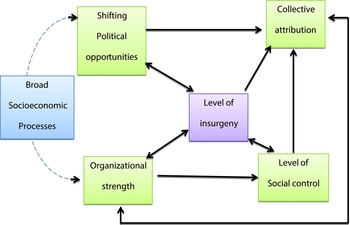
Meanwhile, a relatively clear version of POS theory is McAdam's political process model. This model seeks to explain insurgency on the basis of a favorable confluence of factors internal and external to the movement. This theory, which has a remarkable capacity for explaining the origins of social movements, asserts that the emergence of social movements is determined by expanding political opportunities, indigenous organizational strength, and cognitive liberation. In addition, ‘expanding political opportunities’ and ‘indigenous organizational strength’ have a positive effect on ‘cognitive liberation’ and are influenced by ‘broad socio-economic processes’ (Carl-Dieter, Reference Carl-Dieter2009: 190). Political opportunity is defined as a change in the political environment that raises the political leverage of excluded groups. Indigenous organizational strength is defined as the structural potential of challengers to mobilize and take advantage of political opportunity. It includes members, leaders, established structures of solidarity incentives, and communication networks. Finally, cognitive liberation is defined as the collective assessment of the prospects for successful insurgency. Mediating between opportunity and action are people, and the subjective meanings they attach to their situations. This crucial attribution process has been ignored by proponents both from the classical and resource mobilization perspectives. It must be noted that the political process model offers a framework for analyzing the entire process of movement development rather than a particular phase (e.g., the emergence of social protest) of that same process (McAdam, Reference McAdam1982: 36–48). Accordingly, it can be applied to the development/decline of social insurgency. Figure 1 illustrates the factors affecting the development/decline of social movements.
A political process model of movement development/decline
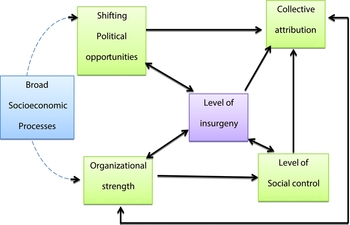
‘The structure of political opportunities’ and the process of ‘collective attribution’ are expected to influence the development of the movement in much the same ways as they did in the generation of insurgency. The former conditions the ongoing vulnerability of the political system to pressure from the movement, while the latter determines the extent to which insurgents continue to share the particular mix of cognitions needed to sustain insurgency. As explained earlier, these cognitions involve the perception that conditions are unjust yet subject to change through group efforts. ‘Organizational strength’ implies that sustained insurgency depends, in part, on the level of organizational resources that movement forces are able to maintain over time. Efforts to ensure an ordered flow of resources usually lead to the establishment of formal organizations to supplant the indigenous groups out of which the movement emerged. Finally, ‘the social control response to insurgency’ serves to reemphasize the reciprocal relationship that exists between the movement and its external environment. This factor refers to the response of other groups to the movement. The strength of insurgent forces and the interests of other groups are of principal importance in shaping these responses. Meanwhile, it is the goals and tactics of insurgents that are of crucial importance, since together they largely define the degree of threat/opportunity posed by the movement (McAdam, Reference McAdam1982: 52–9).
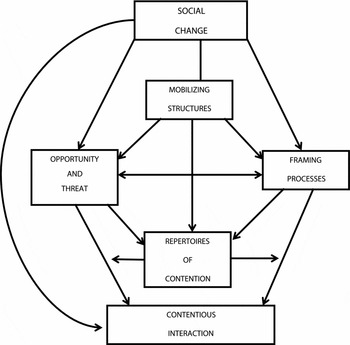
The political process model has evolved since McAdam's formulation. Notably, framing has largely replaced cognitive liberation, and indigenous organizational strength has been replaced by mobilizing structures. Political opportunities – the element which has received the most attention – has been both narrowed and broadened. Additionally, Tarrow's notion of protest cycles is sometimes included as a part of political process theory, as is Tilly's concept of repertoires of contention (Caren, Reference Caren and Ritzer2006). It must be noted that a strong consensus has emerged in recent years with respect to the factors affecting the formation and development of social movements. In fact, by the 1980s, most North American students of social movements had adopted a common social movement agenda, which differed chiefly in their relative emphasis on different components of that agenda. Figure 2 sketches the classic agenda in that vein.
The classic social movement agenda for explaining contentious politics
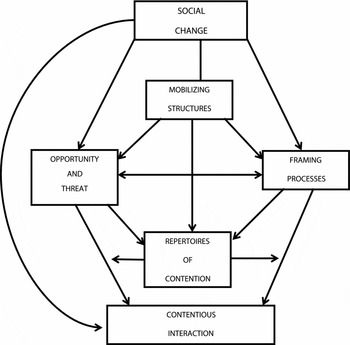
Taking advantage of that common agenda, it is argued that political opportunities, mobilizing structures, framing processes, and the repertoire of collective actions, are the factors that determine the success or decline of social movements as follows:
-
1. Political opportunities: The success or failure of social movements is primarily affected by political opportunities. It must be noted that political opportunities were found by scholars in such a variety of places as to make the concept nearly unfalsifiable (Caren, Reference Caren and Ritzer2006). According to Tarrow, the concept has four dimensions: the degree of openness or closure of formal political access, the degree of stability or instability of political alignments, the availability and strategic posture of potential alliance partners, and the political conflicts within and among elites (Kriesi, Reference Kriesi, Jenkins and Klandermans1995: 83). Similarly, Mc Adam specified the following four dimensions: (1) the relative openness or closure of the institutionalized political system; (2) the stability of that broad set of elite alignments that typically undergirds a polity; (3) the presence or absence of elite allies; and (4) the state's capacity and propensity for repression (McAdam, Reference McAdam and McAdam1996: 26–7). The above-mentioned factors primarily concern the institutional structure of political systems and the configuration of power among the relevant actors within such a system (Kriesi, Reference Kriesi, Jenkins and Klandermans1995: 83). It has been argued that if a government decides to block participation and opposition channels, then movements usually dwindle or enter a dormant phase. Nevertheless, unexpected events in these circumstances, courageous actions and collective resistance while the government is in a relatively weak condition or under pressure from other sectors, or if the movement possesses other fundamental factors such as a formal/informal organization, financial and news facilities, etc., all might make the government retreat, which in itself creates opportunities (Mashayekhi, Reference Mashayekhi1386: 179–86).
-
2. Mobilizing structures: Mobilizing structures are defined as ‘those collective vehicles, informal as well as formal, through which people mobilize and engage in collective action’. It is the organizational vehicles available to the group at the time the opportunity presents itself that condition its ability to exploit the new opening. In the absence of such vehicles, the group is apt to lack the capacity to act even when afforded the opportunity to do so (McAdam, Reference McAdam, Goodwin and Jasper2004: 203–4).
-
3. Framing processes: An important condition for the success of mobilization is a suitable framing. A movement should adjust itself to public understanding, with similar values and sensitivities, by adopting relevant slogans, messages, symbols, and discourses (Mashayekhi, Reference Mashayekhi1386: 179–86). At a minimum, a group needs to describe their grievances persuasively, the diagnostic frame, and present a feasible solution – the prognostic frame. Large movements often provide master frames, such as ‘civil rights’, which subsequent movements and groups can easily refer to. Framing processes are the major place where the cultural is incorporated into the model. As such, framing is sometimes stretched to include all non-structural elements impacting mobilization (Caren, Reference Caren and Ritzer2006).
-
4. The repertoire of collective action: The last factor determining the success or failure of a social movement is choosing the most appropriate and efficient form of collective action by the movement's leadership. The repertoire of collective action consists of the whole set of means that a group has available for use in making claims and to which its members turn consistently (Traugott, Reference Traugott1995: 44). It must be noted that the modern repertoire of collective action emerged with the French Revolution. However, they have changed little since. Boycotts, barricades, petitions, and demonstrations are all still present (and indeed probably dominant) in the panorama of protest (Della porta and Diani 2006: 169–170). The decision made by a movement to take various collective actions, such as demonstrations, general strikes, signing petitions, requests to hold referendums, or hunger strikes (Mashayekhi, Reference Mashayekhi1386: 179–86), has a decisive role in the development/decline of the movement.
3. Theoretical analysis of the crisis of the reform movement (2000–05)
As discussed earlier, the history of Iran's reformist movement can be divided into two periods. The first period, which lasted until the sixth parliamentary election, was the burgeoning period of the reform; there are different opinions on the onset of the second period, or new period. However, it seems that it started after the sixth parliamentary election in the early spring of 2000 and continued until 2005. The main feature of this phase was the stalemate of the reform and the unfulfilled demands of the social forces of the movement through the reformist parliament and the executive. Finally, the reform era came to an end with the ninth presidential election in which a conservative hardliner was elected. In the following section, I will explain this regressive move using the elements mentioned above. Accordingly, political opportunity, mobilizing structures, framing processes, and, finally, the repertoire of collective actions and their mutual effects will be examined both in the flourishing and declining periods of the reform movement.
4. Political opportunity
Opportunity for the reform movement can be explored based on the IRI's political structure and the application of organized repression from higher levels within the regime. The formal political structure of the IRI can be divided into elected and unelected bodies. The president, his cabinet, and parliament are elected directly, while the core of the regime, including the Supreme Leader, the Expediency Discernment Council, the Council of Ministers, the Guardian Council, the Assembly of Experts, the judiciary, and the commanders of the IRGC, are unelected bodies (Tazmini, Reference Tazmini2009: 99). Arjomand characterizes the Islamic republic as a hybrid regime with an elected parliament and President, but one subordinated to clerical authority – a theocratic republic, which can be characterized as a system of collective rule by clerical assemblies or councils under a clerical ruler styled the Supreme Jurist or Leader (Arjomand, Reference Arjomand2009: 91). In sum, it can be argued that the most important features of the political structure of the Islamic Republic, which affect political opportunities, are the different wings and their connection with the various levels of society (Zarifinia, Reference Zarifinia1378); competition among the regime's political wings over parliament and the presidency; and the existence of powerful Islamic institutions, such as the supreme-leadership and the appointed institutions which are legally superior to democratically elected bodies.
The reform movement continued to progress during 1997–2000 using the regime's elective capacities and it did not face organized suppression by the supreme leader or their appointed institutions. Mostafa Tajzadeh admits that there was sporadic resistance until the sixth parliamentary election, but there was no attempt at the highest levels of the regime to crush the movement (Salimi, Reference Salimi1384: 123); however, different conditions arose from 2000 to 2005. Overall, it appeared that with the formation of the sixth parliament in August 2000, in which the overwhelming majority of pro-Khatami reformists were elected, new political opportunities would result for the movement. This would enable the legislative body, along with the administrative body, to enact, and eventually implement, all the reformist demands with regard to issues such as economic affairs, government accountability, citizenship rights, and political development. In addition, due to the existence of some democratic institutions in the IRI, it was possible to have all-party inclusive elections (except in the seventh parliamentary election, which was plagued by the extensive disqualification of reformist candidates). The eighth presidential election, the second city council election, and the ninth presidential election, in which the representatives of all ‘inside-government’ political wings actively participated, are examples of political opportunities for the reform movement during this period.
On the other hand, the conservatives and anti-reform currents were granted adequate opportunities and resources to crush the reform movement after the sixth parliamentary election, and the powerful institutions of the regime seemed to systematically resist this movement. In fact, in the aftermath of the reformists’ success in 2000, hardliner conservatives, supported by the Supreme Leader, who took the unprecedented step of intervening to prevent the ratification of a new, more liberal, press law, moved to block any progress by the reformist Majlis (Ansari, Reference Ansari2007: 27). In the meantime, the appointed institutions of the regime played a highly significant role against the reform movement. In fact, in view of the supreme leader's statements, it appeared that since the spring of 2000 all the regime's capacities, such as the Guardian Council, the Revolutionary Guards, the Expediency Discernment Council, and the Judiciary, were employed to confront the movement.
It can be concluded that in view of the powerfulness of the institutions controlled by the supreme leader, which is a characteristic of the legal power structure in Iran, strong barriers, at least in the framework of institutional politics, were put in place against the movement. The reactions of the Guardian Council and the Expediency Discernment Council against parliament's legislations, political repression, and the judiciary's performance can be explained from this perspective. Why a major part of the government systematically confronted the reform movement with all its legal capacities after the sixth parliamentary election in the spring of 2000 is in itself another debate. Mostafa Tajzadeh explains this in terms of the remarkable victory of the reformists in the sixth parliamentary election (Salimi, Reference Salimi1384: 123). From this perspective, the landslide victory of the reformists intimidated the conservatives and initiated their extreme reactions. In fact, so dramatic was the election victory (reformists winning 189 out of the 230 seats) and so humiliating was the result for the conservatives that even pleas of caution against triumphalism could not disguise the fact that something serious and ground-breaking was under way (Ansari, Reference Ansari2000: 208).
Another view, however, is that the radical measures of the reformists before and during the election, such as intensifying social demands, destructive dealings with Hashemi Rafsanjani, questioning the claimed achievements of the regime, and the harsh criticism of appointed institutions – e.g. the Guardian Council, the Judiciary and the Revolutionary Guards – alarmed the supreme leader and other higher levels of the regime and led them to confront the reform movement in a harsh manner. Elahe Koolaee holds that the treatment dealt to Hashemi by the reformist press was the most important factor for setting future conflicts of the government with the reform movement. In her view, the lack of compromise, extremist behavior, and personal hatred and hostility were often observed in Iranian elites, and many of the practices should be evaluated from this point of view (Interview with the author: 2009). In a similar argument, Zhand Shakibi has criticized the treatment dealt to Hashemi, who, according to Shakibi, can be considered as a pragmatic and moderate politician. Shakibi argues that the institutional weakness of the republican institutions and the diffuse character of IRI institutions required Khatami and his political allies to align or establish a form of political cooperation with some factional groups, not to antagonize needlessly and prematurely powerful figures. The issue here touches on ‘pacting, a political tool by which supporters of politics of change establish political alliances with “regime moderates” in order to sideline hardliners and radicals on both sides of the political spectrum’ (Shakibi, Reference Shakibi2010: 311).
Accordingly, intensification of social demands, radicalization of the political climate, and severe criticism of Hashemi and appointed institutions, such as the Guardian Council, the Judiciary, and the Revolutionary Guards, denoted, for at least some reformists, that the reform was a disguise for regime change. Hajjarian's statements about sweeping parliament from the conservatives and gradually conquering the regime's institutions; the campaign's slogan of Daftar-e Tahkim Vahdat (Compatriot! Wait a little, the dawn is looming); the press's heavy attack against Hashemi and the challenge to many of the regime's claimed achievements; and, finally, the victory of the most radical reformists in the parliamentary election not only intimidated the conservatives, but also produced a shock for the regime, which eventually turned the supreme leader and the all-powerful regime-guardian institutions against this movement.
However, some consider the great storm against Hashemi and the severe criticizing of the regime to be a consequence of the aggregation of social pressures, pointing to the discontinuity feature of Iranian society, which results in extremist behaviors upon the opening of the political sphere, which itself paves the way for re-tightening of the sphere. The radicalization of many reformists, besides the radicalism of the active body of the movement, which was manifested in the results of the sixth parliamentary election, opened up a huge front of conservatives and more moderate political forces against them. This in turn led the head of the regime, and the powerful Islamism-guardian institutions, which hold a great deal of power as a result of the regime's legal arrangements, to confront the movement.
It is noteworthy that international politics has also weakened Iran's democratic forces. In fact, the foreign policy of the United States after the removal of Taliban regime, especially President Bush's ‘axis of evil’ speech in 2002, was harmful for the reform movement and encouraged conservatives to crush it. The speech proved to be counterproductive and was instrumental in launching a united anti-American front, which brought together all factions of the state. The conservative hardliners were quick to cite national security when attacking the reform institutions and the reformers. The speech shocked the reformists and contributed to the consolidation of the conservatives’ power in a number of ways. The speech created a mood of the past, especially of the 1953 coup; forced the hardliners to raise the flag of national security; persuaded some reformers to put their hopes on the back burner, in the hope of better days; and energized Pahlavi royalists, who dreaded reform and hoped that ultraconservative obstinacy would bring about a revolution (Mahdavi, Reference Mahdavi2008: 149). In other words, Bush's ‘axis of evil’ speech in 2002 and more generally the policy of regime change, supported by the neoconservatives in the United States, expanded tension between Iran and the United States. In addition, the radicalism of the reformists and their inattention to pragmatism and compromise led to the polarization of the political environment and consequently to the expansion of oppression against the movement. Thus, the movement was deprived of political opportunity that had moved it forward in previous years. However, as was stated earlier, a movement can be an opportunity-maker in some conditions, but the reform movement suffered from a number of deficiencies, which continued to surface day by day.
5. Mobilizing structures
An effective organization renders the support of social forces into hard power; however, a brief look at the reform movement reveals many organizational weaknesses. In fact, an organic relationship was lacking between the movement, including between students, the intelligentsia, and, more broadly, the new middle class and the elites, who constituted the Second of Khordad reformists. Mojtaba Mahdavi has argued that the reformist parties remained parties of the elites. They lacked strong grassroots, and the inclusive organizations necessary for successful public mobilization. The parties consisted of extremely diverse, but limited, circles and constituencies. They included the reformist clerics organized by the Majma-e Rouhanioun-e mobarez (the Militant Clerics Society), an extremely closed circle of the former populist-revolutionaries organized by the Sazman-e Mojahedin-e Enghelab-e Islami (the Islamic Revolution Mojahedin Organization), a loose coalition of the state's bureaucrats and pragmatist politicians organized by the Kargozaran-e Sazandagi-ye Iran (the Iran's Servants of the Construction), and a small number of progressive reformists organized by the Jebhe-ye Mosharekat-e Iran-e Islami (the Islamic Iran Participation Front). They all, in spite of their diversities, remained elitist political organizations incapable of public mobilization (Mahdavi, Reference Mahdavi2008: 152–3).
In fact, organizations such as Kargozaran-e Sazadegi, Jebhe-ye Mosharekat-e Iran-e Islami, Majma-e Rouhanioun-e Mobarez, and Sazman-e Mojahedin-e Enghelab-e Islami were friendly circles of like-minded people, sometimes linked with past friendships, kinships, or cellmate history, rather than grassroots and inclusive organizations. Such limited circles could never execute the functions of a social organization and mobilize. For instance, the Islamic Iran Participation Front, which formed the largest fraction in the sixth parliament, was too weak in terms of organization and party structure. It remained a party of the in-system reformist elites, not a grassroots political party inclusive of all Iranian democrats (Mahdavi, Reference Mahdavi2008). The organizational expansion of this front and extensive recruiting were only brought to the party's agenda in 2001 and 2002, in the final years of the reform era, but these goals were not realized either. According to the Mosharekat Front's director for public relations, which was Iran's largest reformist party, it had more than 12,000 members out of Iran's 70 million population in 2006, but it was unable to reach 20,000. The situation was still worse for other parties, such as the Majma-e Rouhanioun-e Mobarez, Kargozaran Sazandegi, and Sazman-e Mojahedin-e Enghelab-e Islami (Kadivar, Reference Kadivar1386). Furthermore, Khatami himself was unable, or unwilling, to form a political party of his own. According to Mirsepasi, he viewed himself, much like the earlier nationalist leader Mossadegh, as being beyond party politics. But this position was fraught with danger and eventually weakened the process of the institutionalization of democracy in Iran (Mirsepasi, Reference Mirsepasi2010: 100). As a result, the people who voted for change, ‘having no means to keep themselves engaged’, remained inactive and looked for their president to bring about the changes for which they had voted (Mahdavi, Reference Mahdavi2008: 151).
It must be noted that the reformist parties only became truly active at election times, leaving their supporters to return to their homes afterwards. Mashayekhi holds this view, ‘the relationship of the in-system reformist elites known as the Second of Khordad Front with the wider society, in particular, was highly elitist and instrumental. If a current organization, such as Daftar-e Tahkime Vahdat until 2000, would implement its policies fully, then a close relationship would develop between them; otherwise, a policy of silence would be employed. From this perspective, social forces should be able to enter election campaigns in favor of the reformists, and then return to the private sphere afterwards’ (Mashayekhi, Reference Mashayekhi1386: 68–9). Mirsepasi has argued that the place of the reformists within the current power structure puts constraints on the political discourse within the broader Dovom-e-Khordad movement and stifles its ability to expand and be inclusive (Mirsepasi, Reference Mirsepasi2010: 100). Mahdavi likewise has concluded that for some of the in-system reformists, extensive public mobilization of the people and grassroot socio-political institutions could have undermined the foundations of the IRI. For this reason, some of the in-system reformists preferred to hold a limited constituency rather than public mobilization in order to avoid the unintended consequence of undermining the whole regime (Mahdavi, Reference Mahdavi2008: 151–3). However, other factors seem to have been effective in this respect as follows:
-
1. The reformists achieved an unexpected landslide victory in the 23 May election (Second of Khordad) such that all reformist activists admitted that they had not expected such a victory (Salimi, Reference Salimi1384). The unforeseen winning in the presidential election, and then in the sixth parliamentary and city council elections, quickly engaged many of the reformist activists in bureaucratic and administrative affairs, and this prevented them from paying much attention to social organizing.
-
2. The reformists would have thought in the initial years of the reform, ‘the first phase of the reform movement’, that they could easily ratify the demands of the movement's social body by taking control of parliament, and implementing the demands through the executive, which was in their hands. Akbar Ganji stated, ‘If we want freedom, democracy and human rights, we must all be present at the polling stations . . . if 30 million Iranian citizens go to the ballot boxes and send democratic reformists to parliament, it will be possible to reform all the laws contrary to human rights, civil rights and the constitution’ (Boroumand and Boroumand, Reference Boroumand and Boroumand2000: 127). The reformists never imagined such an extraordinary resistance against themselves, which then weakened the Second of Khordad's elites in their social organization (Salimi, Reference Salimi1384). Later on, the divergence of opinions, the lack of strategic analysis about the political situation, and the lack of planning, all contributed to neglecting the role of social organizations and establishing a grassroots political party.
-
3. There were organizations such as Khaneh Kargar (the Association of Workers) and the Islamic Association of Teachers (Anjoman-e Eslami Moaleman), which claimed to represent these social strata, but they failed to establish the necessary relationships with them.
-
4. Some historical structural obstacles have also posed difficulties for the formation of grassroots parties in this country. Khaniki acknowledges a ‘discontinuity of experience’ underlying many of Iran's contemporary troubles. There is, he maintains, ‘no dialogue in the true sense between new and previous generations’, and they ‘start all over again’ under the influence of some ‘new factor’ (Mirsepasi, Reference Mirsepasi2010: 120). In fact, the weakness of pervasive parties in Iran cannot just be attributed to the performance and strategies of the reformists; rather, factors such as a lack of social confidence, a lack of experience in conducting collective endeavors, and the absence of historical continuity, have been influential in this regard.
In summary, the Second of Khordad Front, were not successful in the organization of social forces. However, despite all of the problems and barriers, the reformist did to some extent fill a vacuum in the first phase of the reform (1997–2000). In effect, the movement moved on to the shoulders of the press, as they played the role of the intellectual center and the neural system of society. The press provided analytic news services to more than five million educated people during that three-year period, and they became the driving force of the movement and connector with its social base. However, the closure of the reformist press cut the relationship between the leadership of the movement, the Second of Khordad Front, and its social forces, because the reformist press not only disseminated the news, it was also used to impart the discourse, objectives, demands, strategies, and tactics of the movement (Jalaeepoor, 1381: 300). Therefore, due to press closures, the organizational weakness of the movement became more apparent in the second phase of the reform movement (2000–05).
Furthermore, in the first chapter of the movement, both the social body and the reformist elites were intending to take control of parliament and use the capacities of institutional politics to achieve their demands. However, the full confrontation of the powerful institutions of the regime with the sixth parliament uncovered serious deadlocks in the field of institutional politics, which in turn drew attention to non-institutional politics. In light of these new conditions, organizational weaknesses were further disclosed.
6. Framing processes
An important condition for the success of social mobilizations is appropriate framing. From the beginning, the reformist discourse was centered upon political development and democracy. This discourse had a close connection with the interests of the new middle class, and yet it was able to attract the support of large groups of people because of its novelty and critical aspects. However, the reformists encountered many problems, some of which were the result of institutional and structural pressures, while others pointed to their organizational and strategic weaknesses. Nevertheless, the concerted resistance of the conservatives rendered these notions ineffective (Soltani, Reference Soltani1384: 249). Studying the effects of structural pressures and social changes, Abbas Khalaji points to a modification of the theory and a discourse of the reform movement as follows:
Khatami initially chose ‘freedom’ as the main theme of his discourse, setting other notions, such as civil society, democracy, political development, law, human rights, citizen rights, public participation, human dignity and sanctity, around that central idea in order to dominate and centralize the reform discourse. However, he adjusted his theory in the middle of his term of office because of structural pressures and social changes. As a result, he chose the notion of law and lawfulness as the main notion for the reformist discourse, from which other concepts derived their meaning in light of this change. The suffix ‘Islamic’ was added to the notions of the reformist discourse in an attempt to reduce the pressures on it. Accordingly, ideas such as religious civil society, religious democracy, Islamic human rights, and Islamic legislation discourse (Khalaji, Reference Khalaji1384: 218) became paradoxes of the reformist.
This adjusted discourse was not able to produce an appropriate framing for significant sections of the intelligentsia and students, due to a lack of solutions to the existing deadlock, its theoretical ambiguity, and precarious theoretical foundations (Khalaji, Reference Khalaji1384). For example, Mirsepasi argues that ‘all interpretations of religion, in one way or another, rest on a concept of the sacred. If any element of government, leaders, ideologies, institutions, laws, and the like, is invested with the aura of the sacred, it cannot claim to have come from the will of the people. It cannot be democratic. In a democracy, legitimacy and representation are not permanent or fixed. People and positions can be changed or recalled. Nothing should occupy a privileged position beyond the reach of popular vote’ (Mirsepasi, Reference Mirsepasi2010: 101). In sum, it can be argued that the adjusted discourse inspired many criticisms and diverted some social groups towards another discourse whose referents were human rights, secularism, unreformability of the regime, election boycotts, and civil disobedience. Akbar Ganji, a prominent journalist, many intellectuals and university professors, and most of the students, including Daftar-e Tahkime Vahdat, were gradually supporting this new discourse. Examination of the famous pamphlet of Akbar Ganji, namely Manifest-e Jomhourikhahi, and the statements of Daftar-e Tahkime Vahdat during 2001–05 clearly demonstrate the elements of this discourse (see Ganji, Reference Ganji1381).
More importantly, from the beginning the reform discourse emphasized only political reform and democracy, and did not relate to the socioeconomic interests of the potential supporter classes, staying at the intellectual and middle class level. A brief look at the reformist press and the statements of the Second of Khordad groups clearly demonstrates that their emphasis was merely at the political level. Although the reformist discourse in its early years was able to achieve provisional support of other social groups, such as workers and the lower classes, in the elections due to its novelty, critical aspects, and using Khatami's charisma, it gradually lost this support base due to a lack of attention to socioeconomic interests. Haji Qasemi argues in this regard:
The Second of Khordad reformists did not offer any well-designed plan in their political campaigns to realize the concrete demands of the different classes, other than to raise political expectations in general and to evoke a spirit of protest against the rival party, without any success in achieving either aim. Political parties in tandem with a discourse with their social supporters should endeavor to offer a suitable welfare model for the country, and to involve these social forces in a political struggle that aims to realize comprehensive welfare programs. It is in this way that political struggle would be more than a mere power struggle between different political parties. (Hajighasemi, Reference Hajighasemi1382: 4–9)
The reformists could have articulated their framework in order to expand their social base, which they did not attempt. Articulation in a time of reform implies that the reformist discourse should have emphasized more strongly the relationship between the political reforms and realization of the population's socioeconomic interests, through strengthening its own connections with the population. Expansion also means that the reformists needed to include some socioeconomic demands, but these did not hold a high position among the main objectives in their agenda (Kadivar, Reference Kadivar1386).
Under conditions in which only political reforms were the central discourse of the Second of Khordad reformists – this was not achieved due to the conservatives’ resistance and the reform's weaknesses – and economic issues and connection with the basic interests of the different groups, including the deprived, were absent in their discourse, the conservatives seemed to attract some social groups by transforming their discourse, putting more emphasis on offering essential services, poverty eradication, justice, and construction (Abadgary). Exploring the texts of the conservatives, Ali Asqar Soltani holds, (Soltani, Reference Soltani1384: 246) ‘Although the conservatives used the clergy and Velayat-e Faghih as their source of legitimacy in 1997, they almost left this notion aside in 2002, focusing instead on issues such as ‘construction’ (Abadgary), ‘poverty eradication’, ‘servicing’, ‘employment’, and the like. One reason for this might be that the conservatives found the former discourse inefficient in the 1997 election’ (Soltani, Reference Soltani1384: 246). In fact, notions such as justice and fighting corruption played a significant role in the victory of hardliners in the election. It seems that at least some conservatives realized that people's real problems were unemployment, poverty, and injustice, so they gradually started to offer a discourse in the second presidential term of Khatami, which was capable of attracting more sectors of the population.
As a significant part of the reform's supporters, especially in metropolitan cities, were disappointed with the reformists inside government and did not participate in the elections, the hardliners won the second city council and seventh parliamentary elections. However, the biggest success of the hardliners, with Ahmadinejad as their symbolic leader, was a landslide victory in the second round of the ninth presidential election. Now, it was the discourse of the hardliners known as Abadgaran that attracted some parts of the population by emphasizing economic demands, social justice, and anti-corruption. In fact, while some layers of the new middle class had transcended the in-system reformists’ discourse in favor of the secular one and boycotted the ninth presidential election, parts of the non-intellectual social forces, the deprived in particular, were attracted to the Abadgaran discourse, which seemed interesting due to its novelty and critical aspects. It must be noted that Ahmadinejad by heavily criticizing Hashemi and Khatami, was also able to utilize the longstanding nation–state cleavage in Iran in favor of the hardliners. Ironically, as Mahdavi has argued, the failure of the in-system reformists turned them into scapegoats for the regime's failures over the past three decades (Mahdavi, Reference Mahdavi2008). In sum, the inappropriate framing of the movement, and its inertness and inefficiency, which did not address the political concerns of the new middle class and neglected the socioeconomic demands of other social groups, diverted them from the movement and served an important role in the decline of the movement during 2000–05.
7. The repertoire of collective action
An important factor for the success of a social movement is the appropriate and efficient selection of the form of collective action to be taken by its leadership. During 1997–2000, the reformist elites emphasized constitutional capacities and public participation in the parliamentary election in favor of the reformist candidates to enact people's demands in parliament. As was stated above, this kind of collective action during that period was well received by the people, finally leading to the dominance of the reformists in the city councils and the sixth parliament. In this section, I will discuss the kind of collective action that occurred in 2000–05, and explore its efficacy in the progress of the movement. Before that, it would be appropriate to look at the head of the Second of Khordad movement, which should have determined the form of collective action of the movement, in order to pull the movement forward by offering suitable tactics and strategies.
A successful social movement usually needs an experienced individual or collective leadership, which the reform movement lacked. This is why Saeed Hajarian described this movement as a headless movement, stating, ‘One of my criticisms of Khatami is that he should have become the leader, which did not happen; Khatami was the symbol, but not the leader of the movement. In fact, the Second of Khordad movement was headless’ (Hajarian: 11 Aban, 1381).
Mohammad Ghuchani admits that Khatami's state was circumscribed with power relationships and questions imposed on it from the regime's higher levels, but the Second of Khordad Front was not bound by these considerations, and, therefore, it could have organized its forces much more easily, responded to their needs, and reacted more effectively against the conservatives – something it was unable to do because it was devoid of the key elements of a front. A front, as the outcome of a movement, should be active, in at least four spheres. The first is to have minimal ideology, which the Second of Khordad Front lacked due to its plurality. In fact, there was a diverse disharmonized set of individuals and groups in the Second of Khordad Front, whose definitions of the reform were utterly different. As Tazmini has argued, the reform movement was comprised of diverse circles, groupings, and constituencies – from traditional conservative clerics organized in the Association of Combatant Clerics and the Association of Lecturers of Qom Theological Seminaries, to progressive secularist intellectuals in the IIPF. There were clear differences among the reformist tendencies regarding the pace and scope of reform (Tazmini, Reference Tazmini2009: 142). The second element absent in this front was strategy. As will be examined in the next section, the Second of Khordad front suffered from the lack of a coherent strategy, partly due to its plurality. The third element was that this front did not rely on a single specified social class and force. The last element is the issue of organization, which has been discussed earlier.
In fact, the Second of Khordad Front was not able to create civil institutions to absorb the potentiality for social participation, and channel it towards well-ordered political behavior (Ghuchani, Reference Ghuchani1381: 46). Ghuchani finally criticizes the Second of Khordad Front as follows, ‘The Second of Khordad Front cannot manage the accumulated social force behind itself; this front is, in truth, a kind of political soiree. It is a friendly political gathering in which some people get to gather and make coordinated decisions, which are often not put into practice, and therefore, they act uncoordinatedly’ (Ghuchani, Reference Ghuchani1381: 46). Generally, the leadership weakness in the Second of Khordad prevented the adoption of coherent solutions for removing challenges and attaining social demands. In what follows, the strategies of the movement during 1997–2005 from the perspectives of its prominent theorists and journalists will be discussed.
The first strategy of the Left Wing was announced on the first anniversary of the electoral victory of the reform movement. In an interview with the weekly Rah-e Now on 23 May 1998, Saeed Hajjarian stated, ‘We do not have any option but to apply pressure from below, and bargain from above.’ This strategy relates to the two movements, republicanism and constitutionalism, that is the large presence of people at the scene and elites who can use this energy and force and raise demands by opening the political arena.’ Ghuchani believes that a major part of the political activities of the reform movement, at least during 1998–9, was carried out under the custody of this strategy (Ghuchani, Reference Ghuchani1381: 120–6). It should be noted that conquering elective institutions through elections was the most important collective action of the movement during this phase. However, using social forces, in particular, the student movement in the form of demonstrations or gatherings, which were a kind of pressure from below, was also planned by the in-system reformists with a manipulative attitude. The events of 9 July 1999 can be analyzed in light of this point.
The victory of the Second of Khordad reformists in the 18 February 2000 election (sixth parliament) initiated a new era in the history of the movement. Ghuchani remarks on this aspect, ‘In the third anniversary of the Second of Khordad electoral victory, parliament had a reformist majority, which was a step forward for the movement. The instruments for bargaining from above were now stronger, but those for pressuring from below were absent. As a result of the reformists’ rise to power (at least in the sense that includes the cabinet and parliament) the pressure from below could also mean pressure on the reformists; accordingly, it was time for the social forces to return to their homes. The reform movement passed through an ‘active relaxation strategy’ (Aramesh Faal) from 22 May 2000 until 8 June 2001’ (Ghuchani, Reference Ghuchani1381: 127–8). Tajzadeh contends that an active relaxation strategy relies neither on the social body of the movement, nor on the maximal use of the government's internal capacities; rather, it basically hopes that a final umpire will intervene for the sake of national expediency to make the game rule-governed and to determine the position of each player proportionately. In fact, this strategy is based on an invitation to calm and to neutralize the opposition, including the extremist opponents of the reform movement (Tajzadeh, 1380: 14–15).
This strategy, which was an invitation for their supporters to return their homes, did not work, to such an extent that the reformists themselves, after approximately one year, admitted its weaknesses against the political challenges facing them, and spoke of the necessity of offering other strategies. The three strategies of active deterrent, withdrawal from government, and civil disobedience were set forth, the first of which was chosen as the best option by the majority of the in-system reformists. This strategy, which was introduced about six months after the eighth presidential election, was not thought by many to be significantly different from that of active relaxation (Ghuchani, Reference Ghuchani1381: 132). Tajzadeh maintains that this approach is based on the maximal use of capacities, either internal to the government or methods that can activate the body of the movement in a way that they cannot be manipulated by the extremist opponents of the reform (Tajzadeh, 1380: 14). According to Ghuchani, the content of the new strategy was not particularly new. The determination of the president and the state, while they were much weaker than in their first term of power, parliament's insistence on its own legal capacities and on legal reaction to political confrontations, relationships with people, and maintaining solidarity in the reform front, were a rehash of strategies which were also supposed to be implemented during the active relaxation strategy (Ghuchani, Reference Ghuchani1381: 132– 3).
As previously mentioned, strategies such as withdrawal from governance and civil disobedience were also raised among some elites of the movement, but they also had some weaknesses. Tajzadeh states:
It is right that many citizens are ready to give their cooperation in favor of the reform and against extremist opponents; however, the main problem here is that while we can initiate public protests, such as sit-ins, demonstrations, etc., these gatherings might lead to violence for two reasons. The first is the existence of profound dissatisfaction among many social groups that are prepared to turn gatherings into radical activities; while the second is due to some organized anti-reform forces who are vigilant for opportunities to take advantage of such a situation. Moreover, most reformists did not accept withdrawal from governance, as it might push the society in a direction in which the outcome is not clear. (Tajzadeh, 1380: 14–15).
In the meantime, to overcome the institutional obstacles, Khatami submitted two key bills to parliament, said to be aimed at ‘limiting the powers of the Right wing by stripping the Guardian Council of its right to vet candidates for public office and enable the president to challenge the judiciary’, and also ‘to assess the position of the president as the number-two figure in the state after the Supreme Leader’ (Ehteshami and Zweiri, Reference Ehteshami and Zweiri2007: 14). However, the reformists, on the one hand, radically bound their fate with the two bills of Khatami, claiming to withdraw from government in the case of their rejection; but, on the other hand, they did not show any significant reaction after the bills were rejected by the Guardian Council.
Furthermore, when a large group of reformists were disqualified on the verge of the seventh parliamentary election, conflict again spread in the country's political arena. Subsequently, some members of the sixth parliament organized a sit-in, and some governors and executive officials spoke of not holding the election; however, the sit-in of the members of parliament did not evoke a wide reaction in society. A large portion of the social body of the reform seemed to consider this move as springing from the self-interests of the in-system reformists. Furthermore, Khatami and executive officials, despite their past threats to not carry out the election, held the seventh parliamentary election, which led to the victory of the conservatives. The last two years of Khatami's term in power passed by in idleness and a lack of planning. Finally, at the brink of the ninth presidential election, the reformists again invited the social body of the movement to participate and to vote for the reformist candidates; although the reformists were highly scattered, some social forces of the movement boycotted the election, and many could not find their demands enshrined in the political agenda of the reformists. Under these conditions, and with the electoral victory of Ahmadinejad, the profile of the reform movement was closed.
A close scrutiny of the reform era during 1997–2005 indicates that the movement, except in the first phase (1997–2000), suffered from strategic weaknesses. If participation in election as a collective action seemed to be effective due to the dominance of the conservatives in the fifth parliament, the in-system reformists failed to offer an appropriate strategy to deal with the challenges after the sixth parliament was formed. In fact, during 1997–2005, except in the seventh parliamentary election, they did not offer any solutions other than a mere invitation to participate in the elections in favor of them. Moreover, facing various political challenges, they confusedly and haphazardly just recommended participation in elections in order to stay permanently in power; as if, the aim of the reform movement in Iran was the perpetual presence of the in-system reformists in power. One author argued, ‘The reformists have proven in recent years that all their ways end in elections. There is no political group or institution that only meets its social body just at the ballot box. The electoral leftists take themselves as the only representative of reformists, the same as they take elections as the only translation of reform’ (Ghuchani, Reference Ghuchani1381: 149–50).
In general, after the victory of the reformists in the sixth parliamentary election, and their control over all elective capacities, on the one hand, and the full confrontation of the supreme-leadership and the powerful appointed institutions with them, on the other, conditions developed in which well-calculated and appropriate strategies were increasingly needed. In these circumstances, it became increasingly obvious that a lack of strategy to address challenges, haphazardness, confusion, insistence merely on elections and instrumental use of social forces, and inattention to other collective actions were undermining the in-system reformists. It seems that a movement that lacks a systematic strategy to face challenges, and any plans to realize the demands of social forces only convinces them to participate in elections and draws on their votes without fulfilling their demands, will not be long-lived. Why the reform movement was not able to address the challenges with reasonable strategies, and limited itself to elections as the sole form of collective action, is a highly significant issue, which can be explained as follows.
-
1. The reform movement suffered from the lack of an intellectual center. The absence of thinking, planning, and preparing the center for medium-term strategies was a significant mistake.
-
2. An important issue that separated the in-system reformists from the movement's social body and rendered benefiting from many collective actions difficult was the lack of organizations or institutions that could establish an organic and functional relationship between the two.
-
3. Another issue was the existence of too many divergent, different views and expectations of the reform among the in-system reformists; in the meantime, some reformists only thought of using social forces instrumentally at election times; such a view obviously affects the kind of strategy and collective actions of a movement.
-
4. Another issue was the division between the social body and the head of the movement, which resulted from its structure. This factor produced a negative impact on the organization of the movement, and practically caused unexpected consequences for many of its collective actions. Many theorists such as Hamidreza Jalaee Pour and Hatam Ghaderi have emphasized the existence of a division between the active social body and the Second of Khordad elites, and that the demand level of the social body was far more radical than that of the elites. Based on this formula, any organizing activity or invitation to take part in a collective action could have unexpected consequences, even for the Second of Khordad reformists (Jalaeepour, Reference Jalaeepour1381; Ghaderi, Reference Ghaderi1380). Ghaderi holds that the in-system reformists were not suitable representatives for the movement; at best, they could only provide social opportunities for its social layers to organize and institutionalize themselves and realize certain values and slogans among themselves and in the wider society (Ghaderi, Reference Ghaderi1380).
However, it should be noted that the in-system reformists, themselves, radicalized the demands of the social body of the movement at election times by intensifying their demands, creating many expectations, and expanding radicalism in society. Thus, they provoked their demands in order to win votes, but after entering the bureaucracy, they sought to contain the demands raised by them themselves.
8. Conclusion
Despite its initial flourishing (1997–2000), the reform movement quickly began to decline after the spring of 2000. The present paper has been an attempt to explain the regress of the movement based on social movement theory, especially the political process model, and factors such as political opportunity, mobilizing structures, framing processes, and the repertoire of collective action. The study demonstrated that the existence of different wings and their connection with various layers of the society, competition among regime's political wings over the elective institutions, and the existence of powerful Islamic institutions, which are legally superior to democratically elected bodies, are the most important features of the political structure of the IRI which affect political opportunities. It is noteworthy that the radical measures of the reformists, before and during the sixth parliamentary election, such as destructive dealings with Hashemi Rafsanjani, questioning the claimed achievements of the regime, and severely criticizing the Guardian Council, the Judiciary and the Revolutionary Guards, delivered a landslide victory to the most radical reformists. However, it also moved the head of the regime and the appointed institutions, which enjoyed high supremacy according to the IRI's legal arrangements, to confront the movement, thus ruining the political opportunity that had pushed the movement forward in the early years (1997–2000).
Organizational weakness was another major deficiency in the movement, which became more conspicuous after the closure of the reformist press in the spring of 2000, as to some extent the press had filled the parties’ vacuum during 1997–9. Moreover, the reform discourse emphasized only political reform and democracy, and it did not relate to the socioeconomic interests of the potential supporter classes. However, it was not able to produce an appropriate framing even for the intelligentsia and students, due to a lack of solutions to the political deadlock and its theoretical ambiguity. In sum, the inappropriate framing of the reform movement diverted many groups from the movement and served an important role in the decline of the movement during 2000–05. Finally, a lack of strategy to address the challenges, haphazardness, insistence merely on elections and instrumental use of social forces, and inattention to other collective actions were undermining the reformists. In fact, the movement suffered a crisis of strategy and a weakness of collective action.
About the author
Seyed Amir Niakooee is an Associate Professor at the Department of Political Science and International Relations, University of Guilan, located in Rasht, Iran. He received his Ph.D. in Political Science from University of Tehran in 2009. His research topics include Iran's foreign policy, social and political developments of Iran since the Islamic Revolution, and Middle East Studies, especially the recent revolts. He is the author of Contemporary Arab Uprisings: Different Processes and Outcomes, which has published in Japanese Journal of Political Science (September 2013). He has published three books and more than 20 research papers in Persian journals. His recent book is The Military and Politics in the Middle East (Guilan University Press, Rasht 2015 in Persian). His email addresses are niakoee@gmail.com and niakooee@guilan.ac.ir.