

I
In a recent overview of the historiography of 1960s Britain, Mark Donnelly draws attention to the competing interpretations of historians who have placed emphasis on differing aspects of the decade.Footnote 1 Marxist accounts stressing political movements and protest have been superseded by histories dwelling on the era's cultural and attitudinal revolutions, which in turn have prompted attention to the mass of the population who experienced none (or little) of these things. These successive waves of revisionism have, however, left one basic perception largely untouched: namely that, as the decade drew to a close, Britain was ‘the vacuum of late 1960s rebellion’, its protest movement ‘diluted’, ‘less violent, less radical and more easily controlled than those in continental Europe and the United States’, even ‘puny’.Footnote 2 Lacking the pressures of conscription, large-scale racial conflict, a legacy of wartime fascism or an aggressively authoritarian government, Britain experienced the traumas of 1968 in moderate form, youthful energies being channelled instead into a vigorous and highly exportable counterculture that challenged social norms and prevailing behavioural codes, but largely abstained from direct involvement in the political crises of the period.
In this light, it should perhaps come as no surprise that younger British composers almost entirely avoided direct reference to contemporary political topics in their music during the 1960s, tending to confirm the impression of the British sixties as mild and unpoliticized. British music theatre of the decade drew subjects from ancient Greece, the Bible, distant history or ancient folk traditions, or it intensively explored the states of mind of historical figures. Of the atom bomb, class relations, civil rights, gender equality or anti-colonial struggle there was none – in contrast to prominent theatrical works of the time from a number of American, Dutch, German and Italian composers.Footnote 3 Vietnam, too, eluded the attention of British composers, in spite of significant opposition to the Vietnam War in Britain, which climaxed with two highly publicized demonstrations in London on 17 March and 27 October 1968. By 1967, two-thirds of the British population were opposed to Prime Minister Harold Wilson's support for the US campaign in Vietnam, a view reflected in the editorials of most newspapers.Footnote 4 The first of the 1968 protests in front of the US Embassy in Grosvenor Square attracted a crowd of 10,000, and the second an estimated ten times more, the tussles with police broadcast live on television. Despite the widespread concern about the conflict, however, this protest movement also failed to generate a mass following among the wider British public, in part (as we shall see) because of the way in which leading activists identified with aspects of the counterculture and so alienated mainstream public opinion. Nonetheless, as I will describe in the following pages, the movement made an impact upon British rock musicians, a number of whom aligned themselves with anti-war activists; and it proved influential, too, upon the development of both established and alternative theatres in Britain.
A valuable corrective to the picture of political disengagement on the part of composers has recently been offered in Michael Hall's posthumously published book Music Theatre in Britain, 1960–1975, which unearths two music-theatre pieces premièred in 1971 that do, in fact, squarely address the conflict in Vietnam.Footnote 5 Anthony Gilbert's The Scene-Machine takes the form of a parable about a folk singer whose surrender to commercial forces is symbolized by the progressive transformation of a protest song about Vietnam (heard at the start of the piece) into a banal love song. George Newson's Arena is a kind of staged oratorio addressing different sociopolitical ‘games’, climaxing in the shooting of anti-Vietnam student protestors at Kent State University; it is presented as a series of ‘acts’ involving different performers, linked by a compère. Hall offers a detailed account of the dramatic shape and theatrical realization of each piece, based on interviews with the composers. Wider questions regarding the relation of these works to the cultural and political context in which they were created and what they tell us about the composers who stayed away from current politics are, however, left largely unexplored.
The purpose of the present article is twofold. First, following Hall's lead, I wish to look again at the concern for politics – or lack of it – in British music-theatre works of the Vietnam era. In his account of the early development of the genre in Britain, Hall gives particular attention to a discussion entitled ‘Opera Today’ at the Wardour Castle Summer School in 1964, which was attended by many leading young composers. There, sociopolitical engagement was urged and the model of Brecht was offered as an exemplar. Yet Brecht is a name generally absent from existing accounts of British music theatre of this period.Footnote 6 So what impact did Brecht's approach to political theatre have on young British composers? Which elements of Brechtian method did these composers develop, and what does their reception of Brecht indicate about their attitude to sociopolitical engagement? Secondly, I wish to address a topic that receives little analysis in Hall's account, namely the nature of these composers’ relationship to popular music. My attention here focuses specifically on what might be called the ‘Manchester generation’: composers born in the mid-1930s (Newson and Alexander Goehr were both born in 1932; Gilbert, Peter Maxwell Davies and Harrison Birtwistle were born in 1934) who conceived themselves as pioneers in their energetic reception of the lessons of the post-war serial avant-garde. Unlike Brecht, these composers generally avoided reference to vernacular musics in their music-theatre works. But it is notable that both The Scene-Machine and Arena, in addressing the subject of Vietnam, also turn their attention to popular-music traditions – as they could hardly avoid doing, I argue, given the particular centrality of popular music to the British anti-war movement. By looking with greater intensity at these two works’ negotiations with popular music, it becomes possible to see how political subject matter was made complex for this generation of composers by its entanglement with rock music especially – an anxiety that left a pronounced mark on the sociopolitical message the works end up conveying. We shall see, too, how significant cultural shifts since Brecht's experiments of the 1920s and 1930s made it impossible to reproduce an ‘authentically’ Brechtian political music theatre. First, though, it is instructive to consider the wider relation of this generation of composers to the distinctive cultural developments of 1960s Britain, developments that provided the context for some of their most enduring theatrical creations.
II
Recent analyses of the relation of British composers of the 1960s to the decade's currents of protest and dissent prise open the complexity of the notion of ‘the political’ as it relates to art-making. Notwithstanding the absence of contemporary political topics from the new experiments in music theatre, other kinds of engagement have been widely perceived. Philip Rupprecht, for instance, compares the ‘sonic ferocity’ of Birtwistle's and Maxwell Davies's scores with the amplified rock of the late 1960s, arguing that the ‘globalized threats of war, either cold or thermonuclear’ are as audible in the works of these composers as they are in ‘the sound of amplified guitars’.Footnote 7 A similar subtext underpins the connection, made by several commentators, of works like Birtwistle's Punch and Judy and Down by the Greenwood Side to Peter Brook's Artaud-inspired idea of ‘rough theatre’, which in 1968 Brook characterized as possessing a ‘militant energy […] that produces rebellion and opposition’.Footnote 8 In both of these readings, a political connection is held to be implicit in the confrontational manner of such works’ modes of expression. Composers’ preoccupations have also been aligned with the counterculture's exploration of alternative values and lifestyles. Virginia Anderson places Maxwell Davies's Eight Songs for a Mad King (1969) in the context of ‘swinging London’,Footnote 9 on account of the work's use of pop-art-like quotation and a vivid theatrical staging involving the flamboyant actor Roy Hart in full ermines and robes of state. Her implication, though, is that this represented a sanctioned and institutionalized appropriation of the counterculture, to be contrasted with the experimental work of Cornelius Cardew, John White and AMM, which for a few years was embraced by the underground press alongside early psychedelic pop and other manifestations of alternative culture.Footnote 10 Benjamin Piekut's account of the ‘mixed avant-garde’ in London between 1965 and 1975 similarly highlights the countercultural ethos of improvisatory music-making at the time, although he is careful to distinguish this scene from the ‘mainstream contemporary music’ associated with establishment institutions – by which he means the ‘composers, works, scores, and performances’ of the Manchester School.Footnote 11 The latter distinction reminds us both of the variegated nature of new-music production in this period and of the way in which affordances of rebellion and dissent were inevitably conditioned and complicated by institutional entanglements. For the social historian David Addison, the patrons of young British composers in the 1960s – most notably the BBC – represented continuity, not rupture, their support reflecting the ‘traditional aristocracy of taste’ of ‘a narrow and self-perpetuating milieu’, even as this milieu cast itself as a force of renewal in British cultural life for its internationalism and progressivism.Footnote 12 In this way, and especially in the absence of concrete political position-taking, the object of a composer's act of provocation or resistance could become a matter of considerable contestation.
Questions around the location and the meaning of ‘the political’ in this repertory are brought into sharp relief by Hall's identification of the model of Brecht as the starting point for a new approach to theatre by a whole generation of British composers. In Hall's account, the event that served to crystallize the new genre of music theatre took place in August 1964 at the first Wardour Castle Summer School. This school, which was reprised the following year, focused specifically upon contemporary music and drew a remarkable cross-section of younger British compositional talent.Footnote 13 Coordinated by Birtwistle and Goehr, the summer schools represented, in Rupprecht's words, the Manchester composers’ ‘own forum for a pedagogy of avant-garde composition’, in answer to the Continental models of Darmstadt and Donaueschingen.Footnote 14 Hall gives special attention to the first school's inclusion of a discussion session entitled ‘Opera Today’, which involved presentations from Maxwell Davies, Goehr and Michael Tippett, all of whom were preoccupied with new stage projects. But it was through an intervention from one of Goehr's students, Anthony Gilbert, that discussion turned to music theatre specifically. As Hall relates the event,
Gilbert took the bull by the horns by attacking the whole concept of traditional opera in the mid-twentieth century. In his opinion opera had had its day […] He felt that composers should develop a much more concentrated form of opera, that it should be relevant to contemporary situations, and cited as an example Hindemith's Das Badener Lehrstück, a work that dates from 1929, lasts fifty minutes and has a text by Brecht about four airmen who attempt to cross the Atlantic as Charles Lindbergh had done two years earlier. According to Gilbert, the general discussion that ensued eventually led to a consensus among the composers present. They decided that ‘Music Theatre’, as all agreed to call it, should be ‘concise, contain no stage fripperies, no large orchestra, no divas, no gigantic arias. It could include the spoken word, ideally be done in the round, and music and theatre should be integrated for the clear purpose of putting across a socio-political message. In its purest form, the idea of plot could be dispensed with, in which case the content could be abstract.’Footnote 15
In a separate interview with Michael Hooper conducted in 2009, Gilbert added: ‘This was the key discussion. It changed the future of British music from that point on.’Footnote 16
In his call for a Brechtian music theatre, Gilbert would presumably have had the example of his teacher Goehr most closely in mind. Goehr was at the time working on Arden Must Die, which, despite being composed for the full resources of a large opera house (the Hamburg Staatsoper), corresponded to key aspects of the Wardour discussion through its clear political subtext and pointed dramaturgical artifice. David Drew was later to describe the work as ‘a morality play in the modern secular tradition of Epic Theatre (without “psychology” or moral conflict)’, an interpretation heightened by the Hamburg production's employment of a director who had worked with Brecht, and a designer who had worked with Brecht's long-time collaborator Casper Neher.Footnote 17 Goehr's interest in German political theatre was deep-rooted.Footnote 18 His father, Walter, had been acquainted with Hanns Eisler since their time as students of Schoenberg, and in the late 1950s Goehr Sr championed Eisler's music in London and with the BBC, taking trips to East Berlin with his son.Footnote 19 After the death of his father, Alexander continued to correspond with Eisler and to proselytize on his behalf.Footnote 20 In 1963, he travelled to East Berlin to experience the theatrical style of the Berliner Ensemble, in preparation for directing Eisler's music for a London production of Brecht's Das Leben des Galilei.Footnote 21 Hall relates that from the moment of Goehr's trip the Brechtian model of ‘music theatre’ was a regular topic of conversation with immediate colleagues.Footnote 22
Preparatory ground for this Brechtian turn had also been laid in British spoken theatre. In the decade following the first performances by the Berliner Ensemble in London in 1956, most of Brecht's plays were performed in Britain, albeit to mixed critical reception.Footnote 23 Principles of Brechtian theatre began to make an impact on home-grown plays and productions, with emerging playwrights such as John Arden, Robert Bolt and Edward Bond openly acknowledging the influence of Brecht on their work of the early 1960s.Footnote 24 The acting style and staging techniques of the Berliner Ensemble also gained an increasing foothold in established theatres; the newly appointed artistic team of London's National Theatre, for instance, made a collective pilgrimage to East Berlin at the start of the decade.Footnote 25 Missing from this early ‘British Brechtianism’, however, was ‘a clear engagement with Brecht's politics’, a gap that Stephen Lacey has attributed to cold-war discomfort about Brecht's identification with the East German state.Footnote 26 This was to change later in the decade, not least because of the growing public unease about the Vietnam War. Brook's US (1966), mounted by the Royal Shakespeare Company and described by Nora Alter as ‘arguably the most powerful of earlier indictments of the Vietnam War offered on the stage in any country’, leant upon Brechtian devices, including the use of direct address to the audience and a strongly didactic flavour to the second half.Footnote 27 Two years later, Brook was to assert: ‘Brecht is the key figure of our time, and all theatre work today at some point starts from or returns to his statements and achievement.’Footnote 28 This statement was lent credence by the new alternative theatre groups that had sprung up around the anti-war and student protest movements, whose commitment to social criticism and class analysis, frequently presented in a brusque, highly unelaborated theatrical style, undoubtedly absorbed lessons from Weimar socialist theatre, even as Brecht's theorizing was rejected for being over-intellectual.Footnote 29
The potential of Brecht to inspire quite different forms of contemporary theatre may have been strengthened by the publication in 1964 of the first edition of John Willett's English translation of Brecht's writings, whose contents were as internally varied, even contradictory, as they were productive for later generations of practitioners.Footnote 30 As Joy Calico reminds us, the term ‘Brechtian’ became ‘the most enduring and dubious remnant of the entire epic theater project’ following Brecht's death, ‘an indefinite adjective so broadly and casually applied as to be rendered virtually meaningless’.Footnote 31 In the first place: what was the nature of ‘Brechtian’ theatre's politics? We have already seen how early British followers tended to sideline Brecht's Marxism. A similar hesitancy is evident from Gilbert's intervention at Wardour Castle, which left open substantial room for flexibility on the question of political content: according to Gilbert's statement, either music theatre should aim to put across a sociopolitical message, or ‘the content could be abstract’. In this respect, it is revealing that Gilbert cited the Brecht–Hindemith Lehrstück (1929) as progenitor for the new model of music theatre, rather than any of the more explicitly militant works of the 1930s. As originally conceived by Brecht and Hindemith, this work interleaves the story of an unnamed crashed pilot with a scene featuring two clowns dismembering a third, offering in sum a parable about ‘whether man helps man’. At its première, Marxist critics attacked the work for its ‘ideological nebulosity’, eventually leading Brecht to revise the work comprehensively without Hindemith's cooperation.Footnote 32 The original version's radicalism resided more in its theatrical innovations, notably the montage effect of the clown scene (which shocked many at the première) and the use of audience participation – the audience is designated as ‘The Crowd’, and at the première was expected to read the lyrics and notated music of their part from a screen projection.Footnote 33 As the different versions of Lehrstück indicate, the genre to which it subsequently lent its name admits of no simple reductive definition, containing a mix of contemporary and universal themes, messages variously ethical and party political, and methods both democratically participatory and discomfitingly confrontational.Footnote 34
Such flexibility was essential for the new generation of British music-theatre composers, because of abiding concerns about the degree to which a musical language developed under the shadow of a compositional culture – namely, post-war serialism – that was preoccupied with autonomy from social meaning could be bent to the demands of concrete political content. A 1967 BBC television documentary about the première production of Arden Must Die furnishes evidence for Goehr's later observation that, as he put it, ‘my political views and my musical views didn't go hand in hand’.Footnote 35 The work's libretto was written by the leading German-language political poet Erich Fried,Footnote 36 and included a spoken epilogue (without music) that drew an explicit connection between the sixteenth-century tale of the murder of Arden of Faversham and the acquiescence of the German people to the crimes of the Nazis. Goehr conceived of the work as ‘a political opera about ourselves and the way we behave in the crises in which we are involved’.Footnote 37 But in interview he stated: ‘I consider myself […] a political being’, but only ‘as far as a musician can’, given that ‘he is dealing in a very abstract language’.Footnote 38 Goehr's proposal that ‘we're not attempting to convince anybody of anything […] they can go and think out what it means for themselves’Footnote 39 could be defended on the basis of Brecht's insistence that an audience ought to take an active role in thinking through the issues presented on stage. But there was more obvious discomfort on the part of the composer around the explicit contemporary parallels laid out in Fried's epilogue: ‘I find the epilogue a great problem, I haven't made up my mind about it.’Footnote 40 The epilogue was not included in the score published later in the year, suggesting that Goehr did make up his mind about it quite quickly. Speaking to Hall 40 years later, Goehr cast the collaboration as an extreme disappointment because of the force with which Fried used the work to express his political views.Footnote 41
It is little surprise, then, that in Goehr's first small-scale music-theatre work, Naboth's Vineyard (1968), which the composer himself likened to the Brecht–Hindemith Lehrstück,Footnote 42 the allegorical content – that man's evil becomes the burden of the future – is general and uncontentious; there is little about the work to urge a specific connection to be made to present-day injustices.Footnote 43 The work's dramatic presentation, on the other hand, concords with many of the features being advocated by Gilbert at Wardour – theatrical minimalism, with a few masked mimes, singers and a small ensemble all sharing the same stage without elaborate sets or props; use of montage, so that narrative continuity is replaced with the juxtaposition of different perspectives on the story; separation of the elements, with the mimes providing an embodied counterpoint to the alternating personifications of singers and instrumentalists – all contributing to a dramatic distancing that is further emphasized by the use of third-person narration and Latin texts.Footnote 44 For Brecht, as is well known, the value of such distancing devices lay in the way in which they withdrew the option of dramatic empathy and prompted instead an audience's critical reflection on lessons to be learnt for the contemporary situation.Footnote 45 But in the absence of specific cues to engage in reflection of this sort (such as are provided in some Brecht plays by narrator figures), the distinctive aspects of Brecht's stage techniques were as likely to function as totems of a more generic anti-romanticism (entailing detachment from naturalistic emotional representation and foregrounding of compositional and theatrical technique, for instance) to which many younger composers of the 1960s could enthusiastically subscribe. Masks, fractured and multiple narrative, and the eradication of the fourth wall or proscenium arch correspondingly became standard fare in British music theatre of the following years, Brecht providing only one of several precedents for such innovations.
Composers of this generation wishing to embrace Brecht as a model faced a further, distinct challenge: how to respond to Brecht's expectation for ‘meaningful and easily comprehensible music’, and indeed his acknowledgement of the purposeful dramatic role that could be performed by ‘so-called “cheap” music’.Footnote 46 Kim Kowalke has argued that Brecht's principal musical collaborators, Eisler and Kurt Weill, came to work with the playwright in part as a consequence of their independent decisions to ‘transcend the self-preoccupation, subjectivity and ultimately isolation of the New Music [as embodied by the compositions of their teachers Busoni and Schoenberg] and to forge new contacts with mass culture and mass audiences for a socially engaged music art’.Footnote 47 This coincided with Brecht's suspicion of the ‘formalism and emotional entanglements’ of cultivated composition,Footnote 48 and his desire to create new forms of music theatre in which the message of his texts was not obscured by compositional pretence and ambition. Brecht was eventually to disown Weill's crowd-pleasing popular song styles (as incorporated most memorably in The Threepenny Opera) in favour of Eisler's more severe proletarianism, which Brecht regarded as constituting a musical ‘voice of reason’.Footnote 49 But the music of both composers marked a clear departure from the learned traditions in which each had been trained. Eisler described Brecht's musical ideal as ‘not decadent and formalist, but extremely close to the people. It recalls, perhaps, the singing of working women in a back courtyard on Sunday afternoons.’Footnote 50
The programmes of the Wardour Castle Summer School, on the other hand, reflected the shared faith of its organizers in the continuing vitality of the compositional innovations of Schoenberg, Webern, Messiaen, Babbitt and Stockhausen, whose music was programmed alongside that of the young British composers. New music-theatre works of the late sixties correspondingly made reference to popular styles only very occasionally, and when they did so such styles tended to be deployed with negative connotations. In Maxwell Davies's Missa super l'homme armé (1968/71) and Vesalii icones (1969), for instance, the foxtrot is invoked as a cipher for corruption and spiritual betrayal, accompanying Christ's recognition of Judas in the first and the appearance of the Antichrist in the second.Footnote 51 Birtwistle's Punch and Judy and Down by the Greenwood Side (1969) engage in a kind of mythologizing reinvention of popular culture (the puppet show and the mummers’ play, respectively), but audible references to vernacular musical styles are limited to the parodied nursery-rhyme rhythms favoured by Punch as he savours his acts of mindless sadism.Footnote 52 Such acts of avoidance or implied expressions of suspicion may be related to the broader cultural milieu inhabited by these composers. In his article, Addison dwells upon the supportive attitude of the BBC as personified by the controller of music from 1959 to 1973, William Glock, who ensured that adventurous young composers received regular BBC commissions and Proms performances throughout the 1960s. Glock had scope for such patronage because of a broader disinclination at the BBC to be led by the ‘tyranny’ of ratings, or to provide (in the words of the BBC's director-general Hugh Greene) mere ‘mild pleasure or a soporific to people too indifferent to switch the programme off’.Footnote 53 Here again the 1960s brought continuity rather than rupture, with the Pilkington Committee on Broadcasting affirming in 1962 the role of the BBC as a bulwark against an Americanized commercial culture – a reiteration of the ‘Death to Hollywood’ sentiment that had conspicuously accompanied the post-Second World War creation of key national cultural organizations such as the Arts Council and the Third Programme.Footnote 54 Building on the perceptions of influential academics such as Richard Hoggart (who sat on the Pilkington Committee), the BBC aimed at expanding public taste in conscious opposition to the perceived regressive impact of the culture industry.Footnote 55 For adventurous composers, it was easy within this context to disregard the sorts of distinctions between authentic and manufactured popular culture that preoccupied Hoggart, and to rally instead to the cruder cause that regarded any musical form enjoying relative audience appeal as a danger to artistic innovation and intelligence.Footnote 56 When the 1969 BBC report ‘Broadcasting in the Seventies’ proposed moving away from the established paternalistic cultural policy towards a new responsiveness to public demand, Richard Rodney Bennett (b. 1936), Maxwell Davies, Goehr and Thea Musgrave (b. 1928) were among 40 prominent cultural figures who wrote to The Times in protest at the potential threat to the ‘quality of listening’.Footnote 57
Yet new developments at the end of the decade inevitably brought this stance under pressure. Growing public concern over Vietnam made it harder for composers to turn a blind eye to current affairs. And the emergence of rock as a distinct category predicated upon perceptions of authenticity and creative independence from the industry that produced it elicited the sympathies of the politically aware, and correspondingly invited a more overt position-taking from composers, in the face of the perception that the most potent ‘political’ expression of the hour lay precisely in the counterculture they rejected. The two works examined in the following pages comprise contrasting case studies in many regards, but both see the turn towards contentious contemporary subject matter occasion parallel comment on different popular-music traditions. The first, by Gilbert himself, unsurprisingly adopts a number of consciously Brechtian devices in a parable about the threat posed by the capitalist system to those holding dissenting views, especially on the question of Vietnam. Equally unsurprisingly, it alights on pop music as the symbol of capitalist incorporation. Where this left the work in relation both to Brecht and to the activists of the anti-war movement is the focus of my discussion. The second, by Newson, invokes a more positive notion of the popular by addressing an array of contemporary topics – including Vietnam – in the guise of a traditional variety show. How to reconcile adoption of a working-class cultural institution with the new priorities and perspectives of anti-war activists was no easy matter, however, and, as in Gilbert's piece, ambiguities within Brecht's practice and theorizing legitimized a solution that entailed the eventual abandonment of the vernacular. In sum, the questions to be asked of these works are as follows. How did they relate to the Brechtian model put forward by Gilbert at Wardour Castle? What ‘sociopolitical message’ did they offer? What was the nature of their engagement with the popular?
III
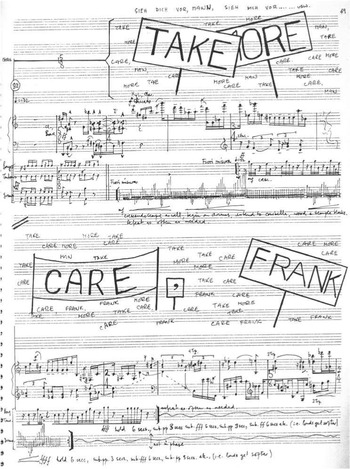
It was only in 1971 that Gilbert himself had the opportunity to realize on stage the vision of music theatre that he had articulated at Wardour seven years earlier. The Scene-Machine, written to a libretto by the poet George MacBeth, was commissioned in 1968 by the Staatstheater in Kassel, which wanted a didactic work for an audience of young people.Footnote 58 The piece relates the Faustian tale of the political folk singer Frank, who is seduced by the trappings of commerce and whose fans consequently turn upon him, killing him but not the forces that corrupted him. The Scene-Machine opens with a protest song by Frank about the Vietnam War, and the core of the work depicts the song being gradually ‘debased’,Footnote 59 both textually and musically, under the pressure of ‘the machine’. Gilbert recalls that the intention was to offer ‘a parable for youngsters, explaining the importance of adhering to one's ideals rather than abandoning them for the sake of simple “success”’.Footnote 60 Unsurprisingly, given both the nature of the commission and Gilbert's own preoccupations, the model of the Lehrstück loomed large. The concision and economy urged at Wardour are reflected in the modest scoring for chamber orchestra and a running time of 50 minutes (cut to 40 minutes in the abridged London production the following year). Dramatic realism is replaced by a montage-like sequence of self-contained scenes, each presenting a different perspective on Frank's fate. A narrator addresses the audience directly in speech, guiding their critical response. Speech also predominates in the writing for the ‘chorus of adolescents’, which follows the Sprechchor model adopted in Brecht and Eisler's Die Maßnahme and other agitational theatre of the early Weimar Republic.Footnote 61 The Brechtian device of role exchange is used for both the narrator, who morphs into a press reporter and a TV host, and the choir, which adopts two different guises, one adoring towards Frank, the other critical of his mutation. At the first performance, the choir was situated among the audience, mimicking the fluidity of the audience–performer boundary in many Lehrstücke. The use of ‘placards’ to notate the uncoordinated chanting of the choral parts (see Figure 1) reflected the way in which Gilbert associated his audience with youthful protest, and provided a further resonance with Brechtian staging techniques.
Anthony Gilbert, The Scene-Machine, p. 49 of short score. Extract from The Scene-Machine. Music by Anthony Gilbert. Text by George MacBeth. © Schott Music Ltd. Reproduced by permission. All rights reserved.

In The Scene-Machine, then, the relationship between popular music and political protest takes centre stage. MacBeth summarized the moral of the tale in brutally direct form:
The Scene-Machine centres on the theme of corruption: how what is fundamentally valuable can be undermined and subverted through the pressures of the commercial machine. Within the terms of the work's period and setting – roughly, England now – the specific forces of evil are those of the pop world acting on a young protest singer who starts out with high ideals.Footnote 62
This focus for the work's critical message was underlined by the German title used for the work's première production: Das Popgeheuer, which translates roughly as ‘The Pop Monster’.Footnote 63 In MacBeth's treatment, the evils of the pop world are embodied in a ‘monstrous puppet figure’, but they only manage to do their work on Frank after the puppet has transformed – in a clichéd gesture that left at least one contemporary music critic wincingFootnote 64 – into a seductive woman. The puppet first appears after Frank is interviewed by a ‘magazine for pop fans’, where, in a symbol of his independence from ‘the whole show-biz machine’, he shows himself to be thoroughly uninterested in the interviewer or his fans. The puppet ‘proceeds to expose Frank to a series of Mephistophelean temptations’, offering him money and boundless poetic inspiration, and as the woman emerges from inside the puppet, she offers him her ‘body, sound and whole’. Frank succumbs, and subsequently defends himself from the speaking chorus warning him to ‘take more care, man’. The fifth scene of the work shows Frank revising his Vietnam song under the guidance of the Mephistophelean force to which he is now in thrall; it is sapped of every trace of political commitment and turned instead into what MacBeth called ‘a sentimental love lyric’. Line by line, the lyrics are revised, so that ‘killing’ becomes ‘kissing’, ‘hate’ becomes ‘heat’, ‘Vietnam’ becomes ‘heart of me’, and ‘I see the small children / Dyin’’ becomes ‘I feel my baby / Flyin’’:
| Frank's ‘opening song’ (scene i) | The ‘debased song’ (scene vi) |
| I hear the leaves | I feel my love's |
| Burnin' | Burnin' |
| Somewhere in Vietnam. | Somewhere in the heart of me. |
| I hear the trees | I know the trees are |
| Turnin' | Learnin' |
| Somewhere in Vietnam. | You are the best part of me. |
| Kill, kill the dark angel | Kiss, kiss me, my angel, |
| Kill, kill the dark angel | Kiss, kiss me, my angel, |
| That's what I hear them say, | That's what I wanna say, |
| All night, all day. | All night, all day. |
| I see the bird | I feel my bird is |
| Flyin' | Tryin' |
| Somewhere in Vietnam. | To soften each part of me. |
| I see the small children | I feel my baby |
| Dyin' | Flyin' |
| Somewhere in Vietnam. | Into the sweet heart of me. |
| Kill, kill the dark angel, etc. | Kiss, kiss me, my angel, etc. |
| I feel the hate | I feel love's heat is |
| Risin' | Risin' |
| Somewhere in Vietnam. | Close to the cold part of me. |
| I see it rim the black | I feel it warm a solid gold |
| Horizon | Horizon |
| Somewhere in Vietnam. | All round the heart of me. |
| Kill, kill the dark angel, etc. | Kiss, kiss me, my angel, etc. |
In the work's final scene (scene vi), the rewritten song is performed in a televised spectacle complete with white grand piano and dance troupe, whereupon Frank's former fans storm the stage in a fury, killing Frank and, in a reminiscence of the clown scene from the Brecht–Hindemith Lehrstück, dismantling the puppet – although the piece ends with the puppet appearing again, newly whole.
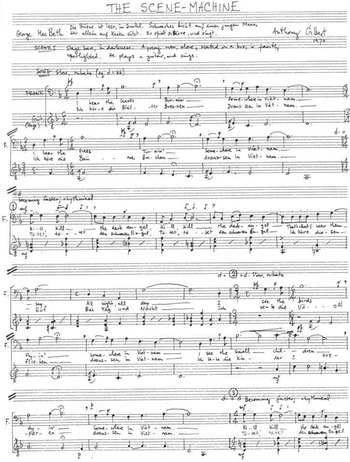
It was left to the composer to characterize the corruption process from a musical point of view. The designation of Frank as a ‘folk singer’ linked him to the long tradition of politically engaged folk musicians, most recently exemplified in the performances of Phil Ochs and Joan Baez at American anti-war rallies. However, when asked about the ‘protest song’ that opens The Scene-Machine, Gilbert was keen to distance himself from any particular model: ‘I wasn't consciously writing a pop-song […] There was no attempt to pastiche anything.’Footnote 65 Nonetheless, Frank's song adopts a quasi-vernacular style very different from Gilbert's customary angular atonality. It alternates metrically free verses cast in a melancholy modal diatonicism with a more militant chorus whose repeated injunction to ‘Kill, kill the dark angel’ – a reference to the helicopters of the American military – is accompanied by insistently strummed crotchets (see Figure 2). Gilbert recalls that the song was ‘entirely based on religious chant, remembered from my early teenage years as a choirboy’;Footnote 66 the Dies irae plainchant is clearly quoted in the opening guitar notes. The idea that this song should be subject to a process of gradual transformation tapped into existing compositional concerns, for Gilbert had for a number of years been preoccupied with what he termed ‘epitome form’, where ‘a piece would consist of a series of multiple, constantly expanding realisations of a simple harmonic premiss’.Footnote 67 In this case, however, the process of modification also passes comment on the popular-music environment of the time, even as Gilbert fought shy of literal ‘pastiche’. As Frank revises the lyrics in the presence of his seductress, erasing all specific reference to the Vietnam conflict, the austere guitar accompaniment of the opening gives way first to a more ingratiatingly triadic piano part, then gradually increasing amplification, and then the electric guitars, keyboard and drums of what the score calls a ‘pop group’. (The première production in Kassel used a local expat British rock group called the Sonics, who apparently did not object to featuring as a cipher of the ‘forces of evil’.Footnote 68) Finally, as the TV show begins, the group enters with full force for the first time, Gilbert's oblique take on contemporary rock underscored by swung rhythms, syncopation and ‘blue notes’ in the vocal part, and a clichéd ‘truck-driver modulation’ between verses.
Anthony Gilbert, The Scene-Machine, p. 1 of short score. Extract from The Scene-Machine. Music by Anthony Gilbert. Text by George MacBeth. © Schott Music Ltd. Reproduced by permission. All rights reserved.

The Scene-Machine's textual and musical presentation of ‘pop’ as symbol of ‘spiritual annihilation’Footnote 69 corresponded in broad terms to the brickbats hurled at Bob Dylan when he ‘went electric’ in the mid-sixties, a development regarded by many of his former fans as a betrayal of authenticity, and made worse by his refusal to offer clear statements of opposition to the Vietnam War.Footnote 70 It corresponded, too, to the almost total absence of Vietnam from rock and pop hits of the time; a scant two per cent of the songs featuring in the Billboard top 100 singles charts during the Vietnam War mentioned the conflict.Footnote 71 Yet as well as linking pop with an abandonment of politics, The Scene Machine implicitly acknowledged the tremendous pull exerted by mass-marketed popular music on young people desiring social change – and by rock in particular, whose emergence as a distinct category in the late sixties hinged precisely upon perceptions of authenticity and rootedness in longer histories of popular culture.Footnote 72 (Gilbert's avoidance of the word ‘rock’ in his score may represent a tacit refusal of the idea of this ‘alternative’ to manufactured pop.) Indeed, in few places were leading rock musicians more exalted than among British anti-war activists. As Celia Hughes discusses in her ethnographic study Young Lives on the Left, music played a central role in the lives and identities of young radicals associated with the anti-war movement.Footnote 73 This is clearly reflected in the pages of Black Dwarf, house journal of the International Marxist Group, whose lead editor was Tariq Ali, co-founder of the Vietnam Solidarity Committee (VSC). The VSC was responsible for coordinating the largest Vietnam rallies in London in 1968, regarded today as the ‘key events in the protest landscape of 1960s Britain’; in Hughes's words, the organization formed ‘the heart of a growing activist scene’.Footnote 74 Among the articles on American imperialism, student protests and workers’ control, Black Dwarf grappled with rock's sonic construction of defiance and liberation, alongside its frequently non-committal lyrics and its perceived complicity with capital. The magazine's sharply polarized reception of ‘Street Fighting Man’ by the Rolling Stones and ‘Revolution’ by the Beatles – the first deemed ‘the seed of the new sub-cultural revolution’, the second mere ‘establishment propaganda’Footnote 75 – epitomized the passion of the debate, and famously triggered responses from Mick Jagger and John Lennon, which were published in subsequent issues.Footnote 76 Writer for Black Dwarf John Hoyland encapsulated rock's elevated status among activists with his assertion that rock music was ‘part of what has made me into the kind of socialist I am’.Footnote 77
How then are we to position The Scene-Machine in relation to the ‘youthful idealism’ that the work sought to defend?Footnote 78 There were undoubtedly elements of Gilbert and MacBeth's analysis with which those who led the opposition to the Vietnam War could identify. The entanglement of rock musicians with radical politics during these years was unquestionably an equivocal and sometimes blatantly opportunistic phenomenon.Footnote 79 Black Dwarf contributors were not blind to the ways in which rock was ‘embroigled [sic] in the ethics of Big Business and Showbiz’ or to the fact that ‘the system chooses to set up the pop business as a kind of Roman circus of unprecedented splendour and debauchery’; nor did they overlook the reluctance of most rock musicians to commit to political action.Footnote 80 But the wholesale condemnation of pop presented in The Scene-Machine misses a distinction that was evident to many youthful commentators at the time and has remained a mainstay of rock criticism ever since: namely that the politics of rock music could not be reduced to the politics of either rock musicians, the rock business or (especially) rock lyrics. Richard Neville encapsulated this insight in his 1970 chronicle of the London counterculture, Play Power: ‘Rock is revolutionary. Usually the performers and promoters are not, at least consciously.’Footnote 81 In this reading, neither the statements of musicians nor the words of a song – one of the focal points of The Scene-Machine – were decisive for the music's political significance. Audience research at the time demonstrated that words were frequently incidental to listeners’ responses to rock music.Footnote 82 Instead, as Peter Wicke has argued, ‘the supposed protest character of rock's musical appearance relieved it of the necessity of taking a clear political position in its lyrics. The power of this music was in its effect on the senses.’Footnote 83 This was recognized by contemporary rock critics: Greil Marcus wrote of ‘Revolution’ that ‘There is freedom and movement in the music, even as there is sterility and repression in the lyrics’;Footnote 84 and Ellen Willis commented that, in spite of the ‘innocuous’ lyrics of Jagger's ‘Street Fighting Man’, ‘the heavy beat and all that chaotic noise in the background […] leave no doubt where his instincts are’.Footnote 85 The moralizing of The Scene-Machine's narrator that by being ‘a cog in the show-biz machine’ Frank's music will ‘right no wrongs, or put no brakes on wars’ created a dichotomy not recognized by rock's audiences.
The potential of rock's visceral and sensual satisfactions to motivate and animate protest is most readily grasped when we take into account the demographics involved. The anti-war movement in late-1960s Britain was overwhelmingly a movement of the young, dominated by the students and recent graduates aligned with the VSC.Footnote 86 In the largest anti-war march of the decade, coordinated by the VSC in October 1968, three-quarters of the 100,000 marchers were under 24; moreover, the protestors were preponderantly highly educated, with almost all having enjoyed some form of higher or further education.Footnote 87 Rock was susceptible to alignment with youth-dominated political movements simply by virtue of its status as the music of a new generation. But its overtly physical charge additionally resonated with the broader concern for ‘the liberation of the self’, which Hughes depicts as central to the lives of young, educated activists. This was a project that encompassed sexual experimentation and the pursuit of pleasure alongside campaigning and political debate – albeit (as Hughes describes) to an unequal extent between the sexes. ‘Intimate relations’ consequently became ‘an integral if unconscious site of activism’. In this regard, the relationship of political militancy and countercultural lifestyles was one of ‘fluid boundaries’ rather than sharp differentiation.Footnote 88
In The Scene-Machine, on the other hand, it is precisely the drum kit, electric instruments and amplification – those elements of modern popular music most central to its ‘effect on the senses’ – that are figured as the corrupted musical equivalent to Frank's newly written, blandly apolitical lyrics. Gilbert's unwillingness to attribute a productively resistant energy to rock's sonic qualities is further underscored by the work's moralistic equation of sexual pleasure with capitalist decadence and abandonment of principle. What the narrator sardonically casts as ‘seduction as destruction’ is graphically presented in a lengthy ‘Scene of Bizarre Seduction’, in the course of which the Woman first emerges from inside the ‘monstrous puppet’ and then takes control of Frank as her own puppet, singing, ‘I take you to my thighs and place you there, […] in passion bound’, to which Frank replies: ‘In love's disguise, I blow my mind, am nearly blind.’ The equation of sensual immersion with loss of sight and mind, subsequently generalized out to rock's pounding sonic embrace, presents bodily satisfaction as something intrinsically opposed to rational political action. The point is bluntly underlined during the ‘Big Show’ at the end of the work, when the chorus, adopting its second, ‘adorational’ guise, sings a ‘chorus of false praise’ consisting entirely of animalistic grunts.
Anxiety about the suspension of rational thought and the mutation in habits of listening was widespread in high cultural circles, as we saw at the end of the previous section. Gilbert was not alone among his peers in fearing for those ‘lost in passion, following the fashion of the times’, as The Scene-Machine's narrator wryly expresses it. But in adopting such a view, Gilbert and his contemporaries were also adhering to a well-worn trope of modernist aesthetics, namely an ambivalence towards (or out-and-out repudiation of) pleasure. What Laura Frost calls ‘the modernist doxa of difficulty’ is generally agreed to have emerged as a response to the flood of easy pleasures afforded by mass culture from the end of the nineteenth century onwards – pleasures, moreover, that were, as in The Scene-Machine, frequently gendered feminine.Footnote 89 From this perspective artistic modernism jarred with the life priorities of 1960s anti-war activists. This larger history also helps to identify an important aspect of the appeal of Brecht for post-Second World War composers. Brecht's best-known writings appear exemplary of the modernist doubts about pleasure. In them, he famously proselytized for a ‘theatre for instruction’ over a ‘theatre for pleasure’, rejecting the ‘culinary character’ of the bourgeois theatre and its preoccupation with the gratifying of ‘appetites’.Footnote 90 Special ire was reserved for the German concept of Genuβ, ‘with its connotations of hedonism and excessive indulgence’.Footnote 91 In fact, on this question (as on others) Brecht was prepared to change his mind. Elsewhere he wrote: ‘It is in fact a characteristic of the resources of the theatre to transmit knowledge and impulses in the form of sensual pleasures: the intensity of the knowledge and the impulses is directly related to the intensity of the sensual pleasure.’Footnote 92 But the reputation of Brecht's theatre for austerity and didacticism only served as encouragement for post-war composers’ censoriousness with regard to mass-marketed entertainment, even when (as we have seen) Brecht saw a place for popular-music idioms as an essential element of his socially engaged art.Footnote 93
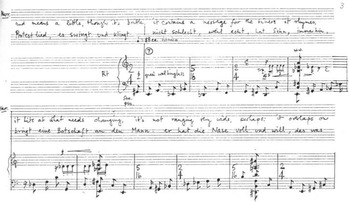
This is not to say that The Scene-Machine is devoid of its own particular pleasures, especially for those who share Gilbert's predilections and points of creative departure. Recent studies of the relationship between modernism and pleasure have argued that, rather than rejecting pleasure outright, modernists were more frequently concerned with the ‘redefinition of pleasure’ or (sometimes) with the pleasures to be had in appreciating things others find difficult.Footnote 94 Here, the generational difference between the work's creators and its intended audience was decisive: Gilbert and MacBeth were a decade older than most of those in the anti-war movement. Barry Faulk has noted how in the mid-1960s rock ‘pushed out jazz music to become the primary soundtrack of the British underground, and fostered a generational divide that separated a British Left which had come of age before the sixties from younger radicals’.Footnote 95 Interestingly, it is precisely modern jazz that is the musical reference point for the knowing cynicism of The Scene-Machine's narrator, whose barbed remarks about Frank are accompanied by a kind of serial bebop, complete with hectic plucked-string bass spelling out 12-note rows, and prominent muted trumpet (see Figure 3).Footnote 96 But this generational gap had larger consequences for the work's ‘socio-political message’, the presence of which Gilbert had argued at Wardour should be intrinsic to the new music theatre. The very end of The Scene-Machine hints briefly and obliquely at a critical judgment on the Vietnam War itself: the revived puppet-monster is greeted despairingly by a member of the chorus as a ‘Dark Angel’, creating a pointed elision between the helicopters of Frank's protest song and the big business that eventually crushes him. But the work's larger warning is clearly directed towards a more local concern, namely the cultural choices of the young – especially those who proclaim radicalism but forgo the challenges of demanding high culture.
Anthony Gilbert, The Scene-Machine, from p. 3 of short score. Extract from The Scene-Machine. Music by Anthony Gilbert. Text by George MacBeth. © Schott Music Ltd. Reproduced by permission. All rights reserved.

IV
Like The Scene-Machine, Newson's Arena was written specifically with a young audience in mind. Commissioned by Glock for performance at the Proms, its conception was shaped by the concerts’ traditional venue, the circular Royal Albert Hall, whose ‘arena’ (the stalls area, with seats removed) is given over to the standing promenaders. The idea for the piece derived, the composer explained, ‘from the Albert Hall as a place where so many other activities than music have their day: politics, religion, sports, commerce – all the games people play. And it derived from the youth and exuberance of the Promenaders.’Footnote 97 In the event, the work was separated from the venue that had inspired it, becoming part of a new venture in 1971 that took some late-night Prom performances to the more informal environment of the Roundhouse in Camden. The compendious nature of the piece extended to the work's performing forces: Newson conceived each movement as ‘a kind of showpiece with, if possible, a set star or group of stars’.Footnote 98 The work's first and (so far) only performance brought together an attention-grabbing line-up of performers: the a cappella vocal group the King's Singers, the jazz vocalist Cleo Laine, the soprano and avant-garde specialist Jane Manning, the clarinettist Alan Hacker, a student ‘speaking choir’ from Goldsmiths College and an ensemble of wind, brass, percussion and electric guitars (22 players, with ‘the inference of 11-a-side’) from the BBC Symphony Orchestra under Pierre Boulez. The impression of a kind of variety show, with each movement showcasing a different soloist or group, was strengthened by the use of Joe Melia, a veteran of West End theatrical comedy and satirical revues, as a compère or master of ceremonies. Melia's linking texts were scripted by Newson's friend Leonard Smith to resemble the cheery patter and ribald jokes favoured by hosts of popular variety shows like ‘Sunday Night at the Palladium’.Footnote 99
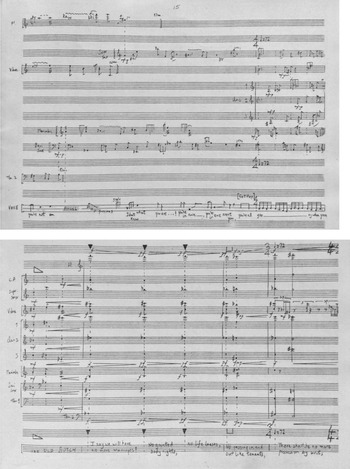
Arena represented a marked departure in Newson's output, both for its allusions to popular entertainment and for its overt ‘relevance to contemporary situations’.Footnote 100 An introductory first movement, ‘Beginning to begin and stopping beginning’, allows the musicians to assemble on stage one by one, their warm-up rehearsal routines composed into a staged crescendo, accompanied by exclamations of curiosity and anticipation by the speaking choir. The second movement is a ‘Black Magnificat’, sung by the King's Singers and a small brass and percussion ensemble, which dissects what the composer called the ‘egotism game, the pay-attention-to-me game’, in reflection of his perception that, in sharp contrast to the self-deprecating injunction of the Magnificat, ‘most of us are too intent on magnifying ourselves’.Footnote 101 The title of the third movement, ‘My dancing days are over’, was triggered by a casual remark made by the composer's wife;Footnote 102 scored for Jane Manning, the King's Singers and wind quintet, it sets its titular phrase, repeated several times, alongside lines taken from the Lamentations of Jeremiah that figure Jerusalem as a forsaken woman. In the context of the surrounding movements, the framing lines of this movement – ‘Our dance is turned into mourning […] The young men have ceased in their music’ – readily connote the sobriety and disillusion that accompanied the end of 1960s counterculture. The fourth movement, punningly entitled ‘Garden Fate’, is an elaborate allegory on the Garden of Eden from the viewpoint of Eve. Here the connection to the Royal Albert Hall was more immediate, for (as Hall notes) November 1970 saw the televised sabotaging and stage invasion of the Miss World competition – a protest today remembered as ‘probably the most famous women's liberation action of the early seventies’.Footnote 103 Eve (sung by Cleo Laine) is presented as ‘a woman of today’, tracing emotional states that are ‘at different times sad, extrovert, lyrical, violent, satirical’ and which allow the showcasing of a range of vocal types consciously modelled after Cathy Berberian (see Figure 4).Footnote 104
George Newson, Arena, movement 4: ‘Garden Fate’, p. 15 (copy of score held in BBC Music Library).

In the fifth movement, the contemporary political scene comes most overtly to the fore – and, indeed, in its intensity of engagement with the political turmoil of the time this movement knows no equal in British composition. In his introduction to the television broadcast of the performance, Newson stated:
I wanted to write a movement based on the feeling of confrontation, particularly between the young and the old. Because many of the things young people believe in I sympathize with very much. If I was 21 now instead of 39 I think I'd be a dropout like the rest of the young people.Footnote 105
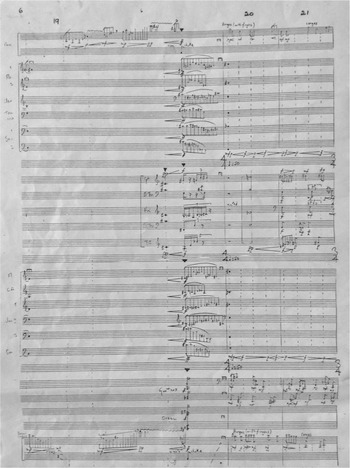
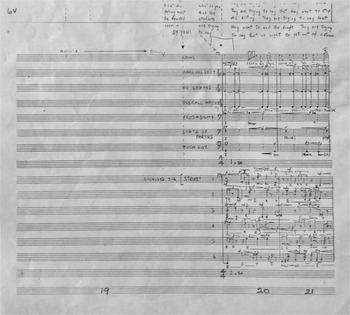
The movement's title is a verbatim quotation from a statement by Enoch Powell in the wake of his sacking as a shadow minister following his infamous Rivers of Blood speech against immigration in April 1968: ‘I'm in the game, I shall continue to play, and I do not use the game at all lightly.’Footnote 106 Assembling all the work's performers except Laine, the movement comprises a tumultuous collage of texts taken, in the composer's words, ‘from many sources: political speeches, news cuttings and TV reportage, slogans heard chanted and seen written up, quotes from Hippies/Yippies, an Art School manifesto calling for action against institutions, and Women's Lib pronouncements’.Footnote 107 These are variously recited by Melia, sung by the King's Singers and chanted by the student speaking choir (who were positioned within the audience seated on the Roundhouse floor), their topicality highlighted by an accompanying film that juxtaposed street demonstrations and police scuffles with images of prominent politicians and voting statistics from the 1970 general election. These vocal and visual layers are superimposed upon a reorchestrated version of an existing instrumental work, This Gap of Time (1968). From this welter of layered spoken and sung texts, the topic of Vietnam emerges as central: ‘What do you think the students are trying to say?’, Melia shouts. ‘They are trying to say that they want to stop the killing. They are trying to say that they want to end the draft. They are trying to say that we ought to get out of Vietnam’ (see Figures 5a–b). The climax is formed by the police shooting of student protestors at a Vietnam demonstration at Kent State University in May 1970, a moment unsparingly depicted both by a violent orchestral and vocal tutti and by film projections of the demonstration and its aftermath. The movement closes with quotations of words by one of the student victims, Allison Krause, and a press statement from her father. A short concluding movement, ‘The Final’, is built around the idea of ‘the mass protagonism of football crowds’, with the speaking chorus split into opposing sides. It provides an ambiguous end to the work, with the ‘Away Side’ chanting ‘It's not as though I understood a word!’ and the ‘Home Side’ narrowing its focus onto the ‘marvellous moves’ of the game.
George Newson, Arena, movement 5: ‘I'm in the game, I shall continue to play, and I do not use the game at all lightly’, p. 6, upper staves (copy of score held in BBC Music Library).

George Newson, Arena, movement 5: ‘I'm in the game, I shall continue to play, and I do not use the game at all lightly’, p. 6, lower staves (copy of score held in BBC Music Library). The six vocal parts immediately below the speaker are the King's Singers; the six vocal parts below those are the student speaking choir.

For all the many differences between Arena and The Scene-Machine (some of which will shortly be elaborated), sociopolitical comment in both is treated as occasion for pronouncement on popular-music traditions. How this works in Arena is more complex than how it works in The Scene-Machine. In the former, there is no attempt directly to incorporate popular-music idioms. Newson's score, like those of his better-known British contemporaries, takes its principal points of orientation from the structural and gestural preoccupations of post-war European serialism, to which Newson had been thoroughly exposed at the Dartington and Darmstadt summer schools, and by periods of work at electronic studios in Urbana-Champaign and Milan.Footnote 108 This remains the case even for Laine's extended movement: her own extravagantly demanding part is counterpointed by instrumental scoring that makes full use of pointillist textures, irrational rhythms, proportional and unmeasured notation, rhythmic mobiles and free counterpoint, all couched (like the score as a whole) in a fully chromatic harmonic language. Instead, popular music is referenced in Arena by the diverse star performers, whose presence invokes other musical worlds including jazz (Laine), light music (the King's Singers) and musical comedy (Melia). The chosen frame of the variety show brings further musical associations, which are, as it were, evoked in absentia by Melia's substantial linking ‘spots’.Footnote 109 These embrace coarse humour, social comment (notably a joke at Boulez's expense about the European Common Market) and brief audience participation in a jaunty rhyme about environmental pollution (assisted by the choreographed involvement of the speaking chorus stationed in the audience).Footnote 110 This delicately balanced acknowledgement of various popular-music traditions reflects aspects of Newson's own path into composition. Born into modest circumstances, his first exposure to music-making came as a wartime evacuee in Taunton, where he learnt boogie-woogie from a local club pianist. Back in London he played in and made arrangements for dance bands while gaining formal musical tuition through scholarships at the Blackheath Conservatoire and later at Morley College and the Royal Academy of Music.Footnote 111 While the compositional circles he inhabited from the late 1950s onwards militated against literal references to vernacular musics in his mature compositions – as we have seen, this was most definitely not ‘the done thing’ for this generation of composers – Newson never felt the kind of distance from popular traditions experienced by some of his contemporaries.
Striking in their absence from Arena's invocations of diverse popular forms, however (especially given the point of departure in the ‘youth and exuberance’ of the intended audience), are pop and rock, neither of which is represented among Newson's compendious performing forces. Moreover, the work's second movement, the ‘Black Magnificat’, appears to single out these genres for criticism. Its text takes aim at the ‘grotesques craving their downstage spots’, and the target is made more specific by references to music and ‘amps’:
Introducing the work for the BBC television broadcast, Newson was clear that his metaphor for contemporary self-obsession was ‘the pop star’.Footnote 113 Arena's adoption of the variety-show format can be connected to this diagnosis of the shortcomings of the popular-music scene. Traditional music hall, from which the modern variety show descended, had long been celebrated as ‘an authentic cultural expression of the popular classes, with the special function of reinforcing British unity’.Footnote 114 This reading remained strong as the waves of imported jazz, Hollywood movies and rock 'n’ roll intensified after the Second World War, so that by the 1960s, even as music hall appeared on the verge of extinction, the genre was being extolled specifically for its role in ‘a search for authenticity in the face of the Americanization of British popular culture’.Footnote 115 Music hall, in other words, stood for these commentators as the ‘truly’ popular, in opposition to the corporatized products of the music industry.Footnote 116 In this way, Arena's allusions to the variety form represented an implicit rejection of modern pop's commercialism, of a kind that invites clear comparison with The Scene-Machine.
However, the surface absence of pop or rock from Arena hides a more complex story, which is important to grasp if we are to understand the nuances of the work's relationship to popular culture and politics. There is an underlying affinity between Newson's composition and the work of many rock musicians from the period. Precisely one of the facets of rock artists’ attempts to distinguish themselves from their ‘pop’ counterparts was a changing attitude towards the music business of which they were a part – a change that in some cases led to a self-conscious embrace of elements of traditional working-class culture, including music hall. As Faulk discusses at length in his book British Rock Modernism, from 1967 onwards rock musicians’ growing consciousness of their integration within a hugely lucrative industry and the way in which this chafed with the rebellious image they wished to project led to a concern for how ‘to detach rock music-making from corporate enterprise’.Footnote 117 Musicians from modest backgrounds who had met fame and fortune, as well as those from more metropolitan, middle-class backgrounds who sought to portray a working-class image, felt drawn to forms of traditional working-class culture, either as a response to their sense of cultural and economic displacement or as demonstration of their claimed roots. Faulk cites the film production The Rolling Stones Rock and Roll Circus, recorded in December 1968, which presented a variety of musical and circus acts, performed by rock artists, clowns and acrobats within a specially constructed circus tent and before a live audience.Footnote 118 In place of a single compère, each act was introduced by one of the musicians, some of them wearing ostentatious Victorian dress. The musical emphasis was placed upon the progressive wing of late 1960s rock, including the Who's multi-section epic ‘A Quick One, While He's Away’, the flute-dominated folk-rock of Jethro Tull, a blues jam from one-off ‘supergroup’ Dirty Mac with violin and vocal extemporizations from Ivry Gitlis and Yoko Ono, and of course the Stones themselves. Faulk proposes that the project was ‘meant to build a powerful link between the new rock music and the British working-class past’.Footnote 119 In both the Rock and Roll Circus and Arena, then, the variety-show frame acted as a device for presenting modern, even experimental, material as rooted and authentic – and thus a means of reconciling their authors’ current creative selves and their imagined or actual pasts.Footnote 120
Yet as Faulk observes, uniting the worlds of popular cultural tradition and countercultural innovation was no simple matter, especially when the latter came to be associated with the political radicalism of 1968, as it did on the pages of Black Dwarf and elsewhere. Such efforts had to confront one of the defining schisms of late-1960s Britain, between predominantly middle-class student protestors and the broader population. The revolutionary rhetoric of VSC activism, together with growing moral consternation around drug-taking and sexual libertarianism, drove what Donnelly terms a ‘backlash against permissiveness’ that set in fully in 1969.Footnote 121 A New Society survey published in November of that year demonstrated ‘the resilience of illiberal popular attitudes’ among the British public at large.Footnote 122 The public response to Powell's ‘Rivers of Blood’ speech was indicative: Wapping dockers came out on strike in support of the sacked minister and opinion polls showed a 67–82 per cent approval rating for his speech.Footnote 123 The New Society survey revealed the two least popular developments of the 1960s to be ‘student unrest’ and ‘immigration of coloured people’.Footnote 124 Writers for Black Dwarf despaired at the conservatism of working-class culture. An article analysing the dockers’ strike concluded that a ‘traditional working class culture […] meshed in kin and neighbourhood’ reflected ‘an essentially conservative nostalgia’ that was ‘the antithesis of an ideology of socialism’.Footnote 125 Black Dwarf writers glumly concluded that the anti-war campaign in Britain was being waged at a time of ‘comparative working-class non-consciousness’.Footnote 126 In May 1969, Jagger himself critiqued the ‘self-interest’, ‘tribalism’ and ‘fantastically backward’ nature of traditional working-class culture, as manifested by the striking dockers, remarks that reflected an awareness of the larger British public's disdain for his own unconventional lifestyle.Footnote 127
In the light of such tensions it is interesting to examine what happens in Arena when attention turns to political conflict and activism specifically, as it does in movement 5. As we have seen, this movement articulated Newson's sympathy for the ‘dropouts’ and took particular critical aim at Powell by conjoining his declaration of defiance (as quoted in the movement's title) with the student deaths at Kent State. As if in response to this alignment with the activism of the young, the work's evocations of traditional popular culture are briskly dispensed with. First, the linking role of the compère disappears, so that movement 5 proceeds directly from the end of movement 4 and is followed directly by movement 6.Footnote 128 More drastically, in a quite Brechtian gesture of role exchange, movement 5 recasts Melia – up to this point, essentially the implied on-stage representative of the audience – as, first, an impassive news reporter and then (through a megaphone) the trigger-happy police commander ordering the shooting on the Kent State demonstrators, a perturbing metamorphosis that throws a dark shadow over the levity of earlier parts of the work. Above all, the movement shifts away from the relative coherence and focus of earlier parts to present an overwhelming welter of musical, verbal and visual stimuli: multiple shouted and sung texts delivered from different places in the auditorium; spatially separated ensembles of wind and percussion hurling out volleys of arhythmic pitch configurations; coloured spotlights; and a quick-fire bombardment of visual images from the film projection. The movement's multilayered textures link it to Newson's recent works Twenty-Seven Days (1969/70) for orchestra, with its spatially separated ensembles, and June Is a Month in the Summer (1969) for choir and orchestra, with its superimposed sung and spoken texts. But they could hardly be further removed from the world of the variety show.
What, then, of the famed economy and ‘minimalism’ of the Brechtian Lehrstück, which Gilbert had urged as a model for his contemporaries, and elements of which were adopted in The Scene-Machine?Footnote 129 We have already noted some putatively ‘Brechtian’ elements in Arena, including the use of a master-of-ceremonies figure, role exchange and a speaking choir, all of which are also common to Gilbert's work. But rather than ape the style of Brechtian theatre directly, this movement's approach to political subject matter is closer to influential Italian precursors such as Nono's Intolleranza 1960 and the third movement of Berio's Sinfonia (1968). Newson studied briefly with Nono at Darmstadt and enjoyed a friendly relationship with Berio that lasted the whole of the 1960s, culminating in a period working in Milan's Studio di Fonologia in 1968. Both Nono and Berio were themselves influenced by the first Italian productions of Brecht in the 1950s, and a number of their works, including Intolleranza 1960 and Sinfonia, reference Brecht's texts directly.Footnote 130 Newson recalls, indeed, that ‘it was through Berio I first discovered Bert Brecht’.Footnote 131 But it is instructive to analyse the shape that this Italian Brechtianism takes. Characteristic of both Intolleranza 1960 and the third movement of Sinfonia is a desire to overwhelm the spectator or listener with a barrage of stimuli, in which the Brechtian device of ‘separation of the elements’ is taken to extremes, the principle of montage being, so to speak, verticalized. In the case of Intolleranza 1960, this involved simultaneous stage action, multiple film and slide projections, and electronic sound diffusion through speakers placed around the auditorium.Footnote 132 The primary point of reference here was the idea of ‘total theatre’ first pioneered by one of Brecht's early collaborators, Erwin Piscator, and subsequently adopted in different ways by Antonin Artaud and Josef Svoboda (Nono's collaborator on Intolleranza 1960).Footnote 133 Total theatre sought to deploy the full staging and technological resources of a professional theatre, including multiple stages and film screens, to create an immersive and unsettling experience. The third movement of Sinfonia, whose combination of superimposed sung and spoken texts Newson admired, achieves a comparable effect in the context of the concert hall.Footnote 134
The techniques of total theatre have often been regarded as an extension of Brechtian practice, creating what David Osmond-Smith describes as ‘a bundle of mutually alienating praxes’ which ‘compels the audience into self-consciousness’.Footnote 135 But other commentators have noted how the idea of total theatre pulled in the opposite direction to Brecht in the emphasis it placed upon extravagant resources and complexity. Graham Holderness makes a pointed contrast between the crisp montage of the Lehrstück, which holds the spectator at bay (thus allowing critical reflection), and the immersiveness of total theatre that ‘internalises the spectator within its experiential medium’ and thus brooks ‘no distance, no opportunity for reflection, no exercise of the sceptical intelligence’. Noting the uncomfortable proximity of aspects of total-theatre practice to the Wagnerian Gesamtkunstwerk so reviled by Brecht, Holderness marks Piscator's model as ‘inextricably involved with currents of cultural authoritarianism’.Footnote 136 Whatever stance is taken on this question, it is easy to see the appeal of total-theatre practice for composers preoccupied with the rigorous organization of material across multiple domains; from this perspective, total theatre is less a means to stoke audiences into independent action, more an extension of sophisticated composerly control.Footnote 137 The elaborate construction of the fifth movement of Arena, while delivering an impressively visceral spectacle in response to its overtly political texts, inevitably signals a further kind of distance from the vernacular and the everyday.Footnote 138 In doing so, however, it expresses not simply the late modernist's pursuit of mastery, but also the fundamentally different political context from that of Brecht's Germany. In early 1970s Britain, as we have seen, the popular voice and political activism could not be assumed to coincide – indeed, they were frequently viewed as sharply at odds. In this light, Brecht's solutions for engaging the contemporary and the sociopolitical could not be expected to be Newson's.
V
The only music most people know – pop music – has become a big business beyond anything ever imagined in the musical world, playing its part in drugging constructive, creative thinking.Footnote 139
Why is your music so effing loud? You must all be brain dead. Maybe you are: I didn't know so many clichés existed until the last half-hour.Footnote 140
In recent years, leading composers of the Manchester generation have been more forthcoming about their views of popular music, maybe feeling impelled to express opinions that decades earlier could have been assumed as widely shared in high cultural circles. As the remarks quoted above suggest, their verdict is not much different from that issued by The Scene-Machine. One of my arguments has been that this outlook brought consequences for British composers’ approach to contemporary political topics, especially those attracting the attention of student radicals, because of the close association of student culture with popular music and rock in particular. The relatively mild political culture of the British 1960s undoubtedly played its part in conditioning composers to look for subject matter elsewhere. But it is notable how the few works that did take on contemporary political themes felt obliged to pass comment on the music with which political activism was most strongly associated. Even a composer more personally sympathetic towards rock music like Newson – he recalls it being woven into the fabric of family life via radio and TVFootnote 141 – struggled to accord it a place in his most political work, resorting instead to traditional popular forms that were seen as more authentic than rock, and which were then themselves ultimately judged out of place in relation to radical causes. The prevailing doubts about contemporary popular culture as a whole impacted upon composers’ preparedness to learn from Brecht, as Gilbert had encouraged his Wardour peers to do. Where Brechtian traits are perceptible, it is particular tropes that are emphasized: the retreat from emotional empathy; the formalism of montage and separation of the elements; the suspicion of pleasure; and an interest in alienation as an end in itself, whether achieved through extreme austerity or overwhelming complexity.
It is important not to overgeneralize from the picture drawn in the preceding pages. Older and younger composers often took a different stance. Tippett (b. 1905), who participated in the Wardour discussion, had no qualms at any stage in his career about evoking popular music as an expression of what Ian Kemp terms his ‘covenant with real life’.Footnote 142 Gilbert's The Scene-Machine received its British première alongside a new work by Tippett's contemporary Elisabeth Lutyens (b. 1906). Time Off? Not the Ghost of a Chance!, a ‘charade’ for two singers and small ensemble, ruminated philosophically on generational difference and the passing of time, and made non-judgmental use of a pre-recorded pop song (complete with electric guitars, electric piano and drum kit) as a symbol of the transience of youth. Younger composers such as Tim Souster (b. 1943), meanwhile, were able to perceive at the end of the 1960s that ‘pop and the avant-garde have been fixed on a collision course for some time’, a view embodied in a figure like John Tavener (b. 1944), whose flamboyant lifestyle and friendship with the Beatles reflected a rejection of what he later termed ‘the intellectual kitchens of Europe’ (in other words Darmstadt and the Manchester school).Footnote 143 Rupprecht notes how members of this younger generation discovered rock and the European avant-garde simultaneously as teenagers, although this naturally did not mean that their careers followed identical trajectories: consider Gavin Bryars and Michael Nyman (both b. 1944) on the one hand; Brian Ferneyhough and Roger Smalley (both b. 1943) on the other.Footnote 144
Some prominent contemporaries of Gilbert, Newson and the Manchester triumvirate also found an easier accommodation with popular styles. For Malcolm Williamson (b. 1931) and Richard Rodney Bennett (b. 1936), this formed part of a more general willingness to embrace different aspects of musical tradition. More directly relevant to the present discussion is the case of David Bedford (b. 1937), who studied with Nono in Italy and attended the 1964 Wardour Castle Summer School, but by the end of the 1960s was working as ‘a gigging pop musician’ and writing concert-hall works which enthusiastically embrace rock influences.Footnote 145 In a published discussion from 1966 with his friend and exact contemporary Cornelius Cardew, Bedford compared the leading rock band the Who to John Cage, for their shared interest in unorthodox instrumental techniques at the service of new sounds.Footnote 146 Among his generation, however, Bedford was extremely unusual in his positive appraisal of rock.Footnote 147 Despite the underground press's positioning of Cardew and his associates alongside the psychedelic rock of Soft Machine and Pink Floyd, Cardew himself appears to have been uninterested. John Tilbury observes that Cardew ‘showed no interest in the popular music of the time’ and ‘there is no recollection within circles of friends and family of any discussion of the phenomena of pop culture’.Footnote 148
It may be that Cardew, who in his late-1960s projects for school groups and the part-amateur Scratch Orchestra was developing his own brand of ‘experimental vernacular’, would have agreed with Eisler's harsh diagnosis of mass-produced ‘entertainment music’: namely that it comprised a form of ‘musical barbarism’ that offered only ‘facile pleasure’ and promoted ‘a corrupt musical passivity’.Footnote 149 In a 1976 essay, Goehr explicitly invoked Eisler's view of ‘the emotionally cheapening mass qualities of mechanised pop’ in support of his own broader attack on rock's ‘primitive repetitions’ and ‘technical manipulation that impairs the response of the listener’.Footnote 150 But by the late 1960s, Eisler's was a difficult view to sustain in unmodified form, even if plenty of composers tried to do so (and not just in Britain).Footnote 151 Evidence that rock, in particular, was an active agent for social change was not hard to come by in Britain as the decade neared its close. A greater challenge was that the old imagined binary, in which modernists, political activists and the masses were aligned in unison against the forces of oppression, clearly no longer held. Politicized students often rejected modernism, and ‘the people’ often rejected politicized students. From this fallout, it was difficult to retrieve a clear and uncontentious agenda for progressive composers wishing to rearticulate their social role.