Introduction
The population of older adults living with human immunodeficiency virus (HIV) has been growing steadily due to both an increase in new infections among people aged 50 and over and an increase in the life expectancy for all people living with HIV. While several studies have focused on the social lives of older adults living with HIV, their intimate relationships and sexual lives have so far not been well documented beyond aspects related to at-risk sexual practices (Cooperman, Arnsten and Klein Reference Cooperman, Arnsten and Klein2007; Golub et al. Reference Golub, Botsko, Gamarel, Parsons, Brennan and Karpiak2011; Illa et al. Reference Illa, Brickman, Saint-Jean, Echenique, Metsch, Eisdorfer, Bustamante-Avellaneda and Sanchez-Martinez2008; Klein Reference Klein2012; Lovejoy et al. Reference Lovejoy, Heckman, Sikkema, Hansen, Kochman, Suhr, Garske and Johnson2008; Önen et al. Reference Önen, Shacham, Stamm and Overton2010). Located at the intersection of HIV and ageing, this population finds itself particularly likely to experience difficulties regarding intimacy and sexuality, since those living with HIV, including older adults, are more likely to face obstacles in this area of their lives when compared to the general population (Flyckt and Kingsberg Reference Flyckt, Kingsberg and Stuart-Hamilton2011; Gott Reference Gott2005; Hooyman and Kiyak Reference Hooyman, Kiyak, Hooyman and Kiyak2008; Keegan, Lambert and Petrak Reference Keegan, Lambert and Petrak2005; Maticka-Tyndale, Adam and Cohen Reference Maticka-Tyndale, Adam and Cohen2002; Minichiello, Hawkes and Pitts Reference Minichiello, Hawkes and Pitts2011; Schiltz et al. Reference Schiltz, Bouhnik, Préau and Spire2006). In addition, difficulties regarding intimacy and sexuality are likely to occur earlier among people living with HIV, often as early as their fifties, due to the multiple and complex health issues which emerge as a consequence of HIV and which contribute to the early onset of disability and accelerated ageing processes experienced by this population (Blanco et al. Reference Blanco, Jarrín, Vallejo, Berenguer, Solera, Rubio, Pulido, Asensi, del Amo and Moreno2012; Effros et al. Reference Effros, Flechter, Gebo, Halter, Hazzard, Horne, Huebner, Janoff, Justice, Kuritzkes, Nayfield, Plaeger, Schmader, Ashworth, Campanelli, Clayton, Rada, Woolard and High2008).
Studies on people living with HIV reveal limitations in relation to intimacy and sexuality resulting from fears of transmitting HIV, stigma surrounding HIV, difficulties associated with disclosing the infection, a loss in desire and feelings of unattractiveness, along with the constraints of ‘safe’ sexual practices (Maticka-Tyndale, Adam and Cohen Reference Maticka-Tyndale, Adam and Cohen2002; Keegan, Lambert and Petrak Reference Keegan, Lambert and Petrak2005; Schiltz et al. Reference Schiltz, Bouhnik, Préau and Spire2006). Furthermore, several studies have revealed a decline in sexual activity within the general older population for reasons that are both biological (physiological changes, declining health) (Flyckt and Kingsberg Reference Flyckt, Kingsberg and Stuart-Hamilton2011; Hooyman and Kiyak Reference Hooyman, Kiyak, Hooyman and Kiyak2008), and social (lack of a partner, ageism) (Gott Reference Gott2005; Minichiello, Hawkes and Pitts Reference Minichiello, Hawkes and Pitts2011).
What few data are available on the intimate lives of older adults living with HIV reveals a more substantial decrease in sexual activity within this population, when compared with the general older adult population. For example, studies from both the United States of America (USA) and France have revealed that the rate of sexual inactivity for older adults living with HIV increases noticeably in relation to age when compared to the general population (Golub, Grov and Tomassilli Reference Golub, Grov, Tomassilli, Brennan, Karpiak, Shippy and Cantor2009; Schiltz et al. Reference Schiltz, Bouhnik, Préau and Spire2006). A study conducted in the USA reported that 50 per cent of older adults living with HIV between the ages of 50 and 59, 45 per cent of those between 60 and 64, and 31 per cent of those 65 and above remained sexually active (Golub, Grov and Tomassilli Reference Golub, Grov, Tomassilli, Brennan, Karpiak, Shippy and Cantor2009). In comparison, another US study reported that 73 per cent of the general population aged 57–64 and 53 per cent of those aged 65–74 remained sexually active (Lindau et al. Reference Lindau, Schumm, Laumann, Levinson, O'Muircheartaigh and Waite2007).
According to the literature, the primary reason for this decline in sexual activity involves erectile challenges caused by the interaction of HIV, lengthy exposure to antiretroviral treatment and ageing (Asboe et al. Reference Asboe, Catalan, Mandalia, Dedes, Florence, Schrooten, Noestlinger and Colebunders2007; Brennan, Emlet and Eady Reference Brennan, Emlet and Eady2011; Nokes et al. Reference Nokes, Nicholas, Rivero, Rosa, Kirksey, Moezzi, Corless, Maryland, Willard, Robinson, Hamilton, Sefcik, Wantland, Holzemer and Portillo2011). Qualitative research has demonstrated that menopause is sometimes considered by older women living with HIV as a contributing factor explaining diminished sexual interest (Grodensky et al. Reference Grodensky, Golin, Jones, Mamo, Dennis, Abernethy and Patterson2015; Taylor et al. Reference Taylor, Munoz-Plaza, Goparaju, Matrinez, Holman, Minkoff, Karpiak, Gandhi, Cohen, Golub, Levine, Adedimeji, Gonsalves, Bryan, Connors, Schechter and Wilson2016). The few qualitative studies that address the intimate lives of older adults living with HIV (Grodensky et al. Reference Grodensky, Golin, Jones, Mamo, Dennis, Abernethy and Patterson2015; Nevedal and Sankar Reference Nevedal and Sankar2016; Psaros et al. Reference Psaros, Barinas, Robbins, Bedoya, Safren and Park2012; Siegel and Schrimshaw Reference Siegel and Schrimshaw2003; Taylor et al. Reference Taylor, Munoz-Plaza, Goparaju, Matrinez, Holman, Minkoff, Karpiak, Gandhi, Cohen, Golub, Levine, Adedimeji, Gonsalves, Bryan, Connors, Schechter and Wilson2016; Wallach Reference Wallach2013; Wallach et al. Reference Wallach, Ducandas, Martel, Trottier and Thomas2013) point to obstacles similar to those faced by younger adults living with HIV. This includes the stigma of HIV, the fear of rejection when disclosing HIV, the fear of infecting a partner and the loss of desire. There are, however, several unique characteristics reported in the literature. For example, even when the loss of desire or decreased sexual activity are related to HIV status, some older adults living with HIV also attribute this reality to ageing (Grodensky et al. Reference Grodensky, Golin, Jones, Mamo, Dennis, Abernethy and Patterson2015; Siegel and Schrimshaw Reference Siegel and Schrimshaw2003). Several studies have reported on gender differences in the experiences of ageing with HIV. Siegel and Schrimshaw (Reference Siegel and Schrimshaw2003) noted a gendered difference in the reasons given regarding declining sexual interest. After being infected by a male partner, women interviewed for this study tended to internalise feelings of anger and a lack of trust towards men. Men, however, stated that erectile difficulties and, less frequently, the feeling of being unattractive, explained their decline in sexual activity. Studies addressing women's experiences point to several key issues. The lack of available men has been described as one of the factors making engaging in new relationships difficult (Grodensky et al. Reference Grodensky, Golin, Jones, Mamo, Dennis, Abernethy and Patterson2015). Physical changes experienced by women as a result of ageing and long-term use of antiretrovirals (e.g. lipodystrophyFootnote 1) can lead to a deterioration of women's body image or engender negative reactions from male partners (Psaros et al. Reference Psaros, Barinas, Robbins, Bedoya, Safren and Park2012; Wallach Reference Wallach2013). Finally, research has described women's fears regarding HIV-related stigma from partners resulting in a refusal to engage in relationships or situations in which they may face rejection as a result of the need to disclose their HIV status (Grodensky et al. Reference Grodensky, Golin, Jones, Mamo, Dennis, Abernethy and Patterson2015; Psaros et al. Reference Psaros, Barinas, Robbins, Bedoya, Safren and Park2012).
While previous studies provide important insight demonstrating that ageing can interact with HIV, the interaction itself does not appear to be well defined. Consequently, the difficulties experienced by older adults living with HIV in their intimate lives, due to the intersection of HIV and ageing, remain largely unknown. Our research attempts to document the challenges faced by older adults living with HIV in their intimate relationships and sexual lives by paying particular attention to the intersection of HIV and ageing, as well as to the impact of changes associated with ageing along the lifecourse on their current experiences of sexuality and intimacy.Footnote 2
Theoretical framework
Our research contributes to the theoretical approach of intersectionality (Bilge Reference Bilge2009; Brotman and Lévy Reference Brotman and Lévy2008; Crenshaw Reference Crenshaw, Crenshaw, Gotanda, Peller and Thomas1995). It is also based on certain concepts from the lifecourse approach and follows up on emerging research that combines both approaches (Brotman et al. Reference Brotman, Ferrer, Sussman, Ryan, Richard, Orel and Fruhauf2015; Ferrer et al. Reference Ferrer, Grenier, Brotman and Koehn2017; Grenier Reference Grenier2012; Vespa Reference Vespa2009). This integrated theoretical approach is particularly relevant when considering the experiences of older adults living with HIV, insofar as they may experience difficulties related to their current social location (including gender and age) and their overall lifecourse experiences.
According to the intersectionality approach, attempts to understand the experiences of individuals should not rest upon the analysis of a single aspect of their identity. Instead, it requires consideration of how their multiple social locations intersect (gender, sexual orientation, age, etc.), along with the relevant structures of oppression (sexism, homophobia, racism, ageism, etc.) to which they are subject (Bilge Reference Bilge2009; Brotman and Lévy Reference Brotman and Lévy2008; Crenshaw Reference Crenshaw, Crenshaw, Gotanda, Peller and Thomas1995). By rejecting the cumulative approach of double jeopardy, intersectionality focuses on the interactions of multiple systems of oppression with the unique experiences of individuals or groups situated at a specific intersection (Bilge Reference Bilge2010; Collins Reference Collins2000; Crenshaw Reference Crenshaw, Crenshaw, Gotanda, Peller and Thomas1995; Hancock Reference Hancock2007). Several authors have called for the inclusion of age as a central component of an intersectional approach alongside other social categories, including gender, sexual orientation, social class, etc. (Calasanti and Slevin Reference Calasanti and Slevin2006; Grenier and Brotman Reference Grenier, Brotman, Charpentier, Guberman, Billette, Lavoie, Grenier and Olazabal2010). Our research centres age and HIV status, when considering lived experience of intersectional identity and social location (including gender, sexual orientation, drug use, etc.).
This research is also based on contributions from the lifecourse approach. According to this approach, an individual's lifecourse is composed of trajectories that span various areas of life (work, family, sexuality, etc.), all of which include a multitude of transitions. Transitions refer to ‘changes in status that are discrete and bounded in duration, although their consequences may be long term’ (George Reference George1993: 358). The transition into late adulthood is particularly salient given the many status changes involved, along with the multiple transformations in one's life, roles and identity (Caradec Reference Caradec2008). Furthermore, and according to the time-linking concept central to the lifecourse approach, individual transitions and experiences at one stage in life, particularly during one's youth or adulthood, will lead to impacts in later years (Carpenter Reference Carpenter2010; Elder Reference Elder1994; Settersen Reference Settersen, Binstock and George2006). Another essential concept with regard to this theoretical approach involves the influence of historical contexts on individual lifecourses (Elder Reference Elder1994). Here, the fact of having been born at a specific time and belonging to a particular cohort will influence the opportunities and constraints faced by individuals throughout their entire lifecourse. The combined influence of one's individual lifecourse and one's belonging to a specific cohort will contribute to the emergence of inequalities that may grow over time. This phenomenon, identified by certain authors as accumulated advantages and disadvantages (Dannefer Reference Dannefer2003; O'Rand Reference O'Rand1996), sheds light on the long-term effects of beneficial or harmful experiences and transitions on subsequent life stages due to factors that are both individual and structural in nature. While the concept is often linked to socio-economic issues, this research will focus on the intimate aspects of accumulated disadvantages, following recent work that applies the lifecourse approach to sexuality (Carpenter Reference Carpenter2010; Carpenter and DeLamater Reference Carpenter and DeLamater2012). While rarely used in research involving the experiences of older adults living with HIV, the lifecourse approach appears as a useful tool for our analysis as it integrates an understanding of the effects of ageing transitions and lifecourse events on the current intimate lives of older adults living with HIV.
Methodology
The results presented in this article are part of a larger study on the personal and social lives of older adults living with HIV undertaken between 2010 and 2012. This study used a qualitative approach that focuses on the development of a deeper understanding of the life experiences of individuals and the meaning they give to these experiences (Creswell Reference Creswell2012; Paillé and Mucchielli Reference Paillé and Mucchielli2012).
Recruitment and sampling
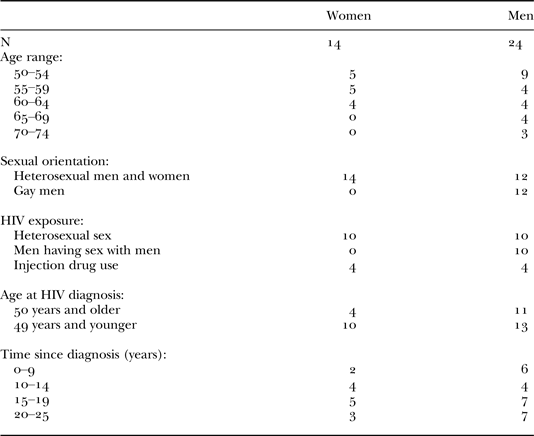
Respondents were recruited from a Montreal (Canada) medical clinic specialising in HIV/AIDS. Inclusion criteria were based upon being at least 50 years of age and living with HIV. Recruitment was terminated when data saturation was reached. The sample included 38 persons living with HIV between the ages of 50 and 73 (for a summary of demographic characteristics of participants, see Table 1). A little under two-thirds of participants were in their fifties and a little more than one-third were in their sixties and seventies. In order to reflect the diversity of older adults living with HIV, the sample was diversified according to a variety of criteria, including gender, sexual orientation, date of diagnosis and cause of infection. The sample included 12 men who have sex with men, 14 heterosexual womenFootnote 3 and 12 heterosexual men. Eight of the 38 participants were (ex) injection drug users.
Participant characteristics

With regard to the date of diagnosis, eight participants had been diagnosed less than ten years prior, when HIV acquired the status of chronic disease following the arrival of highly active antiretroviral therapy in 1996. The remaining 30 participants had been diagnosed 10–25 years prior to the study.
With regard to family status, 21 participants were parents, including 11 heterosexual men, eight women and two men who have sex with men. Nine were grandparents.
Data collection and ethical considerations
This research was based on in-depth, semi-structured individual interviews, each lasting an average of two and a half hours. Nearly all of the interviews were conducted in the research offices of the clinic where the participants were recruited (except for cases involving travel difficulties). The interviews were conducted by three team members, including the main researcher and two research assistants specialising in anthropology, sexology and social gerontology.
According to ethical guidelines,Footnote 4 participants were informed of the research objectives and asked to sign a consent form ahead of time to remind them of their right to not answer questions or to remove themselves from the project at any time. Procedures were also implemented to protect confidentiality and anonymity, both inside and outside the clinic. The interviews focused on subjective experiences surrounding HIV and ageing, along with their impact on the various aspects of personal and social life. The interviews concluded with a socio-demographic questionnaire. At the end of the interview, an honorarium of Can $40 was given to each participant to cover their travel and other expenses incurred as a result of participation in the study (meals, beverages, etc.).
Data analysis
Interviews were transcribed in full. The data analysis was based on the Grounded Theory approach (Strauss and Corbin Reference Strauss and Corbin1998), which relies on an ongoing process of comparison between the collected data and established codes and categories. This was facilitated by the use of QDA Miner software. The interviews were coded by the three team members who conducted the interviews. After reading the first interviews, the first list of categories and codes were determined according to recurring themes identified in the responses, along with themes contained in the interview guide and literature. By regularly reviewing the material associated with each code, codes were refined according to categories of analysis. This also helped generate consensus between the main researcher and the two research assistants with respect to the definition and assignment of each code. It also allowed for recoding, after discussions, in the event of disagreement.
The ‘intimate life’ category, which involved the participants’ relationships and sexual lives, was structured around two main sub-categories: ‘love life’ and ‘sexual life’. The ‘sexual life’ sub-category was further divided into several codes, including ‘condom use’, ‘sexual activity’, ‘desire’, ‘use of medication to improve sexuality’ and ‘sexual-life difficulties’. The ‘love life’ sub-category was subdivided into codes that include ‘stable relationship’, ‘being single’ and ‘love-life difficulties’. Connecting these categories helped us identify the links between the ‘intimate life’ category and other categories, like ‘HIV’, ‘ageing’, ‘stigma’, ‘health’, ‘appearance’ and ‘biographical course’.
The data analysis was shaped by our intersectionality theoretical framework. Special attention was given to the influence of social location on the intimate and sexual lives of older adults living with HIV. In accordance with the intracategorical approach of intersectionality, which emphasises the variations that can occur within a group located at a specific intersection, we compared the experiences of participants according to social locations (and their intersections) other than those of HIV and age (these included gender, sexual orientation, drug use, etc.).
Finally, and beyond the triangulation of researchers with regard to data gathering and the interpretation of data and triangulation of theories, different measures were used to validate the results (Creswell and Miller Reference Creswell and Miller2000), including verification by presenting the results to both older adults living with HIV and stakeholders working with this population during meetings held by community organisations.
Results
The data analysis highlights the impact of HIV and ageing on the intimate and sexual lives of participants, along with the specificities that emerge from gender, sexual orientation and, occasionally, the participants’ other social locations and experiences (such as date of HIV diagnosis, drug use, etc.). After a brief description of the conjugal and sexual situations of participants, we will present the various challenges associated with their intimate lives, as revealed by an analysis of their responses.
Conjugal and sexual situation
Only one-third of participants were involved in an intimate relationship, whether or not they lived with their partner. The remaining two-thirds were not involved in a serious relationship and were therefore considered single at the time of the study. Women were included in both groups, heterosexual men interviewed were primarily involved in stable and intimate relationships, and most gay men did not have a stable and intimate partner. It should be noted that responses from women and men revealed differences regarding how both genders experienced being single. Women participants seemed to have chosen or accepted their situation, while men participants stated more often that they did not choose to be single and experienced this status as a time of great difficulty. The fact that older women in our study reported positive experiences of living alone and being single in old age is accounted for in the general ageing literature on gendered perspectives on intimate relationships. Interpreted as a generational cohort effect, this literature suggests that the current generation of older women, brought up in a time of more rigid gender roles in the context of family life, often express an appreciation for new-found independence and autonomy gained in old age. For example, the literature suggests that the experience of widowhood or children moving out of the home can engender feelings of relief among women as they no longer have to take care of or perform domestic duties for others (Davidson Reference Davidson2001; De Jong Gierveld Reference De Jong Gierveld2004; Karlsson and Borell Reference Karlsson and Borell2002; Malta and Farquharson Reference Malta and Farquharson2014).
The three main sexual situations identified in this study included (a) active sexual lives, (b) sexual lives with little or reduced activity, and (c) the absence of a sexual life. It should be noted that this classification rested primarily on sexual activities conducted with a partner. No questions involving autoerotic activities were included in the study. With regard to the first situation, only five participants stated that they had an active sexual life without any noticeable reduction in sexual activity over the past years, although this did not prevent certain HIV and/or age-related sexual difficulties from surfacing. The other participants were divided almost equally between those with little or reduced sexual activity, mainly including heterosexual and gay men, and those who reported a total stoppage in sexual activity during the past several years, which mainly related to the experiences of women. From a lifecourse perspective, this may be interpreted as a generational cohort effect. Some literature has suggested that the current cohort of older women accord less importance to the maintenance of sexual activity as they age when compared to men (Fisher Reference Fisher2010; Gott and Hinchliff Reference Gott, Hinchliff, Arber, Davidson and Ginn2003; Schwartz, Diefendorf and McGlynn-Wright Reference Schwartz, Diefendorf, McGlynn-Wright, Tolman and Diamond2014). This viewpoint reflects previous social mores regarding sexuality and desire in which men were viewed as active agents and women as passive and uninterested in sexual activity, particularly upon ageing. These variations in attitudes regarding sexual activity among men and women are, however, diminishing. There are, without a doubt, differences in socialisation processes regarding sexuality among men and women which, although apparent amongst those 75 years of age and over to a greater extent, are changing among more recent cohorts (Bajos and Bozon Reference Bajos and Bozon2012).
Ageing, physiological changes and diminished sexual desire
Many participants identified ageing as the primary cause of their reduction in desire or interest in sexual activity. In some cases, the decline was attributed to ageing itself. One heterosexual participant stated:
At my age, I don't think about sex anymore. [How come?] Ah, I'm getting on in years, it's been a long time… (laughs). At some point you have to stop. (HM59Footnote 5)
Similarly, one gay participant said:
The urge is completely gone. At 70, sexual urges are gone, or almost gone. My god! Ouch! In my forties and fifties, let me tell you … It's all I could think about. Not anymore. (MSM71)
A few female participants also talked about a drop in sexual interest. Many among them mentioned an evolution in their sexual practices, which had become increasingly focused on intimacy rather than genital stimulation, as illustrated by this quote:
I think that as we get older, our taste for sex diminishes. It's less physical, I don't know, it's something else. It's more about tenderness, affection. (W62)
Here as well, the gendered historical and social context may play a part in helping to explain this experience. According to the literature (Hughes Reference Hughes2011; Lodge and Umberson Reference Lodge and Umberson2012; Sandberg Reference Sandberg2011, Reference Sandberg2013), older men's appreciation and desire for intimacy and affection in their relationships increases as they age.
Other female participants were more specific in attributing their drop in sexual desire to the physiological changes associated with menopause. For example, one participant explained her decrease in sexual desire by the arrival of menopause after a long pre-menopausal period:
[Menopause] comes and goes. But now, if you ask me, it's here for good. I get a lot of hot flashes, and I have no interest in sex anymore! I'm no longer interested. Nothing. Nothing at all… (W-IDU51)
The decrease in desire associated with menopause was exacerbated by the negative effects of pain brought on by vaginal dryness during penetration-based sexual relations.
It becomes very dry … It's like tearing your skin. You feel like it's going to open! … So yes, it certainly cuts into the desire. I also feel like my libido is dead. (W56)
Overall, these responses highlight the effects of ageing on desire in older adults living with HIV and the gendered variations that exist within this population.
Erectile changes and diminished sexual activity
Several participants reported experiencing erectile difficulties (i.e. problems having or maintaining an erection or changes in the intensity of erections), which was generally attributed to ageing. These difficulties produced a variety of effects related to both self-concept and the impact on their sexual lives. One participant implied that these changes were particularly difficult to accept:
I would say that the erectile function is probably the biggest source of panic in your fifties … These days, I get urges but I ask myself: Will I be able to? Or it happens differently. The orgasm comes but the erection was only partial. Or it happens very quickly and it's disappointing. (MSM53)
In contrast, certain participants appeared to have accepted these changes, which they interpreted as a normal consequence of ageing. They remedied the situation with medication that promotes erection. For example, one participant stated:
In terms of erections, I tell myself: ‘It's old age.’ Then, like a lot of men in their fifties, I guess, there must be a lot of them that take Viagra, so I take Viagra. (MSM56)
Another participant stated
I'm absolutely certain that it's caused by ageing. Because, normally, most are like that after 50 … I think it's normal. There's no problem. Because we found a way to fix the problem. Whenever I want relations, I take [medication that promotes erection], and everything works like it used to. (HM51)
It is also worth noting that some participants expressed reticence towards this medication. One participant explained:
It's not as easy, and on some level, I know that I can compensate artificially but that's not how I want to fix my problems. (MSM53)
Another man, aged 71, expressed even greater scepticism towards these products:
I have friends who are younger than me, and they've started taking that famous pill, the blue one. I want none of that. I don't want it! I'd rather not have any sexual relations at all. (MSM71)
From a lifecourse perspective, consideration of the relationship between the reticence of this 71-year-old man to use medication and his generational cohort position is warranted. In comparing himself to friends in their fifties, he pointed to a generational difference in attitudes regarding the use of medication to enhance performance. Indeed, these types of medications emerged in the market in the 1990s and, along with the medications, surfaced rhetoric reinforcing the idea that maintaining masculinity in old age was directly tied to performance (Marshall Reference Marshall2006; Marshall and Katz Reference Marshall and Katz2002). Those that aged prior to the ‘era of erectile medications’ may not have been as exposed to the pervasive rhetoric of performance and so may be less receptive to the idea of maintaining sexual performance and the cult of youth as a necessary component of intimacy in old age.
These quotes highlight the complexity and diversity of the experiences surrounding erectile changes that may or may not, according to participants, constitute an obstacle in their sexual lives.
Difficulties relating to condom use
The willingness to use a condom during sexual relations to prevent HIV transmission between partners seemed to create difficulties and hinder the continuance of sexual activities for several male and female heterosexual participants. These participants reported several obstacles, both physical and social in nature, that may have interfered with condom use, most of which related to issues of ageing.
One of the first challenges mentioned by participants involved difficulties associated with condom use during sexual relations due to age-related erectile changes in the male participants, or in the partners of female participants. In certain cases, participants described difficulties maintaining an erection when using condoms which were related to loss of sensation or problems with putting on the condom. Although this was understood as a general concern among men regardless of age, in certain cases, these difficulties were considered amplified by erectile difficulties occurring as a result of ageing. Referring to her spouse, one female participant stated:
I think he does, in fact, have a problem with condoms, but he has erection problems because of his age. (W59)
Beyond the effects of physical ageing, however, some responses indicated that erectile difficulties hindering condom use may have been caused by older men's lack of familiarity with this method of protection. According to another female participant:
We made love for the first time with a condom, and this is somebody who has never used a condom. He's been in a relationship with someone for 18 years, so he doesn't use it … Now he loses his erection every time he uses a condom. (W59)
Finally, a few female participants reported greater resistance towards condom use from ageing men than from younger ones. One stated:
I noticed that older men were the ones who refused … I always want them to wear a condom and, in fact, it has happened that men who were 50 or older did not want to… (W62)
HIV stigma
An analysis of participant responses revealed that HIV-related stigma represented a major obstacle in their intimate and sexual lives. It would appear to explain most experiences of single status, along with the low rate of sexual activity and high rate of abstinence experienced by several participants. HIV-related stigma primarily took two forms: real, which directly caused rejection, and internalised, in which older adults living with HIV anticipate or fear rejection, which causes them to renounce all intimate relations. While stigma was more often described by heterosexual participants, including both men and women, HIV-related stigma was also found to interfere with the intimate lives of several men who have sex with men who participated in the study.
Several participants reported rejection from their intimate partner after disclosing their HIV status. This discrimination most often occurred after meeting a new sexual partner, as stated by one heterosexual participant:
I have sexual relations once in a while but it's always protected. If I go out three or four times with a woman, after three or four times: ‘Why do we always use a condom?’ Then I explain it to her, and it's ‘Bye!’ (HM65)
Although less frequently reported by participants, HIV-related stigma also constituted an obstacle for new intimate relations among the population of men who have sex with men:
These days, sometimes, I'll meet somebody. Even if I tell him: ‘I'm positive’, suddenly, oops, he's gone. So now, I'm not really looking for a normal relationship. (MSM65)
Rejection can also occur after HIV disclosure in a long-term relationship, although this situation was less widely reported by our participants. One heterosexual participant reported having been left by his partner of several months after disclosing his seropositivityFootnote 6:
I didn't tell her right away, only when it started getting serious, because I wanted her to know me and judge me as an individual. But when she found out, she went to see her doctor, then she paid a visit to her daughter, and when she came back, it was over. (HM65)
Alongside external stigma, some participants, especially women, experienced constraints in their intimate lives due to an internalised HIV-related stigma characterised by a fear of rejection. Several female participants preferred to renounce all sexual and intimate relations rather than risk HIV-related discrimination. HIV disclosure seemed particularly difficult for these women and limited their ability to start new intimate relationships with men. According to these participants:
Saying I have it, then being rejected, then hearing: ‘I'm not interested’ and ‘Yuk, I don't want AIDS!’ I don't want to go through that. (W51)
Sometimes I meet an interesting man but I stop myself quickly. I try to end it quickly because HIV is hard to disclose. (W50)
Finally, certain participants, particularly men, discussed situations in which they chose to remain with their current spouse, despite conjugal dissatisfaction, due to their fear of not finding a new intimate partner that would accept their HIV status. For example, this heterosexual male participant remained with a partner despite his lack of amorous feelings or desire. He stated:
If I didn't have HIV, to be honest, I wouldn't be with her … I don't get very excited with her on a personal or intimate level. We own an apartment together, she has two kids, grandkids. We spend time with them, which is fine, but emotionally she's not the spouse I would have liked to have had. (HM65)
It is important to consider these previous quotes from a lifecourse perspective as, by doing so, a deeper understanding of the impact of gender socialisation among older adults is possible. For this cohort of older adults, gender socialisation processes of an earlier era may play a part in both older women's decision to renounce sexual activity and intimate relationships, and older men's decisions to stay in relationships despite sexual dissatisfaction. For example, as stated previously, older women may have been socialised to expect reduced opportunities for sexual activity (disconnected to procreation) as they age. This coupled with an appreciation for living alone and being single in old age as an expression of independence and autonomy may play a part in explaining decisions to renounce intimate and sexual relationships with little stress among women (Davidson Reference Davidson2001; De Jong Gierveld Reference De Jong Gierveld2004; Watson, Bell and Stelle Reference Watson, Bell and Stelle2010). For men, studies have suggested that heterosexual older men tend to prefer living in a couple relationship. This could be attributed to reticence to manage domestic tasks (Karlsson and Borell Reference Karlsson and Borell2002) and the reality that older heterosexual men within this generational cohort rely more heavily (or solely) on spouses for social connection (Russel Reference Russel2007).
Ageism
Age-related stigma was mentioned by several participants, particularly men who have sex with men, as a hindrance to their intimate and sexual lives. In fact, several respondents mentioned experiences of ageist discrimination in seeking new partnerships. These situations were reported by several men over 65, who stated difficulties in finding intimate or sexual partners due to their age:
I'd like to have someone in my life. But when you're 65, the people who approach you are often 45–50 years old. When you tell them you're 65, ‘Ah, you look young for your age.’ But you never see them again. (MSM65)
Another participant stated that he's now forced to pay his partners for sexual relations:
I pay them 20 dollars, 40 dollars. Nobody wants to sleep with you for your good looks! (MSM71)
It should be noted that younger gay participants in their fifties also experienced difficulties in finding partners due to ageist attitudes, as shown in this quote:
At a certain age, it was easier to meet people. People came to me more often, they came toward me, but now that I'm over 50 … The looks I get from the gay population does not have the same connotation, obviously, as it did when I was 30 or 40 years old… (MSM55)
Another manifestation of ageism in intimacy, expressed by the sample of men who have sex with men who participated in the study, was related to a preference for seeking out younger partners. This preference can lead to two types of negative repercussions. On one hand, older men who have sex with men risk being discriminated against by younger men, as one participant experienced while looking for a partner online:
I already approached some people, then I got rejected. I was told: ‘What is it that you want? You're old!’ (MSM56)
Another problem that arises from valuing younger partners over older ones involves the difficulty of men over 50 finding partners their own age. According to one interview excerpt:
What I would like, for sure, would be to meet a guy my age but … People my age, most of them prefer to go to bed with younger guys. (MSM55)
Finally, several participants attributed their difficulty in finding partners to a combination of both age and HIV-related stigma, with the interaction of both amplifying these difficulties.
There's the rejection side of it as well, one that I feel, or would feel. Now, it's like I feel limited in having a long-term relationship with someone, developing a long-term relationship. It's like there's a blockage there … HIV is a very large obstacle … There's also rejection, which means that the older you get, the more often you get rejected. (MSM56)
For one female participant, the internalised HIV-related stigma was reinforced by the impression that her age restricted her ability to find an intimate partner, which indicated a form of internalised ageism:
I know that at my age, the opportunities to meet someone are not as frequent as they were when I was young … And meeting someone who would turn around and leave because I have HIV would sadden me, for sure. I would tell myself: ‘My god, at my age, I'm running out of opportunities.’ (W59)
Physical changes related to ageing and/or HIV
Physical transformations, whether related to physical ageing or to the effects of anti-HIV medication, led to other difficulties in the intimate lives of participants. In most cases, the negative repercussions of physical changes on the participant's intimate and sexual life involved the phenomena of ageing and HIV, as mentioned above, whether these phenomena represented a source of rejection by others or an internalised source of self-rejection.
Several men who have sex with men mentioned the loss of their ‘power of seduction’ and the invisibility triggered by their ageing physical appearance, which considerably reduced their ability to find new partners. Consequently, the possibility of finding new partners declined due to other men's negative perspectives of their bodies:
Of course, when we get older we're less attractive to a lot of people. When you walk down the street, you know, at a certain age people come on to you. But when you're older, when you reach 50 … Ok, I cheated a little. I dyed my beard a little. But they don't look as much. (MSM50)
This exclusion due to physical ageing appeared to start before 50:
I used to be a good-looking boy. And let me tell you, the most painful part of ageing was to see my power of seduction chipping away slowly. But that starts long before 50. (MSM53)
For some of the men who have sex with men who participated in the study, the loss of ‘seductive power’ was due to intersections of physical ageing and a loss of attractiveness due to physical changes associated with the effects of antiretroviral medication. For example, thinning cheeks, which can be interpreted by other gay men as a sign of seropositivity, was mentioned by participants. One participant stated:
There's a lot of cruising going on in that shopping centre. But it's like there's a discrimination there too with regard to age, the greying. But there's also the fact of having sunken cheeks, it's like they can tell! It's like … I don't know, maybe I'm deluding myself. In any case, I feel judged. (MSM50)
While less frequently reported, changes in appearance caused by ageing or HIV also had negative repercussions on the intimate lives of some female participants, as previously discussed. In these cases, however, the shame they felt with regard to their own transformed bodies created a new obstacle to their intimate lives. A woman having undergone a severe loss in muscle mass due to the undesirable effects of anti-HIV medication explained how, years ago, she broke up with her spouse for this very reason, and how she was still ashamed to show her body to a man:
I'm no longer with my former spouse because of that … At some point, I lost my muscle mass, no more buttocks, flat, to the bone. I couldn't accept being like that … After that, I started denigrating myself in front of my husband, saying: ‘No, you're better off … You're still young, you're younger than me. You can find someone else…’ So I pushed him away … And it's not just that, I could feel it in him too. When we made love, he didn't look at me. He no longer told me: ‘You're beautiful’ … [Today] I don't even want to try to find a partner. A lover, I mean. I'm not presentable, that's how I see myself now. (W51)
Another participant recognised her lack of desire for an intimate partner due to the shame she felt in showing her body after gaining weight, which she attributed to ageing:
I don't like it. I'm not proud of my body. That's just a fact. [Did this change occur over time? Were you ever proud of your body?] I had a nice body (participant laughs) I had a nice body, yes! [But why aren't you proud of your body today?] Because I'm fat and I have bulges. (Silence) [And you're ashamed of that?] Yes. Very much. I don't think I want a partner because of that. I'm ashamed of my body. (W-IDU59)
The impact of lifecourse events on current intimate situations
An analysis of lifecourse experiences also highlighted the influence of the past on the current intimate lives of participants. This may have involved the long-term effects of living with HIV during the first years of the epidemic, or the effects of past activities on sexual trajectories, as was evident among former female injection drug users and former sex workers interviewed in this study.
Responses from former injection drug users highlighted the impact of past sexual experiences on their current situation. Both women we interviewed who had used injection drugs over a period of many years described having worked in the sex trade to pay for their injection drug use. In both cases, the participants discussed a loss in sexual desire, which they attributed to years of sex work. In discussing her relationship with a spouse, one participant stated:
We don't have sex anymore. I've lost my libido … Look, I think I've had enough for 100 years! (W-IDU61)
The second participant mentioned problems associated with her current intimate partner's negative reactions towards her lack of desire, which compelled her to have sex out of obligation.
Sex doesn't interest me anymore. Sometimes, my companion, he gets on my nerves … I told him: ‘OK, I want my celibacy.’ But the other guy, he's old and 65 and he likes it. It's a conflict … It's like I don't have a choice, because I live with him. We sleep in the same bed. (W-IDU51)
This perspective reflects the reality that older women may continue to engage in sexual relations to please their partner, putting their own needs aside for the sake of the relationship.
Parallel to this situation, which is linked to the intersection of specific social locations, several participants who were diagnosed over ten years ago, when antiretroviral treatments were just being introduced on the market, highlighted the impact of their first years with HIV on their intimate lives. This indelible mark of perception and experience with HIV/AIDS at a time when the infection meant a quick death can be seen in the themes they discussed: the abandoning of all sexual relations due to a fear of transmitting HIV and the long-term effects of losing a partner to AIDS.
Several participants shared their reticence to commit to a new intimate relationship since losing their spouse to AIDS, even if the death occurred many years ago. This was especially true for those who accompanied their spouse throughout their disease and final stages of their life. One female participant explained how she renounced any intimate or sexual life after the death of her spouse, 19 years ago, when she was still in her thirties:
I didn't want to be in a couple anymore. That part of my life is behind me. When you experience the death of a loved one like that, it's a part of your own life that goes away. (W53)
According to some of these participants, one reason to avoid an intimate relationship involved the fear of new suffering, along with the fear of causing suffering in others, in the event one of the partners were to die. This preoccupation appeared in a statement by one gay participant:
I'm not ready to get involved with someone. I'm afraid of getting attached to somebody and re-experience what I went through. On the other hand, I don't want to put anyone else through it either. (MSM52)
The fear of transmitting HIV created an obstacle to the intimate lives of participants who were diagnosed in the past and lived through the first years of the HIV/AIDS epidemic, which represents a significant and unique lifecourse impact. Several participants reported making the decision to become abstinent, in some cases as soon as they were diagnosed. It should be noted that choosing abstinence from a fear of transmitting HIV was primarily reported by heterosexual men and women. For most of these participants, the decision to renounce all sexual relations stemmed from a desire to protect partners and to avoid putting them through what they themselves experienced. One heterosexual man stated:
I don't feel like having a sex life. It's always at the peril of the other. (HM53)
One woman stated:
Me, I never had relations after that. I was too scared of passing the disease on to the other. So I told myself: ‘I have myself. That's enough.’ (W60)
Discussion
Our research confirms the few studies that highlight the many obstacles to maintaining an intimate and sexual life among older adults living with HIV. Our data also shed light on the role of multiple social locations at the intersection of HIV and ageing, alongside the influence of both age and lifecourse-related transitions, in shaping the difficulties faced by this population in the context of intimacy and sexuality.
As discussed in other studies involving both young and older adults living with HIV (Keegan, Lambert and Petrak Reference Keegan, Lambert and Petrak2005; Psaros et al. Reference Psaros, Barinas, Robbins, Bedoya, Safren and Park2012; Schiltz et al. Reference Schiltz, Bouhnik, Préau and Spire2006; Siegel and Schrimshaw Reference Siegel and Schrimshaw2003), the stigma associated with HIV and seropositivity disclosure surfaced as a significant challenge for our participants, whether this stigma involved the fear of rejection, the actual rejection experienced after disclosing seropositivity or the difficulty of disclosing one's HIV status in an intimate context. Our study adds the identification of ageism as a central form of stigma experienced by older adults living with HIV, which can interact with HIV-related stigma. Several men who have sex with men who participated in the study discussed age-related discrimination as a primary source of difficulty when seeking a new intimate partner. Their responses also revealed that such age-related exclusion often begins earlier in life, prior to their fifties. These statements support research observations involving the gay community as a whole that highlight an idealisation of youth and a devaluing of ageing among gay men in particular (Brotman, Ryan and Cormier Reference Brotman, Ryan and Cormier2003; Heaphy Reference Heaphy2009; Schope Reference Schope2005). Our results also reveal that ageism can have negative repercussions on the intimate lives of women, supporting previous work highlighting gendered inequalities in the perception of ageing, with women being subject to a double standard when compared to heterosexual men. The interaction of sexism and ageism, as experienced by the general population of older women, can partly explain their withdrawal from sexual activity along with their difficulty in finding partners as they grow older (Allen and Roberto Reference Allen and Roberto2009; Calasanti and Slevin Reference Calasanti and Slevin2001; Lagrave Reference Lagrave2009; Vares Reference Vares2009). For older women living with HIV, both forms of oppression can interact with HIV-related stigma, further reducing the possibility of engaging in satisfying intimate relations.
The interaction between HIV and age-related stigma also surfaced in the negative impact of physical changes on the participants’ ability to maintain intimate lives. Our results corroborate those of previous qualitative research, which revealed that the physical transformations associated with HIV occasionally lead to withdrawal from one's intimate partnerships and sexual lives (Psaros et al. Reference Psaros, Barinas, Robbins, Bedoya, Safren and Park2012; Siegel and Schrimshaw Reference Siegel and Schrimshaw2003). However, our study demonstrates that the physical changes associated with ageing play an almost equal role to the effects of antiretroviral medication on the difficulties experienced by participants, both of which may act simultaneously. Participants who identified as men who have sex with men stated the experience of physical ageing was central to their difficulties in meeting new partners, due to negative and ageist perceptions of other men with regard to their ageing bodies (Herdt and de Vries Reference Herdt and de Vries2004; Schope Reference Schope2005), while the lipodystrophy associated with seropositivity may have created an additional obstacle (Smit et al. Reference Smit, Brady, Carter, Fernandes, Lamore, Meulbroek, Ohayon, Platteau, Rehberg, Rockstroh and Thompson2012). Among women, withdrawal from sexual practices and relationships appeared to be rooted in negative perceptions by their partners, or of themselves, with regard to their transformed bodies, whether such transformations were linked to HIV or ageing. In such cases, the difficulties experienced in their intimate lives related to physical changes appeared less rooted in HIV-related stigma than in the sexism and pressure to preserve a body that corresponds to ideals of beauty, which persists with ageing due to double standards associated with the intersection of ageism and sexism (Clarke and Korotchenko Reference Clarke and Korotchenko2011; Furman Reference Furman1997; McCormick Reference McCormick2008; Sontag Reference Sontag1972; Wallach Reference Wallach2013).
Parallel to the obstacles that relate to the intersection of various forms of oppression, our research highlights the impact of age-related transitions on the intimate lives of participants, which can interact with HIV-related obstacles. As in other studies involving young and older adults living with HIV (Keegan, Lambert and Petrak Reference Keegan, Lambert and Petrak2005; Schiltz et al. Reference Schiltz, Bouhnik, Préau and Spire2006; Siegel and Schrimshaw Reference Siegel and Schrimshaw2003), a decrease in desire was commonly mentioned by participants when explaining their decrease in sexual activity. While other studies identified HIV as the primary root of this decrease in desire, our study primarily associated it with ageing. In fact, several participants traced their decrease in sexual desire to the process of ageing or to the physiological changes associated with ageing. This reality echoes previous research on the role of menopause in explaining the loss of sexual desire among women (Grodensky et al. Reference Grodensky, Golin, Jones, Mamo, Dennis, Abernethy and Patterson2015; Taylor et al. Reference Taylor, Munoz-Plaza, Goparaju, Matrinez, Holman, Minkoff, Karpiak, Gandhi, Cohen, Golub, Levine, Adedimeji, Gonsalves, Bryan, Connors, Schechter and Wilson2016).
These results support many studies on the changes related to sexuality experienced by older people, which associate a decrease in desire to physiological changes such as menopause. However, the physiological explanation for loss of desire must be interpreted with caution as it may also reflect the internalisation of ageist attitudes by older people themselves (Gott Reference Gott2005; Walz Reference Walz2002; Weeks Reference Weeks2002). Changes in sexual expression with age, including the shift from a singular focus on genital stimulation to one which is based more predominantly on affection, represents a phenomenon that has been widely described in the literature on the sexuality of older people generally, and older women specifically (DeLamater and Koepsel Reference DeLamater and Koepsel2015; Fisher Reference Fisher2010; Lindau et al. Reference Lindau, Schumm, Laumann, Levinson, O'Muircheartaigh and Waite2007; Ménard et al. Reference Ménard, Kleinplatz, Rosen, Lawless, Paradis, Campbell and Huber2015).
According to participants, age-related erectile changes constituted another barrier in their sexual lives, which is in keeping with results from other studies noting the significant prevalence of erectile problems in older men living with HIV, as compared to younger ones (Asboe et al. Reference Asboe, Catalan, Mandalia, Dedes, Florence, Schrooten, Noestlinger and Colebunders2007; Nokes et al. Reference Nokes, Nicholas, Rivero, Rosa, Kirksey, Moezzi, Corless, Maryland, Willard, Robinson, Hamilton, Sefcik, Wantland, Holzemer and Portillo2011). Our results also highlight a variability in the reactions of participants with regard to erectile problems, which often vary between acceptance and negative experiences. As in the general population of older men, the perception of both erectile problems and the medication used to correct them will determine whether or not such problems represent an obstacle in maintaining sexual activity for older men living with HIV (Loe Reference Loe2004; Potts et al. Reference Potts, Grace, Vares and Gavey2006; Sandberg Reference Sandberg2011; Wentzell and Salmerón Reference Wentzell and Salmerón2009). It should also be noted that erectile changes constitute an even greater challenge for older men living with HIV, insofar as they often feel constrained to use condoms to avoid transmitting HIV to their partner.
Beyond the effects brought on by changes linked to ageing, our study highlights the role of the lifecourse in shaping difficulties they face in their intimate lives, whether this involves belonging to a specific cohort, or the disadvantages accumulated over their individual intimate trajectories.
Our results regarding the difficulty of using condoms among heterosexual male participants, and those of women who requested condom use from their similarly aged partners, confirm studies involving the low rate of condom use within the older heterosexual population. Beyond the psychological reasons stated previously, this low rate of use stems from social causes and could be attributed to a generational phenomenon. Studies on the older seronegative population have highlighted the misconceptions of older people with regard to HIV, and their belief that they are not at the risk of infection (Gott Reference Gott2005; Maes and Louis Reference Maes and Louis2003; Minichiello, Hawkes and Pitts Reference Minichiello, Hawkes and Pitts2011). While the low rate of condom use can be linked to practical difficulties associated with a lack of familiarity and reticence, it can also be linked to a cohort effect, particularly for those who began their adult lives during the sexual revolution of the 1960s and 1970s in North America, before the appearance of HIV/AIDS (Prati, Mazzoni and Zani Reference Prati, Mazzoni and Zani2014). Among this group, little attention was placed on either safe-sex practices or the impact of HIV at a time period when their sexual identity and expression was being formed. With little connection to the reality of HIV/AIDS, and having spent a large segment of their lives with the same partner, they re-enter the ‘sexual market’ in their fifties and sixties unaware of the risks associated with HIV (Minichiello, Hawkes and Pitts Reference Minichiello, Hawkes and Pitts2011). In addition, the difficulties experienced by older women when negotiating condom use with their partner can also be linked to prevailing gender norms, which are less egalitarian among older generations (Neundorfer et al. Reference Neundorfer, Harris, Britton and Lynch2005; Zablotsky and Kennedy Reference Zablotsky and Kennedy2003).
The impact of belonging to a specific generational cohort on one's current intimate life can also surface in the tendency of those who were diagnosed at the start of the HIV/AIDS epidemic to prefer abstinence from all sexual relations due to the fear of infecting their partners. This fear of transmitting HIV as a determining factor when renouncing sexuality is supported by previous research (Siegel and Schrimshaw Reference Siegel and Schrimshaw2003). If this tendency was more noticeable in heterosexual male and female participants than in men who have sex with men, as was indicated in the current study, it is because of the reality that men who have sex with men are historically considered as a ‘high-risk’ HIV transmission group and therefore have been the targets of educational campaigns and outreach – a reality that may have, over time, resulted in the trivialisation of HIV status within the gay community (Brener et al. Reference Brener, Wilson, Slavin and de Wit2013; Brennan and Karpiak Reference Brennan, Karpiak, Brennan, Karpiak, Shippy and Cantor2009). This ‘normalisation’ of HIV may contribute to a reduction in HIV stigma within the gay community which is uncommon among heterosexual populations, a point which was reflected in our findings.
In closing, an analysis of the responses of several participants highlights the long-term effects of past experiences on current intimacy, which could be analysed in terms of accumulated disadvantages. The situation faced by ex-injection drug users and former sex workers is illustrative of this reality. Having been constrained by client-based sexual relations throughout their adult lives due to consumption and economic needs, they are currently experiencing a lack of sexual desire that is linked to the past. Furthermore, the situation of participants who renounced all intimate relations after experiencing the death of their partner due to AIDS in the early years of the epidemic can be seen as another example of disadvantages accumulated during one's intimate trajectory, which then reappear in one's current intimate situation. Once again, it is interesting to note the significant gender differences between women and men who have sex with men; while the latter's experience in losing a partner created difficulties in forming new and stable relationships, this absence of emotional involvement did not appear to hinder their sexual lives. Inversely, the female participants’ inability to disassociate love and sexual relations highlights their internalisation of traditional sexual gender roles, as observed in other ageing female populations (Bajos and Bozon Reference Bajos and Bozon2012; Gott and Hinchliff Reference Gott, Hinchliff, Arber, Davidson and Ginn2003).
In conclusion, older adults living with HIV are a population that is very likely to face obstacles in relation to intimacy and sexuality. While similar to those of younger adults living with HIV in some ways, their unique experiences are shaped by ageing, whether the cause involves their increasing age or the effects of their lifecourse on the ageing process. Among other factors, their difficulties appear to be related to the intersection of social location, HIV status and ageing. We suggest that further research should build upon the notion of intersectionality in order to enhance our understanding of the intimacy and sexuality of older adults living with HIV in such a way as to pay attention to the full diversity of their lives and experiences across the lifecourse.
Acknowledgements
This project was supported through a research grant from the Quebec Ministry of Families and Seniors (programme: Soutien aux initiatives visant le respect des aînés (SIRA)). The authors would like to thank Xuân Ducandas and Michel Martel for their assistance with data collection and analysis, Dr Réjean Thomas and Dr Benoît Trottier of the Clinique médicale l'Actuel for their support on participant recruitment, and all of the people who participated for their trust and availability.