During the middle childhood years, emotional adjustment difficulties can interfere with children's development and portend lifelong struggles with mental health (Dunn & Goodyer, Reference Dunn and Goodyer2006; Kasen, Cohen, Skodol, Johnson, & Brook, Reference Kasen, Cohen, Skodol, Johnson and Brook1999). Depressive symptoms, in particular, may affect the accomplishment of important developmental tasks (e.g., succeeding in school, building healthy relationships with peers) via their associations with chronic physical distress (Pinquart & Shen, Reference Pinquart and Shen2011) and other psychological and behavioral difficulties (e.g., anxiety, attention-deficit/hyperactivity disorder, conduct problems; Garber & Rao, Reference Garber, Rao, Lewis and Ruldolph2014). Depressive symptoms in middle childhood also predict increased risk for adulthood psychiatric disorders (Kasen et al., Reference Kasen, Cohen, Skodol, Johnson and Brook1999), including depression (Dunn & Goodyer, Reference Dunn and Goodyer2006; Rutter, Kim-Cohen, & Maughan, Reference Rutter, Kim-Cohen and Maughan2006).
The estimated rate of clinical depression in middle childhood is 2.8% (Garber & Rao, Reference Garber, Rao, Lewis and Ruldolph2014); however, significant numbers of children experience depressive symptoms in the middle childhood years: around 10% of children in middle childhood reported being sad and depressed (Angold & Costello, Reference Angold, Costello and Goodyer2001). Compared with the large amount of research on depressive symptoms in adolescence and emerging adulthood, however, depressive symptoms in middle childhood have received less attention. Uncovering the antecedents of depressive symptoms in middle childhood is critical to intervention efforts to preserve and enhance children's mental health.
According to theory and research, high-quality parent-child relationships are key to children's emotional adjustment (DeKlyen & Greenberg, Reference DeKlyen, Greenberg, Cassidy and Shaver2016; Groh, Roisman, van IJzendoorn, Bakermans-Kranenburg, & Fearon, Reference Groh, Roisman, van IJzendoorn, Bakermans-Kranenburg and Fearon2012). In fact, a vast body of literature has documented links between parent-child relationships and child depressive symptoms and related outcomes (DeLay, Hafen, Cunha, Weber, & Laursen, Reference DeLay, Hafen, Cunha, Weber and Laursen2013; Hazel, Oppenheimer, Technow, Young, & Hankin, Reference Hazel, Oppenheimer, Technow, Young and Hankin2014). Middle childhood is underrepresented, however, in the literature on the roles of parent-child relationships in children's mental health. During this period, parent-child relationships continue to play a significant role in children's development, even as children begin to spend more time with peers and less time with family members (Kobak, Rosenthal, & Serwick, Reference Kobak, Rosenthal, Serwik, Kerns and Richardson2005). Moreover, little of this work has approached the development of children's adjustment problems from a family systems perspective, even though this perspective has much to offer to understanding the development of psychopathology, including the consideration of parent and child gender (Palkovitz, Trask, & Adamsons, Reference Palkovitz, Trask and Adamsons2014).
The purpose of this study was to use a family systems perspective to examine the trajectories of parent-child relationship closeness and conflict and their associations with child depressive symptoms across middle childhood. This study made several important advances over past work, including examining the role of father-child relationships together with mother-child relationships, assessing both closeness and conflict in parent-child relationships, and using a longitudinal design with multiple informants.
Depressive symptoms in middle childhood
One reason that depressive symptoms in middle childhood have received less research attention may be the assumption that middle childhood is a less vulnerable (or “calm”) period between two periods with rapid and dramatic physical and social cognitive growth: early childhood and adolescence. Important developmental changes do take place in middle childhood, however, and may explain the risk for depressive symptoms in this period.
In middle childhood, children often have the first encounter with, and become increasingly exposed to, hormone fluctuations (Richardson, Reference Richardson, Kerns and Richardson2005), anxiety-eliciting social evaluation, and social comparison in the school context (Skinner & Welborn, Reference Skinner, Wellborn, Wolchik and Sandler1997). Twenge and Nolen-Hoeksema (Reference Twenge and Nolen-Hoeksema2002) conducted a meta-analysis with 310 studies that used the Children's Depression Inventory (CDI; Kovacs, Reference Kovacs1992), one of the most frequently used tools to measure child depressive symptoms in community samples. They found that among the 61,424 children aged between 8 and 16 years, boys rated themselves as more depressed at age 12 than at any other age. Girls’ CDI scores also increased at 12 years old (Twenge & Nolen-Hoeksema, Reference Twenge and Nolen-Hoeksema2002).
Parent-child relationships and child adjustment in middle childhood
According to attachment theory, high-quality parent-child relationships enhance the development of children's mental health (Bowlby, Reference Bowlby1982). On the other hand, low-quality parent-child relationships can shape the emergence of developmental psychopathology through the formation of cognitive and emotional expectancies (DeKlyen & Greenberg, Reference DeKlyen, Greenberg, Cassidy and Shaver2016). Children may internalize their positive or negative relationships with parents and caregivers into “internal working models” that frame children's expectations toward self and others. Children with lower parent-child relationship quality may hold negative beliefs or “maladaptive schemas” (Roelofs, Lee, Ruijten, & Lobbestael, Reference Roelofs, Lee, Ruijten and Lobbestael2011) that position them at higher risk of experiencing depressive symptoms.
Although children's internal working models show consistency across development, the quality of parent-child relationships over time continues to matter for children's mental health (Vaughn et al., Reference Vaughn, Waters, Steele, Roisman, Bost, Truitt and Booth-Laforce2016). Children who have better relationships with their parents may have fewer depressive symptoms because they can obtain greater support from parents when facing emotional problems. The positive interactions, perceptions of acceptance, and feelings of being valued derived from a higher quality parent-child relationship can also protect children against depressive symptoms by promoting the development of mental health (Branje, Hale, Frijns, & Meeus, Reference Branje, Hale III, Frijns and Meeus2010). Indeed, across multiple studies, more supportive and less conflictual parent-child relationships were associated with lower levels of depressive symptoms and decreased risk for depression (Branje et al., Reference Branje, Hale III, Frijns and Meeus2010; DeLay et al., Reference DeLay, Hafen, Cunha, Weber and Laursen2013; Hazel et al., Reference Hazel, Oppenheimer, Technow, Young and Hankin2014; Sheeber, Hops, Alpert, Davis, & Andrews, Reference Sheeber, Hops, Alpert, Davis and Andrews1997; Stice, Ragan, & Randall, Reference Stice, Ragan and Randall2004).
Two important aspects of parent-child relationship quality are conflict and closeness. Parent-child conflict refers to parent-child interaction involving “behavioral opposition” or “overt disagreement” (Laursen, Coy, & Collins, Reference Laursen, Coy and Collins1998). Patterns of father-son, father-daughter, mother-son, and mother-daughter relationship conflict vary during adolescence (Laursen, Coy, & Collins, Reference Laursen, Coy and Collins1998). Parent-child conflict is comorbid with multiple childhood disorders, including but not limited to attention-deficit/hyperactivity disorder, oppositional defiant disorder, and conduct disorder (Burt, Krueger, McGue, & Iacono, Reference Burt, Krueger, McGue and Iacono2003). Parent-child closeness, on the other hand, is a positive feature of parent-child relationships and is defined by how much the parent and child “affect” and “are affected” by one another (Laursen & Collins, Reference Laursen, Collins and Vangelisti2004). Close parent-child dyads show trust, intimacy, interdependence, and affection to each other. Parent-child closeness can buffer the effect of negative life events on adolescent depressive symptoms (Ge, Natsuaki, Neiderhiser, & Reiss, Reference Ge, Natsuaki, Neiderhiser and Reiss2009).
Yet, the focus on parent-adolescent relationships and adolescent depressive symptoms limits generalizability to other developmental periods. Parent-child relationships undergo meaningful changes during middle childhood. Attachment behaviors become fewer and subtler compared with early childhood: children less frequently, urgently, and overtly seek physical proximity with their parents (Kerns, Tomich, & Kim, Reference Kerns, Tomich and Kim2006; Mayseless, Reference Mayseless, Kerns and Richardson2005). Increasingly, parent-child relationships function as mutual rather than unidirectional relationships (Mayseless, Reference Mayseless, Kerns and Richardson2005). Children also begin to develop important relationships outside of their families (Steele & Steele, Reference Steele, Steele, Kerns and Richardson2005). During middle childhood and adolescence, children's psychological needs for autonomy and individuality increase (Wray-Lake, Crouter, & McHale, Reference Wray-Lake, Crouter and McHale2010). In response to children's increasing desire for autonomy, relationship closeness with parents may decrease, and conflict may arise. Nonetheless, parent-child relationships remain vital for children's development during middle childhood (Kobak et al., Reference Kobak, Rosenthal, Serwik, Kerns and Richardson2005).
The value of a family systems perspective
Most studies of the associations between parent-child relationships and child developmental psychopathology only examined mother-child relationships or aggregates of father- and mother-child relationships (see Bögels & Phares, Reference Bögels and Phares2008, for a review). Accumulating empirical evidence does suggest that paternal characteristics are associated with child psychopathology, including depressive symptoms (see DeKlyen & Greenberg, Reference DeKlyen, Greenberg, Cassidy and Shaver2016, for a review); however, father-child relationships, which are important components of the family system and fundamental to the experiences of many children, have been largely ignored (to name two exceptions, Branje et al., Reference Branje, Hale III, Frijns and Meeus2010; Hazel et al., Reference Hazel, Oppenheimer, Technow, Young and Hankin2014).
According to family systems theory (Palkovitz et al., Reference Palkovitz, Trask and Adamsons2014), fathers and mothers have different roles in family systems, and therefore in their children's lives. Fathers and mothers also have distinct interaction patterns with children, and these distinct roles and patterns lead children to form different expectations for mothers and fathers. Thus, children experience relationships with fathers and mothers differently, and therefore father-child relationships may have effects on children's development that are distinct from effects of mother-child relationships. Empirical evidence supports family systems principles regarding distinctions between father-child relationships and mother-child relationships. Early research showed that compared with father-child relationships, mother-child relationships were characterized by greater emotional expressions (both positive and negative) and more conflictual interactions (Bronstein, Reference Bronstein1984; Russell & Russell, Reference Russell and Russell1987). Such findings make sense given the greater amount of shared time (Lam, McHale, & Crouter, Reference Lam, McHale and Crouter2012) and more communication about emotions and feelings (Russell & Russell, Reference Russell and Russell1987) between mothers and children, which potentially provide mother-child dyads more sources of conflict as well as greater opportunities to foster closeness. Lam et al. (Reference Lam, McHale and Crouter2012) found that from age 8 to 12, family social time decreased, whereas the “one-on-one” time each parent spent with children increased. Their findings suggest that during middle childhood mothers and fathers are more often interacting with children separately, which provides the opportunity for more differentiated effects of father-child and mother-child relationships.
Family systems theory also emphasizes the roles of child and parent gender and their combinations: mother-son, father-son, mother-daughter, and father-daughter dyads. Sons and daughters are likely to learn different scripts through social learning from fathers and mothers (Palkovitz et al., Reference Palkovitz, Trask and Adamsons2014). Empirical evidence also supports this hypothesis. Branje et al. (Reference Branje, Hale III, Frijns and Meeus2010) found that greater adolescent-reported father-child relationship quality predicted boys’ fewer depressive symptoms, whereas greater mother-child relationship quality predicted both boys’ and girls’ fewer depressive symptoms. A recent meta-analysis (Weymouth, Buehler, Zhou, & Henson, Reference Weymouth, Buehler, Zhou and Henson2016) showed that the gender of the adolescent has an effect: parent-child relationship conflict (regardless of gender of the parent) was more strongly associated with girls’ than boys’ maladjustment. Weymouth et al. (Reference Weymouth, Buehler, Zhou and Henson2016) did not examine whether the interaction between parent and child gender made a difference in the association, however.
In middle childhood, the gender difference in depression is not yet pronounced. If anything, girls have lower rates of depression than boys (Angold, Reference Angold and Hudziak2008); however, in adolescence, girls are at greater risk of depression (Garber, Reference Garber, Masten and Sroufe2006). This shift happens around 12 years old (Angold, Reference Angold and Hudziak2008); thus, the developmental processes of boys’ and girls’ depression may differ in middle childhood. In our study, child depressive symptoms are measured at Grade 6 (i.e., around 11–12 years of age) when this shift happens. Mother- and father-child relationship quality may differentially predict boys’ and girls’ depressive symptoms (Avison & McAlpine, Reference Avison and McAlpine1992). Moreover, combinations of parent and child gender (i.e., mother-son, father-son, mother-daughter, and father-daughter dyads) might be particularly important to this shift in child vulnerability to depressive symptoms for boys and girls.
We do not yet have a full understanding of how father-child and mother-child relationships predict child depressive symptoms uniquely. Our knowledge of the roles of parental in conjunction with child gender in such associations is also limited. In light of family systems theory (Palkovitz et al., Reference Palkovitz, Trask and Adamsons2014) and findings from Branje et al. (Reference Branje, Hale III, Frijns and Meeus2010) and Lam et al. (Reference Lam, McHale and Crouter2012), the associations between parent-child relationships and child depressive symptoms in middle childhood may differ across different combinations of parent and child gender.
The current study
The current study used data from the Eunice Kennedy Shriver National Institute of Child Health and Human Development (NICHD) Study of Early Child Care and Youth Development (SECCYD). In prior research using this sample, researchers have found that parental closeness buffers against associations between higher teacher conflicts and children's lower engagement in school (Heatly & Votruba-Drzal, Reference Heatly and Votruba-Drzal2017), and that mother-child relationship quality at Grade 3 predicts children's school engagement at Grade 5 (Perdue, Manzeske, & Estell, Reference Perdue, Manzeske and Estell2009). In addition, less close and more conflictual mother-child relationships were predictive of greater sleep problems in Grades 3–6 (Bell & Belsky, Reference Bell and Belsky2008), and faster increases in father-child and mother-child conflict, as well as faster decreases in father-child closeness, predicted greater engagement in sexual behaviors by age 15 (McElwain & Bub, Reference McElwain and Bub2015). To our knowledge, no prior research using this sample has addressed the questions pursued in the current study.
Our primary goal in this study was to examine the longitudinal associations of parent-child relationships with child depressive symptoms over middle childhood. We tested the following hypothesis: The growth factors (intercepts and slopes) of father-child and mother-child relationships will explain unique variance in child depressive symptoms. Specifically, we expected that greater intercepts and slopes of parent-child conflict would predict higher child depressive symptoms, whereas higher intercepts and slopes of parent-child closeness would predict lower child depressive symptoms. We also aimed to gain a better understanding of the roles of parent and child gender in these associations via two exploratory questions: (a) Is the predictive power of father- and mother-child relationships on child depressive symptoms equal or different? (b) Is the association between parent-child relationships and child depressive symptoms equal or different across child gender?
Several constructs were controlled in the analyses to help rule out alternative explanations. Control variables included socioeconomic status (SES), parent depressive symptoms, and child behavior problems measured at the beginning of middle childhood (at Grade 1). These variables were included because of their established associations with both parent-child relationships and child depressive symptoms to better test whether parent-child relationships per se are associated with child emotional adjustment. Children who are from higher SES families, who have fewer behavior problems at the first grade, and those who are raised by less depressed parents may experience better relationship quality with parents (Hagan, Roubinov, Alder, Boyce, & Bush, Reference Hagan, Roubinov, Adler, Boyce and Bush2016) and fewer depressive symptoms (Hammen, Hazel, Brennan, & Najman, Reference Hammen, Hazel, Brennan and Najman2012). Because father- and mother-child relationships are correlated constructs (Hazel et al., Reference Hazel, Oppenheimer, Technow, Young and Hankin2014), models simultaneously examining the parent-child relationships of mothers and fathers enable more comprehensive understanding of the associations between parent-child relationships and child depressive symptoms and more effectively rule out alternative explanations (Cummings, George, Koss, & Davies, Reference Cummings, George, Koss and Davies2013).
Method
Participants
Data were drawn from the NICHD Study of Early Child Care and Youth Development (SECCYD). Participating families (N = 1,364) were recruited shortly after the birth of the target child in 1991 at 10 locations across the United States and were followed from 1 month postpartum to 15 years of age in the 4 phases of study. For a detailed description of the recruitment and sampling procedures, see NICHD Early Child Care Research Network (2004). The current study used data at 5 time points (Grades 1, 3, 4, 5 and 6) in Phases 2 and 3. Among the 1,364 families, we focused only on those with coresident biological fathers and mothers to control for parental residence status. Families that responded at least once to the residence status for both fathers and mothers and never indicated nonresidence status were included. These inclusion criteria resulted in a final sample of 685 families.
A total of 345 study children (50.4%) were boys, and 340 (49.6%) were girls. A majority of mothers identified their child as either white (n = 617; 90.1%) or black (n = 32; 4.7%). Mothers’ age ranged from 18 to 46 years (M = 30.00, SD = 5.03). Fathers’ age ranged from 19 to 48 years (mean [M] = 31.67, standard deviation [SD] = 5.37). A total of 353 mothers (51.5%) and 356 fathers (52%) had at least a bachelor's degree; 663 mothers (96.8%) and 656 fathers (95.8%) had graduated from high school or had a GED. At Grade 1, the income-to-needs ratio ranged from .10 to 21.29 (M = 4.66, SD = 3.12). Of note, a 1 on the income-to-needs ratio indicated poverty level, 2 indicated threshold of low income, and 3 indicated threshold of middle class. Thus, the average family in this sample was middle class.
Procedures
At all five time points (Grades 1, 3, 4, 5, and 6), both fathers and mothers rated their relationships (i.e., conflict and closeness) with the study child. At Grade 6, children provided information on their depressive symptoms. At Grade 1, mothers reported on children's internalizing and externalizing problems, which were included as covariates. Mothers reported the child's gender and ethnicity and both parents’ ages and educational background at the hospital right after childbirth, when the families were first recruited to participate. Income-to-needs ratio at Grade 1 was also reported by mothers. Fathers and mothers independently rated their depressive symptoms at Grade 1.
Measures
Parent-child relationships
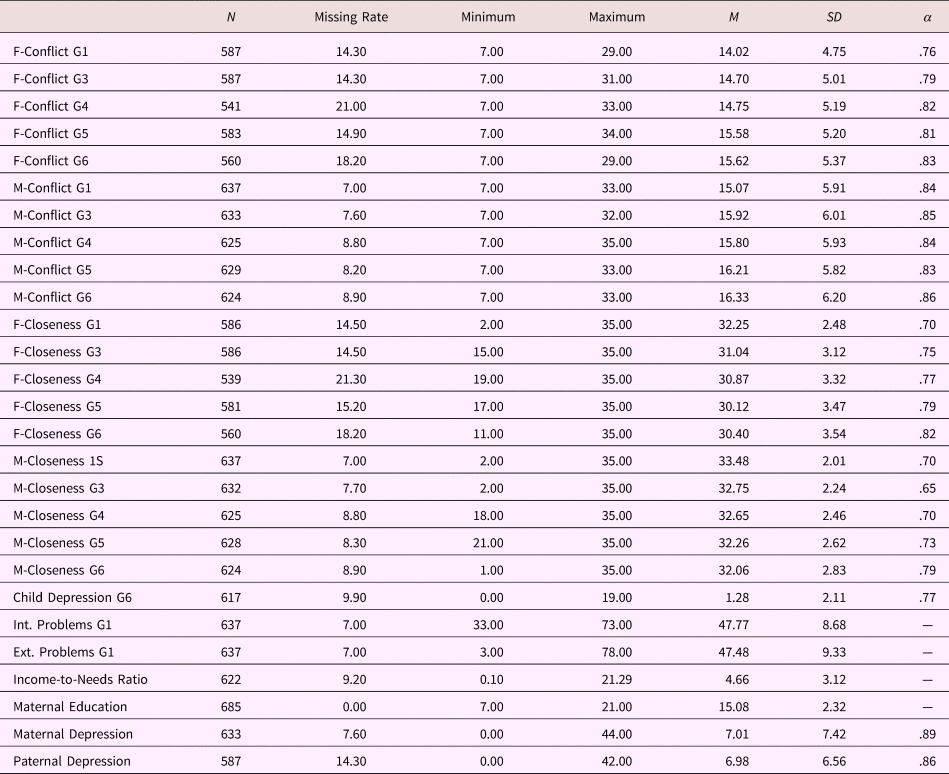
Fathers and mothers reported their beliefs about their relationship with the study child on the 15-item short form of the Child-Parent Relationship Scale (Pianta, Reference Pianta1992). Of the 15 items, 8 asked about parent-child relationship closeness (e.g., “I share an affectionate, warm relationship with my child”). The other seven items asked about relationship conflict (e.g., “My child easily becomes angry at me”). The parents were instructed to rate each item on a 1 to 5 Likert scale, with 1 = definitely does not apply and 5 = definitely applies. The internal consistencies ranged between .76 to .86 for parent-child conflict, and between .65 and .82 for parent-child closeness (see Table 1 for α of parent-child relationship in each grade). Of note, 1 of the 15 items (i.e., “My child is uncomfortable with physical affection”) had low correlations with other items and was removed to increase the internal consistency of the closeness scale.
M, SD, missing rates, and ranges of the study variables

Note: Ext = externalizing; F = father; G = grade; Int = internalizing; M = mother.
Child depressive symptoms
Children reported their own depressive symptoms on the 10-item short form of the CDI (Kovacs, Reference Kovacs1992). For each item, children were asked to choose which one of the three sentences best applied to them during the past two weeks (e.g., “I am sad once in a while,” “I am sad much of the time,” and “I am sad all the time”). The selection of the sentence was scored on a 0–2 scale, with higher scores representing more severe depressive symptoms. In this sample, this scale showed good internal consistency (α = .77). The mean score on this scale in the current sample was 1.28 (SD = 2.11). Of the 617 children who responded to this measure, 105 had scores at or above the cutoff score of 3; therefore, 17% of the sample was identified as depressed (Allgaier et al., Reference Allgaier, Frühe, Pietsch, Saravo, Baethmann and Schulte-Körne2012).
Covariates
Child behavior problemsFootnote 1
At Grade 1, mothers completed the 113-item Child Behavior Checklist (Achenbach, Reference Achenbach1991). Mothers were asked to rate a series of behaviors on a 0–2 Likert-type scale, with 0 = not true of the child and 2 = very true of the child. Thirty-five items assess children's externalizing behaviors (e.g., “argues a lot”), whereas 32 items assess children's internalizing behaviors (e.g., “cries a lot”). This measure showed strong psychometric properties in previous research (Achenbach, Reference Achenbach1991).
Parental depressive symptoms
Both fathers and mothers reported on their own depressive symptoms on the 20-item Center for Epidemiological Studies Depression Scale (Radloff, Reference Radloff1977) with a 4-point Likert scale (1 = less than once a week; 4 = 5–7 days a week). This measure asks about how the participants felt in the past week, in terms of depressed affect (e.g., “I felt sad”), positive affect (e.g., “I enjoyed life”), somatic and retarded activity (e.g., “My sleep was restless”), and interpersonal distress (e.g., “People were unfriendly to me”). After reverse-coding items regarding positive affect, a total score was computed and the internal consistencies were .86 and .89 for fathers and mothers, respectively. The mean score on this scale was 7.01 (SD = 7.42) for mothers and 6.98 (SD = 6.56) for fathers. Of the 633 and 587 fathers and mothers who responded to this measure, 73 mothers and 57 fathers had scores at or above the cutoff score of 16; therefore, 12% of mothers and 10% of fathers were identified as depressed (Radloff, Reference Radloff1977).
SES
SES was estimated by the income-to-needs ratio and maternal education level. The income-to-needs ratio was defined and computed using mother-reported annual household income divided by the federal poverty threshold per family size. Mother-reported years of schooling was used as the indicator of maternal education level.
Analytic plan
We performed latent growth curve analysis with maximum likelihood estimation in Mplus 7.11 (Muthén & Muthén, Reference Muthén and Muthén1998–2012) to simultaneously examine both intra- and interindividual changes in mother-child and father-child relationships (i.e., closeness and conflict) over time. In preliminary analyses, for each parent-child relationship dimension (i.e., closeness and conflict), we first fitted parallel process models to examine the initial levels and rates of change in father-child and mother-child relationships. We then compared the trajectories of father-child and mother-child relationships by adding equality constraints and examining the results of χ 2 difference tests. Next, in hypothesis testing, we examined how the growth trajectories of mother-child and father-child relationships predicted child depressive symptoms with the coefficients of intercepts and slopes of both father-child and mother-child relationship trajectories freely estimated. In a further step, we constrained the effects of father-child and mother-child trajectories to be equal in predicting child depressive symptoms (Exploratory question 1). For all these analyses, we conducted a multigroup analysis with child gender as the grouping variable to test the moderating effect of child gender (Exploratory question 2).
Model χ2 statistics with its degrees of freedom and p values, root mean square error of approximation (RMSEA; Browne & Cudeck, Reference Browne, Cudeck, Bollen and Long1993) and its 90% confidence interval (CI), Bentler comparative fit index (CFI; Bentler, Reference Bentler1990), and standardized root mean square residual (SRMR) of each model, as recommended by Kline (Reference Kline2015), were reported to evaluate the model fit. RMSEA values < .01, .05, and .08 indicated excellent, close, and reasonable fit, respectively (Browne & Cudeck, Reference Browne, Cudeck, Bollen and Long1993). CFI values > .90 and .95 were considered as indicators of good and excellent fit, respectively (Hu & Bentler, Reference Hu and Bentler1999). SRMR values < .08 were indicative of a good fit (Hu & Bentler, Reference Hu and Bentler1999).
Results
Preliminary analyses
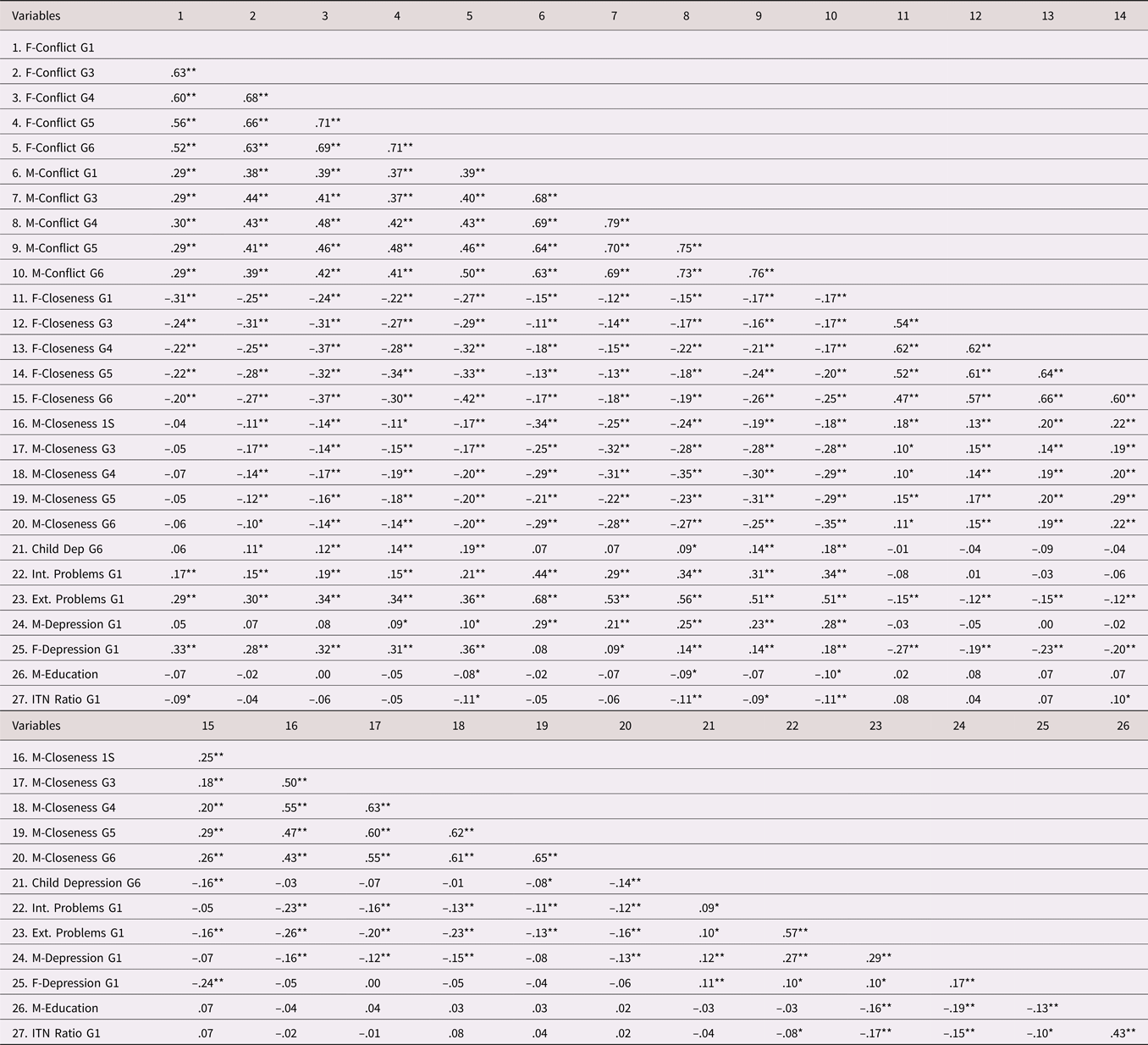
Table 1 shows the M, SD, missing rates, and ranges of the variables and covariates. The nonsignificant results of Little's missing completely at random test suggested that data were missing completely at random [χ2 (2,123) = 2,154.22, p = .31]. Missing data were handled with full information maximum likelihood estimation, as recommended by Enders and Bandalos (Reference Enders and Bandalos2001) for conditions when missing data are ignorable (i.e., missing completely at random or missing at random). The zero-order correlations of all study variables and covariates can be found in Table 2.
Zero-order correlations of the study variables

Note: Dep = depressive symptoms; Ext = externalizing; F = father; G = grade; Int = internalizing; ITN ratio = income-to-needs ratio; M = Mother; *p < .05, **p < .01.
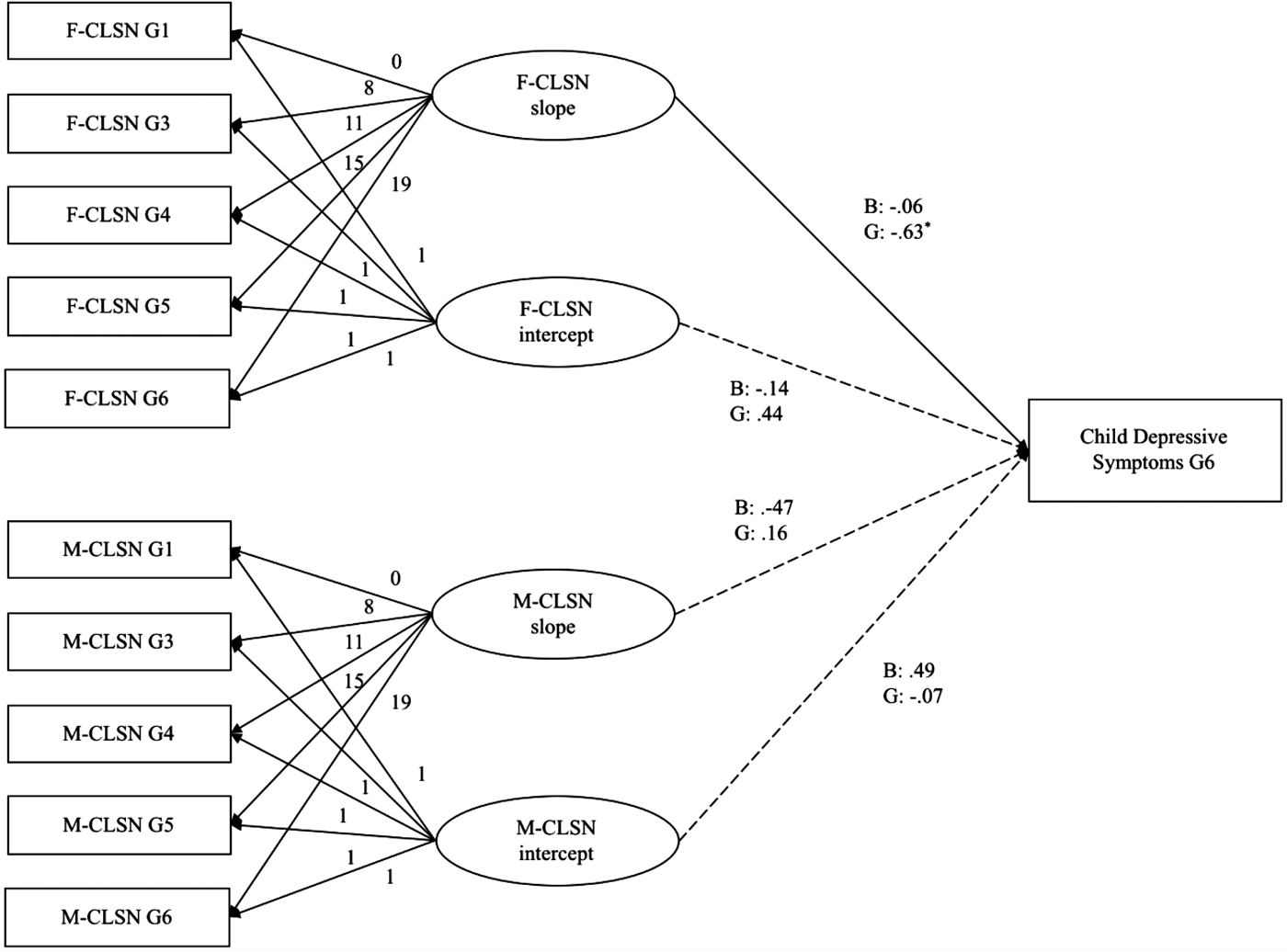
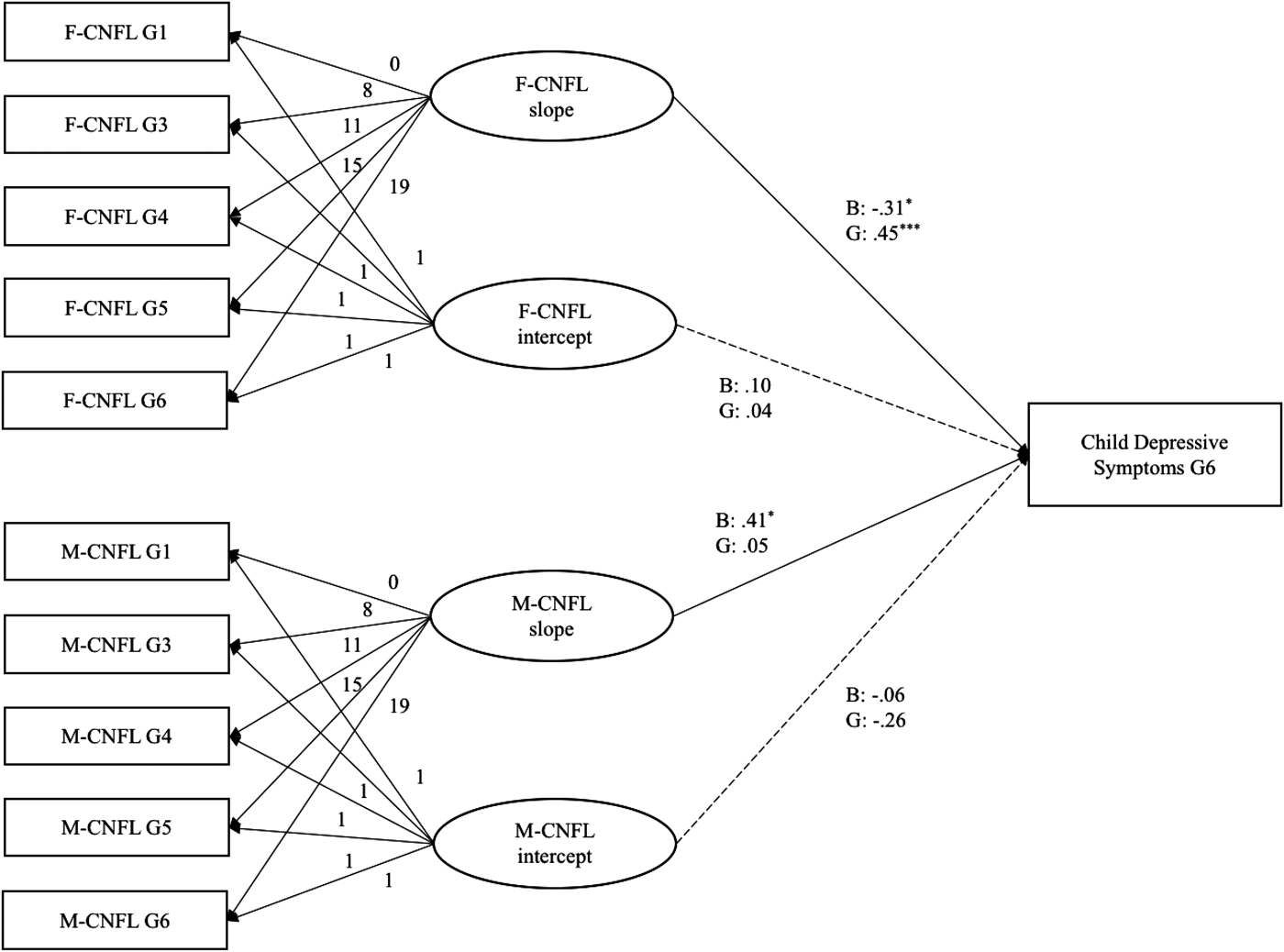
Two parallel process models were fitted to model the linear change in father- and mother-child conflict and closeness. Preliminary analysis suggested linear trajectories for mother-child/father-child relationships. Two latent variables were created for each construct: an intercept, to represent initial levels; and a slope, to represent rates of change over time. The factor loadings for intercepts were fixed to 1 at all 5 time points, whereas the factor loadings for slopes were fixed to 0 at grade 1, 8 at grade 3, 11 at grade 4, 15 at grade 5, and 19 at grade 6.Footnote 2 The trajectories were first estimated separately for boys and girls, and subsequently combined because boys and girls did not differ in any growth parameters according to the results of χ2 difference tests.
Parent-child conflict
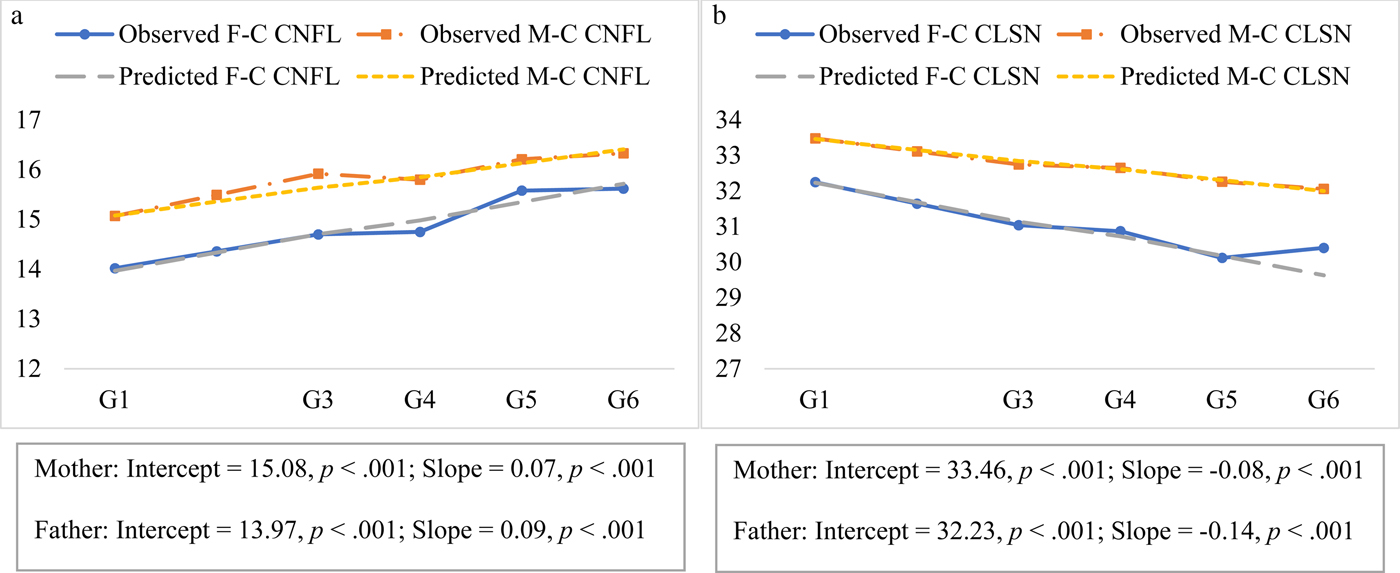
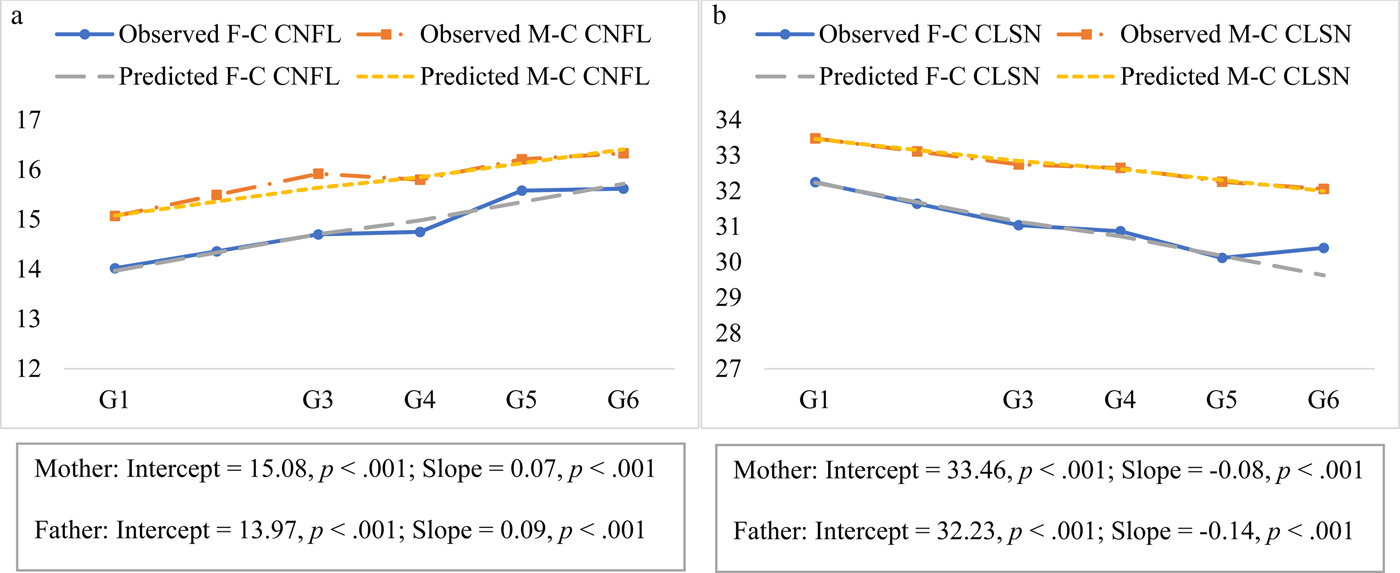
The model for father-child and mother-child conflict demonstrated a reasonable fit to the data, χ2 (40) = 101.20, p < .001; RMSEA = .05 (90% CI = .04, .06); CFI = .99; SRMR = .03. The observed and predicted trajectories of father-child and mother-child conflict are shown in Figure 1a. Greater intercept of mother-child conflict was associated with greater intercept (r = .49, p < .001) and slope (r = .19, p = .01) of father-child conflict, whereas the intercept of father-child conflict was not significantly associated with the slope of mother-child conflict (r = –.06, p = .44). Thus, for families in which mothers perceived more conflict with their children at Grade 1, father-child conflict tended to be higher at Grade 1 and to increase faster over middle childhood. When mother-child conflict increased faster, father-child conflict tended to increase faster as well (r = .43, p = .005). The intercept of mother-child conflict was higher than that of father-child conflict (Δχ2 (1) = 22.00, p < .001). Although mother-child relationships were characterized by greater conflict initially, the rate of change in parent-child relationship conflict did not differ between fathers and mothers (Δχ2 (1) = 2.50, p = .11).
Predicted and observed trajectories of parent-child conflict (a) and parent-child closeness (b). Note: F-C = Father-Child; M-C = Mother-Child; CNFL = Conflict; CLSN = Closeness; G1 = Grade 1; G3 = Grade 3; G4 = Grade 4; G5 = Grade 5; G6 = Grade 6.
Parent-child closeness
The model for father-child and mother-child closeness also demonstrated a reasonable fit to the data, χ2 (39) = 72.42, p < .001, RMSEA = .04 (90% CI = .02, .05), CFI = .99, SRMR = .07. The observed and predicted trajectories of father-child and mother-child closeness are shown in Figure 1b. Greater intercept of mother-child closeness was associated with greater intercept (r = .24, p < .001) and slope (r = .22, p = .001) of father-child closeness, whereas the intercept of father-child closeness was not significantly associated with the slope of mother-child closeness (r = .005, p = .94). Thus, for families in which mothers felt closer with their children at Grade 1, father-perceived closeness with their children tended to be also higher at Grade 1, and declined more slowly over middle childhood. When mother-child closeness declined faster, father-child closeness declined faster as well (r = .23, p = .006). The intercept of mother-child closeness was higher than that of father-child closeness [Δχ2 (1) = 12.34, p < .001], and the slope of father-child closeness was lower than that of mother-child closeness [Δχ2 (1) = 18.41, p < .001]. Thus, mother-child closeness was higher and declined more slowly than father-child closeness.
Hypothesis testing: parent-child relationships and child depressive symptoms
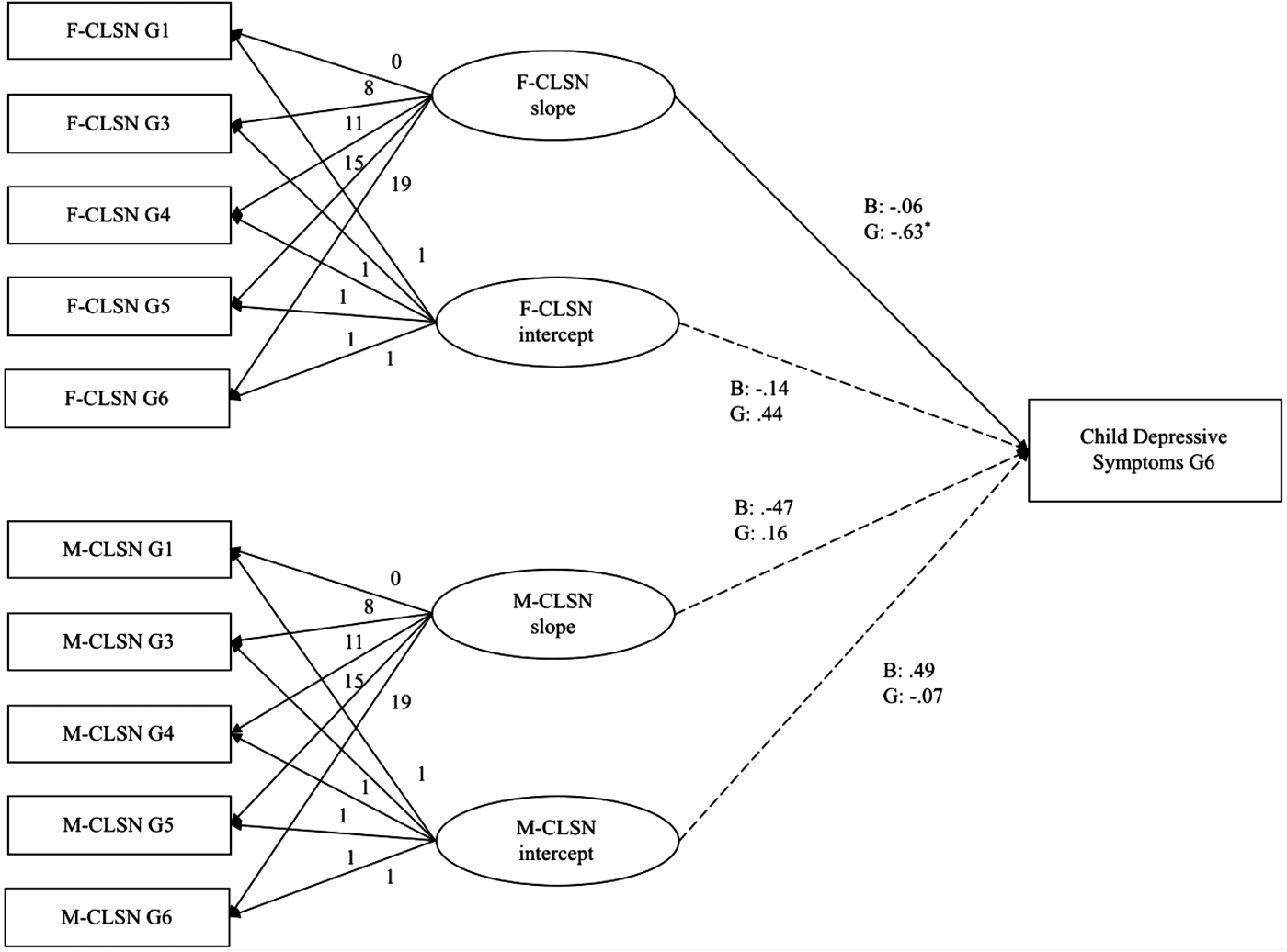
To test the hypothesis, the two aspects of parent-child relationships (i.e., conflict and closeness) were examined in separate models because testing them in the same model was not feasible because of model complexity. For each aspect, a multigroup model was tested to examine the association between parent-child relationship and child depressive symptoms for boys and girls. A series of χ2 difference tests were conducted comparing boys and girls, and also comparing the effects of father- and mother-child relationships on boys’ and girls’ depressive symptoms. Based on the results of χ2 difference tests (see the following section for details), we constrained the coefficients of father-child and mother-child relationship trajectories, as well as the initial level of mother-child conflict on child depressive symptoms, to be equal across the two groups. The covariates (i.e., maternal education, income-to-needs ratio, child externalizing and internalizing behaviors, maternal and paternal depressive symptoms) were included but are not shown in Figures 2 and 3 because they were nonsignificant. The error terms and correlations among predictors were also included in the analyses but omitted in Figures 2 and 3. The significant path estimates and the associated tests for the differences in path estimates by parent and child gender are summarized in Table 3. The path estimates, standard errors, and p values for the associated tests can be accessed from the online supplementary materials (Online Tables 1 and 2).
Final standardized path estimates for boys and girls in the model of trajectories of parent-child conflict predicting child depressive symptoms. Note: *p < .05, ***p < .001. Solid lines represent significant paths for either boys or girls or both. Dotted lines represent nonsignificant paths for either boys or girls. χ2 (164) = 279.37, p < .001, RMSEA = .05 (90% CI = .04, .05), CFI = .98, SRMR = .03. R 2 = .18 and .24 for boys and girls, respectively. Covariates: maternal education, income-to-needs ratio at grade 1; child internalizing behaviors at Grade 1; child externalizing behaviors at Grade 1; maternal depressive symptoms at Grade 1; paternal depressive symptoms at Grade 1. B, boys; F-CNFL = father-child conflict; G = girls; G1 = Grade 1; G3 = Grade 3; G4 = Grade 4; G5 = Grade 5; G6 = Grade 6; M-CNFL = mother-child conflict.
Final standardized path estimates for boys and girls in the model of trajectories of parent-child closeness predicting child depressive symptoms. Note: *p < .05. Solid lines represent significant paths for either boys or girls or both. Dotted lines represent nonsignificant paths for either boys or girls. χ2 (163) = 256.93, p < .001, RMSEA = .04 (90% CI = .03, .05), CFI = .97, SRMR = .08. R2 = .21 and .39 for boys and girls, respectively. Covariates: maternal education, income-to-needs ratio at Grade 1; child internalizing behaviors at Grade 1; child externalizing behaviors at Grade 1; maternal depressive symptoms at Grade 1; paternal depressive symptoms at Grade 1. B, boys; F-CLSN = father-child closeness; G = girls; G1 = Grade 1; G3 = Grade 3; G4 = Grade 4; G5 = Grade 5; G6 = Grade 6; M-CLSN = mother-child closeness.
Parent-child conflict
As shown in Figure 2, a greater increase in father-child conflict predicted girls’ higher depressive symptoms. A faster increase in father-son conflict predicted fewer depressive symptoms in boys. Father-child conflict at Grade 1 was not associated with girls’ depressive symptoms. A greater increase in mother-child conflict was associated with boys’ (but not girls’) higher depressive symptoms. Father-child and mother-child conflict at Grade 1 were not predictive of child depressive symptoms. A χ2 difference test confirmed that the paths from father-child conflict slope to child depressive symptoms differed across child gender [father-child conflict slope: β boy = –.31, βgirl = .45, Δχ2 (1) = 7.6, p = .006], whereas other paths did not.
We next tested the differences between mothers and fathers. For boys, the paths from parent-child conflict slope, but not intercept, to depressive symptoms differed by parent gender [slope for boys: β father = –.31, βmother = –.41, Δχ2 (1) = 9.53, p = .002]. For girls, neither the intercept nor the slope of father-daughter and mother-daughter conflict were different in predicting girls’ depressive symptoms.
Parent-child closeness
As shown in Figure 3, a slower decrease in father-child closeness predicted girls’ fewer depressive symptoms. Results of a χ2 difference test confirmed that the paths from all the growth factors of parent-child closeness to child depressive symptoms differed across child gender [father-child closeness intercept: β boy = –.14, βgirl = .44, Δχ2 (1) = 11.83, p < .001; father-child closeness slope: β boy = –.06, βgirl = –.63, Δχ2 (1) = 14.81, p < .001; mother-child closeness intercept: β boy = .49, βgirl = –.07, Δχ2 (1) = 7.17, p = .01; mother-child closeness slope: β boy = –.47, βgirl = .16, Δχ2 (1) = 4.60, p = .03].
The differences between mothers and fathers were then tested. For both boys and girls, the paths from parent-child closeness slope and intercept to child depressive symptoms differed by parent gender [slope for boys: β father = –.06, βmother = –.47, Δχ2 (1) = 7.00, p = .008; intercept for boys: β father = –.14, βmother = .49, Δχ2 (1) = 8.30, p = .004; slope for girls: β father = –.63, βmother = .16, Δχ2 (1) = 7.65, p = .006; intercept for girls: β father = .44, βmother = –.07, Δχ2 (1) = 10.40, p = .001].
Discussion
The aim of this study was to strengthen understanding of the associations of parent-child relationship closeness and conflict with child depressive symptoms across middle childhood. By examining the role of father-child relationships together with mother-child relationships and by using a family systems perspective that prompted us to closely examine the roles of parent and child gender, this study made important advances over past work. Overall, we found that the trajectories of parent-child relationships were predictive of child depressive symptoms, with father-child relationships especially important to girls’ depressive symptoms, and mother- and father-child relationships important for boys’ depressive symptoms. These findings highlight the important roles of both father-child and mother-child relationships in children's emotional adjustment during middle childhood.
Parent-child relationships and child depressive symptoms
The trajectories of father-child relationships predicted both boys’ and girls’ depressive symptoms after taking into account the trajectories of mother-child relationships. In particular, higher depressive symptoms for girls were predicted by greater rates of increase in father-daughter conflict, whereas higher depressive symptoms for boys were predicted by slower increase in of father-son conflict. The rates of decrease in father-daughter closeness also predicted girls’ depressive symptoms. When father-daughter closeness decreased faster, girls reported higher levels of depressive symptoms. The associations between mother-child relationships and child depressive symptoms were less consistent and less salient when father-child relationships were controlled. Greater rates of increase in mother-child conflict predicted boys’ but not girls’ greater depressive symptoms. Moreover, the trajectories of mother-child closeness were not associated with the depressive symptoms of either boys or girls after taking into account trajectories of father-child closeness. These findings are generally consistent with the growing literature on the association between parent-child relationships and child depressive symptoms (e.g., Branje et al., Reference Branje, Hale III, Frijns and Meeus2010; DeLay et al, Reference DeLay, Hafen, Cunha, Weber and Laursen2013; Hazel et al., Reference Hazel, Oppenheimer, Technow, Young and Hankin2014). It was somewhat surprising that slower increases in father-son conflict were associated with greater depressive symptoms for boys; however, it could be that increases in father-son conflict, in particular, are normative during middle childhood and reflect fathers’ greater involvement with their sons, which could be a positive aspect of the father-child relationship that we did not directly assess in the current study.
The findings underscore the utility of a family systems perspective for research in developmental psychopathology (Minuchin, Reference Minuchin, Hinde and Stevenson-Hinde1988). Fathers and mothers have different roles in family systems, and the gender of children also matters. Fathers and mothers often interact with their daughters and sons in distinct ways. Sons and daughters may also learn different scripts from observations of paternal and maternal behaviors (Palkovitz et al., Reference Palkovitz, Trask and Adamsons2014); therefore, fathers and mothers are likely to make differential contributions to boys’ and girls’ emotional adjustment, consistent with our findings.
Altogether, these findings are consistent with attachment theory and emphasize the role of high-quality parent-child relationships in promoting the development of children's mental health (Bowlby, Reference Bowlby1982). Children may internalize their relationships and interactions with parents, which shape children's expectations toward the world. From high-quality parent-child relationships, children obtain emotional support, positive interactions, perceptions of acceptance, and being valued that protect against developing depressive symptoms. Lower parent-child relationship quality, indicated by greater conflict and less closeness during middle childhood than is typical, may lead to the formation of “maladaptive schemas” (Roelofs et al., Reference Roelofs, Lee, Ruijten and Lobbestael2011) that are associated with higher risk of experiencing depressive symptoms.
Mother- and father-child relationships during middle childhood
Our examination of the trajectories of father-child and mother-child conflict and closeness revealed increasing trends for parent-child conflict and decreasing trends for parent-child closeness from Grades 1–6. This is not surprising considering children's increasing needs for autonomy and independence during middle childhood (Wray-Lake et al., Reference Wray-Lake, Crouter and McHale2010). Moreover, adolescents also experience growing conflict intensity and declining intimacy with their parents (Laursen, Coy, & Collins, Reference Laursen, Coy and Collins1998; McGue, Ilkins, Walden, & Iacono., Reference McGue, Elkins, Walden and Iacono2005). Our findings are therefore consistent with previous findings on the trajectories of parent-adolescent relationships, but show that these patterns originate earlier, in middle childhood.
We also compared the trajectories of father-child relationships with mother-child relationships, finding that mother-child relationships were closer but also more conflictual than father-child relationships during middle childhood. This is consistent with extant literature on parent-adolescent relationships (Bronstein, Reference Bronstein1984; Hosley & Montemoyor, Reference Hosley, Montemayor and Lamb1997; Russell & Russell, Reference Russell and Russell1987). Because mother-child dyads interact more frequently (Lewis & Lamb, Reference Lewis and Lamb2003), share more time together, and communicate about feelings more often than father-child dyads (Lam et al., Reference Lam, McHale and Crouter2012), there might be more opportunities for closeness and more sources of conflict within mother-child dyads. We also found that although conflict between father-child and mother-child dyads increased at a similar rate, father-perceived closeness declined faster than mother-perceived closeness. Future research should further explore the mechanism underlying the steeper decline in father-child closeness. Perhaps father-child relationships are more susceptible to the declines in shared activities (e.g., “rough and tumble play”) over middle childhood (Paquette, Reference Paquette2004), whereas mothers might continue to be involved in their children's lives in ways (e.g., disclosure) that decline more slowly than shared parent-child activities.
Interdependencies across parent-child relationships were also revealed. When mothers perceived their relationships with their children as more conflictual or closer to start with, fathers also perceived their relationships with children as more conflictual or closer accordingly. Moreover, when mother-child conflict increased faster, father-child conflict increased faster, and when mother-child closeness decreased more slowly, father-child closeness also decreased more slowly. Thus, consistent with the family systems principles that family relationships are interdependent (Sameroff, Reference Sameroff, Parke and Kellam1994) and the family functions as a “complex, integrated whole” (Minuchin, Reference Minuchin, Hinde and Stevenson-Hinde1988), father-child and mother-child relationships may change in synchrony.
Additionally, when mother-child conflict was initially higher, father-child conflict increased faster; however, the initial level of father-child conflict was not associated with the rate of increase in mother-child conflict. Similarly, higher initial levels of mother-child closeness were associated with greater change in father-child closeness, whereas initial levels of father-child closeness were not associated with change in mother-child closeness. These findings suggest that father-child relationships may change as a function of mother-child relationships, but not vice versa. This is consistent with previous findings suggesting that, compared with the effect of father's marital satisfaction and coparenting behaviors on mother's parenting, father's parenting is more susceptible to mother's satisfaction and behaviors (Pedro, Ribeiro, & Shelton, Reference Pedro, Ribeiro and Shelton2012). In other words, mothers appear to “set the tone” for parenting within the family. Fathers may also observe maternal behaviors and model mothers when interacting with their children (Barnett, Deng, Mills-Koonce, Willoughby, & Cox, Reference Barnett, Deng, Mills-Koonce, Willoughby and Cox2008).
Limitations
The current study had several limitations. Child depressive symptoms were measured at a single time point at Grade 6, and not at Grade 1. There may be reciprocal relations between child depressive symptoms and parent-child relationship quality, and because depressive symptoms were only assessed at one time point in middle childhood, we were unable to definitively establish the directions of effects. We did control for child internalizing and externalizing behaviors at Grade 1 because these variables were available; however, it would be ideal to take into account prior levels of child depressive symptoms had that been possible. In addition, because the goal of this study was to examine the roles of both father-child and mother-child relationships in child adjustment, we focused on families with biological fathers and mothers who coresided with the target children. Unfortunately, we did not have enough data on nonresidential fathersFootnote 3 to conduct group comparisons between residential and nonresidential fathers. The majority of the NICHD sample in general, and this subsample in particular, included European American, highly educated, and middle- to upper-class families. These features may limit the generalizability of our findings to populations other than European American families with biological residential fathers and relatively high socioeconomic status.
We also examined parent-child closeness and conflict in separate models. Testing them in the same model was not feasible because of the model complexity and lack of convergence; however, these constructs are interdependent. By testing them in separate models, we could not examine the unique effect of one construct above and beyond the other one. Finally, parent-child relationships were assessed with self-reports by parents, which might introduce subjective bias. No observational data or children's perspective on parent-child relationships were collected in the NICHD SECCYD during middle childhood. Future research is encouraged to consider children's perspectives and include more objective observational assessments of parent-child relationships and representational measures to improve the causal validity of the results (e.g., Manchester Child Attachment Story Task; Green, Stanley, Smith, & Goldwyn, Reference Green, Stanley, Smith and Goldwyn2000).
Contributions
Despite these limitations, the current study contributed to the literature in several notable ways. It was among the first to study the trajectories of parent-child relationships with five time points and their longitudinal associations with children's depressive symptoms in middle childhood. Results highlight the importance of examining associations of changes in parent-child relationships with child adjustment from a developmental perspective. This study also expanded knowledge on a frequently neglected family relationship in the extant literature: the father-child relationship. Examining the roles of father-child and mother-child relationships together within the same model and further considering child gender provided insights on fathers’ and mothers’ unique contributions to boys’ and girls’ depressive symptoms. Moreover, two aspects (i.e., conflict and closeness) instead of a single overall measure were used to better characterize the multifaceted nature of parent-child relationships. In addition, parent-child relationships were reported by fathers and mothers, whereas child depressive symptoms were reported by children, which avoided single-reporter bias and thus yielded more trustworthy findings.
Conclusions
The current study highlights the significant roles both father-child and mother-child relationships play in child emotional adjustment in middle childhood. In two-parent families, father-child and mother-child relationships may exert differential impact on boys’ and girls’ social and emotional adjustment. Future research on parent-child relationships including fathers as well as mothers and taking a family systems perspective is encouraged, so that the interactive roles of parent and child gender in the associations between parent-child relationships and child adjustment can be better understood. It is also important to understand the origins of children's mental health earlier in development, so that preventive efforts can be made to protect children's mental health at earlier stages, thereby allowing children to accomplish important developmental tasks, avoid psychopathology, and experience wellbeing and success into adulthood. Intervention and prevention programs focused on lowering depressive symptoms among children in middle childhood are encouraged to focus on improving parent-child relationship quality. Practitioners who work with girls from families similar to those in the current study are advised to pay particular attention to father-daughter relationship quality.
Supplementary material
The supplementary material for this article can be found at https://doi.org/10.1017/S0954579418000809
Financial support
The Eunice Kennedy Shriver National Institute of Child Health and Human Development supported the Study of Early Child Care and Youth Development through cooperative agreement grants (U10s and a U01).