Children are born with the capacity to rapidly acquire the language of their environment, and there is a growing consensus that this ability extends not only to monolingual acquisition but also to bilingual acquisition (Byers-Heinlein, Burns & Werker, Reference Byers-Heinlein, Burns and Werker2010; Curtin, Byers-Heinlein & Werker, Reference Curtin, Byers-Heinlein and Werker2011; Sebastián-Gallés, Bosch & Pons, Reference Sebastián-Gallés, Bosch, Pons, Haith and Benson2008; Werker & Byers-Heinlein, Reference Werker and Byers-Heinlein2008; Werker, Byers-Heinlein & Fennell, Reference Werker, Byers-Heinlein and Fennell2009). Early exposure to two languages is increasingly common due to immigration, international mobility, and government policies directed at maintaining heritage and minority languages. Yet, most research on language acquisition has focused on monolingual children. Many questions remain as to how children growing up in bilingual environments simultaneously learn the sounds, words, and grammar of two distinct language systems from the input.
Bilingual children vary considerably from one another with respect to how they encounter their two languages (Bentahila & Davies, Reference Bentahila, Davies, Extra and Verhoeven1994). Many different early language environments are possible for bilingual children because they are often raised by parents who themselves are bilingual (see e.g. Bosch & Ramon-Casas, Reference Bosch and Ramon-Casas2011, for a recent study of the phonetic properties of bilingual mothers’ speech). This might occur within a matrix of a stable bilingual community or in the context of parents who speak a minority language as well as a majority community language. Bilingual families use a range of language strategies, from a one-parent–one-language approach to a mixed approach where both languages are used freely (Barron-Hauwaert, Reference Barron-Hauwaert2004; Lanza, Reference Lanza1997). Yet relatively little is known about how differences between bilinguals’ early environments relate to language outcomes (Place & Hoff, Reference Place and Hoff2011).
A common behavior among bilingual adults is language mixing, the inclusion of elements from two different languages in the same sentence either as borrowing or as code switching (Myers-Scotton, Reference Myers-Scotton1992; Poplack, Reference Poplack1980). It is unclear, however, whether it is common for bilingual parents to engage in language mixing in interactions with their children, as studies of early bilingual acquisition have focused on a very narrow range of possible bilingual environments. Many studies have only included children growing up in environments where each parent speaks a single language and where language mixing is actively avoided (Bentahila & Davies, Reference Bentahila, Davies, Extra and Verhoeven1994). Large-scale studies using representative samples of parents raising bilingual children are lacking. Thus, little is known about how frequently language mixing occurs in the input of the average bilingual child and whether exposure to language mixing influences language outcomes (Döpke, Reference Döpke1998).
The language outcome investigated in this paper is children's vocabulary size, which is one of the most frequently used metrics of early language development. Methods are now available to efficiently measure children's comprehension and production vocabularies using parental report (Fenson, Marchman, Thal, Dale & Bates, Reference Fenson, Marchman, Thal, Dale and Bates2007). These measures have been validated against behavioral measures in several studies of both monolingual (Dale, Reference Dale1991; Dale, Bates, Reznick & Morriset, Reference Dale, Bates, Reznick and Morriset1989) and bilingual (Marchman & Martínez-Sussman, Reference Marchman and Martínez-Sussman2002) children (see also Houston-Price, Mather & Sakkalou, Reference Houston-Price, Mather and Sakkalou2007, for a discussion of limitations of parental report measures of vocabulary size). Regardless of whether a child is learning one or two languages, each new word must be acquired from the ambient language environment. Congruently, research with monolingual children has demonstrated that both the quantity and the quality of parental input affect vocabulary development (Hart & Risley, Reference Hart and Risley1995; Hoff, Reference Hoff2006; Huttenlocher, Haight, Bryk, Seltzer & Lyons, Reference Huttenlocher, Haight, Bryk, Seltzer and Lyons1991).
Studies with bilingual children have investigated whether the quantity of input in each language predicts children's vocabulary knowledge in that language. For example, Pearson, Fernández, Lewedeg and Oller (Reference Pearson, Fernández, Lewedeg and Oller1997) collected data from a group of Spanish–English bilinguals aged 8–30 months, and found that the number of words known in a given language was roughly proportional to the amount of time spent with speakers of that language. This basic finding has been replicated in several studies of Spanish–English bilingual 1- and 2-year-old children (Hoff, Core, Place, Rumiche, Señor & Parra, Reference Hoff, Core, Place, Rumiche, Señor and Parra2012; Marchman, Fernald & Hurtado, Reference Marchman, Fernald and Hurtado2010; Place & Hoff, Reference Place and Hoff2011) and in at least two studies of French–English bilingual children (David & Wei, Reference David and Wei2008; Thordardottir, Reference Thordardottir2011).
Several studies have also demonstrated that the quality of the language environment impacts early vocabulary acquisition, and that similar qualitative aspects of the input are important in monolingual and bilingual development. Factors such as the length and complexity of utterances predict vocabulary development in both groups (David & Wei, Reference David and Wei2008; Hart & Risley, Reference Hart and Risley1995). Among bilingual children, input from native speakers, but not that from non-native speakers, predicts vocabulary size over and above the total amount of input that children receive (Place & Hoff, Reference Place and Hoff2011). While input from non-native speakers might be particularly common for children growing up bilingual (Fernald, Reference Fernald, McCardle and Hoff2006), it is likely that parallel results would be found in studies of monolingual children (see Kinzler, Corriveau & Harris, Reference Kinzler, Corriveau and Harris2011, for laboratory evidence showing that monolingual children prefer learning words from a native over a foreign-accented speaker).
Precisely because bilinguals are exposed to two languages, there are some qualitative aspects of the early bilingual environment that do not have monolingual analogues. For monolingual children, all interlocutors use the same language in all contexts. However, for bilingual children, an interlocutor might use either one or both languages, and any context might be associated with one or both languages. There is evidence that patterns of language use by parents raising bilingual children can account for preschool and school-aged children's active use of and proficiency in a minority language (De Houwer, Reference De Houwer2007; Gathercole & Thomas, Reference Gathercole and Thomas2009). Yet, very little research has examined how the nature of the exposure to each language affects acquisition in younger bilinguals. Place and Hoff (Reference Place and Hoff2011) collected diary data from the homes of 29 bilingual children. Each day was divided into 30-minute blocks and each block was categorized as English-only, Spanish-only, or both English and Spanish input. Blocks were characterized as both English and Spanish input if two different individuals were each speaking a different language to the child, or if the same individual switched between or mixed the two languages. English and Spanish vocabulary sizes were related to English-only and Spanish-only blocks, but no relationship was found between any language measure and the number of blocks that contained both English and Spanish. David and Wei (Reference David and Wei2008) measured language mixing by parents of French–English bilingual children. They looked for a correlation between the amount of language mixing produced by parents and the number of translation equivalents (cross-language synonyms) produced by their children, but no significant relationship was found. Correlations were not reported between language mixing and other measures of vocabulary, such as total vocabulary or raw vocabulary in each language.
Exposure to language mixing is thought to be common for bilingual children (Bentahila & Davies, Reference Bentahila, Davies, Extra and Verhoeven1994) and is a uniquely bilingual experience. Thus, investigating the impact of this type of input is important for understanding bilingual acquisition. The majority of studies to date that have examined children's exposure to language mixing have used a case study methodology, most often involving families employing a “one parent, one language” approach. Much of this research has been directed at understanding how parental language mixing is related to child language mixing (Goodz, Reference Goodz1989; Lanza, Reference Lanza1997; Nicoladis & Secco, Reference Nicoladis and Secco2000), with little investigation of other potential impacts of exposure to language mixing. In these studies, language mixing was typically measured by directly observing parents’ behavior. Direct observation of language mixing can yield data with high ecological validity, and can minimize potential reporting and recall biases. Such studies have often been qualitative in nature, and thus have not tended to report a quantification of how often parents engaged in language mixing. However, there are at least two exceptions. In a case study of a bilingual family, 10% of the father's utterances and 2% of the mother's utterances were mixed (Nicoladis & Secco, Reference Nicoladis and Secco2000). A more recent study of interactions between English–Marathi bilingual children and their parents reported that over 20% of parental utterances contained both English and Marathi words (Tare & Gelman, Reference Tare and Gelman2011). Based on these findings, language mixing might be a typical part of the input that bilingual children receive.
Could experience with mixed language input affect language acquisition? Theories of bilingual acquisition have emphasized that bilingual infants need to tag or sort their input in order to separate their languages and ultimately acquire them (Curtin et al., Reference Curtin, Byers-Heinlein and Werker2011; Sundara & Scutellaro, Reference Sundara and Scutellaro2011). Languages vary with respect to their inherent rhythm (Ramus, Nespor & Mehler, Reference Ramus, Nespor and Mehler1999), and language rhythm has been proposed as one of the first avenues available to bilingual infants for language separation (Mehler, Dupoux, Nazzi & Dehaene-Lambertz, Reference Mehler, Dupoux, Nazzi, Dehaene-Lambertz, Morgan and Demuth1996). Infants show remarkable sensitivity to the rhythmic differences between languages, even as neonates (Mehler et al., Reference Mehler, Jusczyk, Lambertz, Halsted, Bertoncini and Amiel-Tison1988; Nazzi, Jusczyk & Johnson, Reference Nazzi, Jusczyk and Johnson2000). Bilingual newborns exposed to two rhythmically distinct languages in the womb show evidence of having learned about both languages prenatally and are able to discriminate between sentences of these two languages (Byers-Heinlein et al., Reference Byers-Heinlein, Burns and Werker2010). By age four months, bilingual infants can discriminate sentences of their native languages even when the languages are rhythmically similar (Bosch & Sebastián-Gallés, Reference Bosch and Sebastián-Gallés2001). They also show enduring sensitivity to silent cues shown on speakers’ lips and faces that differentiate their native languages (Weikum, Vouloumanos, Navarra, Soto-Faraco, Sebastián-Gallés & Werker, Reference Weikum, Vouloumanos, Navarra, Soto-Faraco, Sebastián-Gallés and Werker2007). By age 1.5–3 years, bilingual children show evidence of pragmatic language differentiation, wherein they are able to modulate their productions in relation to the language used by a monolingual interlocutor (Genesee, Boivin & Nicoladis, Reference Genesee, Boivin and Nicoladis1996; Nicoladis & Genesee, Reference Nicoladis and Genesee1996).
Bilingual infants are clearly adept at discriminating between sentences from different languages, but in the case of language mixing, elements of two different languages occur within the same sentence. To date, no published research has investigated whether bilingual infants can discriminate between languages when presented with units smaller than sentences, for example individual words. If sentences are the initial unit of analysis for bilingual infants, input with high rates of language mixing might make separation of the two languages challenging. As early speech perception lays a foundation for word learning (Werker & Yeung, Reference Werker and Yeung2005), difficulties with language separation might cascade across language acquisition, eventually leading to smaller vocabularies among children who encounter large amounts of language mixing in their input.
Parental language mixing could also challenge word learning itself, as it might be harder for infants to learn a new word from a mixed-language sentence than to learn a new word from a single-language sentence. In a series of studies that taught bilingual infants minimal-pair nonsense words such as bin and din, infants performed better when words were presented in single-language sentence frames (Fennell & Byers-Heinlein, Reference Fennell and Byers-Heinlein2011) than when they were presented in isolation (Fennell, Byers-Heinlein & Werker, Reference Fennell, Byers-Heinlein and Werker2007). The researchers hypothesized that the sentences helped the bilingual infants to determine which language they were hearing, allowing them to activate the appropriate phonetic categories and more effectively encode and retrieve the words. Mixed-language sentences might provide misleading cues about a word's language, increasing the difficulty of accurately learning a word from such a sentence, and potentially impacting the rate of bilinguals’ early vocabulary growth.
The goal of the current research was twofold. First it sought to describe and quantify language mixing in a large and diverse sample of bilingual parents. The second and main goal was to explore the relationship between parental language mixing (English and another language) and bilingual children's English vocabulary development. Studies 1a and 1b detail the development and validation of the Language Mixing Scale, a brief self-report measure of parental language mixing. Descriptive data regarding how often and in what situations parents mix their languages were gathered. Study 2 examined whether parental language mixing is related to English vocabulary development in 1.5- and 2-year-old bilingual children.
Study 1a: Development of the Language Mixing Scale
Self-report measures allow the rapid collection of data from a large sample. As there are no published self-report questionnaires examining parental language mixing, the goal of this first study was to develop such a questionnaire and to assess its reliability and validity. Reliability was assessed in Study 1a by examining the underlying factor structure of the scale and choosing an appropriate measure of reliability as a function of the scale's psychometric properties. Test–retest reliability was determined in Study 1b. Construct validity was established in Study 1a by examining the relationship of the scale to three concurrent variables, detailed below.
Language mixing is an advanced form of bilingual communication (Poplack, Reference Poplack1980). Bilingual individuals can modulate whether they use one of both of their languages at any given moment, falling along a continuum of language modes that ranges from a monolingual language mode (characterized by using a single language) to a bilingual language mode (characterized by using both languages; Grosjean, Reference Grosjean and Nicol2001). Language mixing is a behavior that is characteristic of the bilingual language mode (Grosjean, Reference Grosjean and Nicol2001). If the current measure of language mixing is valid, then language mixing should be related to parents’ use of the bilingual language mode. This hypothesis yielded three predictions that aimed to assess the validity of the Language Mixing Scale. First, it was predicted that parents from a large bilingual community would spend more time in a bilingual language mode than those from other communities, and thus would report the most language mixing. The three largest communities in Vancouver, Canada (where data collection took place), that speak a language in addition to English (the majority language) are the Chinese community (e.g. Cantonese, Mandarin), the South Asian community (e.g. Hindi, Punjabi), and the Filipino community (e.g. Tagalog, Bissaya), and nearly a quarter of the individuals in the city of Vancouver are from one of these communities (Statistics Canada, 2001). Second, it was predicted that parents who tend to use their languages in equal proportion with their child would use a bilingual mode more often, and thus would report the highest rates of language mixing. Third, it was predicted that parents who use both languages across a number of different contexts with their child would spend more time in a bilingual mode, and would thus report more language mixing than parents who use a single language in each context.
Methods
Participants
Participants were 181 bilingual parents who spoke English as well as another language. Six other parents participated but were excluded because of illegible or uninterpretable responses. Each parent had a child aged 1.5 years old (range: 1;5.8–1;6.22, n = 151), or 2 years old (range: 1;10.11–2;2.22; n = 30). The current data were collected in Vancouver, Canada, as part of a larger research program of experimental studies of early multilingualism. An inclusion criterion for these studies was that the children were being raised bilingual or trilingual, having heard English and one or two other languages regularly since birth. In Canada, French and English are official languages, but French–English bilingualism is relatively uncommon in Vancouver. Due to immigration, bilinguals in Vancouver tend to speak English as well as a wide variety of other languages. As discussed above, several cultural groups (Chinese, South Asian, and Filipino) have large numbers and form stable bilingual communities, while other languages could be described as having a minority status with respect to English. As there were no requirements for the type of environment in which children received this exposure (e.g. one-parent–one-language versus bilingual parenting), this resulted in a broad and representative sample of cultures and language strategies used by parents in the Vancouver area.
Typically, one parent per child completed the questionnaire. This was the primary caregiver when he/she was bilingual or the other parent when the primary caregiver was monolingual. In nine cases where each parent spoke a different non-English language to the child, two parents from the same family completed separate questionnaires. Mothers accounted for 84% of the participants and fathers for 14%. In three cases, parents did not indicate whether they were the child's mother or father.
Parents were asked about their own native language, 16 reported that they grew up bilingual learning both English and another language simultaneously, 14 reported that they were native English speakers, 145 reported that they were native speakers of a non-English language, and six did not report their native language. The non-English languages were diverse and typical of the Vancouver area: Chinese (n = 68), Spanish (18), French, (16), Japanese (13), German (12), Punjabi (10), Tagalog (5), Russian (4), Croatian (3), Czech (3), Hebrew (3), Korean (3), Hindi (2), Italian (2), Vietnamese (2) and 1 each of Afrikaans, Arabic, Bissaya, Carrier, Dutch, Farsi, Greek, Gujarati, Hungarian, Kachi, Polish, Portuguese, Romanian, Serbian, Tamil, Telugu, and Yoruba. Based on their non-English languages, 86 parents were classified as belonging to a large bilingual community (Chinese: speakers of Mandarin and Cantonese; South Asian: speakers of Gujarati, Hindi, Kachi, Punjabi, Tamil, and Telugu; Filipino: speakers of Bissaya and Tagalog). The remaining 91 parents were classified as not belonging to a large bilingual community. Although parents’ language proficiency was not formally measured, interactions between the parents and the researcher occurred in English, and all parents were fluent and comfortable speaking English.
Materials and procedure
Parents completed a one-page questionnaire, which asked them to answer all questions with respect to their language behavior during interactions with their child. Forms were tailored to the specific non-English language spoken by the parent. That is, for a French-speaking parent one question read, “In what situations do you speak French with your child?” while for a Punjabi-speaking parent the same question read, “In what situations do you speak Punjabi with your child?” The researcher verbally encouraged parents to answer openly and honestly by emphasizing that the purpose of the questionnaire was to better understand how they used both languages with their child.
The first set of questions asked parents to indicate the situations in which they spoke each of their languages with their child. The purpose of this section was to have parents reflect on their language behavior during interactions with their child and to gauge whether parents tended to use both languages across contexts, or whether they segregated languages by context. Six contexts were listed: when one on one, at home, with friends, with family, at playgroup/lessons, and when out (shopping, etc.). Parents indicated whether they tended to speak English or their other language in each context. If parents tended to use more than one language in a given context, they were instructed to check both boxes.
The second set of questions asked parents to indicate the percent of their interactions with their child that were in English and the percent that were in their non-English language. It should be noted that this value often differed from the child's total exposure to each language, as it did not account for input from other individuals.
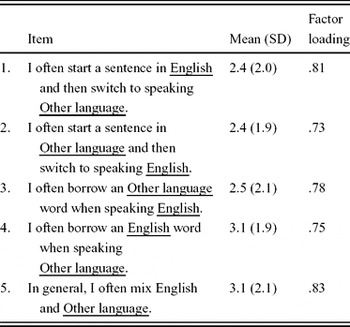
The third set of questions comprised the five-item Language Mixing Scale (see Table 1 for item wording). Parents were given the following instructions: “Please answer the following questions, considering how you speak when interacting with your child. Please circle a number to indicate how much you agree with each statement.” The first two items investigated intra-sentential code switching, and the third and fourth items looked at borrowing. As parents were asked about their mixing of English with a wide variety of non-English languages, no specific examples were given to illustrate each type of mixing. The final item requested a global estimate of language mixing. Items were rated on a seven-point Likert scale, where 1 corresponded to “Very true”, 4 corresponded to “Somewhat true”, and 7 corresponded to “Not at all true”.
Language Mixing Scale items, adjusted means, standard deviations, and factor loadings in Study 1a. The adjusted score on each item ranged from 0 to 6, with 0 indicating “Not at all true of me” and 6 indicating “Very true of me”.

The final type of question probed the situations in which parents tended to borrow a word. Parents were invited to indicate whether they tended to borrow a word in their non-English language in any or all of the following situations: “I'm not sure of the English word”, “No translation or only a poor translation exists for the word”, “The English word is hard to pronounce”, and “Other times/not sure”. An analogous question asked about when they tended to borrow a word in English. Although there was no area provided for an open-ended response to this question, several parents who initially completed the questionnaire spontaneously wrote that they tended to borrow words when teaching new words. Therefore, an additional answer “When I'm teaching new words” was added to the form for the final 30 parents in the study, whose children all fell in the 2-year-old group.
Results
Parents’ self-reported language use across contexts and language mixing
All parents in the study were bilingual in English and another language, and most parents reported speaking both languages to their child at least some of the time. Only eight parents (4%) reported speaking one of their languages 100% of the time with their child and when the criterion was widened to 90%, only 24 parents in the sample (14%) reported using only one of their languages to this degree. On average, parents reported speaking English with their child 40% (SD = 26) of the time and their non-English language 60% (SD = 27) of the time. Based on these data, a balance score was determined for each parent, as the percent of the least spoken language (e.g. a parent who spoke English 70% of the time and French 30% of the time would have a balance score of 30). Parent balance scores therefore ranged from zero (totally unbalanced; the parent spoke one language 0% of the time and the other language 100% of the time) to 50 (totally balanced; the parent spoke each language 50% of the time). The distribution of parent balance scores was negatively skewed, with the median score (30) larger than the mean score (M = 26, SD = 15).
Parents’ choice of language varied across contexts. Of particular interest was how often parents spoke both languages in a context: when one-on-one (60% of parents reported speaking both languages), at home (40%), with friends (25%), with family (33%), at playgroup (21%), and when out (26%). The mean number of contexts where individual parents reported tending to speak both languages was 1.8 (SD = 2.1). Forty-one percent of parents reported that there were no contexts in which they tended to speak both languages, and 12% of parents reported that they tended to speak both languages across all six contexts. As parents were asked to report on the situations in which they tended to speak each language with their child, rather than the situations in which they ever speak each language, the estimate of how many contexts parents use both languages is likely conservative.
Parents’ responses to the questions on the Language Mixing Scale indicated how often they produced various types of language mixing in interactions with their child. All items were re-coded on a 0–6 scale so that a higher score indicated a higher frequency of language mixing (i.e. 0 = “Not at all true”, 3 = “Somewhat true”, and 6 = “Very true”; see Table 1 for means and standard deviations of each item).
Parents reported when they were likely to borrow a word from their other language when speaking English. The most commonly reported occasion (52% of parents whose form included this item) was when they were teaching new words. Parents also reported regularly borrowing a word from a non-English language when no translation or only a poor translation of the word existed in English (43%), when they were not sure of the English word (24%), or when the English word was hard to pronounce (22%).
Parents also reported when they were likely to borrow a word from English when speaking their other language. They reported doing this most often when they were not sure of the word in the other language (51%), when there was no translation or only a poor translation of the word in their other language (45%), when they were teaching new words (42% of parents whose form included this item), and when the word was hard to pronounce in their other language (22%).
Measurement properties of the Language Mixing Scale
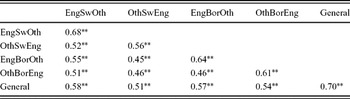
The goal of this analysis was to determine the psychometric properties of the Language Mixing Scale. Inter-item correlations are reported in Table 2. Correlations between all items were significant at the p < .01 level. An exploratory factor analysis was done to examine the underlying factor structure of the scale. The first component extracted had an eigenvalue of 2.99, which accounted for 59.8% of the variance. All other eigenvalues were under 1, suggesting a one-factor solution. Extracted loadings of all the items on the factor are reported in Table 1 above.
Inter-item correlations in Study 1a.

** p < .01
EngSwOth = “I often start a sentence in English and then switch to speaking Other language”
OthSwEng = “I often start a sentence in Other language and then switch to speaking English”
EngBorOth = “I often borrow an Other language word when speaking English”
OthBorEng = “I often borrow an English word when speaking Other Language”
General = “In general, I often mix English and Other language”
Note: Corrected item – total correlations are reported on the diagonal.
One-factor models can have a number of different underlying structures, and the most constrained of these is the parallel items model in which all items have the same underlying relationship with the factor, and thus all factor loadings are equal (de Gruijter & van der Kamp, Reference de Gruijter and van der Kamp2008). For a parallel items model, the common factor loading is the reliability of the scale, also known as Cronbach's alpha. Because all of the inter-item correlations were similar and the factor loading scores were also similar, a parallel items model was fit to the data. A chi-squared model goodness of fit test was conducted to test whether there was any significant misfit of the data from the parallel items model. There was no significant misfit, χ2(13) = 11.10, p = .60, suggesting that the items were indeed parallel. Cronbach's alpha was high, α = .84, indicating good reliability.
Language Mixing Scale score
Because the Language Mixing Scale followed a parallel items model, it was psychometrically valid to calculate a Language Mixing Scale score for each parent as the sum of the responses across the five scale items. As adjusted scores for each item ranged from 0 to 6, mixing scores therefore ranged from 0 to 30. A score of zero corresponded to no reported mixing and a score of 30 corresponded to the highest amount of reported mixing. Four parents did not complete all of the questions on the Language Mixing Scale and thus no score was computed for them.
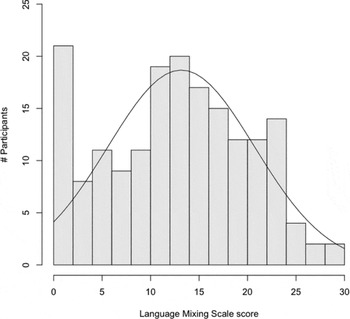
A histogram of scores is shown in Figure 1. The scores followed a roughly normal distribution, with a mode of 12. Across the sample, parents had a mean mixing score of 13.3 (SD = 7.8), which was significantly different from zero, t(176) = 22.7, p < .001, d = 1.7. However, one deviation from a normal distribution was a second mode of scores near zero. Nineteen parents (10%) had mixing scores near the floor of the scale, at zero or one. There was no significant difference in levels of mixing reported by the parents of 1.5-year-olds (M = 13.3, SD = 7.7) and by the parents of 2-year-olds (M = 13.0, SD = 8.2), t(175) = .23, p = .82, d = .11.
Histogram of Language Mixing Scale scores, with an overlay of the normal distribution. Possible scores range from 0 to 30. Most parents reported some amount of language mixing with their child. The distribution of scores is bimodal, with one mode near the midpoint of the scale and a second mode near the floor of the scale.

Validity analysis
To examine the validity of the Language Mixing Scale, these analyses tested predictions regarding a positive relationship between parental language mixing and three measures related to the bilingual language mode. Parents from bilingual communities had significantly higher Language Mixing Scale scores (M = 15.3, SD = 7.2) than other bilingual parents (M = 11.1, SD = 7.7), t(175) = 3.95, p < .001, d = .59. Parents with higher balance scores (more balanced language use with their child) reported more language mixing than those with lower balance scores, r(172) = .60, p < .001. Finally, parents who reported using both of their languages across more contexts reported higher rates of language mixing, r(179) = .30, p < .001. Thus, the predictions were confirmed: those parents who likely spent more time in a bilingual language mode across each of the three measures reported more language mixing. A regression analysis showed that together these factors accounted for 38% of the variance in Language Mixing Scale scores (R = .62, p < .001). When examined for their statistically independent contributions to predicting rates of parental language mixing, parent balance scores remained significant, ß = .53, t(168) = 7.91, p < .001, membership in a bilingual community became marginally significant, ß = .12, t(168) = 1.88, p = .062, and the use of both languages in the same context did not reach significance, ß = .092, t(168) = 1.39, p = .16.
Discussion
The primary goal of Study 1a was to develop a self-report measure of parental language mixing, the Language Mixing Scale. Psychometric analyses of this scale indicated that a single, highly reliable underlying factor accounted for variance across the five items on the scale. This finding is somewhat surprising, as code switching and borrowing are considered distinct phenomena in the linguistics literature (Myers-Scotton, Reference Myers-Scotton1992). Based on this literature, a solution with separate factors for borrowing and for code switching might have been predicted. However, the current results imply that borrowing and code switching, although linguistically distinct behaviors, might be best explained by a single underlying language mixing factor. Another possibility is that parents were unable to distinguish between behaviors that would be traditionally classified as borrowing, and those that would be traditionally classified as code switching. In any case, the psychometric properties of the Language Mixing Scale suggest that frequency of language mixing is a unidimensional construct that can be measured via self-report with high reliability.
Preliminary construct validity of the Language Mixing Scale was established by investigating the relationship between Language Mixing Scale scores, and three other variables hypothesized to be related to bilingual language mode and thus to language mixing. It was predicted that parents’ language mixing would be positively correlated with (i) membership in a bilingual community, (ii) balanced use of the two languages in interactions with their child, and (iii) the use of both languages across more contexts. As predicted, each of these variables showed a positive correlation with language mixing. A more stringent follow-up analysis was conducted to examine whether these relationships would hold when the other two factors were statistically controlled. Balanced language use remained a significant predictor and membership in a bilingual community was a marginally significant predictor even in this stricter analysis. As language mixing as measured by the Language Mixing Scale shows meaningful relationships with variables related to spending time in a bilingual language mode, there is substantive evidence, albeit preliminary, for the validity of this scale.
The reliability and validity of the Language Mixing Scale are particularly important because of how common this behavior appears to be among bilingual parents. The vast majority of parents in the current sample reported engaging in at least some language mixing in interactions with their child. On average, parents reported a moderate amount of language mixing: 13 on a 30-point scale. While the data were generally normally distributed around a mode near the midpoint of the scale, there was a second mode near the floor of the scale. This suggests that an important minority of parents seldom or never mix their languages and might in fact actively avoid language mixing. Another possibility is that these parents underreported the frequency of their mixing. This could occur if some parents perceive language mixing as a stigmatized behavior (for a discussion of attitudes towards language mixing, see MacSwan, Reference MacSwan2005; Romaine, Reference Romaine1995). Currently, little is known about attitudes towards language mixing in this population, thus it is difficult to determine the likelihood of systematic reporting biases. In general, the data suggest that language mixing by bilingual parents is both highly prevalent and highly variable, inviting further study of this phenomenon.
The data reported here also provide insight into some reasons why parents mix their languages. Consistent with previous research on language mixing (Heredia & Altarriba, Reference Heredia and Altarriba2001), parents reported borrowing words when there is no adequate translation for a word, when they are not sure of a word (perhaps failing to retrieve it), and when the word is hard to pronounce. An unexpected finding was that parents report frequently borrowing words when teaching new words to their child. More research will be needed to understand this behavior.
Study 1b: Test–retest reliability of the Language Mixing Scale
In order to further assess the reliability of the Language Mixing Scale, a second study was undertaken of parents who were asked to complete the questionnaire at two different time points approximately six months apart. This study served to replicate the findings of the first study in terms of the psychometric properties of the scale in a new sample and to establish the test–retest reliability of the Language Mixing Scale.
Methods
Seventeen bilingual parents participated, none of who had participated in Study 1a. Inclusion criteria were identical to Study 1a. One additional parent was excluded because several responses on the questionnaire were uninterpretable. All parents spoke English fluently, as well as one of the following non-English languages: Chinese (n = 6), Spanish (2), and 1 each of French, Hungarian, Ilocano, Japanese, Korean, Portuguese, Punjabi, Russian, and Vietnamese. Materials and procedure were identical to Study 1a, except that each parent completed the questionnaire twice approximately 6 months apart: once when their child was 1.5 years old (range: 1;5:16–1;6:21) and once when their child was 2 years old (range: 1;11:20–2;1:24).
Results
Correlations between items across the two assessments were all greater than .5 and significant at the p < .05 level, with the exception of borrowing an other-language word when speaking English (r = .48, p = .052) and how often parents reported mixing their languages in general (r = .40, p = .11). As in Study 1a, an aggregate Language Mixing Scale score was created by re-coding and summing scores across the five Language Mixing Scale items. Parents’ scores across the two time periods were highly correlated, r(16) = .85, p < .001, suggesting strong test–retest reliability. There was also a marginal tendency for parents to report more language mixing at the first assessment (M = 13.64, SD = 8.9) than at the second assessment (M = 11.4, SD = 8.6), t(16) = 12.0, p = .063, d = .26.
Discussion
The results of Study 1b indicate that the Language Mixing Scale shows strong test–retest reliability. Not only were aggregate Language Mixing Scale scores highly correlated across a 6-month time period, but individual items were also highly correlated over the two assessments. Although two of the items did not show statistically significant correlations, the correlations themselves were of moderate size (rs > .4), and the lack of statistical significance is likely due to the smaller sample size in this study as compared to Study 1a. One unexpected finding was that parents reported marginally more mixing when their child was 1.5 years old, as compared to when their child was 2 years old. However, it is difficult to interpret this finding in light of other results. In Study 1a, where a cross-sectional comparison was made between parents of 1.5- and 2-year-olds, there was no effect of children's age on the frequency of parental language mixing. Further, a previous study that examined parental language mixing as a function of children's age found that parents produced more mixed utterances as their children aged, rather than fewer (Goodz, Reference Goodz1989).
Study 2: Parental language mixing and bilingual children's vocabulary size
Studies 1a and 1b established the Language Mixing Scale as a valid and reliable measure of parental language mixing. Study 2 used this scale to investigate whether parental language mixing is related to bilingual children's English vocabulary size. The participants were children whose parents had participated in Studies 1a and 1b, and thus they were all learning English, but their non-English language varied widely. As such, the study focused on children's English vocabulary size. Children's vocabulary in their non-English language was not measured, as many of these languages do not yet have linguistically and culturally-appropriate vocabulary measures, and because vocabulary scores across different languages are often not comparable (Pearson, Reference Pearson1998). Because bilingual children's vocabulary size in a particular language correlates with exposure to that language (David & Wei, Reference David and Wei2008; Marchman et al., Reference Marchman, Fernald and Hurtado2010; Pearson et al., Reference Pearson, Fernández, Lewedeg and Oller1997; Place & Hoff, Reference Place and Hoff2011; Thordardottir, Reference Thordardottir2011), children with different exposure profiles were equated by statistically controlling for the proportion of their exposure that was in English.
In order to further isolate the relationship between language mixing and children's vocabulary size, several other variables known to influence vocabulary size were also measured and statistically controlled. Age and gender were two such variables, as children tend to know more words as they get older, and girls often have larger vocabularies than same-aged boys (Fenson et al., Reference Fenson, Marchman, Thal, Dale and Bates2007). As discussed above, children's percent exposure to English is likely to be related to their English vocabulary size. Yet, above and beyond sheer exposure to English, the relative balance of the exposure to the two languages was also considered, as parents who provide more balanced input tend to mix their languages more (Study 1a), and children with balanced input may have higher vocabularies than children with unbalanced input (Thordardottir, Reference Thordardottir2011).
The analysis strategy in the current study was to perform multiple regression analyses predicting English vocabulary size from the amount of parental language mixing, age, gender, percent exposure to English, and balance of language input. Thus, these analyses estimated the statistically independent contribution of each predictor to vocabulary size. The main hypothesis was that increased exposure to parental language mixing would predict smaller English vocabularies, while controlling for these other factors. It was also hypothesized that previously-demonstrated effects of age, gender, percent exposure to English, and balance of language input would be replicated.
Methods
Participants
Participants in Study 2 were all children of parents who had participated in Studies 1a and 1b. Children were included in the sample if they heard English at least 20% of the time, and if a parent had completed a measure of the child's English vocabulary size. In cases where both parents had participated in Study 1a or 1b and thus had both completed the Language Mixing Scale questionnaire, only the mothers’ data were retained for analysis. A total of 168 children met these criteria; 129 of the children (54 boys, 75 girls) were in the 1.5-year-old age group (range: 1;5.8–1;6.22), and 39 (24 boys, 15 girls) were in the 2-year-old age group (range: 1;10.11–2;2.22). Seventeen children (those whose parents had participated in Study 1b) contributed data at both ages.
Measures
Comprehension and production vocabulary
Children's English vocabulary size was the dependent variable in the main analyses. Vocabulary size was measured using the English version of the MacArthur–Bates Communicative Development Inventory (CDI; Fenson et al., Reference Fenson, Marchman, Thal, Dale and Bates2007). This parental checklist has shown high validity in a bilingual sample (Marchman & Martínez-Sussman, Reference Marchman and Martínez-Sussman2002). Whenever possible, the parent who was most familiar with the child's English vocabulary completed the form. Parents of children who were 1.5 years old filled out the Words and Gestures form of the CDI, which asks about both word comprehension and word production. Parents of two-year-olds filled out the Words and Sentences form of the CDI, which asks only about word production.
Language mixing
The Language Mixing Scale, as described in Studies 1a and 1b, was used to assess parental language mixing. As in those studies, responses across the five language mixing items were re-coded and summed to create a Language Mixing Scale score.
Percent English
Children's exposure to English and to their non-English language was measured using the Language Exposure Questionnaire (Bosch & Sebastián-Gallés, Reference Bosch and Sebastián-Gallés1997), a structured interview that assesses input to the child in both languages from all caregivers. Exposure to English was quantified as a percent.
Child balance score
A balance score was computed for each child, as the percent of the least-heard language (e.g. a child who heard English 70% of the time and French 30% of the time would have a child balance score of 30, whereas a child who heard each language 50% of the time would have a child balance score of 50). Thus, a higher child balance score represented more balanced exposure to the languages.
Results
Comprehension vocabulary
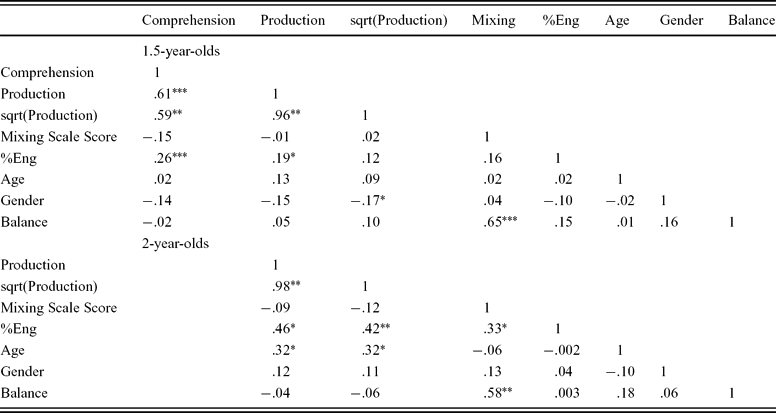
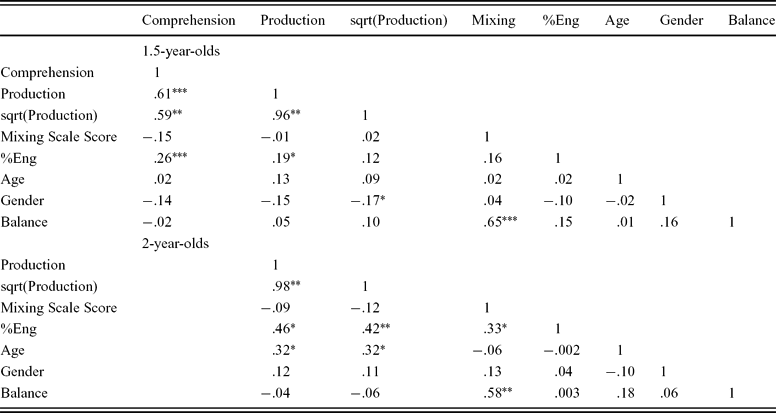
Data on comprehension vocabulary were only available for the 1.5-year-olds, as the Words and Sentences form used for the 2-year-old group does not ask about comprehension. The mean English comprehension vocabulary was 181 words (SD = 101, median = 159, range: 5–395). The analysis sought to examine the relationship between comprehension scores and the following factors: Language Mixing Scale score, child's percent exposure to English, age, gender, and child's balance score. Preliminary analyses computed Pearson correlations across all variables (see Table 3 for correlations). Four significant correlations were found between variables in the 1.5-year-old group. Comprehension and production were strongly and positively correlated. Percent exposure to English was positively correlated with comprehension and production scores. Finally, Language Mixing Scale score and child balance score were positively correlated.
Pearson correlations among items for the 1.5-year-old and 2-year-old groups in Study 2.
*p < .05, **p < .01, ***p < .001
Comprehension = MacArthur–Bates Communicative Inventory comprehension score
Production = MacArthur–Bates Communicative Inventory production score
sqrt(Production) = square root of Production
Mixing = Language Mixing Scale score
%Eng = percent English in child's environment
Age = child's age in days
Gender = child's gender
Balance = child balance score
Note: Missing data are excluded listwise.
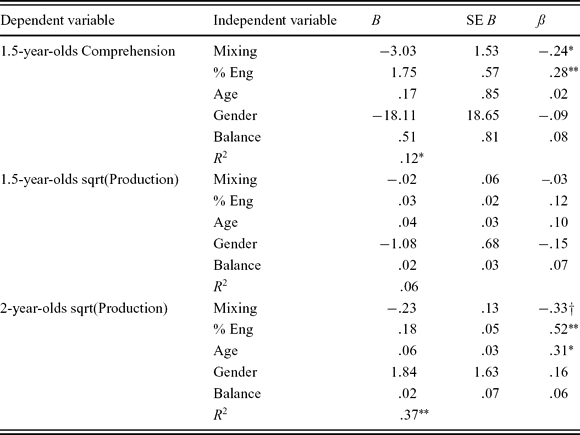
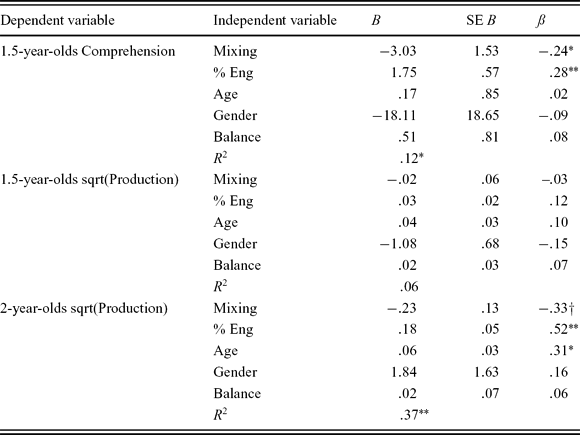
To examine the independent predictive relationships between these variables and children's English vocabulary size, a multiple regression model was estimated with the following predictors: Language Mixing Scale score, child's percent exposure to English, age, gender, and child balance score. The outcome variable was children's CDI comprehension score. Results of the analysis are found in Table 4. Together, the predictors accounted for a significant proportion of the variance in comprehension scores, R = .34, R 2 = .12, p = .013. Two of the four predictors also emerged as statistically significant (ps < .05) and thus were independently related to children's comprehension vocabulary. Percent exposure to English was the strongest predictor: a 1% increase in exposure to English predicted a 1.75 word increase in English vocabulary size, controlling for the other predictors. Language mixing was the second strongest predictor. Each additional point on the Language Mixing Scale predicted a 3.0 word decrease in vocabulary size, controlling for other predictors. Neither gender, age, nor child balance score showed any significant relationship with comprehension vocabulary when the other predictors were statistically controlled.
Regression models predicting children's vocabulary.
†p < .10, *p < .05, ** p L < .01
Comprehension = MacArthur–Bates Communicative Inventory (CDI) comprehension score
Production = CDI production score
sqrt(Production) = square root of Production
Mixing = Language Mixing Scale score
%Eng = percent English in child's environment
Age = child's age in days
Gender = child's gender
Balance = child balance score
Note: Missing data are excluded listwise.
Production vocabulary
Production vocabulary analyses were done separately for the 1.5-year-old and the 2-year-old groups, as each group's vocabulary had been measured using a different form of the CDI. The 1.5-year-olds produced an average of 53 words (SD = 59, median = 33, range: 0–284), and the 2-year-olds produced an average of 217 words (SD = 159, median = 174, range: 7–524). An examination of children's production scores showed that the data had a strong positive skew, due to many children having small production vocabularies. Thus, production scores were subject to a square root transformation prior to analysis in order to normalize the distribution.
Pearson correlations between predictors are presented in Table 3. For the 1.5-year-olds, transformed production scores were negatively correlated with gender, indicating that girls’ vocabularies were larger than boys’ vocabularies. Other significant correlations amongst predictors for the 1.5-year-old group were discussed in the above section. For 2-year-olds, transformed production scores were significantly higher amongst children who were older and who had greater exposure to English. Further, for the 2-year-olds, Language Mixing Scale scores were significantly higher amongst children with more exposure to English, and amongst children with more balanced exposure to their two languages.
Linear regressions were performed to predict the transformed CDI production scores from Language Mixing Scale score, child's percent exposure to English, age, gender, and child's balance score. Models were run separately for the 1.5-year-old and the 2-year-old groups, and detailed results for each model are presented in Table 4. For the 1.5-year-olds, the model was not significant overall, R = .25, R2 = .06, p = .219, and none of the individual predictors were significant, ps > .10. However, for the 2-year-olds, the model predicted a significant proportion of variance in the transformed vocabulary scores, R = .61, R 2 = .37, p = .007. Percent English and age predicted a significant increase in transformed vocabulary production scores, controlling for the other predictors. The main variable of interest, Language Mixing Scale scores, predicted a marginally significant decrease in transformed production scores, controlling for the other predictors. Gender and children's balance score were not significant independent predictors.
Discussion
Study 2 examined the factors that predict bilingual children's English comprehension and production vocabularies, in particular whether parental language mixing and children's vocabulary size is related. The model for children's production vocabulary at age 1.5 years was not significant, making it difficult to evaluate the specific relationship between parental language mixing and production in this group. However, multiple regression models did show that English comprehension vocabulary at age 1.5 years, and English production vocabulary at age 2 years could be predicted. The variable of greatest interest was children's exposure to parental language mixing. Exposure to parental language mixing, as measured by the Language Mixing Scale, predicted significantly smaller comprehension vocabularies in the younger children, and marginally smaller production vocabularies in the older children, while controlling for other factors. Effect sizes, as measured by the standardized regression coefficient (ß), were even larger in the older group than in the younger group, thus the difference in significance level reflects the smaller sample size in the older group. This smaller vocabulary size cannot be accounted for by the amount of children's exposure to English, children's gender, whether or not language exposure was balanced, nor the age of the children, as these were statistically controlled. Thus, parental language mixing significantly and independently predicts English vocabulary size in bilingual children. This finding contributes to the establishment of the predictive and criterion validity of the Language Mixing Scale.
Several other factors were also significant and independent predictors of English vocabulary size. The amount of exposure to English emerged as the strongest predictor of English vocabulary size, and this relationship held both for comprehension in 1.5-year-olds and production in 2-year-olds. This replicates previous findings showing that bilinguals’ vocabulary size in a particular language is linked to exposure to that language (David & Wei, Reference David and Wei2008; Marchman et al., Reference Marchman, Fernald and Hurtado2010; Pearson et al., Reference Pearson, Fernández, Lewedeg and Oller1997; Place & Hoff, Reference Place and Hoff2011; Thordardottir, Reference Thordardottir2011), which has been attributed to increased opportunity to hear and thus learn words in that language. Age was also a significant predictor of vocabulary size for the 2-year-olds, but not for the 1.5-year-olds. Age-related increases in children's vocabularies are well documented (Fenson et al., Reference Fenson, Marchman, Thal, Dale and Bates2007). It is likely that age did not emerge as a significant predictor among the 1.5-year-olds due to the restricted age range included in this group (a one-month age range in the 1.5-year-old group as compared to a four-month age range in the 2-year-old group). Previously-demonstrated advantages of balanced language exposure (Thordardottir, Reference Thordardottir2011) were not replicated. Further, in the current sample, there was no evidence that girls had higher vocabularies than boys once other factors were controlled.
The current study is the first to show a relationship between parental language mixing and bilingual children's vocabulary size. Previously, David and Wei (Reference David and Wei2008) as well as Place and Hoff (Reference Place and Hoff2011) did investigate the relationship between exposure to mixed language and vocabulary development, but found no significant relationship. There are several potential reasons why a relationship between language mixing and vocabulary size was detected in the current study but not in previous studies. First, previous studies had smaller sample sizes, which may have resulted in insufficient power to detect an effect. Second, participation in David and Wei's (Reference David and Wei2008) study was restricted to families that practiced a one-parent–one-language strategy, while in Place and Hoff's (Reference Place and Hoff2011) study, most caregivers used both languages freely with their child. In the current study, a wide variety of families raising bilingual children participated. Thus, language mixing in the current study might have been more variable than in previous reports, facilitating the detection of a relationship between language mixing and vocabulary size. Finally, in the current study the relationship between parental language mixing and children's vocabulary size was only evident after other variables were statistically controlled, a procedure that was not performed in the above studies. This result emphasizes the need to consider multiple aspects of the early bilingual environment simultaneously in order to detect relationships between input factors and child language outcomes.
General discussion
The current studies measured parental language mixing and its relationship to bilingual children's English vocabulary development across a large and linguistically diverse sample. The results indicated that the majority of parents in the sample, over 90%, regularly engaged in some language mixing in interactions with their child. Not only was parental language mixing common, but it also showed consistent relationships with language outcomes in young bilinguals. Higher rates of parental language mixing predicted significantly smaller comprehension vocabularies in bilingual children aged 1.5 years and marginally smaller production vocabularies in a smaller sample of bilingual children aged 2 years. This relationship was evident when statistically controlling for other predictors of children's vocabulary size including percent exposure to English, gender, the child's age, and the extent to which the child's exposure to the two languages was balanced. This study provides the first evidence to date of a relationship between parental language mixing and bilingual children's vocabulary size.
How can the relationship between parental language mixing and bilingual children's vocabulary size be explained? Processing Rich Information from Multidimensional Interactive Representations (PRIMIR) is a framework of infant speech perception and word learning that has recently been extended to include language acquisition in children growing up bilingual (Curtin et al., Reference Curtin, Byers-Heinlein and Werker2011). PRIMIR recognizes that the speech stream contains rich information and emphasizes the bidirectional relationship between speech processing and word learning. An especially important task for bilingual children is to track and separate this rich input as belonging to one language or the other, in order to learn each language rather than an amalgam of the two (Curtin et al., Reference Curtin, Byers-Heinlein and Werker2011; Mehler et al., Reference Mehler, Dupoux, Nazzi, Dehaene-Lambertz, Morgan and Demuth1996; Sundara & Scutellaro, Reference Sundara and Scutellaro2011). Bilingual infants are adept at discriminating sentences from their native languages using both visual (Weikum et al., Reference Weikum, Vouloumanos, Navarra, Soto-Faraco, Sebastián-Gallés and Werker2007) and auditory (Bosch & Sebastián-Gallés, Reference Bosch and Sebastián-Gallés1997; Byers-Heinlein et al., Reference Byers-Heinlein, Burns and Werker2010) cues. However, it is unknown how infants perceive and process language mixing, where sentence-level cues might be uninformative. The results of the current study might be explained if language mixing in the input provides special challenges for early vocabulary acquisition, because of the difficulty of sorting or tagging which part of the utterance comes from which language.
When sentence-level cues are not informative, perhaps children could rely on word-internal cues to determine which words are from which language. For example, languages differ from each other in terms of the sounds that characterize them (phonetics) as well as the sound combinations that they allow (phonotactics). By the end of the first year of life, bilingual infants show knowledge of the phonotactics of their native languages (Sebastián-Gallés & Bosch, Reference Sebastián-Gallés and Bosch2002) and are sensitive to a wide variety of sound contrasts that are used both within and across their languages (for a recent review, see Curtin et al., Reference Curtin, Byers-Heinlein and Werker2011). If children knew which sounds and sound patterns characterized each language, this might allow them to determine which words are from which language even in the case of language mixing.
However, the problem of initial language separation remains. If sentences are spoken entirely in one language, then the rhythm of the sentence is a consistent cue to the language of all words in that sentence, but in mixed sentences words from one language can be heard with the rhythmicity of a different language. If language mixing negates the usefulness of rhythm as a cue to language, it might take longer for children to determine which sound patterns go with which language, making it more difficult for infants to detect and use word-internal cues that indicate its language. Indeed, there is evidence that without a sentence-level cue such as rhythmicity to support language differentiation, the course of phonetic development is altered amongst bilingual infants (Bosch & Sebastián-Gallés, Reference Bosch and Sebastián-Gallés2003; Sundara & Scutellaro, Reference Sundara and Scutellaro2011). Under the PRIMIR framework, there is an important link between speech perception and early word learning. The relationship observed in the current study between increased exposure to language mixing and reduced vocabulary size might occur indirectly via the influence of language mixing on speech perception (for studies linking speech perception and word learning in young bilinguals see Fennell et al., Reference Fennell, Byers-Heinlein and Werker2007; Mattock, Polka, Rvachew & Krehm, Reference Mattock, Polka, Rvachew and Krehm2010).
Language mixing in the input to bilinguals might also challenge some of the basic learning mechanisms that support word learning. PRIMIR proposes a compare–contrast learning mechanism that allows bilinguals to bootstrap knowledge from one language to the other (Curtin et al., Reference Curtin, Byers-Heinlein and Werker2011). The operation of this mechanism might be hindered if language mixing makes it difficult to determine which words are from which language. Further, children are highly sensitive to statistical and co-occurrence patterns in language, for example in the domains of phonetic category acquisition (Maye, Werker & Gerken, Reference Maye, Werker and Gerken2002), speech segmentation (Saffran, Aslin & Newport, Reference Saffran, Aslin and Newport1996), and in detecting frequent frames around word types (Mintz, Reference Mintz2003). Laboratory studies have shown that word learning is boosted when words have previously been segmented via statistical learning (Graf Estes, Evans, Alibali & Saffran, Reference Graf Estes, Evans, Alibali and Saffran2007). In the current study, children exposed to high rates of language mixing might have more difficulty detecting the statistical patterns necessary to segment and categorize words in the speech stream, in turn leading to slower word learning and smaller vocabularies. It is also plausible that learning a word from a mixed-language sentence is more difficult than learning a word from a single-language sentence, as in mixed-language sentences some cues to a word's language that normally support bilingual infants’ word learning (Fennell & Byers-Heinlein, Reference Fennell and Byers-Heinlein2011) do not match the to-be-learned word. Experimental studies are needed to directly test each of these possibilities.
Thus far, the discussion of the relationship between language mixing and language acquisition has focused on the challenges engendered by this type of input. This paper has proposed that these challenges account for the smaller vocabulary sizes of bilingual children who encounter large amounts of language mixing. However, even if exposure to language mixing is initially detrimental to vocabulary acquisition, it might have other long-term benefits. Studies comparing monolingual and bilingual infants as young as 7 and 12 months of age have shown that bilinguals are better able than monolinguals to switch between strategies (Kovács & Mehler, Reference Kovács and Mehler2009a) and are more able to learn two rules at the same time (Kovács & Mehler, Reference Kovács and Mehler2009b). Experience with language mixing might promote such abilities. Infants who frequently encounter language mixing could develop specific strategies for coping with this type of input, eventually leading to cognitive advantages and perhaps attenuating initial word learning difficulties engendered by language mixing. The effects of language mixing on vocabulary size might therefore be transient, but research with older bilinguals is needed to test this possibility. Finally, it is important to consider the sociolinguistic functions that language mixing serves in many bilingual communities (Myers-Scotton, Reference Myers-Scotton1993). Regardless of potential effects of language mixing on early vocabulary acquisition, exposure to language mixing is vital if children are to learn the sociolinguistic norms and rules for language mixing in their communities.
Limitations and future directions
This paper has demonstrated a relationship between higher levels of parental language mixing and smaller English vocabularies in bilingual 1.5- and 2-year-olds. It has been argued that language mixing in the input makes language acquisition more challenging for bilingual children, explaining its relationship to early vocabulary size. However, as with all correlational research, it is impossible for a single study to measure every variable of interest. Future research will need to examine additional factors that might co-vary with parental language mixing and children's vocabulary size, such as other aspects of the quality and quantity of bilingual children's input, parents’ fluency in each language, and family socio-economic status. Further, causation might also run in the other direction. It is possible that some parents modulate the frequency of their language mixing in response to their children's developing vocabularies. Nonetheless, the many theoretical reasons why language mixing would be an especially challenging type of input provide strong support for the current interpretation. Future studies could also examine the relationship of parental input and children's vocabulary size within different types of language communities, for example bilingual communities where both languages have official language status.
In this paper, bilingual children's vocabularies were measured only in English due to inadequate vocabulary measures for the diverse non-English languages being learned by this sample and the issue of comparing vocabularies across different languages (Pearson, Reference Pearson1998). However, to completely gauge the relationship between parental language mixing and children's vocabulary size, future studies should examine children's vocabulary in both of their languages. This would require a population that is homogeneous with respect to the language pair being learned, so that identical and language-appropriate forms could be used for each child. Several researchers have emphasized the need to measure the vocabularies of bilingual children in both of their languages (Junker & Stockman, Reference Junker and Stockman2002; Pearson, Reference Pearson1998; Pearson, Fernández & Oller, Reference Pearson, Fernández and Oller1993), particularly in studies that compare bilinguals to monolinguals. Given that the current study did not compare bilinguals to monolinguals and that the amount of exposure to English was statistically controlled, it is likely that similar results would have been found if vocabulary was also measured in bilinguals’ non-English language. Even so, future studies that measure bilingual children's vocabulary size in each language, as well as their total vocabulary and total conceptual vocabulary across both languages, would provide a more complete understanding of the relationship between parental language mixing and children's vocabulary size. Further, investigations that use behavioral measures of children's lexical proficiency in addition to parental report measures would also be valuable.
The development of the Language Mixing Scale also points to several avenues for future research. While direct observation of language mixing can provide detailed data that is high in ecological validity, this new self-report measure of language mixing has other distinct advantages. Because the Language Mixing Scale is fast to administer, it is feasible to conduct large-scale studies of language mixing. Further, the Language Mixing Scale might be useful more broadly in studies of bilingualism. Future studies could investigate links between the use of language mixing and measures of comprehension and production amongst bilingual children and adults (e.g. Rodriguez-Fornells, Krämer, Lorenzo-Seva, Festman & Münte, Reference Rodriguez-Fornells, Krämer, Lorenzo-Seva, Festman and Münte2012), and could also be informative in understanding language mixing itself. An important step in moving forward with the Language Mixing Scale will be to further validate the scale, through correlating Language Mixing Scale scores with direct observation of behavior. It should be emphasized that until such a study has been undertaken, the current results must be considered preliminary.
The results of this study also demonstrate the need for more research on characterizing the input that bilingual children typically encounter and how the nature of the bilingual input influences language acquisition. Historical notions (Grammont, as cited in Ronjat, Reference Ronjat1913) and books in the popular press (e.g. Barron-Hauwaert, Reference Barron-Hauwaert2004) often imply that a “one parent, one language” approach is typical and perhaps desirable for children growing up bilingual (see also Döpke, Reference Döpke1998), although empirical work testing these claims is scarce (but see De Houwer, Reference De Houwer2007; Place & Hoff, Reference Place and Hoff2011). The current data show that bilingual parents who use only a single language with their children might be in the minority: only 14% of parents reported using a single language 90% of the time or more. Further, only 10% of parents reported little or no language mixing during interactions with their child. It is also not the case that most parents used a single language within each context. Although some children do encounter their two languages with a strict separation either by person or by context, the current results indicate that the average bilingual child regularly encounters two languages from the same individual, in the same context, and even in the same sentence. Is acquisition under these conditions more difficult than acquisition in a milieu where each sentence, each context, and/or each person is characterized by a single language? Much more research is needed before definitive answers can be obtained, but such work is vital for parents and educators seeking to provide the best possible environment to support bilingual acquisition.
Conclusions
The current study demonstrates that language mixing is a common behavior among parents of bilingual children and provides evidence of an association between higher rates of parental language mixing and smaller English vocabulary sizes in bilingual 1.5- and 2-year-olds. Bentahila and Davis (Reference Bentahila, Davies, Extra and Verhoeven1994, p. 114) have pointed out that “the literature on early bilingualism does not necessarily reflect the diversity of ways in which children become bilingual”. The results of this study show that enormous variation exists amongst bilingual children's language environments and that understanding this variation can help explain differences in early bilingual acquisition. More work is needed to precisely understand the mechanism underlying the relationship between parental language mixing and vocabulary development, as well as the short-term and long-term developmental consequences of exposure to language mixing.