Daphne Mayo was the first woman sculptor of renown to emerge from Brisbane during the mid-twentieth century. Against a backdrop of male dominated industries and underfunded, limited arts culture, Mayo persisted to establish herself as a sculptor in her own right in the Queensland capital. Throughout her career she produced over 200 sculptures and received numerous commissions around Australia as well as international fellowships. Her works were also added to permanent collections in public galleries.Footnote 2
After graduating from Brisbane Central Technical College in 1914, Mayo continued her studies at the Royal Academy in London where, in 1923, she won the gold medal for sculpture and the Edward Stott Travelling Scholarship to Rome.Footnote 3 Upon completing this scholarship, Mayo returned to Brisbane in 1925 under the influence of Roman architecture.
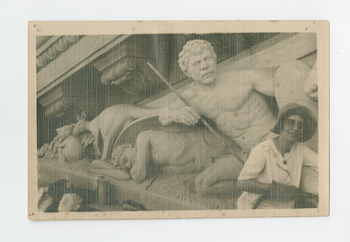
The classicism of Rome can be seen in several of Mayo's large-scale civic projects: The Horse Frieze and pilaster capitals for the new Tattersall's Club, Brisbane (1926), the Tympanum and Concert Hall Frieze, Brisbane City Hall (1927–1930), (figure 1), the Tympanum and Stations of the Cross for the Holy Spirit Church in the inner-city suburb of New Farm (1929–30) and the Queensland Women's War Memorial, Anzac Square, Brisbane (1929–1932).
Daphne Mayo working on the Brisbane City Hall tympanum, c1930, Daphne Mayo Papers, UQFL119, Fryer Library, The University of Queensland. Image courtesy of Fryer Library.

Although she had created a kind of European sensibility through her monumental architectural facades, Mayo was still keenly aware of the lack of a cultural centre in Brisbane. The Queensland National Art Gallery was the least funded in the Commonwealth, its permanent collection was dated and the building ill equipped to accommodate artworks.Footnote 4 From 1934–35, Mayo suspended her art practice to concentrate on leading a fundraising appeal, which secured £10, 000 (£6,000 from the State Government and £4,000 from public donations).Footnote 5 This in turn helped to secure the John Darnell Bequest fund for Queensland art, which transformed the Queensland National Art Gallery with a more substantial permanent collection as well as touring exhibitions.
Having made this contribution to the gallery, Mayo then moved to Sydney in 1940, to complete yet another commission at the State Library of New South Wales. She opened a studio on the first floor of 231 George Street, near Circular Quay as she began work on the bronze doors for the library.Footnote 6
This brief history serves to demonstrate why Daphne Mayo is a significant subject of study. Her collection at the Fryer Library contains correspondence, sketch books, notebooks, photographs, sculpting tools, smaller plaster models and other sculptures. Digital derivatives of some of the items in the collection are also available from the university repository, eSpace.Footnote 7
Laying foundations: Text and image
Judith McKay's thesis, completed in 1981 at the University of Sydney, was among the first detailed accounts of Mayo's life as an artist. McKay consulted primary sources at council archives, galleries and libraries for her 300-page thesis documenting the sculptural career and public art activities of Daphne Mayo.Footnote 8 As a museum curator, McKay was also in a unique position to understand Mayo's work as she was commissioned by the Mayo family to sort and pack Mayo's abandoned studio in the city centre of Sydney. McKay also arranged for works to be sent to various galleries, museums as well as the collection that was sent to the Fryer Library.
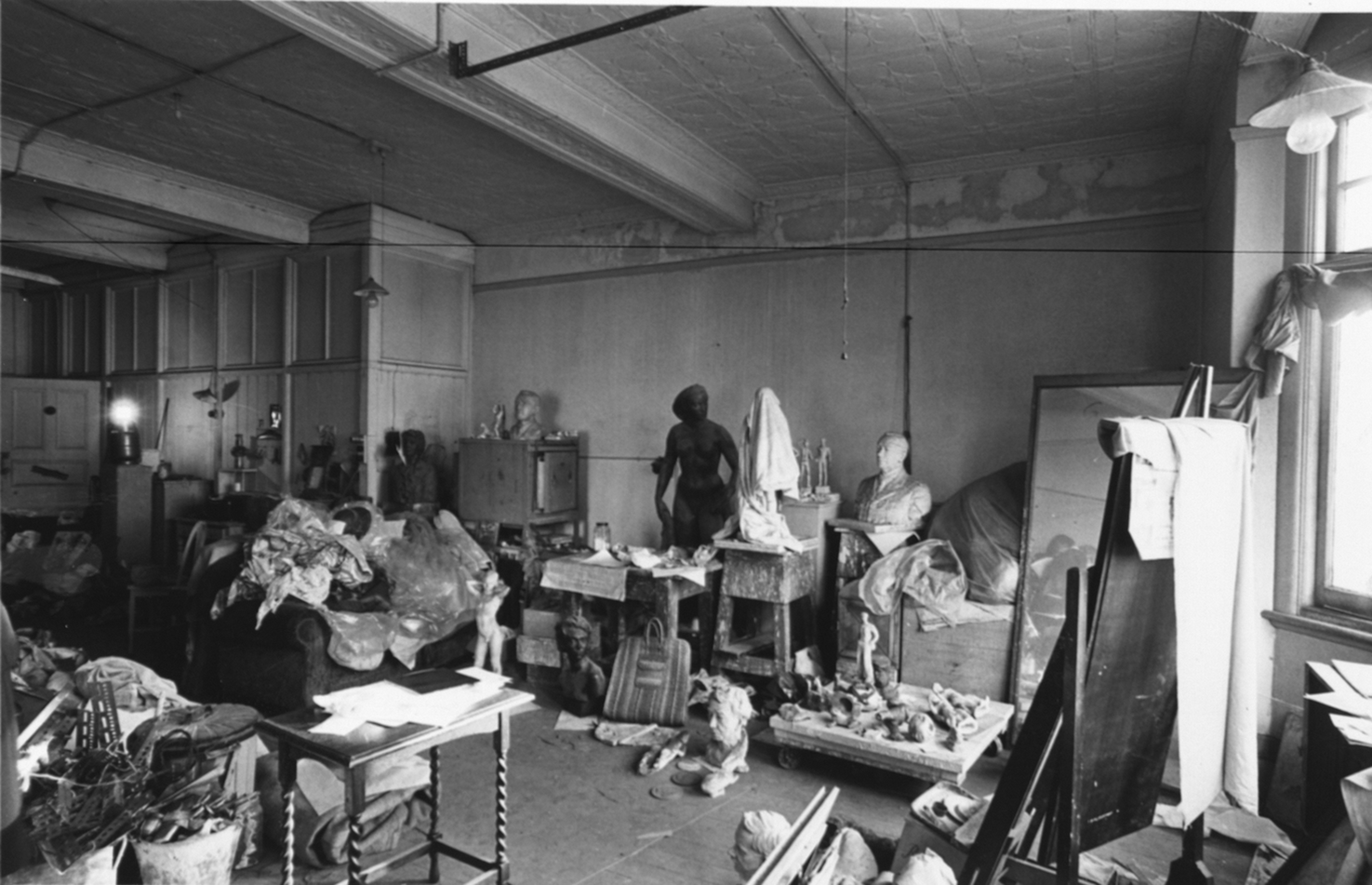
McKay's photographs documenting this process are instructive, revealing the chaotic conditions in which Mayo was working.Footnote 9 What is also apparent in McKay's documentation is Mayo's dedication to her practice, evident through her prolific output. As Figure 2 shows, large and small works fill up nearly every surface of the main room.
Inside the main room of Mayo's Sydney studio before sorting started. Photograph by Judith McKay, 1981, Daphne Mayo Papers, UQFL119, Fryer Library, The University of Queensland. Image courtesy of Fryer Library.

McKay's thesis places not only places Mayo's sculpture within the context of art in Queensland in the early twentieth century, it also places it within the context of sculpture in Australia and considers her wider artistic influence.Footnote 10 It also provides an assessment of Mayo's important public contribution to art in Queensland, improving both institutional investment and cultural standing.
Bringing Daphne back
Twenty-five years after the publication of McKay's thesis, Catherine Bell used the Mayo collection to create an altogether different body of work - a series of six digital photo collages titled Bringing Daphne back (2016).Footnote 11
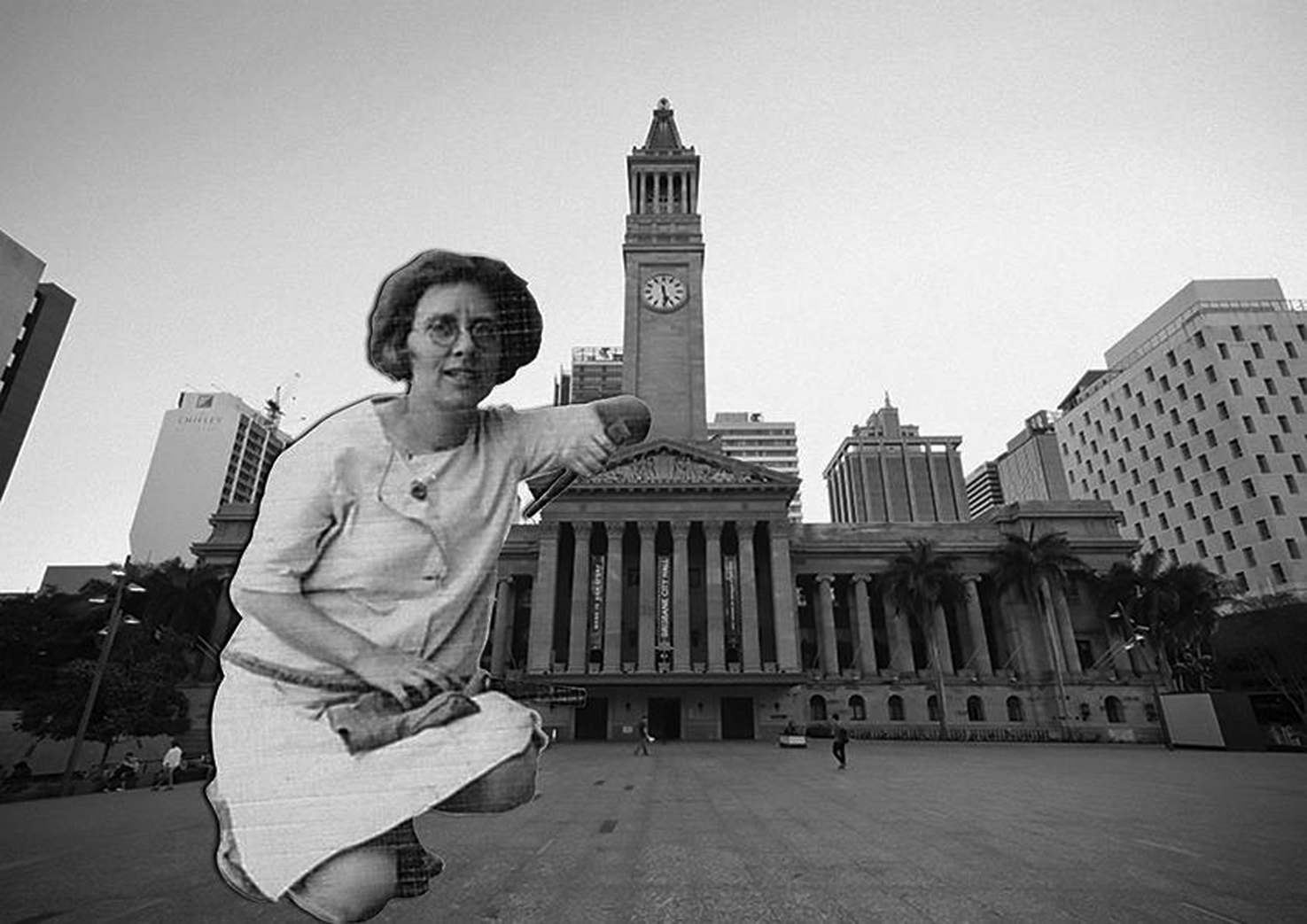
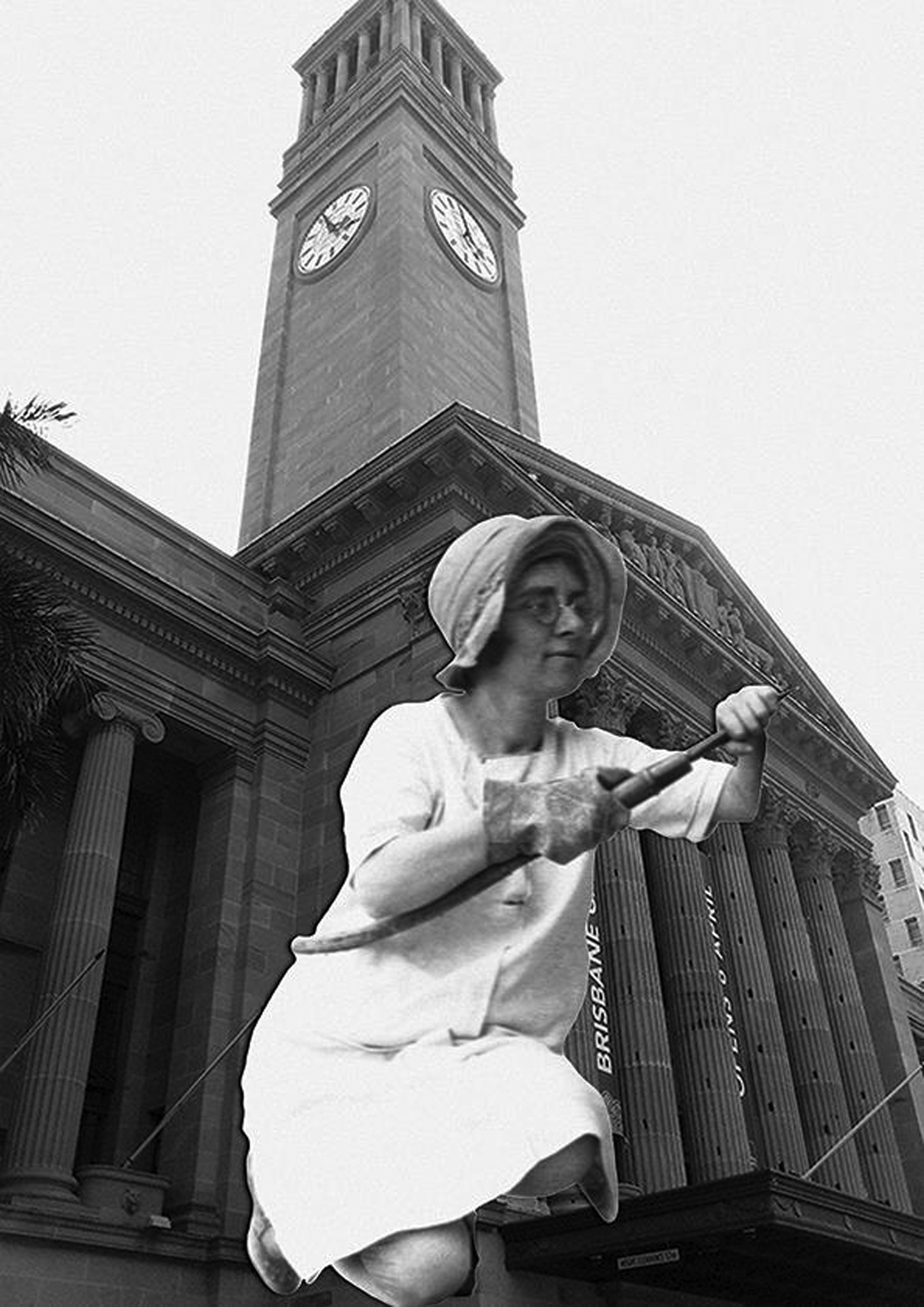
Lack of online attribution to Mayo as the creator of her civic sculpture forms the premise of this work. When searching for ‘Brisbane Museum Tympanum Frieze', Bell observed that the descriptions accompanying the results list of images did not acknowledge Mayo’s work. Bell therefore used these online images as a backdrop and superimposed images of Mayo working on the friezes and tympanum, sourced from glass plate slides in the Fryer Library collection. This reinstatement is regarded by Bell as a feminist intervention to redress the lack of attribution; the more Bell's images are reproduced online, the more they will appear in online search results.
In Bell's collages, the scale of artist to building has been inverted as Mayo towers over the Brisbane Town Hall, poised with chisel in hand (figures 3 & 4). Here, Bell presents the hidden herstory, revealing the woman behind the very well-known public sculptures she created.Footnote 12 To produce such a body of work, Bell undertook a research process of searching through papers, notebooks, letters, drawings to uncover Daphne Mayo the person and the artist. In a book chapter she authored on the project, she states: “I approached the archive like a detective, forensically searching for the unseen, with the goal of rendering Daphne's lived experience visible.”Footnote 13
Image from Catherine Bell's digital collage series “Bringing Daphne back” 2016. Image courtesy of the artist.

Image from Catherine Bell's digital collage series “Bringing Daphne back” 2016. Image courtesy of the artist.

Daphne Mayo is also a singular figure working alone in this series. Mayo's solitude reflects a more personal reflection that Bell encountered within Mayo's papers. As Bell described it, ‘a private lament’:
“Saturated, to fill excess and dedicated, to set apart and consecrate to some sacred purpose isolated in Brisbane - feeding on oneself. The pattern day after day, day after day, day after day, day after day, day after day, day after day. The tune of the days. Each day was the same – get out of bed put on the kettle have a cup of tea and then a second cup of tea read the paper, have a bath and get dressed.”Footnote 14
As a sculptor and academic, making work 70 years after Mayo, Bell nonetheless noted her connection with this personal reflection of the often lonely, tedious existence:
“The combination of Queensland's tropical climate and sculpting in corrugated iron studios left you saturated, longing to escape the everyday cycle of day after day working menial jobs that would interfere with my artistic calling, and feeling isolated, yearning to leave Brisbane's parochial shores and travel the globe to see artworks I had only read about in books. These few lines, written like the stanza of a poem, encapsulate her raison d'etre.”Footnote 15
Bell's photo collages show the power of artistic practice to transform archival material into a visceral, pictorial experience. Immersing the viewer in the lived experience of Daphne Mayo in ways that are sensorially different from reading biographical text. Taking the overlooked artist and making them as monumental as the work they produced.
Shifting ground
Another way of reading manuscript material is to analyse textual data derived from the original material. Instead of forensically searching through boxes of physical papers, a researcher can use software programs, algorithms and other digital technologies to piece together traces of the past.
Using text analysis and topic modelling in this way is to read a manuscript collection distantly instead of closely.Footnote 16 Whereas close reading focuses on the text in its original context, distant reading uses computational analysis of data sets extracted from the original writing.
This approach can be useful when searching across multiple documents, rather than one document at a time. A prime example of this is in letters or correspondence, where the multiple makes meaning rather than the singular. As sender and receiver repeat words, they can be counted and given a weighting. The relative proximity of words in sentences can also measured using text analysis tools. A researcher is able to scan thousands of letters to understand the main subjects contained within the correspondence or have more immediate micro analysis for each individual letter to reveal textual patterns and themes.
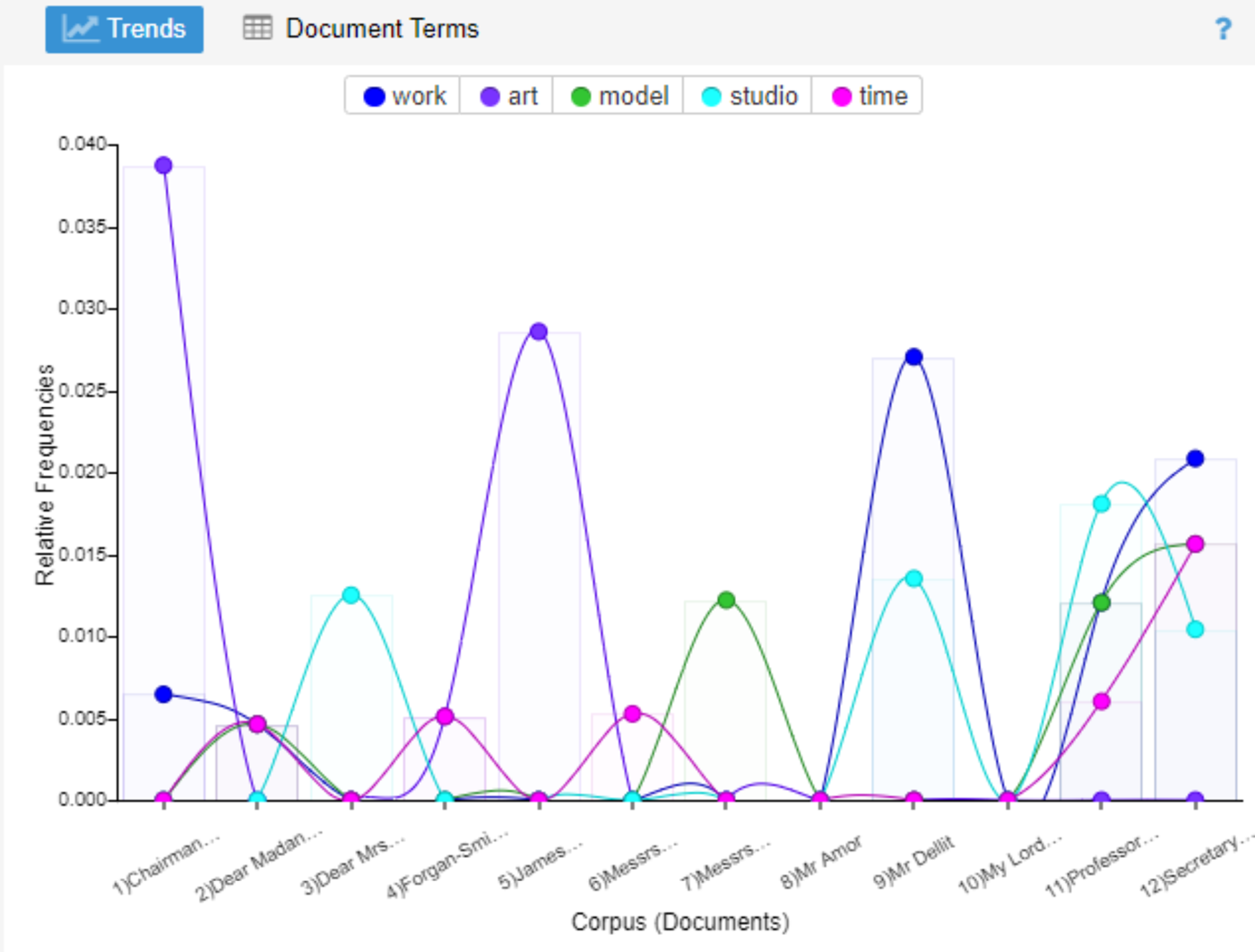
Figure 5 shows this type of topic modelling (pattern identification and thematic clustering) in the Daphne Mayo Papers, using a text analysis open-source software, Voyant. A sample of letters written by Mayo identifies key themes (work, art, model, studio, time) at a glance, within minutes, without physically reading each letter.
Voyant Tools topic modelling using a sample of letters written by Daphne Mayo. Voyant text analysis works by generating topics (term clusters) from a document or corpus and then seeing how each topic (term cluster) is distributed across the document or corpus.

If text analysis is a form of distant reading, equally, photogrammetry is a form of distant experience. It differs from photography in that it maps a surface using light recordings and renders it in three-dimensional form.Footnote 17 As such, its application is in architecture and the built environment, construction, geology as well as computer gaming graphics.
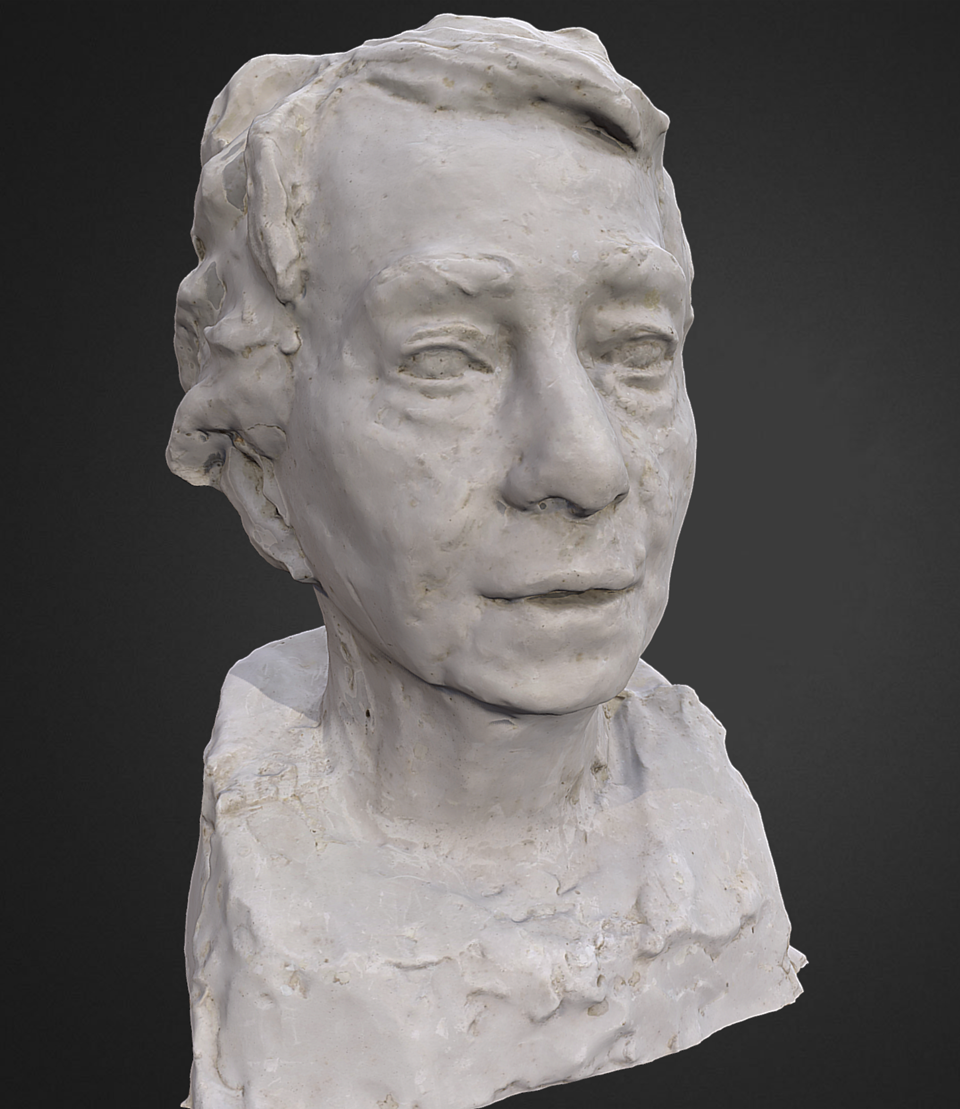
Photogrammetry is also used in museums and cultural heritage collections to render and create models for visitor engagement. Where archaeological or older artefacts are more fragile, a three-dimensional photogrammetry version acts as a preservation copy of the original. It provides a more immersive experience than a two-dimensional digital image as the viewer can click to activate the object, turning it around to view from all sides as a three-dimensional object. Figure 6 shows a photogrammetry model of Mayo's portrait bust sculpture of Dame Mary Gilmore.
3D scan of portrait bust sculpture of Dame Mary Gilmore by Daphne Mayo from Daphne Mayo Papers, UQFL119, Fryer Library, The University of Queensland. Image courtesy of Fryer Library.

Return to the real
What is missing in the digital analysis and reproduction is the materiality - the touch and smell of the thin, worn paper or the appearance of faded ink on a yellowing page. Similarly, the weight of the physical bronze bust, the texture and patinas that have worn over time. This kind of tactile information is only gathered in the original, what Walter Benjamin refers to as the ‘aura’ of the object.Footnote 18
Mayo recorded information in her idiosyncratic, at times almost illegible, handwriting. She wrote on the back of an envelope, on the inside cover of a book or in the margin of a receipt. In keeping with her stream-of-consciousness style, she often made quick, small-scale sketches in between her notes-to-self. As the transcriptions of the letters focus primarily on the text, the drawn lines are not recorded. For this, we would need to revert to close reading.
Text is transcribed in order of appearance on the page. It doesn't register whether it is marginalia or placed to the side. As data, it provides content for analysis, not the original context in which it existed. Sometimes this is also a relevant detail. To return to the original quote of Mayo's that resonated with Bell so much:
“Even better, I found it not in the typical archival material a historiographer would expect, like a diary or in a letter, but buried in the corner of an unassuming, standard, office issue accounts book, with carbon paper inserts.”Footnote 19