Introduction
Recurrent aphthous stomatitis is a common disease of the oral mucosa, affecting 20 per cent of the general population.Reference Shulman1 This disease is characterised by recurrent, round, shallow oral ulcerations surrounded by inflammation, chiefly involving non-keratinised mucosa.Reference Casiglia2
Recurrent aphthous stomatitis is classified into three types: minor, major and herpetiform aphthous ulcerations. The most common form of recurrent aphthous stomatitis is minor aphthous ulceration, followed by major and then herpetiform ulcerations.Reference Bagan, Sanchis and Milian3 The aetiology of recurrent aphthous stomatitis is unknown. These ulcerations may be indicative of underlying systemic diseases, ranging from vitamin deficiency to autoimmunity.Reference Greenberg and Pinto4 In addition, several studies have investigated the role of genetics, stress, haematinic deficiencies, vitamin deficiencies and autoimmunity in this disease.Reference Kozlak, Walsh and Lalla5–Reference Lehner11 Zinc is one of the most important trace elements in the human body. Endre et al. reported the case of a patient with zinc deficiency and cellular immune deficiency who had had recurrent aphthous ulcerations for six years and in whom these ulcers disappeared following zinc treatment.Reference Endre12 Delayed wound healing in zinc deficiency indicates that zinc is important for the metabolic response to wound healing.Reference Hallmans13 However, zinc deficiency has not been investigated in recurrent aphthous stomatitis patients. We report a controlled pilot study comparing zinc levels in a group of patients with recurrent aphthous stomatitis and a well-matched healthy control group.
Materials and methods
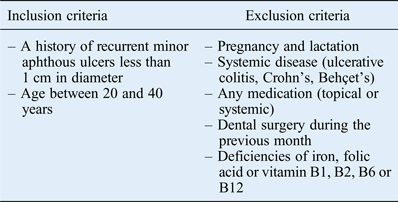
Twenty-five patients with a history of recurrent aphthous stomatitis and 25 healthy people (control group) took part in the study. Patients who attended our otorhinolaryngology clinic between May 2011 and July 2012 complaining of recurrent oral aphthous ulcers less than 1 cm in diameter and between the ages of 20 and 40 years were included in the study.Reference Bagan, Sanchis and Milian3 Exclusion criteria were pregnancy and lactation, systemic disease (ulcerative colitis, Crohn's disease, Behçet's disease), any medication (topical or systemic), dental surgery during the previous month and deficiencies in iron, folic acid or vitamin B1, B2, B6 or B12 (Table I).
Study inclusion and exclusion criteria

Ethics committee approval was obtained and the study was conducted in accordance with the Declaration of Helsinki. Informed consent was obtained from all participants. Serum zinc levels were measured using flame atomic absorption spectrophotometry (UNICAM 929, Portsmouth, NH, USA). The accepted normal serum zinc level is 95–130 µg/dl. Serum zinc levels in patients were compared with those the control group.
Statistical Analysis
Statistical analysis was performed using SPSS version 13.0 software (Chicago, Illinois, USA). The distribution of continuous variables was tested using the Kolmogorov–Smirnov test. The chi-square test was used for comparisons between categorical variables, and the Mann–Whitney U test was used to compare medians between the groups. Statistical significance was set at a p value greater than 0.05.
Results
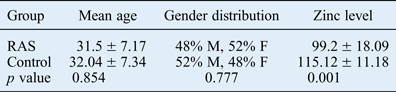
The mean age in the recurrent aphthous stomatitis and control groups was 31.5 ± 7.17 and 32.04 ± 7.34, respectively. Fifty-two per cent of the recurrent aphthous stomatitis group and 48 per cent of the control group were female. The groups were similar in terms of age (p = 0.854) and gender (p = 0.777) (Table II).
Demographics and serum zinc levels
RAS = recurrent aphthous stomatitis; M = male; F = female
Twenty-eight per cent of the patient group and 4 per cent of the control group had serum zinc levels lower than 95 mg/dl. The mean serum zinc levels in the recurrent aphthous stomatitis and control groups were 99.2 ± 18.09 mg/dl (range 65–128) and 115.12 ± 11.18 mg/dl (range 79–128), respectively. The serum zinc level of recurrent aphthous stomatitis patients was significantly lower than that in the control group (p = 0.001) (Table 2).
Discussion
Zinc is the second most abundant trace metal in the human body, and it is present in all living cells and body secretions.Reference Lansdown14 Zinc deficiency is reported to produce marked effects on virtually all components of the immune system. Although not considered to be involved in the immune response, mucosal and barrier immunity (i.e. skin acting as a barrier to prevent penetration of organisms) can be affected by the nutritional status of an individual.Reference Keen15 In a study by Orbak et al., oral aphthous ulcers were seen in rats fed a zinc-deficient diet.Reference Orbak, Kara, Ozbek, Tezel and Demir16 These authors reported zinc deficiency to be a potential risk factor for oral and periodontal diseases.
Several studies have investigated the efficacy of zinc treatment for recurrent aphthous stomatitis, with contradictory results. Orbak et al. reported that 42.5 per cent of the recurrent aphthous stomatitis patients in their study had lower than normal serum zinc levels. They recommended zinc therapy for recurrent aphthous stomatitis because the aphthous ulcers were reduced in size and did not recur in the zinc-treated group.Reference Keen15 Although most reports recommend zinc treatment for recurrent aphthous stomatitis, Wray et al. failed to confirm the beneficial effects of zinc seen in previous studies.Reference Orbak, Kara, Ozbek, Tezel and Demir16–Reference Merchant, Gangarosa, Glassman and Sobel18
In this controlled study, zinc deficiency was detected in 28 per cent of recurrent aphthous stomatitis patients and 4 per cent of controls. The mean serum zinc level for the recurrent aphthous stomatitis group was significantly lower than that of the control group.
• Recurrent aphthous stomatitis is a common disease of the oral mucosa
• The aetiology of recurrent aphthous stomatitis is unknown
• Zinc deficiency was detected in 28 per cent of recurrent aphthous stomatitis patients and in 4 per cent of controls
• Serum zinc levels were significantly lower in recurrent aphthous stomatitis patients than in controls
• Zinc deficiency is a potential aetiological factor for recurrent aphthous stomatitis
This is the first controlled study to compare zinc levels in recurrent aphthous stomatitis patients with those of a well-matched healthy population. However, because it is a pilot study, one limitation was the low number of enrolled patients. It is therefore recommended that larger, more detailed studies should be done to obtain more definitive data.
Conclusion
Our data suggest an association between zinc deficiency and recurrent aphthous stomatitis. Therefore, zinc deficiency must be considered a possible aetiological factor for recurrent aphthous stomatitis.