I. INTRODUCTION
To remove nonmetallic inclusions and ensure the requirements of high purity metal castings, ceramic foam filters (CFFs) have been used in steel applications for several years.Reference Janke and Raiber1 These inclusions determine the deformation and breaking behavior to a large extent as well as the physical properties of the steel. During load, stress concentrations are generated in the proximity of inclusions.Reference Bargel and Schulze2,Reference Jacobi3 Difficulties primarily appear during the verification of inclusions in aluminum-deoxidized steel, especially in the distinction between primary, secondary, and tertiary inclusions.Reference Ovtchinnikov4 Wasai et al. assigned the dendritic, maple-like and polygonal inclusions to the group of the primary inclusions, generated directly after adding aluminum in the metal melt. In contrast, the network-like, coral-like, and spherical inclusions, which are composed of alumina, hercynite, and wüstite, are classified as secondary inclusions. The secondary inclusions are formed due to the lower solubility of oxygen in the melt as a function of the temperature above the liquidus temperature of the melt.Reference Wasai, Mukai and Miyanaga5 Below the liquidus temperature, tertiary and quartenary inclusions are generated that present the highest impact on fractures toughness of steel casts according to Ovtchinnikov.Reference Ovtchinnikov4
The different types of ceramic filters include foam filters, extruded cellular ceramic filters, and pressed filter cores.Reference Adams and Tackaberry6 The production technology for ceramic filters with defined porosity for the molten bath filtration, using a pressing technique, was investigated by Mogilevskii.Reference Mogilevskii and Burtsev7 Regarding the thermo mechanical requirements of CFFs with respect to optimal casting temperatures, by avoiding metal melt freezing, an optimum wall thickness of approximately 0.3 mm is required.Reference Aneziris, Ansorge and Jaunich8,Reference Hasterok, Wenzel, Aneziris, Ballaschk and Berek9 According to Olson et al., when an inclusion interacts with the filter surface, the strength of adhesion must be great enough to resist the force of the flowing metal. The adhesion strength is a function of the interfacial energies between nonmetallic inclusion/filter (σNMI–F), liquid metal/filter (σLS–F), and liquid metal/nonmetallic inclusion (σNMI–LS). The change in free energy for the separation of an inclusion from the melt to the filter wall is given as follows:
 $$\Delta G = {\rm{\sigma }}_{{\rm{NMI}} - {\rm{F}}} - {\rm{\sigma }}_{{\rm{LS - F}}} - {\rm{\sigma }}_{{\rm{NMI - LS}}} \quad.$$
In order for the inclusion to be attached and remain fixed on the filter surface, the free energy must be sufficiently below zero.Reference Olson and Martins10
Hammerschmid et al. and Morales et al.Reference Hammerschmid and Janke11–Reference Morales, Davila-Maldonado, Adams, Oliveira and Alquist13 give an overview of the filtration mechanisms of solid nonmetallic inclusions, filtration efficiencies, filter materials, and filter structures for steel melts. According to Uemura et al., entrapment of the solid nonmetallic inclusions by ceramic filters takes place in three steps, (i) the solid nonmetallic inclusions are transported from the bulk melt to the filter surface, (ii) the solid nonmetallic inclusions are attached to the surface of the filter, and (iii) the solid nonmetallic inclusions undergo solid-state sintering with the filter medium. Based on a two solid globular inclusions contact model (the 2nd inclusion could be also the surface of the filter) in molten steel, a vacancy will be generated between the two inclusions by the surface tension of the steel, and the attraction force works on the particles. Uemura et al.Reference Uemura, Takahashi, Koyama and Nitta14 underline that the “contact angle, and then, the attraction force does not change so much even if the filter composition changes.”
Janiszewski and Kudlinski present theoretical grounds for the process of refining molten steel from liquid nonmetallic inclusions using the thermodynamic precondition to the absorption of liquid nonmetallic inclusions on the surface of a ceramic filter. The thermodynamic prerequisite of spontaneous adsorption of the liquid nonmetallic inclusion by the ceramic filter surface has to satisfy the inequality:
 $$\Delta G = G_2 - G_1 \,\lt \,\,0\quad,$$
with G 1 the energetic state of liquid steel/liquid nonmetallic inclusion/ceramic filter prior to inclusion adsorption and G 2 after the inclusion adsorption by the ceramic filter. In their expression of ΔG, the radius of the liquid nonmetallic inclusion before absorption (R I), the interphase tension between liquid nonmetallic inclusion and liquid steel (σNMI–LS), and the contact angle between the liquid nonmetallic inclusion and the ceramic filter material are incorporated. The authors come to the expression:
 $$\Delta G = {\rm{\pi }}R_{\rm{I}}^{\rm{2}} {\rm{\sigma }}_{{\rm{LNMI}} - {\rm{LS}}} {\bf{B}}{\rm{\quad,}}$$
in which B is defined as a function of “angle of the filter ceramic wetting by the liquid nonmetallic inclusion.” Based on surface tension equilibriums and on trigonometric dependences in function B, the contact angle between the liquid nonmetallic inclusion and the ceramic filter material is incorporated. When the contact angle between the liquid nonmetallic inclusion and the ceramic filter material lies in the range of 90° and more, ΔG reaches values of <−0.0010 × 10⁻⁷ J independent of the interphase tension between liquid nonmetallic inclusion and liquid steel (σLNMI−LS). On the other hand, as the radius of the liquid nonmetallic inclusion increases, lower values of the ΔG are achieved, approximately −0.040 × 10⁻⁷ (for σNMI−LS 0.3 N/m) up to −0.0140 × 10⁻⁷ J (for σLNMI−LS 0.1 N/m). Also in the case of nonwetting (90°) between the liquid nonmetallic inclusion and the ceramic filter materials in case of liquid nonmetallic inclusions, ΔG lies in the range of −0.004 up to −0.001 10−7 J.Reference Janiszewski and Kudlinski15 Aneziris et al. have determined clogging phenomena by comparing oxide-coated nozzles with uncoated ones. The nozzle with an alumina active coating led to increased clogging phenomena, based on endogenous and exogenous inclusions as well as steel clogged particles. Correlating the clogging behavior to filtration efficiency, a higher filtration of steel melts derives from the application of alumina active coatings on carbon-bonded filters.Reference Aneziris, Dudczig, Hubálková, Emmel and Schmidt16 According to Davila-Maldonado et al.,Reference Davila-Maldonaldo, Adams, Oliveira, Alquist and Morales17 the filtration efficiency of CFFs of nonmetallic inclusions in ferrous melts is <75% in the particle size range from 1 to 100 μm. Based on these fundamentals, the results of this contribution show the generation of new carbon-bonded alumina CFF with cold-applied active oxide coatings, whose chemistry equates to the chemistry of nonmetallic oxidic inclusions. Those filters are to combine the positive properties of the carbon-containing substrate material, demonstrated by Emmel et al.,Reference Emmel and Aneziris18 on the one hand and the active characteristics of the pure oxide coating on the other hand.
II. MATERIALS AND METHODS
The raw materials used for the preparation of the investigated oxidic active coatings were alumina (CL 370, Almatis, Ludwigshafen, Germany, 99.70 wt% Al2O3, d 50 = 2.5 μm), spinel (AR 78, Almatis, Ludwigshafen, Germany, 74.00 wt% Al2O3, 22.50 wt% MgO, d 50 = 2.0 μm), and mullite (SYMULOX M 72 K0C, Nabaltec, Schwandorf, Germany, 72.00 wt% Al2O3, 26.00 wt% SiO2, d 50 ≤ 5.0 μm). The additives were polypropylene glycol (PPG P400, Sigma-Aldrich, Steinheim, Germany—used as a wetting agent), ligninsulfonate (T11B, Otto-Dille, Norderstedt, Germany—used as a temporary binder), Dolapix PC 75 (Zschimmer & Schwarz, Lahnstein, Germany—used as a dispersing agent), and Contraspum K 1012 (Zschimmer & Schwarz, Lahnstein, Germany—used as an antifoam agent).
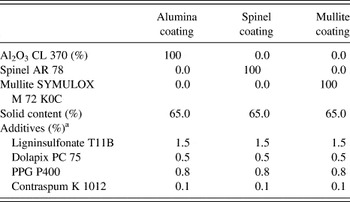
With the aid of a spraying chamber and an airgun of the type SATAjet B (Sata, Ludwigsburg, Germany), with a nozzle diameter of 1.0 mm, the carbon-bonded alumina filter substrates were spray coated. The respective coating compositions are listed in Table I. The spraying pressure was regulated to three bars. The distance between nozzle and filter was kept constant to approximately 10 cm. The spraying took place on all six sides of the filter, whereby the largest sides, in regard to the surface area, were sprayed for 3 s and the smaller dimensioned sides for about 1 s. Spraying times are, however, only approximate values since the aim of the process was to coat the filters by the sprayed slurry up to a filter weight of approximately 28 g in the wet condition. The sprayed samples were dried at room temperature. 20% Carbores® P containing filters (AC5; Rütgers, Castrop-Rauxel, Germany), described by Emmel,Reference Emmel and Aneziris18 served as substrates with a sample size of 50 × 50 × 20 mm3, and an average pore size of 10 ppi.
Compositions of the oxidic active coatings.

a Related to the solid content.
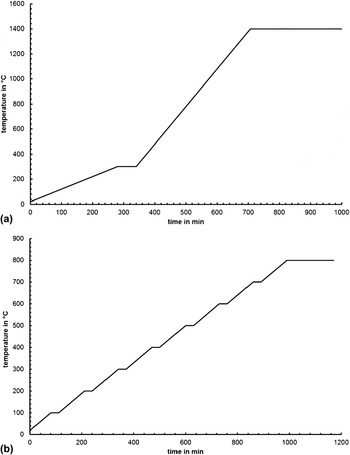
To detect the influence of a thermal pretreatment on the sintering behavior of the coatings on the substrate, thermally pretreated carbon-bonded alumina filters, as well as filters in the green state were spray coated. Concluding, the samples were fired at 1400 °C, according to the firing curve, shown in Fig. 1(a). For the thermal pretreatment of the filter substrates, the coking regime shown in Fig. 1(b) has been applied.
(a) Firing curve for the sintering of the oxide-coated carbon-bonded filter substrate at 1400 °C. (b) Coking regime for the thermal pretreatment of the carbon-bonded filter substrate at 800 °C.

Therefore, the filters were embedded in retorts, filled with calcined petcoke (Müco, Essen, Germany) of particle size distribution of 0.2–2.0 mm, to guarantee reducing conditions.
The characterization of the slurries, regarding their rheological behavior, was accomplished with the aid of the rheometer RheoStress RS 150 (Haake, Germany). For the measurement of the flow curves, a coaxial cylinder measuring system of the type 01038 Z40 DIN Ti was used. The flow behavior was determined by the measurement of viscosity and shear stress during the variation of the shear rate. This was changed linearly from 0.1 to 1000/s, and kept at this level for 90 s, before reduced with the same rate to the initial 0.1/s value. The 1000/s is cited as a common value, achieved during the spray process.Reference Fischer19 The cold crushing strength (CCS) was determined on an universal testing machine TT 2420 (TIRA GmbH, Germany), using a 20 kN pressure cell. The displacement speed was 3 mm/min, until a counteracting force of 5 N was reached. At this load, the displacement speed was changed to 1 N/mm2/s. The experiment was terminated when a strength loss of 80% was reached. Ten samples of each filter type were tested. For the characterization of the shrinkage behavior of the oxide coatings, the dilatometer DIL 402 C (Netzsch, Selb, Germany) was used. The coated filterbars were of the size 5 × 5 × 20 mm3. Under argon atmosphere, the samples were sintered within the equipment at 1400 °C. Both the heating and the cooling rate amounted to 5 K/min. The open porosity of the struts of the coked substrate material and the sintered coating material was measured with the aid of a mercury porosimeter Pascal 140/440 (Porotec, Germany). A Philips XL 30 (Philips, Germany) scanning electron microscope was used for the determination of the strut thickness and for the coating thicknesses. To detect the strut thickness and coating thickness distribution, foams were analyzed using a Micro focus x-ray computer tomograph CT-ALPHA (ProCon x-ray, Germany), equipped with a 160 kV x-ray source and a C7942SK-05 (Hamamatsu, Japan) detector with 2024·2024 active pixels. Measurements were made at 155 kV, and the received cubic pixel (voxel) had a size of 65 × 65 × 65 μm3. The so-called impingement test has been accomplished to verify the applicability of the newly developed filter materials. Within this test, the cold filters (18 °C) are impinged with approximately 6 kg of steel melt (1670 °C) with a drop height of 30 cm, to evaluate their thermal shock resistance, as well as their permeability.
III. RESULTS AND DISCUSSION
A. Rheological behavior of the oxidic active coating slurries
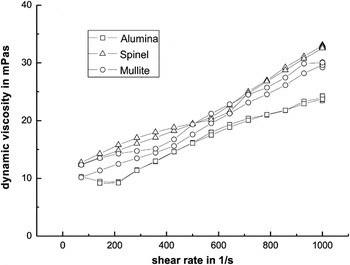
The rheological behavior of the alumina, spinel, and mullite spraying slurries is plotted in Fig. 2. Each slurry shows a shear thickening behavior due to the catching of the respective particles with increasing shear rates, that is necessary for the spraying process. The varying dynamic viscosities at a shear rate of 1000/s with the values 24.4 MPa for alumina, 29.8 MPa for mullite and 32.8 MPa for spinel are traceable back to the absence of the optimization of additive contents for each oxide, since this was only done for alumina and the varying particle sizes. To guarantee comparable conditions with respect to the pore evolution, water contents and additive contents were kept constant. Higher solid contents are not permissible, since the shear thickening behavior of the slurries would not result in sprayable slurries, leading to an inhomogeneous coating of the substrate material.
Rheological behavior of alumina, spinel, and mullite-coating spraying slurry up to a shear rate of 1000/s.

B. Influence of a thermal pretreatment of filter substrates on the sintering of the oxidic coating
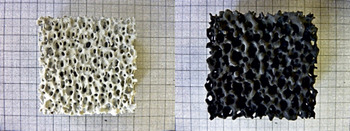
The results regarding the influence of a thermal pretreatment on the oxide coating are presented in Fig. 3, comparing a filter thermally pretreated at 800 °C (left) and a green filter substrate (right). Both oxide-coated filters were sintered at 1400 °C, according to the firing curve shown in Fig. 1(a). The thermal pretreatment of 800 °C [Fig. 1(b)], exemplified on alumina, leads to stable coated filters, whereas the sintering of thermally nonpretreated filters generates macrocracks. Due to its capillary activity, the unsintered coating partially absorbs the binder (Carbores® P), which softens at temperatures >200 °C, as a consequence of the absence of the thermal pretreatment, and leads to a weakening of the binder matrix. Therefore, the generation of a pure oxidic active coating without thermal pretreatment is impractical.
Alumina-coated carbon-bonded alumina filters, coked at 1400 °C (left: with thermal treatment of the substrate material at 800 °C, resulting in pure oxide coating material, right: without thermal pretreatment of the substrate material, leading to bigger struts thicknesses and carbon-containing alumina coating material).

C. Sintering behavior of the coatings on thermally pretreated filter substrates
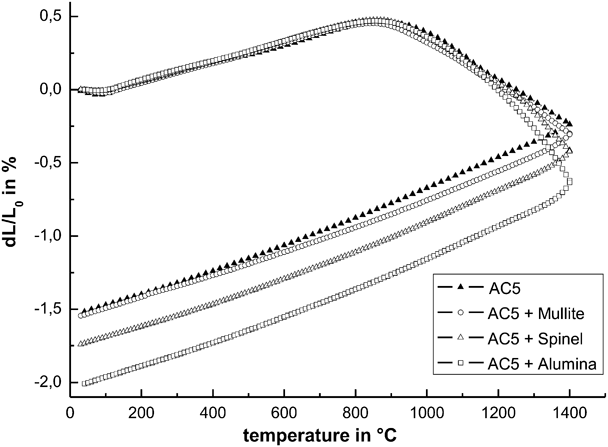
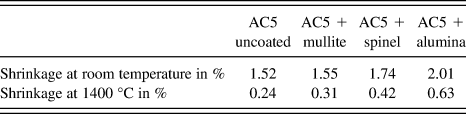
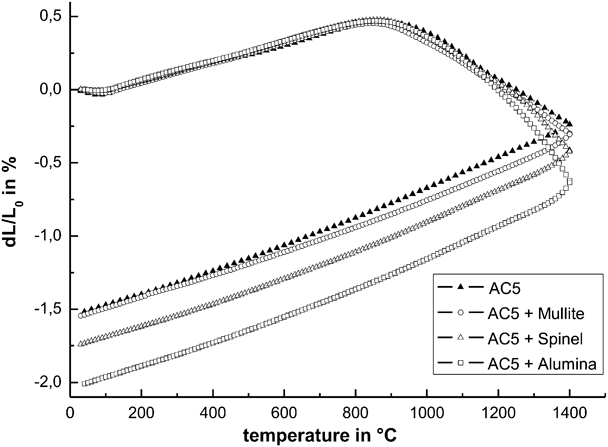
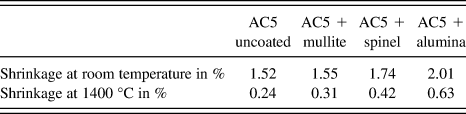
Figure 4 presents the influence of the oxide coatings on the strain and shrinkage behavior of a 20% Carbores® P containing filter. For this, the dilatometer curve of an uncoated filter is opposed to the filters coated with mullite, spinel, and alumina, in situ sintered within the dilatometer under inert atmosphere. All curves, up to a temperature of approximately 850 °C, show an expansion of 0.5%, which is to be attributed to the thermal strain. The following shrinkage behavior of all tested filters is to trace back to a dehydrogenation process of the carbon-bonded substrate material, with which most of the remaining volatile components are removed. These are still present up to 800 °C because of a thermal pretreatment of only 800 °C. Shrinkage is increased besides by a graphitization process, resulting in a higher degree of order of the graphite-like structures. The oxide-coated filters present a more pronounced shrinkage within the temperature range of 1150 °C, up to the final temperature of 1400 °C. The varying sintering behaviors of the respective oxides lead to different shrinkage values, shown in Table II. Due to the thermal treatment, the oxides shrink onto the substrate material, resulting in tight and microcrack free coatings.
Shrinkage behavior of the coated and uncoated filters, in situ sintered under argon within the dilatometer.
Shrinkage values of the in situ sintered coated and uncoated filters at room temperature and 1400 °C.
D. Evaluation of the strut and coating thicknesses by means of scanning electron microscopy and computer tomography
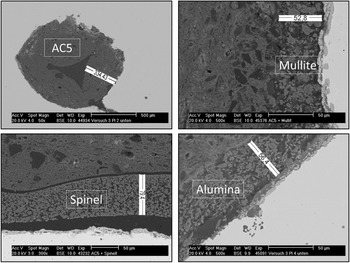
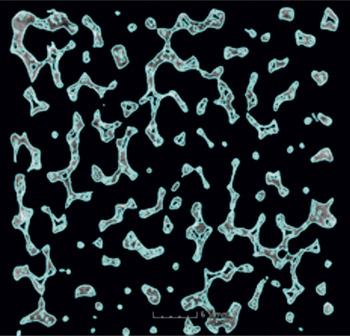
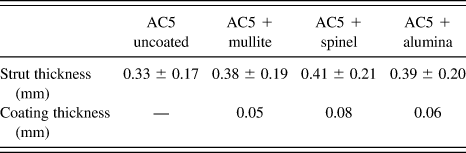
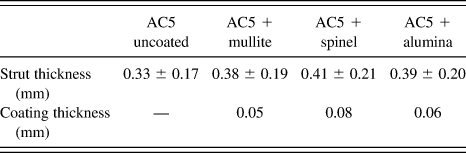
The strut thickness of the carbon-bonded alumina filter as well as the coating thicknesses of the oxide coatings are illustrated in Fig. 5. Based on the strut thicknesses determined with the aid of the scanning electron microscopy (SEM), the computer tomography (CT) should provide the detection of the coating thickness within the entire filter. Due to the similar chemistry of both the coating and the substrate materials, the material contrast disallows explicit separations (Fig. 6). Moreover, the voxel size of 53 μm implies a resolution, which is partially smaller than the coating itself, which is traceable back to the sample size of 50 × 50 × 20 mm3. Therefore, the measurement of the coating thickness has to be divided into two steps. The 1st step consists of the strut thickness evaluation of uncoated filters. In the 2nd step, the filter has to be measured in the coated condition. By subtracting the strut thicknesses of both, the coated and the uncoated filters, approximate coating thicknesses could be calculated, Table III. From this, nearly the same values arise for the respective coatings, which additionally equate to the values investigated by using SEM. These coating thicknesses prove to be independent of the varying dynamic viscosities of the slurries and give good reproducibility and comparability.
SEM-image, presenting the strut thickness of the carbon-bonded alumina filter (334.43 μm), sintered at 1400 °C, and the coating thicknesses of mullite (52.8 μm), spinel (79.4 μm), and alumina (56.4 μm), sintered at 1400 °C.

CT-image of an alumina-coated filter, coked at 1400 °C.

Strut thickness of the coated and uncoated filter systems, coked at 1400 °C.
E. Evaluation of the open and functional porosity by means of mercury porosimetry and computer tomography
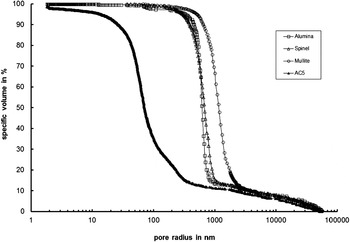
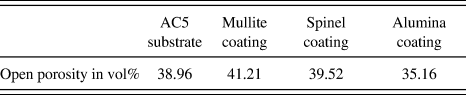
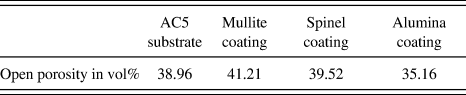
The results of the open porosity (Table IV) of the filter substrate and coating materials correlate with the shrinkage values, presented in chapter 3.3. Independent of the constant solids and additive content, the open porosity of the respective coating systems varies. Compared with the substrate material, which exhibits pores ranging predominantly between 30 and 320 nm, the respective coating materials show porosities, comprising larger pore radii, plotted in Fig. 7. In the case of the alumina coating, these range between 470 and 820 nm, for spinel between 430 and 1010 nm, and for mullite between 610 and 1800 nm. From this it follows that the more pronounced the shrinkage of the coated filters, the lower the open porosity.
Pore size distribution of the carbon-bonded alumina substrate as well as of the respective coating materials.

Open porosity of the substrate and coating materials, coked at 1400 °C.
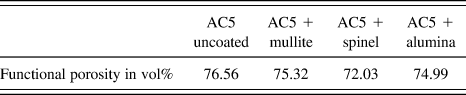
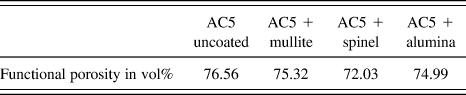
The values of the functional porosity, determined with the aid of computer tomography, are shown in Table V. As a logical consequence, the uncoated filter AC5 exhibits the highest porosity. Due to the application of the respective coatings, the functional porosity decreases with increasing coating thickness. Referring to this, the spinel-coated filter system shows the lowest functional porosity value in accordance with the coating thicknesses, presented in chapter 3.4.
Functional porosity of the uncoated and coated filters, coked at 1400 °C.
F. Influence of the coating on the cold crushing strength
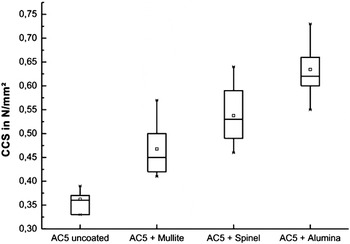
The results regarding the influence of the coating on the CCS are illustrated in Fig. 8, which includes thermally pretreated filters, coked at 1400 °C. Based on the application of the coating, the CCS increases from 0.36 N/mm2 (uncoated) to 0.47 N/mm2 for mullite, 0.54 N/mm2 for spinel and 0.63 N/mm2 for the alumina coating. Due to the coating, the effective cross-section increases slightly, and a minimization of the carbon oxidation is expected. Moreover, the shrinkage of the coating onto the filter struts is assumed to generate compression stresses that counteract the peak stresses of the hollow filter struts, resulting in higher CCS. The dependence of the CCS increases, as a function of the coating material, correlates exactly with the shrinkage, and opens porosity values, shown in chapters 3.3 and 3.5. With an increasing amount of shrinkage, the porosity is decreased and compression stresses are increased, which leads to the highest CCS for alumina and the lowest CCS for mullite. Due to nearly same coating thicknesses, other influencing factors are mainly eliminated.
Cold crushing strength of the coated and uncoated filter systems, coked at 1400 °C.

G. Impingement test
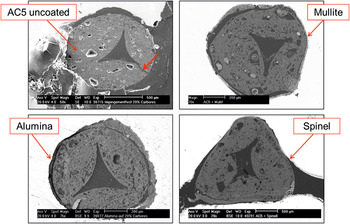
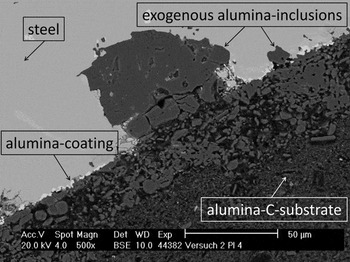
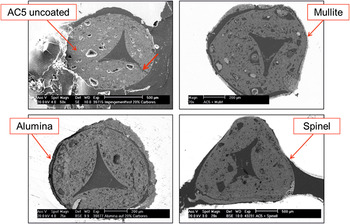
The accomplishment of the impingement test verified the applicability of the newly developed filter materials. Therefore, thermally pretreated filters (800 °C), coated with the respective oxides, sintered at 1400 °C have been tested. The polished cross-sections of the filter struts after the impingement test are shown in Fig. 9. From this arises that the respective coatings still remain after the test due to the high thermal conductivity of the carbon-bonded substrate material, which compensates the poor thermal shock resistance of the oxide coating materials. The gap between coating and substrate material confirms the assumption in chapter 3.3, which indicates that the mechanism of the adhesion of these coatings is primarily to trace back to the pronounced shrinkage and less to potential chemical reactions. Moreover, stress peaks appearing at the trigonal, hollow filter struts are reduced by the coatings. In comparison with the impingement test, industrial castings with an amount of approximately 70 kg steel melt do not lead to a gap between the filter substrate and the oxide coating, Fig. 10. In the case of the impingement test, the respective filters are incompletely filled with steel after the test, leading to higher deformation values in means of shrinkage of the steel. The industrial tested filters are, however, entirely filled, which prevents pronounced shrinkage of the steel and therefore decreases the generation of gaps. The interface between active coating, trapped inclusions, and steel melt of the impingement and industrial tests will be described in a future paper contribution.
Polished cross-sections of the oxide-coated filter struts after the impingement test.
Polished cross-sections of the alumina-coated filter struts after the industrial casting with trapped exogenous alumina inclusions of a particle size up to 60 μm on its active alumina surface.

IV. CONCLUSIONS
In terms of this contribution, new active oxide-coated filters for the steel melt filtration with a coating thickness of approximately 50–80 μm have been developed. It was shown that Carbores® P containing filter substrates have to be thermally pretreated, to guarantee pure oxide coatings. A sintering temperature of 1400 °C led to the generation of tight-coated filter systems due to a pronounced shrinkage of the coating materials onto the filter struts. In addition, the shrinkage generated compression stresses that counteract the peak stresses of the hollow filter struts, resulting in higher CCS. The amount of the CCS increase was dependent on the sintering activity of the respective oxides. Therefore, the CCS decreased from alumina over spinel to mullite. Concluding, the applicability of the newly developed filter systems in consideration of their thermal shock resistance as well as their permeability was approved.
ACKNOWLEDGMENTS
The authors would like to thank the German Research Foundation (DFG) for supporting these investigations through the Collaborative Research Centre 920 “Multi-Functional Filters for Metal Melt Filtration—A Contribution towards Zero Defect Materials”, Subproject A01, Mrs. Jana Hubálková for the CT measurements, and Mr. Gert Schmidt for the SEM images.