


The statistic
 ${\rm{\hat H}}$
= 2 (Rmz – Rdz), commonly used to estimate heritability H from the intraclass correlations of MZ and DZ twins, is quite variable unless the sample size is much larger than is typical in twin research. Loehlin and Nichols (Reference Loehlin and Nichols1976) recommend that heritability estimates should be based on a minimum of Nmz = Ndz = 400 or a total of 800 pairs of twins and they note that, even with this large a sample, one could have only 5% confidence that, for example,
 ${\rm{\hat H}}$
x = .60 was truly larger than
 ${\rm{\hat H}}$
y = .25. The purpose of this note is (1) to describe a potentially more accurate method of calculating confidence intervals on H than that usedFootnote
1
by Loehlin and Nichols, (2) to show that their discouraging conclusion about the variability of
 ${\rm{\hat H}}$
remains valid even with this more precise method, and (3) to point out that heritability estimates based on the intraclass correlation of MZ twins raised apart (MZA twins) are, in contrast, much more stable, requiring a rarer kind of twin pair but only about 5% as many of them.
Confidence Intervals for the Intraclass Correlation ρ
Fisher (Reference Fisher1921) derived the exact sampling distribution of the sample intraclass correlation coefficient R and showed that the transformation
 $$Z = {1 \over 2}{\log _e}{{(1 + {\rm{R}} )} \over {(1 - {\rm{R}} )}}$$
is approximately normally distributed with mean
 $$\zeta = {1 \over 2}{\log _e}{{(1 + \rho )} \over {(1 - \rho )}}$$
and variance
 $${V^2} = {1 \over {N - 3/2}}$$
and is in general closer to normality than is R-ρ divided by its standard deviation. From (1) it is easy to calculate that the confidence limits on ρ, for a confidence coefficient of 1−2a, are equal to
 $${\rho _L} = {{a - 1} \over {a + 1}}\quad {\rm{and}}\quad {\rho _U} = {{b - 1} \over {b + 1}}$$
for the lower and upper limits respectively, where
 $$\matrix{ {a = {{1 + R} \over {1 - R}}{e^{ - 2V{x_\alpha }}}} \cr\cr {b = {{1 + R} \over {1 - R}}{e^{ 2V{x_\alpha }}}} \cr }$$
and xα = the αth percentile of the standard normal distribution.
Confidence Intervals for H = 2(ρmz − ρdz)
Let Y = Zmz – Zdz, where Zmz and Zdz are defined as the transforms of Rmz and Rdz as in (1). Then Y is approximately normally distributed with mean
 $$\xi = {\xi _{mz}} - {\xi _{dz}}$$
and variance
 $${V^2} = {2 \over {N - 3/2}},$$
where
 $$N{\rm{ }} = {\rm{ }}{N_{mz}} = {\rm{ }}{N_{dz}}.$$
Hence a little algebraic manipulation reveals that 1 − 2a confidence limits for H = 2(ρmz − ρdz) are equal to
 $${H_L} = {{2(T - a)(1 - \beta )} \over {a + T}}$$
and
 $${H_U} = {{2(Ta - 1)(1 - \beta )} \over {1 + Ta}},$$
for the lower and upper limits respectively, where
 $$\matrix{ {T = {{(1 - {R_{dz}})(1 + {R_{mz}})} \over {(1 + {R_{dz}})(1 - {R_{mz}})}}}, \hfill \cr\cr {a = {e^{2V{x_\alpha }}}},}$$
and
 $$\beta = {\rho _{mz}}{\rho _{dz}}.$$
Although the limits depend on β, they can be well approximated by using the estimate β = RmzRdz, for large enough samples. Since Fisher’s transform (1) of the intraclass correlation R yields a variate whose distribution is much closer to normality than that of R itself, the limits given above, depending on the difference between two independent Fisher transforms should be more accurate than those obtained using the large sample normal approximation for the difference between two independent Rs.
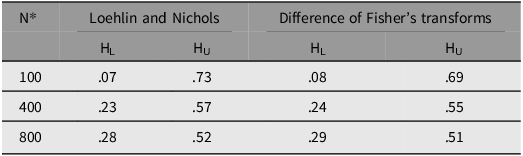
Table 1 shows that this potentially more accurate method provides only a trivial improvement in the situation illustrated by Loehlin and Nichols. Even with 400 pairs of MZ and 400 pairs of DZ twins, the 98% confidence interval for H when
 ${\rm{\hat H}}$
= .40 (based on Rmz = .50 and Rdz = .30) ranges from .13 to .65. So uncertain an estimate —that is, the trait in question is somewhat but not entirely heritable—seems a paltry dividend for so large an investment in experimental effort.
67% confidence intervals for
 ${\rm{\hat H}}$
when H = .40 computed by the method of Loehlin and Nichols (Reference Loehlin and Nichols1976) and by the more accurate method based on the difference of two Fisher’s Z-transformations.
 ${\rm{\hat H}}$
= 2(Rmz – Rdz) = 2(.50 − .30) = .40. The 98% interval runs from .13 to .65 (Fisher’s method)

Note: *N = Nmz + Ndz pairs.
The Efficiency of the MZA Design for Estimating Heritability
In the case of MZ twins reared apart, heritability is estimated directly from the sample intraclass correlation: H = ρmza. The 67% confidence limits for H when the estimate is Rmza = .40 based on just 50 pairs of MZA twins, are .28 and .51, almost identical with the limits of .29 and .51 produced by the standard twin method using a total of 800 twin pairs, as shown in Table 1. The 98% confidence limits for Pmza when Rmza = .50 are .21 and .71. The parallel finding with the standard twin method would be Rmz = .50 and Rdz = .25 resulting in
 ${\rm{\hat H}}$
= .50; with a total of 1000 pairs of twins measured, the 98% confidence limits are .25 and .73, no better than can be achieved with only 50 pairs of MZA twins. With 50 pairs of MZ twins raised together and 50 pairs of DZ twins, the 98% confidence interval for
 ${\rm{\hat H}}$
= .50 ranges from -.07 to .97; that is, one’s a priori estimate of H, whatever it might be, could not be disconfirmed by this experiment. The confidence interval for R narrows as R increases; if Rmza = .70, one can have 98% confidence that the heritability of the trait in question is 50% or greater, even with only 50 pairs of MZA twins.
Assumptions Underlying Estimates of Heritability from Twin Data
Estimates of H based on MZ and DZ twins reared together are predicated on two major and somewhat dubious assumptions:
(1) Shared environment contributes equally to the similarity of DZ and MZ twins. On the contrary, it seems probable that MZ twins experience more uniform and equal treatment on the average than do DZ twins. The influence of ‘twinning’, the psychological pressure to differentiate one’s self from one’s twin, to take divergent paths, is probably greater for fraternal than for identical twins.
(2) The MZ and DZ twins who volunteer for study are equally representative of the MZ and DZ populations with neither group being relatively selective for within-pair similarity. On the contrary, as Lykken et al. (Reference Lykken, Tellegen and DeRubeis1978) have demonstrated, MZ twins are twice as likely to volunteer as experimental subjects as are DZ twins. If one makes the reasonable assumption that MZs and DZs would be equally likely to volunteer individually, in research not requiring twin pairs, then this 2:1 ratio of volunteering in pairs indicates that the DZ twin samples are more selective than are MZ samples for at least certain aspects of within-pair similarity. For example, if 60% of the solicited MZs but only 30% of the solicited DZs volunteer, then one will be comparing the upper 60% of MZs with the upper 30% of DZs in respect to those aspects of similarity that lead both members of a pair to agree on a course of action. This, in turn, will cause the observed
 ${\rm{\hat H}}$
= 2 (Rmz − Rdz) to underestimate the true heritability of any trait associated with these aspects of similarity.
Estimates of H based on Rmza are predicated on different and, we would argue, more reasonable assumptions:
(1) Shared environment prior to separation in infancy and contact since reunion as adults will have negligible influence on the trait under study. The pre- and perinatal environments probably contributes as much to within-pair variance as to similarity. In the Minnesota Study of Twins Reared Apart, the mean age at separation is 4 months and the mean age at reunion is 24 years. Most authorities agree that the ‘formative period’ for most traits is some time interval between these ages. By contrasting the within-pair similarity for MZA twins just recently reunited with the similarity of pairs with years of contact since their reunion as adults, one can test whether post-reunion contact has appreciably increased similarity on the trait in question.
(2) Adoptive homes in which MZA twins are separately reared are uncorrelated in respect to their environmental influence upon the trait under study. Excluding informal placements, there is no doubt that impoverished or flagrantly unsuitable homes are systematically avoided by adoption agencies. Apart from this truncation at one extreme of the distribution, there is no good evidence that the adoptive homes of MZA twins are significantly correlated in characteristics that might be expected to contribute to within-pair similarity. A conservative test of this assumption is provided by the correlation within pairs of biological cousins since it is most unlikely that adoptive homes for separated twins are as similar, on the average, as the homes of ordinary cousins. Thus, for example, the correlation in IQ for cousins averages about .15 (Bouchard & McGue, Reference Bouchard and McGue1981), which suggests that the much higher IQ correlation for MZA twins (.73 for 29 pairs in the Minnesota study) cannot be explained on the basis of correlated rearing environments.
Summary
We confirm the analysis of Loehlin and Nichols (Reference Loehlin and Nichols1976) indicating that it is useless to estimate heritabilities from
 ${\rm{\hat H}}$
= 2 (Rmz − Rdz) unless one is prepared to recruit upwards of 800 twin pairs for study. Even with a very large sample of conventional twins, the assumptions of this method are sufficiently improbable (and usually untestable), so that reasonable critics could legitimately continue to believe that the true value of H was either much larger or much lower than the value found. The intraclass correlation among monozygotic twins reared apart provides at once an estimate of heritability that is remarkably more stable than that provided by the classical twin method and which depends upon assumptions that are more reasonable or, at least, testable.
Funding
Dr Lykken is in the Department of Psychiatry (Box 392 Mayo, University of Minnesota, Minneapolis, MN 55455), Dr Geisser is in the School of Statistics, and his work is supported by research grant NIH-GM-25271 and Dr Tellegen is in the Department of Psychology.
Introduction and Overview
In a tribute to the late Dr Auke Tellegen, Segal (Reference Segal2024) cited an unpublished paper, co-authored in 1981, by Tellegen and two of his University of Minnesota colleagues, David T. Lykken and Seymour Geisser (Lykken et al., Reference Lykken, Geisser and Tellegen1981). Today, at the urging of a reader and Twin Research and Human Genetics editor, three former friends and colleagues of the authors have agreed to reprint this work in full. We believe that this paper, though over 40 years old, has withstood the test of time and will be welcomed by the community of twin research scholars. The first author, David T. Lykken, loved twins, psychology, and research. This is another of the many little gems he and his co-authors have left us. The three co-investigators are shown in Figure 1.
David T. Lykken, Seymour Geisser, and Auke Tellegen (L to R). Photo source: University of Minnesota (Lykken); Wikipedia (Geisser); Photo credit: Nancy L. Segal (Tellegen).

One of us (McGue), upon rereading this work, believes that the paper is methodologically sound, and the conclusions fair. Having taken several graduate classes with Geisser, he recognized Geisser’s valuable input. All three of us appreciate Lykken’s unusual flair for composition that runs through virtually all his publications, as well as Tellegen’s twin research expertise, especially in the study of personality.
We acknowledge the cooperation and consent of Beverly Kaemmer (Auke Tellegen’s partner and collaborator), Joseph Lykken (David Lykken’s son and theoretical physicist), Mindy S. Geisser (Seymour Geisser’s daughter and Biostatistician), Anne Geisser (Seymour Geisser’s spouse), and Wesley Johnson (Professor Emeritus of Statistics) in response to our interest in making this work public. We also appreciate the careful reviews of the manuscript, by both Geisser and Johnson, who raised an issue regarding the selective nature of volunteer twin samples that we wish to clarify. Lykken et al. stated in the unpublished paper and elsewhere (Lykken et al., Reference Lykken, McGue and Tellegen1987; Lykken et al., Reference Lykken, Tellegen and DeRubeis1978) that the approximate 2:1 ratio of volunteer MZ and DZ twins, respectively, in many studies would underestimate estimates of heritability. That is because DZ twins occur more frequently in the population, increasing the likelihood that the most similar DZ pairs would be likely to seek research participation. In contrast, the greater proportion of MZ twin volunteers suggests that they are less selected. This would have the effect of increasing the DZ twin correlation, drawing it closer to the MZ twin correlation, thus biasing heritability estimates downward.
A few caveats to consider — the implications of the paper’s results may be somewhat overstated; and the uncertainty of ascertaining a representative reared-apart monozygotic (MZA) twin samples — paralleling the limitation for reared-together twin studies — was not addressed. Of course, readers will judge the paper for themselves as we have, in the spirit of peer review. Finally, we are unaware of why this 1981 paper was unpublished, but speculation will fail to provide an answer. Regardless, we feel that our knowledge of the authors and the twin research field justifies publication. It is likely that many late scholars have left unpublished work that would benefit current and future investigators. The paper has been edited just slightly in the interest of clarity, together with suggestions from M. S. Geisser and Johnson.