

Introduction
With the biopsy technique, it is possible to study fibre type composition in muscle of horses and differences have been observed between breedsReference Snow, Guy, Poortmans and Niset1. Horses (Quarter horses, Thoroughbreds, Standardbreds) that perform at faster speeds have somewhat more type II fibres than horses that perform at slower speeds (Andalusians, Arabs), although all horses have a high proportion of type II fibres. Many studies report an influence from age and training on muscle fibre composition of horsesReference Essén, Lindholm and Thornton2–Reference Ronéus, Essén-Gustavsson and Arnason7. In these studies, fibre type composition was evaluated by staining for myosin ATPase and three fibre types were identified: slow-contracting type I, fast-contracting type IIA and IIB fibres. Type IIA/IIB ratios increased with age and training, and training – not growth – was shown to be the main factor for this increase. Oxidative capacity was high in type I and IIA fibres, but varied markedly in the type IIB fibres due to the training status. It has also been shown that horses with high performance levels have muscles with higher IIA/IIB ratios and higher oxidative capacities in the type IIB fibres than horses with lower performance levelsReference Essén-Gustavsson and Lindholm3, Reference Ronéus, Essén-Gustavsson and Arnason7–Reference Rivero and Henckel9.
Another method of characterizing fibre types is to use myosin heavy chain (MHC) antibodies that identify the different MHC isoforms MHCI, MHCIIA and MHCIIX. Nowadays this method is often used since a more detailed picture of the muscle and its adaptations to different kinds of stimuli can be obtainedReference Rivero, Talmadge and Edgerton10–Reference Dingboom, van Oudeheusden, Eizema and Weijs13. With this method, it is possible to detect hybrid fibres, i.e. fibres that contain more than one MHC isoform, which may be an indication that fibres are transforming from one type to another, e.g. from MHCIIX to MHCIIA to MHCI. Using the myosin ATPase method, it is not possible to identify hybrid fibres and small adaptations in the muscle might be overlooked. Studies on both endurance types of horse, Thoroughbreds and Standardbred trotters, have shown that the muscle of trained individuals contains hybrid fibresReference Karlström and Essén-Gustavsson12, Reference Serrano, Quiroze-Royhe and Rivero14, Reference Yamano, Eto, Kasashima, Hiraga, Sugiura and Miyata15.
One breed of horse, where muscle characteristics have, as yet, not been described is the Swedish cold-blooded trotter. This is a breed that has evolved from farm horses that worked in the forest and the fields. The farmers used to come together to compete with their horses, often on frozen lakes in winter. Today there are farming and trotting types of cold-blooded horses, the trotting type being somewhat less heavy than the working horse. The cold-blooded trotter is smaller (height at the withers 150–160 cm) and more heavily and squarely built (weight c. 500 kg) than the Standardbred trotter. Both these breeds race over short distances, but the speed of the cold-blooded trotter (~1.20 min km− 1 or ~12.5 m s− 1) is slower than that of Standardbred trotter (~1.10 min km− 1 or ~14.5 m s− 1).
The aim was to investigate fibre type composition and oxidative capacity of fibre types in muscles of young and racing cold-blooded trotters that were in professional training, using both histochemical and immunohistochemical techniques.
Materials and methods
Horses
Twenty-four Swedish cold-blooded trotter stallions in professional training were included. Eighteen horses were 2 years old and four of these were sampled again during their 4-year-old season. Six horses were 4–8 years old. The young horses were just at the beginning of their training and the older horses were actively training and racing. Horses usually start racing in the spring of their 3-year-old season. Some of the horses are among the elite in Scandinavia. Muscle biopsies (gluteus medius) were taken at the training camp, in all cases by the same person, using a biopsy needleReference Lindholm and Piehl16. The samples were obtained at approximately the same relative depth in the muscle, usually 4–5 cm, a similar site as used earlier in our studies on Standardbred trotters. Samples were rolled in talcum powder and frozen in liquid nitrogen and then stored at − 80°C until analysed. This study was approved by the Ethical Committee for Animal Experiments in Stockholm, Sweden.
Histochemical analysis
Transverse sections, 10 μm, were cut in a cryostat (Reichert-Jung, Cambridge Instruments GmbH, Nussloch, Germany) and stained for myosin ATPase at pH 4.6 to detect fibre types I, IIA and IIBReference Brooke and Kaiser17. Serial sections, 10 μm, from 2-year olds (n = 7) and 4–8-year olds (n = 10) were also reacted with myosin heavy chain (MHC) antibodies N2-261 (MHC I+IIA), A4-74 (MHC IIA) and S5-8H2 (MHC I+IIX) using the PAP staining method. Furthermore, sections were stained with the NADH tetrazolium reductase methodReference Novikoff, Shin and Druckner18. To evaluate ATPase fibre type composition and fibre type area, a computerized image analyser (Bio-Rad, Scan Beam, Hadsund, Denmark) was used. The immunohistochemical sections were photographed and fibres were classified according to the MHC content into MHCI, MHCIIA, MHCIIAX and MHCIIX fibres. Oxidative capacity was subjectively evaluated from the NADH stains (30–50 fibres of each type) into high- medium- or low-oxidative fibres.
Statistical analyses
Differences between groups were evaluated using Mann–Whitney U and between staining techniques using Wilcoxon signed-rank tests. Values are presented as median and range.
Results
Fibre types and fibre areas
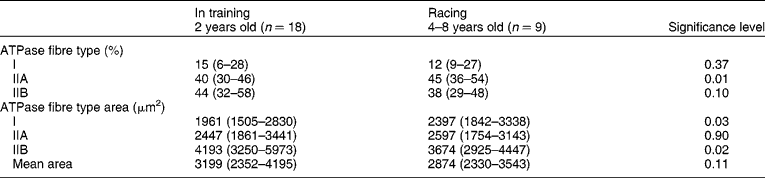
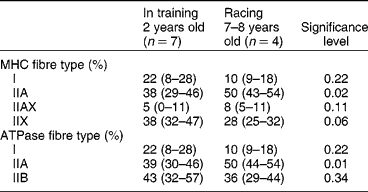
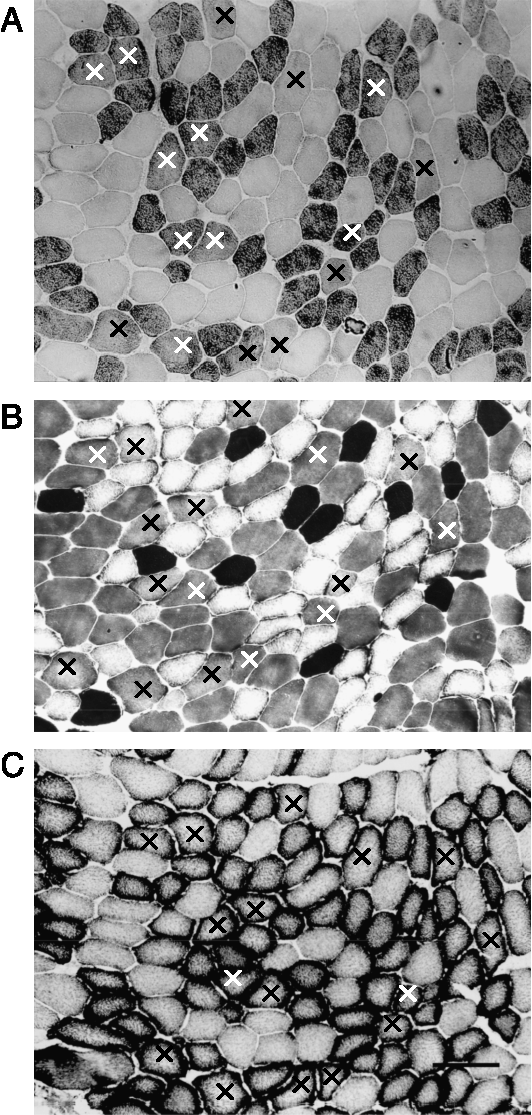
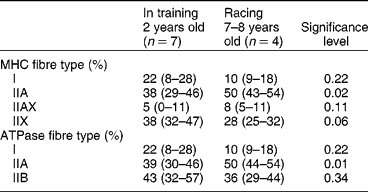
ATPase type I and type IIA fibres corresponded to MHCI and MHCIIA fibres (Table 1). There were fewer pure type MHCIIX (32%, range 25–47) than type IIB fibres (43%, range 29–57; P < 0.001). Some type IIB fibres immunohistochemically contained MHCIIA isoform, and thus hybrid MHCIIAX fibres were identified (Table 2). Within the MHCIIAX fibres, a variation of staining intensity was found (Fig. 1). The oldest racing horses had more type IIA and MHCIIAX fibres and fewer MHCIIX fibres as compared with the youngest (Tables 1 and 2) and a higher MHCIIA:MHCIIX fibre ratio (old: 1.7, range 1.3–2.2; young: 1.0, range 0.7–1.4; P = 0.02). Three of the four horses (nos 1–3) that were sampled both at 2 and 4 years old had increased the proportion of MHCIIAX fibres at 4 years of age after they had been racing several times (Table 3). The fourth horse lost his 3-year-old season due to injury and did not change in fibre type composition. Areas of the type IIB fibres were smaller and the type I fibres larger in the racing horses as compared with the younger horses (Table 1).
Median (range) for fibre type composition and fibre type areas in skeletal muscle of young horses in training and older cold-blooded trotters actively racing, and significance levels for differences between groups

Median (range) for MHC and m-ATPase fibre type composition in skeletal muscle of young horses in training and older cold-blooded trotters actively racing, and significance levels for differences between groups
Photomicrographs of serial sections of a 4-year-old horse. MHCIIAX fibres are marked in all stains. (A) MHCIIA isoform staining; (B) m-ATPase pH 4.6; (C) NADH tetrazolium reductase. Bar in (C) (lower right) represents 100 μm

Number of starts and myosin heavy chain fibre type composition of muscle of four horses at 2 and 4 years of age

Oxidative capacity
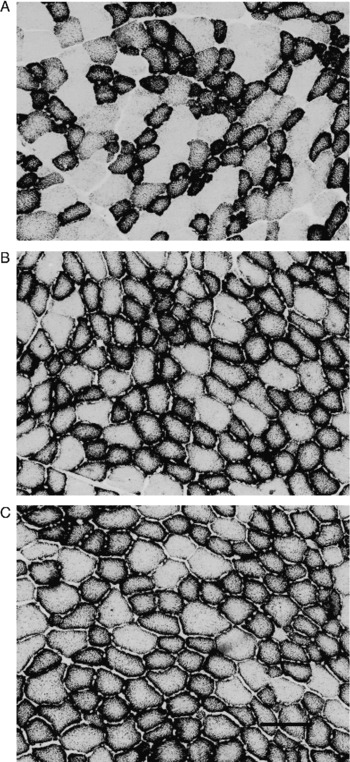
Oxidative capacity was, in both young and old horses, high in type I and IIA fibres and medium in MHCIIAX fibres. In MHCIIX fibres, the staining intensity for oxidative capacity varied markedly (Fig. 2). In the 2-year-old horses 51% (range 45–54) of MHCIIX had medium staining intensity, and in the 4-year-old horses 81% (range 67–100) were medium stained (Table 4). The remaining MHCIIX fibres had low staining intensity. In the oldest, racing horses all MHCIIX fibres were found to have a medium staining intensity (Fig. 2).
Photomicrographs of NADH stains from the same horse at (A) 2 and (B) 4 years old and (C) one 8 year old horse. Bar in (C) (lower right) represents 100 μm

Oxidative capacity of the MHC fibre types subjectively classified into high, medium or low according to staining intensity in the NADH tetrazolium reductase stain

Discussion
The results of this study show that fibre type composition of younger and older Swedish cold-blooded trotters is quite similar to that of the Standardbred trottersReference Karlström and Essén-Gustavsson12, Reference Ronéus and Essén-Gustavsson20, Reference Ronéus, Essén-Gustavsson, Lindholm and Persson21. This would have been expected since the cold-blooded trotters train in a similar way and race over the same distances as Standardbred trotters (1640–3140 m).
The results suggest that adaptations in the muscle occur due to long-term training as trained and raced horses had a higher oxidative capacity, a higher percentage of type IIA fibres and lower percentage of type IIB fibres, larger type I fibres and smaller type IIB fibres. The immunohistochemical results of the cold-blooded trotters further suggest that the higher percentage of MHCIIA fibres seen with training/racing is due to a transition from MHCIIX fibres as hybrid MHCIIAX fibres were found. These results are in agreement with other training studies on other breeds that indicate that transitions occur from pure type MHCIIX via hybrid MHCIIAX to MHCIIA fibresReference Rivero, Talmadge and Edgerton10, Reference Karlström and Essén-Gustavsson12, Reference Rivero and Serrano19.
The horse material in this study is not large but it is unique in comparison with many other studies, as it included superior racehorses. Some of these horses had been training and racing for several years. This is in contrast to many earlier training studies where the training has been undertaken for relatively short (5–12 weeks) periods using sedentary horsesReference Essén-Gustavsson, McMiken, Karlström, Lindholm, Persson and Thornton22–Reference Eto, Yamano, Mukai, Sugiura, Nasu, Tokuriki and Miyata24. In these studies, fibre type changes were not seen. In the present study, the youngest horses had a few hybrid fibres and these horses had been in training for a very short period. The 4-year-old horse that had been out of training due to injury also proved to have a low percentage of MHCIIAX fibres (Table 3). A higher amount of hybrid MHCIIAX fibres was seen in the 4-year-old horses that had been in training for a couple of years and had started to race. The staining intensity from MHCIIA isoform varied among MHCIIAX fibres. This may indicate that the fibres are in different states of transformation. The older racehorses that had been training and racing over several years had a high percentage of MHCIIA fibres and only a few hybrid MHCIIAX fibres. This is probably due to the fact that a total transformation of several MHCIIX to pure MHCIIA fibres had occurred by that time.
Muscle fibres are recruited in a specific order with type I and IIA fibres first and as the intensity and duration of work increase, more fibres need to be recruited and thus type IIB (MHCIIX) fibres will be includedReference Valberg25, Reference Gottlieb26. The latter are shown to be of great importance to successful racingReference Barrey, Valette, Joughlin, Blouin and Langlois27. The size of type IIB fibres was decreased in the older racehorses, which is in agreement with studies on trained and racing Standardbred trottersReference Essén-Gustavsson and Lindholm3, Reference Karlström, Essén-Gustavsson, Lindholm, Persson, Persson, Lindholm and Jeffcot28. The advantage of a decreased fibre size is that it facilitates transport of oxygen and substrates to and efflux of waste products such as lactate and heat from the fibre. When type IIB (MHCIIX) fibres with a low oxidative capacity get recruited at the end of a race it is likely that they fatigue quickly. All MHCIIX fibres in older horses showed a medium oxidative capacity, which indicates a high degree of fatigue resistance. Transformation of type IIA to type I fibres seemed not to occur in this group of horses since no changes in the percentage of type I fibres were seen. The variation between individuals in type I fibre proportions at 2 years of age was also seen at 4 years of age, which confirms the reliability of muscle biopsy sampling (Table 3).
Conclusion
In Swedish cold-blooded trotters, muscular adaptations occur due to training and racing, and with immunohistochemical methods hybrid fibres were detected, indicating fibre type transitions.
Acknowledgements
This study was supported by grants from the Swedish Racing Board (ATG), Hälsinge Trav AB and Mälaren Equine Clinic. The authors thank trainer Jan-Olov Persson for excellent help in performing this study.