Introduction
Chronic fatigue syndrome (CFS) is a highly debilitating disorder characterized by persistent and unexplained fatigue resulting in severe impairment in daily functioning (Fukuda et al. Reference Fukuda, Straus, Hickie, Sharpe, Dobbins and Komaroff1994). There has been much debate and controversy about the aetiology of the disorder. One school of thought argues that CFS is caused by or precipitated by an acute infection, as many patients predate the onset of their illness to an initial infection from which they never recovered (Wessely et al. Reference Wessely, Butler, Chalder, David, Jenkins and Mowbray1991).
A number of prospective studies have therefore investigated the role of infections in the onset of CFS. Two of the earlier studies showed that common viral infections, such as upper respiratory tract infections, were not associated with the subsequent development of either chronic fatigue (CF) or CFS, and concluded that viruses did not play a role in the onset of the illness (Cope et al. Reference Cope, David, Pelosi and Mann1994; Wessely et al. Reference Wessely, Chalder, Hirsch, Pawlikowska, Wallace and Wright1995). Subsequent studies, however, have shown that certain more severe infections played a role in the onset of CFS including infectious mononucleosis (glandular fever; GF) (White et al. Reference White, Thomas, Kangro, Bruce-Jones, Amess, Crawford, Grover and Clare2001; Moss-Morris & Spence, Reference Moss-Morris and Spence2006), hepatitis (Berelowitz et al. Reference Berelowitz, Burgess, Thanabalasingham, Murray-Lyon and Wright1995), viral meningitis (Hotopf et al. Reference Hotopf, Noah and Wessely1996), Q fever (Wildman et al. Reference Wildman, Smith, Groves, Beattie, Caul and Ayres2002) and Ross River virus (Hickie et al. Reference Hickie, Davenport, Wakefield, Vollmer-Conna, Cameron, Vernon, Reeves and Lloyd2006). Why then, do the majority of patients recover within several weeks from these infections without sequelae, while a small subgroup have prolonged and disabling illness?
The cognitive behavioural model of CFS provides a possible explanatory framework for understanding how an organic insult such as a virus precipitates a cycle of psychological responses, which mediate between the acute organic illness and the chronic syndrome (Wessely et al. Reference Wessely, Butler, Chalder, David, Jenkins and Mowbray1991; Sharpe et al. Reference Sharpe, Peveler and Mayou1992; Sharpe, Reference Sharpe1997). The model includes predisposing, precipitating and perpetuating factors (Surawy et al. Reference Surawy, Hackmann, Hawton and Sharpe1995). Predisposed people are thought to be high on perfectionism and prone to distress, basing their self-esteem and the respect from others on their abilities to live up to certain high standards. When these people are faced with precipitating factors which affect their ability to perform, such as a combination of excessive stress and an acute biological illness, their initial reaction is to press on and keep coping. This behaviour leads to the experience of ongoing symptoms which may be more closely related to pushing too hard than to the initial infection. However, in making sense of the situation, patients attribute the ongoing symptoms to an infection. The common response to a physical illness is rest. However, reduced activity conflicts with achievement orientation and may result in bursts of activity punctuated by the need to rest up to recover, known as all-or-nothing behaviour (Spence et al. Reference Spence, Moss-Morris and Chalder2005), in an attempt to meet expectations. These periodic bursts of activity inevitably exacerbate symptoms and result in failure, which further reinforces the belief that they have a serious, ongoing illness. As time goes by, efforts to meet previous standards of achievement are abandoned and patients become increasingly preoccupied with their symptoms and illness. This results in chronic disability and the belief that one has an ongoing incurable illness which is eventually diagnosed as CFS.
The theoretical basis for this model comes largely from anecdotal clinical evidence and cross-sectional and retrospective research (for a review, see Moss-Morris, Reference Moss-Morris2005). A handful of prospective studies have shown that psychological distress at the time of the initial virus and negative illness beliefs are predictors of post-viral fatigue (Cope et al. Reference Cope, David, Pelosi and Mann1994; Wessely et al. Reference Wessely, Chalder, Hirsch, Pawlikowska, Wallace and Wright1995; Hotopf et al. Reference Hotopf, Noah and Wessely1996; Candy et al. Reference Candy, Chalder, Cleare, Peakman, Skowera, Wessely, Weinman, Zuckerman and Hotopf2003; Petersen et al. Reference Petersen, Thomas, Hamilton and White2006). A limitation of these studies is the selection of a small number of predictors for investigation and no prospective studies have investigated all aspects of the model or variables such as perfectionism and all-or-nothing behaviour.
Using the cognitive behavioural model to guide our choice of predictor variables, the purpose of this study was to investigate the role of psychological variables, alongside a clearly identifiable physiological variable, GF, in the precipitation of and early perpetuation of CFS. We chose to look at GF because there is good evidence that it is a risk factor for the development of CFS (White et al. Reference White, Thomas, Amess, Grover, Kangro and Clare1995; Buchwald et al. Reference Buchwald, Rea, Katon, Russo and Ashley2000; Candy et al. Reference Candy, Chalder, Cleare, Wessely, White and Hotopf2002). We were interested in looking at the contribution of each cognitive, behavioural and emotional risk factor individually as well as which of these may be the most important risk factors. We hypothesized that cases of CF identified at 3 months and CFS at 6 months post-GF would report higher levels of depression, anxiety, somatization, negative perfectionism, perceived stress, negative illness beliefs and all-or-nothing behaviour at the time of their acute infection.
Methods
Design and procedure
This was a prospective cohort study of patients with GF. Patients who agreed to participate in the study completed a baseline questionnaire at the time of their acute infection which included a range of potential risk factors for CFS. Follow-up assessments to determine the new incidence of CF and CFS were completed 3 and 6 months later. This study was reviewed and approved by the Auckland Ethics Committee (2001/303).
Participants
Potential participants were recruited through Diagnostic Medlab Auckland, the major provider of community clinical diagnostic services in Auckland (New Zealand), using consecutive sampling over a 20-month period. Individuals over the age of 16 years experiencing an acute case of GF were eligible to participate in the study. Individuals with a history of CFS, or any medical condition known to cause fatigue symptoms (e.g. anaemia, cancer, chronic obstructive pulmonary disease, fibromyalgia, hepatitis, multiple sclerosis) were excluded.
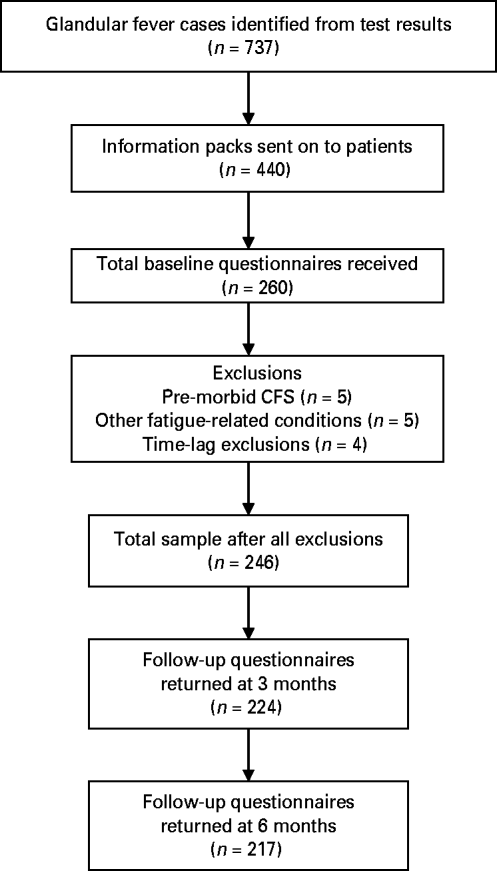
A total of 737 GF cases were identified using either the infectious mononucleosis screen (monospot), which tests for heterophile antibodies in the blood, or the Epstein–Barr virus serology test, which measures viral capsid antigen immunoglobulin (Ig) M and IgG antibodies. Information packs were sent to these patients' general practitioners (GPs) by the laboratory to be forwarded on to the patient concerned. Tracking processes suggested that approximately 440 questionnaires actually reached participants. A total of 260 usable questionnaires were returned, giving a response rate of 59%. Of these, 246 were included in the study. Of the participants, 10 were excluded because they reported either a history of CFS (n=5) or a medical condition known to produce fatigue (n=5). A further four participants were excluded due to an excessive time lag between their acute illness and answering the questionnaire. Fig. 1 illustrates the flow of participants in this study.
Flow of participants through the study. CFS, Chronic fatigue syndrome.

Measures
Baseline questionnaire
The baseline questionnaire incorporated questions about demographics and current and past illness. These included a checklist of symptoms associated with GF (sore throat, loss of appetite, weight loss, headache, fever, swollen glands, fatigue/tiredness, rash) to determine the severity of the acute illness and a number of non-specific symptoms (e.g. sore eyes, loss of strength, dizziness, racing heart beat) as a measure of general somatization. Specific details about the acute illness were also gathered, including the onset, treatment and advice given by the GP. Questions regarding history of CFS and related disorders, and serious physical illness were used to exclude people from the study.
The remaining measures described below were used to operationalize the variables described in the cognitive behavioural model of CFS.
Cognitive measures
The Illness Perceptions Questionnaire – Revised (IPQ-R; Moss-Morris et al. Reference Moss-Morris, Weinman, Petrie, Horne, Cameron and Buick2002) was included to assess patients' beliefs about their GF. The IPQ-R was modified to reduce the overall size of the scale and to make it more relevant to patients with GF as per the authors' recommendation. Six subscales were included: ‘illness identity’ (the number of symptoms out of a list of 23 that the individual ascribes to their illness); ‘consequences’ (what impact patients believe their illness will have on their everyday life); ‘timeline’ (how long they believe their illness will last); ‘personal control’ (how much control they believe they have over their illness and its treatment); ‘emotional representations’ (the perceived emotional impact of their symptoms); and ‘illness coherence’ (how well the individual believes they understand their illness). Cronbach's α for the subscales ranged from 0.68 for personal control to 0.85 for the emotional representations subscale, with all but personal control having scores of 0.70 or higher.
The 10-item Perceived Stress Scale (PSS; Cohen et al. Reference Cohen, Kamarck and Mermelstein1983) was used to measure participants' perceptions of their levels of stress at the time of acute infection. It has been used in a wide range of health-related studies to determine the impact of stress on outcome (Burns et al. Reference Burns, Drayson, Ring and Carroll2002; Chiu et al. Reference Chiu, Chon and Kimball2003; Schwarz & Dunphy, Reference Schwarz and Dunphy2003; Ebrecht et al. Reference Ebrecht, Hextall, Kirtley, Taylor, Dyson and Weinman2004). The scale's internal reliability in this study was high (α=0.88).
The negative subscale from the Positive and Negative Perfectionism Scale (Slade & Owens, Reference Slade and Owens1998) was included as a measure of perfectionism. Several studies have found the negative rather than the positive subscale to have the strongest predictive validity across a variety of conditions (Terry-Short et al. Reference Terry-Short, Owens, Slade and Dewey1995; Haase et al. Reference Haase, Prapavessis and Owens1999, Reference Haase, Prapavessis and Owens2002). As with the PSS, the scale's internal reliability in this study was high (α=0.89).
Behavioural measures
The Behavioural Responses to Illness Questionnaire (BRIQ; Spence et al. Reference Spence, Moss-Morris and Chalder2005) was used in order to determine the effect of specific behavioural responses at the time of acute illness. The limiting subscale measures the extent to which patients rest and reduce activity in response to illness. Items include ‘I have gone to bed during the day’ and ‘I have avoided my usual activities’. The ‘all-or-nothing’ scale measures a pattern of over-activity and then rest and includes items such as ‘I have overdone things, then needed to rest up for a while’ and ‘I have pushed myself as hard as ever until I cannot push myself any more’. The all-or-nothing scale has been shown to be an important predictor of the onset of irritable bowel syndrome following an episode of food poisoning (Spence & Moss-Morris, Reference Spence and Moss-Morris2007). Cronbach's α in this study was 0.87 for the limiting subscale and 0.82 for the all-or-nothing subscale, confirming that the scale has excellent internal reliability.
Measures of emotion
The Hospital Anxiety and Depression Scale (HADS; Zigmond & Snaith, Reference Zigmond and Snaith1983) was used to assess the severity of anxiety and depression experienced in the month prior to infection. A review of 747 studies on the psychometric properties of the HADS found that its internal consistency was high and that the two-factor structure was largely confirmed (Bjelland et al. Reference Bjelland, Dahl, Haug and Neckelmann2002). Internal reliability was good in the current study, with a Cronbach's α of 0.81 for anxiety and 0.76 for depression.
Follow-up outcome questionnaire
Participants were sent two follow-up questionnaires designed to identify those who met diagnostic criteria for CFS at 3 and 6 months. Patients who met either the Centers for Disease Control (CDC) (Fukuda et al. Reference Fukuda, Straus, Hickie, Sharpe, Dobbins and Komaroff1994) or British criteria (Sharpe et al. Reference Sharpe, Archard, Banatvala, Borysiewicz, Clare, David, Edwards, Hawton, Lambert and Lane1991) were considered cases of CFS. As both definitions specify that CFS should only be diagnosed after fatigue has been experienced for a minimum of 6 months, we have labelled people who met the criteria at 3 months, cases of CF and those at 6 months, cases of CFS.
An initial screening question asked participants if they were experiencing fatigue or excessive tiredness so that those without fatigue could omit this section. If affirmative, participants were asked to rate the severity of their fatigue and answer a range of questions derived from the CDC and British criteria for CFS. Questions included the type of fatigue experienced (physical or mental), the onset of fatigue (whether there was a definite start to fatigue and length of time since onset), the extent of fatigue (proportion of time affected by fatigue, and their ability to ignore it), any moderating effects experienced (i.e. impact of rest, excessive exercise) and the impact of fatigue on their daily activities.
Statistical analysis
All analyses were conducted with SPSS software (version 14.1; SPSS, Inc., USA). Demographic, illness and mood variables were compared between the CF/CFS cases and non-cases using independent-sample t tests and χ2 tests. The significance of each individual psychological variable as a risk factor for the development of CF/CFS was examined using binary logistic regression analyses. CF/CFS outcome was entered as the dependent variable (coded 0 for ‘no CF/CFS’ and 1 for ‘CF/CFS’) with each psychological variable measured at baseline entered into separate regression analyses as a covariate with gender, age and number of GF symptoms to ensure that any significant effects were independent of these potentially confounding variables.
In order to determine the relative importance of the CF/CFS predictors, the 11 psychological variables that were found to predict CF or CFS were reduced to a smaller number of factors using principal components analysis (PCA) with varimax rotation. Reducing the number of predictor variables was necessary, as many of the variables were inter-correlated, which creates problems of multicollinearity. In addition, for regression, the ideal ratio of participants to predictor variables is 20:1 (Tabachnick & Fidell, Reference Tabachnick and Fidell1989). As we had 217 participants at 6-month follow-up, ideally we needed no more than 10–11 predictors in a multivariate analysis, including the control variables – age, gender and GF symptoms. By reducing the psychological variables to five factor scores, we were able to enter a total of eight predictors into a single multivariate logistic regression analysis, with CF/CFS caseness as the dependent variable.
Results
Demographic and clinical characteristics
The mean age of the sample recruited at baseline was 22.8 (s.d.=8.3) years, 62% were female, and the majority were New Zealand European (96%), with 2% identifying as Asian and the remaining 2% as Maori, Pacific Island or other. The majority of participants were single (82%), with 15% stating that they were married or in a de facto relationship, 3% divorced or separated, and one person widowed. Of the sample, 60% had secondary school qualifications as their highest level of education, 19% had a university degree and a further 16% a technical qualification.
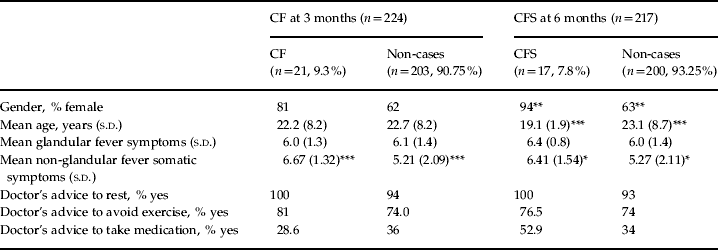
A total of 224 participants returned questionnaires at 3 months follow-up and 217 participants returned questionnaires at 6 months follow-up, response rates of 91% and 88%, respectively. A total of 21 (9.4%) participants met criteria for CF caseness at 3 months and 17 (7.8%) for CFS caseness at 6 months. Table 1 shows the comparison of CF/CFS cases and non-cases at each time point on demographic and clinical variables that may have influenced outcome. Data analysis showed that there were no significant differences between CF cases and non-cases with regard to gender [Pearson χ2(1, 224)=3.08, p=0.08] and age [t(222)=0.26, p=0.79] at 3 months; however there were significant differences between CFS cases and non-cases at 6 months with regards to gender [Pearson χ2(1, 217)=6.71, p<0.01] and age [t(215)=5.18, p<0.001], indicating that CFS cases were significantly more likely to be female and younger than non-cases. There were no significant differences with regard to the number of baseline GF symptoms at either time point [3 months: t(222)=0.2, p=0.84; 6 months: t(215)=−1.13, p=0.26]. However, CF/CFS patients reported a significantly greater number of non-GF somatic symptoms at both time points [3 months: t(222)=−4.51, p<0.001]; 6 months: t(215)=−2.19, p=0.03]. There were no significant differences in the advice given to cases and non-cases by their doctors including to rest, avoid exercise or take medications such as paracetamol.
Comparison of CF/CFS cases and non-cases at 3 and 6 months post-GF on relevant demographic and illness variables

CF, Chronic fatigue; CFS, chronic fatigue syndrome; GF, glandular fever; s.d., standard deviation.
* p<0.05, ** p<0.01, *** p<0.001.
Psychological risk factors in the development of CF/CFS
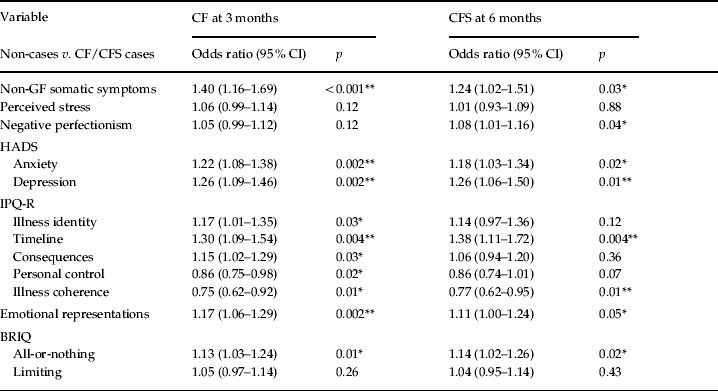
The data from the series of binary logistic regression analyses used to examine the role of each of the psychological variables as risk factors in the development of CF and CFS controlling for age, gender and GF symptoms are presented in Table 2. Non-GF somatic symptoms were included as a psychological risk factor rather than a control variable as they were assumed to be independent of GF.
Individual logistic regression analyses of CF/CFS outcome at 3 and 6 months following GFFootnote a

CF, Chronic fatigue; CFS, chronic fatigue syndrome; GF, glandular fever; CI, confidence interval; HADS, Hospital Anxiety and Depression Scale; IPQ-R, Illness Perceptions Questionnaire – Revised; BRIQ, Behavioural Responses to Illness Questionnaire.
a All equations controlled for age, gender and GF symptoms (data not presented).
* p⩽0.05, ** p⩽0.01.
Of the 13 cognitive, behavioural and emotional variables, 10 predicted the onset of CF at 3 months post-GF. The exceptions were perceived stress, perfectionism and the limiting activity subscale of the BRIQ. The pattern was similar for CFS cases at 6 months. The timeline, illness coherence and emotional representations subscales of the IPQ-R, all-or-nothing behavioural pattern, anxiety, depression and somatization were still found to be significant risk factors at 6 months, whereas illness identity, personal control and consequences subscales were no longer significant. Negative perfectionism was found to be significant at 6 months, but not at 3 months.
Relative importance of the psychological variables
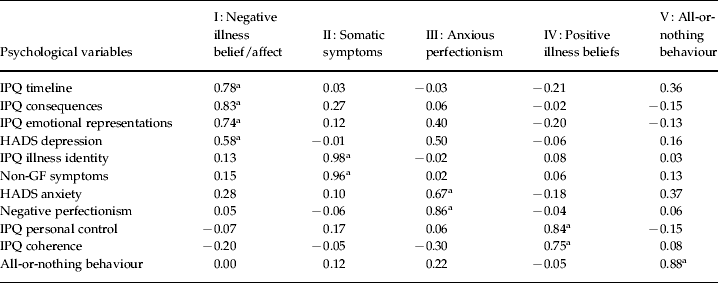
The 11 psychological variables that were shown to be significant predictors of CF/CFS at either 3 or 6 months were subject to a PCA to see if we could reduce the number of predictors for a multivariate analysis. The first PCA produced four factors with eigenvalues greater than 1; however, examination of the scree plot suggested that a five-factor solution may be more appropriate. A five-factor solution resulted in easily interpretable factors explaining 77% of the variance, with all but one variable, HADS depression, loading greater than 0.74 on a key factor and 0.40 or less on any other factor (see Table 3 for factor labels, items and loadings). Depression loaded highest (0.58) on factor 1, with the IPQ dimensions that measured negative aspects of illness representations including beliefs that GF symptoms will last a long time, have serious consequences and are emotionally upsetting. Depression also loaded on factor 3 with anxiety and negative perfectionism but to a lesser extent. The other factors were labelled somatic symptoms (including illness identity and the reporting of non-GF symptoms), positive illness beliefs (including the IPQ dimensions which measure a sense of control and coherence over symptoms) and a final single-item factor, all-or-nothing behaviour.
Factor loadings for the principal components analysis of the psychological variables

IPQ, Illness Perceptions Questionnaire; HADS, Hospital Anxiety and Depression Scale; GF, glandular fever.
a Items interpreted as loading onto column variable.
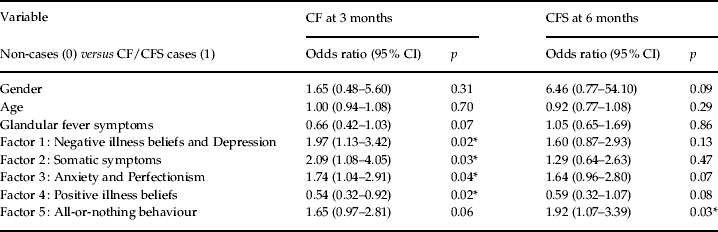
The five factor scores were entered as covariates along with gender, age and GF symptoms (eight predictors in total) into two separate logistic regression equations, with CF and CFS outcomes as the dependent variables. Table 4 shows that the first four factors predicted the onset of CF at 3 months, while only factor 5, all-or-nothing behaviour, predicted CFS at 6 months. Age, gender and GF symptoms were not significant predictors in these equations. Interestingly, patients with fewer GF symptoms were more at risk of CF symptoms at 3 months.
Multivariate logistic regression analyses of the psychological factor scores on CF/CFS outcome at 3 and 6 months following GF

CF, Chronic fatigue; CFS, chronic fatigue syndrome; GF, glandular fever; CI, confidence interval.
* p⩽0.05.
Discussion
The results from this prospective study provide good support for the cognitive behavioural model of CFS. A range of factors operationalized from this model was shown to interact with a viral event (in this case GF) in the development of CF and CFS. With regards to patients' beliefs about their illness, patients who went on to develop CF were more likely to ascribe their daily physiological complaints to their GF, believed that their GF would last a long time and have a negative impact on their daily life, were less likely to feel that they understood the nature of their illness or had control over it, and were more likely to think of its emotional impact. At 6 months, the most important illness perception predictors of CFS were believing that the GF symptoms would last a long time, were distressing and difficult to understand.
In accordance with previous studies, anxiety, depression and somatization were also all associated with the onset of both CF and CFS at 3 and 6 months post-infection (Cope et al. Reference Cope, David, Pelosi and Mann1994; Wessely et al. Reference Wessely, Chalder, Hirsch, Pawlikowska, Wallace and Wright1995; Hotopf et al. Reference Hotopf, Noah and Wessely1996; Candy et al. Reference Candy, Chalder, Cleare, Peakman, Skowera, Wessely, Weinman, Zuckerman and Hotopf2003; Petersen et al. Reference Petersen, Thomas, Hamilton and White2006). In addition, this study was the first prospective study to show that negative perfectionism is a risk factor for the development of CFS, although this was evident at the 6-month follow-up only. The cognitive behavioural model of CFS suggests that perfectionism may predispose people to respond to symptoms in an all-or-nothing fashion (Surawy et al. Reference Surawy, Hackmann, Hawton and Sharpe1995). The results from this study are in accord with this, in that all-or-nothing behaviour in response to GF symptoms was associated with the onset of both CF and CFS and was the most significant predictor for CFS at 6 months. It is also interesting to note that perfectionism loaded with anxiety in the PCA and to a lesser extent with depression. Having unrealistically high expectations may predispose people to negative affect, particularly anxiety, which together act as risk factors for CF. At 3 months this combination of variables was a key predictor of CF, as were negative illness beliefs and somatization. Having more positive beliefs about GF, including a sense of control and coherence over symptoms, was in contrast protective of developing CF.
Neither perceived stress at the time of acute infection nor limiting activity was found to be significant predictors at either time point. The failure of previous studies to find a clear relationship between stress and the development of CFS may have been due to retrospective design or the measurement of life events as a proxy of stress (Bruce-Jones et al. Reference Bruce-Jones, White, Thomas and Clare1994; Lewis et al. Reference Lewis, Cooper and Bennett1994; Candy et al. Reference Candy, Chalder, Cleare, Peakman, Skowera, Wessely, Weinman, Zuckerman and Hotopf2003). Consequently we measured perceptions of stress in this study to see if this altered the results. It is possible that our null findings are specifically related to the use of a post-infectious sample or again related to the type of measure; however, it would appear that stress as a risk factor for the development of CFS may not be as strong as the model suggests. A previous prospective study found that the experience of stressful life events was more strongly associated with the onset of psychiatric disorder than CF or CFS (Bruce-Jones et al. Reference Bruce-Jones, White, Thomas and Clare1994).
At first glance the lack of association between limiting behaviour and the onset of CF/CFS may appear contradictory with other findings. A systematic review found that delayed convalescence was the strongest risk factor of CF and CFS post-GF and concluded that prolonged inactivity and bed rest were key factors in the onset of these conditions (Candy et al. Reference Candy, Chalder, Cleare, Wessely, White and Hotopf2002). However, the fact that all-or-nothing behaviour was a key significant risk factor in this study suggests that rather than too much rest on its own, a fluctuating pattern of behaviour seems to be important. This oscillating pattern of activity may indeed result in prolonged convalescence. This has important clinical implications, as there is some evidence that educating people early on to avoid this pattern of behaviour may help reduce the onset of CFS. A study of a simple behavioural intervention during the recovery phase of GF, where patients were encouraged to slowly increase their level of activity, was shown to reduce the incidence of CFS post-GF (Candy et al. Reference Candy, Chalder, Cleare, Wessely and Hotopf2004).
Other variables relevant to the development of CFS including gender, symptom severity, and the prevalence rate of post-infectious CFS, were also investigated in this study. Results showed that CFS cases reported no more GF symptoms than those who were non-cases. Indeed, there was a slight trend at 3 months for CF cases to report fewer symptoms, suggesting that severity of the acute illness was not a risk factor in the onset of CFS. Cases of CFS were significantly more likely to be female, which is consistent with previous findings on the association between fatigue and female gender 6 months after infection (Buchwald et al. Reference Buchwald, Rea, Katon, Russo and Ashley2000; Candy et al. Reference Candy, Chalder, Cleare, Peakman, Skowera, Wessely, Weinman, Zuckerman and Hotopf2003). More work is needed to understand this gender bias. The prevalence rate of CFS (8%) at 6 months in this study is comparable with the only other study using the Fukuda criteria, which found a rate of 9% 6 months after infection (White et al. Reference White, Thomas, Amess, Crawford, Grover, Kangro and Clare1998). As expected, the rate was much higher than the 1.3% to 4.4% found in those studies which examined the development of CFS following upper respiratory tract infection (Wessely et al. Reference Wessely, Chalder, Hirsch, Pawlikowska, Wallace and Wright1995; White et al. Reference White, Thomas, Amess, Crawford, Grover, Kangro and Clare1998).
Certain limitations in this study need to be taken into account. First, we tested the model only in one at-risk sample; therefore, the results apply specifically to post-GF CFS. The mean age of the participants (22.8 years) was lower than the typical age of onset for CFS. Therefore, the generalizability of these findings to the wider group remains to be determined. Second, the use of limited self-report data to identify prior onset cases of CFS must also be carefully considered. It is possible that a number of participants may have experienced CFS prior to their infections, but had never been diagnosed by their doctors, and were therefore not excluded as prior cases. In terms of the measure of GF severity, clinical examination and physiological measures may have provided more objective markers than simply the overall number of symptoms. Finally, diagnosis of CF and CFS at follow-up relied on detailed self-report rather than clinical diagnosis.
In conclusion, the findings suggest that negative perfectionism, anxiety, depression and somatization may act as predisposing factors, and a range of negative illness beliefs and all-or-nothing behaviour may act as early perpetuating factors in the psychobiological pathway from GF to CFS. The results provide a good rationale for developing prevention and early intervention strategies. Simple psychoeducational strategies such as encouraging gradual and consistent return to activity, dealing with anxiety over symptoms and helping to explain the nature of GF symptoms and recovery should be easy to integrate within primary care practice or digital interventions like simple computerized cognitive behavioural therapy. The distinction between what perpetuates CFS in its early stages and whether the influence of these variables changes over time needs clarification with longer-term prospective studies in future.
Acknowledgements
This research was supported by a grant awarded to R.M.-M. from the University of Auckland Vice Chancellor's development fund and by two scholarships awarded to M.J.S.: a University of Auckland Doctoral Scholarship and a Foundation for Research, Science and Technology Scholarship. Our work was independent of these funding providers. We thank Dr Susan Taylor from Diagnostic Medlab for her advice and information on the diagnostic test used in this study, and for her invaluable help with recruitment. We also thank Grant Sutcliffe for designing and developing the Mailout tracker database for this study.
Declaration of Interest
None.