Introduction
The risk of developing schizophrenia is not only lower for women compared to men (Aleman et al. Reference Aleman, Kahn and Selten2003) but also women with schizophrenia have been documented to show a less severe course of illness, with better preservation of social skills, than men (Goldstein et al. Reference Goldstein, Lewine, Castle, McGrath and Kulkarni2000; Leung & Chue, Reference Leung and Chue2000). Differences between men and women in the pace of brain development (slower in men) and in asymmetry in brain structures (more lateralization in men), as regulated by prenatal effects of sex steroid hormones, have been suggested to underlie these differences in the manifestation of the illness (Geschwind & Galaburda, Reference Geschwind and Galaburda1987; Diamond, Reference Diamond1989; Collaer & Hines, Reference Collaer and Hines1995). Specifically, the effects of oestrogens on the female brain have been hypothesized to protect women against severe developmental disorders such as early onset schizophrenia (Goldstein et al. Reference Goldstein, Lewine, Castle, McGrath and Kulkarni2000).
In healthy subjects, sexual dimorphism of the brain has been related to differences in performance on cognitive and emotional tasks between the sexes. For example, widely reported domains of sexual dimorphic performance are verbal processing (Kimura, Reference Kimura1999; Halpern & LaMay, Reference Halpern and LaMay2000) and emotion recognition (Hall, Reference Hall1978, Reference Hall1984; McClure, Reference McClure2000), better in healthy women, and visuospatial processing, better in healthy men (Linn & Petersen, Reference Linn and Petersen1985; Roberts & Bell, Reference Roberts and Bell2003). Structural magnetic resonance imaging (MRI) studies have demonstrated sex differences in morphology of brain regions subserving dimorphic task performance. For example, brain regions associated with verbal functions, such as the planum temporale, Broca's region and the dorsolateral prefrontal cortex, have been found to be larger in women compared to men (Schlaepfer et al. Reference Schlaepfer, Harris, Tien, Peng, Lee and Pearlson1995; Harasty et al. Reference Harasty, Double, Halliday, Kril and McRitchie1997). In addition, sex differences have been reported in the corpus callosum (Dubb et al. Reference Dubb, Gur, Avants and Gee2003; Mitchell et al. Reference Mitchell, Free, Merschhemke, Lemieux, Sisodiya and Shorvon2003), with a more bulbous splenium in (more bilaterally organized) women than in men (Allen et al. Reference Allen, Richey, Chai and Gorski1991), which has been suggested to contribute to greater interhemispheric processing and better verbal performance. Results from an MRI study by Gur et al. (Reference Gur, Gunning-Dixon, Bilker and Gur2002) on structures associated with emotion processing demonstrated that men and women had identical volumes of amygdala, hippocampus and dorsal prefrontal cortex, but differed significantly in volume of orbital frontal cortex, with higher volumes in women. This difference was speculated to be related to sex differences in aggression (higher in men) (Gur et al. Reference Gur, Gunning-Dixon, Bilker and Gur2002). Regarding visuospatial processing, greater leftward asymmetry in the inferior parietal lobule (Frederikse et al. Reference Frederikse, Lu, Aylward, Barta and Pearlson1999, Reference Frederikse, Lu, Aylward, Barta, Sharma and Pearlson2000) and greater right-sided parietal activation (Jordan et al. Reference Jordan, Wustenberg, Heinze, Peters and Jancke2002) in men may be associated with a male advantage in spatial ability. Findings from a study by Siegel-Hinson & McKeever (Reference Siegel-Hinson and McKeever2002) also suggested that mental rotation ability is positively related to the magnitude of right hemispheric specialization, which is higher in men than in women.
In research on schizophrenia, a dearth of studies have reported abnormalities in most of these regions (Wright et al. Reference Wright, Rabe-Hesketh, Woodruff, David, Murray and Bullmore2000; Shenton et al. Reference Shenton, Dickey, Frumin and McCarley2001). Some studies showed sex-specific brain changes that may be the result of loss or reversal of normal sexual dimorphism (Goldstein et al. Reference Goldstein, Seidman, O'Brien, Horton, Kennedy, Makris, Caviness, Faraone and Tsuang2002a). Brain alterations in schizophrenia are reflected in various deficits in cognitive and emotional processing such as impaired recognition of emotional prosody (Murphy & Cutting, Reference Murphy and Cutting1990; Leentjens et al. Reference Leentjens, Wielaert, van Harskamp and Wilmink1998; Edwards et al. Reference Edwards, Pattison, Jackson and Wales2001; Ross et al. Reference Ross, Orbelo, Cartwright, Hansel, Burgard, Testa and Buck2001), facial affect (Edwards et al. Reference Edwards, Jackson and Pattison2002; Kohler et al. Reference Kohler, Turner, Bilker, Brensinger, Siegel, Kanes, Gur and Gur2003), and non-verbal emotional cues (Mandal et al. Reference Mandal, Pandey and Prasad1998; Edwards et al. Reference Edwards, Jackson and Pattison2002; Kohler et al. Reference Kohler, Turner, Bilker, Brensinger, Siegel, Kanes, Gur and Gur2003) and impaired semantic processing (Nestor et al. Reference Nestor, Han, Niznikiewicz, Salisbury, Spencer, Shenton and McCarley2001; Condray et al. Reference Condray, Steinhauer, van Kammen and Kasparek2002; Walder et al. Reference Walder, Seidman, Cullen, Su, Tsuang and Goldstein2006). These difficulties were found to be associated with impoverished social skills (Mueser et al. Reference Mueser, Doonan, Penn, Blanchard, Bellack, Nishith and DeLeon1996; Penn et al. Reference Penn, Spaulding, Reed and Sullivan1996; Poole et al. Reference Poole, Tobias and Vinogradow2000; Hooker & Park, Reference Hooker and Park2002). As male patients are more impaired in social functioning than female patients (Goldstein et al. Reference Goldstein, Lewine, Castle, McGrath and Kulkarni2000; Leung & Chue, Reference Leung and Chue2000), this might in part be the result of the preservation of the female advantage in cognitive and emotional processing relative to men.
Indeed, in a previous study on facial affect recognition (Scholten et al. Reference Scholten, Aleman, Montagne and Kahn2005), the advantage in emotional processing in healthy females relative to healthy males was found to be preserved in schizophrenia. As verbal emotion processing (e.g. the recognition of emotional prosody) has also been reported to be compromised in schizophrenia, and to be strongly associated with impaired social functioning (Poole et al. Reference Poole, Tobias and Vinogradow2000), in this study we chose to focus on the effect of schizophrenia on sex differences in emotion recognition of spoken language.
To understand the emotional relevance of a spoken message, attention has to be paid not only to the semantic meaning of the message but also to the affective prosody, or ‘tone of voice’. Both types of information are processed simultaneously (Buchanan et al. Reference Buchanan, Lutz, Mirzazade, Specht, Shah, Zilles and Jancke2000; Schirmer et al. Reference Schirmer, Kotz and Friederici2002; Gandour et al. Reference Gandour, Tong, Wong, Talavage, Dzemidzic, Xu, Li and Lowe2004; Tong et al. Reference Tong, Gandour, Talavage, Wong, Dzemidzic, Xu, Li and Lowe2005), and may be incongruent in affective meaning, as in the case of irony, sarcasm, or indeed by just not saying what is meant. In two event-related potential (ERP) studies, Schirmer et al. (Reference Schirmer, Kotz and Friederici2002, Reference Schirmer, Kotz and Friederici2005) examined, in a cross-modal priming experiment, sex differerences in the influence of emotional prosody (in sentences with a happy or sad intonation) on visually presented positive and negative target words. In the first study (Schirmer et al. Reference Schirmer, Kotz and Friederici2002) participants were required to ignore the sentence and to indicate whether or not the target word was a pseudo-word or a real word. Overall, women, but not men, responded faster to congruent target words and showed a smaller N400 amplitude for congruent conditions. However, in another experiment (Schirmer et al. Reference Schirmer, Kotz and Friederici2005) in which participants had to indicate whether the target word matched the prosodic emotion of the sentence, no sex differences were found. Therefore, sex differences in emotional prosodic priming were speculated to be dependent on allocation of attention. In another task (Schirmer & Kotz, Reference Schirmer and Kotz2003) with an emotional Stroop-like paradigm, participants were presented with positive, negative or neutral valenced words, spoken with happy, angry or neutral prosody. Word valence and prosody could be congruent or incongruent, and participants were required to judge word valence and ignore the prosody in one condition and vice verse in the other condition. Women were found to respond faster across conditions and to show a smaller N400 for congruent stimuli (compared to incongruent) when judgement of word valence was required. Thus, taken together, sex differences have been demonstrated in inhibition and integration of emotional congruent and incongruent prosodic and semantic information. Women seem to make faster use of emotional prosodic information during language processing, to integrate this information more readily into semantic processing and to be less dependent on the allocation of attention in this process. Findings from a study by Besson et al. (Reference Besson, Magne and Schon2002) revealed that all subjects showed more difficulty in ignoring semantics, while listening to prosody, than in ignoring prosody while listening to semantics. In schizophrenia, many studies have reported patients to be impaired in the inhibition of unattended stimuli (Iwanami et al. Reference Iwanami, Kanamori, Isono, Okajima and Kamijima1996; Barch et al. Reference Barch, Carter, Hachten, Usher and Cohen1999, Reference Barch, Carter, Hachten, Usher and Cohen2004). Therefore, we were particularly interested in the results on the incongruent conditions (incongruence in emotional content and affective prosody) of the emotional language task.
As general intellectual deficits have been hypothesized to underlie deficits in affect recognition in schizophrenia (Poole et al. Reference Poole, Tobias and Vinogradow2000; Edwards et al. Reference Edwards, Pattison, Jackson and Wales2001), IQ measures [estimated verbal IQ by the National Adult Reading Test (NART; Nelson, Reference Nelson1982) and current IQ by Raven's Standard Progressive Matrices (Raven et al. Reference Raven, Court and Raven1996)] were also obtained.
With regard to visuospatial processing, patients with schizophrenia have been reported to be significantly slower (de Vignemont et al. Reference de Vignemont, Zalla, Posada, Louvegnez, Koenig, Georgieff and Franck2006) and less accurate (Halari et al. Reference Halari, Sharma, Hines, Andrew, Simmons and Kumari2006a) than control subjects. As healthy men generally outperform healthy women in visuospatial ability, we also examined whether this male advantage is preserved in schizophrenic subjects.
Thus, in this study, we expected controls to outperform patients on an emotional language task and a visuospatial task. In addition, we expected sex differences favouring women in emotional language processing, and favouring men in visuospatial processing in patients as well as in healthy controls. Although some studies have reported loss or reversal of sexual dimorphism (Goldstein et al. Reference Goldstein, Seidman, O'Brien, Horton, Kennedy, Makris, Caviness, Faraone and Tsuang2002a), other studies on facial emotion recognition (Scholten et al. Reference Scholten, Aleman, Montagne and Kahn2005) and on verbal and visuospatial abilities (Halari et al. Reference Halari, Mehrotra, Sharma, Ng and Kumari2006b) have shown sex differences to be preserved in schizophrenia. Therefore, we hypothesized that the advantage in emotional language processing in healthy women and the advantage in visuospatial processing in healthy men would be preserved in schizophrenia.
As negative symptoms, duration of illness and number of hospitalizations may reflect the severity of the illnes, we predicted low scores on the emotional language task and the visuospatial task to correlate with high scores on these variables. Scores on the NART (estimated verbal IQ) and the Raven (current non-verbal IQ) were expected to show a positive correlation with scores on the emotional language task, and scores on the visuospatial task were expected to show a positive correlation with scores on the Raven.
Method
Participants
Forty-eight patients with schizophrenia (25 males, 23 females) and 46 healthy controls (23 males, 23 females), all native Dutch speakers, participated in this study. All patients attended the out-patient clinic of the Schizophrenia Research Unit at Utrecht University Hospital. The psychiatric diagnosis had been confirmed by an independent psychiatrist by a structured diagnostic interview [the Comprehensive Assessment of Symptoms and History (CASH); Andreasen et al. Reference Andreasen, Flaum and Arndt1992]. All patients satisfied the DSM-IV-R criteria for schizophrenia. To avoid any effects of affective symptoms and co-medication on the scores, only patients without prominent affective symptoms (e.g. no schizo-affective disorder, no concurrent depression) and no other concomitant Axis I disorder were recruited for the study. Most female (n=22) and male (n=21) patients were diagnosed with the paranoid subtype of schizophrenia, in which negative symptoms are not dominant. Only one female patient and two male patients were diagnosed with a disorganized subtype, and two male patients with a residual subtype.
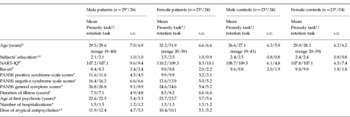
At the time of testing, all patients were taking atypical antipsychotics without any co-medication, such as tranquillizers or antidepressants. Patients were studied while clinically stable (at least 6 weeks stable on the same dosage of antipsychotics). Positive and negative symptoms, including their severity, were measured with a structured interview [the Positive and Negative Syndrome Scale (PANSS; Kay et al. Reference Kay, Opler and Fiszbein1986)] on the day of testing. Male and female patients did not differ significantly in age at onset of the first psychosis, the number of hospitalizations, the duration of illness, or the dosage of their medication.
The control subjects were either volunteers from Utrecht University Hospital or had been recruited through advertisements in local newspapers. They had been screened, using the Mini-International Neuropsychiatric Interview Plus (MINI-Plus), for current or past psychiatric illness, in themselves and their first-degree relatives (Sheehan et al. Reference Sheehan, Lecrubier, Sheehan, Amorim, Janavs, Weiller, Hergueta, Baker and Dunbar1998).
Participants were assessed with the Dutch version (Schmand et al. Reference Schmand, Lindeboom and van Harskamp1992) of the NART (Nelson, Reference Nelson1982), a test devised to estimate pre-morbid intellectual functioning in subjects suspected of cognitive decline. The test is composed of a list of 50 non-phonetic words (i.e. pronunciation does not follow the normal phonetic rules), printed in order of increased difficulty. The subject is required to read these words aloud, scores are based on the number of errors made in pronunciation. Scores on the Raven (Raven et al. Reference Raven, Court and Raven1996) were used as an index for current non-verbal, performal IQ.
All subjects were screened using a standard medical history questionnaire and interview of Utrecht University Hospital. Exclusion criteria included a history of neurological or systemic disease, head injury with documented cognitive sequelae or loss of consciousness longer than 5 min, any hearing impairment, and diagnosis of an active substance use disorder diagnosis in the 3 months prior to study. To avoid any effects of the menstrual cycle (as spatial performance is best when oestrogen is low) (Moody, Reference Moody1997; Epting & Overman, Reference Epting and Overman1998; Maki et al. Reference Maki, Rich and Rosenbaum2002; Driscoll et al. Reference Driscoll, Hamilton, Yeo, Brooks and Sutherland2005), all female participants were tested in the first 10 days of their cycle (starting from day 1 of menstruation).
Patients and control subjects did not differ significantly in terms of education and pre-morbid estimated IQ (NART), but differed across sex in age [F(1, 90)=5.2, p=0.025], with higher age in patients than in controls, and in current non-verbal IQ (Raven) [F(1, 90)=5.3, p=0.024], with higher IQ in controls than in patients.
All control subjects were Caucasian. In the patient group one male patient and two female patients were Asian, while the other patients were all Caucasian. Group characteristics of patients and controls are reported in Table 1.
Characteristics of all participants

NART-IQ, National Adult Reading Test; PANSS, Positive and Negative Syndrome Scale; s.d., standard deviation.
a Not all subjects participated in both tasks.
b Differences between diagnostic groups were significant.
c Education was measured on a four-point scale: low (1); middle (2); high (3); university (4).
d Differences between diagnostic groups were non-significant.
e Differences between male and female patients were non-significant.
f Dose of atypical antipsychotics in mg olanzapine equivalents (dose conversion: 20 mg olanzapine is equivalent to 6 mg risperidone, 700 mg quetiapine, 15 mg aripiprazole or 500 mg clozapine; Kohler et al. Reference Kohler, Turner, Bilker, Brensinger, Siegel, Kanes, Gur and Gur2003). Olanzapine (n=21; range=5–20 mg; mean dose 10 mg). Clozapine (n=11; range=100–650 mg; mean dose 336 mg=13.5 mg equivalent olanzapine). Risperidone (n=10; range=1.5–6 mg; mean dose 3.5 mg=12 mg equivalent olanzapine). Quetiapine (n=1; dose 400 mg=16 mg equivalent olanzapine). Aripiprazole (n=7; range=15 mg; mean dose 15 mg=15 mg equivalent olanzapine).
After receiving a complete description of the study, written informed consent was obtained from the subjects. The study had been approved by the Medical Ethics Committee of the University Medical Centre Utrecht.
Procedure
Emotional language task
An emotional language task was developed using stimuli derived from Vingerhoets et al. (Reference Vingerhoets, Berckmoes and Stroobant2003). The stimulus material consisted of 96 sentences across four conditions. In condition 1 (affective prosody–neutral content), 24 different sentences with a neutral semantic content, spoken in a happy, sad, angry or anxious tone, were presented and the participants were instructed to identify the emotion from the tone of voice. For example: ‘Silicons protect the surface’ spoken in a sad tone. Each emotion was presented six times. In condition 2 (emotional content–neutral prosody), 24 different sentences with a neutral tone and an emotional semantic content (happy, sad, angry or anxious) were presented and the participants had to determine the emotion that was reflected in the content. For example: ‘No one looks after her sister’ (sad content). Conditions 3 (affective prosody–incongruous emotional content) and 4 (emotional content–incongruous affective prosody) each consisted of 24 different sentences with emotional semantic content and an incongruous affective tone. In condition 3, participants were required to attend to the affective prosody of the sentence while ignoring the incongruous emotional content, whereas in condition 4 they had to attend to the emotional content of the sentence while ignoring the incongruous affective prosody. For example: ‘The man bought a nice present for his wife’, spoken in an angry tone. When attending to the emotional content, the correct answer would be ‘happy’; attending to the affective prosody the correct answer would be ‘angry’. To control for sex differences in the affective prosody of the spoken sentences, in all conditions 12 of the sentences were articulated by a professional male actor and 12 by a female actor. In each condition, the four types of emotions (happy, sad, angry, anxious) were presented six times and divided equally over the 24 sentences in a pseudo-random order. All stimuli were presented binaurally through earphones, with a 2-second interstimulus interval between each sentence, while the Dutch words for the four emotions were displayed on a computer screen. The testing of each condition was preceded by a series of four practice trials. Participants were instructed to name the perceived emotion, and their answers were written down by a test-assistant.
Mental rotation task
A computerized version of the mental rotation task, consisting of 20 pairs of three-dimensional geometric line drawings, was presented to all participants (Shepard & Metzler, Reference Shepard and Metzler1971). Subjects were asked to compare the mental representations of two line drawing objects, presented at different orientations, and to indicate, by pressing a left or right button, whether these figures were identical or different. Subjects were instructed to work as fast as possible, but not at the cost of accuracy. The subject's error rate (ER) and mean response time (RT) were recorded by the computer.
Statistical analysis
The accuracy scores and reaction time data derived from the rotation task were both analysed by an ANOVA (group and sex). Age and Raven were entered as covariates, because patients and controls differed on these variables; Raven and NART were entered as covariates because differences in IQ could explain differences in scores on this cognitive task. Separate analyses with age, NART and Raven as covariates showed a significant effect of all variables on task performance, but when all variables were entered simultaneously as covariates, only the Raven revealed a significant effect. Therefore, only the results with Raven as a covariate is reported.
On language task performance a repeated measures two-way ANCOVA was conducted with two within-subject factors (Congruence: congruence versus incongruence; and Task: prosody versus semantics), two between-subjects factors (sex: male versus female; and group: patient versus control) and current non-verbal IQ (Raven) as a covariate. Separate analyses with age, NART and Raven as covariates were performed, showing no effect of age or NART, only a significant effect of Raven.
To analyse the error pattern for the individual emotions (happy, anger, fear and sad), descriptives were computed for all scores on each individual emotion on all conditions combined. The proportion of accuracy scores for each emotion was calculated (e.g. ‘sad’ on all conditions together).
Correlation coefficients (Pearson) were computed for associations between scores on prosody (condition 1) and patient variables (duration of illness, dosage of medication and PANSS scores), and between scores on semantics (condition 2) and patient variables. The same was done for the visuospatial data and patient variables.
Results
Clinical variables
As shown in Table 1, no significant differences were found between male and female patients in the severity of negative symptoms, positive symptoms or general psychopathology as measured by the PANSS.
Accuracy scores on the emotional language task
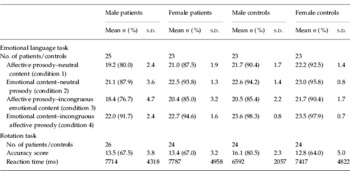
Accuracy was defined as the proportion of correctly identified expressions. The results for all subjects are listed in Table 2.
Accuracy scores on the emotional language task and the mental rotation task

s.d., Standard deviation.
A repeated measures two-way ANCOVA with two within-subject factors (Congruence: congruence versus incongruence; and Task: prosody versus semantics), two between-subjects factors (sex: male versus female; and group: patient versus control), and current non-verbal IQ (Raven) as a covariate revealed main between-subjects effects for Raven [F(1, 89)=20.7, p<0.001], group [F(1, 89)=12.2, p=0.001] and Sex [F(1, 89)=7.1, p=0.009]. Overall, patients made more errors than control subjects, and female participants outperformed male participants.
Significant within-subjects main effects were found for Congruence: all groups performed significantly better on the congruent than on the incongruent tasks [F(1, 89)=6.4, p=0.014]. The influence of Raven was significantly stronger for all groups in the incongruent conditions [F(1, 89)=5.5, p=0.021] compared to the congruent conditions.
On average, more errors were made across diagnostic groups on the prosody task compared to the semantics task, but this difference did not reach significance. In addition, current non-verbal IQ (Raven) did not show a differential effect on processing semantics or prosody.
When entered as covariates, age and estimated IQ (NART) did not show any effect.
The emotion fear was found to be the most difficult to recognize for all groups in all conditions.
Lower affective prosody scores (condition 1) correlated with higher negative symptom scores (r=−0.318, p=0.028). Higher affective prosody scores correlated with higher age of first psychosis (r=0.357, p=0.013).
Accuracy scores on the rotation task
An ANCOVA with IQ (Raven) as a covariate revealed an effect of IQ [F(1, 93)=26.2, p<0.001), a main effect of sex [F(1, 93)=9.1, p=0.003], and a sex×group interaction [F(1, 93)=4.5, p=0.036]. Importantly, the effect of sex was limited to the male and female controls [F(1, 46)=8.8, p=0.005], with men outperforming women. No sex difference was found between the male and female patients [F(1, 48)=0.02, p=0.901). Male patients, female patients and female controls obtained similar scores.
A positive correlation was found between scores on the rotation task and IQ measures [Raven (r=0.451, p<0.001], but not between spatial data and patient characteristics.
Regarding response times, an ANCOVA with IQ (Raven) as a covariate showed a significant effect of IQ [F(1, 93)=9.7, p=0.003] and a trend towards significance for group [F(1, 93)=3.2, p=0.077], with controls performing faster than patients, but no effect of sex and no interaction.
Table 2 shows the proportions of correct responses for emotional language and spatial ability.
Discussion
The aim of this study was to investigate whether the female advantage in emotional prosodic and semantic processing and the male advantage in visuospatial ability are preserved in schizophrenia, and to examine whether the scores obtained in both domains are related to IQ and to symptomatology.
Concerning emotional language processing, we found that healthy controls outperformed patients, and that women outperformed men. All groups made more errors in identifying emotional prosody than in identifying emotional semantics and performed significantly better on the congruent than on the incongruent tasks. Our findings on the incongruent conditions in patients are consistent with results from several studies reporting patients with schizophrenia to be impaired in the inhibition of unattended stimuli (Iwanami et al. Reference Iwanami, Kanamori, Isono, Okajima and Kamijima1996; Barch et al. Reference Barch, Carter, Hachten, Usher and Cohen1999, Reference Barch, Carter and Cohen2004). IQ (Raven) did not show differential effects in processing prosody or semantics, but the influence of Raven was found to be significantly stronger for all groups in the incongruent conditions compared to the congruent conditions.
Low scores on prosodic processing (condition 1) were found to correlate significantly with severity of negative symptoms. This is in line with previous studies on processing prosody (Fricchione et al. Reference Fricchione, Sedler and Shukla1986; Leitman et al. Reference Leitman, Foxe, Butler, Saperstein, Revheim and Javitt2005) in schizophrenia patients and is consistent with a recent model proposed by Aleman & Kahn (Reference Aleman and Kahn2005), in which amygdala damage in combination with reduced interconnectivity with the prefrontal cortex is hypothesized to give rise to emotion processing deficits. These deficits [reduced emotional expression (affective flattening) and impaired emotion recognition] are suggested to be central to schizophrenia and to form part of the negative symptom dimension, which may reflect the severity of the illness.
In confirmation of a previous study by Edwards et al. (Reference Edwards, Pattison, Jackson and Wales2001), we also found that fearful vocal expressions were the most difficult to recognize for all participants.
Although the mechanisms that underlie the sex differences in recognition of emotional language are not known, it is possible that specific sex differences in patterns of brain activation during speech processing may account for these findings. Results from several studies on language processing in healthy subjects suggest a greater extent of lateralization in men than in women (Shaywitz et al. Reference Shaywitz, Shaywitz, Pugh, Constable, Skudlarski, Fulbright, Bronen, Fletcher, Shankweiler, Katz and Gore1995; Rossell et al. Reference Rossell, Bullmore, Williams and David2002; Baxter et al. Reference Baxter, Saykin, Flashman, Johnson, Guerin, Babcock and Wishart2003). A study by Schirmer et al. (Reference Schirmer, Zysset, Kotz and Yves von Cramon2004) reported that processing of affective prosody initiates relatively more right hemisphere activation in both sexes, while processing emotional word valence elicits more bilateral activation in women and left hemisphere activation in men. In the case of schizophrenia, evidence from several functional MRI (fMRI) studies suggests some abnormal reversal of lateralization in speech processing, with relatively more left lateralization in response to prosody (Mitchell et al. Reference Mitchell, Elliott, Barry, Cruttenden and Woodruff2004) and relatively more right lateralization in response to semantics (Woodruff et al. Reference Woodruff, Wright, Bullmore, Brammer, Howard, Williams, Shapleske, Rossell, David, McGuire and Murray1997). As men and women differ in their basic patterns of brain activation in speech processing, changes in lateralization may impact differently on both sexes.
However, the results in our study suggest that the sex differences in patients on emotional prosodic and semantic processing are not a specific effect of schizophrenia, but of preservation of the well-known female advantage in verbal emotional processing in schizophrenia.
In contrast to the findings of this study, a study by Bozikas et al. (Reference Bozikas, Kosmidis, Anezoulaki, Giannakou, Andreou and Karavatos2006) reported only male patients with schizophrenia to be impaired in prosody perception, while female patients showed deficits in just recognizing sadness. This discrepancy may be explained by differences in patient variables between male and female patients (or by the small number of women included in the Bozikas study, which limits statistical power). Notably, in our sample, male and female patients did not differ in age at first psychosis, although age at onset is usually higher in women than in men (Häfner, Reference Häfner2003; Häfner et al. Reference Häfner, Maurer, Löffler, Fätkenheuer, an der Heiden, Riecher-Rössler, Behrens and Gattaz1994). As lower prosody scores were found to correlate with younger age of first psychosis this might explain why in our sample deficits in prosodic perception were shown in both male and female patients.
On the task of visuospatial ability, we replicated the previous findings of a male advantage on the mental rotation task in healthy participants (Linn & Peterson, Reference Linn and Petersen1985; Roberts & Bell, Reference Roberts and Bell2003; Burton et al. Reference Burton, Henninger and Hafetz2005), even though all women had been tested during menstruation, when oestrogen is low and spatial performance is best (Silverman & Phillips, Reference Silverman and Phillips1993; Moody, Reference Moody1997; Epting & Overman, Reference Epting and Overman1998; Maki et al. Reference Maki, Rich and Rosenbaum2002; Driscoll et al. Reference Driscoll, Hamilton, Yeo, Brooks and Sutherland2005). However, differences in performance between male and female patients were not significant in our study. Remarkably, female patients and female controls obtained similar scores, whereas male patients performed considerably worse than male controls. Low oestrogen levels, reported in women with schizophrenia, irrespective of antipsychotic-induced hyerprolactinaemia (Bergemann et al. Reference Bergemann, Mundt, Parzer, Jannakos, Nagl, Salbach, Klinga, Runnebaum and Resch2005), may have facilitated visuospatial performance in the female patients. Furthermore, there is evidence that men and women differ in cognitive strategies and cerebral activation patterns during mental rotation (Jordan et al. Reference Jordan, Wustenberg, Heinze, Peters and Jancke2002; Weiss et al. Reference Weiss, Siedentopf, Hofer, Deisenhammer, Hoptman, Kremser, Golaszewski, Felber, Fleischhacker and Delazer2003), with women using more verbal strategies than men on spatial tasks (Jordan et al. Reference Jordan, Wustenberg, Heinze, Peters and Jancke2002), and with more right lateralized hemispheric activation in men but not in women (Rilea et al. Reference Rilea, Roskos-Ewoldsen and Boles2004; Bell et al. Reference Bell, Willson, Wilman, Dave and Silverstone2006). As schizophrenia has been associated with right hemisphere dysfunction (Cutting, Reference Cutting1992; Borod et al. Reference Borod, Martin, Alpert, Brozgold and Welkowitz1993; Ross et al. Reference Ross, Orbelo, Cartwright, Hansel, Burgard, Testa and Buck2001; Kucharska-Pietura et al. Reference Kucharska-Pietura, David, Dropko and Klimkowski2002), and mental rotation ability has been suggested to be positively related to the magnitude of right hemispheric specialization (Siegel-Hinson & McKeever, Reference Siegel-Hinson and McKeever2002), this could imply that neurocognitive defects (e.g. right hemispheric damage by schizophrenia) might have stronger consequences for spatial ability in (more right lateralized) male patients with schizophrenia compared to female patients.
However, it is not yet fully understood when or why differences in activation patterns lead to differences in task performance. For example, in healthy controls, sex differences have been found in cerebral activation patterns during a mental rotation task, while performance was similar in men and women (Jordan et al. Reference Jordan, Wustenberg, Heinze, Peters and Jancke2002). By contrast, comparable brain activation with differential performance has been reported on mental rotation and verbal fluency (Halari et al. Reference Halari, Sharma, Hines, Andrew, Simmons and Kumari2006a).
Our findings on the mental rotation task are in contrast to a study by Halari et al. (Reference Halari, Mehrotra, Sharma, Ng and Kumari2006b), which demonstrated that sexual dimorphism on a spatial task (favouring men) remains intact in patients with schizophrenia. This discrepancy may be explained by sample differences between the studies. Compared to the study by Halari et al., the duration of illness was shorter (8.5 v. 21.5 years) in the female patients of our study, which may have advanced preservation of their cognitive skills. Furthermore, the patients in Halari's study were all treated with typical antipsychotics, while in our study all patients were on atypical antipsychotic medication. Improvement on verbal tasks (Buchanan et al. Reference Buchanan, Holstein and Breier1994; Muller et al. Reference Muller, Werheid, Hammerstein, Jungmann and Becker2005) and on spatial tasks (Gur et al. Reference Gur, Kohler, Ragland, Siegel, Bilker, Loughead, Phend and Gur2003; Harvey et al. Reference Harvey, Napolitano, Mao and Gharabawi2003) has been linked to treatment with atypical antipsychotic medication, but not with typical antipsychotics. Moreover, female patients have been reported to show a better treatment response to antipsychotics relative to male patients (Goldstein et al. Reference Goldstein, Cohen, Horton, Lee, Andersen, Tohen, Crawford and Tollefson2002b). These factors might explain why we found preservation of sexual dimorphism on the verbal task in female patients, and loss of sexual dimorphism on the spatial task in male patients with schizophrenia.
A noteworthy strength of this study is that the sex differences that were found cannot be attributed to sex differences in the severity of illness because age of onset, severity of symptoms and dosage of medication did not show significant differences between the male and female patients. This lends additional credibility to our findings. A limitation of this study might be that the sample was a selective one, consisting of stabilized out-patients on atypical antipsychotics, without co-medication, recent drug abuse or co-morbid affective symptoms.
Systematic research of sex differences in cognitive and emotional (language) processing is still in its infancy. Better understanding of sex effects on these domains in healthy subjects is necessary to understand the impact of sex on schizophrenia. fMRI studies may reveal whether men and women differentially recruit particular brain regions to perform specific tasks. By varying the level of task difficulty it might be possible to examine sex differences in the use of additional resources in more demanding tasks. Furthermore, the role of sex hormones in emotional processing should be more explored.
In conclusion, women's superior ability relative to men in identifying the affective prosody and emotional content of a spoken message is preserved in schizophrenia, albeit at a lower accuracy level compared to controls. In addition, the ability to recognize the emotional prosody and content of a message is highly influenced by IQ, especially in the incongruent conditions, in all groups. As the ability to recognize emotions in speech is essential for social interaction, preservation of the female advantage in recognition of affective prosody and emotional semantics in female patients may explain, in part, the better social skills and global outcome in women compared to men with this illness. By contrast, the male advantage in visuospatial processing was found to be compromised in schizophrenia.
Regarding therapy, there is some evidence that the training of verbal-semantic encoding in patients with schizophrenia may improve the ability to identify social cues (Corrigan et al. Reference Corrigan, Hirschbeck and Wolfe1995), and male patients, in particular, might benefit from this type of therapy. Finally, the results of this study stress the importance of taking into account the influence of sex differences on emotional processing in schizophrenia.
Acknowledgements
We thank Professor G. Vingerhoets for providing the stimuli for the emotional language task. A. Aleman was supported by a VernieuwingsImpuls grant (no. 016.026.027) from the Netherlands Organization for Scientific Research (NWO).
Declaration of Interest
None.