
Introduction
The anthropological and ethnographic literature is rich in examples of the significance of bifacial tools—mainly axes, adzes and chisels—for horticulturists and farming societies worldwide (e.g. Campbell-Smith Reference Campbell-Smith1965; Claris & Quartermaine Reference Claris and Quartermaine1989; Darvill Reference Darvill1989; Pétrequin & Pétrequin Reference Pétrequin, Pétrequin, Berthelet and Chavaillion1993, Reference Pétrequin, Pétrequin, Davis and Edmonds2011: 347; Thomas & Tilley Reference Thomas, Tilley and Tilley1993; Cooney Reference Cooney, Gibson and Simpson1998; Le Roux Reference Le Roux, Edmonds and Richards1998; Pétrequin et al. Reference Pétrequin, Pétrequin, Jeudy, Jeunesse, Monnier, Pelegrin, Praud, Edmonds and Richards1998; Brumm Reference Brumm, Davis and Edmonds2011). This importance was not simply due to specific attributes of the end-product, but was also imparted by the raw material from which the tools were made; the selection of the raw material used and the location of the quarries and production sites were key elements of the process for ancient communities. This is explicitly described by Pétrequin and Pétrequin (Reference Pétrequin, Pétrequin, Davis and Edmonds2011: 339) in their ethnographic account of the symbolic role of polished stone axe-heads from modern day New Guinea:
the raw material being worked was not simply a block of stone. On the contrary: in the realm of social imagery, we are dealing with material that is almost a living entity, relating to the origin of the world, the dream time.
It seems that the qualities of the raw material, whether practical or symbolic, were just as important as those of the end-product and were major factors promoting their circulation, some being exchanged over long distances from the quarry sites and others having a more local, restricted distribution (e.g. Clark Reference Clark1965; McBride Reference McBride1978, Reference McBride1984; Cobb Reference Cobb1989; McAnany Reference McAnany1989; Bradley & Edmonds Reference Bradley and Edmonds1993; Brumm Reference Brumm, Davis and Edmonds2011).
In this light, and as many ethnographic studies have demonstrated, the documentation of bifacial tool distribution can provide a powerful means to explore social aspects of past communities. Indeed, the appearance of bifacial tools in the archaeological record is fundamentally linked with the onset of the Neolithic period. During this time, they were a principal part of an elaborate set of tools and techniques used during the transition to agriculture in order to exploit the environment more efficiently. In the Levant, early Neolithic settlements first appear during the Pre-pottery Neolithic A period (c. 11 500–10 500 cal BP). At that time, communities were usually organised in small villages that practised agriculture and showed significant developments in material culture and economic and social organisation (e.g. Bar-Yosef & Belfer-Cohen Reference Bar-Yosef and Belfer-Cohen1989, Reference Bar-Yosef, Belfer-Cohen, Gebauer and Price1992; Bar-Yosef Reference Bar-Yosef1991; Kuijt & Goring-Morris Reference Kuijt and Goring-Morris2002; Belfer-Cohen & Goring-Morris Reference Belfer-Cohen and Goring-Morris2011).
Bifacial tools made of a variety of raw materials occupy a central place within the context of social and economic changes concerning the consolidation and restructuring of social units (e.g. Rosenberg Reference Rosenberg2008). Bifacial tools, predominantly flint axes, appear in the southern Levant for the first time during this period and were produced in habitation sites or in specialised workshops (e.g. Roshwalb Reference Roshwalb1981: 21–95; Taute Reference Taute, Gebel and Kozlowsky1994; Barkai Reference Barkai2005; Rosenberg et al. Reference Rosenberg, Nadel and Ronen2011). These tools show techno-typological trends in shaping and re-sharpening techniques, as well as morphological variation through time, which are mainly reflected in an increase in the frequencies of adzes (e.g. Barkai Reference Barkai2005; Yerkes et al. Reference Yerkes, Khalaily and Barkai2012).
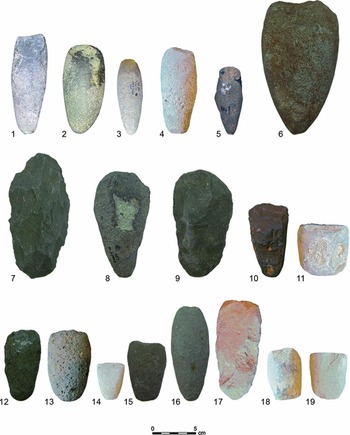
Ground-stone bifacial tools, mostly made of basalt and limestone but also of more exotic raw materials, appear for the first time during the Pre-pottery Neolithic A period (e.g. Dorrell Reference Dorrell, Kenyon and Holland1983: 508–10; Samzun Reference Samzun, Lechevallier and Ronen1994: 224; Gopher Reference Gopher, Bar-Yosef and Gopher1997: 163; Garfinkel & Dag Reference Garfinkel and Dag2006: 101; Rosenberg & Gopher Reference Rosenberg, Gopher, Bar-Yosef, Goring-Morris and Gopher2010: 159–62). They continue to form a small component of bifacial tool assemblages during the following Pre-pottery Neolithic B and C, the Pottery Neolithic and the Chalcolithic periods (e.g. Rollefson & Simmons Reference Rollefson and Simmons1985: tab. 4; Rosenberg Reference Rosenberg2011; Rosenberg & Garfinkel Reference Rosenberg and Garfinkel2014: 133–38). During these periods, ground-stone bifacial tools are frequently small and lightweight (Figure 1; see Rosenberg et al. Reference Rosenberg, Shimelmitz and Nativ2008; Rosenberg Reference Rosenberg2011). While axes dominate the assemblages, adzes and chisels are also present (Rosenberg et al. Reference Rosenberg, Shimelmitz and Nativ2008; Rosenberg Reference Rosenberg2011). Some items are miniature in scale and probably represent votive objects, their significance enhanced by the exotic materials from which they were made, sometimes transported hundreds of kilometres from the nearest source. Towards the end of the Chalcolithic period and the onset of the Early Bronze Age when copper celts become more prevalent, bifacial tools made of flint and various other stones disappear from most assemblages (Rosen Reference Rosen1997; Barkai Reference Barkai2005).
Basaltic bifacial tools from Neolithic and Early Chalcolithic sites in Israel: 1–3) Gesher; 4) Hatoula; 5) Yiftahel; 6) Hatanur; 7–9) Beisamoun; 10) Ain Retet; 11) Abu-Gosh; 12–14) Kabri; 15–16) Hagoshrim; 17–19) Hazorea.

In contrast to flint tools, no evidence existed for the production context of ground-stone bifacial tools in the Levant until recently. This hindered any understanding of the production, distribution and circulation of these tools around the landscape, or the distances that they were transported from their production sites. The lack of evidence precluded any coherent analysis of the social and economic mechanisms that were involved in the distribution of these tools. The recent discovery of a basanite quarry and bifacial production site at Giv‘at Kipod in the Manasseh Hills, Israel (Rosenberg et al. Reference Rosenberg, Shimelmitz and Nativ2008) provided an excellent opportunity to study basaltic rock bifacial production strategies. The geochemical fingerprint of the basanite (a fine-grained alkaline igneous rock) of Giv‘at Kipod quarry and production site was recently defined, and this distinguished it from other basaltic rock sources in northern Israel (Gluhak & Rosenberg Reference Gluhak and Rosenberg2013). The finding of this rare site, the geochemical study conducted there and on other potential sources of basaltic rocks in Israel (and on a range of basaltic bifacial tools) allow us to confront, for the first time, some of the interpretive challenges relating to basalt bifacial tool exchange in the southern Levant, and to explore the mechanisms behind this trade.
The quarry and production site at Giv‘at Kipod
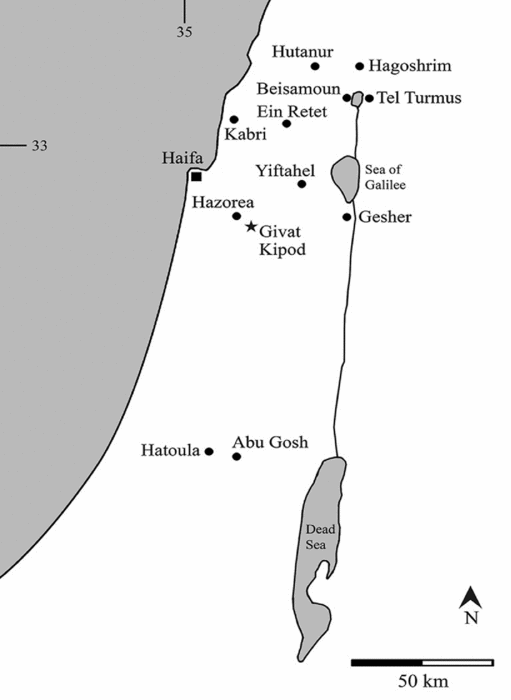
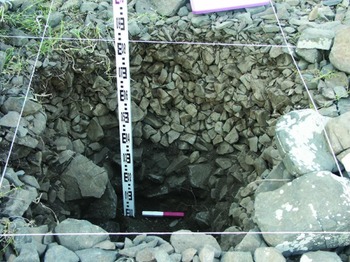
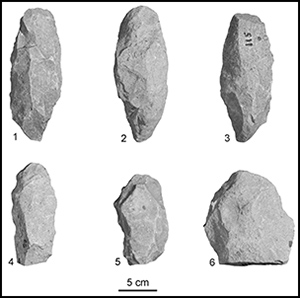
Giv‘at Kipod is a basanite hill on the south-east margins of the Manasseh Hills (Figure 2), approximately 20km east of the Mediterranean Sea. In a survey conducted at the site, several accumulations of knapped basalt were noted, some of which included thousands of pieces of debitage. The largest of these piles was on the south-east slope of the hill (Rosenberg et al. Reference Rosenberg, Shimelmitz and Nativ2008). The surface of the pile was packed with thousands of items of production waste (Figure 3), mainly fragments and flakes, with fewer numbers of bifacial roughouts, which were primarily of axes (Figure 4). The thickness of the pile varied, in some places reaching a depth of at least 1m. The technological analyses show a high density of finds, mainly debitage items.
Our survey and excavations demonstrated that Giv‘at Kipod was clearly a quarry and production site devoted exclusively to the manufacture of basanite bifacial tools (Rosenberg et al. Reference Rosenberg, Shimelmitz and Nativ2008). The waste material suggests that most of the bifacial production sequence is represented, although, as no polished bifacials were found, it seems that the final stage was conducted elsewhere.
A map showing the location of Giv‘at Kipod and sites from which basaltic bifacial tools were sampled.

The main production locus at Giv‘at Kipod during excavation (photograph by Danny Rosenberg).

Basanite bifacial tools from Giv‛at Kipod.

The geochemical study
Provenance studies of ground-stone bifacial tools have been carried out in many areas of the world (e.g. Campbell-Smith Reference Campbell-Smith1965; Darvill Reference Darvill1989; Bradley & Edmonds Reference Bradley and Edmonds1993; Lass Reference Lass1994; Mills et al. Reference Mills, Lundbald, Smith, McCoy and Naleimaile2008). Until recently, however, no such study had been conducted in the southern Levant, despite the clear potential for examining aspects such as raw material selection, mobility, trade and exchange patterns, control over resources, and the long-term use of sources for raw material. A small number of provenance studies of basalt tools and vessels in the southern Levant were conducted in the past, but these focused mainly on the artefacts and not on possible sources for raw material (e.g. Philip & Williams-Thorpe Reference Philip and Williams-Thorpe1993, Reference Philip and Williams-Thorpe2001; Williams-Thorpe & Thorpe Reference Williams-Thorpe and Thorpe1993; Weinstein-Evron et al. Reference Weinstein-Evron, Lang, Ilani, Steinitz and Kaufman1995; Rutter et al. Reference Rutter, Pearson, Philip, Day, Ottley, Holland and Tanner2003; Watts et al. Reference Watts, Bennet III, Kopp and Mattingly2004; Rutter & Philip Reference Rutter, Philip, Rowan and Ebeling2008). These studies were only able to associate the tested tools with relatively large regions without specific provenances and so were not useful for the location of extraction sites or the reconstruction of ancient trade systems. Nonetheless, a few provenance studies on basalt deposits in other regions, which were based on a detailed geochemical study of the potential raw material in combination with multivariate methods, proved very successful (Johnson et al. Reference Johnson, Pearl, Eckert and James2007; Harper et al. Reference Harper, Neff and Lipo2008; Gluhak & Hofmeister Reference Gluhak and Hofmeister2009, Reference Gluhak and Hofmeister2011). These merit additional provenance research using state-of-the-art methods for geochemical evaluation.
During a recently conducted geochemical study (Gluhak & Rosenberg Reference Gluhak and Rosenberg2013), Miocene magmatic rocks of the Jezreel Valley were sampled along with other sources in the Jordan Valley and the Galilee. Thus far, 115 field samples from the Jezreel Valley and its soundings have been analysed, and 150 more from Upper and Lower Galilee are currently being examined. A further 20 samples were tested from basaltic bifacial tools found in archaeological sites spanning the Pre-pottery Neolithic A and through the Late Neolithic/Early Chalcolithic periods (Figure 2).
Major and minor trace elements of both field and archaeological samples were determined by wavelength-dispersive X-ray fluorescence and laser-ablation inductively coupled plasma mass spectrometry (for the analytical methods used, see Gluhak & Rosenberg Reference Gluhak and Rosenberg2013). To limit damage, only a very small sample could be collected from some artefacts. In these cases, major element compositions were measured by electron-microprobe-analyser.
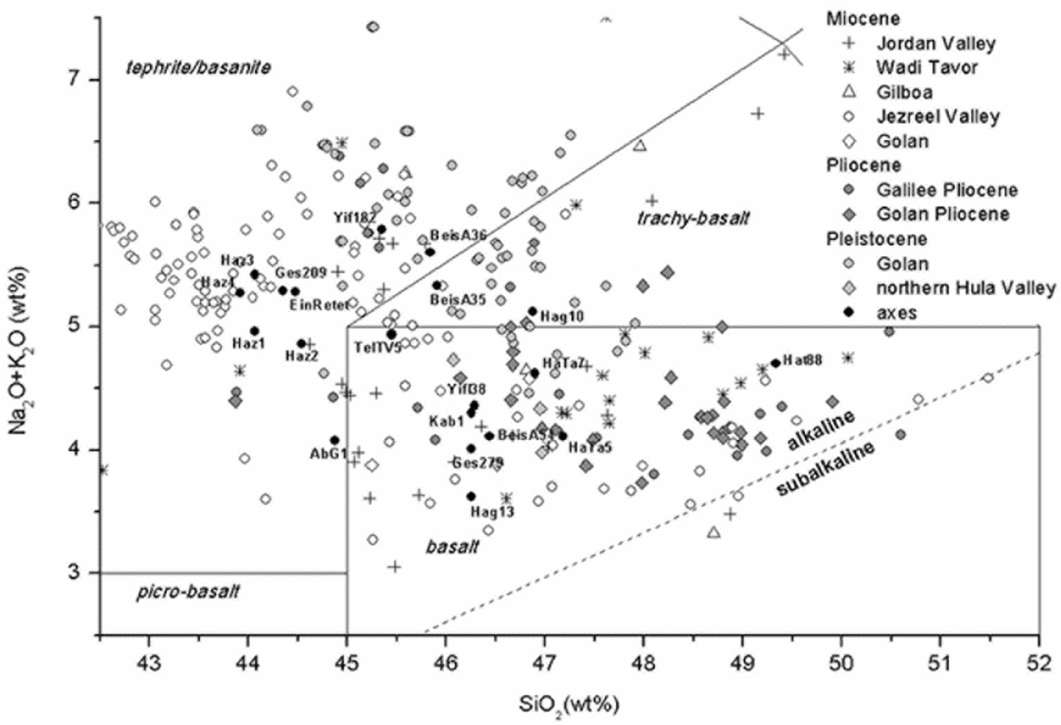
The geochemical data (Table 1) showed that the Giv‛at Kipod basanite can be distinguished from the other Miocene Jezreel Valley lavas by its major element composition (Figure 5). The trace element pattern is less clear and Giv‛at Kipod shows a well-defined composition for only a few elements. Cluster analysis was used to check the possible Giv‛at Kipod provenance on a multivariate basis (for details on data selection, data transformation, cluster algorithm and distance measure, see Gluhak & Rosenberg Reference Gluhak and Rosenberg2013). In the first step, cluster analysis was applied to the geological field samples, resulting in a well-constrained Giv‛at Kipod cluster. This result was the precondition for checking more precisely whether the rocks from which the individual artefacts were produced did indeed derive from this specific lava outcrop. Every tool sample was clustered individually with the geological field samples. These analyses clearly demonstrated that six of the tools were produced from Giv‘at Kipod lava: one from the Pre-pottery Neolithic A site of Gesher in the Jordan Valley; one from Pre-pottery Neolithic B Yiftahel in the Galilee; and four from the Late Neolithic/Early Chalcolithic site of Hazorea (located near Giv‘at Kipod). (For details on cluster analyses, data transformation, and normalisation, see Gluhak & Rosenberg Reference Gluhak and Rosenberg2013.)
Chemical composition of the tested bifacial tools.

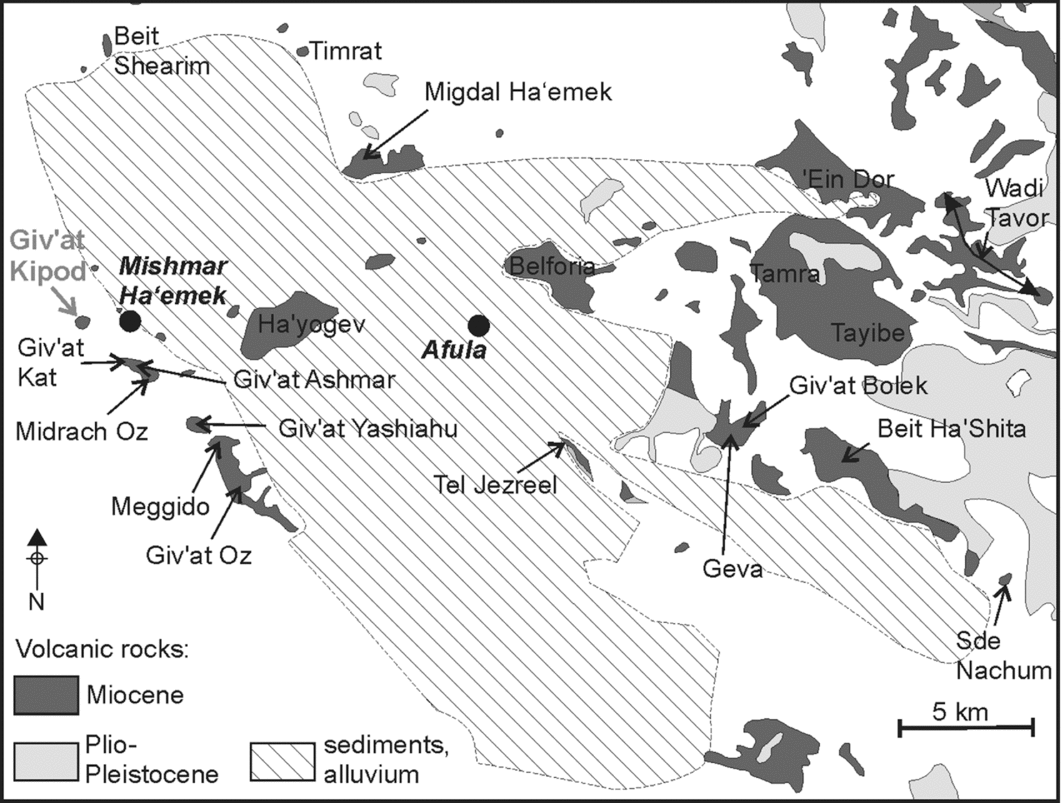
Sampling locations in and around the Jezreel Valley, modified from Gluhak and Rosenberg Reference Gluhak and Rosenberg2013; map according to Geological Map of Israel (Sneh et al. Reference Sneh, Bartov and Rosensaft1997).

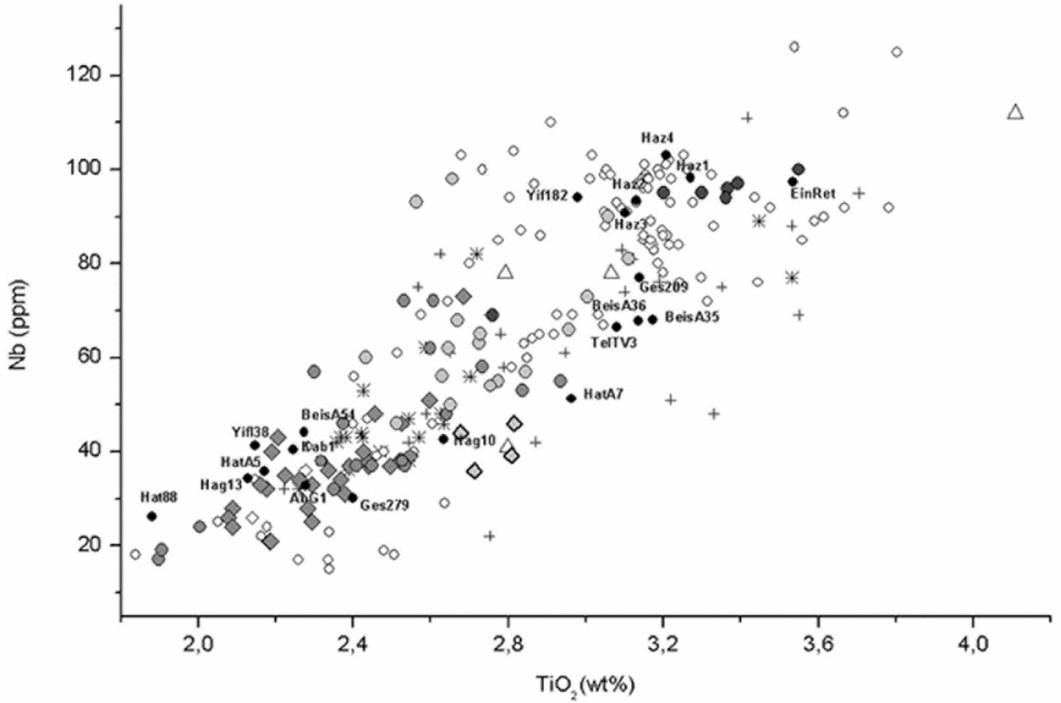
The remaining basaltic bifacials tested were produced from other sources of raw material. It is not yet possible to locate these clearly using published geochemical data for volcanic rocks in the region (Philip & Williams-Thorpe Reference Philip and Williams-Thorpe1993, Reference Philip and Williams-Thorpe2001; Weinstein Reference Weinstein2000; Weinstein et al. Reference Weinstein, Navon, Altherr and Stein2006; Gluhak & Rosenberg Reference Gluhak and Rosenberg2013). Based on the geochemical data, we can, however, assume that the bifacial tool from Ein Retet (in the upper Galilee) was made of Jezreel Valley lava (Figure 6). According to the cluster analysis (Gluhak & Rosenberg Reference Gluhak and Rosenberg2013), it could have come from sources at Giv‘at Kat or Midrach Oz on the western margins of the Jezreel Valley, in the vicinity of Giv‘at Kipod. Bifacial tools from Hagoshrim (Hag13) and Hatanur (HatA5) in the northern Hula Valley, and from Kabri (Kab1) and Yiftahel (Yif138) in the Galilee, were most probably derived from a single extraction site (Figure 7). Similarly, the bifacial tools from Beisamoun (BeisA36 and BeisA35) and Tel Turmus (TelTV3) in the Hula Valley also have a common source (Figure 7). All other bifacial tools tested so far present singular geochemical signatures.
Total alkali vs silica (Le Bas et al. Reference Le Bas, Le Maitre, Streckeisen and Zanettin1986); sources for data: Miocene data from Weinstein (Reference Weinstein2000) and Gluhak and Rosenberg (Reference Gluhak and Rosenberg2013); Pliocene and Pleistocene rocks from Galilee and Golan from Weinstein et al. (Reference Weinstein, Navon, Altherr and Stein2006); Northern Hula Valley from Rosenberg et al. (Reference Rosenberg, Shimelmitz, Gluhak and Assaf2014); bifacial tools Yif182, YifI38, Hat88, Kab1, Haz1–Haz4, AbG1, Ges209 and Ges279 from Gluhak and Rosenberg (Reference Gluhak and Rosenberg2013).

TiO2-Nb composition of the bifacial tools and volcanic rocks from the region (see Figure 6 for symbols and references).

Discussion
Several salient points emerge from the results of the present geochemical study, allowing us to move one step towards interpreting the provenance and distribution of basaltic bifacial tools. First, it is clear that in the southern Levant these tools were created on several production sites. Second, bifacial tools from a single quarry and production site travelled to more than one habitation site. Third, it appears that a single raw material source was serving some of the communities of northern Israel over a considerable time, as items made of geochemically similar raw material are found in sites dated to different periods. This pattern is evident for Giv‘at Kipod, which is, thus far, the only known quarry and production site for basaltic bifacial tools in the Levant (Rosenberg et al. Reference Rosenberg, Shimelmitz and Nativ2008), but also for at least two as yet unidentified ‘virtual’ extraction sites that produced raw materials for bifacial tools found in sites of different periods in northern Israel. It is clear that these locations, and especially Giv‘at Kipod, were carefully chosen given that other suitable sources were available.
Based on the archaeological and geochemical data, it may now be further concluded that Giv‘at Kipod was an important production centre over several millennia. Artefacts of Giv‘at Kipod origin found in dateable contexts indicate that the site was operating from the Pre-pottery Neolithic period A (an item found at the site of Gesher); during the Pre-pottery Neolithic period B (an item found in a Pre-pottery Neolithic period B context at Yiftahel); and through the Late Neolithic/Early Chalcolithic (four bifacials found at the site of Hazorea).
These results reflect the significance of ground-stone bifacial production sites (see also Vardi Reference Vardi, Borrell, Ibáñez and Molist2013) and suggest that this significance was not chronologically limited. Rather, it seems that these sites were geographic and social landmarks, and that their practical and cultural importance was passed from generation to generation. These extraction sites may have been more than just sources of raw material per se, providing localities for social interactions between groups of different communities (e.g. Pétrequin et al. Reference Pétrequin, Pétrequin, Jeudy, Jeunesse, Monnier, Pelegrin, Praud, Edmonds and Richards1998).
While most of the geochemical information retrieved so far concerns items found in habitation sites in northern Israel, it is interesting to note that the single item from the Pre-pottery Neolithic A site of Hatoula was not produced at Giv‘at Kipod. Moreover, its geochemistry does not match any of the other bifacial tools sampled or any of the geological sources analysed. Although we still lack information concerning bifacial tools from other sites that are at a great distance from probable basalt sources, it should be noted, based on the data accumulated so far, that Giv‘at Kipod did not produce bifacial tools for sites beyond Yiftahel in the north and Gesher in the east (20–25km away). This suggests that despite the large scale of production documented at Giv‘at Kipod (Rosenberg et al. Reference Rosenberg, Shimelmitz and Nativ2008), the quarry was mainly operating on a regional scale. Thus, some villages in the Hula Valley, for instance, were acquiring raw material for ground-stone bifacial tools from different, and probably closer, extraction sites (western parts of the Golan Heights or the Galilee).
Of note is the fact that in two sites, Yiftahel and Gesher, additional bifacial tools were found that were not produced of material derived from Giv‘at Kipod. This implies that there was no specific restriction concerning the localities where basalt raw material for bifacial tools production was acquired. The accessibility of these sites, and the extent of any control exercised by a specific village, remains to be demonstrated. Yet given that the largest number of Giv‘at Kipod products at one site was found at Hazorea, just a few kilometres north, may indicate that, at least during the Late Neolithic/Early Chalcolithic, local communities in the area held some control over bifacial tool production at Giv‘at Kipod.
The evidence from Giv‘at Kipod reflects a pattern of short journeys (to and from the production site) and thus a restricted distribution and circulation system of the quarry end-products through time. If so, there remains the challenge of explaining the sheer size of production at the site given the paucity of basaltic bifacial tools found at archaeological sites in the southern Levant, even in extensively and thoroughly excavated sites (e.g. Dorrell Reference Dorrell, Kenyon and Holland1983: 510; Gopher Reference Gopher, Bar-Yosef and Gopher1997: 163; Rosenberg & Gopher Reference Rosenberg, Gopher, Bar-Yosef, Goring-Morris and Gopher2010: 159). If we are correct and Giv‘at Kipod was a centre for the production of hundreds if not thousands of basanite bifacial tools from the Pre-pottery Neolithic A onwards, we would expect to find more than just several dozen basaltic bifacial tools in the entire prehistoric southern Levant. Given the geochemical data from Giv‘at Kipod and the basaltic bifacial tools presented in this paper, the distribution mechanisms for these tools in the southern Levant appear to be complex, albeit primarily regional. These questions focus attention towards the disposal patterns of the tools, and to the ways in which they may have been ‘removed’ from the archaeological record.
The transition to agriculture in the southern Levant was a complex and lengthy process. It seems that during this formative phase, the most effective flint bifacial tools appear hand-in-hand with their ground-stone counterparts during the Pre-pottery Neolithic A period, and that they played an important role, exhibiting significant formal and functional changes. Although flint bifacial tools appeared in response to a growing need for carpentry, land clearance for fields and grazing areas, and the provision of fuel, it seems that ground-stone bifacial tools were the outcome of the economic changes that characterised this period and of the social mechanisms that promoted and structured it. Thus, ground-stone bifacial tools represent a form of skeuomorphism, being by-products of the increasing significance of flint bifacial tools and reflecting different, yet interlaced operative systems.
Similarly, it seems that the production-and-distribution mechanisms of flint and ground-stone bifacial tools operated in different realms, and that these two distinct lithic industries circulated using separate exchange mechanisms. Indeed, while we have ample and clear evidence for the production and maintenance of Neolithic flint bifacial tools in habitation sites and in other localities, it appears that the production and, more notably, the distribution of ground-stone bifacial tools, specifically those made of basaltic rocks, were more restricted in nature. It seems that while the two industries clearly appeared during the same period, their production-and-distribution mechanisms followed different paths. Further, it seems that these dual systems continued in a similar fashion until the end of the Chalcolithic period.
Acknowledgements
The Giv‘at Kipod research was supported by the Irene Levi Sala CARE Archaeological Foundation and the Zinman Institute of Archaeology, University of Haifa. The geochemical research and field work was supported by the Johannes Gutenberg University. We thank E. Marcus for his helpful comments on the original manuscript, and the two anonymous reviewers for their helpful and insightful comments.