Introduction
English as a lingua franca (ELF) is a means of communication in English between speakers who have different first languages. While some definitions (e.g. House, Reference House2003) exclude native speakers of English (NSs) from ELF interactions, others allow NSs to take part in ELF interactions as long as they defer to ELF norms (Jenkins, Reference Jenkins, Murata and Jenkins2009b). In order for an interaction to be classified as ELF, however, NS contributions are always expected to be minimal (Jenkins, Reference Jenkins, Murata and Jenkins2009b: 41). ELF is therefore mainly, if not exclusively, used between non-native speakers of English (NNSs).
Whether ELF should be considered a variety of English is a matter of considerable debate. On the affirmative side of the argument, Seidlhofer and Jenkins conceptualise ELF as having a common grammar and language system. They believe that competent ELF users systematically and frequently produce forms that are both communicatively effective and different from their equivalents in native English varieties (ENL), which are difficult to learn (Seidlhofer, Reference Seidlhofer2002: 16; Jenkins, Reference Jenkins, Murata and Jenkins2009b: 42). Meanwhile, others (e.g. Mollin, Reference Mollin2006) acknowledge that ELF contains some linguistic innovations that differ from native English varieties (ENL), but contend that it lacks coherent features to mark it off from other varieties and should instead be conceptualised as a functional register. There is insufficient space here to detail the arguments for and against the classification of ELF as a variety, so for the purposes of this study I have assumed that ELF is an established variety of English that will eventually be codified. It is important to remember throughout this discussion, however, that this matter is by no means settled.
Despite their differences, applied linguists on both sides of the ELF debate can probably agree that English does increasingly serve a lingua franca function in Europe and that it is still taught in much the same way as other foreign languages. The majority of English-teaching publications are still based on NS norms (Seidlhofer, Reference Seidlhofer, J. Cummins and C. Davison2007: 146) and the conceptual and linguistic differences between ELF, English as a foreign language in education (EFL) and ENL are not widely recognised in pedagogical theory and European language policy (Seidlhofer, Reference Seidlhofer, J. Cummins and C. Davison2007: 139). Seidlhofer believes that the findings of the VOICE ELF corpus project will soon provide a linguistic description of the grammatical, lexical and discourse features of ELF (e.g. Breiteneder, Reference Breiteneder2009). Meanwhile, Jenkins' ‘lingua franca core’ (LFC) (2000) details the phonological features of ELF. The LFC contains features that are essential for intelligible pronunciation in ELF contexts; pronunciation features which impede or do not contribute to mutual intelligibility are thereby excluded from the LFC (Jenkins, Reference Jenkins, Murata and Jenkins2009b: 45–6). Seidlhofer believes that these descriptions entail important implications for English learning and teaching in Europe. She therefore argues that learners should abandon ‘unrealistic notions of achieving “perfect” communication through “native-like” proficiency’ (Seidlhofer, Reference Seidlhofer2002: 12) and instead receive ELF instruction as a basis for learning, which they can later fine-tune to native or non-native varieties if required (Seidlhofer, Reference Seidlhofer, J. Cummins and C. Davison2007: 147).
As a teacher of English in central Europe, however, it is not clear to me that ELF is actually the variety of English L2 users want to learn and speak. The literature to date shows an overwhelmingly negative attitude towards non-native varieties of English such as ELF from both students (eg. Dalton-Puffer et al., Reference Dalton-Puffer, Kaltenboeck and Smit1997; Timmis, Reference Timmis2002) and teachers (e.g. Murray, Reference Murray2003; Jenkins, Reference Jenkins2005; Llurda, Reference Llurda2007; Young & Walsh, Reference Young and Walsh2010). While NS teacher participants in these studies are somewhat more accepting of non-native varieties than NNS teachers, students display very negative attitudes towards it. This study differs from all of the above, however, as it is not focused on those currently involved in formal language learning and teaching. Rather, it asks the users themselves – NNSs who are using English in their work, home and social lives to communicate with speakers from other L1 backgrounds in Europe – whether ELF is a part of their desired language identity.
This paper therefore considers whether Seidlhofer's proposals for ELF instruction are in fact in line with the linguistic goals of learners and speakers of L2 English in Europe. Based on data collected through a survey of NNSs from a variety of European L1 backgrounds, it seeks to answer the following research questions:
1. Do European speakers of L2 English regard native or non-native varieties of English as more desirable output goals?
2. Do they believe that ELF should replace ENL as the variety of English taught in schools in Europe? Would they be happy to learn ELF themselves?
Methodology
The survey instrument used is shown in the appendix.
Part 1 of the survey collected background information about first language(s) and other languages spoken, whether English is usually spoken with NSs, NNSs or a mixture of the two, and frequency of English use in home, work/education and social contexts.
Part 2 addressed the question of whether native or non-native varieties were seen as more desirable output goals. Participants listened to one of three NS (Speaker A) recorded narratives and one of three NNS (Speaker B) narratives describing two short Mr Bean videos. All six speakers work at the same large international company in Zürich, Switzerland, where English is the exclusive working language. Of the NSs, two spoke British English (one close to received pronunciation and the other with a slightly northern British accent) and the other had a general American accent. The NNSs all have different L1s: Hungarian, German and Romanian. All three NNSs have an advanced level of spoken English proficiency and an accent that is noticeably influenced by their L1. The survey software was programmed to select audio excerpts randomly so that NS and NNS descriptions of the same story were not directly compared. Participants then chose which speaker was easier to understand, which speaker they would prefer to speak like, and whether they believed Speaker A and Speaker B were NS or NNS. They were also asked to provide reasons for all their choices in Part 2 if possible.
Part 3 addressed the question of the potential use of ELF as a target variety in European language education. After reading a short definition of ELF (called ‘European English’ in the survey and based on the description in Murray's (2003) survey), participants rated statements about the following on a five-point Likert scale:
• willingness to learn European ELF
• willingness to be identified as speakers of European ELF
• whether European ELF should be taught in schools
• whether it is appropriate to speak European ELF with NNSs in a variety of contexts
Participants were finally given the opportunity to comment on any of the issues raised in the survey. The survey's web address was circulated through a variety of workplaces and universities across Europe. European NNSs of English were encouraged to complete the survey online. Between 18 October and 8 November 2010, a total of 127 valid responses were collected.
Results
a. Participant profiles
Participants came from 22 different European L1 backgrounds, as shown in Figure 1.
L1 background of participants

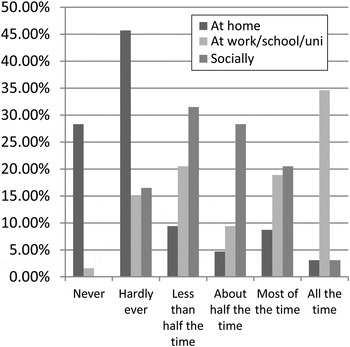
Almost all participants reported using English at least some of the time in work/study and social contexts. As can be seen in Figure 2, however, English was much less likely to be used at home.
Frequency of English use in different contexts

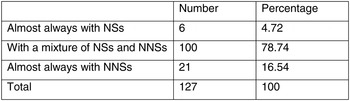
Figure 3 shows that a vast majority of participants speak English with a mixture of NS and NNS:
(Q 6) Who do you usually speak English with?

b. Speaker preferences
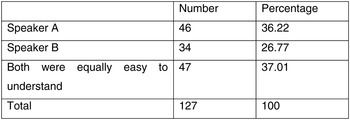
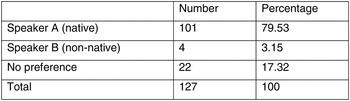
There was no significant difference between Speaker A and Speaker B results for intelligibility (p = 0.17) (Figure 4). However, participants showed an overwhelming preference to speak like the NSs (Figure 5).
(Q7) Which speaker did you find easier to understand?

(Q8) Which speaker would you prefer to speak like?

Participants were largely accurate in identifying whether a speaker was a NS or NNS of English. 89.76% correctly identified Speaker A as a NS, while 8.66% were not sure and 1.57% incorrectly identified him as a NNS. 96.06% correctly identified Speaker B as a NNS, with 2.36% not sure and 1.57% identifying him as a NS.
c. Non-native attitudes to European ELF
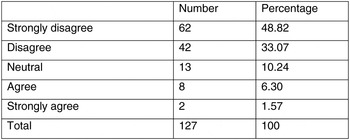
Figure 6 shows that an overwhelming majority of participants rejected the idea that European ELF should be the variety of English taught in schools in Europe.
(Q13) European English, rather than a native variety of English, should be taught in schools in Europe.

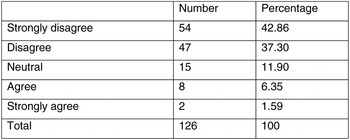
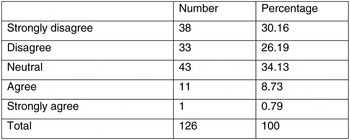
Similarly negative figures were obtained when participants were asked whether they would personally be happy to learn European ELF (Figure 7) or be identified as a speaker of ELF (Figure 8).
(Q14) I would be happy to learn European English rather than a native variety of English.

(Q15) I would like to be identified as a speaker of European English.

Finally, participants judged the use of European English between NNSs to be generally acceptable in most contexts. 83% of participants agreed, strongly agreed or felt neutral about it being spoken socially; 79% at home and 68% at work.
Discussion
a. Output goals and the question of accent
In relation to research question 1, these results clearly show that NS norms are still the goal for L2 users of English in Europe. After listening to a NS and a NNS recount a similar story, 79.53% of respondents identified the NS as their preferred language model and only 3.15% preferred the NNS. It is important to note that the NNSs who appeared in the recordings are highly proficient users of English who have no trouble expressing themselves, yet the NSs' speech was still overwhelmingly rated as more desirable. These results raise questions as to why participants felt NS speech to be preferable. While the issue of NS versus NNS accent was not directly tackled in the survey, 91 comments addressing the reasons for choosing Speaker A as the preferred language model were obtained. It is clear from these comments that accent was the principal motivating factor in choosing the NS, and in not choosing the NNS, as the preferred model. Additionally, the goal of attaining a native-like accent and avoiding a non-native accent was expressly articulated by many participants, thereby directly contradicting Jenkins' (Reference Jenkins1997) claim that ‘the majority express a desire to retain something of their L1’ (cited in Timmis, Reference Timmis2002: 242). For example:
1. Speaker A is a native and I always wanted to sound like one.
2. I would like to speak English without a foreign accent, as a native speaker.
3. Speaker B has a very distinctive and quite awful French accent.
4. Speaker A had English as mother tongue and who would not like to speak English like that.
5. Because Speaker B has a quite strong foreign accent, I would like to speak like Speaker A, that people don't notice that English isn't my mother language.
Interestingly, while the ‘imperialism’ of imposing another culture through use of a particular accent is often used as an argument against ENL teaching, some participants particularly commented on the desirability of accessing English-speaking culture through language learning:
1. Speaker A uses more idiomatic English, is more fluent, sounds more like an Englishman. Would not be spotted as a foreigner in the UK, would activate all sorts of positive associations people in other countries have with English people.
2. Part of the attraction of English as a second language is access to the large, dynamic anglophone culture. De-emphasising the native features of the language in teaching could make it more difficult to understand this culture at the same level.
While Jenkins believes that ‘one of the only means available to preserve L1 identity is, increasingly, L1 accent’ (Jenkins, Reference Jenkins2000: 207), participants in this study have clearly shown that maintenance of L1 identity in English through an L1 accent is not a priority nor, in many cases, is it desirable. Additionally, while many respondents volunteered their reasons for preferring a NS accent, no support was found in this survey for Jenkins' idea that threatened identity is a factor in NNSs not approximating native pronunciation. Like Remiszewski, I also have ‘never met a person who could speak a second language with a near-native or native accent and who would confess that he or she felt uncomfortable doing that’ (Remiszewski, Reference Remiszewski, Dziubalska-Kołaczyk and Przedlacka2005: 295). Quite the contrary: many participants in this survey would very much like to speak English with a native accent and thereby adopt a NS identity and go unnoticed as a NNS.
This is not to say that all NNSs of English in Europe want to speak idiomatic, native-accented American or British English. Rather, like the teachers in Young and Walsh's (2010) study, others aim to speak English that in grammar and lexis resembles a native variety and can be understood by NSs and NNSs of English alike. In doing so, they will be able to ‘transfer their knowledge and competence in the deep structure of their variety to the other varieties they will confront’ (Rubdy & Saraceni, Reference Rubdy, Saraceni, Rubdy and Saraceni2006: 210). In the words of one participant:
When speaking to a native American/English person, you would like to have a correct English and also sound like the native variety. When speaking to a European, this is not as important – you just want to have a conversation that is easily understood by all parties.
Seidlhofer, Jenkins et al. often state that ELF is used more among NNSs, yet 78.74% of participants in this study said that they usually use English with a mixture of NSs and NNSs. It is therefore a priority for them to learn and speak a variety of English that can be understood and is respected by both NSs and NNSs. This brings to mind what Prodromou calls ‘the fallacy of the absent native-speaker’ in the ELF debate (Prodromou, Reference Prodromou2007: 49). It is all very well to say that NSs have to adapt to ELF norms when they participate in ELF interactions, but this is no justification for making assumptions about how NNSs wish to communicate. In fact, these users are looking for a common ground which NSs and NNSs can negotiate together. As another participant commented:
British or American English seems a better ‘common ground’ internationally than ‘European English’ or ‘Asian English’ to me. Why limit oneself with a set of distinctive features when the common ground exists and is spoken by a fair amount of people?
The choice before us does not need to be between complete dependence on NS norms and on the new set of norms posed by ELF (Prodromou, Reference Prodromou2007: 47). Rather, a target variety that recognises the mutual intelligibility of a native English grammar but avoids culturally-loaded or idiomatic lexical items is much closer to what many NNSs want to learn.
b. Teaching and learning ELF
Research question 2 asks whether ELF should replace ENL as the variety of English taught in schools in Europe, and whether participants would be happy to learn ELF themselves. These proposals were also soundly rejected. More than 80% of participants disagreed or disagreed strongly with the idea that ELF should be taught in schools, and only approximately 8% agreed with it. Very similar figures were obtained in relation to whether the participants themselves would be willing to learn ELF. Participants offered quite strong views about the question of ELF in education. For example:
1. I think we should all stick to learning and speaking proper English, and not European English, which in my view is not registered and not an official language. We should attempt to speak English our best according to the current grammar and pronunciation – as set in American, British English or Australian English.
2. I have never heard about this concept before, and I don't think it reasonable to teach anybody a language that is not spoken by native speakers.
Jenkins suggests that the ‘staunchly native speaker ideology’ that pervades language teaching material (Jenkins, Reference Jenkins2009a: 203–4) and underpins SLA research (Jenkins, Reference Jenkins2006: 154) is responsible for negative learner attitudes to ELF such as these. Consequently, learner choices should only be made ‘in full knowledge of the sociolinguistic facts and without pressure from the dominant NS community’ (Jenkins, Reference Jenkins2006: 155). This seems a terribly heavy responsibility to place on learners: prior to choosing which variety of English to study, they must investigate the sociolinguistic setting of each variety while resisting invisible influence from NSs and ENL media. Jenkins is probably right that NS ideology informs learner choices, but that ideology is part of the world in which learners live.
Teachers may disagree with students as to what their aspirations should be or whether those aspirations are realistic. Yet, ‘[w]hile it is clearly inappropriate to foist native-speaker norms on students who neither want nor need them, it is scarcely more appropriate to offer students a target which manifestly does not meet their aspirations’ (Timmis, Reference Timmis2002: 249). Furthermore, these aspirations make sense if we compare them to the acquisition of another, non-linguistic skill. When we try to learn something new, we normally accept that our eventual attainment will fall somewhere on a graded scale of proficiency in this skill. Nonetheless, we try to get as close to the proficient end of the scale as possible with the resources available to us (Remiszewski, Reference Remiszewski, Dziubalska-Kołaczyk and Przedlacka2005: 299). If we teach ELF, we shorten this scale so that it ends well before native-like standards can be obtained. While learners should not be forced to attain native-like standards, nor should they be forced to give them up as unattainable.
The academic arguments in favour of a codified ELF becoming the basis of English instruction in Europe have been gathering pace in recent years. However, the responses obtained in this survey make it clear that these ideas are not accepted by the very people who would be affected by them: the learners and users of L2 English in Europe. Academics' or teachers' preferences or mere political correctness should not dictate what our students' goals should be: ‘in particular that they should not want to sound like native speakers if they clearly wish to do so’ (Jenkins, Reference Jenkins1998: 125). This study shows that to sound like a NS is, in fact, what most L2 users still want.
Conclusions
Indirectly, this study has revealed how detached from reality the ELF debate remains. While Seidlhofer would have high school students receiving ELF instruction (Seidlhofer, Reference Seidlhofer2002: 22), participants in this study remain to be convinced that a uniform ELF even exists:
1. I think it's not by choice that people speak European English. For every language there are difficulties for foreigners to speak like a native speaker. But I'm not so sure that German, French and Italian people speak the same English. Does European English really exist?
2. While it seems very good to me to get some exposure to various kinds of English (American, Indian, British, ‘European’), so that one becomes able to understand any of them, I think that schools should focus on teaching British or American English: the European English mentioned in the survey does not exist. The French English and German English are very different, and speakers of each language do not understand each other that well … While claiming to teach European English, I fear that each country would in fact teach its own version of English, rather than a really European one (i.e. a common language).
The proposed change to ELF as a target variety impacts directly on learners and therefore should place them directly at the centre of this debate (Remiszewski, Reference Remiszewski, Dziubalska-Kołaczyk and Przedlacka2005: 296), yet it is very easy to sense that ‘what is at stake is not the sense of justice as seen from the EFL classroom, but instead, the sense of justice as seen from the conference halls occupied by researchers and applied linguists’ (Remiszewski, Reference Remiszewski, Dziubalska-Kołaczyk and Przedlacka2005: 297). At the same time, people cannot be forced to acquire certain linguistic forms against their will (Jenkins, Reference Jenkins1998: 120) and institutions will not start teaching a variety of English that is unacceptable to most learners. ELF will therefore not become the variety of English targeted and learnt by L2 users in Europe unless their perceptions and aspirations drastically change. I therefore challenge ELF theorists to reposition L2 English users at the centre, rather than at the periphery, of their discussions. ‘At the end of the day, our scholarly deliberations and laboratory research will have to confront the realities of English in the classroom and the world and will, above all, need to motivate learners and meet their aspirations’ (Prodromou, Reference Prodromou2007: 48). This study has shown that ELF currently neither motivates nor meets the aspirations of L2 English users in Europe. Perhaps in the future this will change; if not, it is our responsibility as linguists to respect that fact.
Appendix: survey instrument
Background information
1. What is your native language?
2. Do you speak any other languages? Which ones?
Language 1: _______________
Language 2: _______________
Language 3: _______________
Language 4: _______________
3. How often do you speak English at home?
( ) All the time
( ) Most of the time
( ) About half the time
( ) Less than half the time
( ) Hardly ever
( ) Never
4. How often do you speak English at work/school/university?
( ) All the time
( ) Most of the time
( ) About half the time
( ) Less than half the time
( ) Hardly ever
( ) Never
5. How often do you speak English socially?
( ) All the time
( ) Most of the time
( ) About half the time
( ) Less than half the time
( ) Hardly ever
( ) Never
6. Who do you speak English with?
( ) Almost always with native speakers of English
( ) Almost always with non-native speakers of English
( ) With a mixture of native and non-native speakers of English
You will now hear two speech samples from different speakers. The speakers are describing a video they have just seen. After the recordings, you will be asked to answer some questions about the way the people in the recordings speak. You do not need to remember anything about the content of the recordings.
Please listen to the following recording of Person A: (participants hear one of three NS narratives)
Now listen to the following recording of Person B: (participants hear one of three NNS narratives)
Listening responses
7. Which speaker did you find it easier to understand?
( ) Speaker A
( ) Speaker B
( ) Both were equally easy to understand.
8. Which speaker would you prefer to speak like?
( ) I would prefer to speak like Speaker A
( ) I would prefer to speak like Speaker B
( ) No preference
9. If you would prefer to speak like a particular speaker, can you give any reasons for your choice?
10. Do you think Speaker A is a native or non-native speaker of English?
( ) Native
( ) Non-Native
( ) Not sure
11. Do you think Speaker B is a native or non-native speaker of English?
( ) Native
( ) Non-Native
( ) Not sure
12. Can you identify any reasons for your decision that either speaker is a native or non-native speaker of English?
European English
In Europe, English is increasingly being used as a language of communication between people who are non-native speakers of English with different first languages. For example, when Spanish, French, German and Italian people speak to each other in English, they use pronunciation, vocabulary and grammar that is somewhat different to how native speakers might speak. Over time, they tend to use some of these non-native-like features again and again. We could call this emerging non-native form of English “European English”. Native speakers of English may consider some of its features to be incorrect. However, people who speak European English generally understand each other very well.
Please indicate to what extent you agree with the following statements:
13. European English, rather than a native variety of English (British, American etc.), should be taught in schools in Europe.
( ) Strongly disagree
( ) Disagree
( ) Neutral
( ) Agree
( ) Strongly agree
14. I would be happy to learn European English rather than a native variety of English (British, American etc.).
( ) Strongly disagree
( ) Disagree
( ) Neutral
( ) Agree
( ) Strongly agree
15. I would like to be identified as a speaker of European English.
( ) Strongly disagree
( ) Disagree
( ) Neutral
( ) Agree
( ) Strongly agree
16. It is appropriate to speak European English with other non-native speakers of English in the following situations: [See below]

17. Is there anything else you would like to say about the issues raised in this survey?

Thank you very much for your participation in this study!
 CHLOE GROOM is a lecturer in the Legal English program at the University of Basel, Switzerland, and a teacher at a private language school in Zürich, Switzerland. She recently completed a Master of Applied Linguistics at the University of Melbourne, Australia. Her research interests include the acquisition of L2 grammar, user perceptions of different varieties of English, and broader issues of language variation and change. She has previously taught in China and Australia. Email: chloeioana@gmail.com