


During the last decade, right-wing populist parties (RPPs) have been very successful in Europe (Inglehart and Norris Reference Inglehart and Norris2016). According to the previous literature, this growth has been mainly caused by the effects of the Great Recession (Kriesi and Pappas Reference Kriesi and Pappas2015). The chain of events that made this phenomenon possible seems clear. In the first instance of the economic recession, voters would have punished the incumbent in those areas most affected by the economic crisis. Following a direct interpretation of the literature on economic voting (Stegmaier and Lewis-Beck Reference Stegmaier and Lewis-Beck2000), voters would have chosen not to reward the incumbent, producing extraordinarily high levels of volatility in Europe (Emanuele Reference Emanuele2015). In the second instance, after seeing that the effects of the crisis would not be reversed with a change of government, these voters would have opted for parties in the margin of the supply side – among these were those located in the populist right (Hernández and Kriesi Reference Hernández and Kriesi2016; Zaslove and Wolinetz Reference Zaslove and Wolinetz2018).
However, and despite these convincing arguments, some of the best results for this set of parties have taken place in Poland (Law and Justice (PiS) 38%), Denmark (Danish People's Party (DF) 21%), Austria (Freedom Party of Austria (FPÖ) 20%) and Finland (Finns Party (PS) 18%), four of the European countries least affected by the crisis.Footnote 1 How is it possible that it is precisely where the effects of the crisis have been more superficial that a higher number of citizens have opted for fringe parties such as RPPs, while in some of the countries where the effects of the crisis have been deeper (Ireland, Portugal or Spain, for instance), these parties have not achieved good results?
If, at the contextual level, the previous literature pointed to the effects of the economic crisis as the main reason behind the success of RPPs (Dalio et al. Reference Dalio, Kryger, Rogers and Gardner2017; Funke et al. Reference Funke, Schularick and Trebesch2015), who (at the individual level) is more likely to vote for these parties? According to some of the most popular theories, the populist and nationalist discourse of these parties, which defends national interests against free trade, would have attracted mainly the so-called ‘losers of globalization’ – that is, those individuals most affected by global trade and offshoring (Kriesi et al. Reference Kriesi, Grande, Lachat, Dolezal, Bornschier and Frey2006, Reference Kriesi, Grande, Lachat, Dolezal, Bornschier and Frey2008, Reference Kriesi, Grande, Dolezal, Helbling, Höglinger, Hutter and Wüst2012). The typical profile of this loser is that of a low-skilled citizen with low levels of education and income (Inglehart and Norris Reference Inglehart and Norris2016: 33). However, there is no consistent proof that voters supporting RPPs are more likely to be unemployed, have lower incomes, come from lower classes, or have a lower level of education (Rooduijn Reference Rooduijn2018a: 364). Moreover, it is not clear whether RPPs gain higher levels of support among the old (Inglehart and Norris Reference Inglehart and Norris2016) or among the young (Arzheimer Reference Arzheimer and Rydgren2018), although most studies seem to confirm the latter. In their meta-analysis Daniel Stockemer et al. (Reference Stockemer, Lentz and Mayer2018: 577) have shown that in only 29% of the cases was there a significant relationship between being young and voting for radical right-wing parties, arguing that ‘the relationship between age and radical right-wing support … is probably complex and situational’.
In this article, focusing on the behaviour of the youth, we show that these two explanations (at the micro and at the macro level) are correlated and complementary to the assessment of the rise of RPPs in Europe. It is the youngest who are most likely to vote for these parties in contexts in which their job prospects are less promising. This is, in those countries where the levels of temporary youth employment are higher, young voters tend to support RPPs to a greater extent than older voters. Therefore, these results suggest that the employment insecurity of a segment of the population that has habitually not been very active in electoral contests, such as young people (Blais Reference Blais, Dalton and Klingemann2007), could explain the success of parties which develop populist and nationalist discourses. Their defence of the national economy, criticism of the corrupt elite and attacks on immigration could appeal to those who see their economic and job prospects as being at risk. These findings are especially important if we consider the cohort regeneration of the electorate and the relevant effects electoral behaviour during the formative years has throughout adult life.
Theoretical framework and hypotheses
Populism, populist parties and the reasons behind their rise
Given the success of populist parties around Europe since the Great Recession, the number of academic articles that include the word ‘populism’ has increased from 76 to more than 300 between 2010 and 2017 (Rooduijn Reference Rooduijn2018b). It is not surprising that ‘populism’ was declared Cambridge Dictionary Word of the Year in 2017. However, despite the study of populism having started in the 1960s (Ionescu and Gellner Reference Ionescu and Gellner1969), it is not clear what populism really means and which parties should be classified in this category. There are three main approaches to the analysis of populism. First, some scholars define populism as a (thin) ideology (Mudde Reference Mudde2004; Stanley Reference Stanley2008); second, others consider populism as a political style (Moffitt Reference Moffitt2016); and third, there are studies which refer to populism as a discursive frame (Hawkins Reference Hawkins2010). Notwithstanding the fact that populism is a controversial concept, most of the scholars share the ideational approach, which stresses the importance of the following three characteristics of populism: ‘1) a Manichean and moral cosmology; 2) the proclamation of the people as a homogenous and virtuous community; and 3) the depiction of “the elite” as a corrupt and self-serving entity’ (Hawkins and Rovira Kaltwasser Reference Hawkins, Rovira Kaltwasser, Hawkins, Carlin, Littvay and Rovira Kaltwasser2018: 3).Footnote 2
RPPs can be characterized by the priority they give to sociocultural issues, with a special focus on attitudes towards immigration, seeing it as a threat to national identity and values (Rydgren Reference Blais, Dalton and Klingemann2007: 244). Besides their anti-establishment stances related to populism, one of the main features of these parties is their nationalist and nativist profile. Mobilizing grievances over immigration makes these parties successful (Hobolt and Tilley Reference Hobolt and Tilley2016; Ivarsflaten Reference Ivarsflaten2008) and it is the anti-immigration attitude that unites their electoral bases (Rooduijn Reference Rooduijn2018a). Furthermore, as many RPPs reject the existence of a plurality of interests and checks and balances between powers as necessary elements for liberal democracies, authoritarianism is also a significant characteristic defining these parties (Mudde Reference Mudde2007: 15–20).
Most scholars have explained the recent rise of RPPs by macroeconomic factors, specifically the global financial crisis that started in 2007 (Dalio et al. Reference Dalio, Kryger, Rogers and Gardner2017; Funke et al. Reference Funke, Schularick and Trebesch2015; Kriesi and Pappas Reference Kriesi and Pappas2015).Footnote 3 For some others, it is not so much about economic downturns but rather the perception that the national economy is performing poorly (Mols and Jetten Reference Mols and Jetten2017; Rico and Anduiza Reference Rico and Anduiza2019). Still, for certain academics, the ‘surge in votes for populist parties can be explained not as a purely economic phenomenon but in large part as a reaction against progressive cultural change’ (Inglehart and Norris Reference Inglehart and Norris2016: 2–3). This is not to say that cultural factors are independent of the economic ones, as Pippa Norris and Ronald Inglehart (Reference Norris and Inglehart2019: 50) duly note in their recent book, affirming that economic grievances are drivers of cultural values. Although they claim that ‘today the most heated political issues in Western societies are cultural’, they also find that ‘both authoritarianism and populism are usually generally significantly stronger among less prosperous respondents’. According to the globalization thesis, the processes of denationalization, as well as political and economic integration, have produced a divergence between the winners and the losers of globalization. The losers (low-skilled and less educated) are supposed to be mobilized by RPPs, whereas the winners (the high-skilled and better educated) are supposed to be mobilized by left and green – populist or not – parties (Hernández and Kriesi Reference Hernández and Kriesi2016: 208).
In a similar vein, the material deprivation theories affirm that changes in the employment structure that derive from the knowledge-driven economy increased economic insecurity and social deprivation among the most vulnerable citizens (Oesch and Rennwald Reference Oesch and Rennwald2018). Feeling that traditional parties on the left and the right are no longer able or willing to improve their situation (McGann and Kitschelt Reference McGann and Kitschelt2005), the losers of the occupational structure are more inclined to listen to whoever promises to address their concerns.
However, it should be noted that, from the supply side, RPPs do not tend to focus on economic insecurity in their discourses. Nonetheless, it is safe to assume that the nativist discourse they use finds a particular breeding ground among those who feel an economic threat from immigrants in the sense of competition for scarce and insecure employment. RPPs’ leaders have proved to deliver particularly successful discourses among this population, by focusing on restrictions to the mobility of goods (protectionism) and labour (control of immigration). As James Sloam (Reference Sloam2013: 6) has pointed out: ‘these parties often recruit well amongst young people of low socio-economic status by at least pretending to listen to their concerns’. Moreover, many RPPs are adopting central or even left-wing positions on the left–right economic scale, articulating not only welfare chauvinism but also an expansion of the welfare state (Eger and Valdez Reference Eger and Valdez2015: 121, see Figure A1 in the Appendix).
All in all, the motivations to vote for RPPs stem from cultural and economic grievances, as both of these matter for anti-immigrant attitudes (Golder Reference Golder2016). As Cas Mudde and Cristóbal Rovira Kaltwasser (Reference Mudde and Rovira-Kaltwasser2018: 13) summarize: ‘the rise of populist radical right parties is linked to mass immigration and multiculturalism, and support for these parties is mostly an expression of nativism’. Consequently, in Western European countries, millions of voters have abandoned their traditional parties and embraced RPPs (de Lange Reference de Lange2007; Ivarsflaten Reference Ivarsflaten2005).
Who are the ‘losers’ of globalization that support RPPs?
Nevertheless, the profile of supporters of RPPs is not that clear. This article focuses on the demand side of right-wing populism. What are the socio-demographic characteristics of those most affected by the changes in the structure of employment, and consequently, those more likely to be lured by the populist promises of RPPs? It is well established that men have a higher propensity to vote for RPPs than women and that education has a negative effect upon RPPs’ support (Arzheimer and Carter Reference Arzheimer and Carter2006: 428f; Lubbers et al. Reference Lubbers, Gisberts and Scheepers2002: 362; van Hauwaert and van Kessel Reference van Hauwaert and van Kessel2018: 12; Werts et al. Reference Werts, Scheepers and Lubbers2013: 194–195). However, with regard to variables related to the globalization thesis, the empirical evidence is inconclusive. Although manual workers seem to be more inclined to vote for RPPs (Arzheimer and Carter Reference Arzheimer and Carter2006: 438–439; Lubbers et al. Reference Lubbers, Gisberts and Scheepers2002: 362; Werts et al. Reference Werts, Scheepers and Lubbers2013: 194–195), unemployment often does not significantly affect voting for RPPs (Rooduijn Reference Rooduijn2018a; van Elsas Reference van Elsas2017: 74).
With regard to age, a key variable in the analyses that follow, it has been suggested that the RPPs’ voters are to be found among the older generations, resentful of rapid social change (Inglehart and Norris Reference Inglehart and Norris2016). In line with the modernization theory (Inglehart Reference Inglehart1997), younger cohorts with post-materialist values replace their parents and grandparents, who grew up in less secure surroundings and thus are less open-minded and tolerant. It could also be argued that, as older citizens are less educated and have more traditionalist views than the younger generations, they form part of the losers of globalization – those who are unqualified and also identify strongly with their national community (Kriesi et al. Reference Kriesi, Grande, Lachat, Dolezal, Bornschier and Frey2008: 8) – and thus they are more likely to be attracted by the discourses of RPPs and to vote for them.
On the other hand, the young have less clear political preferences and weaker party identification, and thus due to the high volatility of their vote, together with a tendency to experiment, they will have a higher propensity to vote for RPPs (Arzheimer Reference Arzheimer and Rydgren2018). Moreover, ‘youth are increasingly vulnerable to uncertainty’ that ‘materializes in increasingly more precarious and lower-quality employment such as fixed-term contracts, part-time or irregular work hours’ which ‘makes them the “losers” of globalization’ (Mills et al. Reference Mills, Blossfeld, Klijzing, Blossfeld, Klijzing, Mills and Kurz2005: 438–439).Footnote 4 Many studies find age has a negative effect upon the support of RPPs or other closely related parties (Allen Reference Allen2017: 110; Lubbers et al. Reference Lubbers, Gisberts and Scheepers2002: 362, Rooduijn Reference Rooduijn2018a: 363; van Elsas Reference van Elsas2017: 74; Werts et al. Reference Werts, Scheepers and Lubbers2013: 194f), while other scholars argue that this effect is positive (Greven Reference Greven2016: 6; Inglehart and Norris Reference Inglehart and Norris2016: 33; Rooduijn et al. Reference Rooduijn, Burgoon, van Elsas and van de Werfhorst2017: 549), and still others find a U-shaped correlation, whereby the youngest and oldest citizens vote for RPPs more than those aged between 35 and 64 years (Arzheimer and Carter Reference Arzheimer and Carter2006: 428f).
Therefore, it should not come as a surprise that some recent studies found that the profiles of RPP voters differ between countries (Rooduijn Reference Rooduijn2018a). In some countries, the main electoral base of these parties is to be found among the oldest and those without university education (Denmark and the UK, see respectively Rooduijn Reference Rooduijn2018a; Ford and Goodwin Reference Ford and Goodwin2014: 270). In other countries, the young and best educated are the main supporters of these parties (as in Greece, France and Hungary, see respectively Teperoglou et al. Reference Teperoglou, Tsatsanis and Nicolacopoulos2015: 348–350; Stockemer Reference Stockemer2017; Kovács Reference Kovács, Wodak, KhosraviNik and Mral2013).Footnote 5 Thus, the social profile of RPPs’ supporters seems to be context dependent.
Hypotheses: the combination of the macro and micro explanations
According to Mudde (Reference Mudde2007: 201), in order to avoid problems of ecological fallacy, the combination of macro and micro explanations is particularly necessary for explaining the success of RPPs. In fact, the diverse effects of the Great Recession in European countries could generate a different set of losers depending on their socioeconomic environment. That is why we find it necessary to combine contextual and individual variables to analyse the success of RPPs.
At the contextual level, one of the key variables used to understand the success of these parties is the level of unemployment (Golder Reference Golder2003; Jackman and Volpert Reference Jackman and Volpert1996). Some studies have pointed out that there is a positive relationship between growth in unemployment rates and support for new (Tavits Reference Tavits2007), anti-immigration (Boomgaarden and Vliengenthart Reference Boomgaarden and Vliegenthart2007) and far right parties (Vlandas and Halikiopoulou Reference Vlandas and Halikiopoulou2019). The meta-analysis conducted by Take Sipma and Marcel Lubbers (Reference Sipma and Lubbers2018) of 49 studies shows that the effect of aggregate unemployment on the vote for radical right parties is positive in Western and Eastern Europe after 2008.
Interestingly, some contributions have combined macro and micro explanations to shed light on the effects of socioeconomic characteristics on the profile of RPP voters. Kyung Joon Han (Reference Han2016: 63) has shown that when economic inequality increases, the poor become more likely to vote for radical right parties, whereas the rich become less likely to support this set of parties. His findings suggest that this ‘macro-level phenomenon may alter not only the overall level of support for RRPs, but also the compositional structure of party's support’. With similar reasoning, Matthijs Rooduijn and Brian Burgoon (Reference Rooduijn and Burgoon2017: 18) argue that those who experience economic difficulties are only more likely to vote for a radical right party if the unemployment rate of a country is low, the GDP per capita is high and if inequality levels are low.
In sum, although some contributions have highlighted that economic contextual factors condition the voter profile of RPPs (or closely related parties), it is not clear which group of voters is affected by them and in which direction. In this sense, the young were among the social groups hardest hit by the economic crisis (Marx 2014). Although some countries experienced different economic difficulties during the Great Recession, in general terms the percentage of unemployed among the youth was exceptionally high. Thus, if we assume that those belonging to the young cohorts were the most affected by the economic crisis, it is plausible to argue that, under high levels of aggregate youth unemployment rates young voters would be more likely to support RPPs. Therefore, we expect that:
Hypothesis 1:
The higher the levels of youth unemployment in a given country, the higher the vote for RPPs among the young.
Most of the works analysing the causes of support for RPPs have focused on the effects of unemployment as a proxy for economic insecurity (Arzheimer Reference Arzheimer2009; Inglehart and Norris Reference Inglehart and Norris2016; Rueda Reference Rueda2007). Nevertheless, given the recent liberalization of the job markets, which aimed to increase the flexibility of contracts, unemployment does not show the whole picture with regard to economic insecurity. Among different measures of economic insecurity, Paul Marx (Reference Marx2014: 137) finds that one of the reasons to study ‘temporary employment is that it has turned into a major societal concern … particularly given its prevalence among young citizens’. Judith Bessant (Reference Bessant2018: 3) claims that ‘we are now witnessing the emergence of a new “class”, namely, “the precariat” which, along with other groups, has embroiled young people’. The precariat lacks the rewards of socioeconomic security that ‘social democrats, labour parties and trades unions pursued as their “industrial citizenship” agenda after the Second World War, for the working class or industrial proletariat’ (Standing Reference Standing2013).
As recently stated by the International Monetary Fund Staff Discussion, ‘today, the young are the age group most at risk of poverty. This generation has been adversely affected by economic stagnation and labour market developments’ (Chen et al. Reference Chen, Hallaert, Pitt, Qu, Queyranne, Rhee, Shabunina, Vandenbussche and Yackovlev2018: 5). This report shows that, in most of the European countries, people belonging to the 15–24 age cohort have faced higher unemployment rates, higher levels of poverty, they have more often been employed part-time and they have faced job insecurity in a higher proportion than other cohorts during the economic crisis (Chen et al. Reference Chen, Hallaert, Pitt, Qu, Queyranne, Rhee, Shabunina, Vandenbussche and Yackovlev2018: 9).
Thomas Siedler (Reference Siedler2011: 754), focusing on the German case, finds that the unemployed youth are actually less likely to support far right parties. However, young people who ‘express economic worries’ are more likely to identify themselves with this set of parties. In other words, following Siedler, while unemployment itself does not predict youth far right party identification in Germany, a sense of economic insecurity does. The best way to measure economic insecurity is by using temporary employment indicators. David Guest and collaborators (Reference Guest, Isaksson and De Witte2010: 2) said that, ‘from a worker's perspective, temporary employment, with its implied uncertainties about continuity of employment, is perhaps the most precarious form of employment flexibility’. Young people are particularly exposed to this risk as they ‘must build up their own CVs and personal profiles to locate themselves within a more flexible or dislocated labor market’ (Sloam Reference Sloam2014: 675–676). Therefore, we will be able to better identify the profile of RPPs’ supporters if we consider temporary employment, given it has potential repercussions for those who suffer it, such as political disenchantment or radicalization (Marx Reference Marx2014: 137). Our second hypothesis will take the following form:
Hypothesis 2:
The higher the level of youth temporary employment in a given country, the higher the vote for RPPs among the young.
Data and measurement
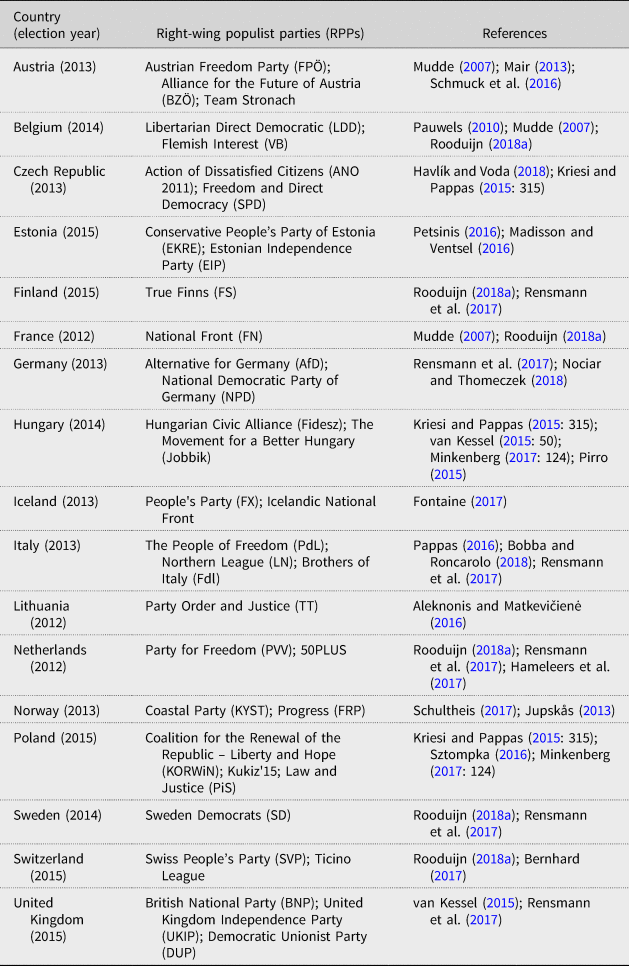
At the individual level, we use data from the 2016 European Social Survey (ESS Round 8).Footnote 6 Country-level data are taken from Eurostat.Footnote 7 The dependent variable considers voting in the last parliamentary elections and it is binary, coded 1 for having voted for a right-wing populist party and 0 for casting a ballot for another party.Footnote 8 Abstainers, those who do not know whether they voted or not, and those not answering the question, are omitted from the analysis (following, among others, Rooduijn and Burgoon Reference Rooduijn and Burgoon2017). We followed the main contributions on the topic to classify parties as RPPs. Overall, we assess the vote for 34 RPPs in 17 European countries (see Table A1 in the Appendix).Footnote 9
The key independent variables measure age, youth unemployment and temporary youth employment. At the individual level, as the focus is set on the young, we code age as a dichotomous variable, with those between 18 and 29 years old taking the value of 1, and those older 0. All variables at the contextual level are lagged (Lewis-Beck and Stegmaier Reference Lewis-Beck and Stegmaier2013), meaning that we use values from a year before the parliamentary election took place (ranging from the year 2012 to 2016 – see Table A1). Youth unemployment is measured as the unemployment rate among those aged 20–29 (in percentages, [lfsa_urgan]). Temporary youth employment is measured as the ratio of temporary employees among the total number of employees aged 20–29 (in percentages, [yth_empl_050]).Footnote 10
The following variables perform as controls in our models: gender, education, ethnic minority, anti-immigration attitudes, ideology, unemployment and temporary employment (all at the individual level).Footnote 11 Table 1 shows the summary statistics for all the variables.
Descriptive Statistics of All Variables

Source: Own elaboration, ESS8 and Eurostat.
Note: Design and population size weights have been applied.
Results
Before turning to the multivariate analysis, we begin with a descriptive view of the relationship between the key individual-level variables and vote choice (Table 2). On average, 19.6% of those aged 18–29 report voting for RPPs, compared to 16.8% of those 30 years old or older. Overall, those without university education, male, not belonging to an ethnic minority, unemployed, and on a temporary or no contract are more likely to vote for RPPs.
Voting for RPPs and for Other Parties by the Individual-Level Variables (percentages)

Source: Own elaboration, ESS8.
Note: Design and population size weights applied.
Moving on to the multivariate analyses, as the dependent variable is dichotomous, we use logistic regression to test our hypotheses. Due to the limited number of clusters (17 countries) – despite our covering all of the European countries with RPPs included in the ESS – we opted for single-level models, although we rely on multilevel models to check for the robustness of our findings (results in Table A2 in the Appendix show robust findings). Table 3 shows the coefficients of logistic regression with voting for RPP as the dependent variable. The first model is an ‘empty’ one, covering the independent and control variables at the individual level. As expected, those with tertiary education show a lower propensity to support RPPs. The discourses of RPPs tend to address those who have suffered the consequences of globalization to a greater extent – those who are less educated and less trained being the most hard hit by delocalization (Lubbers et al. Reference Lubbers, Gisberts and Scheepers2002; Werts et al. Reference Werts, Scheepers and Lubbers2013). Not surprisingly, the effects of an anti-immigration attitude and right-wing ideology upon voting for RPPs are also positive and significant, while the effect of belonging to an ethnic minority is negative as well as significant. As the previous literature has discussed (Rooduijn Reference Rooduijn2018a), one of the features that most differentiates RPPs is how predominant in their discourses is the idea of immigration as a threat to national interests and/or culture. In this sense, supporting the statement that ‘people from other countries make their country worse’ explains significantly the vote for RPPs.
Explaining Youth Support for RPPs: Unemployment and Temporary Employment

Source: Own elaboration, ESS8 and Eurostat.
Notes: Coefficients of logistic regression where voting for RPPs is coded as 1 and voting for other parties as 0. Standard errors in parentheses; + p < 0.1, * p < 0.05, ** p < 0.01, *** p < 0.001. Design and population size weights applied. Contextual-level variables are lagged.
However, there are no significant effects for females on voting for populist parties (see e.g. Lubbers et al. Reference Lubbers, Gisberts and Scheepers2002; Werts et al. Reference Werts, Scheepers and Lubbers2013). Nor are there for being unemployed or being on a temporary contract. Although we would expect that those in a position of vulnerability would be more inclined to support fringe political options such as RPPs, as the previous literature has shown, not having a job does not make voters more inclined to opt for these parties (Rooduijn Reference Rooduijn2018a; Siedler Reference Siedler2011; van Elsas Reference van Elsas2017: 74). In sum, we find that education, attitudes towards immigration, ethnicity and ideology are important variables explaining the vote for RPPs while, in line with previous studies, work status is not a relevant individual characteristic explaining why some voters opt for RPPs.
Now, focusing on our main individual-level independent variable, which in the previous literature showed a debated effect, we find that being young has a strong positive influence on the likelihood of voting for RPPs. It seems that, in those national elections that took place between 2012 and 2016 in Europe (including Western, Central and Eastern countries), those aged 18–29 had more propensity to vote for RPPs than older voters. Why does the youth choose to support RPPs to a greater extent than older people?
In order to shed light on the debated effect of age on voting for RPPs, it seems crucial to analyse the effects of the context, given that the age profile of RPPs’ voters is diverse in different settings. More specifically, in this article we are interested in analysing the impact of the labour market on the youth vote choice. We address this issue in models 2 to 5. Firstly, in models 2 and 3 we account for the country-level youth unemployment rates to study to what extent the job market in a specific country has an impact on the probability of the youngest voters opting for RPPs. The coefficients demonstrate that the higher the youth unemployment rates, the higher the chances of voting for RPPs. However, youth unemployment does not affect the propensity of the youth to support RPPs in any particular way, as the insignificant interaction term in model 3 and the marginal effects plot in the left panel of Figure 1 show. Thus, we reject Hypothesis 1. It may sound counterintuitive at first, but as Marx (Reference Marx2014) has pointed out, it is not unemployment per se which throws young voters into the arms of RPPs. It is mainly temporary employment which has the potential to do just that.
Marginal Effects of Youth Unemployment and Temporary Youth Employment on RPPs’ Vote by Age
Source: Own elaboration, ESS8 and Eurostat.
Note: Coefficients of the interaction terms in models 3 (left) and 5 (right) from Table 3.

Consequently, in models 4 and 5 the effect of the temporality of youth employment at the country level is assessed. Our goal here is to test, given the liberalization of the job markets, to what extent it is the precariousness, which particularly affects the youngest segments of the population, that explains voting for RPPs. Our models show that in those countries where the rate of youth temporary employment is higher, the propensity to support RPPs is also greater. Furthermore, its effects are substantially higher for the young. As demonstrated by the interaction term in model 5 and shown in the marginal effects plot in the right panel of Figure 1, in those countries where contracts are less stable for the younger, the younger are more likely to vote for RPPs. If the temporality of youth employment is low, the propensity to vote for RPPs of both young and old is inferior to 10 per cent. The higher the temporality, the higher the propensity of both categories to support RPPs. However, from the temporality of 25% on, RPPs start to gain more support among the youth. This gap grows exponentially until it reaches 20 percentage points (around 24% of RPP support among the older and around 44% among the young).
Interestingly, after controlling for the interaction of temporality of youth employment and age (model 5), the coefficient of being young flips to negative. To put it differently, if we take into account temporality of youth employment and its effects on youth voting behaviour, significantly, it is not the youngest ones that are more likely to support RPPs, but the citizens over 30 years old. This finding points out the need to combine the explanations at the micro and macro levels, not only for methodological reasons but also for conceptual purposes. Young voters have a higher propensity to support RPPs only in those countries where the job market is less promising and stable for their segment of the population.
In order to assess the relative impact of this particular economic explanation in comparison to other attitudinal predictors of voting for RPPs, we estimate average marginal effects (AMEs) of each of the variables included in all five models of Table 3 (see Figure 2). AMEs allow us to assess the magnitude of the effects of different independent variables. As Figure 2 shows, left–right self-placement and anti-immigration attitudes have the strongest effects on voting for RPPs vs. voting for other parties. Nevertheless, the impact of economic variables at the aggregate level (Country youth unemployment, Temporary youth employment) and the interaction of Young and Temporary youth employment is also considerable. It is actually stronger than the effect of education, a variable often used to explain how socioeconomic status affects RPP voting.
Explaining Youth Support for RPPs: average marginal effects (AMEs)
Source: Own elaboration, ESS8 (2016) and Eurostat.
Note: AMEs for models 1–5 from Table 3.

We checked for the robustness of these main findings using multilevel logistic regression models with random intercepts by countries (see Table A2 in the Appendix). The results are similar to the ones of single-level models. The country-level variables and the interactions are introduced in a similar fashion to the ones from Table 3, finding the same significant effect (although this time with a 0.1 margin of error) of the interaction term between being young and aggregate temporality of youth employment (model 4).Footnote 12
To sum up, the results obtained in this analysis point towards the importance of contextual effects of the economic variables on RPPs’ vote. We showed that those aged 18–29 are more likely to support RPPs than older citizens, mainly due to employment insecurity. In line with other studies on populist parties, we find that the economic variables affecting the propensity to vote for RPPs operate rather at the aggregate level. The temporality of youth employment at the country level is by far more important for the youth to support RPPs than if the young person in question is actually unemployed or employed on a temporary contract. Its effect on youth RPP vote is also stronger than the impact of education or gender, key variables in explaining populist voting. Furthermore, we argue that when debating the positive or negative effect of being young on RPPs, a consideration of the context is crucial. Younger voters are more likely to vote for RPPs only in those countries where the job prospects are poorer and job precariousness is more present among their peers.
Conclusions
Since the Great Recession RPPs have experienced quick electoral growth in Europe. Some examples of this rapid electoral success are the Northern League in Italy, the Fidesz in Hungary or the Danish People's Party, although the right-wing populist vote share has risen in almost every European country over the last decade. Some of the most relevant contributions to the study of the voter bases of these parties have pointed to the effects of the crisis as the main factor explaining this unprecedented advance. The economic crisis would have accentuated the social inequalities that especially affect certain sectors of the population – the less educated and manual workers (the so-called ‘losers of globalization’) – who would have found in these parties a response to their frustrations and demands, not addressed by mainstream parties.
However, the electoral results of RPPs have also been especially good in countries less affected by the economic crisis, such as Austria, Denmark, Finland and Poland. Nor does it seem to be true that those individuals most affected by delocalization and globalization have been the main electoral base of these parties in many countries. For instance, in France and Greece, the youngest and best educated also voted for the National Front and the Golden Dawn, respectively.
In this article, we have focused on the young voters in order to analyse to what extent the labour insecurity triggered (or at least accentuated) by the Great Recession has affected the vote choice of the youth. We have focused on a specific population segment – the youth – which has been somewhat neglected by the previous literature linking populist voting to the Great Recession. We have also used the temporality of employment as a subtle measure of employment security. We argue that it captures the precariousness of youth employment better than the conventionally used measure of (youth) unemployment.
Our results show that, in the case of parliamentary elections that took place between 2012 and 2016 in 17 European countries, young voters have a greater propensity to vote for RPPs. However, it is only true in those contexts where the economic prospects of the youth are more adverse, especially where the labour market is precarious for the youngest segment of the population. In other words, the higher the temporality of youth unemployment in a given country, the higher the support for RPPs among the youth. In contexts of high insecurity, young citizens seem more likely to be attracted by the nativist discourse of these parties.
Although right-wing ideology and nativist attitudes are the strongest predictors of RPP voting, as our results show, economic insecurity plays a relevant role in populist voting in Europe. The effects on the RPP vote of aggregate youth unemployment and youth temporality of employment are stronger than such individual predictors of support for RPPs as young age per se, gender and university education.
From the methodological point of view, these findings underscore the need to combine explanations at the micro and macro level when carrying out comparative analyses of the electoral sociology of populist parties. Voter profiles are context-dependent. In this sense, it seems particularly relevant to highlight the role of economic explanations at the macro level (sociotropic voting) during the Great Recession, combined with the individual characteristics of the voter (in this article, age) to explain the rise of populist parties in Europe.
With regard to the policy implications, our findings point to the importance of paying greater attention to the economic security of the youth – a sector of the population that has been especially affected by the economic crisis and has seen its labour prospects as particularly unstable. The attraction of these parties and their nativist discourses for young people is of special relevance, since political boundaries and values are formed in these years, with a huge impact on future electoral attitudes and behaviour. Providing a more secure employment environment for the young could be a measure to counteract the rise of right-wing populist parties in Europe.
Acknowledgements
We would like to thank the participants in the First Spanish Congress of the European Social Survey (September 2018, Madrid), the participants in the Research Seminar at the Autonomous University in Madrid (October 2018), as well as the editors and the anonymous reviewers for helpful comments on earlier drafts of this paper.
Appendix
Left–Right General and Left–Right Economic Means for RPPs vs. Other Parties.
Source: Own elaboration based on Chapel Hill Expert Survey 2017 (Polk et al. Reference Polk2017).

List of Right-Wing Populist Parties by Country
Multilevel Logistic Regression Models with Random Intercept by Country



