Significant outcomes
∙ Looking at the entire material (−)-OSU6162 did not differ significantly from placebo in alleviating fatigue in ME patients.
∙ There were significant correlations between (−)-OSU6162 concentration and change in mental fatigue scale (MFS), FibroFatigue scale (FF), and Beck Depression Inventory (BDI) score.
∙ (−)-OSU6162 was superior to placebo in counteracting fatigue in a subgroup of patients who received concomitant pharmacological treatment for depression.
Limitations
∙ There was a high placebo response in this study.
∙ The treatment period was short.
Introduction
Myalgic encephalomyelitis (ME) is an acquired multi-systemic illness classified as a neurological disease. It is a common disorder with a prevalence between 0.4% and 2.7%. This means that in Sweden at least 40 000 patients suffer from ME (for review see (Reference Zachrisson1)). The number of people afflicted with ME in the United States is assumed to be 1 million. In all, six of 10 ME patients are females. The costs for ME in the United States are estimated to 20 billion dollars per year according to patient associations. Apart from pathological fatigue, typical symptoms in ME include post-exertional malaise, sleep problems, pain, and impaired memory and/or concentration. Results from a double-blind cross-over study in mental fatigue after stroke or traumatic brain injury (Reference Johansson, Carlsson and Carlsson2) indicate that the symptom fatigue can be treated pharmacologically. Fatigue is a dominating symptom in ME. At present there is no cure for the ME disease. Treatment is directed at symptom relief and concomitant disorders like depression, insomnia and pain syndromes.
(−)-OSU6162 belongs to a group of compounds called monoaminergic stabilisers which are novel drugs that modulate primarily dopaminergic and serotonergic transmission. In clinical studies (−)-OSU6162 has been well tolerated with only mild to moderate adverse events (AEs) reported, for example, short-lasting mild nausea and attenuated appetite. In the present study, with the stepwise increasing dose level design and with the final dose 30 mg twice daily, no or very mild non-serious side effects were expected. The drug was expected to have a beneficial effect on fatigue symptoms in ME.
The present placebo-controlled study was conducted in order to evaluate the safety and therapeutic efficacy of (−)-OSU6162 in ME.
Methods
Participants
Patients diagnosed with ME according to the Fukuda and the International Consensus Criteria (ICC) (Reference Carruthers, van de Sande and De Meirleir3,Reference Fukuda, Straus, Hickie, Sharpe, Dobbins and Komaroff4) were recruited from the Gottfries Clinic AB, Mölndal, Sweden where the study took place. Exclusion criteria were (i) active substance abuse, (ii) pregnancy, (iii) women of childbearing age not on contraceptives, (iv) abnormal laboratory parameters judged to be of clinical significance, (v) unstable therapies, (vi) medications known/judged to interfere with the substance tested (−)-OSU6162), for example, anti-epileptics or antipsychotics.
Stable therapies were allowed. A stable therapy was defined as having started at least 6 months before the study onset and continued to be unchanged during the study period. Examples of such medications were antidepressants, hypnotics and anxiolytics, analgesics such as NSAIDs (e.g. acetyl salicylic acid) and paracetamol as well as anti-hypertensive therapy. Acute or chronic medications for other medical conditions were allowed based on clinical judgment.
Occasional use of over-the-counter (OTC) medications was allowed at the investigator’s discretion. All concomitant medications, whether OTC or prescription, were required to be noted on the Concomitant Medication form.
Study design and procedure
This was a double-blind placebo-controlled study, where half of the patients received active drug and the other half placebo for 2 weeks. All patients provided written informed consent to participate in the study prior to being screened. The patient information sheet detailed the procedures involved in the study (aims, methodology, potential risks, anticipated benefits) and the investigator explained these to each patient. About 1 week after screening the first (baseline) assessment was performed and the drug was dispensed (day 1). Circular coated tablets of 15 mg for oral use and matching placebos were used. The start dose was 15 mg twice daily (before breakfast and lunch) during the first week with a dose increase up to 30 mg twice daily during the following week. The dosage was individually flexible; if a patient experienced AEs, the dose was reduced with 15 mg (one tablet).
All participants were assessed with respect to safety and efficacy (see rating scales below) at screening (day −7), at baseline (day 1), after 1 (day 7) and 2 (day 14) weeks of treatment and at follow-up after 6 (day 42) weeks. Neuropsychological tests (see below) were performed at baseline and after 2 weeks of treatment. Electrocardiography (ECG) and blood samples were taken at screening and after 2 weeks of treatment. Relapse and discontinuation problems were assessed from a telephone check-up (day 21) and at follow-up.
Randomisation
Randomisation was done externally and measures were taken to guarantee blinding. All persons dealing with the patients were blinded towards active drug or placebo. The randomisation procedure was performed in agreement with Consolidated Standards of Reporting Trials guidelines.
Efficacy outcomes
A primary endpoint was the result of (−)-OSU6162 treatment on the MFS (Reference Johansson, Starmark, Berglund, Rodholm and Ronnback5). Another primary endpoint was the result on the Clinical Global Impression of Change (CGI-C) scale where the rating was made by the doctor in charge of the patient. CGI-C scores range from 1 (very much improved) to 7 (very much worse).
Secondary endpoints were the results on the FF (Reference Zachrisson, Regland, Jahreskog, Kron and Gottfries6), the BDI, the pain visual analogue scale (VAS) and the neuropsychological tests described below.
The MFS, BDI, and VAS pain scales are based on self-assessments by the patient. The FF is an observer’s rating scale.
Neuropsychological tests
The Barrow Neurological Institute Screen for Higher Cerebral Functions is a screening test constructed to quantitatively and qualitatively reflect the outcome of a range of higher cerebral functions. The test provides a total score=50 of overall cognitive functioning and subscale scores. A score <47 indicates brain dysfunction. This test was performed before treatment only. Coding [a subtest from Wechsler Adult Intelligence Scale (WAIS)] measures processing speed. The performance reflects abilities as visual-motor coordination, motor and mental speed and working memory. Trail making test (TMT) A and B: TMT-A is a time-based measure of visual attention and TMT-B in addition involves measures of alternating attention. TMT-A is considered to provide a measure of cognitive processing speed and TMT-B is believed to constitute a measure of cognitive flexibility/executive functioning. The Stroop test is a time-based test sensitive to frontal lobe dysfunction. This test is considered to measure selective attention, cognitive flexibility and processing speed, and it is used as a tool in the evaluation of executive functions.
Safety outcomes
Safety evaluation included registration of AEs, blood pressure, pulse rate, and weight, as well as ECG and blood sample analyses – the samples were analysed for content of haemoglobin, leucocytes, thrombocytes, serum C-reactive protein, serum sodium, potassium, creatinine, calcium, aspartate aminotransferase, alanine aminotransferase, alkaline phosphatase, albumin, γ-glutamyl transferase, thyroid-stimulating hormone, free thyroxine, prolactin, postprandial glucose, and erythrocyte sedimentation rate.
The blood samples were also analysed for (−)-OSU6162 contents. Plasma concentrations of (−)-OSU6162 were determined by high-performance liquid chromatography/tandem mass spectrometry described previously (Reference Tolboom, Berendse and Leysen7).
Statistical methods
The analysis set included all randomised patients with at least one post randomisation assessment. Data from all included patients were used for the assessment of safety.
For all efficacy variables, mean changes from baseline values were analysed with the restricted maximum likelihood-based mixed model for repeated measures. The model included fixed, categorical effects of treatment (placebo/OSU), week (1, 2, and 6), and treatment-by-week interaction, as well as a fixed covariate for gender. An unstructured covariance matrix was used to model the within-patient errors. Significance tests were based on estimated marginal means (LSmeans) using a two-sided α=0.05. Contrasts were used to estimate group mean in changes from baseline for each time point (week 1, 2, and 6) and to estimate group differences at each time point. Contrasts were subjected to Bonferroni-Holm family-wise multiple comparison p-value adjustment (6 comparisons/scale).
Exploratory subgroup analyses were performed to evaluate effect of placebo/(−)-OSU6162 treatment and concomitant pharmacological treatment of depression. The analysis included fixed, categorical effects of treatment (placebo/(−)-OSU6162), use of antidepressant (yes/no), week (1 and 2) and the fixed covariate for gender. Full factorial analyses were performed. Four subgroup analyses were performed, that is on MFS, CGI-C, FF, and BDI data. These four analyses were not adjusted for multiple comparisons.
Correlational analyses between (−)-OSU6162 plasma concentration and outcome were performed with Spearman’s rank correlation. Nominal safety variables were analysed with Fisher’s exact test. Possible pre-treatment group differences were assessed by comparing assigned treatment groups at baseline. Analyses were performed with SAS 9.3 (SAS Institute Inc., Cary, NC, USA).
Results
Patient disposition and dosing
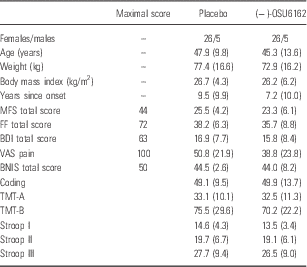
Out of 79 patients screened, 62 were randomised 1 : 1 to double-blind treatment with (−)-OSU6162 or placebo. One patient allocated to placebo dropped out after 3 days’ treatment due to need of another medication. Five patients in the (−)-OSU6162 group and six in the placebo group reduced their dose at some point during the course of the study. In the (−)-OSU6162 group the final dose was 30×2 mg for 29 patients, 30+15 mg for one patient and 15×2 mg (due to a misunderstanding of dose escalation) for another patient. In the placebo group the 30 patients that completed the study had a final tablet intake corresponding 30×2 mg. Demographics and baseline data did not differ between assigned groups (Table 1).
Demographics and baseline characteristics

BDI, Beck Depression Inventory; BNIS, Barrow Neurological Institute Screen for Higher Cerebral Functions; FF, FibroFatigue scale; MFS, mental fatigue scale; TMT, trail making test; VAS, visual analogue scale.
Shown are quantity or mean (SD).
Effects of (−)-OSU6162 treatment
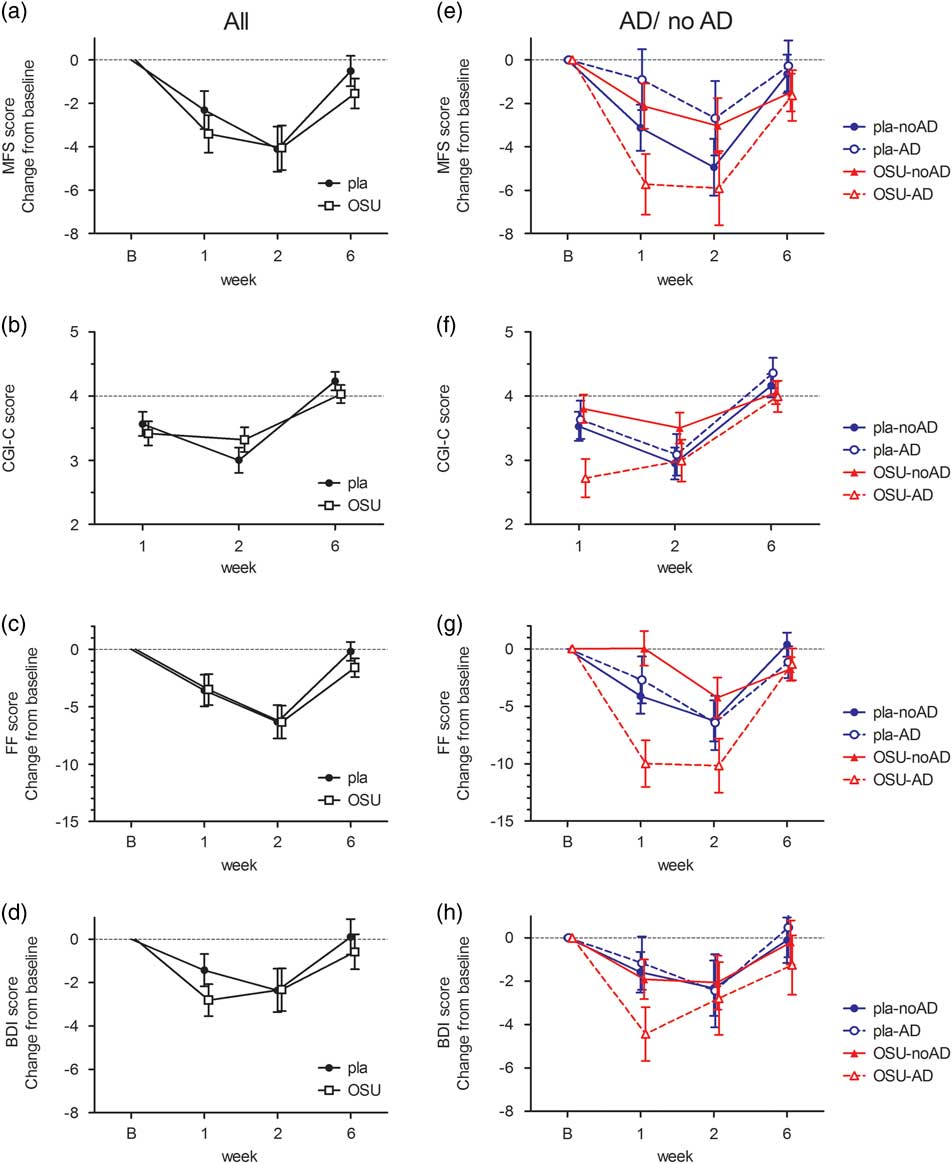
The primary outcome variables MFS and CGI-C showed significant improvements for both treatment groups during the 2-week long treatment period (Fig. 1a and 1b). Mean score change from baseline on MFS were after 2 weeks −4.05 (95% CI: −6.11 to −2.00) in the (−)-OSU6162 group and −4.11 (95% CI: −6.20 to −2.03) in the placebo group (p=0.0012 vs. baseline for both groups).
Mental fatigue scale (MFS), clinical global impression of change (CGI-C), FibroFatigue scale (FF), and Beck Depression Inventory (BDI) scores plotted for each test occasion during the study. LSmean shown are changes from baseline and SE (for CGI-C; LSmean score and SE). (a–d) (−)-OSU6162 and placebo group, respectively. (e–h) Treatments subgrouped according to whether patients were on stable antidepressant therapy for depression (AD) or not.

On CGI-C, the mean score was after 2 weeks 3.32 in the (−)-OSU6162 group and 3.00 in the placebo group, which correspond to an improvement of 0.68 (95% CI: 0.29–1.06) p=0.004 respective 1.0 (95% CI: 0.61–1.39) p=0.0006 steps on the scale (score 4 represents no change and score 3 minimally improved). In the (−)-OSU6162 group 17 of 31 (55%) patients were improved (score 1–3; very much improved, much improved, minimally improved), and in the placebo-treated group 19 of 30 (63%) patients were improved after week 2.
A statistically significant difference between treatment groups could not be demonstrated for either scale at any time point (all p-values for differences between treatments >0.2).
At follow-up, week 6 (4 weeks after the end of treatment), the MFS score did not differ from baseline level for any group and mean CGI-C score had returned to level of unchanged (score 4) in both groups.
A similar pattern was seen for FF (Fig. 1c), that is both groups were significantly improved compared with baseline during treatment but not at follow-up (at week 2, p=0.0006 vs. baseline for both groups). The BDI score (Fig. 1d) was significantly improved in the (−)-OSU6162 group after 1 week of treatment (p=0.0012) but failed to show significance after 2 weeks, while for the placebo group there were no significant changes from baseline at any time point. No difference between treatment groups could be detected at any time point (p-values for difference between treatments >0.1).
For the VAS assessment and the neuropsychological tests both the (−)-OSU6162 and the placebo group showed improvements following treatment; there was no significant difference between the two treatment groups in degree of improvement.
The above analyses were subjected to the Bonferroni-Holm family-wise p-value corrections; the corrected p-values are shown.
Subgroup analyses exploring effect of treatment and concomitant use of an antidepressant
A large proportion of patients in this study received pharmacological treatment for depression. Among the 61 participants in the study 22 were on antidepressant therapy for depression, 11 in the control group and 11 in the (−)-OSU6162 group. This therapy was allowed according to the exclusion criteria. However, in view of the fact that both the antidepressants used and (−)-OSU6162 (Reference Burstein, Carlsson and Owens8,Reference Carlsson, Burstein and Kloberg9) have effects on serotonergic neurotransmission we deemed it important to investigate a possible interaction. Figure 1e to 1h shows the changes from baseline in the different subgroups; the figure gives an indication that the response to the (−)-OSU6162 treatment might be different among patients on treatment with an antidepressant.
To find out if there were any significant differences in treatment effect related to concomitant antidepressant therapy, antidepressant was included as a fixed factor in the analyses. The antidepressant factor included two levels: (1) Patients on stable (i.e. since at least 6 months before start of the trial) antidepressant therapy to treat depression and (2) patients who did not receive medication to treat depression. Analyses were performed on the MFS, CGI-C, FF, and BDI data.
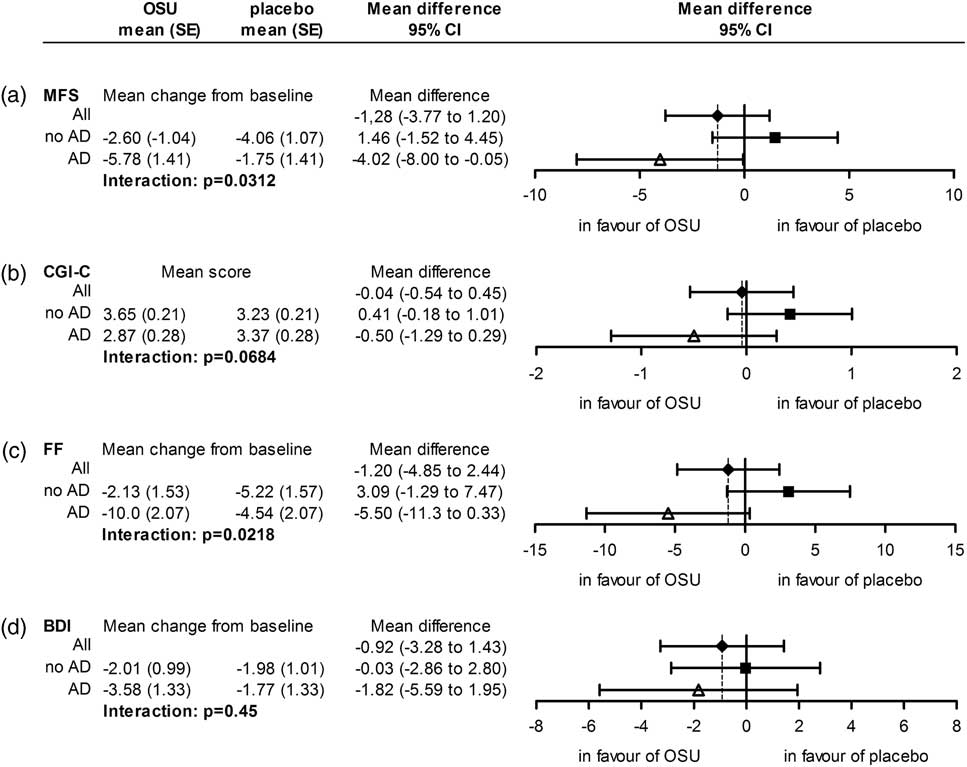
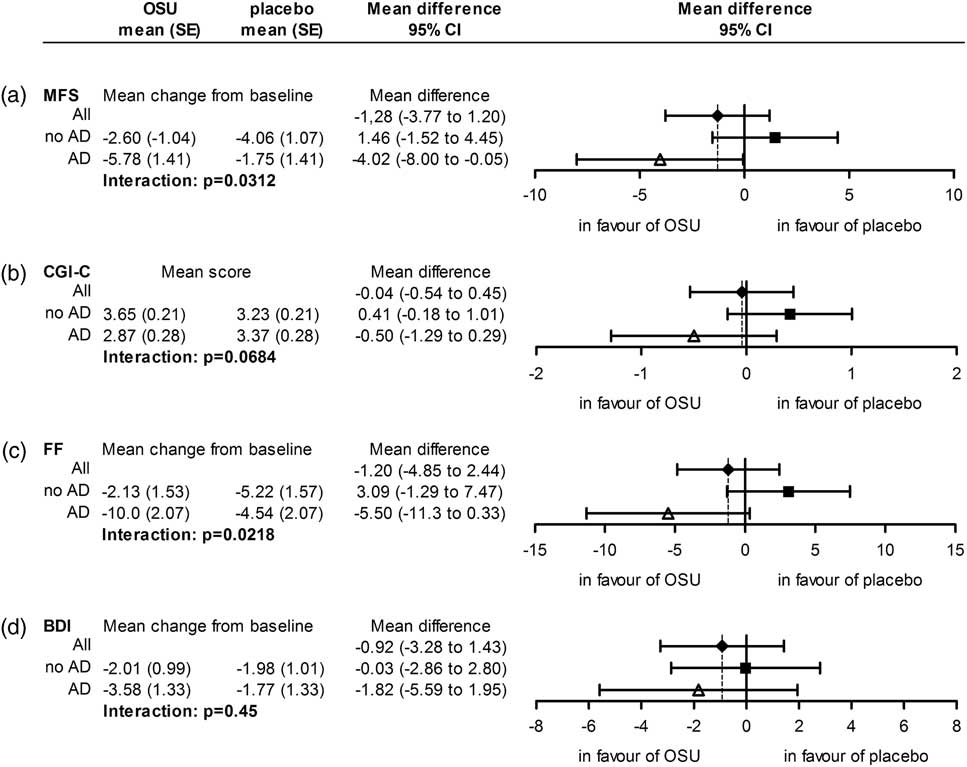
The results of the subgroup analyses are illustrated in Figure 2. Shown are for the four analysed scales the mean treatment effects with 95% CIs over the 2-week treatment period for the subgroups, together with the overall treatment effect. There was a significant interaction between the effects of treatment and use of antidepressant for the MFS (p for interaction=0.031; difference between subgroups −5.48 (95% CI: −10.5 to −0.51); Fig. 2a) and the FF scale (p=0.022; difference between subgroups −8.59 (95% CI: −15.9 to −1.30); Fig. 2c) – both interactions show a larger treatment effect with (−)-OSU6162 in improving MFS and FF symptoms in patients on antidepressant therapy compared to those without antidepressant treatment. For those on stable antidepressant therapy, the mean difference between placebo and OSU treatment on the MFS scale was −4.02 (95% CI: −8.00 to −0.05) p=0.047 in favour of (−)-OSU6162; for participants who were not on treatment for depression the treatment effect was 1.46 (95% CI: –1.52 to 4.45) p=0.33. The FF scale yielded a treatment effect of −5.50 (95% CI: −11.3 to 0.33) p=0.064 for those on antidepressants and 3.09 (95%CI: –1.29 to 7.47) p=0.16 for participants who were not on treatment for depression. A similar trend was observed for CGI-C (p for interaction=0.068).
Summary of the four subgroups analyses. The graphs show, over the 2-week treatment period, the mean overall treatment effect and the subgroup effects. Data are expressed as LSmeans and SE or 95% CIs. (a) Mental fatigue scale (MFS), (b) clinical global impression of change (CGI-C), (c) FibroFatigue scale (FF), and (d) Beck Depression Inventory (BDI).
The antidepressant therapy was not found to influence the (−)-OSU6162 plasma concentrations.
(−)-OSU6162 plasma concentration measurements
Plasma concentrations of (−)-OSU6162 were measured in 30 patients on placebo and 31 patients on (−)-OSU6162. The blood sample was drawn in the morning after the tablet was taken – the time of the tablet intake was noted and reported to the clinic by the patient. The blood sample was taken a minimum 65 and a maximum 180 min after the tablet intake; the mean time was 123 min and the standard deviation 33 min. No concentration of (−)-OSU6162 was detected in placebo-treated patients. In one patient on (−)-OSU6162 treatment there was no detectable level of (−)-OSU6162, hence this patient was omitted from the statistical analyses below on correlations.
A correlation analysis (Spearman’s rank correlation) was made between plasma concentration of (−)-OSU6162 and time elapsed in minutes between intake of tablet and blood sampling. No significant correlation was found.
Correlations between (−)-OSU6162 concentration in plasma and change in MFS, FF and BDI score
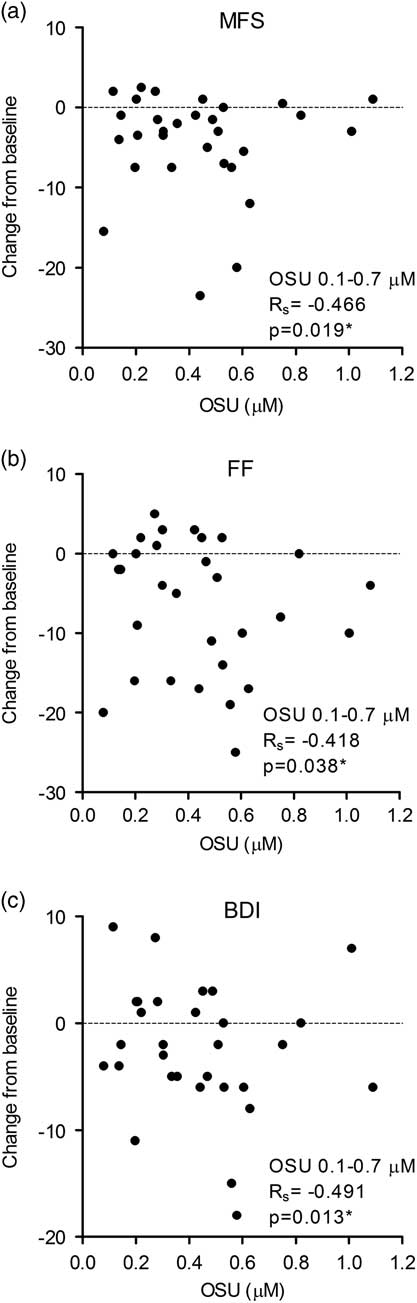
Figure 3 shows the patients’ (−)-OSU6162 concentrations measured after week 2, plotted against change in MFS, FF, and BDI score. There seems to be a therapeutic optimum around 0.3–0.7 µM; concentrations above 0.7 µM do not seem to lead to any further improvement.
(−)-OSU6162 concentrations at the end of week 2, plotted against score change from baseline on (a) Mental fatigue scale (MFS), (b) FibroFatigue scale (FF), and (c) Beck Depression Inventory (BDI).
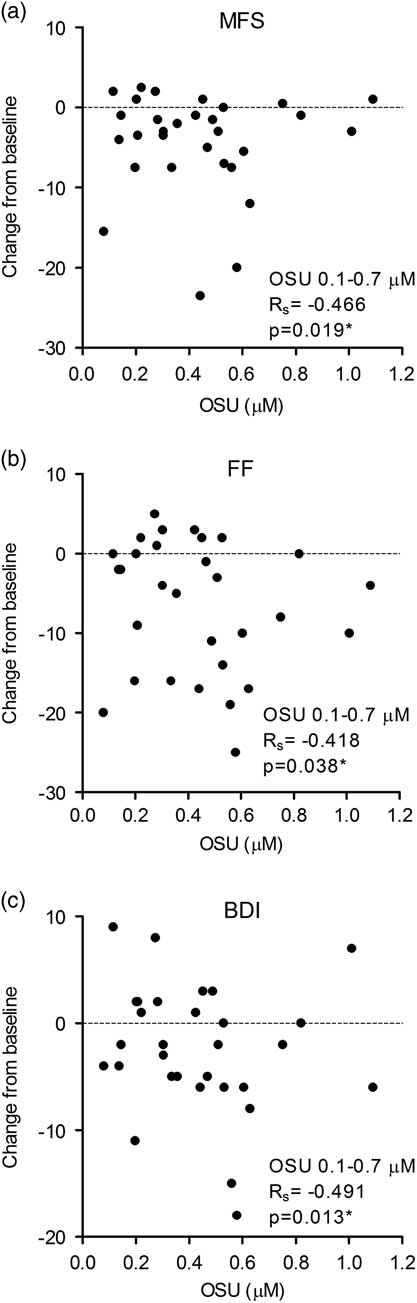
Correlation analyses showed a significant correlation between (−)-OSU6162 concentration and change in MFS, FF, and BDI score, respectively, within the concentration interval 0.1–0.7 µM. (MFS: R s=−0.466, p=0.019; FF: R s=−0.418, p=0.038; BDI: R s=−0.491 p=0.013, Spearman’s rank correlation).
Safety evaluation
Pulse, systolic blood pressure, diastolic blood pressure, weight, and QT interval showed no statistically significant changes at the studied assessment points. No statistically significant group differences were found for the nominal safety variables (i.e. abnormality in lab-test values, ECG, relapse frequency or occurrence of discontinuation problems) at any of the studied assessment points.
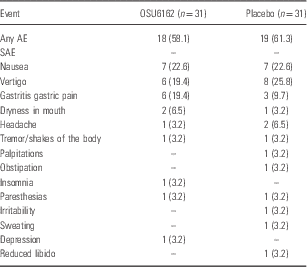
There were no significant differences between the treatment groups concerning treatment-related AEs. No serious AEs were observed during the study (Table 2).
Summary table of adverse event rates

AE, adverse event; SAE, serious adverse event.
Shown is the number of participants reporting one or more events during the study. Percentage is given in brackets.
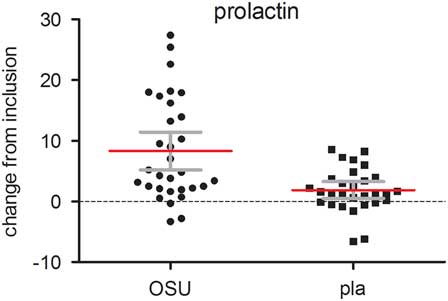
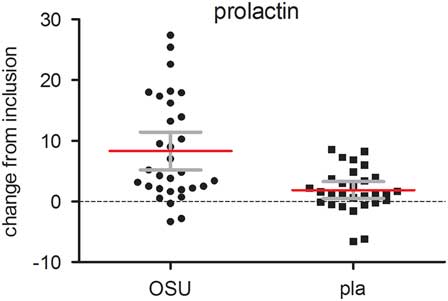
Except for prolactin no significant changes were recorded for the laboratory values analysed before (at screening, day −7) and after treatment (day 14). Prolactin concentrations increased significantly in both treatment groups between assessments, see Figure 4. The mean increase in prolactin was 1.86 (95% CI: 0.49–3.23) µg/l (p=0.0096) for the placebo group and 8.33 (95% CI: 5.23–11.43) µg/l (p<0.0001) for the (−)-OSU6162 group; paired sample t-test. The increase in prolactin was significantly greater in the (−)-OSU6162 group than in the placebo group. The difference in group mean change was 6.469 with a 95% CI of 3.068–9.869 (p=0.0003; unpaired t-test).
Change in prolactin concentration. Individual changes in prolactin concentrations between inclusion (day −7) and end of treatment (day 14) for both treatment groups. Red lines show the group mean change. Error bars show 95% CI.
Discussion
The present study has shown that although (−)-OSU6162 did not differ significantly from placebo in alleviating fatigue in ME patients in general, (−)-OSU6162 was found to be superior to placebo in counteracting fatigue in the subgroup of ME patients who received concomitant pharmacological treatment for depression. Moreover – and this was true for the entire material – there was a correlation between therapeutic improvement and the plasma concentrations of (−)-OSU6162.
In the present study around 60% of the patients receiving placebo improved according to CGI-C, a remarkably high figure, and clearly a more pronounced placebo response than observed in previous clinical studies with (−)-OSU6162 conducted in patients with mental fatigue following stroke/head trauma and Huntington’s disease patients (Reference Johansson, Carlsson and Carlsson2,Reference Kloberg, Constantinescu and Nilsson10). In part this could be due to a shorter duration of the present study (2 rather than 4 weeks). Further, ME patients are very research-minded and as there is at present no evidence-based pharmacological treatment for ME, the patients are eager to assist in identifying a new, effective drug. Another possible explanation could be the different nature of the conditions studied – it is probable that for the disorders included in the previous trials there was a greater number of patients with obvious brain damage.
An interesting aspect of placebo responses in the case of (−)-OSU6162 is that we are dealing with mechanisms involving the dopamine system both for placebo and the study drug. In the case of placebo Parkinson’s disease patients’ expectation-linked improvement has been shown to be accompanied by an increased release of dopamine in the striatum, as evidenced by PET technique using the D2/D3-receptor ligand [11C]raclopride; the estimated amount of dopamine release was similar in magnitude to that previously found in healthy volunteers after amphetamine (Reference de la Fuente-Fernandez, Phillips and Zamburlini11,Reference de la Fuente-Fernandez, Ruth, Sossi, Schulzer, Calne and Stoessl12). Similarly, in a pain study with placebo in healthy volunteers, a high placebo response was associated with dopamine release in the right nucleus accumbens (Reference Scott, Stohler, Egnatuk, Wang, Koeppe and Zubieta13). In the case of (−)-OSU6162 a dose-related displacement of [11C]raclopride has been found in a PET study (Reference Tolboom, Berendse and Leysen7), apparently caused by a preferential blockade of dopaminergic autoreceptors and ensuing release of dopamine, that is, a dopamine-releasing mechanism which is profoundly different from that of central stimulants such as amphetamine.
In favour of a pharmacological effect of (−)-OSU6162 is the correlation found between therapeutic improvement with respect to MFS, FF, and BDI scores and the plasma concentrations of (−)-OSU6162. Moreover, these plasma concentrations are in reasonable agreement with those found able to displace [11C]raclopride in the PET study of (Reference Tolboom, Berendse and Leysen7).
Thus it may be concluded that the effects recorded after placebo and test drug were not much different, although mechanistically separate. This in conjunction with experience from an ongoing open study in stroke patients, showing an increase in the therapeutic action of (−)-OSU6162 over weeks and months while keeping the dosage constant (15 mg BID) – placebo responses generally show the opposite trend with time – speaks in favour of a distinct therapeutic activity of (−)-OSU6162.
With respect to therapeutic utility (−)-OSU6162 can be expected to cover, among other things, the indications established for the central stimulants of amphetamine type and has in fact even the potential to replace these agents in view of its appreciably higher safety, as judged by experience thus far. The central stimulants have their well-known limitations with risk of over-dosage and abuse, among other adverse effects, whereas (−)-OSU6162 so far has shown no trends in direction of abuse, and its dual action, switching from behavioural stimulation to inhibition by blocking dopaminergic heteroreceptors after higher doses, should offer good protection in this regard. In the present study the increase in therapeutic response with increasing plasma levels of (−)-OSU6162 was found to occur only up to a certain level. Similar observations have been made in another placebo-controlled study on patients with mental fatigue following stroke and head trauma (unpublished observations). We attribute this ceiling effect to a plasma-concentration-dependent dopamine heteroreceptor blockade, preventing and antagonising further dopaminergic activation brought about by the autoreceptor blockade (occurring with lower plasma concentrations of the drug).
An unexpected observation in the present study was the statistically significant difference in treatment effect depending on whether the patients received concomitant pharmacological treatment for depression or not. A direct pharmacokinetic explanation is highly unlikely, because no effect of the antidepressants on the plasma levels of (−)-OSU6162 could be detected. (Such an effect might have occurred because antidepressants are capable of inhibiting CYP2D6, which is one of the enzymes involved in the degradation of (−)-OSU6162.)
To account for an interaction between (−)-OSU6162 and antidepressants one can refer to previous evidence indicating an antidopaminergic action of some of the major representatives of the latter drugs; the antidopaminergic effects of SSRI are well known (Reference Damsa, Bumb and Bianchi-Demicheli14–Reference Madhusoodanan, Alexeenko, Sanders and Brenner16) but also serotonin–norepinephrine reuptake inhibitors can cause extrapyramidal side effects (Reference Hawthorne and Caley15,Reference Madhusoodanan, Alexeenko, Sanders and Brenner16). This antidopaminergic effect could explain the clinical experience that antidepressant drug treatment of patients with concomitant depression and mental fatigue, while displaying an antidepressant effect, rarely shows any alleviation of the fatigue, which in fact is a known side effect of SSRI (Reference Jakobsen, Katakam and Schou17). An additional, not uncommon side effect of antidepressant drugs is ‘apathy’ (Reference Barnhart, Makela and Latocha18), that is loss of initiative and drive, a side effect that all antidopaminergic drugs have in common. Thus, antidepressant drug treatment of patients with concomitant fatigue and depression, even if successful regarding the depression, could actually add to the fatigue component and thus set the stage for a fatigue-alleviating effect of (−)-OSU6162.
It should also be taken into consideration that the difference between study drug and placebo found in the groups with concomitant antidepressant treatment might not be entirely due to an enhancement of the study drug’s effect; at least with respect to the MFS scale a trend to a reduction of the placebo effect was observed. If such an effect exists it might result from the fact that antidepressants can dampen emotions in both directions (Reference Price, Cole and Goodwin19) and thus also placebo-linked positive expectations, presumably via a serotonin-induced inhibition of dopaminergic transmission.
Another possibility is that the co-morbid disorder itself, for example depression, makes this group of patients more responsive to (−)-OSU6162, although it might be argued that if this were the case you would have expected a clear-cut effect on BDI in the present study. Antidepressive effects of (−)-OSU6162 have been observed previously in Huntington’s disease patients (Reference Kloberg, Constantinescu and Nilsson10).
Acknowledgements
The authors wish to thank neuropsychologist Birgitta Renström Linde for her excellent work in performing of the psychological tests on the patients. Authors’ Contribution: O.Z., C.G., M.M., B.P., S.F., M.C., and A.C. took part in the study design. O.Z., M.M., B.P., and S.F. performed the clinical evaluation. R.S. carried out the high performance liquid chromatography analysis. M.N. and A.K. performed the statistical evaluation. All authors contributed to the interpretation of data. M.N., M.C., and O.Z. wrote the manuscript draft, which was critically revised and finally approved by all authors.
Financial Support
This study was supported by the Arvid Carlsson Foundation, The Foundation for Neuropharmacological Research and Education, and Västra Götalandsregionen.
Conflicts of Interest
(−)-OSU6162 was provided by A Carlsson Research AB. A.K. is employee and A.C. is shareholder of A Carlsson Research AB.
Ethical Standards
The study was performed in accordance with the current version of the Helsinki Declaration of 1975, revised in 2008 and the International Conference on Harmonisation (ICH) guidelines on Good Clinical Practise (GCP). The study protocol and the patient information sheets were reviewed and approved by the regional ethics committee in Gothenburg (Number 806-11) before the study began.