

Introduction
The endangered Mount Cameroon Francolin Pternistis camerunensis is confined to the montane forest on the south-eastern to north-eastern slopes of the mountain, at 850–2,100 m asl (IUCN 2019, BirdLife International 2000). This francolin is a monotypic species, and sister of the Noble Spurfowl P. nobilis from the distant Ruwenzori and Kivu mountains in Uganda and the Democratic Republic of Congo (Suinyuy Reference Suinyuy2006). Early fieldwork described the species as common with an estimated number of 600–1,700 mature individuals (Collar and Stuart Reference Collar and Stuart1985). However, Mount Cameroon Francolin is at risk of extinction from several threats including: (i) excessive hunting pressure, as with many birds at global level (Benítez-Lopéz et al. Reference Benítez-López, Alkemade, Schipper, Ingram, Verweij, Eikelboom and Huijbregts2017); (ii) agricultural extension driven by the high fertility of volcanic soils (Kah Reference Kah2006, Laird et al. Reference Laird, Awung, Lysinge and Ndive2011); (iii) wildfires set by farmers and hunters, which cause the destruction of eggs and young birds (Bayly and Motombe Reference Bayly and Motombe2004, Forboseh et al. Reference Forboseh, Sunderland, Comiskey and Balinga2011) and the receding forest/savanna boundary in several places; (iv) gradual disappearance of Red stinkwood Prunus Africana, on the seeds of which the francolins feed, as a result of excessive debarking for international trade (Stewart Reference Stewart2003); (v) volcanic eruptions of Mount Cameroon.
Though Mt. Cameroon Francolin is classified as ‘Endangered’ (BirdLife International 2016, IUCN 2019) and fully protected under Cameroon’s legislation (Republic of Cameroon 1994), its current population status is unknown as there has not been a single study to this effect since 1984 (BirdLife International 2016). In fact, previous surveys that used point counts, random walks and mist netting on Mount Cameroon failed to turn up a single individual (Bayly and Motombe Reference Bayly and Motombe2004, Djomo et al. Reference Djomo, Sedláček, Bayly, Albrecht, Ferenc, Reif, Motombi and Hořák2014, Sedláček et al. Reference Sedláček, Vokurková, Ferenc, Djomo, Albrecht and Hořák2015). The species is rare, and little is known about its biology (Fotso et al. Reference Fotso, Dowsett-Lemaire, Dowsett, Scholte, Languy and Bowden2001, Sinclair and Ryan Reference Sinclair and Ryan2003, BirdLife International 2016). This lack of information can be attributed to the elusive nature of the species and inappropriate census techniques (BirdLife International 2003). Many bird species, particularly gamebirds (Galliformes), rails (Rallidae) and nightjars (Caprimulgiformes), are elusive and rarely call spontaneously or only do so seasonally. Such species are therefore difficult to detect using traditional auditory or visual cues (Kaul and Shakya Reference Kaul and Shakya2001). The call playback technique is often the only realistic way to survey such bird species (Glahn Reference Glahn1974, Fancy and Sauer Reference Fancy and Sauer2000, Allen et al. Reference Allen, Finkbeiner and Johnson2004, Mulotwa et al. Reference Mulotwa, Louette, Dudu, Upoki and Fuller2010).
The aim of this study was to assess the abundance and the spatial occurrence of Mount Cameroon Francolin using playback attraction. Our purpose was to discern which habitat characteristics and anthropogenic factors determined species abundance and therefore could signal potential conservation threats. Accordingly, two specific questions were investigated. Firstly, has there been a change in the spatial trend of the species distribution? Secondly, what are the effects of hunting, logging, and Prunus debarking on the abundance of Mount Cameroon Francolin?
Methods
Study site
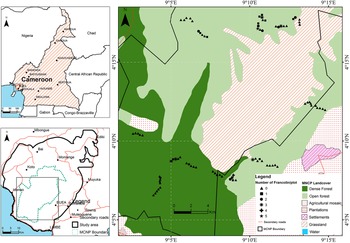
We conducted field work during July-August 2016 in Mount Cameroon National Park (4.055°–4.378° N and 9.031°–9.294° E; 58,178 ha), hereafter MCNP. MCNP is situated on the coast of South West Cameroon, within the Gulf of Guinea (Figure 1). It is an active volcano with large swaths of rugged terrain difficult to access due to extensive lava flows and volcanic craters (Proctor et al. Reference Proctor and Edwards2007). The climate is maritime and equatorial with an average annual temperature of 26°C and average annual rainfall attaining 13,000 mm at Debuncha, the world’s second wettest place (Fraser et al. Reference Fraser, Hall and Healey1998, Miavita 2011). The vegetation ranges from mangroves and dense humid evergreen Guinean–Congolian forest of the Atlantic Biafran type at lowest altitudes to sub-montane and montane forests at higher altitudes (Cable and Cheek Reference Cable and Cheek1998, Cheek et al. Reference Cheek, Mackinder, Gosline, Onana and Achoundong2001). It is the only place in West and Central Africa with unbroken, continued, and stratified vegetation from the sea to mountain summit (Cable and Cheek Reference Cable and Cheek1998). Before the creation of the MCNP in 2009, the forest was being severely degraded by fires and agricultural encroachment, uncontrolled hunting, and excessive debarking of red stinkwood Prunus africana (Djomo and Tchemadeu Reference Djomo and Tchamadeu2014). This tree is a vulnerable, but widespread Afromontane hardwood species traded internationally for the medicinal use of its bark (Cunningham and Mbenkum Reference Cunningham and Mbenkum1993, Vinceti et al. Reference Vinceti, Loo, Gaisberger, van Zonneveld, Schueler, Konrad, Kadu and Geburek2013). Unsustainable bark harvesting, including felling, threatens Prunus africana through the reduced rates of survival, growth and reproduction of exploited trees (Cunningham and Mbenkum Reference Cunningham and Mbenkum1993, Delvaux et al. Reference Delvaux, Sinsin and Van Damme2010), thus leading ultimately to vegetation thinning. The debarking activities also pose an indirect threat to the Francolin which feeds on (and probably help disseminate) Prunus africana’s seeds, in addition to opening the way for its illegal hunting. These risks persist inside MCNP where debarking is allowed, conditional on sustainable practices. A constant human influx fuels land clearance for the purpose of commercial and subsistence farming, in an area where much of the lowland forest is already converted to industrial plantations (Proctor and Edwards Reference Proctor and Edwards2007, Forboseh et al. Reference Forboseh, Sunderland, Comiskey and Balinga2011). The deforestation rate is higher on the east side (headquarters of Buea Subdivision) where at least 70% of the South West Region population is found (Kah Reference Kah2006).
Map of study area showing the location of sampling plots (symbol-coded by count of sighted birds).

Bird count assessment
We used call playback to improve the frequency of bird detection (Dranzoa et al. Reference Dranzoa, Nkwasire and Sande1999, Sande Reference Sande2001, Ssemmanda and Fuller Reference Ssemmanda and Fuller2005). This technique has been found to be effective in provoking responses from many francolin species and even flushing them out of the thick vegetation (Fuller et al. Reference Fuller, Akite, Amuno, Fuller, Ofwono, Proaktor and Ssemmanda2012). Seventeen 1.5-km line transects were laid randomly along an altitudinal gradient, starting from 800 m altitude, i.e. the purported lower range limit of Mt Cameroon Francolin (Birdlife International 2000). In each transect, five survey points were set 300 m from one another, which was assumed to be double the maximum reach of the male francolin call in our study area, thus giving a total of 86 survey points. The location (longitude, latitude, and altitude) of survey points together with distance between them were recorded using a handheld GPS receiver (Garmin 64s). Using an audio disk drive with a ‘Radio Shack mini Amplifier-Speaker, the advertising call of the Mount Cameroon Francolin (obtained from Chappuis Reference Chappuis2000) was played at each survey point for 20 s in three repetitions with one-minute lapse in between and any response noted in the ensuing 5 min. Playback surveys were conducted at 06h30–11h30 and 15h30–17h00 when birds appeared to call more frequently (Bibby et al. Reference Bibby, Burgess, Hill and Mustoe2000). In the lone instance of a rainy day, surveying was suspended until the rain had ceased. The geographical coordinates of detection points were saved in the handheld GPS device and later downloaded into ArcGIS software for the purpose of analysis and plotting on a topographic map of MCNP.
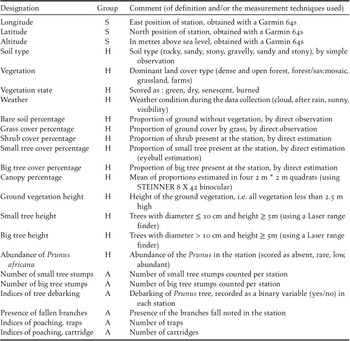
To investigate the habitat associations of francolins, habitat measurements were made in four random 5 x 5 m quadrats set up within 50-m radius from the point of a detected response. In case of non-response, habitat data were collected also in four quadrats of similar size, but this time randomly set up within 50 m of the survey point (i.e. the point where call playback was made). The habitat survey took place on the same day but after the playback sampling had been completed, to avoid disturbing birds. Typically, the observer returned to the survey point and, standing at the centre of the 5 x 5 m quadrat set up as just described, proceeded to record vegetation characteristics and indices of human activities. The vegetation characteristics measured included: (i) dominant land cover (forest, savanna mosaic, grassland, farms); (ii) vegetation state (green, dry, senescent); (iii) percentage of bare soil; (iv) percentage cover of grass; (v) percentage cover of shrubs; (vi) percentage cover of small trees; (vii) percentage cover of large trees; (viii) percentage of canopy cover; (ix) height of the ground vegetation (all vegetation less than 2.5 m high) ; (x) height of small trees (diameter ≤ 10 cm and height ≥ 5 m); (xi) height of large trees (diameter > 10 cm and height ≥ 5 m); (xii) Prunus abundance categories (absent, rare, low, abundant). The recorded indices of human activities were: (i) debarking of Prunus (yes, no); (ii) branch lopping (yes, no); (iii)-(iv): logging intensity (count of small and large stumps); (v) trapping pressure by scoring abundance of traps (absent, rare, few, abundant); (vi) hunting pressure by scoring abundance of cartridges (absent, rare, few, abundant). See Table 1 for the complete list of predictors together with a brief description of the measurement techniques used.
Description of the predictors used in the Poisson logistic regression model indicating (i) designation, (ii) group affiliation (S: spatial or geographical coordinates; H: habitat characteristics; A: anthropogenic or human activities), and (iii) brief comment of the definition and/or the measurement techniques used.

Data analysis and modelling
The 3.5.0 version of R software (R Core Team 2013) was used to fit a Poisson logistic regression for predicting the number of individuals detected at a survey location. A total of 23 candidate predictors including three geographical coordinates, 14 habitat characteristics (extended to soil type and weather), and six indices of human activities were entered selectively in the model using the drop1() function, after they have been duly mean-centered and scaled (where appropriate) using the scale () function and checked for multicollinearity using the pairs () function to draw a scatter plot matrix (SPLOM) graphic. The two pairs of variables with highest correlation coefficient (0.8 or higher in absolute value: number of small and large stumps, percentage cover of grass and big trees) failed the automated selection. The linear and quadratic gradients of altitude were both allowed in order to test for a bell-shaped response of bird occurrence to altitude (Binda and Mayaka Reference Binda and Mayaka2019), giving thus two competing models. We used Akaike’s Information Criterion to select the final model and Wald’s statistic to test the significance of the predictors (Venables and Ripley Reference Venables and Ripley2002).
Results
Bird abundance assessment
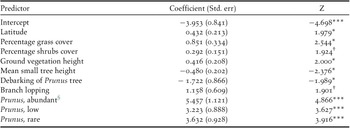
A response by one or more francolins was recorded at 26 (30%) of the 86 sampling points. There were 14 (16.3%) instances of group responses (i.e. at least two individuals) as against 12 (14%) cases of individual responses. There were only five cases of spontaneous calling during the fieldwork period; all were recorded in the undisturbed forest between 05h00 and 06h30. Francolins were detected at 1,023–2,186 m asl. The response rates changed with altitudinal stratification of vegetation types: 15% in the submontane forest (800–1,600 m); 80.8% in montane forest (1,600–1,800 m) and 3.9% in montane scrub (1,800–2,400 m) and nil in lowland forest (0–800 m) and savanna (2,400–4,100 m). Francolins were found in forest undergrowth and tall grass cover around the forest (see details in Figure 1). The count of Mount Cameroon Francolin increased significantly (P ˂ 0.05) with latitude, ground vegetation height, percentage of shrubs cover, percentage grass cover around forest, and Prunus africana abundance —with three degrees of freedom, all of which had a highly significant effect on bird count, compared to when Prunus was absent; but decreased with the density of small trees and the debarking of Prunus africana (see Table 2).
Output of the Poisson logistic model for predicting the count of Mount Cameroun Francolin responding to call playback. The estimated regression coefficients (with standard errors in parentheses) and Wald statistic Z are shown only for predictors with significant effect at 10% probability level or lower.

***,*,†: significant at probability levels 0.1 %, 5%, and 10%, respectively.
§ :Prunus abundance was recorded as an ordered factor with four levels (absent—the reference level; abundant; low; rare) thus allowing three orthogonal contrasts (or comparisons) each based on a single degree of freedom.
Discussion
Determinants of Mount Cameroon Francolin occurrence
This work demonstrated the usefulness of the call playback technique in surveying Mount Cameroon Francolin. A response can be expected at about 30% of survey points in the altitude range of 1,023–2,186 m. The survey covered most of daytime, 06h30–11h30 and 15h30–17h00, given that it is dark before 06h00 and birds are usually silent at noon (but call at night). The effect of time of day on bird response was not investigated but would be worth considering in future work.
Francolins were absent in some locations (Mapanja and Bova-Bonakada) on the eastern side of the mountain previously known as its favoured distribution area (BirdLife International 2000). This absence suggests a declining trend in the population and corroborates the rarity of Mount Cameroon Francolin reported in previous ornithological surveys (BirdLife International 2003, Bayly and Motombe Reference Bayly and Motombe2004). The montane francolins are thought to be globally threatened as they occur at low densities in restricted, human-encroached ranges. However, evidence of population decline is scanty, as temporal changes in numbers are seldom available. This holds true for the populations of Swierstra’s Francolin Pternistis swrierstrai on Mount Moco, Angola (Mills et al. Reference Mills, Olmos, Melo and Dean2011), the ‘Critically Endangered’ Double-spurred Francolin Francolinus bicalcaratus ayesha in Morocco (Hanane and Magri Reference Hanane and Magri2016) and other montane galliformes (Coussoulet Reference Coussoulet2016).
The count of Mt Cameroon Francolin significantly increased with latitude but not elevation. Several reports have indicated the species as being confined to the south-eastern to north-eastern slopes of the mountain, at 850–2,100 m (Mackworth-Praed and Grant Reference Mackworth-Praed and Grant1970, BirdLife International 2000, Fotso et al. Reference Fotso, Dowsett-Lemaire, Dowsett, Scholte, Languy and Bowden2001). This altitudinal range agrees well with our finding, 1,023–2,186 m, and occurs optimally at mid-range elevation of Mount Cameroon, which has its peak at 4,095 m. In effect, the occurrence of mountain avifauna in relation to elevation is known to be bell-shaped, i.e. increasing from low altitudes to mid altitudes then declining towards summits (Joshi and Rautela Reference Joshi and Rautela2014, Kim et al. Reference Kim, Lee, Shin, Lee, Seo and Eo2018, Binda and Mayaka Reference Binda and Mayaka2019). This trend reflects the change in resource availability, as related to the change in forest structure (Hořák et al. Reference Hořák, Ferenc, Sedláček, Motombi, Svoboda, Altman, Albrecht, Nana, Janeček, Dančák, Majeský, Lltonga and Doležal2019) and site productivity (Waterhouse et al. Reference Waterhouse, Mather and Seip2002). The cause of the eastward decrease in the occurrence of Mount Cameroon Francolin was not identified, but might be related to habitat loss and hunting pressure. In effect, these two factors have been reported to change the distribution range of Black Francolin Francolinus francolinus bogdanov in the Sistan Plain, Iran (Heidari et al. Reference Heidari, Arbabi, Noori and Shahriari2009) and that of the Nahan’s Francolin in Uganda (Fuller et al. Reference Fuller, Akite, Amuno, Flockhart, Ofwono, Proaktor and Ssemmanda2004). The change pattern in occupancy with latitude evidenced in this study contradicts previous reports and sounds a wake-up call for the conservation of Mount Cameroon Francolin.
Threats to Mount Cameroon francolin conservation
According to local bird guides, francolins feed on Prunus africana which is probably why their numbers increased with Prunus abundance but declined with its debarking (Table 1). Since berries are only available seasonally, it can be conjectured that other consequences of the Prunus presence are having a positive effect on the incidence of francolins. Therefore, the excessive debarking threatens not only the Prunus — through reduced rates of survival, growth, and reproduction of exploited trees (Cunningham and Mbenkum Reference Cunningham and Mbenkum1993, Delvaux et al. Reference Delvaux, Sinsin and Van Damme2010) — but also the francolins, through food depletion, habitat degradation, and incidental hunting.
Human pressure is causing a rapid decline in the populations of all African montane francolins and other Galliformes (IUCN 2019). In particular, deforestation and hunting are seen as the two main threats to Mount Cameroon Francolins. Firstly, francolins prefer little-encroached forests with abundant shrub and tall ground vegetation (Table 1), presumably for escaping and hiding. In contrast, francolins are negatively affected by habitat change or/and encroachment linked to tree felling, farming, Prunus debarking, illegal fires, and hunting pressure (evidenced in number of traps, gun cartridges, poachers’ camps and pathways). Globally, the dwindling numbers of francolins have been linked to deforestation (BirdLife International 2003). This process is also likely to be at work on Mount Cameroon, where reduction in tree density is highest in the community montane forest than in other vegetation types — i.e. submontane forest, montane scrub, and lowland forest—(Stattersfield et al. Reference Stattersfield, Crosby, Long and Wege1998, Forboseh et al. Reference Forboseh, Sunderland, Comiskey and Balinga2011). Furthermore, the montane savanna and the forest treeline bordering it are being whittled away through intentional bushfires which hunters set to stimulate regrowth and attract antelopes.
Secondly, Mount Cameroon francolin is hunted for its meat (Bayly and Motombe Reference Bayly and Motombe2004), mostly by destitute youths seeking to eke out a living (Djomo and Tchamadeu Reference Djomo and Tchamadeu2014). The Prunus debarking activities also play a role in opening the way to illegal killings (field observation by Francis Guetse) while uncontrolled bushfires destroy the francolin’s eggs and nestlings. We observed that hunting pressure and habitat degradation are at their most intense in lower altitude areas of the park.
Recommendations for further research and improved conservation strategies
The creation of MCNP has resulted in a reduction in the deforestation rate, but much else remains to be done for the francolin and other forest wildlife. We suggest using the call playback technique to achieve the following research programme:
-
(i) Carry extensive surveys to gain a better understanding of the abundance and distribution of Mount Cameroon francolin for updating its IUCN conservation status;
-
(ii) Assess the effects of hunting on the species beyond the anecdotal evidence reported here, by comparing francolin densities in areas with different levels of hunting pressure;
-
(iii) Study the breeding biology of Mount Cameroon francolin in the montane forest which is most appropriate for this purpose;
-
(iv) Carry a detailed radio-telemetric study of Mount Cameroon francolin to discern the seasonal patterns of its movement, habitat use and breeding.
In addition, we suggest the following conservation strategies:
-
(i) Use micro-zoning to demarcate the most sensitive areas, for increased patrolling and enforcement of protective legislation;
-
(ii) Organize awareness-raising campaigns on conservation issues, targeted at local populations;
-
(iii) Enhance the participation of local communities in the decision-making process and management activities (monitoring francolins numbers, checking Prunus debarking activities, policing burning and tree felling; formulating and implementing a sound reforestation scheme);
-
(iv) Keep recreational tourism at a level congruent with conservation constraints.
Acknowledgements
We are thankful to Francis Luma for assistance on the field and Francis Njie Motombi for ornithological collaboration. We are indebted to the referees, Prof. Richard Fuller and Dr. Mark Hulme, and the Editor-in-Chief, Dr. Phil Atkinson, whose comments were helpful in improving the quality of the initial draft and we take responsibility for all weaknesses remaining in this work. The Mount Cameroon National Park authorities made this fieldwork possible. The field work was supported by Czech Science Foundation (project no. GB14-36098G).