This paper focuses on the cases of three specific “wonder horses”: Clever Hans, a famous reading and talking horse from the early twentieth century, Berto, one of the famous “Horses of Elberfeld,” and Lady Wonder, the Typing Horse. All three of these horses seemed to possess a degree of intelligence comparable to young children and were presented as wonder horses – ostensibly learning to speak, count, calculate, make predictions, and grasp the meaning of playing cards and coins. Clever Hans’ Berlin-based owner, Wilhelm von Osten, for example, claimed that he had taught the horse cultural techniques at an elementary school level, namely, reading, counting, and calculating. Hans was quite a sensation in Berlin around 1904-5. His owner held free public presentations and training sessions in his home’s back yard, as observers tried to discern any kind of signaling between teacher and horse. In the year 1904, a seminal study of behavioral psychology concerning these presentations began in Berlin, under the supervision of the experimental psychologist Carl Stumpf, along with his assistant Erich von Hornbostel and his student Oskar Pfungst. The latter, in the role of experimenter, conducted a series of tests on Clever Hans, publishing the results in German (Pfungst Reference Pfungst1907). Four years later, this influential work was published in English translation (Pfungst Reference Pfungst1911), which completed Clever Hans’ transition “from being deemed an intelligent actor to becoming assessed as a mindless reactor” (Crist Reference Crist1997, 1).
The study signified a reversal of focus from the horse to the trainer, shifting the topic from the horse’s purported learning of cultural techniques to the involuntary emission by the horse’s teacher of stimuli that spark a reaction in the horse. This reversal turned the teacher’s apparent success into a simple stimulus-response reaction based in minimal movements of the trainer’s body. Cases like that of Clever Hans, the reading and talking horse, and other famous “wonder animals” (see Lachapelle & Healey Reference Lachapelle and Jenna2010; Moynahan Reference Moynahan1999) were thus the focus of intense debate in behavioral science on the topic of animal intelligence. This contributed to the further development of the study of animals and their behavior as a special subject in psychology and cultural theory (see Despret Reference Despret2004), although such discourse also provided a reason to reconsider the boundaries of psychology and parapsychology (see De Sio & Marazia Reference De Sio and Chantal2014).
The scientific study of the question of whether horses were learning to talk or merely responding to stimuli from the teacher, as explored in the talking horse experiments, fundamentally altered the experimental situation by introducing new levels of communication into the human-animal interaction process. These communication levels were capable of changing both the experimental subject and the experimental object during the very same experiment. The introduction of new levels of communication, moreover, had the not undesired effect of painting each respective (opposite) opinion as the potential charlatan, which then intensified each of opponent’s quest for yet further levels of communication so as to disprove the charlatan label. This paper argues that both detecting charlatans and avoiding this accusation during the talking horse experiments was achieved through the verification or ruling out of specific communication channels, for instance spoken words or visual signs, during the training of the horses.
In this respect, it is no coincidence that the talking horse experiments are mentioned in connection with Claude Elwood Shannon and Warren Weaver’s groundbreaking publication on “the mathematical theory of communication” (Shannon & Weaver Reference Shannon and Weaver1949), which is considered foundational to information theory. With his contribution to the “mathematical theory of communication,” Shannon laid the groundwork for the modern media age by defining the meaning of information as dependent on its transmission, processing, and compression in the presence of noise, and by focusing on the problem of its mathematical calculability. Warren Weaver added to this a theoretical overview that expanded the general facet of communication, enabling it to become a comprehensive theoretical concept, with its different levels summarized by Weaver as follows:
The word communication will be used here in a very broad sense to include all of the procedures by which one mind may affect another. This, of course, involves not only written and oral speech, but also music, the pictorial arts, the theatre, the ballet, and in fact all human behavior. In some connections it may be desirable to use a still broader definition of communication, namely, one which would include the procedures by means of which one mechanism (say automatic equipment to track an airplane and to compute its probable future positions) affects another mechanism (say a guided missile chasing this airplane). (Weaver Reference Weaver, Claude and Weaver1949, 3)
Warren Weaver begins his contribution to the “mathematical theory of communication” by expanding the concept of communication to include guided missiles and other cybernetic machines, where difficulties in communication are found on three different levels: Level A—the technical problem of the transmission of symbols of communication—requires differentiation from Level B—the semantic precision of transmitted symbols and the desired meaning—and from Level C—the effectiveness problem of the communication itself. According to Weaver, in view of such a constellation,
one would be inclined to think that Level A is a relatively superficial one, involving only the engineering details of good design of a communication system; while B and C seem to contain most if not all of the philosophical content of the general problem of communication. The mathematical theory of the engineering aspects of communication, as developed chiefly by Claude Shannon at the Bell Telephone Laboratories, … has, I think, a deep significance which proves that the preceding paragraph is seriously inaccurate. Part of the significance of the new theory comes from the fact that levels B and C, above, can make use only of those signal accuracies which turn out to be possible when analyzed at Level A. Thus any limitations discovered in the theory at Level A necessarily apply to levels B and C. But a larger part of the significance comes from the fact that the analysis at Level A discloses that this level overlaps the other levels more than one could possible [sic] naively suspect. Thus the theory of Level A is, at least to a significant degree, also a theory of levels B and C. (Weaver Reference Weaver, Claude and Weaver1949, 6)
This connection between the levels of communication can also be summarized as a general principle: the theory of the technical transmission of communication symbols informs the semantic level and the problem of message efficacy.
Considering that the concept of communication expanded during the technical age to include the detection and tracking of machines by machines, the question of technical transmission has become particularly topical, especially in the case of its faltering or failure. So the question as to whether transmission has actually occurred in a specific communication channel - or, on the contrary, not occurred - takes on decisive significance. Therefore, for the theory of technical transmission, due to its determinative function for the semantic and pragmatic level even in other contexts besides cybernetics, it can become a decisive problem to substantiate the circumstance that no communication had actually taken place in order to demonstrate the autonomy of certain cultural-technical achievements.
Warren Weaver alludes to this problem in his contribution to the mathematical theory of communication with his mention of “the Horses of Elberfeld.” In doing so, he addresses the semantic problems of such communication, noting that these are “concerned with the identity, or satisfactorily close approximation,” that can be drawn between “the interpretation of meaning by the receiver” and “the intended meaning of the sender” (ibid., 4). According to Weaver, one can never really be sure of this identity, even when the message itself is confirmed. Indeed, after a scientific study demonstrated that Clever Hans, Muhamed, and Zarif, the talking horses from Wuppertal-Elberfeld, “who were showing marvelous linguistic and mathematical ability, were merely reacting to movements of the trainer’s head, Mr. Krall, their owner, met the criticism in the most direct manner. He asked the horses whether they could see such small movements and in answer they spelled out an emphatic ‘No’” (ibid., 5).Footnote 1 This basically said it all, for this anecdote about the talking horses represented, in Weaver’s view, evidence of a substantial crisis of the semantic problem of communication, which he felt could only be resolved if the concept of communication were to become more strongly focused on the form of transmission of the communication symbols.
In the year 1943, the first large-scale Allied air raid on Munich was carried out with the help of cybernetic equipment for automatically tracking and directing an airplane, involving more than 200 airplanes and a great deal of damage. In the context of the air raids in 1943, a taxidermied horse’s head disappeared from the office wall of the library director of the Ludwig Maximilian University Library in Munich (Abresch Reference Abresch1988, 6), the last remaining physical trace of Clever Hans—who, before arriving in Wuppertal-Elberfeld, had been trained by his former owner, Wilhelm von Osten, in Berlin. Osten was an elementary school teacher who claimed that he had taught Clever Hans cultural techniques at an elementary school level: reading, counting, calculating, identifying money and coins, playing cards, and more. Osten was very proud of his horse’s achievements, which were articulated through a special hoof language. To communicate with his trainer, Clever Hans used a numerical code for the letters of the alphabet, which he tapped on a wooden board designed especially for that purpose using his forelegs. However, once the educator found himself confronted with the accusation of charlatanry in regard to the educational performance of the horse, he agreed to a more precise scientific study of the learning achievements of Clever Hans. The ensuing experimental investigation showed that the problem of transmitting communication symbols was in fact highly relevant, especially the transmission channel, thus increasingly focusing the study on this aspect.
Both detecting charlatans and avoiding this accusation during the talking horse test series proceeded with the same method of introducing new levels of communication in the human-animal interaction process to substantiate each respective standpoint, as this essay intends to elucidate. All three cases studied here are telling, since they—in my view—negotiate the issue of human-animal relations (Despret Reference Despret2004) on the plane of potential channels of communication and, in terms of consequences, are dependent on the closing or opening of certain communication channels. Since until now the talking horse experiments have been researched in the contexts of behavioral psychology (Pfungst Reference Pfungst1907; Rosenthal Reference Rosenthal1965), semiotics (Sebeock Reference Sebeok, Thomas and Rosenthal1981; Crist Reference Crist1997), and the scientification of parapsychology in early twentieth-century Germany (Wolffram Reference Wolffram2009; De Sio & Marazia Reference De Sio and Chantal2014), the point here is to identify their value in relation to contemporary communications theory. Like Warren Weaver, communications theory invokes the talking horse experiments in exploring its fundamental assumption that the question of the transmission of communication symbols and its channels via the semantic level prevails to such an extent that it might turn spoken language into noise and teachers of cultural techniques into charlatans. In every case, the hypothesis of a transmission of signs or stimuli stood against the ability of a horse to learn the cultural techniques that their owners in Berlin, Wuppertal, and Richmond, Virginia, claimed to teach. Concerning the mutual accusations of being a charlatan expressed by horse trainers and experimental psychologists, the series of different talking horse experiments show that the reproach was rejected each time by expanding the channels of communication.
The point of departure for this conflict was focused on the question of whether the case of the talking horses signified a respectable pedagogical success in the mastery of elementary cultural techniques or whether the horses were receiving secret signs that provoked their reaction. Already in 1904, a scientific committee headed by Carl Stumpf as tenured professor and director of the Psychology Institute at the Friedrich Wilhelms University in Berlin was convened to address the intensive debate of this question in the media at the beginning of the twentieth century (see Gundlach Reference Gundlach2006).
Clever Hans
Wilhelm von Osten, a retired math teacher, spent fourteen years with his horses, every single day, rain or shine, in the back courtyard of his Berlin home located at Griebenowstraße 10, teaching them to recognize images, learn the alphabet, and calculate simple math problems. Only then, in 1904, did he go public with his stallion named Hans, acquired in the year 1900. The press response to Osten’s demonstrations was enormous, for after only two years of training, Hans could already “count, calculate using the main arithmetic types, spell, and read; he recognized the sounds, coins, cards, the pointer position of the clock, and even more…. Every day his tenants and neighbors could watch him at work and especially these regular observers had to realize that a real school lesson was being carried out here” (Krall Reference Krall1912, 17).Footnote 2
After four years of schooling, the ever-growing group of visitors and curious individuals experienced something like the following at the public demonstrations, which were free of charge:
He would answer correctly nearly all of the questions which were put to him in German. If he understood a question, he immediately indicated this by a nod of the head; if he failed to grasp its import, he communicated the fact by a shake of the head…. Our intelligent horse was unable to speak, to be sure. His chief mode of expression was tapping with his right forefoot. A good deal was also expressed by means of movements of the head. (Pfungst Reference Pfungst1911, 18–19)
Hans expressed himself primarily through discrete tapping signs in his “hoof language” (Hufsprache) (Pfungst Reference Pfungst1907, 157): “Since everything had been translated into terms which were to be expressed by means of tapping with the foot, and thus really put into terms of number” (Pfungst Reference Pfungst1911, 221), all information was articulated through hoofbeats on a board designed expressly for that purpose.
On the other hand it was useless to try to get answers upon topics of which he knew nothing. Thus he ignored questions put in French or Latin and became fidgety, thereby showing the genuineness of his achievements; but upon topics with which he was familiar he could not be led astray. Indeed, there was nothing but language lacking to make him almost human and the intelligent animal was declared by experimental educators to be at about the stage of development of a child of 13 or 14 years. (ibid., 24)
Wilhelm von Osten had a strong interest in having his pedagogical achievements in teaching Hans examined publicly, which is why he held free public demonstrations on a regular basis in the back courtyard of his tenement building. In the year 1904, a committee of thirteen specialists and scientists convened, and on September 12, 1904, they arrived at the verdict that “the possibility of tricks of the sort commonly used in training, was excluded” and therefore that Osten’s teaching success, “which has little in common with methods of training, and is patterned after the instruction given in the elementary schools,” was to be considered “worthy of a serious and incisive investigation” (Pfungst Reference Pfungst1911, 253–54).
Carl Stumpf, along with his assistant Erich Moritz von Hornbostel as the clerk recording the experiments and his student Oskar Pfungst as experimenter, spent several weeks working with Clever Hans, with Wilhelm von Osten, and with the Africa explorer Carl Georg Schillings, who had previously spent a considerable amount of time conducting experiments with this horse and was now likewise presenting the results to the public (see Gundlach Reference Gundlach2006, 99). To conduct their experiments, they erected “a large canvas tent” as an ambulatory psychophysical laboratory in Osten’s back courtyard in Berlin (Pfungst Reference Pfungst1911, 30). Their experiments were designed to verify one of the two hypotheses: the cultural-technical learning achievements versus the communication hypothesis.
The methodologically brilliant experimental approach taken by Pfungst lay in his idea to test whether Clever Hans would still remain clever when the experimenter poses both deliberate and undeliberate questions, meaning those “in which the procedure was without knowledge of the answer on the part of the questioner” (ibid., 32). Thus, if in the case of the undeliberate questions no deviations arose in the number of appropriate answers, it could then be said that communication was absent, and the horse’s cognitive ability proven by its mastery of elementary cultural abilities like speaking, calculating, and writing. Carl Stumpf viewed the cultural-technical education of Clever Hans as follows:
It was quite rational that Mr. von Osten should have chosen counting and arithmetical calculation as the process by which to make his attack upon the animal mind, for a matter of fact, nowhere else is it so easy to bridge the gap between perception and conception and nowhere else can the sign of success or failure be perceived so readily as in the handling of numbers. (Stumpf Reference Stumpf1911B, 249)
During the experiments, it emerged of course that the daily schooling of Clever Hans—in an attempt to “install in the horse’s mind the rudiments of human culture through long years of painstaking instruction” (Pfungst Reference Pfungst1911, 212)—had by no means resulted in the horse demonstrating autonomous cognitive ability. In fact: “After all this experimentation it was evident that the horse was unable to work alone, but was dependent upon certain stimuli from its environment” (ibid., 40). Experiments with blinders and other screening mechanisms had determined that “the horse was at a loss in the moment he was prevented from seeing the questioner; whereas his responses were nearly always correct when the experimenter was in sight” (ibid., 43). In his paper from 1907 titled “Clever Hans (The Horse of Mr. von Osten),” which is now considered a classic, Oskar Pfungst phrased it in an equally concise and clear way: “It is evident therefore, that the horse required certain visual stimuli or signs in order to make a correct response” (ibid., 43).Footnote 3
On October 20, 1904, in a meeting of the Psychologische Gesellschaft zu Berlin (Berlin Society of Psychology), the psychiatrist Albert Moll had already made a similar inference, which was based on his own and earlier studies of Clever Hans conducted in June 1903. These might have given the subsequent experiments by Stumpf and Pfungst basic methodological direction, but Pfungst’s book contains “no mention of Moll’s pertinent remarks on this subject” (Gundlach Reference Gundlach2006, 97).Footnote 4 Moll’s analysis of the horse at the time resulted in the conclusion that: “All tasks were brilliantly carried out, but only so long as Herr von Osten and his stablemen were present and aware of which tasks were being presented to the horses” (Moll Reference Moll1904, 369). By contrast, “all attempts miserably failed” as soon as Osten and the stablemen no longer knew the correct answer themselves (ibid.). For this reason, concluded Moll, “the horse by no means showed any kind of concept formation but rather unquestionably received assistance, that is, signals, to which it responded” (ibid.).
Moll thus considered the studied phenomenon to belong “not to the psychology of the animals, but to occultism,” because in his opinion it involved “a source of error that is familiar to anyone working in the sphere of occultism, namely that of minimal movements through which signals are given, such as so-called mind reading” (ibid.). Moll was one of the Fin de Siècle psychiatrists now known as “critical occultists” (Wolffram Reference Wolffram2009, 233) and, in the first known scientific study of Clever Hans, he was able to draw parallels to methods of occultism. This was due to the fact that he had already spent almost twenty years investigating, thanks to his interest in the acceptance of hypnotism by medical and scientific research, their spiritualist and occult thresholds in numerous parapsychological phenomena. He also worked with the notorious Munich doctor, parapsychologist, and hynotist Albert von Schrenck-Notzing in this context (see Sommer Reference Sommer2012).
The Clever Hans phenomenon
The psychologist Carl Stumpf described the baseline situation of his experimental research as follows:
A horse that solves correctly problems in multiplication and division by means of tapping. Persons of unimpeachable honor, who in the master’s absence have received responses, and assure us that in the process they have not made even the slightest sign. Thousands of spectators, horse-fanciers, trick-trainers of first rank, and not one of them during the course of many months’ observations are able to discover any kind of regular signal. That was the riddle. And its solution was found in unintentional minimal movements of the horse’s questioner. (Stumpf Reference Stumpf1911C, 5)
Indeed, the experiment involving Clever Hans had evolved into an observation of the former elementary school teacher Wilhelm von Osten and a self-observation of the experimenter Oskar Pfungst. The theory of a transmission of communication symbols instead of actual learning achievement on the part of the horse primarily pertained to the visual channel. However, the question of how the transmission of certain visual stimuli could have hitherto remained concealed to all observers present initially remained unresolved. Reflecting on his experiments, Pfungst noted:
I had, in the meantime, succeeded in discovering the essential and effective signs in the course of my observations of Mr. von Osten. These signs are minimal movements of the head on the part of the experimenter. As soon as the experimenter had given a problem to the horse, he, involuntarily, bent his head and trunk slightly forward and the horse would then put the right foot forward and begin to tap, without, however, returning it each time to its original position. As soon as the desired number of taps was given, the questioner would make a slight upward jerk of the head. Thereupon the horse would immediately swing his foot in a wide circle, bringing it back to its original position. (Pfungst Reference Pfungst1911, 47)
Therefore, the experimenter Oskar Pfungst directed his attention during the experimental situation from an observation of the horse to a study of the minimal movements of Wilhelm von Osten:
With regard to the regular recurrence of the movements noticed in the case of Mr. von Osten, I was, after some practice, able to note carefully their peculiar characteristics. This was rather difficult, not only on account of their extreme minuteness, but also because that very vivacious gentleman made sundry accompanying movements and was constantly moving back and forth. To abstract from these essential and really effective movements was truly difficult. It was much easier to observe these movements in the case of Mr. Schillings, probably on account of the fewer accompanying movements and perhaps on account of their greater distinctness. (ibid., 48–49)
In order to prove the existence of certain “unintentional signs” (Stumpf Reference Stumpf1911C, 7), the head investigator Carl Stumpf altered the experimental setup to allow him to measure the precise point in time where these signs were transmitted:
Since the doubt was expressed that these movements did not precede but followed closely upon the back-step of the horse (i.e., that an error with regard to the time-element was involved), it became important that time measurements be taken. This was done in the following manner: The questioner asked the horse to tap numbers from 5 to 20, seldom higher. He purposely refrained from pronouncing the number, but recorded it after each test had been completed. This was a matter of indifference to the horse, and had the advantage that the measurement was not influenced by knowledge on the part of the time-keeper. Two observers were required, one watching the horse, the other the questioner…. Measurements of this kind were taken for Mr. von Osten, Mr. Schillings and myself. In the case of the first two it was taken without any knowledge on their part. They did not even know that they were being observed, having been told that the measurements were for the sake of determining the horse’s rate. (Pfungst Reference Pfungst1911, 50-2.)
As soon as the truly effective channel of communication between horse and human during the school lesson was identified, then the semantic level of the spoken questions and requests made of the horse was newly inferred, for they lost all meaning in terms of the horse’s reaction:
As a matter of fact, it made no difference who desired an answer, for the only person upon whom the experiment depended was the questioner, that is, the one who asked the horse to tap…. It was he who gave the directions, and since all that were involved were visual signs, the drama in which Hans appeared as the hero, was nothing but a pantomime. (ibid., 141)
Pfungst’s conclusions thus radically shifted the perspective of the communication that was taking place: no longer was it Hans who was speaking, but rather Osten, whose body language was providing the decisive signals. Prior to Pfungst’s scientific dissection, Hans was seen as an actor providing answers to questions on an elementary school level. After his first experiments, Pfungst turned his attention to Osten as the questioner, accrediting the given answers to his “visual signs” and indicating that Hans was reacting in a stimulus-response scheme.
Pfungst’s explanations have already been criticized as “consistent use of the rhetorik of reversal” (Crist Reference Crist1997, 13), which might have led him to a “de facto exclusion of other explanatory options of Hans’s accomplishments” (ibid., 15). Instead of following this semiotic logic of the reversal of sender and receiver, which turned Clever Hans, the learning horse, into a mindless reactor, and Wilhelm von Osten, the teaching trainer, into an inconspicuous sender of certain stimuli, my argument focuses on the expansion of the channels of communication as a constitutive discourse strategy in the debates about animal psychology in the early twentieth century. As Warren Weaver stated, the form of the communication symbols’ transmission informs “the other levels” (Weaver Reference Weaver, Claude and Weaver1949, 6) – the semantic level and the problem of message efficacy. In the newly discovered channel of communication, the speaker of “hoof language” held the role of receptor who perceived “unintentional minimal movements” (Stumpf Reference Stumpf1911C, 5). Spoken language became noise, while inconspicuous movements transmitted information.
Even skeptical visitors could not avoid expecting a correct answer from Hans and thus inadvertently giving certain signs that contributed to the accuracy of his answers:
If, therefore, the horse at times would ‘hopelessly flounder’ which would seem to be indicated by tapping now with the right and now with the left foot, then as a matter of fact, … this so-called floundering was the only reaction the average person could obtain from the horse in the absence of Mr. von Osten and Mr. Schillings. It would however occur also in the case of these gentleman and would be received with resentment when in truth it was Hans’s greatest feat, for he showed his extremely keen reaction upon every movement of the questioner. (Pfungst Reference Pfungst1911, 146)
After it was determined that the communication perspective was actually reversed, with the experimental subject and the experimental object shifting within the very same experiment, the focus of Pfungst’s scientific study was transferred from the horse to its teacher with the aim of experimentally confirming the discovered channel of communication. However, after Carl Stumpf delivered his report about Clever Hans on December 9, 1904, declaring that he was unable to verify any cultural-technical education on the part of the horse, Osten aborted all further collaboration with the committee. Since this horse was no longer available for study, the next step for Oskar Pfungst lay in laboratory experiments.
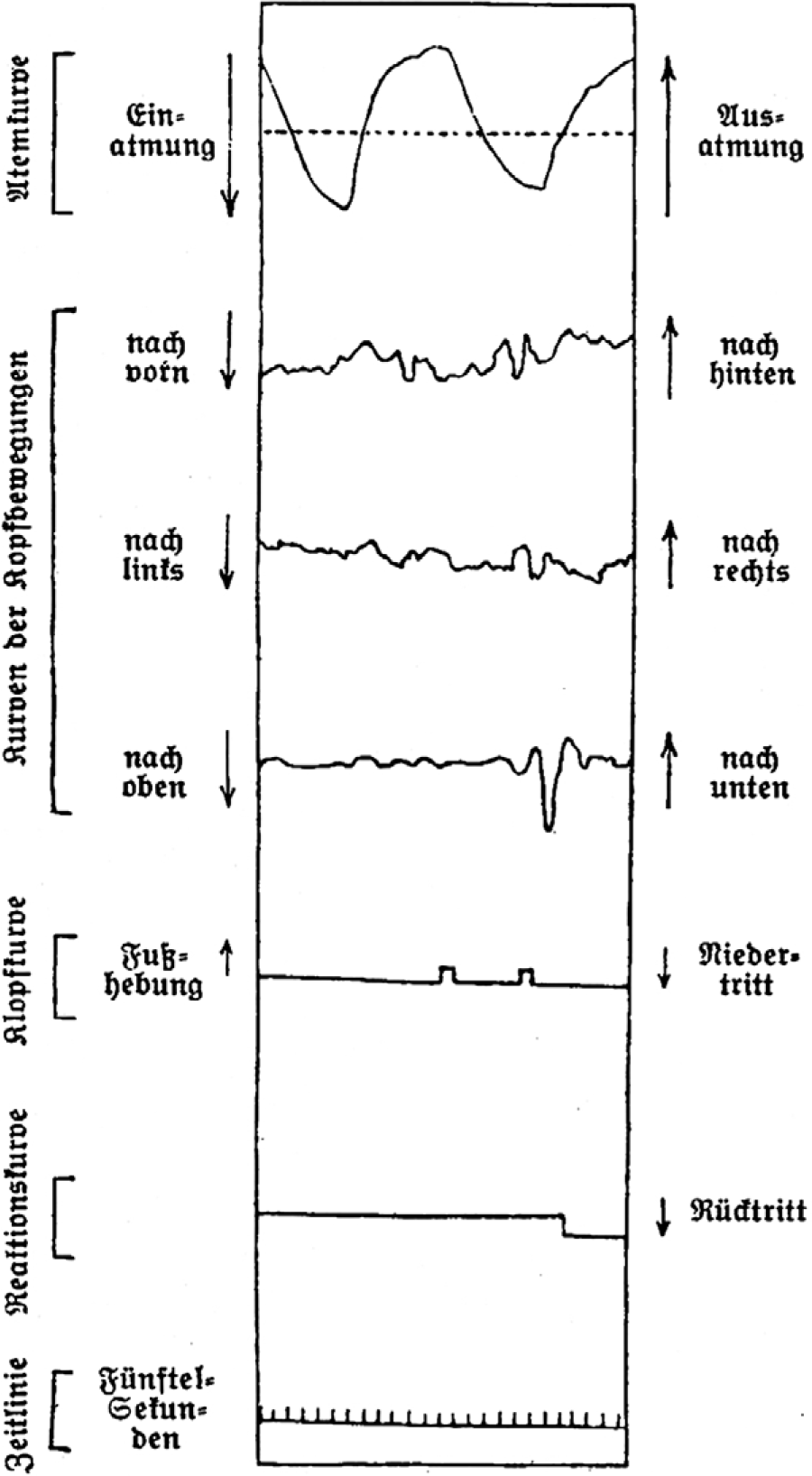
Pfungst noticed “that thus far I have supposed the horse to be a never-failing mechanism and that I placed all errors to the account of the questioner” (ibid., 152). In order to more precisely research, in a laboratory setting, the effects of the questioner on the horse, in the subsequent experiments another test person now adopted the questioner role that had been originally assigned to Oskar Pfungst, while Pfungst himself took on that of the horse. While the respective test person was thinking of a certain number, Pfungst watched him and began, in an act of becoming-animal, to tap with the hand: “Then I would begin to tap—but in human fashion with my right hand, rather than with my foot—and continued until I believed that I had perceived a final signal” (ibid., 103). He noticed involuntary movements—similar to those already seen by Osten in twenty-three of twenty-five test persons—giving him a hint as to the number being thought. Therefore, during the experiment in the laboratory, as an “unintentional by-product of an unsuccessful attempt at real education” (ibid., 241), the symbolic character of involuntary movements supplanted elementary cultural-technical knowledge as the object of experimental interest. Henceforth, the laboratory experiments involved “the graphic registration of the minute involuntary movements which accompany the thought process” (Stumpf Reference Stumpf1911C, 11), for not until the expected number was arrived at did the movement take place. “Indeed, it was very difficult and in some cases almost impossible for those persons whom I had initiated into the secret, to inhibit them voluntarily” (Pfungst Reference Pfungst1911, 107). The device used for recording chronicled both the tapping signals and the head movements in three dimensions, as well as the breathing of the test person, that is, the person sending the signals (fig. 1).
Oskar Pfungst, Diagram of the breathing curve of the questioner; the curves of his head movements in different directions; the reaction of the horse: the taps and the backstep; the lowest line indicating the time in fifth-seconds (Pfungst Reference Pfungst1907, 90).

As soon as the communication system, and thus the manner of transmission for the involuntary signs, had been identified, it was possible to experimentally prove that one cannot not communicate with a “signal animal” (Signaltier) (see Ettlinger Reference Ettlinger1913). The theory of transmitting communication symbols was thus expanded to include the “Clever Hans phenomenon”—as the process of inadvertently providing behavioral cues has been called since a conference of the New York Academy of Sciences in May 1980 (see Sebeok Reference Sebeok, Thomas and Rosenthal1981). It was there that Heini Hediger, a Swiss zoologist, established the following: “Communication, as it preoccupies us here in connection with the Clever Hans phenomenon, is not only a series of flow-processes between a chemical substance and a subject; it is a much more complex connection between the experimenter and the animal” (Hediger Reference Hediger1981, 3). Pfungst had already viewed the years-long education of Hans as a communication process of prompting characteristics, where the sharpening of the horse’s observation in particular showed that involuntary head movements, though at a variation of only 0.2 mm, could ultimately be perceived as signals through a learning process. Therefore, the results of the study by Pfungst and Stumpf opened up a new area of research in the field of psychology focused on ascertaining how “in some subtle, unintentional way experimenters do communicate their expectations to their human subjects, whose performance is then significantly altered” (Rosenthal Reference Rosenthal1965, XXV).
The question of the transmission channel in particular became highly relevant. The psychologist Robert Rosenthal, who released an English translation of the book by Oskar Pfungst in the United States in 1965, even elevated this aspect to the main research question:
If we knew precisely by what means we unintentionally communicate our experiences to our animal and human subjects, we could institute more effective controls against the effect of our expectancies. More generally, if we knew more about the modalities by which we subtly and unintentionally influence one another, we would then have learned a great deal that is new about human social behavior. (ibid., XXXIII)
When, in this respect, both the semantic plane and the effectiveness of a message are viewed as being subordinate to the message channel, then the technical problem of transmission of communication symbols appears to be the central issue of communicative systems.
The levels of communication are ultimately also the key to a new understanding of human-animal-relations, which Rosenthal—in view of Oskar Pfungst’s experiments with Clever Hans, resulting in an act of becoming-animal—had already established as being reciprocal in nature. Indeed, “not only could he read bodies,” as the science studies scholar Vinciane Despret noted about Clever Hans, he could also “make human bodies be moved and affected, and move and affect other beings and perform things without their owners’ knowledge” (Despret Reference Despret2004, 113). Moreover, this effect “could be experimentally studied”, with the result that “Hans could become a living apparatus that enabled the exploration of very complicated links between consciousness, affects and bodies” (ibid., 113–14). Therefore, from the vantage point of human-animal relations, the examination of levels of communication in the talking horse experiments facilitates the possibility of no longer studying actions and operations only in connection with humans, but also studying them as being reciprocally determined by complicated links between human and non-human bodies. This intervolved concept of agency provided a central point of departure for the establishment of the new research field of animal studies, to which reflection on the Clever Hans phenomenon made an important contribution (see Despret Reference Despret2015).
Berto
In his final report on Clever Hans, Carl Stumpf remarked that he would not be commenting on any future discussion about talking horses in the press:
I have no intention of taking part in any discussion which may arise in the press as a result of the present report. Unless they wish to confine themselves to mere guesswork, the defenders of other views will not shrink from the task of basing their criticism upon careful methodical experimentation, and they will keep a detailed record of their results day by day; for statements based solely upon memory, without specific report of experimental conditions, prove nothing. (Stumpf Reference Stumpf1911A, 265)Footnote 5
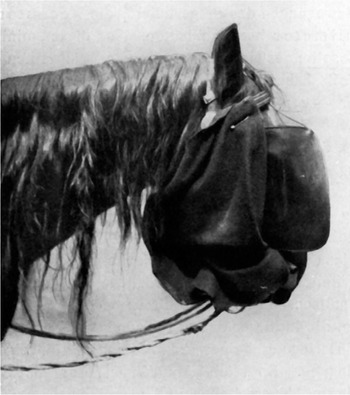
This task was soon taken up by Karl Krall, a jeweler from Wuppertal who had sought out Wilhelm von Osten in May 1905, at a time when Clever Hans was no longer a big attraction after the release of the committee’s report. Following these initial experiments with Hans, and after Pfungst’s report was published in 1907, Krall began carrying out another comprehensive, protocolled, and witnessed series of experiments, in which Hans was fitted with a large blinder in order to rule out any optical signaling (fig. 2) and to exclude this channel of communication if at all possible.
Karl Krall, Clever Hans with blinder (Krall Reference Krall1912, 6).

Krall repeated the experiments initiated by Stumpf’s committee because Osten felt that Stumpf and Pfungst had been the ones to “train Hans to respond to signs and thus spoil him for a long time” (Krall Reference Krall1912, 7). Over time, Krall succeeded in familiarizing Hans with the blinders, after which time he once again correctly mastered the required exercises. In this second series of experiments with the same horse, the focus was now once again on channels of communication, this time with the initial goal of ruling out any kind of visual communication. To this end, in addition to Hans’s cultural-technical abilities, his sensory perception was also tested again. Contrary to the Stumpf committee, Krall came to the conclusion that “a clear understanding between human and animal with regard to its perceptual state is possible” (ibid., 53). He then even taught Hans geometry, physics, and aesthetics, “in order to determine his own ‘aesthetic’ assessment of pictures and objects” (ibid., 59).
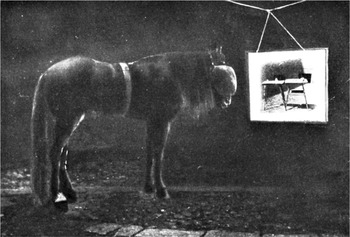
After the death of Wilhelm von Osten in 1909, ownership of the horse was transferred to Krall, who took Hans to Wuppertal so as to integrate him into his various projects with other animals, which were already taking place. These experiments eventually became quite famous as the “Horses of Elberfeld” mentioned by Warren Weaver. The previous year, Krall had already started a series of lessons with the two aforementioned horses named Muhamed and Zarif, which he protocolled in order to “provide a detailed development history of the lessons from the very beginning” (Krall Reference Krall1912, 90) and thus also to counter the research report drawn up by Oskar Pfungst. Instead of direct contact with the horses, here Krall employed media technology, for instance he developed “the option of successfully using the photograph in animal lessons” (ibid., 59) (fig. 3). In his lessons, Krall also implemented the cinematograph, the gramophone, and the telephone so as to avoid any direct contact between horse and experimenter if at all possible and to define only a singular mediatic channel of signal transmission. Though the horses utterly failed during the initial experiments with blinders, after a few weeks Muhamed and Zarif “became accustomed to the new experimental conditions and now performed the tasks in the same capacity before, but with blinders” (ibid., 97).
Karl Krall, Clever Hans in front of a screen for slide projection (Krall Reference Krall1912, 58).

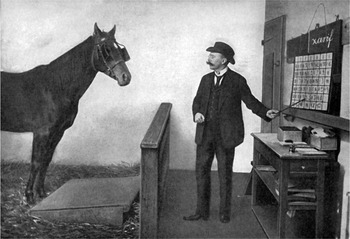
In the “tap-speaking exercises,” Krall experienced how “the horses reproduced the words spoken to them—even those learned orthographically—according to tone color” (Krall Reference Krall1912, 126). This circumstance was described by Krall as “striking proof for the independent thinking of the [equine] pupils, and for this reason any ‘rehearsal’ has been discontinued. Ever since, the horses have been spelling using their own ‘spelling rules’” (ibid., 127). On the basis of free orthography, they were able to independently articulate using both front hooves and a wooden board designed for tapping signs. For example, Zarif responded to this question posed by the groom: “‘Warum sagst du mir das denn nicht mit dem Mund?’ [Why don’t you say that to me with your mouth?]. Zarif: weil ig kein stime hbe [Because I don’t have a voice]” (ibid., 239). In fact, “Muhamed was always especially eager, and it frequently happened that he suddenly stopped spelling a word and tried to speak the sound. While practicing this without being prompted, he then suspended his attempts at speech and started spelling—fully of his own accord—the sentence: ig hb kein gud sdim [I have no good voice]” (ibid., 237–38) (fig. 4).
Karl Krall, Zarif’s instruction in spelling (Krall Reference Krall1912, 182).

Eventually, Krall worked with a blind and anosmic horse by the name of Berto, which he saved from the butcher for the first two and a half years of his life. The idea was to use his successful schooling to put to rest, once and for all, the communication channel for transmitting optical signs, following the experiments with blinders (see Krall Reference Krall1913). There was no chalkboard in the stable from which Berto could learn his numbers. Instead, the numerical value was conveyed to the horse by tapping on his back.
After 14 days he had mastered the concept of numbers up to 9, as well as the three kinds of arithmetic (addition, subtraction and multiplication). On November 13, Berto could calculate two-digit numbers, with the right hoof tapping the first digit and the left hoof the tens. He was also able to recognize the numerals written on his fur (instead of being spoken) by way of touch due to their form, even two-digit numbers and simple arithmetic problems like 3x5, etc. The first instruction in spelling took place on January 29, 1913. Already on February 4, Berto articulated through hoofbeats several of the letters that had been taught to him without any help. On February 13, he spelled out—as had been frequently practiced with him—the answer to the question: ‘Wie heißt Du?’ [What is your name?]—his name without mistakes: b-e-r-t-o. (ibid., 12)
In addition to the witnesses of this schooling—namely, the psychologist Roberto Assagioli and the biologist William Mackenzie—the zoologist Hugo von Buttel-Reepen served as experimenter in December 1912. He ruled out optical signaling in his experiments and consistently received correct tapping signs from Berto, even when there was no groom nearby (see Berg Reference Berg2008, 85–86).
After conducting his experiments over several years with eleven horses, two donkeys, and one elephant (see Berg Reference Berg2008, 90; De Sio & Marazia Reference De Sio and Chantal2014, 95), Krall ultimately considered only two explanations for the communication achievements of his horses to be feasible: “either a ‘connex’ hitherto totally unknown to us, e.g., so-called telepathy, or autonomous thinking activity on the part of the horse” (Krall Reference Krall1912, 8). In 1912, Krall published his opinion in his 500-page book, Denkende Tiere (Thinking Animals), and founded the Gesellschaft für Tierpsychologie (Society for Animal Psychology). The society initially included around forty members (see Berg Reference Berg2008, 97–98) who considered the autonomous thinking hypothesis convincing. Heinrich Ernst Ziegler, a zoology professor at the Technical University of Stuttgart, was elected chairman, while Krall assumed the position of secretary. However, the outbreak of the First World War compelled Krall to discontinue his research and close his schooling stable in 1915. Contrary to a popular anecdote, his talking horses did not end up serving in the German Army on the battlefields of the First World War, but were actually given by Krall to a landowner he knew for use on the estate (ibid., 90).
After his horse school was closed down, Krall decided to set aside his research on “thinking animals” for the most part, and instead became more interested in the first of his two proposed explanations for the phenomenon of talking horses: telepathy. Meanwhile, the communication channel had recently been challenged by Stefan von Máday, who held a critical stance toward Krall and, in the year 1914, not only contested the independent articulation of the horses in his extensive “Entgegnung auf Kralls ‘Denkende Tiere’” (Objection to Krall’s “Thinking Animals”) but also disputed any kind of scientific competence on Krall’s part. Instead of offering further riposte to Máday, Krall chose rather to dedicate his efforts to seeking a further communication channel and, to this end, espoused one of Máday’s main arguments: “Not only did Krall subconsciously train the horses to recognize certain signs that to him—presumably—had remained unknown; he did not merely stay fully ignorant of what brought the horses to understand words and to solve math problems; he likewise did not realize that he had already had the thoughts of the horses before they did” (Máday Reference Máday1914, 450). After the First World War ended, Krall expounded upon this idea that a transmission of his thoughts to the horses must have taken place and created a research program to address it.
Krall’s interest in telepathy actually followed in this regard from his early approach to the work of Wilhelm von Osten and Clever Hans in searching for proof of thought transference between man and animal (see De Sio & Marazia Reference De Sio and Chantal2014, 96; Wolffram Reference Wolffram2009). In the 1920s, he founded the Krallsche Institut für Tierseelenkunde und Parapsychologische Forschungen (Krall Institute for Animal Psychology and Parapsychological Research) with a full laboratory in the south of Munich. This institute was supported by the founder of the Psychologische Gesellschaft (Society of Psychology) in Munich and renowned representative of early twentieth-century German parapsychology, Albert von Schrenck-Notzing (see Sommer Reference Sommer2012). In order to prove the existence of telepathic communication between man and animal, as appeared to manifest especially between dogs in their unspoken accordance with their human caregivers, Krall carried out complicated laboratory tests with the aim of intercepting any kind of “thought radiation” between man and dog (see De Sio & Marazia Reference De Sio and Chantal2014, 99). He published the first results of his research in 1927 and gave a lecture at the third Congrès International de Recherches Psychiques in Paris (see Krall Reference Krall1927).
Lady Wonder
In 1927, the same year that Krall’s parapsychological research was published, a two-year-old horse in Richmond, Virginia named Lady Wonder began learning to count and spell. The mare was given her own typewriter, which she used to type the letters “talking horse” using her muzzle, in order to answer in writing, in a self-referential way, the question of who is speaking. After correctly predicting the outcome of a boxing match between Jack Dempsey and Jack Sharkey, also in 1927, “Lady, the wonder horse of Richmond, Virginia” attracted national interest in the United States. The horse, claimed her owner Claudia Fonda, “could make predictions, solve simple arithmetical problems, answer questions aptly and intelligently, and do all this without verbal command. All that was needed was that the question be written down and shown to Mrs. Fonda” (Rhine & Rhine Reference Rhine and Rhine1929A, 452).
While Lady was paid for answering all kinds of questions, making predictions, and giving personal advice, which ensured the livelihood of her owner, the horse also became the subject of scientific interest, more than twenty years after Clever Hans. This scientific debate focused on the question of whether Lady—as her owner claimed—manifested a new level of communication that had not yet been addressed in the discussion of the talking horse phenomenon. This possibility added to the previous explanatory models of clever animal sensations—trained signaling or independent thinking and calculation ability—by including a third option, which had already been considered by Krall: mind reading.
Lady was promoted as a mind-reading horse. There was special equipment that allowed the horse to spell with her muzzle; she was able to solve simple math problems and even correctly predict the gender of unborn children. Yet in reply to a question posed by a visitor, “How do you like what you do?,” Lady—who at the late horse age of twenty-seven was still required to work and answer three questions for a dollar—gave a clear answer of “Don’t” (Truitt Reference Truitt1952, 21).
The prophesying and mind-reading horse had already been subjected to extensive studies in the winter of 1927–28 by the botanist Joseph Banks Rhine and his wife Louisa Ella Rhine, supported by William McDougall, a professor of psychology from 1927 to 1938 at Duke University in Durham, North Carolina. Their “Investigation of a Mind-Reading Horse” was published in the Journal of Abnormal and Social Psychology in 1929—the year of Karl Krall’s passing.Footnote 6 The Rhines’ studies made direct reference to Krall’s work (Rhine & Rhine Reference Rhine and Rhine1929A, 449–50) and formed an important point of departure for experiments with extrasensory perception (ESP) (see Rhine Reference Rhine1934). As of 1930, these experiments were conducted by J. B. Rhine as assistant for psychology at Duke University and as head of the first parapsychological research lab at a regular university department of psychology, the Department of Psychology at Duke University, established with the strong support of William McDougall, Rhine’s tutor and “the father of the professionalization of modern parapsychology” (Asprem Reference Asprem2010, 125). McDougall lent an academic basis to Krall’s similar project by enabling the creation of a research lab in a regular university department of psychology.
It should be noted that the testing of this talking horse was very important for the creation of this lab, especially because the aspect of parapsychological factors in human-animal communication was introduced by Karl Krall, who possessed no scientific reputation whatsoever. The research question posed by Rhine was therefore adapted to the three hypotheses for explaining the performance of the horses: Could the successful exclusion of signaling be verified while Lady was calculating, predicting, and talking, and could the already known sensory channels for signaling be eliminated?
After a first test series, Rhine concluded: “There is left then, only the telepathic explanation, the transference of mental influence by an unknown process” (Rhine & Rhine Reference Rhine and Rhine1929A, 463). The results “appear to show that Lady does not have a ‘working-knowledge’ of the alphabet, by which most of her work is done, and that in some manner she is directed to the blocks by an external agency” (ibid., 464). In exuberant response to these text results, Rhine wrote a letter to Mrs. Fonda “stating that the animal was ‘the greatest thing since radio’” (Christopher Reference Christopher1970, 43).
In a second test series carried out in December 1928, Joseph B. Rhine and Louisa E. Rhine determined that this external agency could be named because the horse could only read his mind when her owner, Mrs. Fonda, was standing nearby. They concluded that the knowledge of someone present was necessary for successful performance and concluded again that this was a case of mind reading. In a second report, which ended and closed the analysis of Lady, he came to the conclusion “that the telepathic ability we earlier found the horse to possess has been now almost if not entirely lost and that Lady has become merely a trained animal conditioned to a system of signals made up of indicative body movements, voice inflections, whip movements” (Rhine & Rhine Reference Rhine and Rhine1929B, 291). The whole thing was a charlatan trick, he concluded: “When he stood behind F [Mrs. Fonda] and wrote the number on a pad as he had once done with excellent results, there was now complete failure” (ibid., 289).
In the 1950s, when Lady was still reading minds and making prophecies, a professional magician, Milbourne Christopher, visited the horse and had to write a number between one and nine, which the horse was meant to guess. After Claudia Fonda gave him a long pencil and a pad, he had to stand across the room and write any number: “I wrote a 2, which Lady flipped up, then a 1 which Lady gave as 9. I wrote the 2 as anyone would, but when I wrote a 1, I went through the motions of writing a 9 but only touched my pencil to the paper for the downstroke” (Christopher Reference Christopher1970, 44). Since Lady guessed the number nine, he had a clear indication how the trick worked, because Fonda was pencil-reading by observing the motions of the long end of a pencil, and after that the horse guessed correctly what the person had written down. Even though the analysis of how Claudia Fonda and Lady communicated had not yet been finished, the mind-reading performances by the horse had been unmasked, for they were based on a system of signals made up of indicative body movements, voice inflections, and whip movements.
Conclusion
The talking horse experiments impressively show the extent to which the labeling of a person educating these horses as charlatan or the rejection of this ascription respectively depends on whether the effectiveness of certain channels of communication can be verified or ruled out. Experimenting with talking horses demonstrates a kind of switching of communication channels that probes the principally incomplete nature of communication by exploring the potentiality form of transmissions and transmission channels, the substantiation or exclusion of which fundamentally redevelops the semantics of communication symbols. Attempts to verify an existing channel of communication ended up making the horse trainer Claudia Fonda and the elementary school teacher Wilhelm von Osten seem like charlatans, while the attempts to rule out a presumed channel of communication made it possible for the jeweler Karl Krall to consider himself a parapsychologist, just as it allowed the botanist Joseph Banks Rhine to establish parapsychology for the first time at a respected university psychology department. The survey of charlatan practices and talking horse experiments both reference, from their respective perspectives, Warren Weaver’s basic information hypothesis that the word “communication” should be used hereafter “in a very broad sense to include all of the procedures by which one mind may affect another” and that all communication practices involving symbols foster questions concerning the communication channel before they consider semiotic ones.Footnote 7 They make it clear that all forms of communication—including between humans and animals—essentially deal with the determination of the respective communication channel and thus with the substantiation or exclusion of actual communication transmission, in order to then discover the extent at which the semantic and pragmatic levels of communication symbols are determined by this transmission process.
Daniel Gethmann is an associate professor in the Institute of Architectural Theory, History of Art and Cultural Studies at Graz University of Technology (TU Graz). He is the executive editor of Graz Architecture Magazine (GAM) and the chairman of the Curricular Committee for Architecture at TU Graz. His current research interests cover the fields of history of science, media theory, history and theory of cultural techniques, and design theory. His recent book publications include: Feld: Modelle, Begriffe und architektonische Raumkonzepte (Zurich, 2020); Ferdinand Schuster (1920–1972): Das architektonische Werk; Bauten, Schriften, Analysen (Zurich, 2020); Die Enden des Kabels: Kleine Mediengeschichte der Übertragung (Berlin, 2016; with Florian Sprenger).