I would say, as a rough first stab, that kinds are not simply properties or similarities, but more like congeries of properties held together by laws, i.e. clusters of properties co-occurring because they are lawfully connected; and that a kind is real just in case it is independent of how we believe it to be, i.e., the cluster of properties is lawfully connected independently of our classifications. (Haack, Reference Haack2003, pp. 131–132)
Introduction
What kind of things are psychiatric disorders? You would think we should know the answer to this question by now. Psychiatrists have been proposing, evaluating and using psychiatric diagnoses daily for over 150 years. Although this crucial question has been discussed in a philosophically oriented literature read by a modest number of clinicians and researchers (e.g. Meehl, Reference Meehl, Millon and Klerman1986; Cooper, Reference Cooper2005; Murphy, Reference Murphy2006), there remains no consensus as to the best answer.
We begin by outlining three ways of thinking about psychiatric disorders: as essentialist categories, as social constructions, and as practical kinds. Then we introduce a fourth model of kinds for psychiatric disorders, a mechanistic property cluster (MPC) model of kinds. We conclude that practical and MPC kinds are both useful models for psychiatric classification, though the latter is more ambitious. Although the practical kinds model may describe accurately how classifications are developed, it provides limited guidance about how to build a classification. If psychiatry seeks to move toward a causally based classification, in line with most of the rest of medicine, it will be useful to think of psychiatric illnesses as MPC kinds. We complete this essay by exploring the implications and limitations of adopting an MPC view.
Models of kinds
The models for thinking about psychiatric kinds we consider differ from one another along three dimensions. The first is whether kinds exist independently of whether anyone ever categorizes them as such. The second is whether the kinds have essences; that is, sets of features necessary and sufficient for something to count as a member of that kind and from which many identifying characteristics of that kind arise. The third is the utility of the kind, the extent to which recognizing the kind in question helps us achieve our classificatory goals.
Essentialist kinds
In terms of our first two dimensions, essentialist kinds have essences, and they exist whether or not we recognize them. They are indifferent to our psychiatric classifications.
A standard example of an essentialist kind is an element from the periodic table. The putative essence of an element is its atomic number, the number of protons in its nucleus. Take gold. Most important properties of gold (its melting point, malleability, color, and resistance to oxidation) follow lawfully from its atomic number. Furthermore, ‘real’ gold can be identified by checking if that essence is present. Every atom of gold has 79 protons. No atom that is not gold has 79 protons.
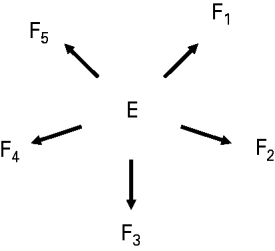
Figure 1 captures a second key feature of the essentialist model, as we understand it here: the emphasis on a single, well-defined etiologic agent. Assume we have a psychiatric disorder, D, with five criteria (F1 to F5) that represent typical clinical symptoms, signs or other features of the illness course such as duration or impairment. Underlying all these features is an essence (E) that is possessed by all individuals with this disorder and no individuals without the disorder. According to essentialism, other key properties of the disorder are consequences of the underlying essence, which is taken to be something relatively simple and unifying, such as a single DNA mutation or a single infectious agent.
An essentialist model for a psychiatric disorder in which an essence (E) is directly and causally responsible for all of the key defining features of the disorder (labeled F1 to F5).

Philosophers of biology have long recognized that essentialism is ill suited to describing biological phenomena. One problem is that developing and evolving organisms vary too much from one to the next (at levels from social organizations down to molecular interactions) for the concept of an ‘essence’ to be very useful. Evolution acts on a population of variants. Genetic and environmental variation act through development to produce different phenotypes across members of a species (Boyd, Reference Boyd and Wilson1999; Wilson et al. Reference Wilson, Barker and Brigandt2007). This diversity and flexibility makes the idea of essential traits in the biological realm, at best, an idealization.
A second problem with essentialism as we have described it is that essentialism assumes a single and simple causal agent. The modern causal concept of medical disease, associated with Koch's postulates, exhibits this feature of essentialist thinking. This concept takes anthrax and tuberculosis as paradigm cases for all diseases; each disease is to be explained by its own invading microorganism (Evans, Reference Evans1993; Carter, Reference Carter2003). Early advocates for the bacterial theory of disease, for example, assumed that a different microorganism would define each kind of illness (Carter, Reference Carter2003). This essentialist model of disease was later applied to other conditions, most notably nutritional deficiency diseases, parasitic and viral infections, and classical Mendelian genetic disorders (Carter, Reference Carter2003).
As western medicine has come to focus more on chronic diseases, such as atherosclerosis, hypertension and autoimmune diseases, the simplifying tendency of essentialist thinking has begun to reveal its limits. Although some diseases have been found that result from single etiologic factors (e.g. Mendelian defects in cholesterol metabolism leading to very early onset atherosclerosis), further research has revealed that, for the large majority of individuals affected with these conditions, the illness arose from a wide range of genetic, metabolic, behavioral and environmental risk factors.
In the 19th and early 20th centuries, the successful demonstration of a single infectious etiology for general paresis of the insane led to the idea that single, discrete causes might exist for other major psychiatric disorders. Over a century of increasingly sophisticated neurobiological research has failed to fulfill this vision. This outcome was anticipated by two eminent German psychiatrists. In 1912, Alfred Hoche wrote:
The main example of a happy final definition of disease conditions, which in all directions constantly prove to belong together, has been progressive paralysis. The success achieved here has perhaps been a misfortune in its side effects because it nourished the illusion that something similar might soon be repeated. (Sass, Reference Sass2007, p. 139)
In 1959, Kurt Schneider reviewed the same subject with a similar conclusion:
General paralysis was the first psychiatric disease entity to be found … [and] became the model for forming disease entities. It was thought it would continue thus, it was hoped that with time more and more such disease entities would emerge from the multifarious conditions of the mentally ill. In fact, however, this did not happen … (Sass, Reference Sass2007, p. 428)
Current evidence suggests that, like other common disorders in the industrialized world, psychiatric disorders have numerous different causes that are probabilistically related to signs and symptoms. Genes, for example, are poor candidates for the essences of psychiatric disorders. Genetics research has thus far failed to uncover genes of large or even moderate effect size for any of the major psychiatric disorders (Kendler, Reference Kendler2005; International Schizophrenia Consortium, 2009; Shi et al. Reference Shi, Levinson, Duan, Sanders, Zheng, Pe'er, Dudbridge, Holmans, Whittemore, Mowry, Olincy, Amin, Cloninger, Silverman, Buccola, Byerley, Black, Crowe, Oksenberg, Mirel, Kendler, Freedman and Gejman2009).
The features by which we classify a case as a member of a given kind are also interdependent to such an extent that it is impossible to pick out any one of these or any subset among them as fundamental to the kind in question. Consider basic biological processes. Risk genes work in cells that are parts of physiological systems that shape behaviors and environments (Kendler & Baker, Reference Kendler and Baker2007), all of which, at all of these levels, feed back to influence genetic regulation and protein expression. To label one of these highly interdependent factors fundamental to the disorder would be an act of fiat rather than a reflection of the causal structure of the disorder itself.
For these reasons, essentialist models of kinds are unlikely to be useful in our efforts to classify psychiatric illnesses. What is needed is a scientific model of classification that accommodates variability in members of the kind, multiple etiologies, and probabilistic interactions between causes and outcomes.
Socially constructed kinds
In our introductory quote, Susan Haak notes that, ‘a kind is real just in case it is independent of how we believe it to be.’ Humans may discover such kinds, but they do not produce them through the act of classifying them. By contrast, according to social constructionism, psychiatric kinds are brought into being by cultures and societies through the act of categorizing them as specific kinds. For example, a constructionist analysis would claim that melancholia in the 17th century and major depressive disorder in the 21st century should be seen as different disorders because they are conceptualized differently in different times and cultures.
Most people would agree that social factors play causal roles in the etiology of psychiatric disorders. Culture influences the experience and reporting of symptoms of depression just as poverty influences the incidence, presentation and outcomes of AIDS. We also accept that disorder concepts are created within cultures to serve social purposes.
In our view, classifications should seek common biological, psychological and social factors that warrant extrapolation across cultural and historical contexts without particular reverence to classificatory schemes of a given age or place. Key psychiatric disorders such as schizophrenia, for example, present similarly across cultures (Jablensky et al. Reference Jablensky, Sartorius, Ernberg, Anker, Korten, Cooper, Day and Bertelsen1992), and etiologic factors, such as genes, play similar roles in disorders studied in different cultures (Kendler, Reference Kendler1983; Sullivan et al. Reference Sullivan, Neale and Kendler2000; Kendler et al. Reference Kendler, Gatz, Gardner and Pedersen2006). The fact that disorders manifest differently across social contexts is not, by itself, an argument that there are no common underlying mechanisms in the distinct cases. That is, we deny that psychiatric kinds have as the basis of their existence only the fact that a particular culture finds them worth distinguishing.
Practical kinds
In our typology of models of kinds, essentialist and social constructionist approaches stake out stark choices along the first two of our dimensions. Essentialists advocate a view of kinds that is independent of human classificatory practices. Constructionists articulate a vision in which the nature of a kind cannot be understood apart from the social and cultural networks in which it is embedded.
The practical kinds model emphasizes the third dimension. Advocates of the essentialist model of kinds believe that nature has joints at which it can be carved. Such joints are discovered through scientific work, not created by fiat. Pragmatist philosophers, such as James (Reference James1907) and Dewey (Reference Dewey1925), and many scientists have less ambitious aims for science (Van Fraassen, Reference Van Fraassen1976). In their view, the constructs of science are tools or instruments that help us achieve important goals. They are judged in terms of practical success, not in terms of correspondence to a reality that exists independently of our theorizing about it.
Imagine you inherit a library of 20 000 volumes. You have to organize your new library. You could classify the books by author, color, size, subject or title. There is no ‘true’ classification for these books out there in the world to be discovered. There are many possible taxonomies and different possible uses for which one or the other will be the best classification. The question becomes not which possible classification of the books is the ‘correct’ one, but which will be most useful for our purposes.
The practical kinds view embodies an instrumentalist approach to science. If, by diagnosing someone with a psychiatric disorder, we can describe how they will behave, detail how they came to be that way, integrate the disorder category with well-tested theories in genetics, physiology and cognitive science, and also cure the disorder, then, the pragmatist insists, nothing important is added by claiming: ‘in addition to all that, the disorder is real’ (Fine, Reference Fine and Leplin1984).
Zachar, in particular, has defended this ‘practical kinds’ approach to psychiatric disorders (Zachar, Reference Zachar2000, Reference Zachar2003, Reference Zachar, Kendler and Parnas2008; Zachar & Kendler, Reference Zachar and Kendler2007). He argues that classification proceeds by determining which categories best help us meet scientific and professional goals, such as reliable diagnosis, prognostication, treatment selection or identification of genetic risk. How we weigh these goals can often shift, and our view of what counts as a good classification may shift as well. Consequently, there need be no general-purpose classification etched in the structure of the world. Nonetheless, according to this view, once our goals have been fixed (for example, to understand the genetic basis of psychiatric illness), the world constrains how and whether those goals can be achieved (for example, to identify gene sets that maximally predict and discriminate between different psychiatric disorders).
This view of kinds has intuitive appeal. Most psychiatric researchers and clinicians have neither tolerance for, nor need of, metaphysics. They often want to ‘cut to the chase’, focusing on the pragmatic benefits of a diagnostic system. Furthermore, the practical kinds model is congruent with the atheoretical/descriptive approach adopted in DSM-III and maintained in DSM-III-R and DSM-IV. Both the practical kinds model and DSM-III and its successors are pragmatic in nature.
Essentialism is comforting and satisfying because it embraces the possibility that dutiful scientific activity might in fact reveal what things are ‘really’ like. But essentialism, as many philosophers of biology believe, has difficulty accommodating the diversity and flexibility of kinds. Likewise, social constructionism offers a revealing view of how psychiatric symptoms are related to social context, but it neglects insight into the underlying genetic, physiological and psychological factors that are often shared among particular cases.
As an alternative to both essentialism and social constructionism, the practical kinds approach takes what each offers, and does not get sidetracked into debates about metaphysics. The problem is that it also sacrifices any clear advice as to how classifications should be built. Pragmatism enjoins us to build useful theories, but it is agnostic about which kinds of theories are most likely to be useful. Because essentialism and social constructivism are inadequate for the reasons discussed above, such guidance must come from a new conception of how classificatory systems are properly to be built. Such a conception would, it is hoped, contain within it the seeds of scientific progress. The ambitious program of essentialism could be replaced by the effort to understand the complex causal structures responsible for psychiatric disorders. It is to such a model that we now turn.
MPC kinds
The move that we recommend for psychiatry, inspired by the philosopher Richard Boyd (Boyd, Reference Boyd1991, Reference Boyd and Wilson1999; Wilson et al. Reference Wilson, Barker and Brigandt2007), is to shift from the quest for essences of psychiatric kinds among either biological and social facts about the disorders to a quest for the complex and multi-level causal mechanisms that produce, underlie and sustain psychiatric syndromes (Kendler, Reference Kendler2008).
Boyd developed his concept of mechanistic property clusters to describe biological species (Boyd, Reference Boyd1991, Reference Boyd and Wilson1999). (Although Boyd describes these as ‘homeostatic’ property clusters, we find this descriptor somewhat misleading given its developed meaning in physiological contexts, and so substitute the more informative term ‘mechanistic’.) Consider a vast multi-dimensional matrix of the properties of all living mammals. The matrix includes facts about behavior, ecology, genetics and physiology. We would observe more or less stable locations within this matrix populated by current species: grey squirrels, humpback whales, lions, etc. The definition of a species, from a property cluster perspective, ‘depends upon the imperfectly shared and homeostatically related morphological, physiological and behavioral features which characterize its members’ (Boyd, Reference Boyd1991, p. 142). The co-occurrence of these features, in turn, is maintained by the existence of causal mechanisms.
Property clusters do not have simple, deterministic essences. Not all members need overlap in some single set of traits; rather, members are clustered near one another in a feature space because of developmental, evolutionary and physiological causal mechanisms and constraints. In the limit of simplicity and determinacy, MPCs tend toward essences, with properties and mechanisms common to all and only members of the kind. At the other extreme, cluster kinds tend toward constructed or practical kinds, where the boundaries of categories are often defined with respect to the classificatory practices of some interested party.
The MPC view encourages the thought that there are robust explanatory structures to be discovered underlying most psychiatric disorders. However, it cautions us to expect that they will be messy and that it will take hard work and some degree of idealization and abstraction to bring them into focus.
The ‘kind-ness’ of species is not, from an MPC perspective, produced by a defining essence but rather from more or less stable patterns of complex interaction between behavior, environment and physiology that have arisen through development, evolution and interaction with an environment. It is this often complex and intertwined mechanism that produces the imperfectly shared characteristics of the members of a species. Such kinds are more heterogeneous than elements in a periodic table. Unlike all atoms of gold, individual members of a species need not share all their properties. Across the range of a species, some systematic differences may arise in subpopulations in coloration, body weight or food preference. Hybrids can also occur. However, the fuzziness of these boundaries does not detract from their stability.
Now consider a different kind of multi-dimensional matrix, one that reflects human mind/brain states. Here the properties are more diverse than with mammalian species and would include genes, cell receptors, neural systems, psychological states, environmental inputs and social–cultural variables. Only a finite number of fuzzy total mind/brain states exist that are cohesive and temporally stable, some proportion of which represents ‘psychiatric syndromes’.
Members of MPC kinds are not similar merely in their superficial properties (like all the things in refrigerators), but because the co-occurrence of these properties from individual to individual is explained by causal mechanisms that regularly ensure these properties are instantiated together. Indeed, MPC kinds are useful for prediction, explanation and control precisely because the kinds are sustained by causal mechanisms. Such clusters allow us to make projective inferences about the past, present and future on the basis of an item's membership in a kind.
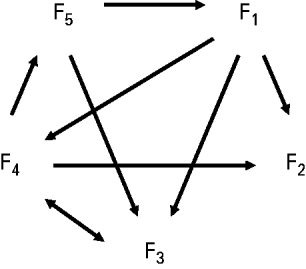
These mechanisms typically span several ‘levels’ (Craver, Reference Craver2007). They might include interactions among the symptoms themselves (Fig. 2). In depression, insomnia predisposes to tiredness, and guilt predisposes to suicidal ideation. In schizophrenia, hallucinations can often produce delusions. Phobias lead to avoidance, which prevents habituation to the feared stimulus. As depicted in Fig. 2, the individual symptoms of psychiatric illness interact so as to sustain the other symptoms characteristic of the illness. Illnesses will thus appear as more or less stable sets of traits, in part because the traits are mutually re-enforcing.
One possibility for a property cluster kind in which individual clinical features (labeled F1 to F5) are causally inter-related to one another. There is no underlying essence that is responsible for the clustering of the symptoms. For example, if the disorder is major depression, suicidal ideation (F2) might be caused by both depression mood (F1) and feelings of guilt (F4).

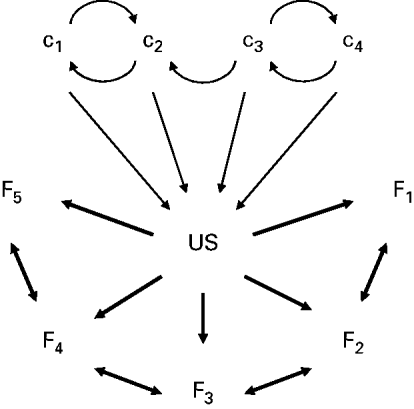
At more basic psychological levels (Fig. 3), Beck & Alford (Reference Beck and Alford2008) describe how the state of depression, through its impact on cognitive biases, can create self-fulfilling negative expectations, which further exacerbate the depressive state. In this case, we have a series of causes (C1 to C4 in Fig. 3) that interact to produce an underlying state (US) that reinforces old symptoms and brings new symptoms into existence over time. The causes in this model could also reflect biological and not psychological processes. (For a view of causation consonant with this view, see Woodward, Reference Woodward2003.) For example, a range of studies has clarified how the continued use of substances of abuse can shift the brain into a different stable state of dependence with a range of resultant changes at biological levels, including receptor function and protein expression (Koob & Kreek, Reference Koob and Kreek2007; Koob, Reference Koob2009; Russo et al. Reference Russo, Mazei-Robison, Ables and Nestler2009).
Another possibility for a property cluster kind in which we have a series of causes (C1 to C4) that interact with each other to produce an underlying state (US) that in turn leads to the individual clinical features (F1 to F5). These causal processes could be psychological or biological. These clinical features in turn could causally interact with each other.

Essentialists and defenders of the MPC view argue that psychiatric kinds are grounded in common features of the causal structure of the world, not merely imposed upon the world by psychiatrists through their classificatory practices. Neither denies that values are intimately involved in determining which psychiatric kinds deserve clinical attention, but each insists that there are more or less general modes of functioning in the human mind/brain and mechanisms that sustain those different modes of functioning. The two differ, however, in several ways. First, the MPC recognizes the potential relevance of many different kinds of cause (evolutionary, developmental, genetic, physiological, psychological, behavioral, social) to defining the kind and to sustaining it as a kind over epochs in a life or in a species. Most obviously, such classifications include underlying etiologic pathways (genetic, physiological and cognitive-affective) but also the overt properties themselves (symptoms for psychiatric illness). No single causal mechanism explains everything that we want to know about the cluster in the way that atomic number and specific pathogens sometimes do. Instead, multiple causal processes contribute to a typical psychiatric disorder (Kendler, Reference Kendler2008). Nonetheless, the identity of the disease across time and across cultures is grounded in the similarity of the complex, mutually reinforcing network of causal mechanisms in each case. Second, the MPC view is explicitly tolerant of probabilistic relationships between relevant causal features and the cluster of overt symptoms. Where essentialists emphasize deterministic causes, we recognize causes that merely change the net risk or probability of a symptom or set of symptoms. Finally, the MPC view allows that the same cluster of symptoms might arise from different etiological, underlying or sustaining mechanisms in different cases. MPC kinds are, in philosophical terms, ‘multiply realizable’ by the mechanisms or sets of mechanisms that produce them.
MPC kinds are defined in part by the mechanisms that underlie and sustain them. This satisfies the intuitions of reductionist psychiatrists. However, in most cases, the stability of these kinds is maintained by mechanisms at multiple levels, including the symptoms themselves, in addition to mechanisms investigated by the molecular, physiological, computational, psychological and social sciences (Kendler, Reference Kendler2008). No one level is likely to capture the full complexity of the mechanisms sustaining or underlying the imperfect cluster of symptoms that characterize our best-codified diagnostic categories. Our prediction is that information about underlying mechanisms will provide new possibilities for classification, but the large number of potentially overlapping mechanisms may mean that there will be no simple and single mapping from mechanism to diagnosis. Other validating factors and clinical utility will probably still be needed to adjudicate nosologic questions.
Whereas the philosophy of biology is the source of the MPC concept, Borsboom (Reference Borsboom2008) advocates a similar approach to psychiatric disorders from a psychometric perspective. He argues, correctly in our view, that traditional factor analytic concepts of psychiatric illness are essentialist in nature, postulating an underlying latent liability to illness (=essence), from which all the symptoms arise. In this model of illness, symptoms are only indices of the underlying liability with all the causal effects (as seen in Fig. 1) going from the essence to the symptoms. Among other viable alternatives, Borsboom particularly advocates for a ‘causal systems perspective’ that is, to all intents and purposes, an MPC model. He writes:
One does not have to do a deep literature search to encounter the not-altogether-implausible idea that, at the level of the individual person, the symptoms [of a psychiatric disorder] are not effects of a common cause at all; rather they stand in direct causal relations to each other. (Borsboom, Reference Borsboom2008, p. 1101)
Psychiatric disorders can best be viewed as ‘sets of symptoms that are connected through a system of causal relations’. Members of essentialist kinds (recall atoms of gold) are expected to be identical, with no one member better representing the kind than any other. Not so for MPC kinds. Imagine a species with a large population at the center of its geographical range and several smaller, distal but still interbreeding, groups inhabiting a variety of different ecosystems. We would expect members of the central group to best typify the species and share more traits with each of the outlying groups than they would probably share with each other. In the same way, we might expect the ‘syndrome’ space in the multi-dimensional matrix of mind/brain states to have a central area containing more prototypical cases and various outlying groups that would share with these cases some, but not all, of the syndromes' features. MPC kinds are thus consistent with a common-sense prototypical model for psychiatric disorders; that for teaching and diagnostic purposes we begin by considering prototypes of syndromes with the expectation that we will confront cases that are less typical in their presentation.
As with species, the expectation is that the boundaries of MPC kinds are fuzzier than with essentialist kinds. This is surely true of psychiatric disorders. As Boyd acknowledges ‘it is agreed that kind definitions must conform to the (sometimes messy and complex) causal structure of the world’ (Boyd, Reference Boyd1991, p. 143).
We are under no illusions that the MPC approach to psychiatric disorders will solve the problems bedeviling psychiatric nosology. In our current state of relative ignorance about the mind/brain, we are far from being able to define plausible stability-producing mechanisms for most psychiatric disorders. The boundaries between these mechanisms may be as confusing as those between the disorders themselves, and the mapping of these mechanisms onto our current clinical syndromes may be anything but pretty. Yet one reason to embrace an MPC conception is that it promises to bring as much order as possible to the complex phenomena in the domain of psychiatry.
The MPC model does not tell us how or whether to privilege one set of mechanisms over another. Which of the diversity of possible causal processes should we emphasize when we construct our nosology? What happens if one set of mechanisms broadly predisposes to a range of syndromes whereas others may be specific to a particular syndrome? For example, how should our classification of dysphoria change if our understanding of brain processes suggested some common mechanisms that predispose to chronic dysphoria but other mechanisms determine whether that dysphoria is experienced more as anxiety than as depression? In cases such as this, appeal to underlying mechanisms may not tell us when to ‘split’ versus ‘lump’ the category. By advocating now for an MPC approach to psychiatric disorders, we are taking out a promissory note on the future of the science of psychiatry – that nosologists will be able to make progress by exploring causal mechanisms. However, by tying our account to the investigation of objective causal structures, we provide prescriptive guidance that practical kinds do not supply, specifically, an injunction to link psychiatric nosology as closely as possible to our emerging knowledge of the causal structures that play a key role in producing, sustaining and (we hope someday) preventing or treating these disorders.
Conclusion
We outline four major approaches to answering the question ‘What kinds of things are psychiatric disorders?’ Essentialist models, while elegant and appealing, are empirically inadequate. Social constructionist models, while containing a grain of truth, leave out facts of biology that are by now undeniably relevant to the course of these disorders. A strong argument could be mounted that, at our current stage of ignorance about the nature and causes of psychiatric illness, we should be humble and accept a practical kinds account, postponing any more ambitious agenda to some vague future date.
The major thrust of this essay is to suggest that we can be more ambitious and make commitments that are bolder than those associated with the practical kinds model. A conditionalized realism about psychiatric disorders (Schaffner, Reference Schaffner1993) is so useful because it forces us to revise our theories when the world tells us that they are wrong. This iterative act of revision proceeds in the most orderly fashion if we take ourselves to be investigating an objective causal structure that is independent of our investigative and instrumental practices (Kendler, Reference Kendler2009). We are not faced solely with the stark choice between essentialism and social construction. The model of MPC kinds is plausible for psychiatry. Defining our disorders at the level of property clusters under-girded by dysfunctional but self-sustaining mechanisms is a practical goal. Indeed, we are seeing early signs of success of uncovering such mechanisms in contemporary research. Although it is perhaps too early to make psychiatric classification fit MPC kinds, such an approach offers the most promising answer to the question of what kinds of things psychiatric disorders are.
Declaration of Interest
None.