




No CrossRef data available.
Semantic and phonological processing in illiteracy
Published online by Cambridge University Press: 01 October 2004
Abstract
Researchers of cognitive processing in illiteracy have proposed that the acquisition of literacy modifies the functional organization of the brain. They have suggested that, while illiterate individuals have access only to innate semantic processing skills, those who have learned the correspondence between graphemes and phonemes have several mechanisms available to them through which to process oral language. We conducted 2 experiments to verify that suggestion with respect to language processing, and to elucidate further the differences between literate and illiterate individuals in the cognitive strategies used to process oral language, as well as hemispheric specialization for these processes. Our findings suggest that semantic processing strategies are qualitatively the same in literates and illiterates, despite the fact that overall performance is augmented by increased education. In contrast, explicit processing of oral information based on phonological characteristics appears to be qualitatively different between literates and illiterates: effective strategies in the processing of phonological information depend upon having had a formal education, regardless of the level of education. We also confirmed the differential abilities needed for the processing of semantic and phonological information and related them to hemisphere-specific processing. (JINS, 2004, 10, 818–827.)
Information
- Type
- Research Article
- Information
- Journal of the International Neuropsychological Society , Volume 10 , Issue 6 , October 2004 , pp. 818 - 827
- Copyright
- © 2004 The International Neuropsychological Society
INTRODUCTION
Recent years have witnessed a growing interest in the cognitive and cerebral correlates of illiteracy. Some investigators have used illiteracy as a naturally occurring brain model of language processing unadulterated by the acquisition of symbolic representation through learning to read and write (Castro-Caldas et al., 1998; Reis & Castro-Caldas, 1997). By studying language processing in illiterates, they have attempted to elucidate the cognitive mechanisms involved in language processing, as well as changes in cerebral organization consequent to attaining literacy.
Researchers studying the cerebral correlates of illiteracy have suggested that learning to read and write in childhood modifies the cerebral organization for language processing in adulthood. Petersson et al. (1998) have found differences in the posterior parietal cortex between literate and illiterate individuals performing a verbal repetition test. Morphological data also support this finding, showing increased size of the corpus callosum between left and right posterior parietal cortices in literate, as compared with illiterate, individuals (Castro-Caldas et al., 1998). The effect of literacy on the function and morphology of the brain, however, remains unclear.
In an attempt to elucidate the cognitive mechanisms involved in language processing among illiterate individuals, Reis and Castro-Caldas (1997) reasoned that, if a particular skill is not learned at a given developmental period, the expression of this ability will be limited in the future. Based on this assumption, they proposed a three-pathway model of language processing, which includes semantic, lexical, and phonological strategies (Castro-Caldas et al., 1998). They described these three pathways as functioning in parallel. While they presumed that the processing of semantic information is innate and does not require training, they suggested that the explicit processing of phonological information depends on the acquisition of symbolic representation. Thus, through learning to match graphemes with their corresponding phonemes, one becomes aware of phonological information, and acquires a visual representation of sound segments (Reis & Castro-Caldas, 1997). Consequently, they concluded that illiterate individuals are limited to lexicosemantic processing, whereas literate individuals have access to a combination of the three pathways, making their efforts more effective (Reis & Castro-Caldas, 1997).
Despite the fact that illiterate individuals generally show no apparent problem with the comprehension and production of words in everyday speech, several studies have demonstrated differences between illiterate and literate individuals in their performance on a variety of neuropsychological tests (Ardila et al., 1989; Lecours et al., 1987; Manly et al., 1999; Matute et al., 2000; Reis et al., 2003). More specifically, a number of studies have shown that illiterates have difficulty with explicit phonological processing (Manly et al., 1999; Morais et al., 1979; Reis & Castro-Caldas, 1997), presumably due to the lack of knowledge of the grapheme-phoneme correspondence that develops through learning to read and write. This lack of phonemic representation may also compromise functions such as working memory (Manly et al., 1999). Working memory is thought to rely on the use of a phonological loop wherein one mentally repeats auditory information long enough to process it (Baddeley et al., 1998). Creating a visual representation of phonological information may enhance the ability to retain it in working memory.
Another area that has received considerable attention recently is that of the influence of level of education on test performance. In fact, level of education has been found to correlate highly with performance on a variety of neuropsychological measures, including word fluency on phonological fluency tests (Cohen & Stanczak, 2000; Crossley et al., 1997; Kempler et al., 1998; Kosmidis et al., 2004; Tombaugh et al., 1999; Tomer & Levin, 1993). The effect of education on these measures appears to be continuous: the more education one has, the better one's performance. Therefore, we wondered if the differentiation made by previous investigators regarding the ability of literates and illiterates to explicitly process phonological information might really be a reflection of the level of education attained, rather than whether or not they had acquired symbolic representation through learning grapheme–phoneme correspondence.
Our goal in undertaking the present study was twofold. On the one hand, we sought to investigate the putative distinction between processing information based on its semantic characteristics versus processing information based on its phonological characteristics in illiterate individuals relative to literate individuals with a low level of education. Semantic processing has been purported to be an innate skill, and, thus, uninfluenced by knowledge of grapheme–phoneme correspondence, whereas explicit processing of information based on its phonological characteristics is considered to be dependent on acquisition of symbolic representation through learning to read and write (Reis & Castro-Caldas, 1997). Since the participants in the Reis and Castro-Caldas (1997) study were either completely illiterate with no formal schooling or had attended, but not necessarily completed, elementary school (their literate group), there was a potential confound of education inherent in their findings. Despite the clear differences between their groups, the extent to which these differences could be attributed to the acquisition of grapheme–phoneme correspondence per se, as proposed by the investigators, or were also influenced by exposure to formal schooling was unclear.
Given the potential confound of formal schooling, we also sought to determine—to the extent possible—its effects on the measures used in the present study by investigating whether any differences in lexical information processing between illiterate and literate individuals might be a function of education. In other words, is the poor performance of illiterates on tasks requiring explicit phonological processing simply a reflection of its negative correlation with the number of years of schooling? Or does it reflect a skill that must be taught? Given the rarity of individuals who are illiterate despite several years of formal schooling, as well as the converse, namely, literate individuals with no formal schooling (i.e., self-taught), we sought to disentangle the effect of formal education on our findings by comparing literate groups and varying the amount of education.
In order to test the model proposed by Reis and Castro-Caldas (1997) and its implications for understanding the effects of literacy or exposure to formal education on the processing of semantic and phonological information, we sought to replicate and extend their findings related to semantic and phonological word fluency. In accordance with the implications of previous investigations, suggesting a qualitative change in lexical information processing once any grapheme–phoneme correspondence had been learned, we defined illiteracy in our study as having no knowledge of any grapheme–phoneme correspondence in individuals who had never attended school.
EXPERIMENT 1—WORD FLUENCY: SEMANTIC VERSUS PHONOLOGICAL WORD PRODUCTION
Several studies have used word fluency tests in studying language processing in illiteracy (Manly et al., 1999; Ostrosky-Solis et al., 1998, 1999; Petersson et al., 2001; Ratcliff et al., 1998; Reis & Castro-Caldas, 1997). Overall, these investigations have reported group differences on both semantic and phonological tasks, with illiterates performing the poorest on phonological word fluency. Only one group of investigators failed to find a literacy group difference on semantic fluency (Petersson et al., 2001; Reis et al., 2003). The authors suggested that this was due to the type of category chosen, namely, supermarket items, which may be less artificial and abstract than the categories most often used, and, thus, more ecologically valid for this population. In fact, the various versions of word fluency tests may not be equivalent in their level of difficulty, with factors limiting performance on any given task being quite different from one population to the next (Ratcliff et al., 1998).
We administered a standardized version of a word fluency test for Greek (Kosmidis et al., 2003, 2004) in order to confirm previous reports of poorer word fluency among illiterates given phonological, rather than semantic, cues. We were primarily interested, however, in investigating potential differences in the cognitive strategies used by each group to perform optimally on these tasks. More specifically, we calculated the average size of clusters of words that are related to a subgroup, a process that appears to be dependent on verbal memory and word storage (Troyer et al., 1997).
We hypothesized that illiterate individuals may have less output than literate individuals for reasons other than difficulty with phonological processing, and an investigation of the strategies used to perform this task might elucidate the nature of the putative differences in language processing. More specifically, we expected that we would find a difference between illiterate/uneducated and literate/low education individuals in output on both the semantic and the phonological tasks. We also expected, that in the case of the semantic test, the two groups would use the strategy of clustering information equally effectively, reflecting an innate ability to use semantic characteristics regardless of formal education. In contrast, we expected that the illiterate/uneducated group would be less able to use clustering strategies based on phonological cues than the literate/low education group, consequent to their lack of phonological awareness. This would indicate a strategic difference between the illiterate/uneducated group and the literate/low education group in lexical processing.
In order to differentiate the effect of level of education versus that of illiteracy or a lack of knowledge of grapheme–phoneme correspondence, we also compared two groups of literate individuals with different levels of education. We expected that the literate/low education group would perform more poorly than the literate/high education group on their output on both tasks, but that they would not differ in their use of cognitive strategies, on either task, thus implicating the influence of symbolic representation rather than that of the amount of education on information processing.
METHODS
Research Participants
Sixty right-handed women volunteered to participate in this study. They were classified into one of three groups based on their educational background. One group comprised 19 completely illiterate women (Mage = 71.95 years, SD = 7.57, range = 63–92). They had never attended school due to socioeconomic reasons (they grew up in a poverty-stricken agrarian society during and after World War II, in which going to school interfered with agrarian responsibilities and was often considered superfluous for girls under the circumstances), but could sign their initials. Their illiteracy was confirmed by a brief test requesting that they identify several graphemes (e.g., letters of the alphabet) and read a short text (taken from a first-grade reading test). None of the illiterate/uneducated participants succeeded on this brief screening device (none could identify any of the printed letters of the alphabet, although some could name a few letters that they had heard before). They all lived in a small Greek town and worked in agriculture. According to their self-report, their illiteracy did not impede their integration into the local community.
In order to control for potential sociocultural differences that might influence performance, we recruited another group of 20 age-matched women (Mage= 69.90 years, SD = 8.91, range = 56–85) from the same community as the first group and who had attended school from 1 to 9 years (Meducation= 5.35, SD = 1.90). The women in the literate/low education group succeeded on the brief screening device mentioned above (all could read the letters of the alphabet as well as a simple text aloud) and reported reading on a regular basis, primarily church texts and popular magazines. Most were employed as maids.
Finally, in order to assess the model suggesting that differences in word fluency performance between literate and illiterate individuals might, in fact, be attributable to level of education rather than exposure to formal schooling per se, we also included a group of 21 more highly educated women (Mage = 61.62 years, SD = 5.04, range = 55–74). These women had progressed beyond the basic level of education (compulsory education in Greece now is 9 years), having attended school for a minimum of 10 years, while some had a university degree as well (Meducation = 13.60 years, SD = 2.56). Since we encountered difficulties in identifying such a group in the same small town and in the same age range as the other two groups, we recruited these participants from a large metropolitan area. All of the women in the literate/high-education group were either currently employed in white-collar jobs or had retired.
Participants in all three groups denied any serious health problems that might affect the central nervous system. Despite their advanced age, we did not test the hearing abilities of any of the participants. Upon observation, none of the participants appeared to have obvious hearing problems nor did any request the experimenter to repeat instructions or test items because she had not heard them. Because the literate/high education group was significantly younger than the literate/low education group [t(39) = 3.684, p = .001], and age has been shown to influence word fluency performance (Kosmidis et al., 2004), we included age as a covariate where appropriate.
Procedure
We administered a semantic and phonological word fluency test that has been used in the Greek population and for which we have developed norms for healthy adults (Kosmidis et al., 2004). On the semantic task, participants produced as many different words as they could belonging to pre-specified categories (i.e., animals, fruit, objects), each within 60 s. Variables of interest on this test were the following: the sum of the words generated for all three categories and the average semantic cluster size for all three categories (clusters were scored when at least three consecutive responses, excluding repetitions or rule infractions, belonged to the same conceptual subcategory; for example, farm animals, winter fruit, furniture. We divided the number of words within a cluster by the number of clusters in each category separately to calculate the average cluster size first, then added the average cluster size of all semantic categories and divided by 3). On the phonemic task, participants produced words beginning with pre-specified letters [i.e., Χ (“chi”), Σ (“sigma”) and Α (“alpha”)], each within 60 s. Since one of the groups was illiterate, instead of naming the letters, we asked all participants to generate words beginning with the sound of each letter (it is not uncommon in Greek to substitute the sound of the letter when indicating a particular letter of the alphabet). Variables of interest were the following: sum of the words produced for each of the three letters and average phonological cluster size for all three letters (clusters were scored when at least three consecutive items began with the same sound based on the first two letters; for example, silk, sift, situation. We then divided the number of words within a cluster by the number of clusters in each category separately to calculate average cluster size, then added the average cluster size of all phonological categories and divided by 3).
RESULTS
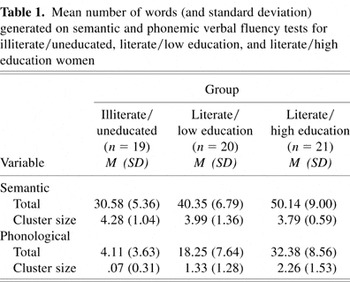
We conducted a multivariate analysis of variance (MANOVA) to compare the performance of the illiterate/uneducated and the literate/low education groups on semantic and phonological word fluency tasks using a 2 (groups) × 2 (tasks) design. Table 1 lists the mean values for each group and task variable. Our analyses yielded an effect of group [Pillai's Trace: F(2,36) = 27.71, p < .001] on both semantic [F(1,37) = 24.71, p < .001] and phonological [F(1,37) = 53.53, p < .001] total word production, whereby the illiterate/uneducated group generated fewer words than the literate/low education group on both tasks. When investigating the strategy of clustering words [Pillai's Trace: F(2,36) = 8.58, p = .001], we found that the illiterate/uneducated and the literate/low education groups did not differ in the average size of the clusters produced on the semantic test [F(1,37) = .56, p > .05]. In contrast, the illiterate/uneducated group created smaller clusters than the literate/low education group on the phonological test [F(1,37) = 17.55, p < .001].
Mean number of words (and standard deviation) generated on semantic and phonemic verbal fluency tests for illiterate/uneducated, literate/low education, and literate/high education women

When investigating the influence of level of education on these processes, we compared the performance of the same literate/low education group to that of the literate/high education group. Whereas the literate/low education group generated fewer words than the literate/high education group on both tasks [MANCOVA covarying for age; Pillai's Trace: F(2,37) = 8.30, p = .001; semantic: F(1,38) = 5.24, p < .05; phonological: F(1,38) = 17.05, p < .001], they did not differ from each other in the use of clustering strategies on either the semantic or the phonological test [Pillai's Trace: F(2,37) = .39, p > .05; semantic: F(1,38) = .04, p > .05; phonological: F(1,38) = .80, p > .05].
DISCUSSION
Our findings of decreased total word production among illiterate/uneducated, relative to literate/low education, individuals are consistent with previous reports of decreased word fluency to phonological, primarily, but also to semantic categories (Manly et al., 1999; Ostrosky-Solis et al., 1998, 1999; Petersson et al., 2001; Ratcliff et al., 1998; Reis & Castro-Caldas, 1997). Since optimal overall performance depends on the effective use of specific cognitive strategies, we also investigated the use of such a strategy by each group. The creation of clusters is dependent on the ability to categorize information based on semantic or phonological characteristics. We found that, as predicted, illiterate/uneducated individuals generated clusters of the same size as the literate/low education group on the semantic test, suggesting that the strategy used for grouping semantic–conceptual information is not dependent on either symbolic representation or exposure to formal schooling, but, rather, reflects an innate human ability. In contrast, the illiterate/uneducated group presented difficulty subcategorizing words based on phonological information: they created smaller clusters than the literate/low education group, suggesting that the strategy used for organizing information based on phonological characteristics is an acquired skill.
In order to disentangle whether the acquisition of strategies to process information based on phonological characteristics is related to literacy (symbolic representation) per se or exposure to formal schooling, we also investigated the effect of the amount of education on word fluency output and cognitive strategies. We compared the literate/low education group with a literate/high education group and found that the former group generated fewer words than the latter group. This pattern was observed on both semantic and phonological fluency tests, and, combined with the aforementioned findings, suggested that total word output is a function of the amount of education rather than of the phonological awareness (symbolic representation) typically attained through formal schooling. In contrast, the two literate groups did not differ in their use of clustering strategies on either task, suggesting that the strategies used to perform the tasks are not a function of education, but, in light of our aforementioned findings, reflect knowledge of grapheme–phoneme correspondence or exposure to formal schooling.
The influence of level of education in the current experiment was noteworthy. As expected, increased education led to increased performance on total word production on verbal fluency tasks. Previous investigators have implied that semantic processing occurs implicitly and naturally, without aid or training, and, consequently, that it should be less affected by low (or no) education (Reis & Castro-Caldas, 1997). In the present study, we replicated the finding of Reis and Castro-Caldas (1997); in fact, in our study, increased education appeared to have improved the effectiveness of processing not only of phonological, but of semantic information as well. The pattern of this finding is therefore consistent with the Reis and Castro-Caldas (1997) model. Our results are also of particular interest because previous studies have reported that education plays a more influential role in phonological, rather than semantic, word fluency (Kosmidis et al., 2004; Tombaugh et al., 1999).
When observing the pattern of the cognitive strategy involved in performing the tasks, however, a different picture emerged. The semantic and phonological tasks yielded a different pattern of group differences. Whereas illiterate/uneducated individuals could rely on their implicit semantic processing strategies to perform the semantic fluency task, when these strategies were not relevant, they were considerably less effective in processing phonological information than the literate/low education group, indicating that the strategies used to process and organize phonological information are qualitatively different from those used in semantic processing. The fact that the performance of the literate/low education group did not differ from that of the literate/high education group on the phonological task, is consistent with the notion of a skill that one has either developed through attaining grapheme–phoneme correspondence or exposure to formal schooling, or has not developed it at all, and would suggest that the processing of information based on its phonological characteristics is not influenced by the level of education attained, but rather, by the acquisition of symbolic representation. Overall, while the putatively explicitly acquired strategies (clustering words according to their phonological characteristics) appeared to either exist or not, implicit strategies (clustering words according to their semantic characteristics) were consistent across all three groups. Thus, the improved word output observed with increasing education might reflect other factors contributing to performance related to formal schooling, namely, increased vocabulary, cognitive efficiency, associative learning skills, motivation when given such artificial tasks, etc.
EXPERIMENT 2—DICHOTIC LISTENING
Dichotic listening tests have been used to study cerebral lateralization for language in illiterates (Castro & Morais, 1987; Damasio et al., 1976; Karavatos et al., 1984; Tzavaras et al., 1981, 1993). Previous investigations have yielded conflicting results: decreased laterality for language among illiterates relative to literates (Joanette et al., 1983) or not (Damasio et al., 1976), or stronger lateralization among illiterates relative to literates (Tzavaras et al., 1981). In an attempt to explain these inconsistent findings, others have discussed the influence of stimulus bias on the effect found (Ahonniska et al., 1993; Castro & Morais, 1987). More recent models of the dichotic listening procedure take into account not only the structural brain areas involved in linguistic processing (left hemisphere areas), but also the functional mechanisms, namely, bilaterally represented attentional resource activity (Reinvang et al., 1994).
Our interest in conducting the current experiment was to investigate differences between illiterate/uneducated and literate/low education individuals with respect to the processing of real words based on their semantic and phonological commonalities. We used a dichotic listening paradigm in order to investigate previous reports of increased reliance on semantic information and decreased phonological processing skills among illiterate/uneducated individuals when processing oral language (Reis & Castro-Caldas, 1997) and to correlate these patterns with information-specific hemispheric processing. Therefore, we designed a novel dichotic listening test that included semantically related and phonologically related word pairs, in addition to the more traditional unrelated word pair format. We were interested in exploring ear advantage for each word pair type and the relationship of putative lateralization differences between individuals who were illiterate/uneducated and those who were in the literate/low education group based on the type of information to be processed. Additionally, we explored the effect of amount of education on this process by also studying the performance of a literate/high education group, relative to that of the same literate/low education group.
METHODS
Research Participants
All participants in the illiterate/uneducated and literate/low education groups that had participated in the previous experiment also participated in the current investigation, but only 15 of the literate/high education group. The latter group was significantly younger than the other two [F(2,51) = 8.16, p < .001; illiterate/uneducated: M = 71.95, SD = 7.57, literate/low education: M = 69.90, SD = 8.91; literate/high education: M = 61.87, SD = 5.00]. Therefore, statistical analyses included age as a covariate where appropriate.
Procedure
Twenty-four sets of frequently used words were presented by audio recording. The words were presented in blocks of three pairs followed by a brief pause. Pairs of words were presented simultaneously, one word in each ear via different channels. During the pause, participants repeated as many as they could of the six words they had just heard. We used word pairs that belonged to one of three categories: semantically related, phonologically related, and unrelated words. Eight sets of words were chosen so that each pair belonged to the same semantic category (e.g., morning /pro-i'/-night /vra'-thi/). Eight sets of words were chosen so that they were similar to each other phonologically (e.g., step /vi'-ma/-verb /ri'-ma/), and eight sets of words were merely matched according to number of syllables (e.g., tongue /glo'-ssa/-monkey /mai-mou'/). We did not attempt to match paired stimuli with respect to frequency, phonemic complexity, or other characteristics. A male actor read the stimuli and recorded them on two separate channels using a Macintosh Powerbook computer. Stimulus pairs were edited so as to match both words for onset and duration of presentation. Each stimulus pair was separated from the next by a 2-s intertrial interval, and each set of three pairs was followed by a 5-s interval, to allow sufficient time for participants to respond. The test was then tape-recorded and administered on a Panasonic RQ-E25V stereo cassette player with Panasonic stereo headphones at a comfortable listening level. During test administration, the headphones were reversed for the second half of the trials in order to control for any imbalance between the two channels. Two sample trials preceded the actual test in order to familiarize participants with the procedure. One variable of interest was the total number of words for each category (i.e., semantic, phonologic, unrelated) repeated correctly, regardless of the ear to which the words were presented (maximum score on each category of paired words was 48). Another variable of interest was the total number of words repeated for each ear for the semantic and phonological categories (i.e., semantic–left ear, semantic–right ear, phonological–left ear, phonological–right ear).
RESULTS
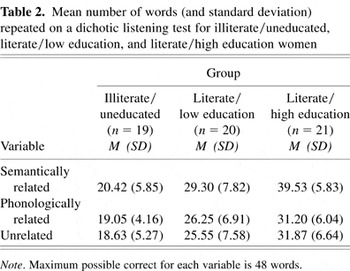
A MANOVA revealed a group effect [Pillai's Trace: F(1,35) = 5.39, p < .005] on all three types of stimulus pairs: semantically related [F(1,37) = 15.98, p < .001], phonologically related [F(1,37) = 15.32, p < .001], and unrelated [F(1,37) = 10.84, p < .005]. Analyses suggested poorer performance in the illiterate/uneducated group relative to the literate/low education group on all types of word pairs.
A comparison of the two literate/educated groups revealed that the literate/low education group performed more poorly than the literate/high education group [Pillai's Trace: F(1,35) = 5.39, p < .005] only on the semantically related word pairs[F(1,37) = 15.98, p < .001]; the two literate/educated groups did not differ from each other on either the phonologically related [F(1,37) = 15.32, p < .001] or the unrelated pairs [F(1,37) = 10.84, p < .005]. This pattern of results, combined with the aforementioned findings, suggests a dissociation between the processing of semantic and phonological information with respect to education: semantic processing appears to be influenced by the level of education attained, whereas phonological processing depends on whether the individual had attained symbolic representation per se or had been exposed to formal schooling.
Additional within subject analyses showed that the illiterate/uneducated group's performance was the same for all three types of word pairs. In contrast, both of the literate/educated groups performed better on the semantically related pairs than on the other types. Table 2 lists the mean performance of the three groups on each type of word pair.
Mean number of words (and standard deviation) repeated on a dichotic listening test for illiterate/uneducated, literate/low education, and literate/high education women

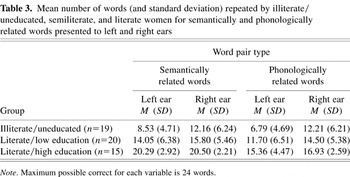
In order to explore the effect of stimulus type on ear advantage addressed in previous studies (Ahonniska et al., 1993; Castro & Morais, 1987), we compared the number of words repeated of those administered to the left ear to those given to the right ear for each group separately, and for the semantically and phonologically related pairs separately (maximum score for each category and each ear was 24). None of the groups showed an ear difference for the semantically related words [illiterate/uneducated: t(18) = −1.706, p > .05; literate/low education: t(19) = −.881, p > .05; literates/high education: t(13) = −.392, p > .05]. In contrast, only the illiterate/uneducated group showed better performance from the right ear as compared with the left ear for the phonologically related word pairs [illiterate/uneducated: t(18) = −2.330, p < .05; literate/low education: t(19) = −1.293, p > .05; literate/high education: t(13) = −1.388, p > .05]. Table 3 lists the mean number of words repeated based on group, task, and ear to which they were presented. When we repeated the analyses covarying for age, however, the only ear advantage found previously disappeared.
Mean number of words (and standard deviation) repeated by illiterate/ uneducated, semiliterate, and literate women for semantically and phonologically related words presented to left and right ears

DISCUSSION
In the present experiment, we found that the illiterate/uneducated group did not benefit from the semantic material in perceiving words presented dichotically: their performance was consistent across the three types of word pairs. Instead, those who did benefit from the semantic information were the two literate/educated groups, with the literate/high education group benefiting the most. Increased education, thus, appears to enhance the ability to utilize semantic associations. In fact, identifying and using associations is a skill often trained during formal schooling in order to retain information. Not surprisingly, this increased effectiveness appeared to increase with the level of education attained. Consequently, only the semantically related word pairs differentiated the three groups. This finding is consistent with the results of Experiment 1, wherein total word production was related to amount of education, as well as with the existing literature (Manly et al., 1999; Ostrosky-Solis et al., 1998, 1999; Petersson et al., 2001; Ratcliff et al., 1998; Reis & Castro-Caldas, 1997). The finding that illiterate/uneducated individuals performed more poorly on the repetition of phonologically related word pairs than the literate/low education group, while the two literate/educated groups did not differ from each other, is also consistent with our conclusions in the previous experiment that phonological processing reflects a skill based on phonological awareness or exposure to formal schooling—not the amount of education attained. The apparent right ear advantage we found among illiterate/uneducated individuals on the phonologically related word pairs appeared to be attributable to reduced left ear processing relative to the other two groups, but also was an artifact of age. The lack of a right ear advantage in all groups, while inconsistent with the literature, may be attributed to the unique nature of our stimuli. Unlike other dichotic listening tests, which utilize unrelated word pairs, digit pairs or syllables (ba, ga, da, etc.), the words in our pairs were related to each other. This may have enhanced the participants' ability to repeat words presented to the non-dominant ear. Finally, we cannot rule out the possibility that hearing problems added error to our measurements, leading to the unexpected lack of an ear effect for any of the participant groups.
GENERAL DISCUSSION
In the present experiments, we sought to elucidate the cognitive mechanisms involved in processing the semantic and phonological characteristics of orally presented information in illiterate/uneducated individuals. More specifically, we tested the proposition that the processing of semantically related material is dependent on an innate skill, and, thus, intact in illiterate/uneducated individuals. In contrast, the processing of phonologically related material, we hypothesized, should be dependent on symbolic representation skills acquired through learning grapheme–phoneme correspondence, and, consequently, undeveloped or inaccessible in illiterate/uneducated individuals. A second goal was to disentangle the potential confound of education inherent in any comparison of illiterates with no formal schooling and literates with formal schooling: which, if any, of the cognitive processes might be a function of education? We approached this question by comparing two groups of literate/educated individuals, one with a low level of education and the other with a high level of education.
In order to answer the two questions we posed, we conducted two separate experiments. Both involved commonly used neuropsychological tests, which, however, were designed so as to differentiate the mechanisms involved in the processing of semantic and of phonological information. In Experiment 1, we explored total word output, as well as one of the cognitive strategies (i.e., clustering) used to perform on semantic and phonological word fluency tasks. In Experiment 2, we used a novel dichotic listening test (using the dichotic stimuli presentation procedure as a paradigm) to compare the groups on the processing of semantically and phonologically related word pairs; we were interested not only in the total number of words repeated for each type of word pair (i.e., semantically related, phonologically related, unrelated), but also potential ear differences in the number of words repeated for each word pair category.
Our findings in Experiment 1 suggested that overall word production on both semantic and phonological word fluency is a function of education. It is consistent with previous findings regarding the strong influence of level of education on phonological processing, and confirms the proposition of Reis and Castro-Caldas (1997) that explicit phonological processing skills must be acquired in order for the innate ability to manifest itself. In contrast to previous studies reporting a greater influence of education on phonological, as compared with semantic, word fluency, the present data also suggested that increased education led to improved semantic word fluency. This improvement could be attributed to formal schooling, which teaches other skills in addition to language processing (e.g., increased vocabulary, effective memory and working memory strategies, abstract thinking skills, increased motivation to perform well, appreciation of the inherent importance of examinations on artificial tasks).
We also investigated the hypothesis that the cognitive strategies used for processing oral lexical information are a function of education. More specifically, we explored the extent to which illiterate/uneducated, literate/low education, and literate/high education individuals utilized semantic and phonological information in order to process oral language explicitly. Our results suggested a twofold pattern: processing of material based on its semantic characteristics reflected abilities that were adequate in illiterate/uneducated individuals, but were augmented by the number of years of schooling. In contrast, explicit processing of the phonological characteristics of material appeared to be acquired with literacy or formal schooling, regardless of the level of education attained: those who had attended school and had acquired symbolic representation could perform the task, but those who had not, did very poorly. Our findings extend the previous model of information processing based on its phonological characteristics (Reis & Castro-Caldas, 1997) by suggesting that the system may be more flexible for processing information based on semantic characteristics as it is enhanced with increased education. Explicit processing of phonological information appears to be a skill that is related to knowledge of grapheme-phoneme correspondence or exposure to formal schooling, and, thus, not influenced by the level of education completed. We could not have reached this conclusion had we only investigated total word production and not one of the cognitive strategies involved in performing each task.
Finally, in Experiment 2 we confirmed the differential abilities needed for the processing of semantic and phonological information and related them to hemisphere-specific processing. Whereas successful repetition of semantically related pairs on the dichotic listening task was a function of education, it was symbolic representation skills or formal schooling that determined performance for the phonologically related pairs, a pattern consistent with our findings in Experiment 1. Moreover, whereas the illiterate/uneducated group repeated an equivalent number of words from both the semantically related and the phonologically related word pairs, both the literate/low education and literate/high education groups were more successful in repeating semantically, as compared with phonologically, related words. The pattern of these findings supports the contention that the processing of orally presented information based on its semantic characteristics is a function of the amount of education attained, whereas the processing of orally presented information based on its phonological characteristics reflects an acquired skill that is unrelated to level of education.
In exploring hemispheric specialization for processing semantic and phonological information, we investigated potential ear effects for the semantic and the phonological word pairs. There were no ear differences for any of the groups on the semantically related pairs, indicating that each of the groups involved both hemispheres equally in processing information based on its semantic characteristics. For phonologically related pairs, there was a right-ear advantage for the illiterate/uneducated group only. This right-ear advantage was produced by the significantly poorer performance on the words heard by the left ear by the illiterate/uneducated group, indicating reduced right hemisphere involvement. It is possible that performance on dichotic listening tasks reflects not only linguistic processing, but also attentional or other cognitive processes, such as matching stimuli, typically mediated by the right hemisphere and augmented by education.
To the extent that performance on words heard by each ear indicates the level of involvement of the opposite hemisphere, then, finding no ear advantage would imply that the contribution of each hemisphere is equivalent for processing the specific type of information. A right-ear advantage, however, would indicate preferential use of the left hemisphere to perform the task. Our findings of a right-ear advantage for the illiterate/uneducated group when processing information based on its phonological characteristics indicated a left-hemisphere preference. This right-ear advantage only in illiterate/uneducated group is consistent with the findings of at least one study reporting stronger lateralization among illiterate/uneducated individuals for dichotically presented digits (Tzavaras et al., 1981). Tzavaras and his colleagues postulated that education reduced the inhibitory influence of the left hemisphere on the right with respect to language processing, thus enabling bihemispheric participation. When we repeated the analyses including age as a covariate, however, the right-ear advantage observed in the illiterate/uneducated group disappeared. In fact, Castro and Morais (1987) have suggested that some of the inconsistent reports regarding hemispheric lateralization in illiterate/uneducated individuals may be attributable to age differences, particularly with respect to the report of a stronger right ear advantage in illiterates (Tzavaras et al., 1981), while others have discussed the influence of stimulus type on findings of ear advantage (Ahonniska et al., 1993).
In evaluating the generalizability of the present findings, we must consider some demographic issues. First, we did not include men in our study samples. While many investigators have reported no gender differences in word fluency, others have found that women outperform men on letter fluency (naming words that begin with specific letters), but not on a measure of semantic category fluency (naming animals) (Kempler et al., 1998). In a normative study conducted in our own lab, women outperformed men only on the category of fruit (Kosmidis et al., 2004). Second, our sample was limited to elderly individuals who had not had the opportunity to attend school for socioeconomic reasons during and shortly after World War II. Under the circumstances, it is unlikely that group differences were due to pre-existing undiagnosed learning disabilities leading to the illiteracy of some; our findings, however, may not generalize to young individuals who are illiterate/uneducated due to socioeconomic reasons. Finally, we did not directly assess the actual literacy level of the literate/educated participants, but used their self-report regarding the number of years of school completed as an indication of their literacy level. It is possible that some individuals may have been either more or less skillful than the average person at each educational level.
Understanding how illiterate/uneducated individuals process lexical information is interesting for several reasons. It is of interest on a basic level for understanding the cognitive mechanisms related to education and brain plasticity. It also might have implications for improving the effectiveness of adult literacy programs, the majority of which have poor success rates. Finally, if illiterate/uneducated individuals process verbal information in a fundamentally different manner than literate/educated individuals, we must take this information into consideration in clinical assessments of dysfunction: it is important to understand their approach to each task—not only to calculate their overall test scores. Given the reported differences between illiterate/uneducated and literate/educated individuals both in overall performance and in the specific cognitive strategies used on the tasks of the present experiments, it is critical that clinicians develop and use separate norms for commonly administered neuropsychological tests when evaluating the former.
ACKNOWLEDGMENTS
This study was funded by a European Commission 5th Framework Programme awarded to the first author. Parts of this study were presented at the 17th Panhellenic Psychiatry Conference in Kallithea, Chalkidiki, Greece and the 30th Annual Meeting of the International Neuropsychological Society, Honolulu, Hawaii, February 2–5, 2003. We would like to thank Dr. Alexandra Reis and the anonymous reviewers for their comments on earlier versions of the manuscript, as well as the volunteers for their participation.
References
REFERENCES
Ahonniska, J.,
Cantell, M.,
Tolvanen, A., &
Lyytinen, H.
(1993).
Speech perception and brain laterality: The effect of ear advantage
on auditory event-related potentials.
Brain and Language,
45,
127–146.Google Scholar
Ardila, A.,
Rosselli, M., &
Rosas, P.
(1989).
Neuropsychological assessment in illiterates: Visuospatial and
memory abilities.
Brain and Cognition,
11,
147–166.Google Scholar
Baddeley, A.,
Gathercole, S., &
Papagno, C.
(1998).
The phonological loop as a language learning device.
Psychological Review,
105,
158–173.Google Scholar
Castro, S.L. &
Morais, J.
(1987).
Ear differences in illiterates.
Neuropsychologia,
25,
409–417.Google Scholar
Castro-Caldas, A.,
Petersson, K.M.,
Reis, A.,
Stone-Elander, S., &
Ingvar, M.
(1998).
The illiterate brain: Learning to read and write during childhood
influences the functional organization of the adult brain.
Brain,
121,
1053–1063.Google Scholar
Cohen, M.J. &
Stanczak, D.E.
(2000).
On the reliability, validity, and cognitive structure of the
Thurstone Word Fluency Test.
Archives of Clinical Neuropsychology,
15,
267–279.Google Scholar
Crossley, M.,
D'Arcy, C., &
Rawson, N.S.B.
(1997).
Letter and category fluency in community-dwelling Canadian seniors:
A comparison of normal participants to those with dementia of the
Alzheimer or vascular type.
Journal of Clinical and Experimental Neuropsychology,
19,
52–62.Google Scholar
Damasio, A.R.,
Castro-Caldas, A.,
Grosso, J.T., &
Ferro, J.M.
(1976).
Brain specialization for language does not depend on literacy.
Archives of Neurology,
33,
300–301.Google Scholar
Joanette, Y.,
Lecours, A.R.,
Lepage, Y., &
Lamoureux, M.
(1983).
Language in right-handers with right-hemisphere lesions: A
preliminary study including anatomical, genetic and social
factors.
Brain and Language,
20,
217–248.Google Scholar
Karavatos, A.,
Kaprinis, G., &
Tzavaras, A.
(1984).
Hemispheric specialization for language in the congenitally blind:
The influence of the Braille system.
Neuropsychologia,
22,
521–525.CrossRefGoogle Scholar
Kempler, D.,
Teng, E.L.,
Dick, M.,
Taussig, M., &
Davis, D.
(1998).
The effects of age, education, and ethnicity on verbal fluency.
Journal of the International Neuropsychological Society,
4,
531–538.Google Scholar
Kosmidis, M.H.,
Bozikas, V.P.,
Vlahou, C.H., &
Karavatos, A.
(2003).
Verbal fluency in institutionalized patients with schizophrenia:
Age-related performance decline.
Manuscript submitted for publication.
Kosmidis, M.H.,
Vlahou, C.H.,
Panagiotaki, P., &
Kiosseoglou, G.
(2004).
The Verbal Fluency Task in the Greek population: Normative data and
clustering and switching strategies.
Journal of the International Neuropsychological Society,
10,
164–172.Google Scholar
Lecours, A.R.,
Mehler, J.,
Parente, M.A.,
Beltrami, M.C.,
Silva, A.B.,
Tolipan, L.C.,
Cary, L.,
Castro, M.J.,
Carrono, V.,
Chagastelles, L.,
Dehaut, F.,
Delgado, R.,
Evangelista, A.,
Fajgenbaum, S.,
Fontoura, C.,
de Fraga Karmann, D.,
Gurd, J.,
Torné, C.H.,
Jakubovicz, R.,
Kac, R.,
Lefevre, B.,
Lima, B.,
Maciel, J.,
Mansur, L.,
Nobrega, M.C.,
Osorio, Z.,
Pasiornic, J.,
Papaterra, F.,
Penedo, M., &
Texeira, M.
(1987).
Illiteracy and brain damage 3: A contribution to the study of
speech and language disorders in illiterates with unilateral brain
damage (initial testing).
Neuropsychologia,
26,
575–589.Google Scholar
Manly, J.J.,
Jacobs, D.M.,
Sano, M.,
Bell, K.,
Merchant, C.A.,
Small, S.A., &
Stern, Y.
(1999).
Effect of literacy on neuropsychological test performance in
nondemented, education-matched elders.
Journal of the International Neuropsychological Society,
5,
191–202.Google Scholar
Matute, E.,
Leal, F.,
Zarabozo, D.,
Robles, A., &
Cedilo, C.
(2000).
Does literacy have an effect on stick construction?
Journal of the International Neuropsychological Society,
6,
668–672.Google Scholar
Morais, J.,
Cary, L.,
Alegria, J., &
Bertelson, P.
(1979).
Does awareness of speech as a sequence of phones arise
spontaneously?
Cognition,
7,
323–331.Google Scholar
Ostrosky-Solis, F.,
Jaime, R.M., &
Ardila, A.
(1998).
Memory abilities during normal aging.
International Journal of Neuroscience,
93,
151–162.Google Scholar
Ostrosky-Solis, F.,
Davila, G.,
Ortiz, X.,
Vega, F.,
Garcia Ramos, G.,
de Celis, M.,
Davila, L.,
Gomez, C.,
Jimenez, S.,
Juarez, S.,
Corte, G., &
Molina, B.
(1999).
Determination of normative criteria and validation of the SKT for
use in Spanish-speaking populations.
International Journal of Psychogeriatrics,
11,
171–180.Google Scholar
Petersson, K.M.,
Reis, A.,
Askelöf, A.,
Castro-Caldas, A., &
Ingvar, M.
(1998).
Differences in interhemispheric interactions between literate and
illiterate subjects during verbal repetition.
Neuroimage,
7,
S217.Google Scholar
Petersson, K.M.,
Reis, A., &
Ingvar, M.
(2001).
Cognitive processing in literate and illiterate subjects: A review
of some recent behavioral and functional neuroimaging data.
Scandinavian Journal of Psychology,
42,
251–267.CrossRefGoogle Scholar
Ratcliff, G.,
Ganguli, M.,
Chandra, V.,
Sharma, S.,
Belle, S.,
Seaberg, E., &
Pandav, R.
(1998).
Effects of literacy and education on measures of word fluency.
Brain and Language,
61,
115–122.Google Scholar
Reinvang, I.,
Bakke, S.J.,
Hugdahl, K.,
Karlsen, N.R., &
Sundet, K.
(1994).
Dichotic listening performance in relation to callosal area on the
MRI scan.
Neuropsychology,
8,
445–450.Google Scholar
Reis, A. &
Castro-Caldas, A.
(1997).
Illiteracy: A cause for biased cognitive development.
Journal of the International Neuropsychological Society,
3,
444–450.Google Scholar
Reis, A.,
Guerreiro, M., &
Petersson, K.M.
(2003).
A socio-demographic and neuropsychological characterization of an
illiterate population.
Applied Neuropsychology,
10,
191–204.Google Scholar
Tombaugh, T.N.,
Kozak, J., &
Rees, L.
(1999).
Normative data stratified by age and education for two measures of
verbal fluency: FAS and Animal Naming.
Archives of Clinical Neuropsychology,
14,
167–177.Google Scholar
Tomer, R. &
Levin, B.E.
(1993).
Differential effects of aging on two verbal fluency tasks.
Perceptual and Motor Skills,
76,
465–466.Google Scholar
Troyer, A.K.,
Moscovitch, M., &
Winocur, G.
(1997).
Clustering and switching as two components of verbal fluency: Evidence
from younger and older healthy adults.
Neuropsychology,
11,
138–146.Google Scholar
Tzavaras, A.,
Kaprinis, G., &
Gatzoyas, A.
(1981).
Literacy and hemispheric specialization for language: Digit
dichotic listening in illiterates.
Neuropsychologia,
19,
565–570.Google Scholar
Tzavaras, A.,
Phocas, C.,
Kaprinis, G., &
Karavatos, A.
(1993).
Literacy and hemispheric specialization for language: Dichotic
listening in young functionally illiterate men.
Perceptual and Motor Skills,
77,
195–199.Google Scholar
Mean number of words (and standard deviation) generated on semantic and phonemic verbal fluency tests for illiterate/uneducated, literate/low education, and literate/high education women
Mean number of words (and standard deviation) repeated on a dichotic listening test for illiterate/uneducated, literate/low education, and literate/high education women
Mean number of words (and standard deviation) repeated by illiterate/ uneducated, semiliterate, and literate women for semantically and phonologically related words presented to left and right ears
 You have
Access
- 55
- Cited by