
Introduction
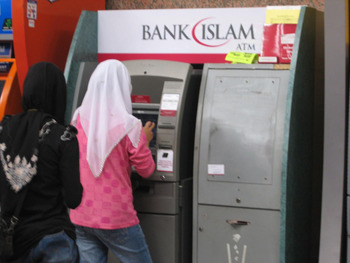
Today, in the streets and public spaces of Malaysia's larger cities, the ubiquity of Islamic finance cannot be missed. As much of the rest of the world recoils in the wake of a financial crisis that spread across the United States and Europe, signs, promotions, and new office towers visually attest to the conspicuous growth of Islamic financial services in the country. Along Kuala Lumpur's main arteries, advertisements seek to lure customers with the Bank Islam credit card that provides “free takaful [a form of Islamic insurance] coverage, low fees, and no compounding finance charges.” Inside the city's massive, ultramodern train station and on the streets outside, eye-catching advertisements for Al-Rajhi Bank, a Saudi Arabian firm that claims to be the world's largest Islamic bank, encourage potential customers to “Get There Fast” with “Al Rajhi Personal Financing.” On the other side of the station, a branch of Kuwait Finance House does brisk business (see figure 1). Malaysian ringgit are readily available at the numerous ATMs owned by over twenty Islamic banks operating in the country, and long lines often form at the terminals during peak commute times and prime shopping hours (see figure 2). Banks and other financial firms across the country have readily sought to develop this market, and Islamic financial institutions are aggressively promoting shariah-compliant credit cards, home loans, and targeted insurance schemes, among other financial instruments.
A Kuwait Finance House branch in KL Sentral train station, December 2012. Photo by Daromir Rudnyckyj.

Customers queue to withdraw funds from a Bank Islam ATM, April 2010. Photo by Daromir Rudnyckyj.

In Malaysia, Islamic finance is big business. An Asian “tiger economy,” Malaysia is a key site in which to comprehend the dynamics of contemporary Islamic finance. The Malaysian state is seeking to forge an integrated Islamic alternative to the conventional financial system that is centered in the financial capitals of North America, Europe, and East Asia. As I will show, Malaysia's ambitions to make its capital, Kuala Lumpur, the “New York of the Muslim world” are the outcome of thirty years of state efforts to promote Islamic finance as an economic and political strategy.
Scholars have drawn attention to grassroots efforts to develop transnational connections through Islam in Southeast Asia (Noor Reference Noor2010; Osman Reference Osman2010). Rather than focusing on such bottom-up efforts, this article argues that Malaysia's plans to become a transnational hub for Islamic finance represent an effort to globalize Islam from the top down, by mobilizing religion to create new economic networks. Scholars have previously shown how Islam was invoked within the space of the nation-state to create an environment conducive to growth and development. I argue that today Malaysia is extending that earlier effort by leveraging Islamic practice to make the country a key center for both flows of capital marked as Islamic and the creation of instruments for Islamic banking. Grounded in ethnographic fieldwork, this article documents the emergence of Islamic finance in Malaysia and highlights how the state has sought to make Islamic finance a critical component of its strategy for future economic growth.
To demonstrate efforts to facilitate a global Islamic financial network through the creation of new financial instruments and technologies, I begin by contextualizing these efforts within the broader contours of Malaysia's colonial and postcolonial political history. I draw special attention to the way in which Islamic finance articulates with the history of ethnic and religious differentiation in the country, and then show how efforts to become a global hub for Islamic finance draw on the way the state has invoked Islam to bolster its developmentalist agenda in the postcolonial period. I then demonstrate how Islamic finance is defined by practitioners in Malaysia and explain the key features they invoke to distinguish it from what they refer to as “conventional finance”. I further note some of the central debates that have developed as experts seek to transform Islamic finance from a disaggregated set of systems based in discrete nation-states to an integrated transnational system which some proponents hope may eventually rival the conventional global financial architecture. Finally, I document how Islamic finance represents a new dimension of Malaysia's development strategy and identify the key steps the state has undertaken to make the country a global center of Islamic finance. I focus not just on state encouragement of private firms but also on strategic investments the state has made to become a leading center for the production of Islamic financial knowledge and the regulation of Islamic financial contracts. I conclude that, as the recent financial crises in Europe and the United States have shaken confidence in Western financial systems, Malaysia is geographically and culturally well-positioned between two rapidly growing regions that are at the forefront of current economic expansion. Efforts to design instruments to facilitate the investment of surplus capital from wealthy Middle Eastern petro-states into centers of industrial production in East and Southeast Asia thus illustrate a continuation of the state's shrewd development strategies in a rapidly changing global economy.
Islamic Finance and the Malaysian Modernity Project
The promotion of Malaysia as a global hub for Islamic finance is part of state strategies to sustain the nation's impressive record of economic development since the early 1970s. In part, efforts to foster the growth of Islamic finance are an outcome of how religion and ethnicity have been integrated into what Aihwa Ong (Reference Ong2006, 77) has labeled “postdevelopmentalism” in Malaysia. Malaysia's current efforts to become a leader in the Islamic world are tied to its colonial and postcolonial history, and reveal the role that Islam has played in what Christine Chin (Reference Chin1998) has called Malaysia's “modernity project.”
Even prior to colonial occupation, Islam served as a key marker of Malay identity (Shamsul Reference Baharuddin2001). Later, after Britain began to expand its occupation of the Malayan peninsula, Islam differentiated the Malay population from migrants from elsewhere in Asia, whose numbers grew rapidly during the nineteenth century as the colonial economy expanded and the demand for labor increased. Due to colonial policies that promoted the transnational movement of laborers from the South Asian subcontinent and what is today southern China for work in the colonial economy, Malaysia became a paradigmatic example of what John Furnivall (Reference Furnivall1948, 304) called “plural societies,” consisting of three main groups, labeled by the British as the Indians, Chinese, and Malays. Colonial rule was premised on a political economy in which subject populations were created through the various technologies of knowledge introduced by the British, such as the census (Hirschman Reference Hirschman1987). Although the three main racial groups produced through what Shamsul (Reference Baharuddin2001) terms “colonial knowledge” were culturally and linguistically heterogeneous, prior to independence in 1957, they were differently incorporated into the colonial economy. Indian workers were mainly plantation or public works laborers, Chinese pursued industrial and entrepreneurial activities, and the Malays were overwhelmingly rural and engaged in either small-scale agriculture or fishing (Chin Reference Chin1998, 41). Harold Crouch (Reference Crouch1996, 15) writes that in 1957 the “working class was overwhelmingly non-Malay” and only one out of five urban residents was Malay.
These divisions, largely created through colonial knowledge, bred resentment, as the Chinese were perceived to have benefited more from the colonial economy and enjoyed better economic standing after the end of British sovereignty compared to the majority Malay population. This resentment culminated in the riots of May 13, 1969, which saw violent clashes in cities across Malaysia between Chinese and Malay groups. For the most part, the conflict was attributed to the fact that many Malays felt “the only ultimate weapon the ordinary Malay had against Chinese wealth was violence or the threat of violence” (Reid Reference Reid1969, 269). In the aftermath of the riots, the state introduced the New Economic Policy (NEP) (Jomo Reference Sundaram1990–91). The NEP had two fundamental objectives. First, it was meant to eradicate poverty and increase economic opportunity for all groups; second, it was meant to accelerate the “process of restricting Malaysian society to correct economic imbalance, so as to reduce and eventually eliminate the identification of race with economic function.”Footnote 1 In practice, as Johan Fischer has noted, the NEP was designed to create an “urban, educated, entrepreneurial and shareholding Malay middle class” (Fischer Reference Fischer2008, 33) known as “new Malays” (Melayu Baru) (Ong Reference Ong2006, 35). The creation of these “new Malays” led to the introduction of affirmative action policies that provided those classified as ethnic Malays with privileged access to resources offered by the state, such as civil service positions, business licenses, government contracts, and access to secondary education (Crouch Reference Crouch1996). These policies have created what Ong (Reference Ong2006, 80) has called “the world's first affirmative action system tied exclusively to ethnicity.” Today, of Malaysia's population of roughly twenty-nine million, the state identifies roughly 67 percent as bumiputra (indigenous or literally “sons of the soil”), 25 percent as Chinese, and 7 percent as Indian (Department of Statistics Malaysia 2010). Most of those classified as bumiputra are further identified as ethnically Malay and are granted special rights by the state in virtue of their claims to be the original inhabitants of Malaysia (Ong Reference Ong1999, 284 n.83). Islam is a central criterion for Malay-ness, and most (although certainly not all) Malaysians of Indian and Chinese descent are non-Muslim.
Malaysia's initial development success stemmed from its position as a global center for high-tech assembly and offshore industrialization in the 1970s and 1980s. With the active encouragement of the developmentalist state, Japanese, American, and European firms set up shop in extensive industrial zones and hired a vast number of new workers to provide the labor for export-oriented growth. Islam was deployed by corporations and the state as a means of disciplining especially the young, female laboring population involved in high-tech assembly (Ong Reference Ong1987). Subsequently, in the 1990s, the state embarked on a series of ambitious development projects (Baxstrom Reference Baxstrom2008), such as the Multimedia Super Corridor (MSC), which was conceived as a hub for the development of information and multimedia technology. The MSC included sites like Cyberjaya, which was intended to become the Silicon Valley of Southeast Asia (Bunnell Reference Bunnell2004).
Islam has played a pivotal role in the state's development strategy, as the state has sought to develop industries and services deemed suitable for an increasingly educated and skilled laboring population. Scholars have noted how the state has strategically deployed Islam to discipline the population and create an environment conducive to economic growth (Mauzy and Milne Reference Mauzy and Milne1983–84). Thus, “government policies seek to bring Islam in line with capitalism” by promoting a form of Islam that is fully compatible with the state's development objectives (Ong Reference Ong1999, 204). The “new Malay” citizen is represented as “self-disciplined, able and wealth accumulating, but in a way that is cast within the precepts of Islam rather than of capitalism.” In this business-friendly endorsement of Islamic practice, “seeking wealth and prestige [are] presented as being in line with Islamic precepts” (Ong Reference Ong1999, 204). Thus, Islam is used to denote ethnic Malays, and the state has promoted a style of Islamic practice that is fully commensurable with capitalism and the state's project of modernization (Sloane Reference Sloane1999).
Today, the state is not only representing Islam as conducive to economic growth, but also cultivating the religion to forge stronger relations with majority Muslim countries in the Middle East, South Asia, and Central Asia. Mahathir Mohamad, who was prime minister during the period in which Malaysia achieved its most impressive economic growth, actively sought to enhance the country's profile in the Muslim world. During Mahathir's tenure (1981–2003), Malaysia assumed an increasingly prominent role in the Organization of the Islamic Conference as well as a range of affiliated institutions and initiatives, such as the Islamic Development Bank, the International Islamic University, and the Islamic Solidarity Fund (Milne and Mauzy Reference Milne and Mauzy1999, 135).
Recently, rising income levels and the emergence of other, lower-wage sites for industrial assembly in East and Southeast Asia (most notably China, Vietnam, and Indonesia) have called into question the export-oriented economic growth paradigm that fueled Malaysia's initial development success. This has precipitated a turn away from export-oriented production and instead toward the provision of services. Indeed, as income and education levels in Malaysia have risen, the state has sought to develop sectors to which its “knowledge-based” population can add value (Evers Reference Evers2003). Malaysia hopes to isolate a particular niche in providing services labeled Islamic, including making the country a global halal food certification center (see figure 3).Footnote 2 The state's most aggressive endeavor in developing a service-oriented sector has been to make the country a global center of Islamic financial services. Thus, the state has sought to construct the infrastructure necessary for Islamic finance to function both domestically and transnationally, promoting research and innovation in Islamic financial instruments and creating some of the premier global institutions for higher education in Islamic finance. This state promotion of Islamic banking furthers its development ambitions, given the changing educational and class composition of the country, which will require new development initiatives to promote ongoing economic growth.
A billboard proclaiming “Malaysia: the World's Halal Center, Together We Can Make it Happen,” April 2010. Photo by Daromir Rudnyckyj.

Delimiting Islamic Finance
Most simply, “Islamic finance” refers to the management of money and the provision of capital in a manner that complies with Islamic prescriptions on economic action (Rosly Reference Rosly2005, 20). However, there is a lack of consensus as to exactly what counts as compliance and exactly what qualifies as economic action that conforms to Islamic prescriptions (Pepinsky, n.d.; Warde Reference Warde2010, 2). Substantial disagreements exist over what constitute acceptable practices and instruments. In this section, I draw on quotations garnered from ethnographic fieldwork among Islamic finance practitioners in contemporary Malaysia to explain how they defined Islamic finance.
Islamic finance experts most often refer to the Qur'anic prohibition against the payment of interest, or what is called riba in Arabic, as the central difference between Islamic finance and what they call “conventional finance.” According to Islamic finance experts, accepting interest is among the most serious sins that are proscribed in the Qur'an and referred to in the hadiths.Footnote 3 The collection of interest would therefore severely impact one's possibilities for otherworldly salvation. As one former conventional banker in Kuala Lumpur—who had in his own words “converted” to Islamic banking—said to me with a smile, “the prophet Muhammad stated that collecting interest is a sin worse than committing adultery [zina] thirty-six times.” This equation was mentioned to me several times by bankers, regulators, and scholars in defining the existential problems confronting those who sought to engage in commerce and simultaneously live according to the prescriptions set forth in key Islamic texts.
In explaining the moral imperative to avoid riba, Islamic scholars trained in the classical disciplines of shariah (Islamic law) and fiqh (Islamic jurisprudence) explain the prohibition on interest by arguing that Islam endorses economic action grounded in “real” (as opposed to speculative) exchanges (Abdul Ghafar Reference Abdul Ghafar2010). Thus, the morality of economic activity is dependent on whether it involves the production or exchange of actual assets or services.Footnote 4 While I conducted fieldwork for this article in the wake of the deepest effects of the financial crisis, many Islamic finance experts attributed the better performance of Islamic financial institutions compared to their conventional counterparts to the fact that they did not partake in speculative investments in money itself, such as mortgage-backed securities and to which the economic crisis and the failure of many conventional financial firms have been attributed (Tett Reference Tett2009).
Restrictions on interest and proclamations that Islam is averse to speculation (maysir) and endorses only those exchanges grounded in real production are often invoked to delimit Islamic finance, according to many experts in the field. However, Islamic scholars and Islamic economists have endorsed other practices as constitutive of Islamic finance as well. These include promoting investments that “share risk” rather than transfer it, avoiding uncertainty, and facilitating ethical investments that enhance social well-being.
Proponents of Islamic finance argue that whereas the debt-based contracts that characterize conventional finance involve the transfer of risk, the preferred contracts in Islamic finance are based on sharing risk between contracting parties. Thus, partnership contracts like musharakah and mudarabah, which date to the time of the prophet and are frequently mentioned in classical juristic texts, are most preferred (Udovitch Reference Udovitch1970, 170–248). These contracts involve profit-and-loss sharing agreements rather than simple money lending (Warde Reference Warde2010, 145–49). For example, a mudarabah is an equity-based contract in which a mudarib and a capital provider enter into a partnership. The mudarib typically has expertise and entrepreneurial acumen, but possesses no capital of his or her own. Hence, the entrepreneur forms a partnership along the lines of the venture capital arrangements that have served as key sources of financing for entrepreneurial endeavors in places like Silicon Valley (Çizakça Reference Çizakça2011, 249–74). Profits generated by the business venture are split between the parties according to a predetermined ratio. However, the party providing the capital bears all financial losses, while the mudarib or investment manager bears the opportunity costs associated with managing the venture.
Promoting risk sharing is not only evident in the redesign of contracts dating to the early history of Islam in order to make them commensurable with the demands of modern financing. Indeed, some of the most creative efforts in contemporary Islamic finance have been to redesign modern institutions to realize the emphasis on partnership, mutual benefit, and risk sharing that is constitutive of Islamic economic action. For example, in late January 2010, at a well-attended lecture hall deep in the recesses of Malaysia's sleek but staid Central Bank complex, I watched as Dr. Abbas Mirakhor (a former director at the International Monetary Fund and one of the world's leading authorities on Islamic banking and finance) presented a bold proposal. With most of the country's key Islamic and conventional bankers and regulators in attendance, including the Central Bank's highest official, Governor Dr. Zeti Akhtar Aziz, Dr. Mirakhor argued that the global financial landscape was changing and that the future would present tremendous opportunities for the industry. In a lecture titled “Paradigm Change in Shaping the Future of Islamic Finance,” Dr. Mirakhor suggested that “after thirty years of development” the next step in the “necessary evolution of Islamic finance” was the establishment of a central location to trade assets. He proposed an Islamic stock market specifically dedicated to the provision of capital for Islamic firms. Dr. Mirakhor justified the need for such a market by citing the low levels of stock market participation in Muslim Southeast Asia, stating, “Malaysia and Indonesia have the lowest risk-sharing parameters in Southeast Asia, but risk sharing is necessary to make Malaysia a hub [of Islamic finance].” He said that a centralized equities market to “trade assets” would be the next step in the “necessary evolution of Islamic finance.” He also noted that a central tenet of Islamic finance was risk sharing, which enables “economic growth and poverty reduction, [and] … the best instrument for risk sharing is a stock market.”
Another characteristic of Islamic finance often invoked by Islamic finance experts is that contracts avoid uncertainty (gharar). The insistence that all contracts be transparent from their initial iteration was made evident to me in courses that I took on Islamic law (shariah) at the International Center for Education in Islamic Finance (INCEIF) in 2010. The professor in the course, Dr. Sharif,Footnote 5 gave an overview of the major contracts used in financial transactions permissible in Islam, including bai salam (a forward sale contract), istisna'a (a manufacturing contract), and ijarah (a leasing contract). In describing the terms and correct execution of each contract, he took great pains to emphasize that all aspects of the contract must be unambiguous and clearly stated. For example, istisna'a is a contract used in exchanging a commodity before it comes into existence, such as when a not-yet-fabricated machine is sold to a buyer for future delivery and entails “an agreement to pay a definite wage or price for the article.” Dr. Sharif explained that an istisna'a transaction is permissible because, although the good does not yet exist, the manufacturer possesses the necessary skills and tools requisite for its production. Dr. Sharif noted that the good had to be “well defined because it does not yet exist.” He said that “the price, quality, genus, and quantity” should all be “clearly stated” in advance. I was initially struck by Dr. Sharif's focus on the precision with which the contract must be articulated: note the focus on a “definite wage or price,” the fact that the good must be “well defined,” and that the characteristics of the good must be “clearly stated.” At first, this seemed a bit trivial and redundant. When, during the break in the three-hour lecture, I asked him why he focused on this, he told me that the reason was to “avoid the slightest tinge of uncertainty”; any uncertainty had the potential to lead to disputes, which would then precipitate conflict and a loss of social harmony.
The final constitutive feature of Islamic finance is facilitating ethical investments that enhance social well-being and avoid objects that are not commensurate with expressions of Islamic piety. This ethical dimension of Islamic finance has led some scholars to compare it to corporate social responsibility movements and specifically socially responsible investing (Pitluck Reference Pitluck, Browne and Milgram2008). Minimally, it includes efforts to direct investment away from objects explicitly prohibited in the Qur'an, such as pork, alcohol, and gambling. More restrictive versions discourage investment not only in activities explicitly prohibited in Islam but also in any sectors that are contrary to Islamic morality, such as certain weapons, entertainment that might depict illegitimate sexuality, or financial activities that might involve the payment or collection of interest.Footnote 6
From National Development to Global Growth
In this section I detail how the Malaysian state has moved from seeking to cultivate Islamic finance nationally to making the country the lynchpin of a globally integrated Islamic financial system. I detail the expansion of the domestic Islamic financial infrastructure in the 1980s and 1990s and conclude with some of the efforts that strategists today have embarked on to make Malaysia a global “hub” for the provision of Islamic financial services.
Islamic Finance and Islamization
By the 1980s, the presumption that development was a secular project underwent a thorough reexamination in Malaysia. In part this was an effect of the 1979 revolution in Iran, which brought Islamists to power in a modern state for the first time (Esposito Reference Esposito1998, 309–10). This event coincided with, and some have argued it gave rise to, a wider resurgence of Islam across Asia and elsewhere in the world (Hefner Reference Hefner2010). Malaysia witnessed an extensive Islamic resurgence in which an Islamist opposition political party, Partai Al-Islam Se-Malaysia (PAS), consolidated political power in the northern state of Kelantan (Jomo and Cheek Reference Sundaram, Cheek, Kahn and Wah1992; Kessler Reference Kessler1978; Muzaffar Reference Muzaffar1987; Nagata Reference Nagata1984). The growing popularity of this party pushed the ruling United Malays National Organization (UMNO) party to more explicitly embrace Islam, especially given the PAS critiques that the UMNO catered to Chinese, Indian, and foreign business interests (Ong Reference Ong1990; Peletz Reference Peletz2002, 10–11). Perhaps most significantly, Mahathir Mohamad, who became prime minister in 1981, initiated a measured rejection of some of the underlying features of modernization and the presumption that the manner in which economic development unfolded in the West was a universal model for developing countries to follow (Beeson Reference Beeson2000). Mahathir invoked Japan as an alternative model of development, embracing so-called “Asian values” and suggesting that Malaysia did not need to abandon its cultural inheritance in pursuing economic growth (Ong Reference Ong1999, 197). As noted above, these factors led to a shift in representing Islam as commensurable with modernity and capitalist development but indeed as conducive to economic growth.
Mahathir's rejection of “western capitalist blueprints” for modernity (Ong Reference Ong1999, 73) meant that a major preoccupation of the state's developmentalism was the creation of a viable financial system grounded in Islamic prescriptions for economic action. Indeed, the Islamic revolution in Iran initiated strong interest in Islamic finance across the Muslim world. In addition to Malaysia, Sudan, Iran, and Pakistan also sought to develop Islamic banking systems in the early 1980s (Warde Reference Warde2010, 114–25). However, unlike those three countries, which sought the wholesale transformation of their banking systems over to full Islamic systems, Malaysia “initiated Islamic banking in parallel with conventional banking on a trial basis” (Venardos Reference Venardos2006, 146). In 1981 the state formed the National Steering Committee on Islamic Banks, consisting of twenty experts who were tasked with outlining the development of an Islamic banking sector (Khiyar Reference Khiyar2005, 204). The committee's recommendations laid the basis for the Islamic Banking Act of 1983 and the establishment that same year of the nation's first Islamic bank, Bank Islam Malaysia Berhad (Laldin Reference Laldin2008, 226–27). Bank Islam operated in accordance with shariah principles as advised by its own Shariah Advisory Council, a body of Islamic scholars endowed with the authority to interpret Islamic sources to ensure shariah compliance under the regulatory supervision of Malaysia's Central Bank, Bank Negara. Furthermore, the Government Investment Act of 1983 allowed for Bank Negara's issuance of Government Investment Certificates (shariah-compliant treasury bills and government bonds), giving Bank Islam and future Islamic banks the opportunity to meet their liquidity requirements in a shariah-compliant manner.
The National Steering Committee had realized that economic action in accordance with Islamic prescriptions would require an integrated, comprehensive financial system consisting of not only banking institutions but also an Islamic money market, Islamic capital markets, and an Islamic insurance system. Following the establishment of the country's first Islamic bank, the state embarked on the creation of an Islamic insurance system. Thus, in 1984 the parliament passed the Takaful Act, which facilitated the establishment a year later of Syarikat Takaful Malaysia, the first takaful operator to provide mudarabah contracts for shariah-compliant insurance on the principle “that nobody should make a profitable business out of the sufferings that naturally befall humanity” (Iqbal and Molyneux Reference Iqbal and Molyneux2005, 57). Analogous to mutual insurance, takaful generally operates as savings accounts on the premise that policy holders agree to insure each other against damage or loss using a company to act on their behalf as trustee of the premium contributions of each participant. The premiums, which are invested in shariah-compliant investments, form the fund from which both claims and any surplus are paid out to policy holders based on prearranged profit-sharing ratios (Iqbal and Molyneux Reference Iqbal and Molyneux2005, 57). A portion of the premiums, known as tabarru', is an obligatory donation representing the mutual assistance premise upon which takaful is based.
Making Islamic Banking National
Islamic finance expanded apace with Malaysia's rapid economic development through the 1980s and early 1990s. Within its first ten years of operation, Bank Islam grew to approximately eighty branches across the country and by 1992 was listed on the main board of the Kuala Lumpur Stock Exchange (Iqbal and Molyneux Reference Iqbal and Molyneux2005, 45). After the establishment of the Islamic banking and insurance sectors, the Central Bank's next phase involved establishing an Islamic securities market in conjunction with Malaysia's Securities Commission. Thus, in 1990 an Islamic debt securities market was created to facilitate the creation and exchange of Islamic bonds (sukuk), in 1994 an Islamic interbank money market was established (facilitating the provision of short-term capital between Islamic banks to enable them to balance their books on a daily basis), and in 1995 an Islamic equity market was formed (Venardos Reference Venardos2006, 153).
To further facilitate the growth of Islamic finance, the Malaysian government sought to build a network of Islamic banking institutions, rather than rely on a single state-supported Islamic bank. The “dual banking system” established in Malaysia “allowed Islamic banking and conventional banking to co-exist side by side” (Venardos Reference Venardos2006, 146). To encourage conventional banks to participate in the Islamic system, in 1993 the Central Bank introduced the Interest-free Banking Scheme.Footnote 7 This program offered tax breaks for conventional banks that opened up Islamic “windows” to offer Islamic financial products, such as home mortgages or savings accounts. Thus, conventional banks could use their existing institutions and infrastructure to expand into Islamic banking on a gradual basis and offer conventional and Islamic financing options under the same umbrella. According to some observers, the Islamic window scheme offered the most cost-effective and efficient way to “disseminate Islamic banking on a nation-wide basis, with as many players as possible so as to be able to reach all Malaysians” (Iqbal and Molyneux Reference Iqbal and Molyneux2005, 46), thus giving Malaysia a competitive advantage in the growth of its Islamic financial sector. Further, by increasing the number of firms in the sector, the state sought to spur innovation of instruments and products.
From Wall Street to Halal Street
Concordant with its development strategy that increasingly encouraged the provision of globally valued services, the Malaysian state established a coordinated effort to aggressively scale up Malaysia's domestic Islamic finance infrastructure to become a transnational hub for Islamic financial services. The state sought to create the institutional infrastructure and regulatory environment to ensure that Malaysia became a central node in the emerging transnational Islamic financial architecture. An explicit goal of these efforts was to provide an alternative to the conventional financial system, which by the end of the first decade of the 2000s was facing its most severe challenge since the 1930s and at times seemed to teeter on the brink of collapse. To become a global hub, the Malaysian state sought to make a number of key interventions in Islamic finance through regulatory reform and clarity, the reduction of ambiguity in Islamic financial services, enhanced research and education regarding shariah, the development of innovative instruments, and the creation of new institutions.
Several regulatory reforms were initiated to reduce ambiguity in Islamic finance. Notably, the existence of Islamic “windows” within conventional banks had raised questions about how institutions organized along such lines could guarantee the separation of their conventional operations from their Islamic banking business. To clarify the distinctiveness of the emerging Islamic economy, in 2004 the Central Bank terminated the Islamic windows program and required conventional banks with Islamic operations to establish full-fledged subsidiaries. Thus, the Central Bank required that Islamic banking operations be distinguished within conventional banks by a clearly demarcated “firewall” (Venardos Reference Venardos2006, 147–48). This entailed the segregation of Islamic from conventional funds, with each segment of the bank's business containing its own individual handling and clearing accounts.Footnote 8 Participants reported that, for the most part, the firewall is enforced. However, some noted that Islamic subsidiaries would occasionally fall back on their “parents” to settle overnight debts, rather than the Islamic money market, which is still embryonic.
Another effort to reduce uncertainty came in seeking to reduce conflicting interpretations of Islamic law. To this end, the 2009 Central Bank of Malaysia Act contained key provisions clarifying the status of the Central Bank's National Shariah Advisory Council (NSAC). These provisions sought to more effectively administer shariah compliance by granting the NSAC the status of the sole authoritative body on shariah matters pertaining to Islamic banking, takaful, and Islamic finance. The act granted the NSAC power to prevail over any other ruling passed by a shariah body in Malaysia. In addition, the act stipulated that any courts or arbitrators are required to refer to NSAC rulings in any dispute pertaining to Islamic financial matters. Finally, the act mandated that any rulings of the NSAC be binding and supersede the rulings of any other shariah body in the country. This essentially gave the NSAC supreme authority in the arbitration of matters connected to Islamic finance.
In addition to questions of regulation and shariah supervisory authority, the state has also sought to create new institutions vital to the functioning of transnational Islamic finance. In 2009, at the behest of Malaysia's Central Bank, the country's stock exchange Bursa Malaysia launched Bursa Suq Al-Sila', a commodity trading platform specifically dedicated to facilitating liquidity management in the Islamic banking system. In so doing, it sought to enable Islamic banks around the world to balance their daily accounts through a sale, rather than through interest-based loans. Using Malaysia's most important agricultural commodity, crude palm oil, as an underlying asset, the exchange enables institutions to comply with shariah restrictions by avoiding interest-based lending. Under a contract known as a commodity murabaha, the exchange enables the circulation of capital through a formal sale of palm oil (Dusuki Reference Dusuki2010).
Another step the state has taken to make Kuala Lumpur a global node for Islamic finance has been to locate key institutions in Malaysia. After a successful lobbying initiative by then prime minister Mahathir, the Organization of the Islamic Conference awarded Kuala Lumpur the headquarters of the Islamic Financial Services Board, an international standard-setting body that develops global standards and guiding principles for Islamic finance, including banking, takaful, and capital markets. This institution seeks “to coordinate bank supervision, promote Islamic finance, and facilitate the integration of the Islamic sector in mainstream finance” (Warde Reference Warde2010, 130).
The Malaysian state has also sought to create other institutions to cement its position as a key Islamic finance center, notably those engaged in the production of Islamic financial knowledge. The Central Bank has spent $200 million to create key research and educational institutions intended to address what has been termed a “knowledge gap” in Islamic finance. This has been primarily used on two key bodies: the International Center for Education in Islamic Finance (where I took courses in shariah and fiqh in 2010) and the International Shariah Research Academy, to which Islamic finance practitioners most often refer by their acronyms INCEIF and ISRA.
Islamic finance experts had long bemoaned the dearth of potential employees with training in Islamic finance and the lack of educational programs to train such professionals. Typically most employees in the industry have been conventional bankers who are then recruited into Islamic financial institutions. This has precipitated critiques by those who allege that such hiring practices threaten the integrity of Islamic banking because such transplants do not always recognize the important differences between the two types of providing credit. For example, the former deputy governor of the Central Bank, Dato' Muhammad Razif, who was responsible for the Central Bank's Islamic finance portfolio, stated, “If you critically review, even in Malaysia, [Islamic finance] has been based on imitation rather than innovation.… Our starting point is compliance, it's not shariah-based. The bankers right now are converts; conventional bankers transformed into Islamic bankers. Of course [their] mind sets are conventional…. My suggestion [is] that banks would employ shariah scholars as bankers” (ISRA 2009). To remedy these problems, the Central Bank founded INCEIF in 2006 and designated it the “global university” for education in Islamic finance. The university offers graduate degrees in fields related to Islamic finance and occupies an impressive new campus close to the national university, the University of Malaya. Students at INCEIF come from around the world: while I was studying there I met students from across Asia, Africa, Europe, North America, and Australia. The goal of the university is to cultivate the human resources necessary to create a critical mass of professionals, skilled in both shariah and finance, to staff Islamic financial institutions around the world. Another effect of this initiative would be to extend the influence of what practitioners call the “Malaysian model” of Islamic finance. Many faculty members were recruited from the International Islamic University outside Kuala Lumpur but come from across the Muslim world.
Another obstacle to the growth of Islamic finance and the global integration of institutions around the world has been a lack of basic research in the field. To remedy this, ISRA was founded by the Central Bank of Malaysia in 2008 to promote applied research on shariah questions in Islamic finance and bridge the gap between critical scholars and more applied bankers and businesspeople. In addition to creating new knowledge, it is also a repository of knowledge for shariah decisions (fatwa) on Islamic finance and examines debates over shariah in the Islamic financial industry both in Malaysia and abroad. A major function undertaken by ISRA is the translation of Arabic documents into English and vice versa, in order to reduce language barriers in the circulation of knowledge in fields pertaining to Islamic finance.
Finally, the state has sought to promote integration of banking institutions and spur growth and innovation by opening its borders to competition from Islamic financial institutions based in the Persian Gulf region. These include Kuwait Finance House; the Saudi-based Al Rajhi Bank; and Asian Finance Bank, which is mostly owned by Qatari investors (Warde Reference Warde2010, 130). The aggressiveness of these institutions is evident in the bold advertisements that they have posted on prominent thoroughfares (see figure 4). Branches of these banks can be found in major cities across the country. Most recently, the Central Bank has floated plans to create a $1 billion mega Islamic bank, and is actively soliciting foreign capital to fund its operations (Sadiq Reference Sadiq2012).
A prominent advertisement for the Saudi-owned Al Rajhi Bank on Jalan Bangsar in southern Kuala Lumpur, December 2012. The slogan reads “Transparent. Honest. Sincere.” Photo by Daromir Rudnyckyj.

Conclusion
This article builds on the work of scholars who identified the way in which Islam was mobilized for Malaysian national development and shows how Islam is being redeployed today as part of a new state development strategy (Bunnell Reference Bunnell2004, 46; Fischer Reference Fischer2008; Mauzy and Milne Reference Mauzy and Milne1983–84; Ong Reference Ong1987, Reference Ong1999). These scholars have shown how the state deployed Islam first to discipline its laboring population and subsequently to create an educated, upwardly mobile middle class. During the 1970s Islam was deployed to subjectify young “factory women” who were leaving their kampungs (villages) for newly established “runaway” factories in Malaysia's new industrial zones to work in high-tech assembly for multinational firms. Fears expressed by religious leaders over changes to social organization, in which these young women were no longer subject to familial supervision by fathers and elder brothers, led the state and multinational firms to embrace a version of Islam that was designed to encourage these women to exhibit moral behavior (Ong Reference Ong1987). Later, in the 1980s and 1990s, the state fostered a style of Muslim practice in which “Islamized norms of self-discipline in the production of the entrepreneurial and professional classes are buttressed by extensive affirmative action benefits in education, employment, and business activities” (Ong Reference Ong2006, 81).
Today the state is extending its efforts to mobilize Islam for development, not only through the discipline and government of citizens but also through creating what one interlocutor referred to as an “Islamic Wall Street.” Thus, it is positioning itself as the center of global financial networks that are structured according to Islamic prescriptions for economic action. It is invoking Islam for development, not just as a national project but to cement a role as a key center for the provision of services with transnational value. This draws on the legacy of mobilizing Islam for creating a self-disciplined and wealth-accumulating citizenry and also scales up these efforts by emphasizing Malaysia's common Islamic heritage with countries in the Persian Gulf region. Given Malaysia's shared Islamic tradition with much of the Middle East and its proximity to the world's fastest-growing export economies in Southeast and East Asia, including China, Indonesia, and Vietnam, the country is well-positioned to become a key broker for flows of Islamic capital between these two regions. High energy prices and the resulting vast amount of surplus capital in the oil- and gas-producing countries of the Middle East have led to the emergence of massive sovereign wealth funds in countries like the United Arab Emirates, Saudi Arabia, Kuwait, Qatar, and Libya. By developing the world's most sophisticated Islamic financial system, Malaysia seeks to become the manager for Islamic investment in the expanding economies of Asia and beyond. Indeed, the economic crisis that continues unabated in the United States and Europe and the massive losses that many investors from the Middle East suffered led many to question the reliability of conventional finance. Thus, state planners seek to emphasize Malaysia's advantageous position, both geographically and culturally, between the two most dynamic centers of global growth today, and Islamic finance offers an opportunity to capitalize on that growth.
Acknowledgments
I am profoundly grateful for all the assistance I received from generous interlocutors in Malaysia for this article. I would particularly like to recognize the support of the International Center for Education in Islamic Finance for facilitating my research in Malaysia. Versions of this essay were presented at the annual meetings of the Association for Asian Studies and the American Anthropological Association. I thank participants in those settings for their generous comments and constructive criticism. In particular, I am grateful for the comments and insights of Dilip Menon, John Osburg, Deborah Davis, Don Emmerson, and Jennifer Munger, who created a generative conversation in which to develop the article. I am grateful for the funding for this research project, which I received in the form of an Insight Development Grant and a Standard Research Grant from the Social Sciences and Humanities Research Council of Canada. This article was further enabled by the research and editorial assistance of Madeline Holden and Basit Iqbal. Any remaining errors of fact or interpretation are my own alone.