INTRODUCTION
Over the past several decades, the topic of gender workplace diversity has garnered much attention among business leaders, scholars, and policy makers across the globe. According to a recent global diversity report (Forbes Insights, 2011), economies throughout the world have been experiencing a growth in women’s labor force participation. This is especially the case for the more highly industrialized economies. Globally, about half of working aged women are employed in the labor force, compared with ~70% of men (United Nations, 2015). A recent report by the McKinsey Global Institute (Reference Mannix and Neale2015) suggests that having women’s labor force participation equal to that of men’s worldwide could increase the overall global economic output by 26%, compared with current employment patterns.
The potential to boost economic returns and address concerns over aging populations, as well as low fertility rates, have led government leaders in some Asian countries to offer business incentives aimed at improving women’s labor force participation. For example, the administration of South Korea’s President Park Geun-Hye has created initiatives to encourage women’s continued employment following childbirth. While women’s overall labor force participation rate in South Korea is around 55%, the rate for younger women (25–29) is nearly 73%, compared with just under 56% for women ages 35–39 (OECD, 2015). A central concern for the Korean government is how to create policies that keep women in the labor force and set them on track for managerial positions. In 2013, women comprised only 10% of managerial positions in the central government, motivating the countries’ administrators to set a target of 15% by 2017 (Lee, Reference Lee2015).
The concerns over a lack of female workplace leadership have led to a growing body of research focusing on the economic benefits of gender diversity. A number of studies have examined the relationship between diversity and organizational performance, with mixed results (Wellalage & Locke, Reference Wellalage and Locke2012; Darmadi, Reference Darmadi2013; Chapple & Humphrey, Reference Chapple and Humphrey2014; Nguyen, Locke, & Reddy, Reference Nguyen, Locke and Reddy2015; Post & Byron, Reference Post and Byron2015; Noland, Moran, & Kotschwar, Reference Noland, Moran and Kotschwar2016; Terjesen, Couto, & Francisco, Reference Terjesen, Couto and Francisco2016). Two different theories suggest opposite predictions for the effect of increasing female workforce/management participation. For example, studies drawing on the knowledge-based and decision-making perspectives have found that diversity in the workplace has a positive influence on organizational performance, that is, labor productivity or financial profit (Watson, Kumar, & Michaelsen, Reference Watson, Kumar and Michaelsen1993; Darmadi, Reference Darmadi2013; Nguyen, Locke, & Reddy, Reference Nguyen, Locke and Reddy2015; Post & Byron, Reference Post and Byron2015; Noland, Moran, & Kotschwar, Reference Noland, Moran and Kotschwar2016; Terjesen, Couto, & Francisco, Reference Terjesen, Couto and Francisco2016). Conversely, some researchers have shown evidence of a negative relationship between diversity and organizational performance, supporting the social identity theory (SIT), similarity/attraction, and homosociality perspectives (Pelled, Eisenhardt, & Xin, Reference Pelled, Eisenhardt and Xin1999; Darmadi, Reference Darmadi2011; Wellalage & Locke, Reference Wellalage and Locke2012; Holgersson, Reference Holgersson2013; Chapple & Humphrey, Reference Chapple and Humphrey2014).
Somewhat surprising, very few studies have accounted for a nonlinear relationship between gender managerial diversity and organizational performance (for exceptions see Richard, Barnett, Dwyer, & Chadwick, Reference Richard, Barnett, Dwyer and Chadwick2004; Richard, Murthi, & Ismail, Reference Richard, Murthi and Ismail2007). Because efforts to increase workplace diversity, particularly at the managerial levels, are likely to create some organizational uncertainties, it is reasonable to expect performance outcomes to vary based on the extent to which such personnel changes have occurred. As previous research has shown, mixed work groups may increase and expand information in ways that can be beneficial to organizational performance (Van Knippenberg, De Dreu, & Homan, Reference Van Knippenberg, De Dreu and Homan2004). However, as optimal levels of diversity are reached, intergroup conflict may interfere with performance and productivity. At higher levels of managerial diversity, knowledge expansion and increased competitiveness may reflect positive performance outcomes (De Carolis, Reference Dean and Snell2003). Thus, in this paper, we develop models to account for a curvilinear relationship between gender diversity and organizational performance, such that low and high, but not moderate levels of diversity positively influence organizational performance. Our use of data over time allows for examination of changes in these relationships and can facilitate causal inference by controlling for certain unobserved characteristics of firms (Greene, Reference Greene2003).
In addition, under the contingency theory, previous studies have found that organizational performance is likely to be influenced by various factors such as environment, industry type, gender supportive culture, or task (Tosi & Slocum, Reference Tosi and Slocum1984; Drazin & Van de Ven, Reference Drazin and Van de Ven1985; Richard et al., Reference Richard, Barnett, Dwyer and Chadwick2004; Richard, Murthi, & Ismail, Reference Richard, Murthi and Ismail2007; Post & Byron, Reference Post and Byron2015; Hoobler, Masterson, Nkomo, & Michel, Reference Hoobler, Masterson, Nkomo and Michel2016). The present study adds to this literature by considering the moderating role of family-friendly policies in the diversity and performance relationship. Because family-friendly policies play a pivotal role in reducing work–family conflict for dual-income households, we anticipate that the relationship between gender diversity in management and organizational performance will be stronger in family-friendly workplaces.
Finally, because far less is known about how varying levels of workplace gender diversity influence organizational performance in Asian countries, we focus on South Korea, where efforts are being centralized to improve and expand women’s employment opportunities. An important aspect of creating gender diverse workplaces is understanding potential performance benefits. As Korean businesses develop strategies to maintain women’s workforce participation following childbirth, the interplay of work-family policies, gender managerial diversity, and performance will likely be of considerable importance.
GENDER DIVERSITY IN THE MANAGEMENT LEVEL AND ORGANIZATIONAL PERFORMANCE
Generally, the early theoretical literature on the relationship between firm-level performance and gender diversity in the workplace falls within two fields (Van Knippenberg & Schippers, Reference Van Knippenberg and Schippers2007; Bell, Villado, Lukasik, Belau, & Briggs, Reference Bell, Villado, Lukasik, Belau and Briggs2011; Van Dijk, Van Engen, & Van Knippenberg, Reference Van Dijk, Van Engen and Van Knippenberg2012; Schneid, Isidor, Li, & Kabst, Reference Schneid, Isidor, Li and Kabst2015). The first field, comprised of ‘knowledge-based research’ and ‘decision-making theory,’ holds that the primary problem facing an organization is how to gain knowledge and bring that knowledge to bear when making decisions (Watson, Kumar, & Michaelsen, Reference Watson, Kumar and Michaelsen1993; Mannix & Neale, 2005). This perspective predicts that diversity increases firm-level production because a diverse workforce brings more perspectives and knowledge sets to bear and can function to ensure that no single perspective or set of knowledge is privileged to the exclusion of others. Firms can integrate specialized knowledge of multiple individuals through socialization, interpersonal communications, and collaboration among polling of groups’ resources, which as a result, leads to a firm’s success (Haythornthwaite & Wellman, Reference Haythornthwaite and Wellman1998; Darmadi, Reference Darmadi2013; Nguyen, Locke, & Reddy, Reference Nguyen, Locke and Reddy2015; Post & Byron, Reference Post and Byron2015; Noland, Moran, & Kotschwar, Reference Noland, Moran and Kotschwar2016; Terjesen, Couto, & Francisco, Reference Terjesen, Couto and Francisco2016). For example, female employees may have different perspectives and experiences from male workers, which contribute to organizational effectiveness.
The second field, known as ‘SIT’, holds that the fundamental problem of an organization is achieving group cohesion (Tsui, Egan, & O’Reilly, Reference Tsui, Egan and O’Reilly1992; Pelled, Eisenhardt, & Xin, Reference Pelled, Eisenhardt and Xin1999). This field predicts that diversity decreases productivity because increasing the differences among group members raises barriers to the cohesion necessary for optimal productivity (Tsui, Egan, & O’Reilly, Reference Tsui, Egan and O’Reilly1992; Pelled, Eisenhardt, & Xin, Reference Pelled, Eisenhardt and Xin1999; Wellalage & Locke, Reference Wellalage and Locke2012; Chapple & Humphrey, Reference Chapple and Humphrey2014). SIT posits that individuals in a demographically homogeneous group work together to achieve a common mission for the organization (Williams & O’Reilly, Reference Williams and O’Reilly1998). It is argued that an individual’s self-concept is determined by their group membership (Hogg & Abrams, Reference Hogg and Abrams1988). Individuals prefer to form relationships within similar social groups, but these homogeneous groups may breed conflict and hamper interaction when paired with members of dissimilar groups in work settings (Bae, Sabharwal, Smith, & Berman, Reference Bae, Sabharwal, Smith and Berman2016). For instance, in a study by Pelled (Reference Pelled1996), gender homogeneity was found to have a positive association with satisfaction and collaboration, but a negative association with relationships and emotional agreement. Research has shown that as gender diversity increases, the tendency is toward social comparison and categorization, with a rise in in-group/out-group formation as well as cognitive bias (Ely & Thomas, Reference Ely and Thomas2001; Richard, Murthi, & Ismail, Reference Richard, Murthi and Ismail2007). Thus, the potential for conflict may reduce organizational effectiveness.
Given the somewhat mixed empirical support for knowledge-based research and decision-making theory, as well as SIT, Van Knippenberg, De Dreu, and Homan (Reference Van Knippenberg, De Dreu and Homan2004) proposed the categorization-elaboration model (CEM) to examine the relationship between diversity and organizational performance. They emphasized the role of information processing systems between diversity and organizational performance. The CEM suggests that diversity engenders a process of information elaboration that leads to an increase in organizational performance (Van Knippenberg, De Dreu, & Homan, Reference Van Knippenberg, De Dreu and Homan2004). However, diversity may also stimulate social categorization, which leads to intergroup biases and the potential reduction of organizational performance. The CEM argues that diversity may have both positive and negative relationships with performance (Schneid et al., Reference Schneid, Isidor, Li and Kabst2015). Palmer (Reference Palmer2006) used the model for predicting a curvilinear relationship between gender diversity and organizational performance.
Previous empirical studies have supported the CEM (Blau, Reference Blau1977; Earley & Mosakowski, Reference Earley and Mosakowski2000; Richard et al., Reference Richard, Barnett, Dwyer and Chadwick2004). For example, Blau (Reference Blau1977) found a curvilinear relationship between group heterogeneity and social association, indicating that social contact is more prevalent in homogeneous groups and highly heterogeneous groups in race and religion. Social contact is increased in homogeneous groups because members of these groups do not have cultural barriers or feel a sense of difference. However, increasing group heterogeneity to a moderate level gives rise to barriers of social intercourse or discrimination. At a high level of heterogeneity in race and religion, discrimination against out-groups would be reduced as minor groups become less prominent, and barriers of social intercourse diminish (Blau, Reference Blau1977: 80).
Richard et al. (Reference Richard, Barnett, Dwyer and Chadwick2004) also found a U-shaped relationship between managerial diversity and productivity. In particular, they showed that in banking firms engaged in acutely innovative behaviors, high levels of productivity were related to low and high diversity in managerial groups, compared with those with moderate levels of managerial diversity. This is consistent with SIT, which explains in-group favoritism and out-group discrimination in diversity at a moderate level. Moderate heterogeneity in management can create barriers within firms, resulting in negative effects on organizational performance. Conversely, high levels of diversity are argued to weaken these barriers (Blau, Reference Blau1977). When an organization is highly diverse, members of its heterogeneous groups are more evenly distributed. This balanced dispersion among group members tends to reduce in-group and out-group identities (Alexander, Nuchols, Bloom, & Lee, Reference Alexander, Nuchols, Bloom and Lee1995).
According to Richard et al. (Reference Richard, Barnett, Dwyer and Chadwick2004), and consistent with knowledge-based theory, knowledge transfer at moderate levels of diversity are impeded due to communication gaps. This constraint of knowledge transfer hinders effective decision-making, resulting in a negative effect on organizational performance (Haythornthwaite & Wellman, Reference Haythornthwaite and Wellman1998). Meanwhile, firms with a low level of diversity show increased interaction and communication among employees, which leads to an increase in organizational performance. Moreover, at high levels of firm diversity, members of heterogeneous groups may provide unique insight, experience, and know-how, triggering competitiveness and enhanced firm performance (De Carolis, Reference Dean and Snell2003).
Van Knippenberg, De Dreu, and Homan (Reference Van Knippenberg, De Dreu and Homan2004) state that both process of information elaboration and social categorization can be used to explain the relationship between gender diversity and organizational performance through the CEM. Empirical studies have also found that the effects of gender diversity on organizational performance may be different according to the degree of diversity in an organization. We postulate that gender diversity within South Korean firms will have a curvilinear association with firm performance, such that low and high, but not moderate levels of diversity positively influence organizational performance (Richard et al., Reference Richard, Barnett, Dwyer and Chadwick2004; Richard, Murthi, & Ismail, Reference Richard, Murthi and Ismail2007).
Hypothesis 1: Gender diversity in management has a U-shaped relationship with organizational performance.
The moderating effects of industry
Given the complex nature of organizations and their environments, contingency theory posits that there is no one best strategy that fits all conditions for organizational performance (Miller & Shamsie, Reference Miller and Shamsie1996). According to the theory, organizational performance is also likely to be influenced by various factors such as environment, industry type, culture, or task (Tosi & Slocum, Reference Tosi and Slocum1984; Drazin & Van de Ven, Reference Drazin and Van de Ven1985). The context in which organizations operate is thus, an important consideration, particularly as it relates to diversity and firm performance.
Drawing from previous research on industry classifications (Jackson, Schuler, & Rivero, Reference Jackson, Schuler and Rivero1989), we argue that a distinction between service-oriented and manufacturing industries may account for fundamental differences in performance outcomes. Bowen and Schneider (Reference Bowen and Schneider1988) suggest that service-oriented firms are more involved with customers in the production and delivery processes. In addition, there is considerable emphasis on human resources to marketing, as well as retaining customers (De Carolis, Reference Dean and Snell2003). Since services are produced mostly by employees and customers, customers of the service industry are considered ‘partial employees’ (Mills & Morris, Reference Mills and Morris1986). Knowledge-based resources are, therefore, of particular significance in the service-oriented industry compared with manufacturing industries (Ali, Kulik, & Metz, Reference Ali, Kulik and Metz2011). Gender diversity in management can reflect the needs of male and female customers and increase interaction with consumers. Accordingly, gender diversity in management is more likely to be advantageous to firms in service-oriented industries compared with manufacturing firms. Consequently, as knowledge-based theory postulates, the positive effects of gender diversity on firm performance is expected to be greater in service industries as a result of the strong reliance on group interactions within firms.
In contrast, employees within manufacturing industries tend to be more isolated from customers and from one another, relative to those of service-oriented firms (Kulonda & Moates, Reference Kulonda and Moates1986; Bowen and Schneider, Reference Bowen and Schneider1988). Manufacturing firms generally attain a competitive advantage in the market through improved technology, facilities and equipment, and a high level of productivity, rather than through market investigation or knowledge-sharing within firms, characteristic of service-oriented firms. Thus, manufacturing employees have low job interdependence and require less interaction with other work groups in a firm (Dean & Snell, Reference De Carolis1991; Frink et al., Reference Frye and Breaugh2003). Further, employees in manufacturing tend to belong to the same social group and have almost no opportunity to interact with other groups, relative to those in service-oriented industries.
Previous studies have examined the relationship between diversity and organizational performance within service-oriented and manufacturing industries. For instance, Richard, Murthi, and Ismail (Reference Richard, Murthi and Ismail2007) found the curvilinear relationship between diversity and productivity to be stronger in service-oriented industries compared with manufacturing. Ali, Kulik, and Metz (Reference Ali, Kulik and Metz2011) also examined whether industry type moderates the relationship between gender diversity and organizational performance, finding positive effects of gender diversity to be stronger in the service sector, whereas negative effects are stronger in manufacturing firms. Similarly, we expect that positive effects of gender managerial diversity will be stronger in service-oriented industries than in manufacturing industries.
Hypothesis 2: The relationship between gender diversity in management and performance will be moderated by industry type, with a significantly stronger curvilinear relationship for firms in service-oriented industries compared with manufacturing.
The moderating effects of alliance networks with other firms
Within the literature, there is no consensus on how to define alliance networks and firm connectedness. Networks or business relationships may be formed based on a number of factors such as cost sharing and risk reduction (Hagedoorn, Reference Hagedoorn1993), acquisition or access to critical resources (Powell, Koput, & Smith-Doerr, Reference Powell, Koput and Smith-Doerr1996), or to combine and/or share resources and knowledge. Of particular interest for researchers investigating the relationship between organizational performance and diversity is the extent to which organizations engage in networks. For example, previous studies have suggested that firms with a larger number of alliance networks connecting them to other firms or partners will be more capable of achieving organizational goals and increasing organizational performance compared with those with fewer connections (Burt, Reference Burt1992; Barkema, Shenkar, Vermeulen & Bell, Reference Barkema, Shenkar, Vermeulen and Bell1997). The reason for this is that firms with a comparatively large number of alliance networks are more likely to be exposed to diverse information and resources (Barkema et al., Reference Barkema, Shenkar, Vermeulen and Bell1997). This valuable information provides a strategic advantage regarding profit opportunities and the possibility to internalize a partner’s know-how (Dyer & Singh, Reference Dyer and Singh1998; Gulati, Reference Gulati1999).
A firm’s capacity, along with its alliance networks, is also an important factor in determining organizational performance (Powell, Koput, & Smith-Doerr, Reference Powell, Koput and Smith-Doerr1996). If two firms possess a similar number of alliance networks, the firm with a larger capacity for utilizing information is expected to outperform the one with a smaller capacity. Even with a large number of alliance networks, if firms do not have the capacity to take advantage of the information, they will not be able to utilize the information and know-how provided by their alliance networks. Thus, this hinders higher organizational performance. Firms need to possess the capacity to assimilate and utilize the necessary information to gain profit (Cohen & Levinthal, Reference Cohen and Levinthal1990). Thus, the effect of a network structure on firm performance is contingent on the firm’s capacity to operate its network resources (Zaheer & Bell, Reference Zaheer and Bell2005).
In this paper, we argue that gender diversity in management increases a firm’s capacity to utilize its alliance network. A management team with heterogeneous members has a broader field of vision compared with a homogenous group, thus developing its capacity to assimilate external information (Hambrick & Mason, Reference Hambrick, Cho and Chen1984; Hambrick, Cho, & Chen, Reference Hambrick and Mason1996). When the level of diversity in management becomes relatively high, members of each group within the organization are evenly distributed, creating active interaction, and communication between alliance networks (Alexander et al., Reference Alexander, Nuchols, Bloom and Lee1995). Thus, we expect that firms with a large number of alliance networks would benefit from gender diversity compared with those with a small number of alliance networks.
Hypothesis 3: Alliance networks moderate the relationship between gender diversity in management and performance such that the U-shaped relationship will be significantly stronger in firms with a larger number of alliance networks.
The moderating effects of family-friendly policies
Frye and Breaugh (Reference Frink, Robinson, Reithel, Arthur, Ammeter, Ferris, Kaplan and Morrisette2004: 206) define family-friendly policies as the ‘degree to which people perceive that their company has policies to personally assist them in integrating their work and family roles.’ Although family-friendly policies tend to vary to some extent across countries and firms, the universal policies examined in the existing literature include employee paid leave, childcare leave, sick leave, parental leave, maternity leave, alternative work schedule, and telework (Selden & Moynihan, Reference Selden and Moynihan2000; Meyer, Mukerjee, & Sestero, Reference Meyer, Mukerjee and Sestero2001; Kim & Wiggins, Reference Kim and Wiggins2011; Lee & Hong, Reference Lee and Hong2011). Scholars have studied the effects of family-friendly policies on organizational performance and have shown that such policies improve a firm’s performance (Kim & Campagna, Reference Kim and Campagna1981; Johnson, Reference Johnson1995; Lawlor, Reference Lawlor1996; Perry-Smith & Blum, Reference Perry-Smith and Blum2000; Selden & Moynihan, Reference Selden and Moynihan2000; Clifton & Shepard, Reference Clifton and Shepard2004; Bae & Goodman, Reference Bae and Goodman2014; Bae & Yang, Reference Bae and Yang2017). For instance, Kim and Campagna (Reference Kim and Campagna1981) found that firms with more extensive family-friendly policies attain higher levels of market performance and growth in profit. Furthermore, in a study using a sample of 527 US firms, Perry-Smith and Blum (Reference Perry-Smith and Blum2000) showed that family-friendly policies enhance performance at the organizational level.
However, the effects of family-friendly policies on organizational performance may vary by gender group (Bae & Kim, Reference Bae and Kim2016). According to gender role theory, male groups are more likely to separate work and family roles compared with female groups (Crosby, 1991; Kossek & Ozeki, Reference Kossek and Ozeki1999). It is argued that female workers, in general, are likely to focus simultaneously on the workplace and household, which may lead them to regard family matters as a source of conflict (Friedman & Greenhaus, Reference Friedman and Greenhaus2000). Particularly, in Korea’s male-oriented society, which has its roots in Confucianism, female workers may find it difficult to balance between domestic work and their careers. Research by O’Neil and Greenberger (Reference O’Neil and Greenberger1994) show that female workers’ well-being tends to be related to social support, not only from their spouses but also from their neighbors, supervisors, and coworkers; in contrast, male workers’ well-being is mainly associated with social support from their spouses.
Based on these previous studies, we expect that the effects of firm gender diversity on organizational performance will be related to the extent that family-friendly policies exist. Because Korean employers are increasingly looking for women to fill jobs vacated by an aging workforce, family-friendly policies are likely to be an important employment recruitment strategy and benefit. Further, such policies are likely to help employers retain female employees, particularly managers, whose jobs tend to be more demanding. Research findings suggest that employees, both women and men, tend to have higher work outcomes, including job satisfaction, decreased burnout and lower turnover intentions when employed by firms supportive of family-friendly policies (Haar & Roche, Reference Haar and Roche2010). This leads us to predict that gender diversity will have positive implications for firms with a large number of family-friendly policies.
Hypothesis 4: Family-friendly policies moderate the relationship between gender diversity in management and performance such that a U-shaped relationship will be significantly stronger in firms with a larger number of family-friendly policies.
METHODS
Sample
Our data set consists of the Korea Workplace Panel Survey (KWPS) dataFootnote 1 , which was collected by the Korea Labor Institute for years 2005, 2007, and 2009. The data consists of the same firms for all 3 years. The Korea Labor Institute, a government-funded policy research organization, collected a nationally represented sample of establishments using a stratified sampling technique. For each year, human resource managers and employee representatives of the organizations with 30 or more employees were asked to respond to a survey comprised of questions regarding human resources management and financial information. We use both the human resource managers’ survey data and financial statistics of organizations. Based on the National Statistical Office standards, the sample of this study includes general private firms, banks and insurance companies, communication services companies, electric and gas companies, and public and state-owned enterprises and excludes agricultural, forestry, fishery, and mining industries (Statistics Korea, 2015). After excluding observations with missing data, we retained 2,118 observations including 870 service-oriented firms and 1,185 manufacturing firms.
Measures
Dependent variables
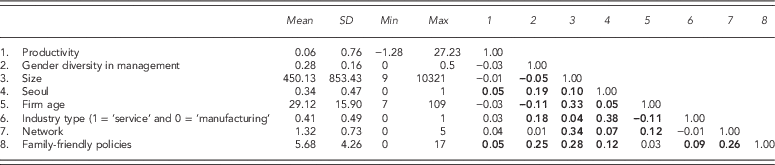
Based on prior gender diversity research (Richard, 2000; Dwyer, Richard, & Chadwick, Reference Dwyer, Richard and Chadwick2003; Richard et al., Reference Richard, Barnett, Dwyer and Chadwick2004; Ali, Kulik, & Metz, Reference Ali, Kulik and Metz2011; Schwab, Werbel, Hofmann, & Henriques, Reference Schwab, Werbel, Hofmann and Henriques2016), organizational performance is measured as labor productivity. Labor productivity is a continuous variable calculated as net firm income per employee. As noted in Table 1, the values for this measure in our data range from −1.28 to 27.23, with a mean of 0.06. Reported values are scaled by dividing by 1,000 for interpretation. Because one of the primary functions of management is to improve employees’ productivity, we expect organizational managerial performance to be closely related to employee productivity.
Means, standard deviations, and correlations

Note. All correlations above the absolute value 0.04 (shown in bold values) are significant at p<.05 for a two-tailed test.
Independent variables
Gender diversity is measured using Blau’s (Reference Blau1977) heterogeneity index with respect to firm management; it captures the distribution of group members across categories. Blau’s index is calculated as 1−Σpi 2, where p is the proportion of group members in a given category and i is the number of different categories, such that a perfectly homogenous group (all male or all female) would be represented by a value of 0, while a completely heterogeneous group would have a score of 0.5. The raw measure, as well as the quadratic form are used, with the latter included capturing the potential curvilinear relationship between gender managerial diversity and organizational performance (see also Richard et al., Reference Richard, Barnett, Dwyer and Chadwick2004; Richard, Murthi, & Ismail, Reference Richard, Murthi and Ismail2007). Gender diversity and the proportion of females in management are not synonymous. For example, a group consisting of 80% females and 20% males and another group with 20% females and 80% males have the same Blau index score. As presented in Table 1, the mean gender managerial diversity for our sample is 0.28, while the actual values range from 0 to 0.50. A test examining the distribution of this measure did not indicate a need for variable transformation (based on skewness).
Moderators
The influence of industry is captured using a dichotomous measure for service-oriented industries (coded as 1) and manufacturing industries (coded as 0), based on Korean Standard Industrial Classification codes. ‘Transportation, Communications, Electric, Gas, and Sanitary Services,’ ‘Wholesale Trade,’ ‘Retail Trade,’ ‘Finance, Insurance, and Real Estate,’ and ‘Services’ are included within the measure of service-oriented industries given their high level of interaction between provider and customers (Ali, Kulik, & Metz, Reference Ali, Kulik and Metz2011). ‘Agriculture, Forestry, and Fishing,’ ‘Mining,’ ‘Construction,’ and ‘Manufacturing’ are classified as manufacturing industries because customers are not deeply involved in the production process (Ali, Kulik, & Metz, Reference Ali, Kulik and Metz2011). As indicated in Table 1, ~41% of the firms in our sample are located in service industries.
Alliance network is measured using responses from five questions included in the KWPS questionnaire pertaining to firm connectivity with other firms. Managers were asked to respond ‘yes’ or ‘no’ to the following items: ‘participation in regular meetings with managers in other firms,’ ‘seeking advice and information in management associations,’ and ‘benchmarking successful cases of leading firms,’ subscribe to one or more professional periodicals on personnel and labor management,’ and ‘received assistance on personnel and labor management issues from professional consultants.’ The measure is calculated by adding a value of 1 for each affirmative response, resulting in a range between 0 and 5. Table 1 shows that the average network value for firms in our sample is 1.3. The Cronbach’s α value for the alliance network is 0.70. An inter-item correlation test was performed to ensure the appropriateness of each item in capturing the concept of alliance network.
Family-friendly policies is included as a continuous measure based on the total number of family-friendly policies reported by each firm. This study uses family-friendly policies from the KWPS questionnaire which include: ‘maternity leave,’ ‘childcare leave,’ ‘on-site childcare,’ ‘menstrual leave (unpaid or paid),’ ‘monthly sick leave,’ ‘support for childcare costs,’ ‘breastfeeding time at work,’ ‘restriction of night duties for pregnant women,’ ‘restriction of work during holidays for pregnant women,’ ‘restriction of overtime work for pregnant women,’ ‘restriction of harmful job duties for pregnant women,’ ‘restriction of alternative work duties for pregnant women,’ ‘opportunity for work conversion,’ ‘restriction of harmful job duties until 1 year postpartum,’ ‘infertility leave,’ ‘miscarriage and stillbirth leave,’ and ‘leaves for regular doctor visits during pregnancy.’ The values for this measure range from 0 to 17. As shown in Table 1, the average number of family-friendly policies for the firms in our sample is 5.7, and the Cronbach’s α value is 0.89. An inter-item correlation test was performed to ensure the appropriateness of each item in capturing the concept of organizational family-friendly policies.
Control variables
Several additional variables are included in models to control for organizational characteristics. Firm size is measured as the natural logarithm of the total number of employees in 2005, 2007, and 2009. The average firm in our sample has ~450 employees (see Table 1), with a range from 9 to 10,321. We control for firm size because large firms have a greater capacity for profits due to economies of scale. We also include a dichotomous measure to control for geographic location where Seoul is a dummy variable taking 1=‘the business is headquartered in Seoul’, 0=‘otherwise’. Given that Seoul is South Korea’s major urban center, it is possible that firms headquartered in this location will have expanded the potential for firm productivity. Approximately 34% of firms in our sample are headquartered in Seoul (Table 1). A measure for firm age is included and measured as the number of years since establishment. We control for firm age because new firms have less formalized structures, and may be positioned to more easily promote creativity and innovation, which can be beneficial to organizational performance. As shown in Table 1, the average firm age in our sample is just over 29 years, with a minimum of 7 years and a maximum of 109.
Model
The KWPS is a longitudinal data set for years 2005, 2007, and 2009, from which we investigate the relationship between gender diversity and firm performance using panel data methods with Stata 11. Fixed and random effects models, in particular, are used to eliminate any unobserved heterogeneity. After testing our models using the Hausman specification, we determine that fixed effects models are most appropriate for our analyses (Wooldridge, Reference Wooldridge2012). To avoid problems associated with multicollinearity, we also employ a variable centering strategy. The fixed effects models are specified by the following equation:
 $$\eqalignno{ {\rm Productivity}_{{{\rm it}}} \,{\equals} \,&{\rm \beta }_{{\rm 0}} {\plus}{\rm \beta }_{{\rm 1}} {\rm Gender}\,{\rm diversity}_{{{\rm it}}} {\plus}{\rm \beta }_{{\rm 2}} {\rm Gender }\,{\rm diversity }\,{\rm square}_{{{\rm it}}} {\plus}{\rm \beta }_{{\rm 3}} {\rm Firm }\,{\rm size}_{{{\rm it}}} {\plus}{\rm \beta }_{{\rm 4}} {\rm Seoul}_{{{\rm it}}} {\rm } \cr & {\plus}{\rm \beta }_{{\rm 5}} {\rm Firm age}_{{{\rm it}}} {\plus}{\rm \beta }_{{\rm 6}} {\rm Industry }\,{\rm type}_{{{\rm it}}} {\plus}{\rm \beta }_{{\rm 7}} {\rm Network}_{{{\rm it}}} {\plus}{\rm \beta }_{{\rm 8}} {\rm Family }\,{\rm friendly}\,{\rm policies}_{{{\rm it}}} \cr & {\plus}{\rm \beta }_{{\rm 9}} {\rm Moderator}{\times}{\rm Gender}\,{\rm diverity}_{{{\rm it}}} {\plus}{\rm \beta }_{{{\rm 10}}} {\rm Moderator}{\times}{\rm Gender}\,{\rm diverity}\,{\rm square}_{{{\rm it}}} {\rm {\plus}{\varepsilon}}_{{{\rm it}}} . $$
We analyzed the effects of gender diversity with moderators on organizational performance using five models. Model 1 is a fixed effects model estimating the effect of gender diversity in management, firm size, Seoul dummy, and firm age on productivity. Model 2 adds several control variables to Model 1 including industry type, network, and family-friendly policies. Model 3 examines the moderator effect of industry type on productivity by adding service industry×gender diversity in management and service industry×gender diversity in management squared (to capture the nonlinear effect). Model 4 analyzes the moderator effect of the network on productivity by adding the interaction between network×gender diversity in management and network×gender diversity in management squared variables (to capture the nonlinear effect). Model 5 tests for a moderator effect of family-friendly policies on productivity by adding family-friendly policies×gender diversity in management and family-friendly policies×gender diversity in management squared variables (to account for a nonlinear effect).
RESULTS
Table 1 reports the descriptive statistics for the sample and the correlation matrix of all variables.
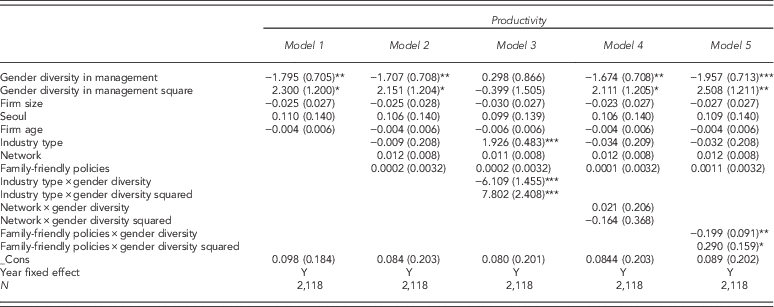
Table 2 reports parameter estimates on the five empirical models delineated supra. Hypothesis 1 predicts that gender diversity in management will have a U-shaped relationship with firm productivity. This means that firms with moderate levels of gender diversity underperform compared with those with a high or low level of gender diversity. Model 1 in Table 2 controls for firm size, Seoul location, and firm age. The results show that gender managerial diversity has a significant and negative effect on productivity (β=−1.795, p<.05), while the coefficient of the quadratic term is significant and positive (β=2.300, p<.1). This supports our prediction of a curvilinear relationship between gender managerial diversity and productivity. At low levels of gender diversity in management, the effect on productivity increases, but declines when managerial heterogeneity is at moderate levels, and then increases at higher levels of diversity. In Models 2, 4, and 5, the results show a similar pattern for gender diversity in management (Model 2: β=−1.707, p<.05, Model 4: β=−1.674, p<.05, Model 5: β=−1.957, p<.01), and the squared term for gender diversity in management (Model 2: β=2.151, p<.1, Model 4: β=2.111, p<.1, Model 5: β=2.508, p<.05). The squared terms reflect the curvilinear relationship between gender diversity in management and productivity. All models except Model 3 support the hypothesis that gender diversity in management has a U-shaped relationship with firm productivity.
Results of fixed effects model

Note. ‘Y’ includes year dummy variables.
The coefficient and SE (in parenthesis) are reported *p<.1, **p<.05, ***p<.01.
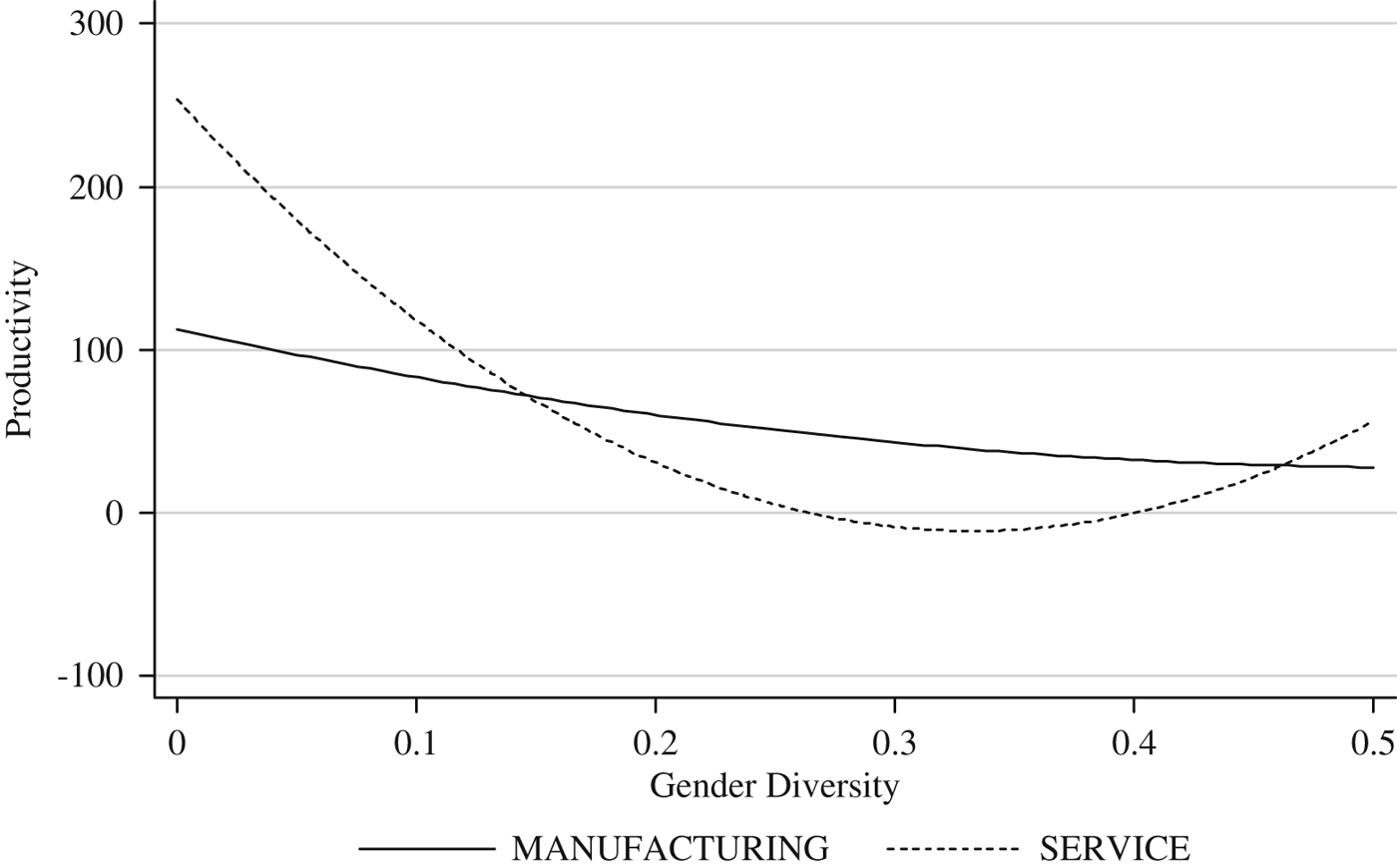
Following Richard et al. (Reference Richard, Barnett, Dwyer and Chadwick2004), we separately estimate the effects of gender diversity in management by categorizing industry into two types: service-oriented firms and manufacturing firms. We include two interaction terms (service industry×gender diversity in management; service industry×gender diversity in management squared) to account for our hypothesized curvilinear relationship. Model 2 shows that the interaction term between gender diversity in management and the service industry is negative and statistically significant (β=−6.109, p<.01), whereas the quadratic term is positive and significant (β=7.802, p<.01). These results, also shown in Figure 1, support Hypothesis 2: the positive effects of gender diversity in management are stronger in service-oriented industries than in manufacturing. In addition, Figure 1 illustrates that for service-oriented firms, low gender managerial diversity is positively associated with productivity, but then the effect decreases as diversity reaches 0.30; the relationship between managerial heterogeneity and productivity is weak but positive at the highest levels of diversity (0.35–0.50). Thus, the findings support a moderating effect for the industry with service-oriented firms showing the highest level of employee productivity in homogeneous groups, and the lowest level of employee productivity in moderately heterogeneous groups.
Relationship between gender diversity and productivity by industry type.

Hypothesis 3 examines the moderating role of networks on gender diversity within the relationship between management and productivity. Model 3 in Table 2 shows two interaction terms (network×gender diversity in management; network×gender diversity in management squared). We find no significant effect for the interaction between gender diversity in management and networks, and the quadratic interaction coefficient. Consequently, our findings do not support Hypothesis 3.
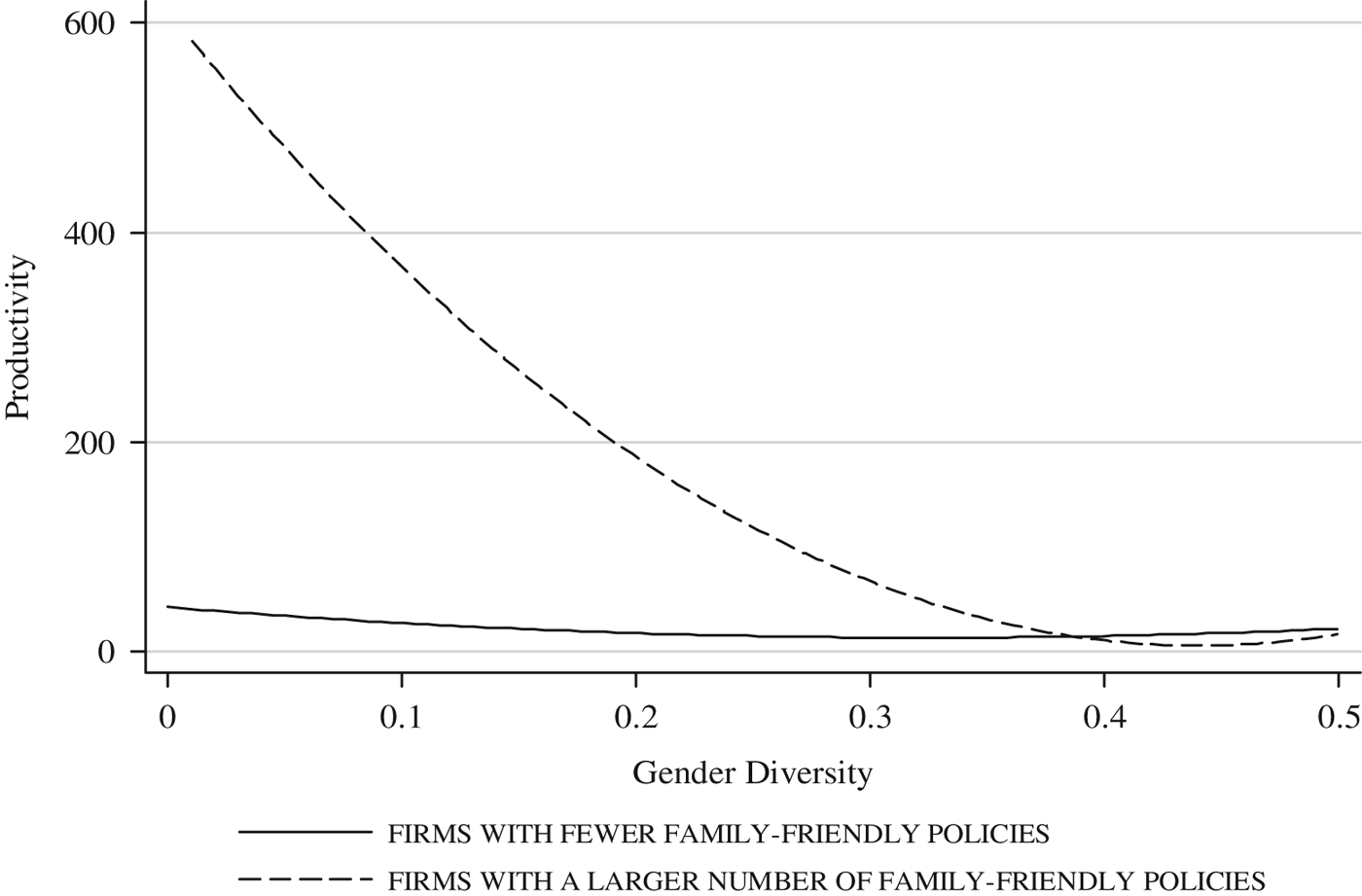
Hypothesis 4 examines the moderating role of firms with family-friendly policies on gender diversity in management and productivity. Model 5 reveals that the interaction between family-friendly policies and gender managerial diversity is significant and negative (β=−0.199, p<.05). Furthermore, the interaction between family-friendly policies and the quadratic of gender diversity in management is positive and significant (β=0.290, p<.01). These results, illustrated in Figure 2, indicate that family-friendly policies positively moderate the nonlinear relationship with productivity, supporting Hypothesis 4. However, as the graph shows, for firms with the greatest number of family-friendly policies, the highest levels of organizational productivity are associated with homogeneous managerial groups.
Relationship between gender diversity and productivity by number of family-friendly policies.

DISCUSSION AND IMPLICATIONS
Discussion
In this study, we examined the effects of gender diversity in management on organizational performance using a sample of South Korean firms. While previous studies have provided mixed results when modeling a linear relationship between gender diversity in management and organizational performance (Wellalage & Locke, Reference Wellalage and Locke2012; Darmadi, Reference Darmadi2013; Chapple & Humphrey, Reference Chapple and Humphrey2014; Nguyen, Locke, & Reddy, Reference Nguyen, Locke and Reddy2015; Post & Byron, Reference Post and Byron2015; Noland, Moran, & Kotschwar, Reference Noland, Moran and Kotschwar2016; Terjesen, Couto, & Francisco, Reference Terjesen, Couto and Francisco2016), a few researchers have shown support for a curvilinear relationship using data on US firms (Richard et al., Reference Richard, Barnett, Dwyer and Chadwick2004; Richard, Murthi, & Ismail, Reference Richard, Murthi and Ismail2007). This study adds to that literature in several important ways. First, similar to Richard, Murthi, and Ismail (Reference Richard, Murthi and Ismail2007), we find evidence of a U-shaped relationship between gender diversity in management and organizational performance, providing further support that productivity is highest in homogeneous managerial groups. Our results illustrate that the pattern for this relationship not only exists in a sample of US firms but also in South Korean workplaces, with national policy incentives to increase managerial gender diversity.
Further, this study considers how organizational context matters for the diversity–performance relationship. Specifically, unique to our research is the inclusion of a measure of workplace family-friendly policies hypothesized to moderate the relationship between gender diversity in management and organizational performance. Our results support this prediction, highlighting that such policies are particularly salient for productivity when managerial groups are homogeneous. This is not surprising when considering that women’s long-term commitment to the labor force has been relatively weak in Korea, especially following childbirth. If women remain in the workforce, they are likely to be few in numbers, particularly in managerial positions that tend to require a greater level of commitment. It may be the case that female managers with families are largely concentrated in homogeneous work groups, with either all or nearly all women, or mostly men. In predominately female managerial groups, we would expect that having family-friendly policies would work to enhance productivity as women experience greater job flexibility and can better balance work and family responsibilities. In the latter case, where women serve as tokens, organizational performance may be heightened as family-friendly policies are implemented to recruit and retain highly qualified females. Depending on how long the policies have been in place and how accessible they are to utilize, it is possible that the benefits of family-friendly workplaces (job satisfaction, retention, and motivation) are just emerging. Given that women comprised only 10% of managerial positions in South Korea’s central government in 2013, it is reasonable to expect that increased diversity over the next decade would yield different results for moderate levels of diversity in private sector firms. Differentiating between these issues is certainly an area of importance and should be considered in future research.
In terms of industry context, we find a U-shaped relationship for service-oriented firms, indicating maximized productivity in a fully homogeneous or fully heterogeneous management group instead of a moderately heterogeneous management group. On the one hand, this may suggest that having managerial ranks comprised of demographically similar others are advantageous for firms that spend much of their time and effort interacting with the public sphere. It may also be that the gender composition of these firms is a reflection of the types of services provided and thus, women managers may be more effective in understanding largely female customer bases and vice versa for men. On the other hand, in managerial ranks that are gender integrated, it could be that such groups are highly productive as a result of top–down support for overall workforce equality. In other words, working together in diverse environments is considered the norm. Conflict is likely low, leading to overall greater productivity. In either case, the results of this research point to the need for a closer examination of the types of service firms that are consistent with each of these managerial arrangements. Perhaps relatively clear distinctions can be made in terms of within service industry variation in productivity based on managerial diversity.
Theoretical implication
The results of this study have several theoretical implications. First, this study utilizes an integrated theoretical approach to examine the relationship between gender diversity and organizational performance. The CEM supports that gender diversity has both positive and negative relationships with organizational performance (Schneid et al., Reference Schneid, Isidor, Li and Kabst2015). The CEM predicts a curvilinear relationship between gender diversity and organizational performance (Palmer, Reference Palmer2006). The results support the CEM that diversity has a curvilinear relationship with firm productivity – firms with a moderate level of gender managerial heterogeneity underperform compared with those with a high or low level of gender heterogeneity. We, therefore, conclude that the CEM holds for firms situated in Eastern cultural context.
Previous studies based on contingency theory examine moderators such as industry type, culture, or task to also understand the relationship between organizational performance and gender diversity (Miller & Shamsie, Reference Miller and Shamsie1996). Empirical studies based on Western economies have found a curvilinear relationship between gender diversity in management and firm productivity, with a stronger association for firms in service-oriented industries relative to manufacturing industries (Richard, Murthi, & Ismail, Reference Richard, Murthi and Ismail2007; Ali, Kulik, & Metz, Reference Ali, Kulik and Metz2011). This research contributes to the generalization of these findings as they relate to contingency theory applied to Asian economies.
The study also considers the application and support of gender role theory in a male-dominated society. Under Confucian ideology, females are expected to take care of household duties even when employed outside the home, which may lead to work–family conflict (Friedman & Greenhaus, Reference Friedman and Greenhaus2000), and ultimately lower firm productivity. As posited by gender role theory, the effects of family-friendly policies on organizational performance may differ by gender group (Crosby, 1991; Kossek & Ozeki, Reference Kossek and Ozeki1999). Consistent with this, the results presented here provide support for gender role theory showing that the productivity of firms with a high level of family-friendly policies is maximized in a homogeneous management group, especially a female-oriented firm, rather than a fully or moderately heterogeneous management group.
Contribution and future research opportunities
Previous studies on diversity focus mainly on Western economies, and thus this study contributes to the previous literature by looking into the case of Korea. Although we provide insights concerning the relationship between gender diversity and organizational performance, these findings have several limitations. First, whereas Richard, Murthi, and Ismail (Reference Richard, Murthi and Ismail2007) found a curvilinear relationship between diversity and intermediate-term performance, and a linear relationship between diversity and long-term performance, we focused only on the relationship between diversity and intermediate performance. Future studies should consider both intermediate and long-term performance to better understand the effects of diversity. Second, we were unable to include micro-level data (e.g., wage, training, education level, and motivation) to capture the complexity of diversity on organizational performance. Future studies should consider how micro-level data could be used to develop the theories of heterogeneity, particularly since the determinants of organizational performance consist of both organizational and individual factors. Third, we examined the effects of gender diversity on organizational performance by excluding racial, cultural, or age diversity. Future studies may want to also take into account these factors for Korean and other Asian firms.