 α
 β





1. Introduction
Meteoroids ranging from
 $\mu$
m to m in diameter enter the Earth system at a rate inversely proportional to their size (Bland & Artemieva Reference Bland and Artemieva2006; Silber et al. Reference Silber, Boslough, Hocking, Gritsevich and Whitaker2018; Shober et al. Reference Shober2020). They deliver a broad range of extraterrestrial materials, from metallic alloys to silicate minerals to cometary dust (Borovička et al. Reference Borovička2005; Ostrowski & Bryson Reference Ostrowski and Bryson2019). Occasionally, metallic and stony remnants are deposited on the Earth’s surface as meteorites. They inform scientific progress because they contain valuable information regarding the chemical and thermophysical conditions present during the early Solar System (Greenwood et al. Reference Greenwood, Burbine and Franchi2020; Jenniskens et al. Reference Jenniskens2024). Understanding the development of the Solar System therefore depends on understanding the materials brought to Earth from space.
Meteorites represent only the most resistant fraction of meteoroids, not the full population we aim to characterise. Most incoming meteoroids are completely vaporised during atmospheric entry and are therefore unavailable for laboratory analysis. For those that reach the ground, preservation depends strongly on mineralogy: iron meteorites are generally more resistant to weathering than stony meteorites, whereas carbonaceous chondrites are easily altered and deteriorate more rapidly (Lee & Bland Reference Lee and Bland2004; Gritsevich et al. Reference Gritsevich2024). Our goal is to develop a method for classifying all extraterrestrial material entering Earth’s atmosphere, including both recoverable meteorites and objects that are lost due to atmospheric vaporisation or terrestrial weathering.
1.1. Meteoroid data by optical and spectral camera networks
The fireballs produced by meteoroid-atmosphere interaction are best characterised when directly observed by ground-based optical camera networks. Examples include the Global Fireball Observatory (GFO; Devillepoix et al. Reference Devillepoix2020), the Global Meteor Network (GMN; Vida et al. Reference Vida, Šegon, Gural, Brown, McIntyre, Dijkema, Pavletic, Kukic, Mazur, Eschman, Roggemans, Merlak and Zubovic2021), the European Fireball Network (EFN; Borovička et al. Reference Borovička2022
b), the Spanish Meteor Network (SPMN; Peña-Asensio et al. Reference Peña-Asensio, Trigo-Rodríguez, Rimola, Corretgé-Gilart and Koschny2023), FRIPON (Boaca et al. Reference Boaca2022), as well as the historic Meteorite Observation and Recovery Project (MORP; Campbell-Brown & Hildebrand Reference Campbell-Brown, Hildebrand, Hawkes, Mann and Brown2005) and Prairie Network (PN; Moreno-Ibáñez et al. Reference Moreno-Ibáñez, Gritsevich, Trigo-Rodríguez and Silber2020). Fireball networks carry out trajectory analyses to predict whether meteorites have been deposited, and if so, their likely landing sites (Moilanen et al. Reference Moilanen, Gritsevich and Lyytinen2021; Vida et al. Reference Vida, Šegon, Gural, Brown, McIntyre, Dijkema, Pavletic, Kukic, Mazur, Eschman, Roggemans, Merlak and Zubovic2021; Peña-Asensio et al. Reference Peña-Asensio, Trigo-Rodríguez, Rimola, Corretgé-Gilart and Koschny2023). Between March 2014 and December 2024, 2 102 fireballs were observed by the GFO alone (Devillepoix et al. Reference Devillepoix2020), of which 1 789 have been reduced with accurate entry and terminal velocities. Their progenitor meteoroids are estimated to have ranged from 1 mm to 4 m in diameter prior to ablation, including 16 events for which meteorites have been recovered. The majority (1 521) were sporadic asteroidal or cometary impactors, which are distinguished from each other based on orbital eccentricity and Tisserand’s parameter (e.g. Tancredi Reference Tancredi2014). The remaining 268 have been linked to known meteor showers based on their radiants and corresponding orbits (Shober et al. Reference Shober2021). Crucially for this study, 1 118 of the reduced fireballs showed significant deceleration, wherein the final observed velocity (
 $V_t$
) was less than 80% of the initial velocity (
 $V_e$
). The remaining 671, approximately one-third of the dataset, showed minimal deceleration, which we define as a terminal velocity exceeding 80% of the initial velocity.
At present the optical cameras employed by the GFO in Australia are supplemented by three spectral cameras from the All-Sky Meteor Orbit System (AMOS; Rudawska et al. Reference Rudawska, Tóth, Kalmancok and Zigo2016) since 2021 (Devillepoix et al. Reference Devillepoix2022 a). Spectral systems like these enable broad classification of meteoroids as iron, stony or cometary based on their fireball emission spectra. In addition to high temporal resolution and precise instrumental calibration (Matlovič et al. Reference Matlovič and Tóth2019), this process requires a number of assumptions, which have been described by Jenniskens (Reference Jenniskens2007) and references therein. Spectral analysis also depends upon complex calibration curves to remove wavelength-dependent atmospheric influences, such as Rayleigh scattering and aerosol concentration (Jenniskens Reference Jenniskens2007), as well as instrumental effects, such as vignetting and optical extinction (Millman Reference Millman, Halliday and McIntosh1980). Data reduction is time consuming, manually intensive, and very difficult to automate. The spatial coverage of spectral cameras is also limited by their relative rarity, thus the traditional optical systems still dominate in meteoroid tracking and identification efforts.
1.2. Characterising meteoroids and minimally decelerating objects
In order to automate the optical data reduction process, fireball trajectories can be characterised using the
 $\alpha$
-
 $\beta$
method of dynamic trajectory analysis described by Gritsevich (Reference Gritsevich2007, Reference Gritsevich2008b). From trajectory observations, measurable physical properties can be effectively reduced to two dimensionless parameters that quantify the ability of a meteoroid to penetrate the atmosphere (
 $\alpha$
) and its susceptibility to mass loss (
 $\beta$
). Gritsevich et al. (Reference Gritsevich, Stulov and Turchak2012) have demonstrated the utility of the ln(
 $\alpha$
) versus ln(
 $\beta$
) plot, upon which it is possible to distinguish large, crater-forming impactors from smaller metallic or chondritic meteorites. It has also been proposed that clustering in
 $\alpha$
-
 $\beta$
space could allow for grouping of meteoroids based on material properties.
To date,
 $\alpha$
and
 $\beta$
cannot be determined for events where
 $V_t/V_e\gt 80\%$
, preventing direct comparison with other events in the
 $\alpha$
-
 $\beta$
space. The aim of this study is the characterisation of meteoroids with little or no measured deceleration, for which the standard
 $\alpha$
-
 $\beta$
method of Gritsevich (Reference Gritsevich2009) is inconclusive. We will refer to these as ‘minimally decelerating objects’ (MDOs). As stated in Section 1.1, MDOs comprise approximately one-third of all meteoroids detected by the GFO. They are significant for a comprehensive understanding of extraterrestrial materials.
This paper will begin by summarising the existing
 $\alpha$
-
 $\beta$
method. Analytically determined
 $\beta$
values from significantly decelerating GFO events, including meteorite falls, are then used to calculate a suite of bulk ablation coefficients (
 $\sigma_b$
). We then introduce new formulae that strongly depend upon
 $\sigma_b$
values in order to calculate
 $\alpha$
and
 $\beta$
for MDOs. Finally, we will discuss how this method can assist in understanding unrecoverable meteoroids, especially if supplementary information is available, for example from emission spectra. We will test dynamics-based meteoroid groupings in
 $\alpha$
-
 $\beta$
space for both deceleration regimes. Our study will lay a foundation for comprehensive classification of the materials delivered to Earth by meteoroids. This in turn will inform the hazards posed by near-Earth asteroids, and contribute to broader understanding of the makeup of our Solar System.
2. Dynamic properties of decelerating meteoroids
The
 $\alpha$
-
 $\beta$
trajectory analysis method is derived from foundational meteor physics, as presented by Stulov et al. (Reference Stulov, Mirskii and Vislyi1995), then refined by Gritsevich (Reference Gritsevich2008
b), Sansom et al. (Reference Sansom2019), and others. It is used to calculate a falling meteoroid’s ballistic coefficient (
 $\alpha$
) and mass loss parameter (
 $\beta$
) based on directly observable kinematic properties, namely altitude and velocity. Both
 $\alpha$
and
 $\beta$
are dimensionless. These can be reliably determined for events that show a minimum of 80% net deceleration (
 $V_t/V_e\lt 80\%$
) (Sansom et al. Reference Sansom2019; Boaca et al. Reference Boaca2022).
Normalised velocity versus normalised altitude for the falls of Arpu Kuilpu (left) and the iron meteoroid DN240406_02 (right). ‘Smoothed’ data are three-point rolling averages of raw data (not to be confused with the Extended Kalman Smoother method of Sansom et al. Reference Sansom, Bland, Rutten, Paxman and Towner2016 used in the GFO automated pipeline).

Figure 1. Long description
Two scatter plots compare normalized velocity versus normalized altitude for two different meteoroid falls. Panel A: The left scatter plot is labeled ’Arpu Kuilpu’. The x-axis represents normalized velocity (1 = entry velocity of meteoroid) ranging from 0.2 to 1.1, and the y-axis represents normalized altitude (1 = 7160 meters) ranging from 3 to 12. The plot includes raw data points in light blue and smoothed data points in dark blue. A deceleration curve is also shown in black. Panel B: The right scatter plot is labeled ’DN160110_02’. The x-axis represents normalized velocity (1 = entry velocity of meteoroid) ranging from 0.7 to 1.1, and the y-axis represents normalized altitude (1 = 7160 meters) ranging from 3 to 12. The plot includes raw data points in light red and smoothed data points in dark red.
2.1. Ballistic coefficient
The ballistic coefficient,
 $\alpha$
, represents the ratio between the aerodynamic drag and weight forces experienced by a falling meteoroid. If
 $\alpha$
is high for a particular object, then that object experiences high drag relative to its weight, and is rapidly decelerated by the dense lower layers of Earth’s atmosphere. If the value of
 $\alpha$
is low, the drag force is comparatively low, and atmospheric penetration is enhanced. Its formal definition is as follows:
 \begin{equation} \alpha = \frac{c_d \rho_0 H_0 S_e}{2 M_e \sin(\gamma)}\end{equation}
Here
 $c_d$
refers to the aerodynamic drag coefficient. It is typically assumed to be unity, which represents a spherical body in a hypersonic airflow regime. Next,
 $\rho_0$
and
 $H_0$
are respectively the critical density (1.29 kg/m
 $^3$
) and critical altitude (7 160 m) of an exponential atmosphere. The variables
 $S_e$
and
 $M_e$
are respectively the cross-sectional area and mass of the meteoroid before atmospheric entry. Area and mass can be calculated in tandem if a particular shape and density are assumed. For instance, a modified formula that uses meteoroid density to calculate initial mass has been published by Sansom et al. (Reference Sansom2019), assuming a spherical shape. Finally,
 $\gamma$
is the angle between the meteoroid’s trajectory and the local horizon at the point of entry.
2.2. Mass loss parameter
The mass loss parameter,
 $\beta$
, is the ratio between the fraction of a meteoroid’s kinetic energy that is converted into heat, and its effective enthalpy of vaporisation (Gritsevich & Popelenskaya Reference Gritsevich and Popelenskaya2008). A high
 $\beta$
value indicates a meteoroid that rapidly loses mass due to ablation and fragmentation processes. Ablation is the continuous process by which matter at the surface is melted, vaporised, ionised and stripped away by the surrounding atmosphere. Fragmentation refers to discrete breakup events that are detectable as luminous flares, as well as subtle increases in deceleration. The meteoroids that are most likely to survive their descent long enough to deposit meteorites yield low
 $\beta$
values and experience a degree of mass conservation. The mass loss parameter is defined by this equation:
 \begin{equation} \beta = \frac{(1 - \mu) \sigma_b V_e^2}{2}\end{equation}
Here
 $\mu$
is the rotational shape factor, which is typically held constant throughout a meteoroid’s descent. It is typically set to
 $\frac{2}{3}$
, which corresponds with an object that is rotating rapidly enough for its entire surface to be evenly ablated. The bulk ablation coefficient
 $\sigma_b$
indicates the amount of mass that is removed per unit of heat energy transferred (see Section 2.4). Finally,
 $V_e$
refers to the earliest observed velocity of the meteoroid. High velocity results in higher dynamic (‘ram’) pressure across the leading face of the meteoroid, which accelerates mass loss (McMullan et al. Reference McMullan2024).
2.3. Calculation of dynamic parameters
For a given meteorite fall event,
 $\alpha$
and
 $\beta$
are traditionally determined analytically using normalised velocity (v) and normalised altitude (y) data (Figure 1). For GFO events, velocity is normalised relative to entry velocity, as determined by an Extended Kalman Smoother (EKS; Sansom et al. Reference Sansom, Bland, Rutten, Paxman and Towner2016). Altitude data are normalised following the method of Lyytinen & Gritsevich (Reference Lyytinen and Gritsevich2016), which allows NRLMSISE-00 (see Picone et al. Reference Picone, Hedin, Drob and Aikin2002) or an equivalent ‘real’ atmospheric model to be incorporated for fall site prediction purposes. We prefer a ‘real’ atmosphere when possible; differences between our results and those of earlier literature (e.g. Sansom et al. Reference Sansom2019) can be attributed to differences in atmospheric models.
A curve is fitted to the normalised velocity versus altitude plot using a global minimisation function. The curve includes an inflection point whose position is determined by
 $\alpha$
. The slope of the curve below this inflection point is controlled by
 $\beta$
. Figure 1 includes the deceleration curve fitted to trajectory data for Arpu Kuilpu, an ordinary chondrite tracked and recovered by the GFO (Shober et al. Reference Shober2022).
An advantage of this method is that it requires no assumptions regarding the shape, size, density or rotation of the falling meteoroid. It is only when deriving other parameters from
 $\alpha$
or
 $\beta$
, such as the preatmospheric mass or bulk ablation coefficient, that such assumptions become necessary (Gritsevich Reference Gritsevich2009). The
 $\alpha$
-
 $\beta$
method provides a means of characterising objects captured by fireball networks, whether or not they survive descent. Sansom et al. (Reference Sansom2019) removed the dependence of
 $\alpha$
upon trajectory slope to eliminate a potential bias of entry angles first identified by Gritsevich et al. (Reference Gritsevich, Stulov and Turchak2012). This is achieved by plotting
 $\alpha \sin \gamma$
, where
 $\gamma$
is the entry angle measured from the local horizon. This method was applied to 273 fireballs (Sansom et al. Reference Sansom2019), including three from which meteorites have been recovered, to generate a ln(
 $\alpha \sin \gamma$
) versus ln(
 $\beta$
) plot and determine probabilistic thresholds for meteorite deposition (‘survivability curves’). Both studies agree that meteorite falls tend to yield low ballistic coefficients and low mass loss parameters when compared with the majority of fireball-producing meteoroids.
2.4. Ablation coefficient
Once
 $\alpha$
and
 $\beta$
are known, their defining equations can be rearranged and solved to determine linked parameters, given reasonable assumptions of shape, size, density and rotation. For our purposes, the most pertinent material parameter is the bulk ablation coefficient,
 $\sigma_b$
. It can be estimated by rearranging the equation for
 $\beta$
, then substituting a rotational shape factor (
 $\mu$
) and earliest observed velocity (
 $V_e$
):
 \begin{equation} \sigma_b = \frac{2 \beta}{(1 - \mu) V_e^2}\end{equation}
An exact value for
 $\mu$
can be derived from light curve analysis, as proposed by Gritsevich & Koschny (Reference Gritsevich and Koschny2011). When a sufficiently detailed light curve is not available, we assume
 $\mu = \frac{2}{3}$
to indicate uniform ablation across the entire surface.
Ablation coefficients are sometimes considered diagnostic of particular meteoroid types (Ceplecha Reference Ceplecha1975), and are expressed in either kg MJ
 $^{-1}$
or s
 $^2$
km
 $^{-2}$
; these units are equivalent. We will provide
 $\sigma_b$
units as kg MJ
 $^{-1}$
.
2.4.1. Intrinsic versus bulk ablation coefficients
An intrinsic ablation coefficient (
 $\sigma_i$
) is treated as an inherent property specific to each meteoroid type. It can be calculated using the thermophysical properties of meteoritic materials such as silicates, organics and iron-nickel alloys. Such properties include the enthalpy of vaporisation, heat transfer coefficient, and atmospheric drag coefficient (Pecina & Ceplecha Reference Pecina and Ceplecha1983). In real meteoroid entries, these values vary with temperature and are difficult or impossible to determine directly, thus they are usually assumed. For instance, the enthalpy of vaporisation for iron meteoroids is typically assumed to be equal to that of pure iron, which is a necessary simplification (ReVelle & Ceplecha Reference ReVelle and Ceplecha1994). It is also possible to estimate
 $\sigma_i$
values by modelling ablation and fragmentation processes separately, for example in the popular erosion simulator of Borovička et al. (Reference Borovička2007). In terms of time and manual effort, this process is highly intensive (Buccongello et al. Reference Buccongello, Brown, Vida and Pinhas2024), but has been shown to produce reliable results for well-studied meteorite falls (e.g. Winchcombe, McMullan et al. Reference McMullan2024).
By contrast, a bulk or apparent ablation coefficient (
 $\sigma_b$
) is calculated using direct fireball observations, and is influenced by multiple mass loss processes, namely ablation, sudden fragmentation, and ‘quasi-continuous’ fragmentation (Borovička et al. Reference Borovička2007). The term ‘ablation coefficient’ is therefore not strictly accurate because it is influenced by multiple mass loss processes; hence the term ‘apparent’. It is typically assumed to be constant throughout a meteoroid’s descent, and is unique to that particular fall event, with a minimum limit that depends upon bulk composition (Pecina & Ceplecha Reference Pecina and Ceplecha1983). It tends to be inflated by up to one order of magnitude compared to
 $\sigma_i$
for events in which extensive or catastrophic fragmentation occurred (e.g. Chelyabinsk, Trigo-Rodríguez et al. Reference Trigo-Rodríguez, Dergham, Gritsevich, Lyytinen, Silber and Williams2021). Some models (e.g. Zinn et al. Reference Zinn, Judd and ReVelle2004) have treated
 $\sigma_i$
as equivalent to
 $\sigma_b$
by assuming the absence of fragmentation. However, only rare monolithic meteorites (e.g. Carancas; Borovička & Spurný Reference Borovička2008) are thought to have impacted without experiencing fragmentation within the atmosphere. It is therefore unrealistic to assume that
 $\sigma_i \approx \sigma_b$
; these are rarely interchangeable.
The
 $\alpha$
-
 $\beta$
method of Gritsevich (Reference Gritsevich2008
b) yields a form of
 $\sigma_b$
because it fits a deceleration curve to raw data, which includes the deceleration associated with fragmentation during luminous flight. In this paper, unless otherwise specified, we will present only bulk ablation coefficients derived from dynamic trajectory analysis. These are most appropriate to employ in our study of MDOs, which directly builds upon the works of Gritsevich (Reference Gritsevich2008
b) and Gritsevich & Popelenskaya (Reference Gritsevich and Popelenskaya2008).
2.4.2 Calculated bulk ablation coefficients for chondrite falls
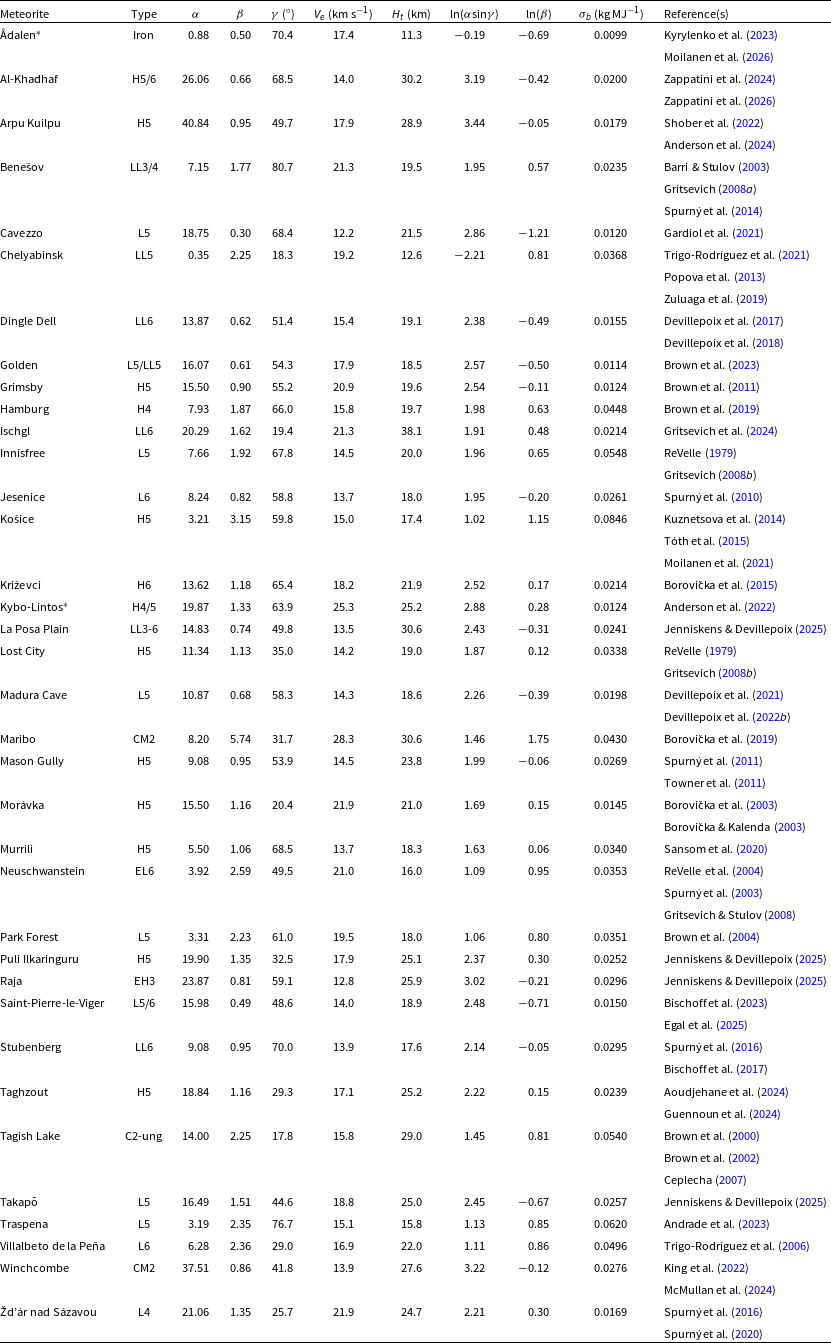
In addition to GFO data, we have independently calculated mass loss parameters and bulk ablation coefficients for a global dataset of 36 meteorites with resolved atmospheric trajectories (Appendix B) using the traditional analytical fit method. Of the fallen meteorites, 35 are chondritic. As shown in Figure 2,
 $\sigma_b$
is highly variable among all chondrite types. The H-chondrite Košice (Kuznetsova et al. Reference Kuznetsova, Gritsevich, Vinnikov, Rault and Roggemans2014) provides a notable outlier. It is believed that this meteoroid produced an airburst and experienced extensive fragmentation throughout its descent, losing comparatively little mass via pure ablation (Tóth et al. Reference Tóth2015; Moilanen et al. Reference Moilanen, Gritsevich and Lyytinen2021). The majority of chondrites tend to break up in two distinct stages as they encounter dynamic pressure thresholds on the order of 0.1 and 1 MPa (Borovička et al. Reference Borovička, Spurný and Shrbený2020).
Bulk ablation coefficients calculated for a selection of instrumentally observed meteorite falls, assuming uniform ablation (
 $\mu = \frac{2}{3}$
).
 $^*$
indicates a provisional name. Previously published values are shown for stony and carbonaceous
 $\sigma_b$
from Ceplecha (Reference Ceplecha and Milani1994), for iron
 $\sigma_i$
from ReVelle & Ceplecha (Reference ReVelle and Ceplecha1994), for stony
 $\sigma_i$
from Ceplecha & ReVelle (Reference Ceplecha and ReVelle2005) and for carbonaceous
 $\sigma_i$
from Ceplecha (Reference Ceplecha2007).

Of the three ordinary chondrite classes, H-chondrites tend to experience the lowest degree of mass loss, which is reflected by their mean
 $\sigma_b$
of 0.0236 kg MJ
 $^{-1}$
(s.d. 0.0099 kg MJ
 $^{-1}$
), excluding Košice. Based on averages, LL-chondrites (mean 0.0262 kg MJ
 $^{-1}$
, s.d. 0.0063 kg MJ
 $^{-1}$
) and L-chondrites (mean 0.0289 kg MJ
 $^{-1}$
, s.d. 0.0133 kg MJ
 $^{-1}$
) are progressively less resistant to mass loss when compared with H-chondrites. Among all three ordinary chondrite groups, median
 $\sigma_b$
is taken as 0.0250 kg MJ
 $^{-1}$
, which will be employed in our analysis of minimally decelerating asteroidal bodies (Section 3).
The friable carbonaceous chondrites Maribo and Tagish Lake produce
 $\sigma_b$
values of 0.0430 and 0.0540 kg MJ
 $^{-1}$
respectively. They fall within the upper range of possible values for ordinary chondrites. Winchcombe provides the lowest carbonaceous value known to date, 0.0276 kg MJ
 $^{-1}$
. This meteorite experienced relatively low dynamic pressures due to its slow entry velocity, which reduced the rate of mass loss and spared it from total destruction (McMullan et al. Reference McMullan2024).
The enstatite chondrites Raja (EH3) and Neuschwanstein (EL6) yield 0.0296 and 0.0353 kg MJ
 $^{-1}$
respectively. Neuschwanstein experienced a singular fragmentation event at the lower end of its trajectory, producing several large fragments of high mechanical strength (Oberst et al. Reference Oberst, Heinlein, Köhler and Spurný2004). The slightly lower value obtained for Raja implies a less destructive fragmentation regime and/or a difference in ablation behaviour due to high metal content in comparison with Neuschwanstein.
Particularly astute readers may note that our
 $\sigma_b$
value for Neuschwanstein is exactly three times that calculated by Gritsevich (Reference Gritsevich2008
b). This is because, whilst we have assumed uniform ablation across all surfaces due to meteoroid rotation, the earlier study assumed no rotation (
 $\mu$
= 0) and produced
 $\sigma_b$
= 0.0117 kg MJ
 $^{-1}$
for the same entry velocity. In conjunction, these two approaches yield the full range of possible bulk ablation coefficients for a given fall. The values illustrated in Figure 2 are maxima; the corresponding minima are one-third in magnitude.
Our
 $\sigma_b$
calculations for chondrites are higher than the
 $\sigma_i$
values presented by Ceplecha et al. (Reference Ceplecha and Borovička1998) for equivalent meteoroid types, but generally agree with more recent models and plasma wind tunnel experiments (e.g. Matlovič et al. Reference Matlovič2024). It is clear that
 $\sigma_b$
can vary significantly among meteorites belonging to the same compositional group (Figure 2). We attribute this variation to differences in fragmentation and ablation behaviour primarily caused by differing sizes, shapes, entry angles and atmospheric conditions. Consequently, it is difficult to select a single bulk ablation coefficient to represent all meteoroids of the same type for the purposes of dynamic trajectory analysis. Accurate characterisation of fallen meteorites requires that each fall be considered independently of the others.
2.4.3. Ablation coefficients for iron meteoroids
Ablation coefficients for iron and stony-iron meteoroids are poorly constrained because metal-rich meteorite falls are rarely observed. Furthermore, the mechanisms by which they shed mass are not fully understood (Girin Reference Girin2017). It has been proposed that iron meteoroids experience two possible ablation regimes, one dominated by melting and the other by vaporisation, depending on their mass. ReVelle & Ceplecha (Reference ReVelle and Ceplecha1994) propose
 $\sigma_i$
values of 0.0743 kg MJ
 $^{-1}$
for iron bodies below
 $2 \times 10^5$
kg, for which melting is the dominant ablation process. For larger bodies, in which vaporisation dominates, a smaller
 $\sigma_i$
value of 0.0124 kg MJ
 $^{-1}$
is proposed. Both of these values are approximate; they were derived from thermophysical properties of pure iron. More recently, Vojácek et al. (Reference Vojácek and Borovička2019) employed the erosion model of Borovička et al. (Reference Borovička2007) to calculate
 $\sigma_i$
values for four instrumentally observed iron meteoroids identified using emission spectra. One produced a value of 0.080 kg MJ
 $^{-1}$
, the other three 0.010–0.013 kg MJ
 $^{-1}$
. These values generally agree with the dichotomy presented by ReVelle & Ceplecha (Reference ReVelle and Ceplecha1994). However, none of the four irons were expected to exceed a few mm in diameter, so the value of 0.080 kg MJ
 $^{-1}$
is the only example that aligns with the prior study.
To date a single iron meteorite, provisionally named ‘Ådalen’, has been captured by fireball cameras in sufficient detail to reconstruct its trajectory and calculate
 $\alpha$
and
 $\beta$
(Kyrylenko et al. Reference Kyrylenko, Golubov, Slyusarev, Visuri, Gritsevich, Krugly, Belskaya and Shevchenko2023). Its derived bulk ablation coefficient of 0.010 kg MJ
 $^{-1}$
matches the lower end of the
 $\sigma_i$
range derived by Vojácek et al. (Reference Vojácek and Borovička2019). It is also marginally lower than the lower intrinsic value proposed by ReVelle & Ceplecha (Reference ReVelle and Ceplecha1994): 0.0124 kg MJ
 $^{-1}$
. The same study states that this ablation coefficient applies only to iron meteoroids exceeding
 $2 \times 10^5$
kg in entry mass, whilst the entry mass of Ådalen has been estimated at only 3 500–8 500 kg (Kyrylenko et al. Reference Kyrylenko, Golubov, Slyusarev, Visuri, Gritsevich, Krugly, Belskaya and Shevchenko2023; McFadden Reference McFadden, Brown and Vida2024). This discrepancy suggests a lower actual mass boundary between melting-dominated and vaporisation-dominated ablation, or errors in the underlying theoretical calculations. In the absence of additional reliable bulk values, we will employ the
 $\sigma_i$
values published by ReVelle & Ceplecha (Reference ReVelle and Ceplecha1994) as reasonable approximations of
 $\sigma_b$
for both large and small irons.
2.4.4. Ablation coefficients for meteor shower bodies
Ablation coefficients for meteor shower bodies (MSBs) have historically been difficult to determine due to material fragility and frequent lack of visible deceleration. Several MSBs captured by the GFO do show significant deceleration, allowing
 $\alpha$
and
 $\beta$
to be determined using the traditional method.
 $\sigma_b$
has been derived for these objects using Equation (3) and assuming uniform ablation (
 $\mu=\frac{2}{3}$
), which is the most common situation according to Bouquet et al. (Reference Bouquet, Baratoux, Vaubaillon, Gritsevich, Mimoun, Mousis and Bouley2014).
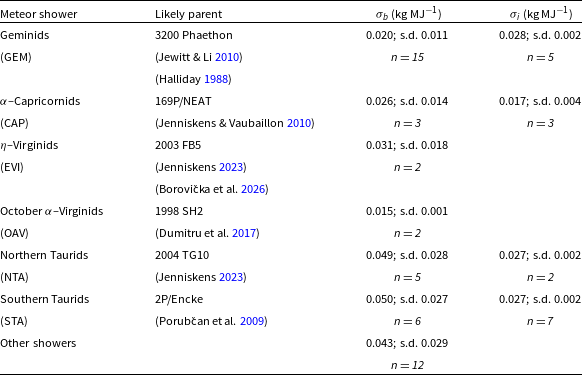
Table 1 displays mean
 $\sigma_b$
values for significantly decelerating objects associated with meteor showers for which multiple such objects have been detected. MSB
 $\sigma_i$
values are available in Buccongello et al. (Reference Buccongello, Brown, Vida and Pinhas2024); we recommend consulting their paper for a thorough review of meteor shower properties and provenance.
Ablation coefficients of significantly decelerating objects associated with selected meteor showers. Bulk coefficients (
 $\sigma_b$
) calculated from GFO detections between 2014 and 2024. Intrinsic coefficients (
 $\sigma_i$
) sourced from Buccongello et al. (Reference Buccongello, Brown, Vida and Pinhas2024). s.d.: standard deviation; n: number of objects.

Table 1. Long description
A table comparing ablation coefficients of meteor showers with their likely parents and standard deviations. The table has 8 rows and 6 columns. Column headers are Meteor shower, Likely parent, σb (kg MJ^-1), σi (kg MJ^-1), and n. Row 1: Geminids, 3200 Phaethon, 0.020; s.d. 0.011, 0.028; s.d. 0.002, n = 15, n = 5. Row 2: α-Capricornids, 169P/NEAT, 0.026; s.d. 0.014, 0.017; s.d. 0.004, n = 3, n = 3. Row 3: η-Virginids, 2003 FB5, 0.031; s.d. 0.018, , n = 2. Row 4: October α-Virginids, 1998 SH2, 0.015; s.d. 0.001, , n = 2. Row 5: Northern Taurids, 2004 TG10, 0.049; s.d. 0.028, 0.027; s.d. 0.002, n = 5, n = 2. Row 6: Southern Taurids, 2P/Encke, 0.050; s.d. 0.027, 0.027; s.d. 0.002, n = 6, n = 7. Row 7: Other showers, , 0.043; s.d. 0.029, , n = 12.
For the Geminids, the mean value of
 $\sigma_b$
is lower than that of
 $\sigma_i$
, contrary to the pattern observed for stony meteorite falls and objects associated with the other meteor showers in Table 1. Objects originating from the Geminids shower are believed to approximate carbonaceous chondrites in bulk composition (Babadzhanov Reference Babadzhanov2002; Jewitt & Li Reference Jewitt and Li2010). There are numerous theorised differences between these and meteorite progenitors that could contribute to the apparent reduction of
 $\sigma_b$
compared to
 $\sigma_i$
, such as smaller sizes and densities, higher porosities, and faster entry velocities. A deeper discussion of MSB structure lies beyond the scope of this study.
2.5. Results of decelerating meteoroid types
The reduced GFO 2014–2024 dataset contains 1 118 events that showed sufficient deceleration for the standard
 $\alpha$
-
 $\beta$
method to be applied. Of these, 45 are associated with meteor showers and another 16 with fall trajectories of recovered meteorites from participating nations (https://dfn.gfo.rocks/meteorites.html). The remainder have been analysed and classified as either asteroidal or cometary on the basis of orbital properties (Shober et al. Reference Shober2021). They include many suspected meteorite droppers from which solid fragments have not yet been recovered. Since all of these objects experienced a significant degree of deceleration, their
 $\alpha$
and
 $\beta$
values have been calculated using the method described in Section 2.3. They are displayed in Figure 3, an update of Figure 3 from Sansom et al. (Reference Sansom2019). We have adopted the convention proposed by the same study to remove the influence of entry angle by plotting
 $\ln(\alpha \sin\gamma)$
instead of
 $\ln(\alpha)$
. This removes potential bias against objects with a comparatively shallow entry angle and consequently long flight time. We also include the survivability curves devised by Sansom et al. (Reference Sansom2019) for a terminal mass of 50 g or more. Figure 3 lends credibility to these survivability curves, showing recovered meteorites are indeed only found in the ‘Likely’ and ‘Possible’ fall zones.
Ballistic coefficient (with slope dependence removed,
 $\ln(\alpha \sin\gamma)$
) versus logarithmic mass loss parameter (
 $\ln\!(\beta)$
) for significantly decelerating meteoroids captured by the GFO between March 2014 and December 2024. Non-GFO meteorites Chelyabinsk, Košice, Tagish Lake and Ådalen* are included for comparison. Survivability curves of Sansom et al. (Reference Sansom2019) are given for 50 g meteorites. *indicates a provisional name. Note that ‘asteroidal’ versus ‘cometary’ classifications are defined by orbital parameters only.

Figure 3. Long description
A scatter plot representing the relationship between the ballistic coefficient (with slope dependence removed) and the logarithmic mass loss parameter for significantly decelerating meteoroids captured by the GFO between March 2014 and December 2024. The horizontal axis represents the logarithmic mass loss parameter, while the vertical axis represents the ballistic coefficient. The plot includes data points for recovered meteorites, shower cometary, geminids, sporadic cometary, and asteroidal meteoroids. The plot is divided into three zones: unlikely fall zone, possible fall zone, and likely fall zone. Specific meteorites such as Chelyabinsk, Košice, Tagish Lake, and Ädalen are highlighted. Survivability curves for 50 g meteorites are also shown. The plot indicates clusters and patterns within these zones, with some meteorites falling into the likely fall zone and others into the possible or unlikely fall zones.
3. Methods for determining
 $\alpha$
and
$\beta$
for minimally decelerating objects


3.1. Minimally decelerating objects in the Global Fireball Observatory dataset
The standard
 $\alpha$
-
 $\beta$
method relies upon an analytical fit to normalised trajectory data. A reasonable degree of deceleration must be present for the fit to converge upon a reliable solution, such that the final observed velocity of an object is less than 80% of its entry velocity. If this is not the case, we consider it a ‘minimally decelerating object’ (MDO) upon which the standard method is unreliable. Figure 1 illustrates the practicality of fitting a curve to a trajectory characterised by ‘significant’ versus ‘minimal’ deceleration, even when smoothed data are employed. After a meteoroid has slowed to below 80% of its entry velocity, as in the case of Arpu Kuilpu, the inflection point in its trajectory is fully visible and the slope of the lower portion can be tightly constrained. By contrast, if a meteoroid does not reach the 80% threshold, then the inflection point cannot be fully resolved and the lower portion of the trajectory cannot be constrained with any degree of accuracy. This is illustrated by the iron meteoroid DN240406_02 (Figure 1).
Over one-third of all fireballs tracked by the GFO can be considered MDOs. Of the 671 MDO falls, 418 represent sporadic impactors, and 253 are associated with known meteor showers. We expect the majority of MDOs to be small, sub-cm bodies that are completely vaporised at relatively high altitudes. Total vaporisation is typical of fast-moving, poorly consolidated cometary remnants. Since atmospheric density is low at high altitude, these objects are destroyed before the atmosphere can exert significant deceleration upon them. Terminal altitudes (
 $H_t$
) and velocities (
 $V_t$
) are always high, and terminal masses (
 $M_t$
) are always zero.
3.2. Novel formulae for the ballistic coefficient and mass loss parameter
To better characterise MDOs, the following logarithmic equation from Gritsevich & Popelenskaya (Reference Gritsevich and Popelenskaya2008) is employed to estimate
 $\alpha$
and
 $\beta$
, wherein the variable
 $y_t$
represents the normalised terminal altitude. This formula was derived from fundamental meteor physics equations under the assumption of zero terminal mass (
 $M_t = 0$
). It effectively states that the terminal altitude of a totally vaporised meteoroid is proportional to the product of its ballistic coefficient and mass loss parameter:
 \begin{equation} y_t = \ln\!(2 \alpha \beta)\end{equation}
Moreno-Ibáñez et al. (Reference Moreno-Ibáñez, Gritsevich and Trigo-Rodríguez2015) validated this formula by applying it to small meteoroids detected by MORP (Halliday et al. Reference Halliday, Griffin and Blackwell1996; Campbell-Brown & Hildebrand Reference Campbell-Brown, Hildebrand, Hawkes, Mann and Brown2005). We have applied the same formula to meteoroids within the GFO dataset and found the same correlation displayed in Figure 1 of Moreno-Ibáñez et al. (Reference Moreno-Ibáñez, Gritsevich and Trigo-Rodríguez2015). Interestingly, this statement holds true for many past events in which a non-zero terminal mass was deposited. Figure 4 compares observed terminal altitudes with those predicted by Equation (4) for GFO decelerating bodies with known compositions and independently calculated
 $\alpha$
and
 $\beta$
values. Both the recovered meteorites and vaporised MSBs fall within a 10% error margin of the 1:1 equivalency line. Note the position of the 2024 Iberian Superbolide (Peña-Asensio et al. Reference Peña-Asensio, Grèbol-Tomàs, Trigo-Rodríguez, Ramírez-Moreta and Kresken2024), which falls exactly on the equivalency line and is believed to have been totally reduced to dust.
Observed versus predicted terminal altitudes for GFO-detected meteoroids of known composition showing significant deceleration. Predicted terminal altitudes are calculated using
 $H_0 \ln \!(2 \alpha \beta)$
, where
 $H_0$
is the standard altitude normalisation factor of 7.16 km. Chelyabinsk, Tagish Lake and the 2024 Iberian Superbolide are included for comparison.

As demonstrated by Figure 4, Equation (4) is appropriate for relatively small meteoroids. It does not hold for objects with large preatmospheric masses, including the airburst-producing meteoroids Chelyabinsk (Trigo-Rodríguez et al. Reference Trigo-Rodríguez, Dergham, Gritsevich, Lyytinen, Silber and Williams2021) and Tagish Lake (Ceplecha Reference Ceplecha2007). We are confident that it provides reasonable
 $\alpha$
and
 $\beta$
estimates for MDOs, which tend to be much smaller than meteorite droppers and airburst generators.
Further derivation (see Appendix A for full details) produces the following formulae for
 $\alpha$
and
 $\beta$
, given the additional assumption of uniform ablation across the entire meteoroid surface:
 \begin{equation} \alpha = \frac{3 e^{y_t}}{\sigma_b V_e^2}\end{equation}
 \begin{equation} \beta = \frac{e^{y_t}}{2 \alpha} = \frac{\sigma_b V_e^2}{6}\end{equation}
Note that the value of
 $\beta$
depends upon the value of
 $\alpha$
, which in turn depends upon
 $\sigma_b$
, the bulk ablation coefficient. For any given value of
 $\sigma_b$
, both
 $\alpha$
and
 $\beta$
can be derived under the assumption of zero terminal mass. The better
 $\sigma_b$
values are constrained, the more accurate our dynamic characterisation of MDOs becomes. 253 of our MDOs are associated with meteor showers, thus we have used the
 $\sigma_b$
values recorded in Table 1 to estimate their dynamic parameters. The 418 sporadic MDOs have been classified as asteroidal or cometary on the basis of their calculated preatmospheric orbital elements, namely Tisserand’s parameter and eccentricity (Tancredi Reference Tancredi2014). Asteroidal MDOs have been assigned a bulk ablation coefficient of 0.025 kg MJ
 $^{-1}$
; the median value for chondritic meteorites. For sporadic cometary MDOs,
 $\sigma_b$
= 0.050 kg MJ
 $^{-1}$
. This is the mean bulk value obtained from a subset of 6 significantly decelerating objects with highly elliptical orbits but no shower association.
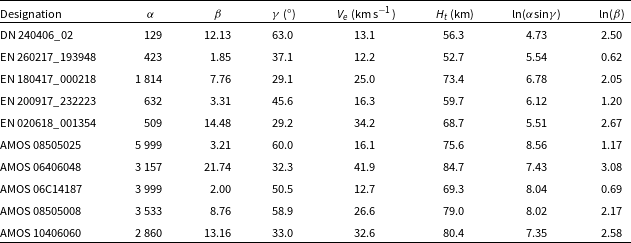
We focus on a set of 10 MDOs detected over Australia and continental Europe that have been assigned iron compositions, based upon spectra analysed by the AMOS and EFN teams (Vojácek et al. Reference Vojácek and Borovička2015; Rudawska et al. Reference Rudawska, Tóth, Kalmancok and Zigo2016). The spectra have been matched with accurate fall trajectories provided by the GFO, or by Vojácek et al. (Reference Vojácek and Borovička2015, Reference Vojácek and Borovička2019), Borovička et al. (Reference Borovička and Spurný2022
a) for European cases. Entry velocities and terminal altitudes are well-constrained in all 10 cases. Each of these iron meteoroids has an estimated entry mass of 150 g or less, and no surviving terminal mass. We use Equations (5) and (6) to determine minimally decelerating
 $\alpha$
and
 $\beta$
for these objects, and in accordance with the work of ReVelle & Ceplecha (Reference ReVelle and Ceplecha1994) and references therein, we assume a melting-dominated ablation coefficient of 0.0743 kg MJ
 $^{-1}$
.
3.3. Results of minimally decelerating objects
Figure 5 shows the positions of all GFO-detected MDOs in
 $\alpha$
-
 $\beta$
space. The position of each object relies on an estimated bulk ablation coefficient,
 $\sigma_b$
, as explained in the previous section. This visualisation can be used as a tool for understanding meteoroid dynamic properties and the likelihood of meteorite deposition from a given fall event.
 $\ln(\alpha \sin\gamma)$
versus
 $\ln(\beta)$
for minimally decelerating meteoroids captured by the GFO between March 2014 and December 2024.

Initially, this study hoped to identify spatial variation among these data that could be attributed to variation in material properties, namely density. To investigate this hypothesis, MDOs of known composition can be used to test whether or not meteoroids’ distribution in
 $\alpha$
-
 $\beta$
space depends upon their density. For this purpose, detailed emission spectra are invaluable for determining bulk compositions, as in the case of the 10 AMOS/EFN iron meteoroids highlighted in Figure 6.
Figure 5 with minimally decelerating iron meteoroids highlighted. The iron meteorite Ådalen is included for comparison.

4. Discussion
4.1. Bulk versus intrinsic ablation parameters
In this study it has been important to distinguish between bulk (
 $\sigma_b$
) and intrinsic (
 $\sigma_i$
) ablation coefficients, particularly given previous studies have published bulk or intrinsic values without necessarily differentiating them. The intrinsic ablation coefficient (
 $\sigma_i$
) is an inherent property of a given meteoroid, based on thermophysical characteristics. For instrumentally observed meteoroid entries, the ablation parameter is more commonly determined as an apparent (or ‘bulk’) value. This bulk ablation parameter (
 $\sigma_b$
) incorporates not only ablation, but also other mass loss effects, such as fragmentation. From our calculations of
 $\sigma_b$
for chondrite falls, small iron meteoroids and meteor shower bodies, there is an interesting relation that emerges between
 $\sigma_i$
and
 $\sigma_b$
. When ablation is the dominant mass loss mode, we expect similar values of
 $\sigma_i$
and
 $\sigma_b$
; this is the case for iron meteoroids. Some chondritic falls also yield
 $\sigma_i \approx \sigma_b$
, although most show fragmentation as the dominant mass loss mode and yield
 $\sigma_i \lt \sigma_b$
.
Meteor shower bodies originating from cometary streams also show
 $\sigma_i \lt \sigma_b$
. No cometary remnants are confirmed to have survived the passage through Earth’s atmosphere. In spite of this fact, enough is understood about such MSBs to explain their measured dynamic parameters. Comets are primarily composed of ices of water, methane, ammonia and carbon dioxide, mixed with organic and/or siliceous particles (Greenberg Reference Greenberg1998; Wesołowski et al. Reference Wesołowski, Bober, Ożóg, Truszkiewicz, Gritsevich, Bester and Wisz2025). The volatility of the icy components promotes their vaporisation and removal during solar approach (Shober Reference Shober2025), so that cometary remnants become progressively more porous and volatile-depleted over successive orbits. We expect this tenuous structure to promote a relatively high rate of mass loss via fragmentation, rather than pure ablation, during atmospheric entry.
4.2. Density/mass sorting of significantly decelerating objects
Among significantly decelerating objects (Figure 3), the size characteristics of a given meteoroid can generally be correlated with its ballistic coefficient. This is primarily due to the influences of bulk density and preatmospheric mass. The higher the density or mass, the lower the corresponding value of
 $\alpha$
. Objects of greater density contain more mass per unit of cross-sectional area. Consequently, they experience lower drag in comparison to their weight and penetrate deeper into the atmosphere. Meteoroids with a relatively dense, stony/asteroidal composition are therefore more common in the low-
 $\alpha$
region than bodies of cometary origin.
The highly friable nature of cometary remnants, coupled with the high heliocentric velocities imparted by their parent comets, can explain the high
 $\beta$
values obtained for MSBs in comparison with stony objects. Furthermore, compressed air exerting pressure upon the void spaces inside a porous cometary body magnifies aerodynamic drag, producing a high
 $\alpha$
value and further enhancing fragmentation (Tabetah & Melosh Reference Tabetah and Melosh2018).
Figure 3 shows that larger and denser objects tend to plot towards lower
 $\alpha$
and
 $\beta$
values. Significantly decelerating objects associated with the Geminid meteoroid stream do not align with the overall density trend described above. They are thought to be denser than cometary remnants (Buccongello et al. Reference Buccongello, Brown, Vida and Pinhas2024; Jenniskens Reference Jenniskens and Jenniskens2024), yet they do not produce lower
 $\alpha$
values as expected of stony bodies, instead showing similar characteristics to cometary remnants. Geminids are fragments of the asteroid 3200 Phaethon (Halliday Reference Halliday1988), and are expected to be similar to carbonaceous chondrites in terms of bulk density and composition (Babadzhanov Reference Babadzhanov2002). However, Figure 3 demonstrates their high ballistic coefficients compared with other stony objects, and even with many cometary MSBs, which are extremely porous and light. It is possible that Geminids are also highly porous, to a degree not considered in any dynamic trajectory analysis. Alternatively, they may represent minor icy components of their predominantly rocky parent asteroid, although this scenario is unlikely due to the asteroid’s close proximity to the Sun at perihelion, and the Geminids’ small sizes precluding volatile preservation (Jewitt & Li Reference Jewitt and Li2010; Jewitt et al. Reference Jewitt, Mutchler, Agarwal and Li2018). The JAXA-operated DESTINY+ mission, which will visit 3200 Phaethon and its associated meteoroid stream in 2028 (Arai et al. Reference Arai2018), may shed light on this mystery.
4.3. Sorting of minimally decelerating objects
There are 671 minimally decelerating objects (MDOs) among the reduced GFO dataset, with 253 determined to be from meteor showers, and 10 known from spectral analyses to be iron meteoroids. These are smaller objects for which a mass/density sorting or clustering effect may not be visible, contrary to the significantly decelerating bodies discussed in Section 4.2.
It is clear from Figure 6 that ‘minimally decelerating’ iron meteoroids do not occupy the same region of
 $\alpha$
-
 $\beta$
space as the much larger object Ådalen. They yield much higher ballistic coefficients because of their small size and high drag-to-weight ratio. Their mass loss parameters are higher because they have been assigned a relatively high ablation coefficient, in accordance with ReVelle & Ceplecha (Reference ReVelle and Ceplecha1994). Consequently, these meteoroids blend into the region occupied by MDOs of stony or cometary composition. There is no apparent trend in their positions. They have been identified as iron meteoroids on the basis of their emission spectra, using the methods and underlying assumptions described by Jenniskens (Reference Jenniskens2007) and Matlovič et al. (Reference Matlovič and Tóth2019). In the absence of spectra, this level of compositional/density distinction would not have been possible. Herein lies a compelling reason for the continued development and expansion of spectral systems within global fireball networks. Our results also illustrate that the ability of our MDO formulae to distinguish between different compositions and densities is not straightforward, unless data from alternative sources or analyses are available.
We observe that MDOs occupy a wider range of possible ballistic coefficients than other meteoroids do. Their wide spread along the horizontal axis is likely due to a size sorting effect, rather than density variation. The majority of MDOs are minuscule bodies with expected entry masses well below 1 kg, which generate high aerodynamic drag forces in comparison to their weight forces. Although there is some overlap between these and decelerating objects, the majority of MDOs occupy positions beyond
 $\ln(\alpha \sin(\gamma)) = 5.5$
where no kg-scale meteoroids have yet been recorded.
Where overlap does occur, it is in the region where
 $2.8 \lt \ln(\alpha \sin(\gamma)) \lt 5.5$
. Most of the bodies in this region are sporadic cometary or asteroidal remnants. There is only one object (DN141214_08) with a confirmed meteor shower association in this region, which belongs to the Geminids. We have examined this object in detail to elucidate factors that separate it from other bodies originating from the Geminids shower. Note that the closest observing camera was situated over 240 km from the fireball, thus any conclusions based on this observation should be considered with healthy scepticism.
Although the traditional
 $\alpha$
-
 $\beta$
method tends to fail for MDOs, certain dynamic parameters such as preatmospheric mass can be estimated using the Extended Kalman Smoother (EKS) built into the GFO reduction pipeline. For the Geminid, an initial mass of 4 kg has been derived. Compared with other Geminids detected by the same network, this mass is relatively large. We take 4 kg to be the upper limit possible for an MDO; several confirmed meteorites including Arpu Kuilpu (Anderson et al. Reference Anderson2024) and Cavezzo (Gardiol et al. Reference Gardiol2021) yield entry mass estimates below this threshold. There is nothing else visibly unusual about the DN141214_08; its entry and terminal altitudes and velocities are typical for the Geminids shower. If this object was indeed unusually large, it may also have been unusually weak, undergoing a singular catastrophic fragmentation event at high altitude.
To explain the overlap between normal and minimally decelerating populations in
 $\alpha$
-
 $\beta$
space, one must first consider instrumentation and analytical error. It is also possible that our
 $\sigma_b$
estimates are too inaccurate. Otherwise, the overlap can be explained by objects of unusually high entry mass (hence low
 $\alpha$
) coupled with low mechanical strength, such as ‘rubble piles’ and ‘dust balls’. These objects could deposit a large number of fragments into the atmosphere, but the small sizes of individual fragments would promote total vaporisation before significant deceleration could occur.
5 Conclusions
Dynamic trajectory analysis using the
 $\alpha$
-
 $\beta$
method, as initially presented by Gritsevich (Reference Gritsevich2008
b), provides a baseline for classification of Earth-impacting meteoroids, whether or not they survive impact. It provides a physically grounded system to classify a wide range of meteoroids, including those that deposit meteorites on the ground. In previous studies this method was limited to meteoroids showing significant deceleration during atmospheric descent. 1 118 such meteoroids were detected by the GFO between March 2014 and December 2024. For the first time, we have estimated
 $\alpha$
and
 $\beta$
values for ‘minimally decelerating’ objects (MDOs) using a method based upon the terminal altitude formula of Gritsevich & Popelenskaya (Reference Gritsevich and Popelenskaya2008) and reasonable bulk ablation coefficient estimates (
 $\sigma_b$
). The GFO detected 671 MDOs in the 2014–2024 period of operation, of which 253 have been associated with known meteor showers. The parameters thus derived can provide insights into the shape, strength, ablation efficiency, and mineralogical nature of shower and sporadic meteoroids.
The most important findings of this study are as follows:
-
1. Ballistic coefficients (
$\alpha$
) and mass loss parameters (
$\beta$
) can be estimated for MDOs under the assumption of zero terminal mass, using a reasonable estimate of the bulk/apparent ablation coefficient (
$\sigma_b$
). -
2. Bulk ablation coefficients for a range of meteoroid compositions have been constrained using
$\beta$
values from a suite of decelerating meteoroids, including 36 instrumentally observed meteorite falls, and 15 events associated with meteor shower bodies. They reflect fragmentation processes in addition to pure ablation. For stony meteorites,
$\sigma_b$
can be highly variable and tends to exceed the intrinsic ablation coefficient
$\sigma_i$
(Figure 2). For meteor shower bodies,
$\sigma_b$
tends to be higher than
$\sigma_i$
, with the exception of the Geminids (Table 1). -
3. Observed and theoretical ablation coefficients for iron meteoroids have been directly compared. Previously, intrinsic ablation coefficients of 0.0743 and 0.0124 kg MJ
$^{-1}$
were proposed for irons respectively smaller or larger than
$2.0 \times 10^5$
kg. Our derived bulk value of 0.010 kg MJ
$^{-1}$
for Ådalen challenges this dichotomy because its estimated entry mass ranges from
$3.5$
–
$8.5 \times 10^3$
kg. Further study of iron meteorites in the laboratory is required to more accurately constrain ablation behaviours, in particular the threshold size between melting- and vaporisation-dominated regimes. -
4. There is an inverse correlation between the bulk density of a significantly decelerating object and its
$\alpha$
value, the primary exceptions being large airburst producers and Geminids (Figure 3). This relationship is not valid for MDOs. -
5. The position of an object in
$\alpha$
-
$\beta$
space can be used to evaluate its likelihood of depositing meteorites, but not its bulk composition. This finding reinforces the ‘fate criterion’ of Sansom et al. (Reference Sansom2019).


To achieve dynamics-based classification of all extraterrestrial impactors, there is a continual demand for linked kinematic, dynamic and compositional data from meteorite falls. In particular, observations of iron meteorites are lacking due to the apparent rarity of large iron meteoroids in near-Earth space. Planned expansion of spectral camera systems across Australia will enable the addition of elemental data to our analyses.
The ability to resolve spectra over time, for example by linking them with traditional fireball cameras, will also allow for easy identification of fragmentation points. The timing of fragmentation can then be used as a proxy for bulk mechanical strength. In a future study we will combine
 $\alpha$
,
 $\beta$
, composition and an appropriate strength indicator to classify large numbers of detected meteoroids. This line of research will enable a more comprehensive understanding of the objects impacting Earth from space.
Supplementary material
The supplementary material for this article can be found at https://doi.org/10.1017/pasa.2026.10251
Acknowledgements
The primary authors acknowledge the traditional custodians of the land where they operate, the Whadjuk Nyoongar people of Western Australia, and their elders past, present and future.
The Desert Fireball Network and Global Fireball Observatory programmes have been funded by the Australian Research Council as part of the Discovery Project scheme (DP170102529, DP200102073, DP230100301), the Linkage Infrastructure, Equipment and Facilities scheme (LE170100106), and institutional support from Curtin University.
We thank Drs P. G. Brown and J. Borovička for their valuable feedback during the preparation of this paper.
T. W. C. Stevenson acknowledges the support of an Australian Government Research Training Program (RTP) Scholarship to support his PhD candidacy.
M. Gritsevich expresses gratitude to the Academy of Finland for supporting the project no. 325806 (PlanetS), and to the Spanish Ministry of Science, Innovation and Universities project No PID2023-151905OB-I00, which facilitated the development of the analytical methods presented in this paper. The programme of development within Priority-2030 is acknowledged for supporting researches at UrFU.
L. Daly acknowledges support from UKRI STFC grants (ST/Y004817/1, ST/T002328/1, ST/W001128/1, and ST/V000799/1).
Appendix A. Derivation of novel formulae for dynamical analysis of MDOs
The formulae we have used to estimate
 $\alpha$
and
 $\beta$
for ‘minimally decelerating’ meteoroids are provided in Section 3.2. Their algebraic derivation follows from formulae presented in prior independent studies. First, we employ the terminal altitude equation of Gritsevich & Popelenskaya (Reference Gritsevich and Popelenskaya2008), which implicitly assumes the absence of a terminal mass: A
 \begin{equation}y_t = \ln\!(2 \alpha \beta)\end{equation}
First, the ballistic coefficient
 $\alpha$
is found by substituting the defining equation for
 $\beta$
as follows:
 \begin{equation}\beta = \frac{(1 - \mu) \sigma_b V_e^2}{2}\end{equation}
 \begin{equation}y_t = \ln\!\big(\alpha (1 - \mu) \sigma_b V_e^2\big)\end{equation}
 \begin{equation}e^{y_t} = \alpha (1 - \mu) \sigma_b V_e^2\end{equation}
Adopting the common assumption of uniform ablation across the meteoroid’s surface, we set
 $\mu = \frac{2}{3}$
. The term (1-
 $\mu$
) therefore becomes
 $\frac{1}{3}$
, leading to:
 \begin{equation}e^{y_t} = \frac{\alpha \sigma_b V_e^2}{3}\end{equation}
 \begin{equation}\alpha = \frac{3e^{y_t}}{\sigma_b V_e^2}\end{equation}
Once
 $\alpha$
is known, the mass loss parameter
 $\beta$
can be found by rearranging the terminal altitude formula (B6):
 \begin{equation}\beta = \frac{e^{y_t}}{2 \alpha}\end{equation}
Into this we may substitute the novel formula for
 $\alpha$
, to arrive at a novel formula for
 $\beta$
that does not depend on the normalised terminal altitude:
 \begin{equation}\beta = \frac{e^{y_t} \sigma_b V_e^2}{6e^{y_t}}\end{equation}
 \begin{equation}\beta = \frac{\sigma_b V_e^2}{6}\end{equation}
In this scheme, the values of both
 $\alpha$
and
 $\beta$
depend upon the bulk ablation coefficient
 $\sigma_b$
. It is for this reason that we have devoted Section 2.4 to placing reasonable constraints on ablation coefficients for metallic, stony and cometary meteoroid types.
Appendix B. Data tables
Kinematic and dynamic parameters for a selection of instrumentally observed meteorite falls.

Table B1. Long description
Table with columns for meteorite name, type, ballistic coefficient, mass loss parameter, entry angle, entry velocity, terminal altitude, bulk ablation coefficient, and references. Each row provides data for a different meteorite, including Madura Cave, Maribo, Mason Gully, Morvka, Murrili, Neuschwanstein, Park Forest, Puli Ilkaringuru, Raja, Saint-Pierre-le-Viger, Stubenberg, Taghzout, Tagish Lake, Takap, Traspena, Villalbeto de la Pea, Winchcombe, and dr nad Szavou.
 $^*$
Indicates a provisional name.
 $\alpha$
: Ballistic coefficient;
 $\beta$
: Mass loss parameter;
 $\gamma$
: Entry angle measured from horizontal;
 $V_e$
: Entry velocity;
 $H_t$
: Terminal altitude;
 $\sigma_b$
: Bulk ablation coefficient.
Kinematic and dynamic parameters for a selection of instrumentally observed ‘minimally decelerating’ iron meteoroids whose emission spectra have been captured by AMOS in conjunction with the GFO or EFN (Vojácek et al. Reference Vojácek and Borovička2015, Reference Vojácek and Borovička2019; Matlovič et al. Reference Matlovič and Tóth2019; Borovička et al. Reference Borovička2022
a). In all cases, an ablation coefficient of 0.074 kg MJ
 $^{-1}$
has been assumed (ReVelle & Ceplecha Reference ReVelle and Ceplecha1994). Fireball DN240406
 $\_$
02 has not previously been reported.

Table B2. Long description
The table presents kinematic and dynamic parameters for a selection of instrumentally observed minimally decelerating iron meteoroids. It includes data on designation, alpha, beta, gamma, initial velocity, H-infinity, ln(sin(gamma)), ln(rho), and sigma-s. The table has 12 rows and 9 columns. Column headers are: Designation, alpha, beta, gamma, V-infinity (km s^-1), H-infinity (km), ln(sin(gamma)), ln(rho), and sigma-s (kg MJ^-1). Row labels include various designations such as DN 24040602, EN 260217193948, EN 180417000218, and others. Each row provides specific values for the parameters listed in the column headers. Notable trends or outliers are not explicitly mentioned but can be observed by examining the values in the table.


 μ=23
 ∗
 σb
 σi
 σi
 σi
 σb
 σi

 ln(αsinγ)
 ln(β)

 H0ln(2αβ)
 H0

 ln(αsinγ)
 ln(β)

 −1
 _


 Open access

