It is well known that some people are relatively successful in learning a second language (L2), whereas others find it relatively more difficult (Dörnyei, 2005; Segalowitz, 1997). One factor that might mediate individual differences in L2 learning is phonological memory (i.e., the ability to recognize and remember phonological elements and their order of occurrence). In spoken communication, listeners must be able to retain phonological elements and their serial order over short intervals of a second or two if they are to correctly identify the words and grammatical structures of the utterances they hear. In a L2, this can pose a potentially significant challenge because the sound system of the target language might differ from the first language (L1) and because the identity of words and phrases might not be as automatically available as in the L1. The ability to hold on to input sounds and their serial order for a short time to allow sufficient processing to take place might thus play a critical role in L2 comprehension and, importantly, in L2 learning. An inability to carry out such a basic phonological process could compromise both immediate comprehension and the short-term retention of information needed for learning new words and grammatical structures. Thus, it is plausible that people with better phonological memory skills find learning languages easier than those with poorer phonological memory abilities. This idea has long been recognized in the language aptitude literature (e.g., Carroll, 1990; Robinson, 2003, 2005; Skehan, 1998); the ability to encode phonological sequences into working memory and maintain them is presumed to be a necessary prerequisite for the further processing essential to SLA, and individual differences in this ability exist. The goal of the present research was to investigate this relationship between phonological memory abilities and L2 oral fluency development in an adult population of learners.
A large volume of research that examines the relationship between phonological memory and language learning has been published in recent years (see Baddeley, Gathercole, & Papagno, 1998, and Ellis, 1996, for reviews). This relationship, especially with children's L1 acquisition, has been found to be so robust that Baddeley et al. proposed that the function of phonological memory is to make the learning of new words possible. Indeed, they called it a “language learning device” (Baddeley et al., p. 887). The primary objective of the current study is to examine whether phonological memory plays a role in adults' acquisition of oral fluency—as opposed to vocabulary skill development—in a L2.
Phonological memory is one component of Baddeley and Hitch's (1974) multicomponent model of working memory. Briefly, the working memory model contains a multifunctional attentional system called the central executive (Baddeley, 1996) and two slave systems: a phonological loop, specialized for verbal information and responsible for phonological memory, and a visuo-spatial sketchpad, responsible for visual and spatial information. A more recent addition to the model is an episodic buffer that integrates information originating from the slave systems with information from long-term memory (Baddeley, 2000; Baddeley & Wilson, 2002). The phonological loop is the component for which there is the most experimental evidence (see Baddeley et al., 1998). It contains a phonological store, which holds verbal information for short periods of time, and an articulatory rehearsal process, which refreshes the contents of the phonological store.
Phonological memory facilitates language learning by holding novel phonological traces temporarily until more permanent representations can be formed. It is estimated that phonological memory is able to store the phonological traces for about 2 s unless they are refreshed by rehearsing them subvocally (Baddeley, Thomson, & Buchanan, 1975). A variety of measures has been used to assess phonological memory: nonword repetition, word span, serial nonword recall (nonword span), serial nonword recognition (SNWR; nonword matching span), digit span, and others. Although these different measures operationalize phonological memory in different ways, the common underlying focus is on the holding mechanisms that keep phonological information available for a short period of time in order to make subsequent, more elaborate processing possible. This information holding aspect is the main focus of this study.
Early studies that reported a relationship between phonological memory and language learning concerned an adult patient, P.V., who had suffered an ischemic lesion to the left hemisphere language area, leaving her with a severe deficit in the phonological loop (Baddeley, Papagno, & Vallar, 1988; Vallar & Baddeley, 1984). P.V. had fluent native speech and was able to perform normally on a number of long-term memory tasks, including the learning of word-word pairs. However, she had a nonword memory span of only two syllables and was unable to learn even one word-nonword pair. Study of this patient provided early evidence that a deficit in the phonological loop impairs the learning of new words.
There have been numerous studies showing that phonological memory is implicated in L1 learning by children. Phonological memory has been shown to correlate with children's native vocabulary knowledge (Adams, Bourke, & Willis, 1999; Gathercole & Adams, 1993, 1994; Gathercole & Baddeley, 1989; Gathercole, Service, Hitch, Adams, & Martin, 1999; Gathercole, Willis, & Baddeley, 1991; Gathercole, Willis, Emslie, & Baddeley, 1992; Michas & Henry, 1994) even as late as 14 years of age (Gathercole et al., 1999) and with children's ability to learn word-nonword pairs, recall new names, and recall definitions of new words (Gathercole, Hitch, Service, & Martin, 1997). Children with better phonological memory abilities are better at repeating complex sentences (Blake, Austin, Cannon, Lisus, & Vaughan, 1994; Willis & Gathercole, 2001), and they produce longer utterances (Adams & Gathercole, 1995, 1996, 2000; Blake et al., 1994), recall more information contained in a story (Adams & Gathercole, 1996), and use more different words in their speech as well as more complex syntactic structures (Adams & Gathercole, 1995, 2000).
Phonological memory has also been shown to relate to children's SLA. In Cheung's (1996) study, phonological memory predicted the number of trials to learn new L2 words, but only for less fluent bilingual children. It has been correlated with elementary school children's L2 vocabulary (Masoura & Gathercole, 1999, 2005). Additionally, earlier phonological memory predicts later L2 abilities of elementary school children, including vocabulary, reading comprehension, listening comprehension, and written production (Dufva & Voeten, 1999; French, 2006; Service, 1992; Service & Kohonen, 1995).
There is evidence that phonological memory plays a role in foreign language or L2 learning in adults. Polyglots, for example, have better phonological memory abilities than nonpolyglots and are better at learning L2 words but not at learning paired associates in their L1 (Papagno & Vallar, 1995). Simultaneous interpreters were also shown to have better phonological memory abilities than L2 teachers: In a study by Christoffels, de Groot, and Kroll (2006), phonological memory was assessed using L1 and L2 word spans, and simultaneous interpreters performed better on both the L1 and L2 versions of this task than did L2 teachers. Phonological memory has also been shown to predict the ability to learn L2 vocabulary (Atkins & Baddeley, 1998; Gupta, 2003; Speciale, Ellis, & Bywater, 2004) and grammar (Williams & Lovatt, 2003) in experimental settings. The effects of articulatory suppression and word length, both thought to affect the articulatory rehearsal component of the phonological loop, and phonological similarity, assumed to affect the storage component, provide further evidence that phonological memory is implicated in L2 learning by adults. For example, studies by Papagno, Valentine, and Baddeley (1991) and Papagno and Vallar (1992) showed that articulatory suppression and word length impaired the learning of word-nonword pairs but not word-word pairs (cf. Duyck, Szmalec, Kemps, & Vandierendonck, 2003, who provided evidence that articulatory suppression also impairs the learning of abstract word-word pairs). Papagno and Vallar (1992; cf. Romani, McAlpine, Olson, Tsouknida, & Martin, 2005) found that phonological similarity also disrupts the learning of word-nonword pairs more than the learning of word-word pairs. Finally, Ellis and Sinclair (1996) found that the maintenance of L2 utterances in memory through repetition resulted in better vocabulary acquisition and more overall grammatically correct speech attempts in the L2 than when repetition was suppressed.
The goal of the present study was to investigate the role of phonological memory in the acquisition of L2 oral fluency. Previous research with adults has employed a variety of paradigms to look at phonological memory with a focus on vocabulary learning, but, to our knowledge, few studies have looked at other aspects of adult L2 learning (cf. Ellis & Sinclair, 1996; O'Brien, Segalowitz, Collentine, & Freed, 2006; Speciale et al., 2004; Williams & Lovatt, 2003), and no study has looked at oral fluency. In contrast, phonological memory has been found to relate to a number of measures of spontaneous speech in children other than vocabulary, including length of utterance, vocabulary richness, syntactical complexity, and the recall of story information (Adams & Gathercole, 1995, 1996, 2000; Blake et al., 1994). Consequently, we wished to look at whether phonological memory would also play a role in other aspects of SLA in adults—namely oral fluency.
This study was carried out in a language-learning environment that was ecologically more natural than previous studies. For the most part, foreign language or L2 studies with adults have looked at the role of phonological memory in laboratory-based experimental word learning. Experimental word learning is a highly controlled paradigm that minimizes the influence of extraneous variables; L2 learning, however, typically takes place not in a tightly controlled environment but in the classroom and by exposure to the target language outside the classroom. This real-world dimension of learning a L2 is highly variable and is influenced by numerous factors not present in the laboratory.
In L1 studies involving children, for whom the native vocabulary has been learned through exposure to the language in highly variable contexts rather than in a controlled experimental setting, phonological memory has been found to correlate with size of native vocabulary (Adams et al., 1999; Gathercole & Adams, 1993, 1994; Gathercole & Baddeley, 1989; Gathercole et al., 1991, 1992, 1999; Michas & Henry, 1994). Furthermore, a number of longitudinal studies of natural language learning have found that earlier phonological memory predicts later L1 and L2 language abilities. Service (1992) tested Finnish elementary school children learning English and found that phonological memory predicted their English course grade 2.5 years later as well as a number of English subskills: listening comprehension, reading comprehension, and written production. However, this relationship was found to be mediated by English vocabulary acquisition (Service & Kohonen, 1995).
Some studies have suggested that phonological memory plays a causal role in language learning. Gathercole et al. (1992) assessed the nature of the relationship between phonological memory and vocabulary skills in children. Using cross-lagged correlations, they found that phonological memory at age 4 predicted vocabulary knowledge at age 5 as well as the gain in vocabulary between ages 4 and 5, whereas vocabulary knowledge at age 4 did not predict phonological memory at age 5, suggesting that phonological memory plays a causal role in vocabulary development. In one of the only L2 studies we know of that attempts to establish causality, French (2006) looked at the role of phonological memory in children's L2 development over time. He tested Francophone (L1) preadolescent children enrolled in an intensive English (L2) language program and found that phonological memory measured at the start of the program predicted their proficiency in English listening comprehension, reading comprehension, and vocabulary 5 months later. Through the use of partial cross-lagged correlations, French also suggested that this relationship was causal in nature.
To our knowledge, only one study has looked at the relationship between phonological memory and L2 learning by adults in a real-world learning environment. Speciale et al. (2004, Experiment 2) tested adults enrolled in an introductory Spanish language course. They found that phonological memory (measured by repetition of nonwords rated low in English wordlikeness) at the beginning of the semester predicted the acquisition of Spanish phonological regularities measured at the end of the semester using the repetition of Spanish nonwords rated high in wordlikeness. The repetition of Spanish wordlike nonwords, in turn, predicted performance on a test assessing listening comprehension, reading comprehension, and written production in Spanish. Thus, phonological memory (repetition of low wordlike nonwords) appears to be associated with the acquisition of long-term knowledge about the phonological properties of a L2.
THE PRESENT STUDY
As shown in the literature review, little is known about the role of phonological memory in adult L2 oral development in an open, non-laboratory-based learning situation. Consequently, the present study was carried out in language learning settings that included a semester in a regular university classroom setting for one group of students and a semester in a study-abroad setting that involved both formal classroom learning and exposure to the native speech community in out-of-class language contact for another group of students. Similar to the relationship between phonological memory and L1 learning in children, such a study might provide evidence that phonological memory is also implicated in real-world L2 learning by adults.
In the present study, phonological memory was understood as the ability to retain phonological elements and their serial order in the short term (i.e., for a few seconds). Such skills would seem, on logical grounds, to be necessary for the development of oral fluency in the L2. Of course, other important phonological processing skills, not addressed here, would include the ability to correctly articulate phonological elements, the ability to orally recall phonological targets, the ability to make perceptual distinctions within the phonological system of the target language, the ability to abstract phonological regularities characteristic of the target language, and the ability to handle phonological variation within the language, among others. Phonological memory was operationalized in the present study as performance on a SNWR task—a task that involves recognizing whether two otherwise identical meaningless phonological sequences have their constituent elements in the same order. Of course, the SNWR task itself is not a pure measure of phonological memory (no task could be) because, by necessity, it includes nonphonological and nonmemory processing demand characteristics (e.g., attention, comparison processes, executive control in decision-making). Future research will need to unpack the psychological constructs that underlie performance on this task and address what role (if any) these various components play in determining performance on the task itself and the association (if any) this performance might have to success in L2 oral fluency development. This study limits itself to determining whether performance on the SNWR task is related to adult L2 oral fluency development; if a relationship is found, it will be assumed that this relationship implicates, at the very least, some aspect of phonological memory, although it is recognized that further research is necessary to be certain that it is the phonological memory components of this task that are crucial, not some other aspects.
Phonological memory was assessed at the beginning (time 1) and at the end (time 2) of the semester using the SNWR. This task required participants to determine whether two strings of nonwords were presented in the same or a different order. Stimuli that followed English (the participants' L1) phonotactic rules were used. SNWR was chosen for several reasons. First, unlike nonword repetition and serial nonword recall (two tasks most often used to measure phonological memory), SNWR does not contain a spoken production component. This was an important consideration in the present context because the measures of L2 fluency were based on speech production. Any relationship found between phonological memory and L2 fluency gains would be more compelling if oral production skill were not a potential confound (i.e., a confound due to mutual output constraints in which associations between speech production measures and phonological memory measures requiring verbal responses reflect common articulatory output requirements). Nonword repetition has been criticized for just this reason: The considerable articulatory processes involved (Snowling, Chiat, & Hulme, 1991) make it difficult to interpret results (i.e., whether results are due to memory or to output demands). This criticism also applies to serial nonword recall (or nonword span).
Second, serial recognition is less affected by lexicality (i.e., better recall with words than with nonwords) than is serial recall or repetition. In serial recall and repetition, performance is much better with words than with nonwords, whereas in serial recognition, the superiority of words over nonwords is much less. For example, Gathercole, Pickering, Hall, and Peaker (2001) observed that the effect of lexicality was more strongly associated with serial recall accuracy (partial η2 between .71 and .94) than with serial recognition accuracy (partial η2 between .25 and .27). The authors found accurate recall of words to be between 71% and 113% better than recall of nonwords, whereas accurate recognition of words was only between 8% and 17% better than recall of nonwords (cf. Jefferies, Frankish, & Lambon Ralph, 2006, who found that SNWR was influenced by long-term phonological knowledge; when phoneme order rather than item order was changed, accurate recognition of words was 14.8% better than nonwords, and for item order changes, accurate recognition of words was 7.6% better than nonwords). These findings suggest that serial recognition relies on long-term (lexical and phonological) memory support to a much smaller extent than serial recall does, and, hence, it provides a more appropriate test of phonological memory. Baddeley (2003) has suggested that long-term knowledge (lexical and phonological) might affect the rehearsal and output components of phonological memory tasks rather than the storage component. Thus, because it does not require a verbal response, SNWR might be a purer measure of phonological storage than is recall or repetition.
Third, serial recognition appears to be less sensitive than serial recall to the language of testing, in that performance is comparable whether bilinguals are tested on recognition of words in their L1 or L2 (Thorn, Gathercole, & Frankish, 2002). In contrast, serial recall of both words and nonwords has been shown to be better in participants' L1 than in their L2 (Thorn & Gathercole, 2001; Thorn et al., 2002). Thorn et al. found that the strength of association (partial η2) between language and serial recall accuracy was .36, whereas between language and serial recognition accuracy, it was only .01.
English nonword stimuli were used for the SNWR task to minimize the influence of long-term L2 knowledge on the phonological memory measure. All of the participants had English as their L1 and all were university students at English-speaking institutions. Thus, it was reasonable to assume that they all possessed good English language skills. We used English-sounding nonwords as a means to equate the participants on their long-term knowledge of the phonotactic properties of the nonword stimuli comprising the task (cf. Frisch, Large, Zawaydeh, & Pisoni, 2001, who provided evidence that phonotactic knowledge and decisions of wordlikeness vary with vocabulary knowledge). We reasoned that, together with the evidence that serial recognition is less sensitive to lexicality than either serial recall or repetition, individual differences in performance on this task were more likely to reflect differences in basic phonological short-term memory ability than would performance on a task using L2-sounding nonwords.
The measures of Spanish oral fluency were taken from recordings of participants' Oral Proficiency Interviews (OPI; Breiner-Sanders, Lowe, Miles, & Swender, 2000). The OPI was used as a standard means for collecting a corpus of oral language data. Four-minute extracts taken from the OPI recordings at time 1 and again at time 2 were analyzed for a number of temporal/hesitation-based oral fluency measures. Oral fluency included both general oral ability and oral fluidity measures. General oral ability was operationalized as the total number of words spoken and the length in words of the longest turn. Oral fluidity was operationalized as rate of speech (words per minute), mean length of speech runs in words containing no silent pauses or hesitations greater than 400 ms, mean length of speech runs in words containing no filled pauses (ums, ahs, etc.), and longest speech run in words containing no silent or filled pauses (see Method section for details).
In the field of SLA, L2 oral fluency is frequently assessed in terms of temporal aspects of speech, such as speech rate, pauses (frequency, placement, location, and length), run length between pauses, and so forth (see Wood, 2001, for a review). There is empirical evidence that quantitative measures of fluency improve with the length of time that participants have spent learning the L2, and that L2 speakers tend to speak at a slower rate, make proportionately more pauses, and produce shorter runs between pauses in their L2 than in their L1 (e.g., Towell, Hawkins, & Bazergui, 1996). The mean run length has been found to be a particularly potent measure of L2 fluency (see Wood). Such temporal aspects of spontaneous speech also correlate with overall evaluations of fluency (e.g., Cucchiarini, Strik, & Boves, 2002; Derwing, Rossiter, Munro, & Thomson, 2004). The quantitative measures used in the present study follow the SLA research tradition and have been shown to improve with increased length of study and to discriminate among fluency levels.
The data reported here were collected as part of a larger study investigating the role of learning context (at the participants' home university in the United States or in a study-abroad semester in Spain), out-of-class Spanish contact, and cognition in the acquisition of L2 oral fluency; the study also involved additional tests not discussed in this article (Segalowitz & Freed, 2004; see also O'Brien et al., 2006).1
Eighteen participants were enrolled in one Spanish language course at their home university in the United States. Twenty-five students were enrolled in three Spanish language courses—grammar and syntax, reading and writing, and conversation—during a study-abroad program in Spain. Fourteen of these students took an additional one or two courses in Spanish culture and society. Additionally, the students studying abroad were able to take advantage of opportunities to interact with native speakers of the language, which were not generally available to the students remaining at their home university. High levels of contact with native L2 speakers could be expected to provide additional practice, leading to greater gains in L2 fluency for the study-abroad students.Segalowitz and Freed (2004) found that learning context played a role in Spanish oral fluency gains; in their study, as a whole, students who had spent a semester in Spain made more gains than those who remained at their home university. Interestingly, although the students who spent a semester abroad were enrolled in three to five Spanish courses, Segalowitz and Freed found that the number of Spanish courses taken by the study-abroad students was not related to their Spanish oral fluency gains. Similarly, the authors found no relationship between the total number of hours per week that students reported they spent on speaking, reading, writing, and listening activities in Spanish and gains in Spanish oral fluency. The absence of such a relationship between oral fluency gains and time reported to have been spent using the L2 might be due to factors that the data do not permit us to identify here (e.g., the relationship might be weaker than expected at the particular levels of ability examined or they might have been offset by other activities not assessed). However, because learning context did play a significant role in Spanish oral fluency gains, as reported by Segalowitz and Freed, context was entered into the analyses to assess the role played by phonological memory in the acquisition of L2 oral fluency over and above the role played by learning context.
In summary, the goal of the present study was to investigate the role of phonological memory in the acquisition of L2 oral fluency and to do so in language learning settings that were more ecologically natural than the controlled laboratory. It was hypothesized that for those participants who gained in oral fluency over the course of the semester, there would be a positive relationship between phonological memory skills and L2 oral fluency development after controlling for the learning environment.
METHOD
Participants
Forty-three students (33 females, 10 males; M = 21.84 years old, SD = 7.00) studying Spanish as a L2 participated in this study. The following criteria for inclusion in the study were used: The participants' L1 was English, they had at least two semesters of formal study of Spanish, they had no prior experience studying Spanish abroad, they did not have Spanish as a heritage language, and no Spanish was spoken in their home. Eighteen of the participants (14 females, 4 males) were enrolled in a regular, formal Spanish course at the University of Colorado in the United States, and the remaining 25 students (19 females, 6 males), also from the United States, participated in a study-abroad program at the Universidad de Alicante in Spain.
Materials and Procedure
At the beginning of the semester, the students performed a SNWR task and took part in a 20–30 min, tape-recorded OPI in Spanish. At the end of the semester, 13 weeks later, they were tested again on phonological memory and completed another OPI.
SNWR (phonological memory).
Students were tested on the serial recognition of sequences composed of one-syllable consonant-vowel-consonant nonwords. The stimulus set consisted of 144 nonwords taken from Gathercole et al. (2001). The set of nonwords for this study was organized into eight sequences at each of three sequence lengths: five, six, and seven items. All of the items within a sequence had a different vowel sound, and the consonant composition within each sequence was as distinctive as possible (see O'Brien et al., 2006, for a list of the nonwords used). Within each sequence, the items were randomly ordered across subjects. The eight sequences at each sequence length were used to construct four same and four different sequence pair trials. In the same-pair sets, a given nonword sequence was presented twice, with a short pause between repetitions. For the different-pair sets, the second presentation of a given sequence contained the same items as the initial presentation but with the order of two adjacent items reversed from the original order. The location of the transposed pair within each sequence was varied randomly across participants with the constraint that the first two and the last two adjacent items in a given sequence were never transposed. Within each sequence length set, the four same and four different trials were randomly ordered across participants. A practice set consisting of two same and two different sequence pairs of four items each was also constructed.
Students were tested individually, commencing with the practice trials. If the participant made an error on the practice trials, the task was explained again and the practice trials were presented a second time. Once there were no errors on the practice trials, the eight five-item sequence pairs were presented, followed by the eight six-item sequence pairs and, finally, the eight seven-item sequence pairs. The lists of nonwords were presented through earphones via a Macintosh computer using the built-in “Victoria, High Quality” computer-generated voice producing the stimulus nonwords from a text file. The nonwords were presented at the rate of approximately one item every 750 ms. The delay between the presentations of the two sequences in the pair that made up a given trial was approximately 1.5 s. Following the second presentation of each list, participants responded by key press to indicate whether the two presentations were in the same or a different order. The number of correct responses for each sequence length was recorded for each participant. A weighted score was computed to reflect the greater difficulty with increasing sequence length: Correct responses at sequence length 5 were assigned a score of 5, correct responses at sequence length 6 were assigned a score of 6, and correct responses at sequence length 7 were assigned a score of 7, for a maximum weighted score of 144.
OPI.
The OPI consisted of a 20–30-min tape-recorded interview given by testers trained and certified by the American Council on the Teaching of Foreign Languages (Breiner-Sanders et al., 2000). There was a time 1 and time 2 interview for each participant. The interview recordings were digitized and two 2-min extracts were taken from each interview: one beginning at approximately minute 7 and the other at approximately minute 12 in the interview, yielding a 4-min time 1 oral extract and a 4-min time 2 oral extract for each participant (for a detailed description, see Segalowitz & Freed, 2004). These extracts of student speech were analyzed for time 1 and time 2 measures of oral fluency (general overall oral ability and fluidity) in Spanish. General overall oral ability included two measures: total number of words spoken in the extract (called totalwords), and number of words in the longest turn (turn). Fluidity included four measures: speech rate in words per minute (rate), absence of hesitations (referred to as hesitfree) expressed as the mean run length in words containing no silent pauses longer than 400 ms, absence of filled pauses (called fillerfree) expressed as the mean run length in words containing no filled pauses (ah, um, etc.), and longest fluent run in words containing no silent or filled pauses (referred to as fluentrun).
RESULTS
The data were first inspected for outliers. Outlier scores were identified and corrected in the following manner: For each variable, scores greater than two standard deviations from the mean were assigned the next highest score plus one unit (Tabachnick & Fidell, 2001). Scores less than two standard deviations from the mean were assigned the next lowest score minus one unit (parallel analyses were carried out without correcting for outliers and this yielded similar patterns of results). For all of the analyses reported in the following, the α level selected for significance was .05, two-tailed, unless otherwise noted.
Means and standard errors of all seven variables (SNWR, two general oral ability variables, four oral fluidity variables) for the entire cohort and for the study-abroad and at-home groups at time 1 and time 2, after adjusting for outliers, are presented in Table 1. To test whether the study-abroad and at-home groups differed on the measures upon entry into the study at time 1, a series of a priori t tests was performed. The t tests revealed that at time 1, the groups differed significantly on fillerfree, t (41) = 2.08, p < .05, and fluentrun, t (41) = 3.24, p < .005; the study-abroad group entered the study with higher scores on these measures than the at-home group (see Table 1). The study-abroad group also had marginally higher scores on rate than the at-home group at time 1. These differences might reflect self-selection factors for those participating in the study-abroad program, which should be kept in mind when interpreting the results.
Means and standard errors for SNWR and oral production measures at time 1 and time 2

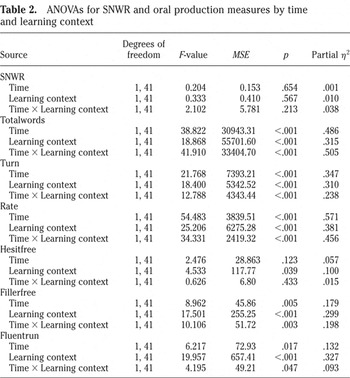
To test whether the participants differed on the measures between time 1 and time 2, a series of mixed ANOVAs, with time (time 1 or 2) as the within-subjects factor and learning context (study-abroad or at-home) as the between-subjects factor, was performed separately for each of the seven variables (see Table 2). For the SNWR task, there was no time or learning context effect and no time by learning context interaction, which shows that the groups did not differ from each other at time 1 or time 2. Given that there was no difference in SNWR performance between time 1 and time 2, only the time 1 SNWR score is used in subsequent analyses. For five of the oral production variables (totalwords, turn, rate, fillerfree, and fluentrun), there were time and learning context effects; all of the participants improved on these measures between time 1 and time 2, and the study-abroad group scored higher on these measures than the at-home group. For these same five measures, there were also time by learning context interactions, showing that the groups experienced different rates of improvement: The study-abroad group improved on these five measures of Spanish oral production between time 1 and time 2, whereas the at-home group did not. With regard to hesitfree, the only significant effect was learning context, such that the study-abroad group performed better on this measure than the at-home group.
ANOVAs for SNWR and oral production measures by time and learning context

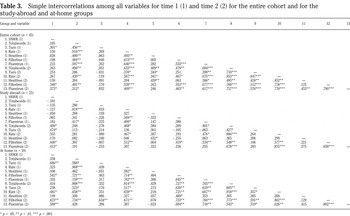
Table 3 (top panel) shows the Pearson intercorrelation coefficients for all measures (except SNWR) across times 1 and 2 for the entire cohort; for SNWR performance, only the time 1 measure is shown. Time 1 SNWR performance was significantly correlated with time 1 turn (r = .301, p = .050). Of particular interest, however, is the relationship between this time 1 SNWR measure and Spanish oral measures at time 2. SNWR performance was significantly correlated with two out of the six time 2 Spanish oral measures—fillerfree, r = .340, p = .026; fluentrun, r = .375, p = .013—and the correlation with totalwords and rate showed a trend toward significance—totalwords, r = .263, p = .088; rate, r = .253, p = .084. This pattern of results suggests that, overall, there is a link between SNWR performance skills and L2 fluency following a semester of learning (11.5% or more variance overlap for the significant variables).
Simple intercorrelations among all variables for time 1 (1) and time 2 (2) for the entire cohort and for the study-abroad and at-home groups

The middle and bottom panels of Table 3 show the Pearson intercorrelation coefficients for all the oral measures (except SNWR) at time 1 and time 2 separately for each group; for SNWR, only the time 1 measure is shown. For the study-abroad group, time 1 SNWR was significantly correlated with four of the six time 2 oral production measures—totalwords, r = .409, p =. 04; turn, r = .474, p = .02; fillerfree, r = .440, p = .03; fluentrun, r = .413, p = .04—and the correlation with rate (r = .355, p = .08) approached significance. For the at-home group, time 1 SNWR was significantly correlated with three of the six time 2 oral production measures—rate, r = .481, p = .04; fillerfree, r = .623, p = .006; fluentrun, r = .588, p = .01— and the correlation with totalwords (r = .416, p = .086) approached significance.
We next wished to see whether SNWR performance was related to the development of oral fluency between time 1 and time 2, which was the main focus of this study. Thus, for each oral production variable, a residualized change score was computed by regressing time 2 oral performance on time 1 oral performance and saving the residuals. The resulting oral fluency development measures reflect the part of participants' scores at time 2 that is not associated with their scores at time 1. The Pearson correlation coefficients among the residualized change scores and SNWR performance are presented in Table 4. SNWR performance was significantly correlated with fluentrun, r = .302, p < .05, and showed a trend with regard to two fluency development variables—turn, r = .262, p = .09, and fillerfree, r = .277, p = .07.
Zero-order intercorrelations among serial nonword recognition and oral fluency residualized change scores for the entire cohort (n = 43)

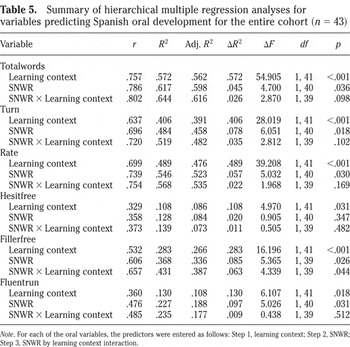
This analysis suggests that phonological memory, as reflected in the SNWR task, is only marginally implicated in the development of oral fluency. However, participants had come from two different learning contexts (18 participants had been enrolled in a Spanish language course at their home university, whereas 25 participants had completed a study-abroad program in Spain). Furthermore, a large number of the students who made gains in oral proficiency were students in the study-abroad group. It was possible, therefore, that learning context effects might have masked any relationship between oral proficiency gains and performance on the SNWR task. Thus, to see whether performance on the SNWR task was associated with Spanish oral fluency development after controlling for learning context, a series of hierarchical regression analyses was performed (see Table 5). The dependent variable was the residualized performance score on each Spanish fluency variable. To control for learning context, location of study was entered in the first step of the regression analyses. The predictor of interest, time 1 performance on the SNWR tasks (phonological memory), was entered in the second step. The interaction between location and performance on the SNWR task was entered in the last step.
Summary of hierarchical multiple regression analyses for variables predicting Spanish oral development for the entire cohort (n = 43)

As expected, learning context accounted for a significant amount of variance for all six oral variables (see Table 4): ΔR2 between .108 and .572, p-values between .031 and <.001. After learning context effects were partialed out, with the exception of hesitfree, SNWR accounted for a further significant amount of variance for five out of the six oral variables (see Table 5): ΔR2 between .045 and .097, p < .05. There was a significant SNWR by learning context interaction for fillerfree, ΔR2 = .063, p < .05, whereas the interaction for totalwords approached significance, ΔR2 = .026, p = .098. To investigate interaction effects, separate multiple regressions were conducted for the study-abroad and at-home groups for totalwords and fillerfree. These regressions showed that SNWR explained a significant amount of variance for the study-abroad students—totalwords, ΔR2 = .201, p < .03; fillerfree, ΔR2 = .234, p < .02—but not for the at home students—totalwords, ΔR2 = .046, p = .393; fillerfree, ΔR2 = .110, p = .179. To summarize, SNWR performance explained a significant amount of variance for all oral development variables with the exception of hesitfree. For totalwords and fillerfree, SNWR performance explained a significant amount of variance for the study-abroad group only.
DISCUSSION
This study investigated the role of phonological memory in the acquisition of L2 oral fluency by adults over the course of a semester. In this study, phonological memory was operationalized as SNWR. A major finding to emerge was that, following one semester of study, phonological memory (SNWR) was implicated in the oral fluency gains of adults learning Spanish as a L2, although SNWR performance itself did not change over the same time span. Furthermore, phonological memory predicted the participants' level of oral fluency in a number of measures at the end of the semester. Phonological memory, therefore, appears to be an important skill necessary for the development of L2 speech production in an adult population.
Phonological Memory and L2 Speech Production
The present study is the first to demonstrate a relationship between phonological memory and L2 oral fluency in adults as measured by temporal and hesitation phenomena, and the results are consistent with previous findings that phonological memory is implicated in children's L1 spontaneous speech. Furthermore, the correlations obtained in the present study compare favorably with correlations observed in studies that examined the relationship between phonological memory and preschool children's length of utterances (Adams & Gathercole, 1995, rs between .23 and .30, n.s.; Adams & Gathercole, 1996, r = .24 and .39; Adams & Gathercole, 2000, r = .39 and .43; Blake et al., 1994, r = .30, n.s., and .66). With the exception of one participant, the L2 learners in the present study were all at the novice and intermediate levels of proficiency. These findings, then, extend the relationship between phonological memory and language learning beyond preschool children learning their L1. Indeed, these results suggest that the relationship between phonological memory and language skill might be more closely related to the level of linguistic competence than to age as such.
The present study also found that phonological memory was related to the development of L2 oral fluency by adults over time. In particular, after partialing out learning context, phonological memory predicted gains made by participants in the amount of speech they produced, the length of their longest turn, their speech rate, the amount of speech they produced between filled pauses, and the length of their longest fluent run. Previous studies investigating the role of phonological memory in speech production looked at preschool children's L1 speech production at one point in time and did not examine children's spoken production development over a longer period. Furthermore, most prior adult studies looked at experimental word learning in the laboratory with a focus on vocabulary development, and, to our knowledge, no studies have investigated the association between phonological memory and the development of speech production in adults. Thus, the present findings are especially noteworthy in that they extend the previously documented relationship between phonological memory and adult vocabulary development to include L2 oral fluency (speech fluidity) development.
Fluency in the present study was operationalized in terms of temporal/hesitation phenomena. These temporal/hesitation phenomena isolated specific qualities of speech that have been identified with perceived assessments of fluency (see Freed, 1995; Wood, 2001). Cucchiarini et al. (2002) analyzed the spontaneous speech of adult L2 learners of Dutch using a number of temporal measures and found that rate of speech and mean run length between silent pauses (the authors did not measure mean run length between filled pauses) explained the greatest amount of variance in fluency ratings of spontaneous speech made by expert raters. Wood suggested that the quantity and quality of speech runs between pauses is the most important discriminator of fluent and disfluent speech. Highly fluent speakers tend to pause at sentence and clause junctures, thereby producing longer runs, unlike less fluent speakers who tend to pause within clauses or sentences, thereby producing shorter runs. Thus, the interpretation of the relationship between phonological memory and the quantitative measures observed in this study should not be restricted to specific quantitative measures as such, but should be looked at within a broader framework of fluency development. Towell (2002), for example, suggested that improvement in quantitative measures of fluency, especially mean run length between pauses, might indicate a qualitative shift in oral production skills. His observations are consistent with the findings in the developmental literature. In the children studied by Adams and Gathercole (1995, 2000), those who produced longer mean run lengths also produced more grammatically complex utterances. Thus, the relationship between phonological memory and L2 oral fluency observed in the present study suggests that it might also be related to L2 grammar skill (see Ellis, 2001; Ellis & Sinclair, 1996; O'Brien et al., 2006; Sleve & Miyake, 2006).
Phonological Memory and Learning Environment
The present results demonstrate that phonological memory is related to L2 learning in a real-world, classroom-based language learning environment. Small but significant relationships between phonological memory and L2 oral fluency development were observed for some measures for the entire cohort despite the considerable interindividual variability inherent in natural learning settings (see Dörnyei, 2005). For participants who studied abroad, the correlations obtained between phonological memory and time 2 oral fluency variables (rs between .36 and .44) were comparable in magnitude to the correlations obtained in longitudinal studies of L2 learning carried out with children in classroom-based learning environments (French, 2006, r = .91; Service, 1992, r = .44; Service & Kohonen, 1995, r = .42), in which earlier phonological memory predicted later language skill. The correlations obtained in the present study were also similar to correlations between phonological memory and children's native vocabulary knowledge reported in the developmental literature (see Baddeley et al., 1998, Table 1, rs between .22 and .61), vocabulary that has generally been learned in a more natural environment, primarily through exposure to the language. Interestingly, the correlations were consistent with those reported in controlled studies with both adults and children that looked at experimental nonword and L2 word learning in the laboratory (Atkins & Baddeley, 1998, rs between .38 and .54; Gathercole et al., 1997, rs between .46 and .58; Gupta, 2003, rs between .32 and .39; Speciale et al., 2004, Experiment 1, r = .36 and .45).
Phonological Memory and Learning Context
With the exception of fillerfree (and perhaps totalwords), the results reported here were independent of learning context. Although learning context accounted for a significant amount of variance in fluency gains for the entire cohort (8.6–57.2% of variance explained), phonological memory still predicted a further significant amount of variance for five oral fluency variables (4.5–9.7% of variance explained) irrespective of whether the participants took one course at their home university or whether they studied abroad in an environment that provided greater immersion opportunities. Thus, those who had better phonological memory skills made greater progress in L2 oral fluency development than those who had weaker phonological memory skills, over and above the progress that was attributable to the richer L2 learning context for some participants (in the study-abroad context). This suggests that the role of phonological memory in language learning is independent of learning environment: Those with better phonological memory skills will make greater gains in L2 fluency development than those with poorer skills.
Phonological Memory and Fluency Development
To our knowledge, the role of phonological memory in adult L2 speech production has not been investigated up to now. This lack of research might be due to the generally accepted view that fluent adult speech is not mediated by phonological memory (Klapp, Greim, & Marshburn, 1981) and might also be due to evidence that indicates that the language of patients with short-term memory deficits remains fluent (Shallice & Butterworth, 1977). In contrast, young children's spontaneous speech production is related to their phonological memory skills (Adams & Gathercole, 1995, 1996, 2000; Blake et al., 1994). It might be that the processes involved in early stages of L2 fluency are similar to those used by young children to acquire fluency in their L1. If this is so, then phonological memory would also be expected to mediate early adult L2 fluency acquisition. For young children, as for novice adult L2 learners, the planning and production of multiword utterances is a controlled, effortful process rather than an automatic one. Perhaps phonological memory plays a significant role when language production is effortful and a lesser role when language has become automatized, as in adult L1 speech and the later stages of adult L2 speech. At earlier stages of L2 learning, phonological memory might constrain the amount of speech produced: L2 learners who are able to retain only a few new items in short-term memory might be limited in the amount of speech they are able to generate.2
It is interesting to note that phonological memory span is related to speech rate (see Baddeley et al., 1975; Brown & Hulme, 1992). Baddeley et al. provided evidence that phonological memory span can be predicted from the number of items that can be read in approximately 2 s. Brown and Hulme showed that phonological memory span measured in a L2 (Italian) increased in a linear manner with the speech rate in that L2.
In support of this proposal, Speidel and Herreshoff (1989) analyzed the speech of first-grade children for their use of imitation (repetition of others' speech) and found that low mean length of utterance (MLU; less fluent) children used more imitation than high MLU (more fluent) children, especially when the utterances were very long. Long utterances were more effortful and required more imitation to produce for the less fluent children than for the more fluent children. Speidel (1989) equated imitation span with verbal memory span (or phonological memory) and suggested that it is related to the rate at which young children acquire L1 fluency. The present study has shown that phonological memory is related to the acquisition of L2 fluency by adults. Thus, similar processes might underlie the development of fluency in both children (in their L1) and adults (in their L2). In adults, as in children, the ability to retain and imitate longer L2 utterances might lead to greater L2 fluency.
The evidence from the present and previous studies suggests that the relationship between phonological memory and language learning is not constrained by age but extends into adulthood. The adults in this study were all at the novice or intermediate level of L2 competence (there were no highly fluent speakers). Consequently, phonological memory appears to be implicated in earlier stages of language learning by both children and adults, when linguistic and metalinguistic knowledge is still fragile. For children learning their L1, this might be as early as the age of 5. For adults learning a L2, phonological memory might continue to remain an active cognitive mechanism because most L2 learners never reach high levels of L2 competence.
The results obtained here are also noteworthy because the measure of phonological memory used was SNWR, a test that, unlike other measures of phonological memory, does not require overt articulation. Thus, the relationship between phonological memory and speech production observed in the present study did not arise because of the mutual output constraints problem discussed previously. Additionally, if SNWR is primarily a measure of phonological storage, as has been suggested, this would mean that the ability to store (rather than rehearse) phonological sequences in short-term memory is the important factor in language learning. Indeed, in their study of preschool children, Gathercole et al. (1999) obtained stronger correlations between nonword recognition and vocabulary (r = .73) than between nonword repetition and vocabulary (r = .54), although the correlations were not significantly different from each other. However, nonword recognition is a measure of phonological memory that is not frequently used. Future studies that investigate the relationship between phonological memory and language learning should include additional measures of phonological memory.
A further question that will need to be addressed is which aspect of the phonological memory process is crucial for language learning. SNWR requires that both item order and item identity be processed, and it is unclear which process drives language learning (Brown, Preece, & Hulme, 2000; Burgess & Hitch, 1999; Jefferies et al., 2006). This question should be addressed in a future study by including additional measures that will permit more fine-grained investigation of the specific components of phonological memory that are implicated.
In summary, this study demonstrated that phonological memory plays a role in SLA by adults in real-world language learning environments (although a direct causal relationship remains to be established). Furthermore, it demonstrated that phonological memory is implicated in other aspects of L2 learning by adults in addition to vocabulary acquisition—namely in the development of specified aspects of oral fluency as measured by temporal and hesitation phenomena. The overall outcome of this study was that phonological memory continues to play a significant role into adulthood in the acquisition of L2 oral fluency. When these results are viewed in conjunction with the results of other studies, it appears that the role of phonological memory in language acquisition is more closely related to the learner's level of language competence rather than to the learner's age as such.