1. Introduction
In today’s digital and multicultural world, it has become increasingly common to interact with English speakers from various linguistic and cultural backgrounds (Chen, Reference Chen2012; Marcoccia, Reference Marcoccia2012). Against this shifting sociocultural landscape, English language teaching (ELT) professionals have made consistent efforts to prepare English learners to function successfully by enhancing their perceptions of different varieties of English, as well as their perceived ability to adopt strategies for effective cross-cultural communication (Matsuda, Reference Matsuda2017). With the development of technology and its greater affordance for language learning, ELT scholars have recently begun studying the pedagogical benefits of computer-assisted language learning (CALL) on the perceptional development of varieties of English, in addition to strategic competence for cross-cultural communication among English as a foreign language (EFL) learners in in-class and extracurricular CALL settings (Lee, Nakamura & Sadler, Reference Lee, Nakamura and Sadler2018) and in extramural CALL settings (also known as informal digital learning of English [IDLE]) (Lee & Lee, Reference Lee and Lee2019a).
Although young EFL learners are increasingly interacting with diverse users of English in a range of IDLE environments (Lee & Lee, Reference Lee and Lee2019b), to date little attention has been paid to the potential relationship between EFL students’ IDLE practice, perception of varieties of English, and strategic competence for cross-cultural communication, which points to the focus of the current study. Consequently, the findings of this study can further our comprehension of these interactions and offer pedagogical insights into how ELT researchers and teachers can better prepare contemporary English learners for cross-cultural interactions, whether in digital or face-to-face milieus.
2. Literature review
2.1 Perception of varieties of English and strategic competence for cross-cultural communication
With a profound shift in the sociolinguistic and sociocultural landscape of English and its users (e.g. English is spoken in 101 countries, and there are over 1.5 billion people learning English worldwide, Noack & Gamio, Reference Noack and Gamio2015; 80% of English interaction is between non-native speakers, Crystal, Reference Crystal2010), critically oriented ELT professionals have, for the past four decades, continuously challenged the monolithic and static perspectives of English and the conventional approach to ELT (Matsuda, Reference Matsuda2017; Smith, Reference Smith1976). Among others, Matsuda (Reference Matsuda2017) has emphasized the functional aspect of English under the conceptualization of English as an international language (EIL): “a function that English performs in international, multilingual contexts, to which each speaker brings a variety of English that they are most familiar with, along with their own cultural frames of reference, and employs various strategies to communicate effectively” (p. xiii). This definition, which is composed of constructs such as perception of varieties of English and strategic competence for cross-cultural communication, has two implications – that is, (1) in today’s multicultural contexts, English learners are likely to communicate with diverse speakers who have different English accents and cultural backgrounds, and (2) consequently, they need to be capable of employing appropriate and effective cross-cultural communication strategies.
Perception of varieties of English can be understood as one’s perceptions about different varieties of English and English users who have different kinds of English accents. Varieties of English include the ones used by both native English speakers from inner circle countries (where English is a native language; e.g. USA and UK) and non-native English speakers from outer circle (English is used as an official or second language; e.g. Singapore and India) and expanding circle countries (English is learned and considered as a foreign language; e.g. China and Korea) in light of Kachru’s (Reference Kachru, Quirk and Widdowson1985) three circles model. However, because contemporary EFL learners increasingly experience non-native varieties of English in comparison to native varieties of English (which have relatively minor differences) across online and offline environments (Sockett, Reference Sockett2014), the current study focuses on varieties of English spoken mainly in the outer and expanding circle societies. At the instructional level, several EIL pedagogies have been put into practice with the goal of helping students develop more positive perceptions of varieties of English. For instance, Galloway and Rose (Reference Galloway and Rose2013, Reference Galloway and Rose2014) found that Japanese EFL students held a more positive perception of varieties of English as a result of their exposure to diverse speakers and accents in English. Tanghe (Reference Tanghe2014) and Hino (Reference Hino and Matsuda2012, Reference Hino and Matsuda2017) also had their Korean and Japanese EFL students experience multiple varieties of English through authentic EIL materials such as blogs and exposure to global English news. More recently, Lee et al. (Reference Lee, Nakamura and Sadler2018) showed the pedagogical benefits of a videoconferencing-embedded classroom for improving EFL students’ perceptions of varieties of English in a Japanese university.
The strategic competence for cross-cultural communication can be defined as one’s self-perceived ability to employ an effective cross-cultural communication strategy. Several instructional efforts have been made to help students use strategies for effective cross-cultural communication. Juan-Garau and Jacob (Reference Juan-Garau and Jacob2015) showed that Spanish and Polish secondary EFL students could communicate more effectively in multicultural contexts as a result of content- and task-based EIL activities situated in a digital, transcultural environment. Ke and Suzuki (Reference Ke and Suzuki2011) also found that online communication between Taiwanese and Japanese EFL university students via computer-mediated communication (CMC) could positively foster their affective variables, thereby increasing L2 confidence as well as strategies for multicultural communication (e.g. using simpler, less complicated forms of English for non-native interlocutors). Similarly, Ke and Cahyani (Reference Ke and Cahyani2014) showed that EIL online exchange activities between Taiwanese and Indonesian EFL university students exerted a positive influence on their perceptions of non-standard English and strategies for multicultural communication. For instance, it increased their acceptance of diverse varieties of English and led them to adjust their English conversations according to their interlocutors’ linguistic and cultural backgrounds.
2.2 Informal digital learning of English
Bax (Reference Bax2003) envisioned the future of CALL as normalization in which “CALL finally becomes invisible, serving the needs of learners and [being] integrated into every teachers’ everyday practice” (p. 27). While Bax’s vision appeared to focus more on teachers’ computer competency, teaching pedagogy and institutional support in formal language classroom settings, with the recent advent and affordance of new technologies, increasing attention has been paid to the way students learn and use their second language (L2) in informal, out-of-class, and digital settings (Reinders & Benson, Reference Reinders and Benson2017). Against this backdrop, out-of-class autonomous language learning with technology is considered to be an emerging area of inquiry in the field of CALL (Lai, Reference Lai2017). Although similar new concepts, such as online informal learning of English (Sockett, Reference Sockett2014), extramural English (Sundqvist & Sylvén, Reference Sundqvist and Sylvén2016), and fully autonomous self-instructed learners (Cole & Vanderplank, Reference Cole and Vanderplank2016), are increasingly available in the literature, this CALL inquiry is still a relatively unexplored research area (Lai, Reference Lai2017).
The current author has devised the term informal digital learning of English (IDLE) in order to explore this emerging CALL phenomenon among digital native EFL students. It is firmly underpinned by Benson’s (Reference Benson, Benson and Reinders2011) four dimensions of L2 learning beyond the classroom (i.e. formality, location, pedagogy, and locus of control). In general, the concept “IDLE” shares much in common with the other similar notions (e.g. online informal learning of English and extramural English) in relation to its visions and pedagogical suggestions. For instance, they all recognize greater opportunity for L2 learning beyond the classroom thanks to the growth in affordances of digital devices and resources. There also seems to be a shared understanding that autonomous learning is significant in informal, out-of-class, and relatively unstructured contexts (see details in Lai’s [Reference Lai2017: 11–14] three dimensions of autonomy).
Specifically, IDLE can be classified into two domains: IDLE in extracurricular and IDLE in extramural contexts. The former category refers to a semi-autonomous L2 activity in out-of-class digital environments that is still structured by a formal language teacher. For instance, EFL students carry out homework activities by viewing subtitled YouTube tutorial videos in out-of-class settings, and later their teachers evaluate their outcomes. The latter indicates a fully autonomous L2 activity in out-of-class digital environments that is not linked to a formal language instruction. For example, L2 learners autonomously write on or view others’ Facebook walls in English for the purpose of connecting with others. Unlike IDLE in extracurricular contexts, as a teacher does not affect this behaviour, it is regarded as IDLE in extramural contexts. This study adopts IDLE in extramural contexts (hereafter referred to as IDLE) as its operational definition, as the present study aims to examine EFL students’ autonomous L2 practice in informal, digital contexts from which teacher intervention is absent. Empirically, IDLE seems to contribute significantly to EFL learners’ affective, cognitive, cultural, and linguistic outcomes (Cole & Vanderplank, Reference Cole and Vanderplank2016; Jensen, Reference Jensen2017; Lai, Zhu & Gong, Reference Lai, Zhu and Gong2015; Sundqvist & Wikström, Reference Sundqvist and Wikström2015; Sylvén & Sundqvist, Reference Sylvén and Sundqvist2012). Yet Lai et al. (Reference Lai, Zhu and Gong2015) cautioned that EFL learners may have a limited ability to sustain IDLE practice on their own. Therefore, by means of constant monitoring and support, teachers could play a critical role in facilitating and sustaining students’ IDLE engagement (Lai, Reference Lai2017).
EIL educators have also begun integrating a range of technology into their approaches to EIL pedagogy (Ke & Cahyani, Reference Ke and Cahyani2014; Lee et al., Reference Lee, Nakamura and Sadler2018; Tanghe, Reference Tanghe2014). Nevertheless, these studies have taken place in formal CALL contexts, in which EIL educators primarily structure and assess such activities. Only recently did researchers begin to explore the relationship between students’ engagement with IDLE activities and their EIL perceptions. Specifically, Lee and Lee (Reference Lee and Lee2019a) reported qualitative findings that Korean EFL students experienced diverse English forms and speakers through engagement in various IDLE activities (e.g. watching Indian movies, socializing with other non-native English speakers on social media, and interacting in English with other game players from around the world). Consequently, these students became more positive about other varieties of English and tended to employ more effective strategies when engaging in cross-cultural communication. For example, Young-sik, one of the Korean interviewees in the study, first struggled to understand English communicated in a heavy Vietnamese accent. But as Young-sik began to socialize with his Vietnamese friend, first face to face and later online, he became increasingly comfortable with his friend’s Vietnamese-influenced English accent and interacted more effectively with his friend in English in both verbal and written forms on KaKaoTalk (Korea’s popular social media). Later, Lee and Lee (Reference Lee and Lee2019b) sought to corroborate their qualitative findings by conducting a structural equation modelling analysis with a sample from 317 Korean EFL university students. The researchers provided additional evidence that Korean students who practised IDLE activities had positive perceptions of different varieties of English, and perceived themselves as having a greater ability to employ effective strategies for cross-cultural communication. Although there was no sampling bias in terms of demographic information (e.g. location of university, gender, academic year, major), overseas experience, which was reported to influence EFL students’ EIL perceptions (Kaypak & Ortaçtepe, Reference Kaypak and Ortaçtepe2014), was not adjusted for in the model.
Although a growing body of knowledge is accumulating on the topics of IDLE and EIL, the association between IDLE practice, perception of varieties of English, and strategic competence for cross-cultural communication remains unexplored. Considering that an increasing number of EFL students are participating in authentic EIL communication in a range of IDLE environments without going abroad, it would be worthwhile to examine the possible relationship among these three variables so as to better prepare our English learners for cross-cultural interactions in today’s digital and multicultural environments.
3. Research models and hypotheses
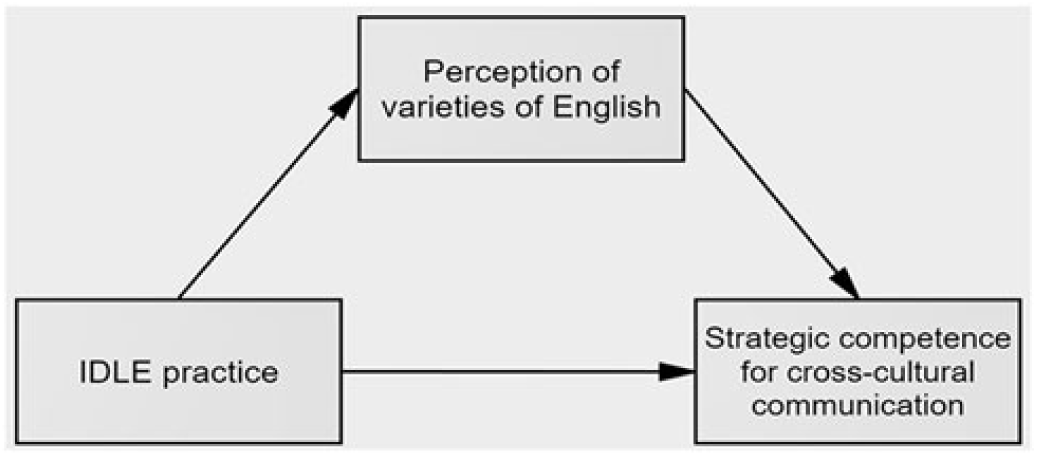
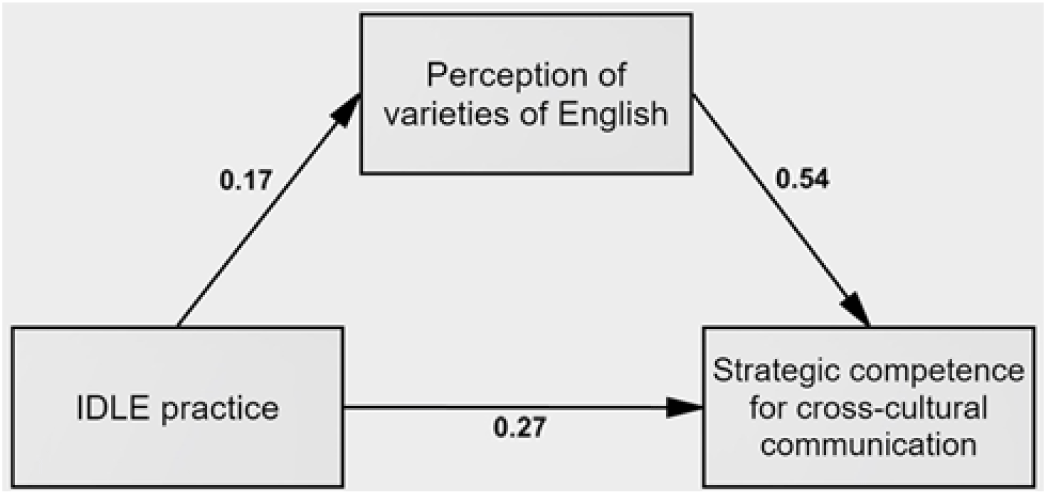
Due to the nature of an exploratory study, only two proposed research models were hypothesized based on Lee and Lee (2019a, Reference Lee and Lee2019b). The first research model indicates that IDLE practice has a direct effect on one’s strategic competence for cross-cultural communication. That is, EFL students’ engagement in IDLE activities may lead directly to enhancing their strategies for cross-cultural communication. The second model contains three constructs, namely IDLE practice, perception of varieties of English, and strategic competence for cross-cultural communication. As indicated in Figure 1, IDLE practice has a direct effect on learners’ self-perceived ability to employ strategies for cross-cultural communication. However, IDLE practice also acts on learners’ perceptions of varieties of English, which in turn affects their strategic competence for cross-cultural communication.
The second model

Based on these models, two hypotheses were postulated:
Hypothesis 1: IDLE practice has a direct effect on students’ use of the cross-cultural communication strategy.
Hypothesis 2: Students’ perception of varieties of English mediates the relationship between IDLE practice and their use of the cross-cultural communication strategy.
4. Method
4.1 Context and participants
Based on Kaypak and Ortaçtepe’s (Reference Kaypak and Ortaçtepe2014) study, which reported that EFL students’ study abroad experience could affect their perceptions of EIL, data were gathered from 266 Korean EFL students (153 females, 113 males) from nine EFL classes in three different universities across South Korea. None of these students had any overseas experience. Written informed consent was obtained from students prior to their participation in the survey. The average age was 21 years, the range in age from 19 to 30. Participants consisted of English majors (n = 103, 38.7%; e.g. English literature) and non-English majors (n = 163, 61.3%; e.g. engineering, sciences). The students owned, on average, at least two different types of digital gadgets (e.g. desktop computers, tablet PCs, mobile devices, wearable devices) (M = 2.15, SD = 0.70).
4.2 Instrument and data collection
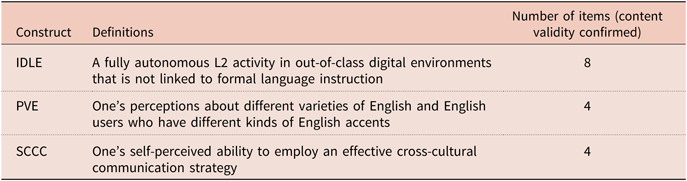
The questionnaire consisted of four parts: (1) demographic information, (2) IDLE practice, (3) perception of varieties of English, and (4) strategic competence for cross-cultural communication. Content validity of IDLE, perception of varieties of English, and strategic competence for cross-cultural communication were factors that were confirmed through two rounds of the modified Delphi survey. This was achieved by selecting 10 experts from the fields of CALL, EIL, and language testing (Hsu & Sandford, Reference Hsu and Sandford2007). A total of 16 items were derived as showing acceptable content validity. The conceptual meaning and the number of items of each construct are exhibited in Table 1.
The theoretical construct and definitions
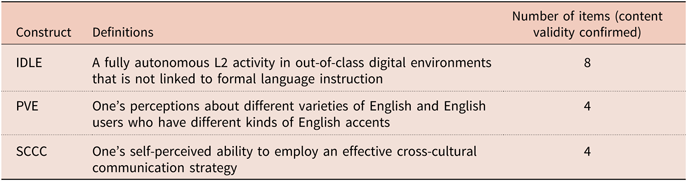
Note. IDLE = informal digital learning of English; PVE = perception of varieties of English; SCCC = strategic competence for cross-cultural communication.
The first part was used to obtain participants’ demographic information, such as gender, age, university major and overseas experience. In part 2, students were asked about their IDLE activities during the previous six months. Briefly, the concept of IDLE, which is discussed in the literature review, was introduced to the students using relevant examples prior to administering the survey. IDLE practice was measured with the following question: “How often do you engage in the following IDLE activities?” Respondents were asked to answer eight items with regard to IDLE practice. They were asked to choose only one answer among “never” (coded 1), “rarely (once a week)” (coded 2), “sometimes (2 or 3 times per week)” (coded 3), “fairly often (once a day)” (coded 4), and “very often (many times per day)” (coded 5).
Parts 3 and 4 were used to measure their perceptions of varieties of English (4 items) and strategic competence for cross-cultural communication (4 items) levels by asking the following question (Lee & Lee, Reference Lee and Lee2019b): “How do you rate your EIL perception level?” Responses were scored on a 5-point Likert scale: “strongly disagree” (coded 1), “disagree” (coded 2), “neutral” (coded 3), “agree” (coded 4), and “strongly agree” (coded 5). Question items of parts 2, 3, and 4 are shown in the Appendix. In order to reduce potential difficulty in comprehension, the Korean version was administered in the participants’ classrooms under the supervision of the researcher and instructors.
In order to complement the exploratory quantitative data, the explanatory qualitative data were collected based on Creswell’s (Reference Creswell2009) sequential explanatory strategy: “… the mixing of the [quantitative and qualitative] data occurs when the initial quantitative results infor[m] the secondary qualitative data collection. Thus, the two forms of data are separate but connected” (p. 211). After the questionnaire (quantitative data) collection was finished, the voluntary, semi-structured interviews (qualitative data) were conducted with two Korean students, who had no overseas experience but practised IDLE activities on a regular basis. Each one-on-one interview was audio-recorded and administered in Korean for 30–40 minutes using open-ended guiding questions, such as: “What do you think of Indian English, German English, and Korean English?”, “Can you explain Korean culture to foreigners in English?”, “Can you describe how you practise IDLE activities?” and “Do you think IDLE activities, perception of varieties of English, and strategic competence for cross-cultural communication are connected? If so, how?”
4.3 Data analysis
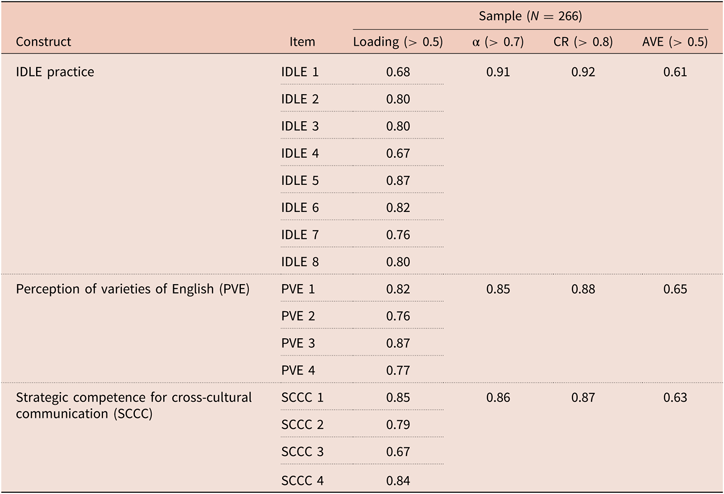
Using the IBM SPSS Statistics V25.0 and the IBM SPSS Amos V22.0, six steps were taken to test the hypotheses through the measurement model (individual item reliability, internal consistency, and convergent and discriminant validity) and structural model assessment (structural equation modelling [SEM]). First, the normality of data distribution (the mean, standard deviation, skewness and kurtosis) was checked (Table 4). Second, the loading values of each item for the corresponding construct were examined for the reliability of individual items. Based on a principal axis factor analysis with the varimax rotation technique, this analysis resulted in three latent factors with factor loadings of well above 0.5, ranging from 0.67 to 0.87, which indicated that all items’ loadings met an acceptable standard (Table 2). Specifically, the first factor consisted of eight items related to IDLE practice. A specific example is, “I talk with English users (e.g. American, British, Korean) in English online.” The second factor consisted of four items that theoretically corresponded to perception of varieties of English, such as “Different varieties of English, such as Hong Kong English, Indian English, and Singaporean English, are acceptable today.” Lastly, the third factor theoretically corresponded to strategic competence for cross-cultural communication and consisted of four items, such as “I can behave appropriately according to English users I speak with.”
Reliability and convergent validity

Note. α = Cronbach’s alpha; CR = composite reliability; AVE = average variance extracted; IDLE = informal digital learning of English.
Squared correlation coefficient matrix and discriminant validity

Note. The square root of AVE is presented along the diagonal line in bold type; IDLE = informal digital learning of English; PVE = perception of varieties of English; SCCC = strategic competence for cross-cultural communication.
** p < 0.01.
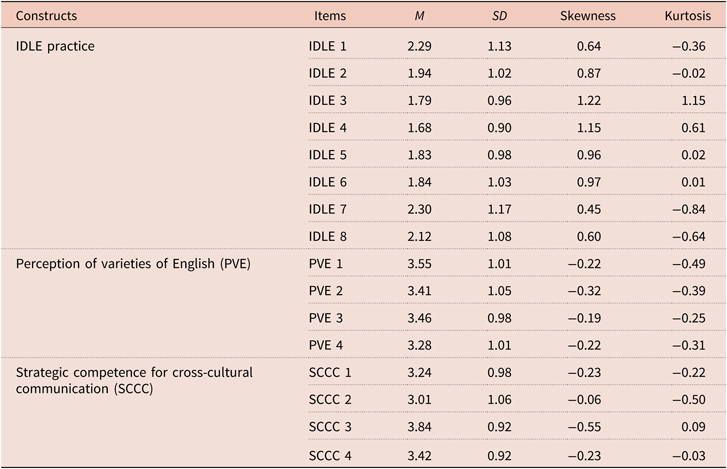
Descriptive statistics

Note. IDLE = informal digital learning of English.
Third, the internal reliability coefficient for the instrument was tested through Cronbach’s alpha (α). The result found that α exceeded a minimum threshold of 0.7, ranging from 0.85 to 0.91. Fourth, convergent validity was assessed through the use of composite reliability (CR) and average variance extracted (AVE) for each construct. The results showed that CR values were above the threshold value of 0.8, and AVE from each construct was also above 0.5, which confirmed that all items for each variable shared in common a significant proportion of variance (Fornell & Larcker, Reference Fornell and Larcker1981).
Fifth, discriminant validity was evaluated by comparing AVE and squared inter-construct correlation (SIC) estimates. The results (Table 3) demonstrated that the AVE estimate for each construct was larger than for the other corresponding SIC estimates, which indicated that each construct was distinct from the others. Finally, a three-factor SEM was constructed and used to scrutinize the association between IDLE practice, perception of varieties of English, and strategic competence for cross-cultural communication.
In terms of qualitative analysis, at the outset, the interview data were transcribed and translated into English. Then the accuracy of the translation was verified through member checking (Birt, Scott, Cavers, Campbell & Walter, Reference Birt, Scott, Cavers, Campbell and Walter2016). Only excerpts, which helped interpret the quantitative results, were reported using pseudonyms in the results section (Twining, Heller, Nussbaum & Tsai, Reference Twining, Heller, Nussbaum and Tsai2017).
5. Findings
5.1 Descriptive statistics
Table 4 presented the mean (M), standard deviations (SD), skewness and kurtosis. The absolute values for skewness and kurtosis were within the acceptable range of 2, confirming that the data were normally distributed (Field, Reference Field2009). Although participants had more than two bits of digital devices each, they did not seem to use these frequently for language learning. For example, students were found to rarely practise IDLE activities (almost once a week), as indicated in below-average agreement for all IDLE items (ranging from 1.68 to 2.30). This suggests that in this study the IDLE perspective does not seem to have been particularly successful among Korean participants. However, respondents generally had a positive perception of varieties of English as well as a higher self-perceived competence in employing strategic competence for cross-cultural communication, as shown in above-average endorsements of perception of varieties of English (ranging from 3.28 to 3.55) and strategic competence for cross-cultural communication (ranging from 3.01 to 3.84).
5.2 Assessment of structural equation modelling
To scrutinize the association among three latent factors, two proposed models were constructed. As depicted in Table 5, both models showed a good fit with the data: χ 2 divided by the value of degree of freedom (χ 2 /df) was less than 3, the comparative fit index (CFI), the normed fit index (NFI), and the goodness-of-fit index (GFI) were above 0.9, the adjusted goodness-of-fit index (AGFI) was above 0.85, and the root mean square of approximation (RMSEA) was less than or equal to 0.08 criterion (Hair, Tatham, Anderson & Black, Reference Hair, Tatham, Anderson and Black1998).
A summary of goodness-of-fit indices of the structural equation modelling models

Note. CFI = comparative fit index; NFI = normed fit index; GFI = goodness-of-fit index; AGFI = adjusted goodness-of-fit index; RMSEA = root mean square of approximation.
5.3 Hypotheses testing
The first hypothesis (the first model) was used to examine the direct effects of IDLE practice on strategic competence for cross-cultural communication. The parameter estimate (β = 0.37) was significant at the p < 0.001 level, thereby accepting the first hypothesis. The R 2 of the first model (explanatory power of IDLE practice) was 0.13, indicating that IDLE practice accounts for 13% of the total variance of strategic competence for cross-cultural communication. It suggests that students’ engagement in IDLE activities has a direct impact on their self-perceived ability to employ the cross-cultural communication strategy.
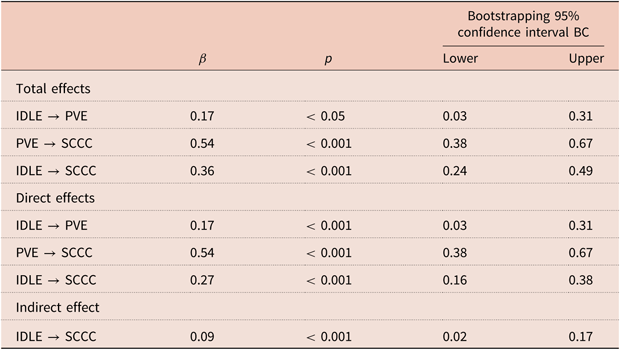
The second hypothesis (the second model) was devised to examine the mediation of perception of varieties of English over IDLE practice and strategic competence for cross-cultural communication (Figure 2). As summarized in Table 6, IDLE practice had a significantly positive effect on perception of varieties of English (β = 0.17, p < 0.05), explaining approximately 3% of the total variance. Perception of varieties of English had a significantly positive effect on strategic competence for cross-cultural communication (β = 0.54, p < 0.001). Approximately 41% of the total variance in strategic competence for cross-cultural communication was accounted for by IDLE practice and perception of varieties of English. This indicates that the second research model, as evidenced by the significant increase in R 2 in comparison to the first model, can better explain the relationship between IDLE practice and strategic competence for cross-cultural communication.
Structural equation modelling results of the second model

Results of the second hypothesis testing

Note. BC = bias corrected, 1,000 bootstrap samples; PVE = perception of varieties of English; SCCC = strategic competence for cross-cultural communication.
The mediating role of perception of varieties of English on the relationship between IDLE practice and strategic competence for cross-cultural communication was assessed in light of Baron and Kenny’s (Reference Baron and Kenny1986) and MacKinnon and Dwyer’s (Reference MacKinnon and Dwyer1993) recommendations. First, there should be a significant association between the independent and the dependent variables (IDLE → strategic competence for cross-cultural communication) when the mediator (perception of varieties of English) is absent. Second, a relationship between an independent variable and a presumed mediator (IDLE → perception of varieties of English) should be significant. Third, there should be a significant relationship between a presumed mediator and a dependent variable (perception of varieties of English → strategic competence for cross-cultural communication) when controlling for the independent variable. Finally, when the mediator is introduced, the previously significant association between independent and dependent variables should be reduced in magnitude, or else disappear.
Table 6 depicts the standardized direct, indirect, and total effects of the second model. Accordingly, the standardized indirect effect was computed for each of 1,000 bootstrapped samples, which was statistically significant (p < 0.001), with bias-corrected 95% confidence intervals ranging from 0.02 to 0.17. The standardized indirect effect of IDLE practice on strategic competence for cross-cultural communication through perception of varieties of English was 0.09. After controlling for perception of varieties of English, the direct effect of IDLE practice on strategic competence for cross-cultural communication was also significant (β = 0.27, p < 0.001). Hence, the effect of IDLE practice on strategic competence for cross-cultural communication was partially mediated by perception of varieties of English, with both direct and indirect effects being significant, which supports the second hypothesis.
Qualitative data further supported the second model that EFL students are likely to adopt a more effective cross-cultural communication strategy when their perception of different forms and users of English becomes more positive through their engagement in IDLE activities. Two excerpts are presented as prime examples. First, there was Jun Sung, a male, 19 years, first-year majoring in business administration. On a daily basis, for more than two hours, he practised 14 different IDLE experiences, which seemed to make a positive impact on his perception of varieties of English and strategic competence for cross-cultural communication. In his own words:
I am an amateur rapper. I listen to all kinds of English rap music produced by singers of around the world for at least three hours everyday from my MP3 player and YouTube. So, I feel comfortable hearing German English, Indian English, or whatever English may be. I also think that different kinds of English accents are acceptable because each English represents its own style and culture … I upload my original songs to rap communities on Facebook, Instagram and SoundCloud. I often talk to rappers and rap fans from other countries in English. For example, I became a Facebook friend with a German amateur rapper who had approached me after listening to my songs from SoundCloud. Although I found it difficult to understand his German-English accent at first, as we continuously talked about various topics, I became used to his accent and style of speaking … Now, I have no problem communicating with him. He told me I am a good English speaker.
Another salient example was Mi-kyung, a female, 21 years, second-year majoring in English. She spent more than two hours daily involved in 14 different IDLE activities, which also appeared to be associated with her perception of varieties of English and strategic competence for cross-cultural communication. She commented:
Since I was an elementary school student, I have spent a great deal of time talking to various English speakers while playing massively multiplayer online role-playing games [MMORPGs] … These days, I play Overwatch on the North American servers. Since it is a multiplayer first-person shooting game, I need to talk quickly to my team players via mic in English. Since game players are diverse in their nationality, I can hear a variety of English accents from my team members. When I can’t understand their accent, I simply ask them to say it again. It has helped me become more open-minded toward varieties of English accents and communicate more effectively with other game players from different backgrounds … I can easily talk to anyone from any country in real-life situations because I just talk as I normally do during digital gameplay.
6. Discussion
The purpose of this study was to investigate the potential connections between IDLE practice, perception of varieties of English, and strategic competence for cross-cultural communication. Results showed that EFL students who practised IDLE activities more frequently perceived themselves as more effective users for the cross-cultural communication strategy. This finding provides additional evidence of the beneficial effects of digital technology (e.g. CMC; Ke & Suzuki, Reference Ke and Suzuki2011) and IDLE activities (e.g. socializing with other users of English via social media; Lee & Lee, Reference Lee and Lee2019a) on EFL students’ enhanced ability to employ the cross-cultural communication strategy. However, previous interventional studies (Ke & Cahyani, Reference Ke and Cahyani2014; Lee et al., Reference Lee, Nakamura and Sadler2018) were primarily organized and monitored by teachers in a formal classroom. Moreover, a potential confounding factor (participants with overseas experience) was not contained in the analyses of the previous study (Lee & Lee, Reference Lee and Lee2019b). In this regard, the findings of the present study seem to be more relevant and applicable to typical EFL students, who do not have any international experience but practise IDLE activities.
Another significant finding was that perception of varieties of English mediated the relationship between IDLE and strategic competence for cross-cultural communication. This result indicates that EFL students without overseas experience are likely to adopt a more effective cross-cultural communication strategy when their perception of different varieties of English becomes more positive through their engagement in IDLE activities. In particular, IDLE practice (e.g. watching international movies in English and interacting in English with foreign speakers on social media and during digital game play) allows EFL students to experience various forms and users of English, in turn helping them hold more positive attitudes toward different varieties of English (Lee & Lee, Reference Lee and Lee2019a, Reference Lee and Lee2019b). Students with higher levels of perception of varieties of English may have become more willing to (and thus have more opportunity to) talk with people with different cultural backgrounds than do those with lower levels of perception, leading ultimately to enhancing their cross-cultural communication strategy. The cases of Jun Sung and Mi-kyung also support this quantitative result. For example, Jun Sung seemed to communicate more effectively with other English speakers (e.g. a German amateur rapper) when his perception of varieties of English including a German-English accent became more positive through his engagement in IDLE activities, such as listening to rap songs in different English accents from YouTube and interacting with rappers and rap fans from other countries in English on Facebook, Instagram and SoundCloud. Mi-kyung also perceived herself as a more effective cross-cultural communicator both in online and offline contexts when she became more positive toward different varieties of English through her frequent interaction in English with other international game players during MMORPGs.
This mechanism can be also explained by the case of Young-sik (a Korean EFL university student without overseas experience) who was introduced in Lee and Lee’s (Reference Lee and Lee2019a) study: At first, Young-sik had a low level of perception of Vietnamese English because he had no experience with Vietnamese-style English. Then, he befriended one international student from Vietnam during a cultural exchange program and continued to socialize with him, for example, speaking to him via text messages and video calls on KaKaoTalk. Young-sik commented, “… over time I became familiar to his English accent. Now I regard it as just one of the local English dialects spoken in Vietnam” (p. 9). Ultimately, he became open minded in accepting a Vietnamese-attached English accent and communicated more effectively and appropriately with his Vietnamese friend in English, both orally and written. This result also corroborates the findings of previous studies (Galloway & Rose, Reference Galloway and Rose2013, Reference Galloway and Rose2014; Hino, Reference Hino and Matsuda2012, Reference Hino and Matsuda2017; Lee et al., Reference Lee, Nakamura and Sadler2018), which found a positive relationship between exposure to diverse English users and materials made available to EFL students and their corresponding perception of varieties of English. However, the present study provides new insight into the mediating role of perception of varieties of English and the indirect effects on strategic competence for cross-cultural communication.
More importantly, in the perception of varieties of English (PVE)-mediating model, IDLE practice and perception of varieties of English explains 41% of the variance in the dependent variable (strategic competence for cross-cultural communication). This suggests that the higher students score on perception of varieties of English and IDLE practice, the greater is the likelihood that they will attain a higher level of strategies for multicultural communication. The data also indicate that the PVE-mediating model can better account for such an association in comparison to the IDLE-strategic competence for cross-cultural communication (SCCC) model, as demonstrated by a significant increase in R 2. This finding may help us better understand the complex (direct or indirect) effects of IDLE practice and the perception of varieties of English on strategic competence for cross-cultural communication. This finding may allow future researchers to apply the PVE-mediating model to other research contexts, thereby making cross-cultural comparisons and advancing our understanding of IDLE practice, perception of varieties of English and strategic competence for cross-cultural communication, all of which will ultimately contribute to a global body of IDLE and EIL knowledge.
From a pedagogical point of view, English teachers can provide opportunities for EFL students to engage in IDLE activities and experience diverse English forms and speakers. Over time, students are likely to have more positive perceptions of different varieties of English and, in turn, adopt a more effective cross-cultural communication strategy. More specifically, during the initial stage, as is the case with most of the existing EIL interventional studies (Ke & Cahyani, Reference Ke and Cahyani2014; Lee et al., Reference Lee, Nakamura and Sadler2018; Matsuda, Reference Matsuda2017), teachers can primarily organize and monitor technology-integrated EIL pedagogy in a formal classroom (e.g. having their EFL students interact with other non-native English users via Skype). However, teachers are gradually handing over control to their students by encouraging them to engage in receptive IDLE activities (e.g. reading and watching English content for better understanding, and appreciating other cultures via YouTube), which would help them become exposed to more diverse and authentic accents and usages of English. Concurrently, teachers can support students to practise productive IDLE activities (e.g. joining an online community based on students’ interests, in which they can speak with both native and non-native English speakers). Ultimately, teachers can help students up to the point at which they take control of choosing appropriate EIL resources and materials online, organizing and implementing IDLE-embedded EIL activities, and critically evaluating these processes on their own. However, it is also worth noting that students may easily initiate IDLE activities but may find it difficult by themselves to sustain IDLE practice (Lai, Reference Lai2017). Therefore, by means of constant monitoring and support, teachers could play a critical role in facilitating and sustaining students’ IDLE engagement.
From the perspective of CALL research, the results seem to be aligned with previous studies, which have reported a significant relationship between IDLE and EFL learners’ affective, cognitive, cultural, and linguistic outcomes (Lai et al., Reference Lai, Zhu and Gong2015; Sundqvist & Wikström, Reference Sundqvist and Wikström2015). Concurrent with Lai’s (Reference Lai2017) argument, however, extant IDLE studies have focused on limited aspects of English learning outcomes. Hence, the findings of this study could contribute to adding new knowledge (e.g. perception of English playing a mediating role in the effect of IDLE practice on strategic competence for cross-cultural communication) to the current CALL literature.
7. Conclusion
This study set out to investigate the relationship between IDLE practice, strategic competence for cross-cultural communication and perception of varieties of English with two proposed research models. The IDLE-SCCC model demonstrated that IDLE practice was significantly associated with strategic competence for cross-cultural communication. Additionally, the PVE-mediating model showed that perception of varieties of English mediated the relationship between IDLE and strategic competence for cross-cultural communication, which was also supported by the qualitative data. It suggests that EFL students without overseas experience tended to adopt more effective cross-cultural communication strategies when their perception of different varieties of English became more positive through their engagement in IDLE activities. This study also found that the PVE-mediating model better explained the relationship among these variables in comparison to the IDLE-SCCC model.
Nonetheless, the current findings should be interpreted in the context of five limitations. First, due to the nature of an exploratory study, as a starting point, only two research models (IDLE-SCCC and PVE-mediating models) were hypothesized, which makes the current study somewhat restrictive. For example, the IDLE-SCCC model accounted for 13% of the variance in the dependent variable, and the PVE-mediating model explained 41% of such a variance. This indicates that a significant portion of the variation in the dependent variable remains undetected in current models, which merely represent a small portion of such a relationship. Although qualitative data somehow complement the quantitative results, future studies may warrant scrutinizing potential independent variables that are not captured in the present models, such as demographic (e.g. age, gender, major), affective (e.g. level of enjoyment, self-confidence, L2 anxiety, degree of motivation), and cognitive (e.g. vocabulary knowledge, school grade) factors. Second, this study examined only EFL university learners in Korea and therefore its findings may not be applicable to other participants from different age or linguistic and cultural backgrounds. Therefore, future research should consider recruiting participants from different institutions and sociocultural backgrounds in order to substantiate the findings of the current research.
Third, as it is an observational study, the survey data were collected for a short period of time, with interviews being limited to two participants. Similarly, the quantitative findings were solely based on self-reported data, which could be affected by respondents’ subjective opinions or inaccurate recollections about the phenomena in question (Akbulut, Reference Akbulut2015). Therefore, a future study should consider obtaining data through additional sources, such as focus groups and observations, so as to elicit more reliable data and comprehend the nuances of the current inquiry. Fourth, the present study took only two dimensions of EIL into consideration based on Matsuda’s (Reference Matsuda2017) conceptualization. As many more factors could constitute EIL from other theoretical frameworks, adding other aspects of EIL, such as English speakers’ identity (e.g. Ha, Reference Ha2009; Widdowson, Reference Widdowson2003), would certainly merit further study. Finally, although the current study adds to our understanding of IDLE, strategic competence for cross-cultural communication, and perception of varieties of English with practical implications, to help ELT professionals implement these pedagogical ideas at the instructional level more effort is needed by researchers and practitioners. Specifically, this would include a follow-up study that could provide detailed descriptions of how to incorporate IDLE-embedded EIL pedagogy into practice in a more qualitative manner and to disseminate anecdotal and empirical evidence as a result of such an intervention. Additionally, future studies may delve deeply into teachers’ and students’ perceptions that take place during the intervention process. Such in-depth understanding could inform the development of contextually appropriate instructional materials and activities that support teachers in providing quality teaching. Consequently, this could contribute to bridging EIL theory and practice, a research topic that is in much demand but is quite limited in volume (Matsuda, Reference Matsuda2017).
With the advent of new technology and increasing interaction via cross-cultural communication occurring in various IDLE contexts (Marcoccia, Reference Marcoccia2012), the conventional pedagogical model of EIL within its heavily restricted classroom contexts would appear to be limited. In this regard, this study addresses an important research gap by unravelling the interaction of two aspects of EIL (strategic competence for cross-cultural communication and perception of varieties of English) and IDLE practice, from which teacher intervention is absent. With their potential for significant pedagogical benefits, many additional intriguing research agendas centring on this topic may also warrant attention.
Ethical statement
This research project was conducted in accordance with and the approval of the institutional review board at the author’s university. Participants were volunteers. There was no potential conflict of interest in this study.
Appendix. Items for IDLE practice, perception of varieties of English, and strategic competence for cross-cultural communication
IDLE practice
IDLE 1. I read English contents online (e.g. news, shopping, travelling).
IDLE 2. I write to communicate with others in English online (e.g. sending an email, chatting via SNS).
IDLE 3. I talk with English users (e.g. American, British, Korean) in English online.
IDLE 4. I practise speaking English using online English contents/programs.
IDLE 5. I use technology to connect with native speakers of the language (e.g. American, British).
IDLE 6. I use technology to connect with non-native speakers of English all over the world (e.g. Japanese, Chinese).
IDLE 7. I use technology to help myself understand and appreciate the target culture better.
IDLE 8. I use technology to help myself to increase my ability to interact with the target culture.
Perception of varieties of English (PVE)
PVE 1. Different varieties of English, such as Hong Kong English, Indian English, and Singaporean English, are acceptable today.
PVE 2. Teachers can use English listening materials that are recorded by people who have different kinds of English accents.
PVE 3. Different varieties of English, such as Indonesian English, Taiwanese English, and Japanese English, are acceptable today.
PVE 4. Teachers can include the interaction between non-native and non-native English speakers (e.g. Indonesian-Japanese speakers) in English listening materials.
Strategic competence for cross-cultural communication (SCCC)
SCCC 1. I can adjust my conversational style according to my interactions with people of other cultural backgrounds.
SCCC 2. I can explain my own culture and customs clearly in English to people from other cultures.
SCCC 3. I am open-minded in accepting speaking/pronunciation patterns that are different from those of my home country.
SCCC 4. I can behave appropriately according to English users I speak with.
About the author
Ju Seong Lee is an assistant professor in the Department of English Language Education at the Education University of Hong Kong. His research interests include informal digital learning of English, English as an international language, communication behaviours, and affect in second language learning.
Author ORCIDs
Ju Seong Lee, 0000-0003-3996-1303