Introduction
Before commencing the main discussion, I believe it is important to call attention to a remarkable article which I believe has never been brought to the attention of those scientists who are concerned with ‘panspermia’ theories. It appeared in Nature as long ago as 1977. This article contains some very profound thinking which may relate to any and all panspermia hypotheses, past, present, and future, although the authors were not actually thinking of panspermia at all but were concerned exclusively with our Earth. The article is entitled ‘Dispersal in Stable Habitats’, by two biologists named W.D. Hamilton and Robert M. May (Hamilton & May Reference Hamilton and May1977). By simple mathematical analyses, these two men have brilliantly demonstrated a generalized fundamental attribute which may apply to all seminal dispersal processes, and hence would presumably apply to all such processes taking place throughout space as well as on the Earth. Hamilton and May speak of an optimal strategy whereby a parent organism will disperse 50% of its seeds (which they call ‘propagules’) to very distant locations despite the probability of mortality of the propagules being extremely high, which at first glance seems absurd but upon deeper analysis is shown to be unexpectedly optimal. Based upon their analyses, I believe that panspermia would represent an extreme but nevertheless excellent example of what they call an ‘evolutionarily stable dispersal strategy’. This is not ‘intuitively obvious’, but I believe the work of Hamilton and May should be taken into consideration by as many scientists currently working in this field as possible. The main point is that these two scientists have come up with a possible theoretical, and even a possible imperative, basis for ‘the ubiquity of dispersal’, as they call it. But if we, with our concerns extended to the scale of the Universe, were to take solid hold of this thinking, we might extend the ‘ubiquity’ referred to by Hamilton and May to a true ubiquity indeed, a cosmic one. This could not be more relevant to the general subject of what we call ‘panspermia’, or the spreading of tiny particles or seeds (‘spermia’ or, to use the Greek word, spermata) of living things, or the materials for making living things throughout the whole of space (‘pan-’).
We turn now to the extraordinary, and largely unknown, pre-history of ‘panspermia’. It is a general concept which is found in the ancient Egyptian religion, in Hinduism, in pre-Socratic Greek philosophy, especially with Anaxagoras, in Judaism and Christianity, and particularly in both Jewish and Christian Gnosticism. We will see that this concept goes back a very long way indeed, and is a fundamental cosmological concept of the ancient Egyptian religion.
Ancient Egypt
The earliest proto-panspermia ideas are found in ancient Egypt. They are, as you might expect, extremely weird. The ancient Egyptian religion was not really a religion in the currently accepted sense. In fact, there is no actual word in the ancient Egyptian language which means ‘religion’, just as they also had no word which means ‘belief’. The concept of ‘religious belief’ was non-existent then. There were no dogmatic doctrines laid down, there was no Bible or Torah or Koran, which laid claim to answer all the secrets of the Universe in a single volume, without benefit of science, but relying upon that strange thing which people call ‘belief’, and which is as meaningless to me as it would be to an ancient Egyptian, since it implies the voluntary abdication of the reasoning faculty! However, there were also no full and systematic accounts of Egyptian ideas written out in books for the reading public, because there was no reading public. The Egyptian priests knew what they meant when they said things but we do not necessarily know what they meant, which is why so many Egyptologists spend much of their time trying to figure it out and write lengthy books about it.
Everyone knows that the Egyptians had lots of gods, and most of them had animal heads, which were presumably symbolic of something or other. This symbolism is beyond the scope of this paper. However, if you have been to Egypt and wandered around Karnak or such places, you may have noticed some pretty strange images of a man or a god with a gigantic erect penis, often with sperm shooting out of it. Or you may have noticed several of these carvings where there once was a gigantic erect penis, and someone has chipped or rubbed it out, sperm and all, or sometimes they leave the sperm. Also, if you have looked more deeply into Egyptian mythological imagery, you may even have noticed the occasional vagina. The night sky, covered in stars, was portrayed as a woman with a prominent vagina. It is remarkable that the goddess of heaven not only had a vagina, but also that she was not shy about showing it. So clearly the Egyptians were not prudes, and they used what today would be called ‘graphic sexual imagery’ in sacred contexts, and they did so without a blush. Our picture books on Egyptian gods or Egyptian mythology suppress these images for reasons of false prudery. The very fact that I feel called upon almost to apologize for it shows just how deeply perverse the puritanical hypocrisy of our culture really is, that even today we still find Egyptian sacred images of a god with a penis and sperm shooting out of it as being objectionable. I will not go into the psychological implications of these attitudes in this paper.
Now it just so happens that all this divine sperm which was being ejaculated all over the place by all these gods and pharaohs was, as you may already have guessed, connected to a kind of proto-panspermia hypothesis. I will try to explain it as simply as I can, without going into the details of who all the gods were who were producing all this sperm, which was spraying here and there around the Universe like somebody distributing junk mail. And in a way, sperm is junk mail: you only need one to score, and the rest gets thrown away.
The Egyptians were not really as polytheistic as they seem. Their religious symbols were so symbolic that they could easily be interchanged. And hence it is that on one day it is one particular god who is being credited with creating the Universe with his sperm, and the next day it is another one. The important thing about the Egyptian gods was not that they were different, but that they were all essentially the same: what mattered was being divine, and if you were called Ptah or Osiris or Amun it did not ultimately matter. The disputes over names were really priestly disputes between rival temples, not dogma disputes. The Egyptian motto seems to have been something along the lines of ‘it’s all the same really’.
Having lots of gods is like having lots of wives; very exhausting. If you have too many, all the faces are the same in the end.
If we are looking for an authoritative name of an ultimate creator god in Egypt, some scholars think we are safe if we choose the rather shadowy and vague early god known as Atum. He had almost no personality, which is always a good sign when you are trying to identify a creator god because, in the history of religions, the less personality a god has, the older he is likely to be. Atum was the chief god of the priests of Heliopolis, who were always quarrelling with the priests of Memphis, whose chief god was Ptah. The rival sets of priests wanted their own god to be the one with the penis turned full-on like a water hose, and there was great competition about it. The earliest surviving texts which we have from Egypt are called the Pyramid Texts, because they were carved in stone inside the pyramids of the fifth and sixth dynasties, and all date from before 2000 BC. These Pyramid Texts were all written by Heliopolis supporters, so Ptah’s name is suppressed, and all the sperm came from Atum. However, if you read a different document called The Memphite Theology, which represents the priests of Memphis, you will be told that all the sperm came from Ptah, and that Atum was a mere nobody.
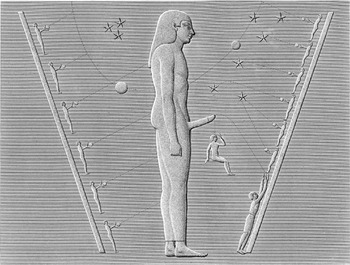
In Fig. 1 we see an image of an Egyptian creator god spurting sperm. Many people know that Napoleon conquered Egypt in 1798. He was obsessed with ancient Egypt, and he took to Egypt with him a small army of 160 scholars and scientists known as the savants. They set to work and over a period of years published a gigantic book in many volumes called Description de l’Égypte, which was illustrated with the aid of 400 engravers and 1600 other artists and technicians. This was one of the greatest publishing projects in the history of the world, and the work has never been translated into English. It was published in 1809 and the first edition contained ten volumes of plates plus nine volumes of text. I have a huge personal Egyptological library, and I have something earlier than the first edition of the archaeological and geographical sections of this work: I have the actual publisher’s proofs. I also have a considerable number of the huge original plates. It is one of those which I have reproduced here: it is an engraving of a bas-relief found in a royal tomb in the Valley of the Kings, although whether this bas-relief still survives I do not know as I have never seen another representation of it anywhere. Hieroglyphs had not yet been deciphered at the time when it was published, so they could not give a name for the pharaoh or the tomb and hence I do not know where it is located. As you can see, this picture shows the creator god with his erect penis shooting out sperm, as well as a lesser dribble of sperm which has fallen down from the tip of his penis and turned into the god Horus. In this case, as we are dealing with New Kingdom times and Horus is shown as a child, the creator god may be presumed to be Osiris, who in a tomb scene such as this is in a sense identified with the dead pharaoh whose tomb it is. The main stream of sperm has shot forward into the hands of a helpful figure who is passing it on to a series of prostrate bodies who are creating stars. These probably represent a series of embalmed and deceased pharaohs who are ancestors of the pharaoh in this tomb, as each pharaoh after death was meant to turn into a star. Ejaculatory trajectories may be seen leading to these stars. The divine sperm is thus portrayed as a stimulus to a succession of many sperm trails leading to different stars, and the underlying idea is of the creator god’s sperm being the source of everything; in other words, this is an ancient depiction of panspermia. However, do not expect a full explanation here because this picture is very weird and I do not think you could find any Egyptologist anywhere who would feel confident in explaining much more than what I have already said. The rest of the details of the picture are obscure. For instance, I have no idea why the dead pharaohs all appear to be playing ball, or what the strange receptors are. I presume that the two spheres depicted in the sky are meant to be the Sun and the Moon. The cluster of three stars in the upper left may be intended to represent the three stars of the belt of Orion, but they are certainly not in the shape of the belt. The sad truth is that no one alive knows how to give a full explanation of this image, but the main panspermia aspects are certainly clear enough.
This engraving of an Egyptian wall carving was published in Description de l'Égypte (Paris, 1809). It shows the creator god of the universe, in this case Osiris, creating the universe by the emission of his seed, which according to the myths he did by masturbation with his fist. The figure of the child formed from a dribble of sperm coming from the phallus is Horus, the son of Osiris, who was often portrayed as a child. (The virgin and child art motif of Christian iconography derives from the Isis-and-Infant Horus motif of Egypt.) The main ejaculation of sperm in the picture shoots across to the hands of the helper who then transmits it up to the row of mummified pharaohs, who are also receiving rays of sperm from the stars and celestial bodies, in an unending succession of divine circulation of cosmic seed from heavenly body to heavenly body. In Egyptian tradition, each dead pharaoh ‘became a star’, and according to this depiction, this transformation appears to have been effected by a stream of cosmic seed being emitted towards his mummy from another star. In addition to various stars, two round cosmic bodies of unequal size are shown here, which with a single star are depicted as following the same cosmic trajectory which seems rather ellipsoidal, and unrelated to the other stars. From this trajectory itself (which is shown as a trail of sperm), seed is shown shooting down towards two of the deceased pharaohs at top left. A group of three stars clustered together is shown near them, having no relation to the other celestial bodies. We do not possess systematic texts enabling us to understand the full details of the mythology depicted here, so that our understanding of it is only partial.

Before we get to the details of the concept of panspermia in the texts, I need to make clear that there was something which was considered to have preceded these gods and panspermia, namely the vast and dark chaos of the primaeval waters, what we would call ‘the dark reaches of outer space’. The Egyptians called this Nu, or Nun, and it was portrayed as a goddess. So, you see, to the Egyptians God really was a woman! Men came later.
We are informed by the Pyramid Texts that Nun existed ‘when the sky had not yet come into being, when the earth had not yet come into being, when the two supports of the sky had not yet come into being’ (Mercer Reference Mercer1952, vol. I, p. 181 (Utterance 486, 1040b–c)). Nun was generally described as ‘the waters’ of the cosmos because that metaphor of an endless cosmic sea was comprehensible to them, whereas what modern people would call ‘empty space’ was not. (However, none of us today believe that space is empty, do we?) From Nun’s association with cosmic waters, the hieroglyph for the first letter of her name, ‘n’, even came to be written with a wavy line which represents water.
As James Allen has said in the commentary to his recent translation of the Pyramid Texts:
‘This world was thought to exist within an infinite ocean, called Nu (“Waters”), which was kept from engulfing the earth by the atmosphere … The sky was seen as the surface of the cosmic ocean where it met the atmosphere. …’ (Allen Reference Allen2005)
Within this vast cosmic ocean of outer space called Nu or Nun there was only one great Being who existed originally. His name, Atum, means in Egyptian ‘the Universe’ (Anthes Reference Anthes1959, p.176). In other words, ‘the Universe’ existed within the Universe, or the Egyptians found it convenient to postulate a personification of the Universe and call him ‘Universe’, or Atum. The next thing that happened was that the innate fecundity and generative power of the Universe exploded in a vast proliferation and was conceived of as being emitted as panspermia by this personification named Atum. In the Pyramid Texts, we are told that ‘Atum created by his masturbation … His put his phallus in his fist, to excite desire thereby’ (Mercer Reference Mercer1952, vol. I, p. 206 (Utterance 527, 1248a–c)). Or, in another and rather more graphic translation of the same passage: ‘He put his penis in his grasp that he might make orgasm with it’ (Allen Reference Allen1988). It was the sperm ejaculated by Atum in this act of cosmic masturbation which then proceeded to create everything which exists within Nun, the cosmic sea. What is rather peculiar is that the seed ejaculated by Atum is called ‘pointed’ in several places in the Pyramid Texts. This is a detail requiring a closer inspection. We are told that the seed was ‘pointed like Sothis’ (Mercer Reference Mercer1952, vol. I, p. 126 (Utterance 366, 632c)). Sothis was the Greek version of the Egyptian name for the star Sirius, which was written in hieroglyphic form as a sharply pointed triangle sitting on its base followed by a serpent. The little triangle was generally referred to as a ‘tooth’. As I explained at length in a book concerning the early legends concerning the star Sirius, this hieroglyphic name for Sirius was literally ‘serpent’s tooth’, and this phrase ‘serpent’s tooth’ carried over into Greek mythology where there is a story that Jason sowed the serpent’s teeth (Temple Reference Temple1998). The Egyptian priests liked to speak in code like this, and the Greeks later took over some of those ideas and used them in their own mythology. ‘Serpent’s Tooth’ was therefore a priestly code name for the star Sirius, since it described precisely in words how you would write the name in hieroglyphics. However, there was a further level of meaning concealed here, which I did not mention in my book, and will mention for the first time now. ‘Tooth’ was itself a priestly code name, or a euphemism, for ‘seed’. Furthermore, this is the true meaning of the strange Egyptian idea of ‘pointed seeds’: they were the same hieroglyph more publicly called a ‘tooth’. And so, for instance, when Jason sowed the serpents’ teeth in Greek mythology and they sprang up as men from the earth, it was not really teeth which he was sowing at all, but seeds. This is all explained by the Egyptologist Patrik Wallin in his fascinating book, Celestial Cycles: Astronomical Concepts of Regeneration in the Ancient Egyptian Coffin Texts, where he tells us of this sign called sept that it ‘appears to be derived from the adjective seped, meaning “sharp” or “effective”’ (Wallin Reference Wallin2002, p. 19). He points out that there is another Pyramid Text where the goddess Isis sits on top of the erect penis of the god Osiris, which states:
‘Your sister Isis comes to you, rejoicing because of love for you. You have placed her on your phallus that your seed might go forth in her, She being prepared as Sothis. …’ (Wallin Reference Wallin2002, p. 22)
As I have already said, Sothis is Sirius. And Osiris was identified as the companion of Sirius, whatever that may have meant originally; by the Middle Kingdom subsequent to 2000 BC, what that generally meant was the constellation Orion. In another Pyramid Text, his seed is described as ‘pointed’ (Mercer Reference Mercer1952, vol. I, p. 65 (Utterance 219, 186c)), and this is stated again in another place where it is said that the dead pharaoh has become ‘thy seed, Osiris, the pointed’ (Mercer Reference Mercer1952, p. 237 (Utterance 576, 1505a)). The sun god Ra or Re later came to take the place of Atum, and they became a joint god named Atum-Ra or Atum-Re, and Re himself in the Pyramid Texts is described as having pointed seed (Mercer Reference Mercer1952, p. 238 (Utterance 576, 1508b)). In other words, all the divine seed ejaculated by all the possible creator gods tended to be described as ‘pointed’, and was associated in some way with the star Sirius and her companion. One possible clue to the origins of this is that Atum was identified as Orion before Osiris was, as Osiris was not really a significant god in the earliest period, and when he became prominent, he inherited the constellation of Orion from Atum (Mercer Reference Mercer1952, vol. IV, p. 41 (Excursus VII; written by Robert E. Briggs)). An even closer examination of the strange concept of ‘pointed’ sperm reveals that the celestial Osiris and the sun god Re were also sometimes called ‘pointed’. This leads Robert Briggs to tell us:
‘Considering its use “pointed” seems to mean “pre-eminent” and is applied to celestial royalty.’ (Mercer Reference Mercer1952, vol. IV, pp. 44–45)
And this brings us back to Wallin’s observation that another meaning in Egyptian for ‘sharp’ and ‘pointed’ was ‘effective’. I would suggest that what the Egyptians really meant by combining the meanings of ‘sharp’ with ‘effective’ was what we would call ‘effectively penetrative’, in other words, ‘effective seed’ – a reference to the seminal power of the creator god. Furthermore, the fact that the original creator god, Atum, was apparently situated at Orion, as his successor Osiris also was, in the function of companion to Sirius, and that it was Sirius’s hieroglyph which actually represented the seed by a visual sign, indicates that it is this particular region of sky where the Egyptians thought the cosmic panspermia had come from. Strangely enough, we shall see in a moment that precisely that same idea was held by the ancient Aryans and preserved in the mythology of the Hindus, who had their own panspermia hypothesis. As for the ejaculating penises which I referred to earlier as being seen at places such as Karnak, they are sometimes of the late god Amun, sometimes of the god Min, and sometimes of the pharaoh. I might add one further point, which is that the name of the original creator god Atum is related to the Egyptian verb tem, which means ‘to be completed in number’, and the other meaning of Atum apart from ‘Universe’, and in fact they are actually conceived of as amounting to the same thing, is ‘he that is completed in number’ (Anthes Reference Anthes1959, p. 177). I would suggest that ‘the number’ refers to the seeds emitted by the god, and the idea of the Universe being reckoned as ‘completed in number’ is a reference to the total number of the seeds which exist, taken as constituting the Universe. So this may be the most all-embracing panspermia hypothesis in history, in that it conceives of the entire Universe being reckoned by and constituting the sum total of all the seeds emitted by that Universe throughout time, obviously including all the things those seeds grew into, such as us. On this basis, the seeds of panspermia are the Universe.
India (Hinduism)
A proto-panspermia hypothesis was at the basis of ancient Hindu cosmology from before the time the Aryans invaded India circa 1500 BC. The mythological and astronomical lore of the Hindus is a highly complex matter, and it changed over time. There are so many gods and so many aspects to those gods that one requires superhuman patience to try to deal with it all. When I was young, I obtained a degree in Sanskrit (the language in which the Hindu texts are written) and I commenced a PhD in Hindu Philosophy but subsequently dropped it one year later and changed subjects, one contributing reason being the exasperation I felt at the lack of precision in India regarding any sense of chronology or history and the intensely tropical profusion of gods, names, and just about everything else, which produces a great mental clutter and little opportunity for historical clarity. (Nothing in ancient Indian history can be precisely dated by texts, because the Indians are too vague about time.) It is like walking through a rain forest and hacking away at all the vines, until you are exhausted and have to turn back because you cannot take it any more.
However, I have taken my machete in hand and decided to clear a path through the vegetative growth towards our important subject, which I shall present in only a brief summary, just enough to give you the idea.
Perhaps the best place to start is with a Hindu creation deity from the earliest period of Hinduism, one of whose names was Hiranyagarbha (Monier-Williams Reference Monier-Williams1899, p. 1299, column 3). Please do not be alarmed at this long and unfamiliar name. Hiranya is only a Sanskrit name meaning ‘gold’ or ‘golden’, and garbha means ‘womb’ or otherwise ‘foetus’ (Monier-Williams Reference Monier-Williams1899, p. 349, column 2). Hence the name means Golden Womb or, as it is more commonly described by commentators, Golden Foetus or Golden Egg. In fact, the great Sanskrit scholar Monier-Williams says specifically of this deity’s name:
‘Golden fetus … so called as born from a golden egg formed out of the seed deposited in the waters when they were produced as the first creation of the self-existent … this seed became a golden egg. …’ (Monier-Williams Reference Monier-Williams1899, p. 1299, column 3)
The waters he is referring to are the cosmic waters, known to us in modern speech as ‘outer space’.
So we see from this that the Hindus envisaged seeds deposited throughout outer space, and that from them a golden foetus was produced, who became the creator god of this Earth. I need to stress that we are speaking of a very ancient level of Hinduism, before the deity known as Brahmā came to be spoken of. He was a later development in the religious tradition, and the Hindu priests known as brahmans are named after him. He is generally thought of as the spirit of the Universe. However, at the time I am speaking of, that concept had not been articulated in the abstruse philosophical sense of later Hindu thought. I am dealing with the earlier mythological period. The being known as Hiranyagarbha was also called by the name of Purusha (which means ‘person’, and here means ‘the primaeval man as the original source of the Universe’ (Monier-Williams Reference Monier-Williams1899, p. 637, column 1), which is merely a personalized way of looking at ‘it’ by turning ‘it’ into a ‘him’. He was also called by the name of Prajāpati. Prajāpati is a name meaning ‘propagator’ or ‘procreator’, applied to the ‘Lord of Creatures’ who created everything, and the name comes from the verb pra-jan which means ‘to propagate or procreate’ (Monier-Williams Reference Monier-Williams1899, p. 658, column 2). Under these two names, the deity becomes more personalized, and less vague. People speak of him as if they know him, as if he lives next door. He was a creator god of the world, and almost takes on a personality. The earliest surviving Hindu writings are the hymns known as the Vedas, which date from no later than 1200 BC, and here is an except from a hymn to Prajāpati:
‘As the Golden Germ [Hiranyagarbha] he arose in the beginning; when born he was the one Lord of the existent. … When the great waters came, bearing all as the Germ, and generating fire (Agni), then arose the one life-spirit of the Gods … who was the one God above the Gods … May he not injure us, who is the generator of the earth … who produced the heaven, who produced the shining mighty waters. O Prajāpati, none other than thou has encompassed all these created things.’ (Thomas Reference Thomas1923)
This hymn makes it pretty clear that the original concept was of a great deity of the Universe, the original creator and the one lord of all which exists, who strewed germs throughout the universe, leading to the existence of all created things. The vast profusion of Hindu gods which came later merely serves to distract our attention from this extremely early concept of the Aryan peoples.
We thus see that at the very earliest levels of Hinduism, and continuing thereafter in more or less elaborated forms, there was a concept which fits very well the general notion of panspermia. I do not have the slightest hesitation in insisting that the ancient Hindus had a proto-panspermia hypothesis as a fundamental basis for their religion and cosmogonic thought.
More detail is given by the historian of religions, Mircea Eliade. He speaks of this process as the ‘fecundation of the original waters’, and as those waters are the cosmic waters, in other words, the cosmos itself, this is genuine panspermia on the grand and fundamental scale. As Eliade says:
‘… the god imagined as Hiranyagarbha (the Golden Embryo) hovers over the Waters; by entering them, he fecundates the Waters … the first germ that the Water received … we have to do with variants of an original myth, which presented the Golden Embryo as the seed of the creator god flying above the primitive Waters.’ (Eliade Reference Eliade1978)
An older and alternative translation of the hymn I have just quoted gives an ever better feeling for what the original myth was:
‘In the beginning rose Hiranyagarbha, born Only Lord of all created things … What time the mighty waters came, containing the universal germ … He in his might surveyed the floods containing productive force … who is earth’s Begetter … the heavens’ Creator Prajāpati! Thou only comprehendest all these created things, and none beside thee’ (Griffith Reference Griffith1897, Vol. II, pp. 566–567)
This translator, Ralph Griffiths, points out that the heavenly waters or river mentioned in this hymn, the name of which is Rasā, is really ‘the mythical river of the firmament’ (Griffith Reference Griffith1897, Vol. II, p. 566, n. 4). This is made clear in another hymn, number 108 of Book 10, in which Rasā is clearly portrayed as something which is crossed when travelling ‘to the ends of heaven’ (Griffith Reference Griffith1897, Vol. II, pp. 550–551). And as Griffiths says in a footnote to that hymn: ‘Rasā is in this place [of the hymn] a mythical stream that flows round the atmosphere and the earth’ (Griffith Reference Griffith1897, Vol. II p. 550, n. 1). Another scholar specifically tells us that Rasā is ‘a mythical river that encompasses both the heavens and the Earth’ and that it was envisaged as having been crossed by the god identified with the star which they called the Little Dog and companion of Sirius (which they called the Heavenly Dog), namely our Procyon (Mukherji Reference Mukherji1969, pp. 36–40).
All of this makes it clear enough that the ancient Aryans imagined a cosmic expanse of ‘water’, which we call ‘space’, which extended ‘to the ends of heaven’, which had been thoroughly impregnated with ‘universal germs’. If this is not Panspermia, what is?
There is one final footnote to this story from India. By doing some further research into the actual observational astronomy of Hinduism, I discovered that the Hindus actually imagined a cosmic source for the panspermia which was located at a particular point in the sky. This came as a big surprise to me. According to the Indian scholar Kalinath Mukherji, Prajāpati was identified with the constellation Orion, which had the astronomical name of Kāla-Purusha. There was a myth relating the star Sirius, known to the Hindus as Lubdhaka, to Orion. It suggested that a stellar arrow was fired from Sirius to Orion which struck Prajāpati and killed him (Mukherji Reference Mukherji1969, pp. 31–41). Since, in Hindu myth, the whole of creation was conceived of as coming from the body of the sacrificed Prajāpati, it appears therefore that the panspermia which emanated from his dismembered body were conceived of as coming from a particular region of the sky, namely the constellations of Orion and Canis Major, to the Earth. This is the only precisely designated astronomical home of panspermia which I have encountered in the ancient traditions, but it tallies uncannily with the somewhat less precise suggestion of an origin of panspermia in the same region of the sky which we have already seen suggested by the ancient Egyptians (see the previous section). It is certainly a curious story, and although I have never discussed this example before, it is closely related to issues which I have discussed at great length in a book entitled The Sirius Mystery (Temple Reference Temple1998), where I collected many ancient and tribal myths relating to the supposed origins of civilization on earth from the constellation of Canis Major, in the accounts of which Orion usually often features as the companion of the Dog Star, or Bow Star, since Sirius was known all over the ancient world by one or both of those names.
Ancient Greece
Turning now to ancient Greece, we find that a panspermia theory was advocated by the philosopher Anaxagoras, whose dates were 500–428 BC. Anaxagoras was the pupil of the earlier philosopher Anaximenes, and he was himself the teacher of the famous playwright Euripides (Hicks Reference Hicks1966, p. 139). He was what is called by classical scholars a ‘pre-Socratic philosopher’, which is the label given to any Greek who dared to think of anything before Socrates and Plato. Anaxagoras is an intriguing figure, whose main preoccupations were astronomy and cosmology. He had a particular fascination with meteorites, as he was fortunate enough to get his hands on one and study it (Freeman Reference Freeman1966a, p. 268). He maintained that the Sun was a large mass of molten metal ‘larger than the Peloponnese’, which is the southern half of Greece, and that it only appeared small because of its distance. This so enraged the petty minded public of Athens, where he lived, that he was taken to court and charged with impiety and offending the gods. He was defended by his friend, the famous statesman Pericles, but he was nevertheless found guilty, fined a gigantic sum, and banished from the city forever (Hicks Reference Hicks1966, p. 143). He was luckier than Socrates, however, who was also convicted of impiety but was executed, as we all know. Aristotle was later charged with impiety in Athens as well, but he had the good sense to leave town before the case could come to court, although he could never return. Anyone who thinks classical Athens was a wonderful place for free thinkers should look into the matter more closely! The so-called Golden Age of Greece is largely a myth, and there was constant persecution of philosophers and scientists in ancient Greece throughout its history.
Anaxagoras’s work only survives in fragments, which is the case with all the pre-Socratic philosophers, so we have to reconstruct his ideas from bits and pieces, mostly from quotations by later writers. The actual direct quotes are all translated into English and are called ‘Fragments’ (Freeman Reference Freeman1966b, pp. 82–86). However, for the panspermia ideas we have to rely not on direct quotes but on paraphrases, and the paraphrases of the pre-Socratic philosophers (which are far more numerous than the few actual direct quotes) have never been translated into English! They have merely been gathered and published in the original Greek or Latin by a famous classical scholar named Hermann Diels, in three large volumes, with the commentary and notes in German (Diels Reference Diels1952, vol. 2, pp. 1–44). For Anaxagoras there are no less than 117 of these paraphrases which survive, while the actual Fragments translated by Kathleen Freeman number only 23, one of which consists of only two words, and several of which consist of only a single sentence, such as: ‘It is the sun which endows the moon with its brilliance.’ (Fragment 18; Freeman Reference Freeman1966b, p. 86). It is therefore the paraphrases which are the more valuable, particularly as they occur in the context of discussions with other philosophers. Only one of the actual Fragments (Number 4) refers partially to the panspermia theory. In it, Anaxagoras speaks of the cosmos being full of:
‘seeds [spermata] infinite in number, not at all like one another … Conditions being thus, one must believe that there are many things of all sorts in all composite products, and the seeds of all Things, which contain all kinds of shapes and colours and pleasant savours.’ (Freeman Reference Freeman1966b, p. 83)
Based upon the paraphrases, Kathleen Freeman tells us that Anaxagoras believed:
‘Animals were created by the fall of “seed” from heaven to earth, and afterwards by reproduction. The seeds of plants were likewise in the air, and were washed down by rain on to the ground, there they took root, and became “living things attached to the ground”.’ (Freeman Reference Freeman1966a, pp. 268–269).
If we look more closely at the paraphrases themselves by turning to the authors from which they come, we can learn more. One of them is from the Father of Botany, Theophrastus of Eresos, who was the chief disciple of Aristotle. In his Enquiry into Plants, Book III, he tells us:
‘Anaxagoras says that the air contains the seeds of all things, and that these, carried down by the rain, produce the plants.’ (Theophrastus Reference Theophrastus1990)
If this were all we knew, we might imagine that Anaxagoras held only an aerial spermata theory, not a panspermia theory. The early Church Father Irenaeus records that Anaxagoras spoke also of animals, not only plants, falling to Earth originally as seeds (Diels Reference Diels1952, p. 31, number 13). However, it is in the Life of Anaxagoras by Diogenes Laertius (Reference Diogenes1942) that we learn explicitly what we are longing to know, namely where did the seeds come from which are washed down from the air by the rain onto the Earth. And he says Anaxagoras maintained that ‘just as gold consists of fine particles which are called gold-dust, so he held the whole universe to be compounded of minute bodies’ (Hicks Reference Hicks1966, p. 139). Thus, he clearly imagined the entire Universe to be full of seeds, or spermata, and the ones in our atmosphere presumably came from outer space. Kathleen Freeman appreciated this, and said of his cosmology:
‘… there was a period before the creation of the Cosmos, in which “all things were together”, that is to say, the infinite number of infinitely diverse particles were mixed and motionless. … (the) particles … could not be perceived because of their smallness. Then, in some unexplained way, at an unspecified time and for no specified reason, Mind, separating off from the Whole, set up a circular motion at one point; this was at first local, but it gradually spread and still is spreading. … Earth solidifies … stones are solidified by the cold, and as the rotatory motion continues, they are flung outward towards the Aether. Then they are carried round with it, and become the sun, moon and stars, together with other unseen bodies; so that sun, moon and stars are not in the places in which they were created, for they are stony and heavy … The heat of the stars is not felt because they are farther away (than the sun), and inhabit a colder region. The moon is also a stone … Animals were created by the fall of “seed” from heaven to earth … Such is the story, in outline, of the creation of the Cosmos.’ (Freeman Reference Freeman1966a, pp. 268–269)
The seeds or spermata of Anaxagoras have been the subject of much exasperated and tortuous discussion by classical scholars. The Swedish scholar Sven-Tage Teodorsson stressed the cosmic dispersal of the seeds, saying:
‘Since everything is everywhere in the universe, the spermata are present in every point, thus constituting the possibility of emergence of whatever sense thing [i.e. material thing] everywhere. When a sense thing is growing from a growth-point, a sperma, this is done through transportation of matter to it. … Anaxagoras probably meant that the spermata combine with the material substances to form perceptible things. Everything in the world has a form. No thing can emerge unless on the basis of a form, a programme, because otherwise the structuring of the ingredient substances would not be possible. Since all the characteristics of the individual things are also the characteristics of its sperma, the sperma can be said to be the thing. It is a thing even when it is not in the perceptible stage. We may assume that Anaxagoras did not think of the spermata as only possible, but actual, real things, the things themselves.’(Teodorsson Reference Teodorsson1982, pp. 87–91)
The British scholar Malcolm Schofield considered the seeds of Anaxagoras at even greater length than did Teodorsson. He says:
‘There are few more contentious issues in the interpretation of Anaxagoras than the identity of his “seeds”. … it is easy to conceive why Anaxagoras might have thought it necessary to include seeds of plants and animals in the primordial mixture. … the general disposition of the cosmic masses of earth, air, water, and so on, together with associated meteorological phenomena, could be plausibly viewed as the product of conflicting forces acting in the conditions created by a cosmic rotation. But … this sort of explanation seems plainly inadequate to account for the generation of plants and animals: first, plants and animals are much too complicated and individual in structure and composition for it to be possible to rest content with a broad invocation of sets of opposites as an explanation of their origin and growth; second, there is a known mechanism whereby plants and animals are produced, viz., the propagation of seeds. The idea that the primordial mixture contained seeds of plants and animals takes account of both these points.’ (Schofield Reference Schofield1980, p. 124)
In 1928, Cyril Bailey published a large book on early Greek philosophy which contained extremely long and complex discussions of the theories of Anaxagoras (Bailey Reference Bailey1928, pp. 34–45, and Appendix I, pp. 537–556). A large portion of his discussions and analyses constitute a rather meandering consideration which is more of a disputatious scholarly intention in weighing various people’s opinions (such as how Lucretius misrepresented the theories of Anaxagoras) than of practical interest from our point of view, but he does say this:
‘Like Empedocles, Anaxagoras was not content with his physical system without working it out in an account of the universe and the creation of ordered worlds from it. … (and) without it the notion of the “seeds”, their character and combinations would be a merely arbitrary assumption. The “ultimate substance” of the universe, in Anaxagoras’ view, is just the original fusion (meigma) of the portions [i.e. the seeds] of all things … Thus our world was created and of course a similar process is taking place in other parts of the universe as well, nor is even our world complete, for “the rotation goes on and will go on more and more”. Not only then is there a complete parallelism between the nature of the macrocosm and that of the “seed”, but the nature of the “seed” is the necessary outcome of its [the Universe’s] origin as a casual fragment of the universal fusion, broken off in the whirl.’ (Bailey Reference Bailey1928, pp. 40–41)
Thus we see that the experts seem to agree that Anaxagoras’s theory about seeds falling to Earth (or, rather, to many Earths) to create plants and animals was cosmic in scope, took place after the stars, the Sun, the Moon, and the Earth were formed – and by the way, Anaxagoras believed that the Moon was inhabited, so doubtless he imagined that some seeds had fallen there as well – and we can say with confidence that Anaxagoras proposed a very robust panspermia theory in the middle of the fifth century BC. Furthermore, we can affirm with confidence that this panspermia theory was not at all metaphysical, but was thoroughly physical, and indeed we might be so bold as to call it astrophysical. And with that observation, we leave ancient Greece and journey forwards in time slightly to yet another ancient culture.
Judaism and early Christianity
Possibly the most important and influential of all ancient proto-panspermia hypotheses was the one held by the people whom we call the Gnostics. But what is a Gnostic? The name Gnostic comes from the Greek word gnōsis, which means ‘knowledge’. However, to the people who came to bear the name of Gnostics because of their belief in gnōsis, they were not referring to just any old knowledge, but to ‘secret knowledge’, by which they meant ‘true knowledge of a transcendent nature’. And there was an even deeper level of meaning, which will become clearer as I tell you more about these people and their beliefs. We have only really understood Gnosticism properly since the serendipitous discovery of many lost Gnostic texts at Nag Hammadi in Egypt in 1947, but there was a long delay for further decades before they were all made public and translated. Another one of these remarkable texts came to light in 2006 and was published in English with great fanfare by the National Geographic organization; this text was really a very shocking one, called The Gospel of Judas, the purpose of which was to turn Judas into a good guy instead of a bad guy. The idea was that Jesus asked him to betray him, but to give an explanation of all that takes us far beyond our concerns here. So as you can imagine, these Gnostics are really shaking up all the Christians and also many Jews who have held firmly to various forms of orthodox belief, whether Roman Catholics, fundamentalist Baptists, or the more rigid of the Jews. All forms of orthodoxy in these two religions are under attack, and passions run high.
You might wonder why so little was known about the Gnostics before. The reason is that the Roman Church systematically sought out and destroyed their writings, and burnt the authors and their followers as heretics. The Gnostics survived up until the Middle Ages. A prominent example of a Gnostic sect was the Cathars in France, who were also exterminated by the Catholics in many bloody sieges and battles in the south of France. Gnostics have always had a hard time, because they are not ‘organization men’. Gnostics are a threat to all bureaucracies, because they advocate free-thinking. After all, how can you achieve gnōsis if you are not allowed to think about it? And as we all know, there is nothing more threatening to any institutional structure or bureaucracy than allowing people to think. As soon as people start to think, they want to fix things that are wrong and change leaders, even perhaps cast votes, and other sorts of unacceptable behaviour. Hence tyrants both temporal and spiritual of all ages have realized that thought control was essential to maintain themselves in power. And the Gnostics were the number one target of tyrants for many centuries.
Now here we come to a dilemma, which is that Jesus the Nazarene was a Gnostic. And yet the religions known as Christian are based upon him, but none of them is a Gnostic religion. How is that? The answer is that much of what Jesus preached is not perpetuated in the Christian religions as they exist today. It is all very well to say ‘love thy neighbour’ and other such pious platitudes; any organization can tolerate that kind of pap. However, if you start saying: ‘Priests are not necessary’, or ‘women are as important as men in the religious context’, as the Gnostics insisted, then you become a trouble-maker and cannot be tolerated. Your books must be burnt and so must you. After all, what are stakes for?
Part of the threat which the Gnostics posed to the Roman Church was their insistence upon certain aspects of their very strange panspermia hypothesis, as I shall explain in a moment. However, first I must deal with ‘where did they come from’. Most scholars accept that Gnosticism began amongst the Jews in Egypt, who were very different from and more culturally sophisticated than the Jews of Judaea; something I certainly agree with. At the time of Jesus there were more than one million Jews living in Egypt, mostly in Alexandria, but tens or hundreds of thousands were living in the other two major Jewish settlements of Leontopolis not far from modern Cairo, and Elephantine Island near modern Aswan. The temple of Leontopolis was just as large and important as the temple of Jerusalem, and they looked down upon the Jerusalem Jews as country cousins. Most Egyptians alive today are partially descended from the Jews, but I do not think they would like to be told that just at the moment. The important reason for mentioning all this is to give you the background to understand just how and why so much of the ancient Egyptian religious traditions entered into first Jewish Gnosticism, and then later the religions which came to be called Christian. To give two prominent examples. You may think the Madonna and Child motif so prominent in European painting and Byzantine icons is of Christian origin, but you would be wrong. It comes from the identical standard pose of the goddess Isis nursing her young son Horus, as portrayed in countless sacred statues. Similarly, the idea of the god who dies and rises again from the dead is based upon the Egyptian god Osiris. Even the Jewish and later Christian practise of baptism originates from the rituals of the Egyptian priests. Have you ever noticed the huge ritual bathing pool at Karnak? We must also not forget that Moses was an Egyptian. So it is not surprising that Gnosticism preserved also some of the subtler and more profound aspects of Egyptian religious belief, and in my opinion drew upon those very panspermia ideas of the Egyptians which I talked about earlier.
This brings us to the actual beliefs of the Gnostics. The Gnostics were not unified, and existed in various forms as different sects and groups which shared many general beliefs but differed greatly on details. After all, as free-thinkers, it is obvious that they would by definition never have a unified doctrine. One of the early Gnostic philosophers was Basilides of Alexandria, who flourished between 120 and 140 AD. Among other things, he insisted that Jesus had not been crucified, but that Simon of Cyrene had been crucified in his place by mistake. Indeed, most of the Gnostics claimed that Jesus survived the crucifixion by either a few months or a few years, but maintained a low profile and only preached privately to his followers during that time, avoiding any more public confrontations. In orthodox Christianity, Jesus’s preaching to his disciples after his crucifixion is mentioned, but is changed and described as preaching done by him as a spirit materialization. To have this taking place after Jesus returned from the dead is a pathetic fairytale, and most Gnostics ridiculed that notion and said he had never died at all under Pontius Pilate. Most Gnostics also insisted that Jesus was a human being, and not a son of God in the literal sense as later insisted upon by the Roman Church as a means of boosting the power of their clergy, who were meant to be the only ones who could communicate with him. However, this is outside the scope of this paper.
Now let us get straight to the sperm. Basilides believed that creation originally started with one seed, and it went on to create endless other seeds, which resulted in the Universe and everything in it. He said:
‘Once upon a time there was nothing, nor was that nothing any kind of entity, but in plain, unequivocal, and unsophisticated language, there was nothing at all. … Now when there was nothing, neither matter, nor substance, nor nonentity, nor simple nor compound, nor man nor angel nor god, nor anything that can be named or perceived by sense or by thought, … (there) came into being afterwards … the germ of a world. And this seed of the world contained all things within itself, just as a grain of mustard-seed collects into the smallest body all things at once … (including) the seeds that are cast off as germs of innumerable other plants in an endless process. Thus not being God made a not being world out of nothing.’ (Quispel Reference Quispel1968, pp. 244–245)
Basilides was even more explicit when he said:
‘All the things which we can enumerate and all the things of which we can say nothing because they have not yet been discovered, which were to belong to the future universe that has been developed progressively, … were heaped up within the original germ … a world in which everything was present in an undifferentiated state. … For [this cosmic germ] contains piled up within it all the [particular] seeds …’ (Quispel Reference Quispel1968, p. 230)
And as the Church Father Clement of Alexandria said, in discussing the theory of Basilides, this meant that ‘Providence was inseminated in the substances … at the very moment of their genesis’ (Quispel Reference Quispel1968, p. 231–232).
Another leading Gnostic teacher was Valentinus (who died circa 160 AD). He said:
‘In invisible and ineffable heights the perfect Aeon, called Depth, was pre-existent. Incomprehensible and invisible, eternal and unbegotten, he was throughout endless ages in serenity and quiescence. And with him was Silence. And Depth conceived the idea to send forth from himself the origin of all and committed this emanation, as if it were seed, to the womb of Silence. She then, having received this seed and becoming pregnant, gave birth to Mind …’ (Quispel Reference Quispel1974, p. 31).
Various other entities then came into being, and they also sent forth their ‘emanations’ or ‘emissions’ to create yet more entities, culminating in Christ, who was also produced by ‘emission’ (Quispel Reference Quispel1974, p. 33). Thus, by a process of successive emanation or emissions of seeds, all the important entities came into being, although Valentinus describes these things in a very flowery and metaphysical way.
Another Gnostic sect of the third century which became a world religion lasting many centuries was founded by a prophet called Mani (circa 216–276 AD), and came to be known as Manichaeism (see, e.g., Widengren Reference Widengren1965). The Catholic Saint Augustine was a Manichaean for ten years before he became a more orthodox Christian. The Manichaeans carried the concept of panspermia much further, or back perhaps closer to its Egyptian and also earliest Christian origins, than the highly philosophical and theoretical Basilides. The Manichaeans saw the Other World as a ‘realm of light’ and this world as a ‘realm of darkness’. They believed that every human contains hidden deep within him or her a ‘divine spark’, called in Greek a spinthēr. This central core of each human being ‘remains unharmed in our … association with the evil and the matter which constitute our life on this base earth’ (Puech Reference Puech1969, p. 253). The divine sparks were conceived as having been emitted as seed and spread throughout the Universe, where they are imprisoned in matter, and they long for release, so that they can rejoin the realm of light. Every time a person rediscovers his true self, it represents the reconstitution of the luminous substance of one more seed to the world of light (Puech Reference Puech1969, p. 255). The divine sparks are literally thought of as ‘particles of light’ imprisoned in matter (Puech Reference Puech1969, p. 296). The Manichaeans were so emphatic about this that they spoke of physical matter ‘whose sole aim is to imprison the particles of light in the body, to retain its dominion over them, by prolonging their captivity from generation to generation’ (Puech Reference Puech1969, p. 294). These particles of light were divine seeds sown into matter and which need to be liberated, so that they can once more experience their true nature and rejoin the world of light. These divine seeds are not only imprisoned in humans, but in plants and animals as well, of whom the Manichaeans say:
‘… the beasts are of more strictly demonic origin than the plants, and the light that is imprisoned in them remains in them forever. … the greater part of the luminous substance susceptible of being saved is distributed among the human bodies and the plants, which having grown from the seed of the Archons [divine creator beings] contain it in greater or lesser degree. … not all the divine light, not all the devoured substance of the First Man [the original creator from whom the seeds of light came], can be fully redeemed. Since the beginning there have been souls who, by the force of circumstances or because of the sins they have committed … cannot be redeemed and who must for all eternity share the imprisonment of matter. The struggle between good and evil ends in a triumph of the light, but it is not without its dangers, and the ultimate victory of God is not achieved without losses. … The story … ends with an imperfect victory.’ (Puech Reference Puech1969, pp. 295–296, 313–314)
According to this strange variant of the Christian religion, seeds of light were sown everywhere, but much of it fell upon what we could call stony space, and is lost forever, so that the harvest is only partial of those who successfully survive the end of the world and rejoin the world of light, leaving behind the arena of their material struggles, where so many have failed and remained behind on a world which is destroyed by fire, and the sinners and the demons are alike immolated and destroyed.
Most of the Gnostic sects held ideas similar to these, although the Manichaeans carried the idea of a panspermia of seeds of light to high metaphysical levels, far removed from matter, and culminating in an end of the world scenario of truly apocalyptic proportions. The Manichaeans have much in common with, and must partially derive from, a remarkable and lengthy ancient book written in the second or third century AD and which has been known to scholars for two centuries, but which was never appreciated until after the discovery in 1947 of so many lost Gnostic texts. I am referring to the incredibly bizarre book entitled the Pistis Sophia, which was translated into English for the first time in 1896 (Mead Reference Mead1921). When the lost texts were recovered, it could be seen that many of the most extraordinary and weird aspects of the Pistis Sophia were in fact standard fare for Gnostic writings, and it tallied uncannily with most of the rediscovered books. It especially tallies with the later Manichaean version of Christianity which I have just mentioned. The Pistis Sophia is probably the most elaborate and sustained account of a theology of light which has ever been written. It is a firmly Christian book, in which Jesus reveals the mysteries of the cosmos to Mary Magdalene and his disciples. These mysteries are typically Gnostic, except that this book has its emphasis, to an astonishing degree, on light. As the individual souls achieve illumination, their particles of light are harvested and gathered in by the Biblical personage known as Melchizedek, who is the divine ‘Light Collector’. Melchizedek of the Bible comes from the name of the Canaanite god Malki-Sedek, which means ‘King of Righteousness’. This became a title of the high priest of the Canaanites, and was later taken over by the Jews after they conquered Jerusalem under King David, so that the high priest of the Temple of Jerusalem, which was built upon the foundations of the Canaanite sun temple, then also called themselves by the title of Melchizedek. The reason I mention this is to point out that we have here an element which is not Egyptian in origin, but Canaanite, passed up through 1200 years of subsequent history by the Jews, and eventually reaching and being adopted in turn by the Christian Gnostics and embodied in their panspermia of light theories. Not enough information survives about Canaanite theology for us to know whether they too had one of these theories, or whether the Canaanite elements were merely taken on as separate details and had no original connection with any theory remotely resembling a panspermia hypothesis. This will probably remain forever unknown.
When the Nag Hammadi manuscripts were discovered in 1947, various lost gospels were among them. These included The Gospel of Thomas and The Gospel of Philip, for instance. Before the New Testament was settled by councils of state-appointed bishops called by the Roman Empire’s Church, there were apparently more than a hundred different gospels, of which only four were selected, altered to suit the Roman doctrine, labelled ‘canonical’, and put into the book which we now call the Bible. The Roman Church burnt all the 96-plus additional gospels, but we have now recovered several of them. One of these is The Gospel of the Egyptians. In this work, there is much mention of cosmic seed. This strange gospel is from a Gnostic movement known as Sethian, and instead of glorifying Jesus, it glorifies Adam’s third son Seth, who is portrayed as ‘the father and saviour of the incorruptible race’ of redeemed men and women, and as ‘the father of the seed of the Primal Father’, who incarnates later as Jesus. In other words, in this gospel, Jesus is merely an embodiment in human form of the supernatural being Seth, who ‘puts on Jesus as a garment, and accomplishes a work of salvation’ (Böhlig & Wisse Reference Böhlig, Wisse and Robinson1977, p. 195). The gospel speaks of calling ‘the seed of the Father the seed of the great Seth’ (Böhlig & Wisse Reference Böhlig, Wisse and Robinson1977, p. 200). As for this cosmic seed which Seth, the prototype of a good human, borrowed from the cosmic father, we are told:
‘Then the great Seth came and brought his seed. And it was sown in the aeons which had been brought forth … the seed of the eternal life which is with those who will persevere because of the knowledge of their emanation. This is the great, incorruptible race … A conflagration will come upon the earth. And grace will be with those who belong to the race … famines will occur and plagues. … temptations will come, a falsehood of false prophets.’ (Böhlig & Wisse Reference Böhlig, Wisse and Robinson1977, p. 202)
These Gnostics, like many others, believed that the world would eventually be destroyed by fire, flood, and plagues, accompanied by many false prophets and much decadence. It sounds rather like what climate change scientists have predicted for the latter part of the 21st century to me, or perhaps not even the latter part. And from this catastrophic destruction of a world, the cosmic seed in the form of the divine sparks or particles of light within the uncorrupted will be saved, will leave this earth, and move elsewhere. The evil and corrupted seed will perish with the Earth. And the Gnostics seem to envisage this as a kind of ongoing cosmic process, whereby the seeds of light are progressively winnowed and purified, possibly from world to world in an endless refining process, either gathered and sorted by a divine figure such as Melchizedek, or drawn upwards from the dross by the magnetic pull of someone like Jesus, who calls to them and helps them raise themselves from the mire. However, it is always the seed, the cosmic seed, the infinitesimal divine spark, which passes with each individual who moves from one incarnation to another – for these Gnostics all believed in reincarnation – and eventually is either lost by the choice of the individual if he chooses darkness, or rises up and moves on further into the cosmos in a kind of panspermia of souls migrating from world to world. This is a panspermia not of physical seed but of metaphysical seed, an astrophysical theology.
There is also evidence that the historical Jesus the Nazarene held these theories himself. In another Gnostic tract found at Nag Hammadi in 1947, entitled The Apocryphon of St. John, we have a situation described as follows:
‘The Gnostic redeemer [Jesus] must himself be redeemed, he must collect the divine spermata that are dispersed in matter (hylē). He must be freed from this matter by a re-ascent and a return; he must be wounded in the mystery … This Christ … (must) fulfil his mission of collecting the divine spermata which are dispersed through matter. … And he wishes to be washed in baptism, for through baptism the divine power is imparted, This baptism should probably be conceived as a baptism by fire … he desires to be washed, because he is inevitably tainted with matter while gathering the seeds of God in the sublunar world.’ (Pulver Reference Pulver1955, pp. 185–186)
We all know that one of the most famous parables of Jesus concerned the sowing of seeds, some of which were eaten by the birds, some of which were choked by thorns, others fell on stony ground and did not take root, but others fell on good soil and produced good fruit. At one point, Jesus was asked by his disciples what the Kingdom of Heaven was like. He said:
‘It is like a mustard seed, the smallest of all seeds. But when it falls on tilled soil, it produces a great plant. …’ (Lamdin Reference Lamdin, Robinson and Brill1977, p. 121)
Jesus also said, referring to the sowing of cosmic seed throughout the world by reference to another metaphor:
‘I have cast fire upon the world, and see, I am guarding it until it blazes.’ (Lamdin Reference Lamdin, Robinson and Brill1977, p. 119)
But whether they blaze or whether they sprout, the sparks of the divine fire, the spermata of the divine light, those cosmic seeds which shall emerge from the worthy and rise once more to union in the Great Hall of Light in the last days, are the divine panspermia of this material world, sown and guarded by the divine forces who wish to save us, whether they be called Jesus, Atum, Osiris, Prajāpati, Krishna, Prometheus, Seth, or by some other name.
This is the pre-history of panspermia before modern times: the history of it as it occurs in pre-scientific cosmologies, philosophies, and religions. But then, let us not be too smug. There are some such as myself who believe that aspects of modern science can constitute something like a religion and are no less superstitious than the cosmology of Atum. I believe this to be the case with the so-called ‘Big Bang Theory’, which, speaking personally, I think is a bit of pseudo-religious nonsense often adhered to for psychological rather than scientific reasons. There are alternative explanations for the cosmic background radiation, and for red shifts, etc. After all, we know perfectly well that any particular red shift of light from a star or a galaxy can just as well be gravitational in its cause as ‘cosmological’ (or a combination of both), and much of the discussion which appears constantly in the press about ‘the most distant galaxy in the universe’ having just been seen, and so forth, may all be complete nonsense and just a lot of media hype. Anyone who says that mankind has advanced beyond the grip of superstition is a fool: it is all around us. Just read the newspapers! So if anyone wants to ridicule the pre-history of panspermia, for the sake of balance, let them also criticize the current history of many other cosmological doctrines, starting with so-called ‘super-string theory’. The fact is that we are all struggling in our own ways to try to understand things, and I hope that my sketch of the early history of one such struggle has been a useful survey, as no such survey has ever been undertaken before, and I am obliged to Professor Chandra Wickramasinghe for offering me the opportunity to undertake it at his wonderfully stimulating Panspermia Conference in Cardiff, Wales, in 2006, where a version of this paper was first delivered.