On 24 January 1762, a lengthy agreement between members of the bathkeepers’ guild that ordered the separation of Muslim and non-Muslim women within Aleppo's bathhouses on specified days concluded with a juridical ruling: “the dhimmī woman is like an unrelated man [ka-l-rajul al-ajnabī] and it is [therefore] most correct that she should not gaze upon any part of a Muslim woman's body.” This statement inverted the typical ordering of privilege by gender and religion in Ottoman social hierarchy. How could co-confessional bathing produce enough anxiety to prompt a jurist to conclude that a non-Muslim woman's gender could suddenly transform from female to male? The 1762 document constitutes one of ten cases from Aleppo's shariʿa court registers between 1726 and 1795 that sought to regulate the city's bathhouses. Historians have documented a broader upsurge in regulations targeting women and religious minorities throughout the empire during the 18th century. Many histories have focused on dress—a major indicator of both social status and the extent of imperial control—during this period of social and political crisis.Footnote 1 Because social capital was confirmed through clothing performances in Ottoman society, its removal placed the entire dhimmī regime, premised on early Islamic traditions affirming Muslim male supremacy, into flux.Footnote 2 Clothing laws have been amply discussed in the literature. This study will devote its attention to local responses to the lack of clothing in a space where, by its nature and function, clothing was sparse: public bathhouses. Archival documentation demonstrates increased anxiety regarding nudity and co-confessional bathing in 18th-century Aleppo, revealing how the female body formed a contested domain upon which definitions of nudity were used to mark communal identification; women were subjected to more intense surveillance than men since female modesty was always prioritized.
Recent scholarship has explored the overlapping categories of gender and religion that constituted the complex, crisscrossing axes of Ottoman social hierarchy.Footnote 3 Attention to layered identities of Ottoman subjects shows how gender relations were complicated by other markers of social status. Generally, a non-Muslim male would have more privilege than a Muslim female, while a Muslim woman would be classified above a non-Muslim woman. Marc David Baer has shown that in 17th-century Istanbul flexible social classifications aided the absorption of new Muslim converts, yet too much flexibility could be a source of anxiety for Muslim clerics and the state, who sometimes sought to halt such crossings and reinforce social hierarchy.Footnote 4 Moving from one category to another placed women in a liminal position where they lacked a permanent, stable identity and therefore posed a danger. The anxiety-producing condition of liminality—the ability of individuals to float between social categories—tends to enter into social discourse at times of crisis.Footnote 5 Dror Ze'evi has shown that the instability of corporeal definitions of male and female prompted early modern Ottoman jurists to construct juridical boundaries to define sex more precisely and thus avoid the social chaos (fitna) that, it was feared, would be produced when a subject's sex was unclear.Footnote 6 Like jurists, states react to gender crises by imposing structure, in the form of hierarchical social identity, onto nonconforming social groups to restore order.
Uncertainty around the proper place for women and religious minorities in Ottoman society prompted authorities to increase enforcement of clothing regulations, sometimes by threat of death or other heinous punishment, in order to uphold social distinctions of women and religious minorities at a time when they were dissipating.Footnote 7 In the 18th century, stricter bathhouse regulations were instituted within a milieu of ostentatious consumption, increasing religious puritanism, and the consolidation of the millet system. Both Muslim and Christian clerics objected to the blurring of boundaries in everyday social practices and corruptive outside influences on their religious communities. Along with court records, chronicles and missives by contemporary Muslim and Christian clerics reveal an attempt to stabilize social boundaries and force compliance with stricter social separation.
With more means at their disposal than dhimmīs had, Muslim elites were able to assert their positional superiority through legal and political apparatuses in order to regulate bathhouse space, a site often suspect due to its cultural associations with social and moral deviancy. Increased anxiety over nudity led to regulations targeting Muslim and non-Muslim women, indicating that both social groups were deemed threatening to public order and the symbolic capital that Muslim male elites possessed. The new attempts to regulate the bathhouse in this period correlated with intensified disciplining of the social body. Throughout the 18th century, Aleppo's bathhouse schedules gradually separated groups of women and allocated more time and space to Muslim women even in bathhouses located in non-Muslim urban quarters.Footnote 8 I argue that these policies sought to define the purity and positional superiority of the Muslim woman over her non-Muslim counterpart and through this binary construct to fashion an ideal feminine form. This “specification of individuals” was performed through the discursive hardening of communal boundaries, experimentation with new regulatory regimes, and the implementation of new methods of surveillance, and is suggestive of an incipient modernity.Footnote 9 Yet, within these policies lies an internal contradiction: the juridical uncertainty surrounding the dhimmī woman and her maleness during co-confessional bathing subverted the very order that societal elites sought to sustain. The repetition of such policies also suggests that authorities may have had difficulty enforcing them.
To investigate this historical moment, I will first map its 18th-century Ottoman context, focusing on reactions to two anxiety-producing phenomena—new global consumption patterns and Christian and Muslim clerics’ growing perception of moral decline—that gave rise to increased monitoring of women and religious minorities who were “crossing boundaries.”Footnote 10 I will then briefly outline the broader cultural anxieties that centered on the institution of the bathhouse, before examining regulations issued by Aleppo's shariʿa courts that barred mixed confessional bathing for women. The study concludes with an examination of the dhimmī female figure in the writings of Muslim jurists, particularly how she came to embody the fears and anxieties of Muslim male elites who sought to structurally maintain the purity of the Muslim woman.
THE DHIMMĪ IN THE OTTOMAN ORDER OF THINGS
In the Ottoman Empire, non-Muslims enjoyed freedom of worship and autonomy over their own religious, legal, and social affairs. Yet they were simultaneously subjected to a complex system of inequality, including taxation in the form of a poll tax (jizya) on non-Muslim subjects who were not lucky enough to gain tax exemption (berat). The law, grounded in historic precedents of past empires, established that only Muslims held the power to rule; thus, in theory, a non-Muslim could only gain full access to power through conversion. The gradual conversion to Islam of former Byzantine Christian subjects, a consistent influx of immigrant communities, and intermarriage made it impossible to identify a subject's religion based on mere physiology. Therefore, religious difference was reified in sumptuary laws regulating non-Muslim consumption of clothing and engagement in behaviors reserved for Muslim elites. Clothing laws helped to demarcate social groups by enhancing the visibility of minority groups that the state sought to monitor.Footnote 11
The Ottoman Empire's increasing absorption into the global economy in the 18th century corresponded with increased surveillance of religious minorities and women. Changes in consumption produced a religious backlash against what Muslim and Christian clerics viewed to be a moral decline in the realm. At the same time, a hardening of boundaries between religious communities and the establishment of the millet system worked to consolidate the power of clerics over their respective religious communities. With Ottoman incorporation in the world economy, many non-Muslims of means began dressing in the latest global fashions, blurring religious boundaries and disregarding sumptuary laws.Footnote 12 Elite Ottoman women also grew more daring in their attire, wearing prohibited transparent veils and form-fitting cloaks made of fine, colored fabrics and fur trimmings, which were viewed by the state as ostentatious displays of wealth and as provocative attire that attracted male attention in public. Madeline Zilfi's pioneering recent work has documented the backlash against these transgressions, including Sultan Osman III's 1757 edict barring women from public space for purposes outside those permitted in the shariʿa. The edict specifically targeted women who transgressed Islamic rules of modesty by wearing contemporary fashions, tight-fitting coats, large headdresses, and colorful fabrics.Footnote 13 The state also issued orders banning certain forms of dress for religious minorities in order to reinforce their subordinate status and prevent them from passing as Muslims in public. Similarly, Muslims were prohibited from dressing like non-Muslims since both prophetic tradition and Ottoman juridical opinions maintained that those who did so had renounced their faith and were guilty of apostasy, a transgression punishable by death.Footnote 14
Ottoman sultans were not alone in targeting ostentatious displays of wealth during this age of expanding consumption. In 1709, Yaʿqub ʿAwad al-Hasruni, the Maronite Patriarch in Bikirki (present-day Lebanon), wrote a letter to the Maronite community of Aleppo complaining about the attire of women who ventured out to public bathhouses and to church. He condemned these displays of wealth as alienating poorer parishioners. Citing an unnamed source, he remarked that Christian women “mix with them [Muslim women] and acquire their habits.” The patriarch specifically blamed the comingling of religious communities for the declining morals of his female parishioners. He noted the irony that Christian women were forbidden to wear the color green before an Ottoman judge, yet felt free to wear whatever they wanted to church. In the end, he recommended that priests approach women at church who dressed inappropriately to request more modest attire, and if the women persisted, he suggested that the priest advise their husbands to intervene.Footnote 15
More extreme discourse emanated from the Kadızadeli (1621–85), who sought to uphold the tenets of Islam and stamp out immoral social practices, including consumption of coffee and tobacco. The leaders of the movement gained credibility and authority through an alliance with Sultan Mehmet IV (1648–87), who adopted their puritanical ideology grounded in “a conversion to piety.”Footnote 16 The movement was rapidly popularized in Istanbul and then spread to the provinces, forming what Zilfi has called “flash points of 18th-century anxieties.”Footnote 17
These social debates around consumption and morality occurred as the Ottoman state was facing a number of internal and external political crises: two major uprisings at the beginning of the century, wars resulting in territorial losses, urban notables and janissaries contesting the command of the Porte, and non-Muslims increasingly transgressing earlier sumptuary codes and flaunting their prosperity.Footnote 18 At the same time, Ottoman Christian clerics sought to enhance state centralization by further consolidating the millet to combat the “poaching” of their flocks by Catholic missionaries. Barred from converting Muslims and unrecognized by the Ottoman state, Catholics focused on converting Orthodox Christians to their brand of Christianity, becoming a thorn in the side of clerics who sought to maintain a grip on their communities. According to Bruce Masters, the Greek (Rum) Orthodox patriarch claimed that this consolidation was a return to the system enacted under Mehmet II, yet it was actually the product of a new series of relations that served the interests of the sultan and the local Christian leadership in Aleppo, both of which sought, for different reasons, to maintain communal distinctions.Footnote 19
BATHHOUSE AMBIVALENCE
As spaces for popular leisure practices, public baths offered a social outlet for Ottoman women while coffeehouses, also in vogue in the period, were an exclusively male domain. Due to modesty requirements in Islamic law, an entirely female economy flourished within Ottoman bathhouses. Female bathhouse workers provided crucial services to patrons during women's hours; barring women from such work would impact not only their incomes but also the efforts of patrons to purify themselves, since only elite households contained private baths. In this sense, ritual purity and public heath required women workers and bathers to cross the boundary between the male-gendered public space and the female-gendered private space. Amid this paradox, jurists found themselves in a thorny situation: on the one hand, they were obliged to defend patriarchal interests by protecting the sanctity of women; on the other, they were compelled by the shariʿa to allow women to perform required ritual purifications. Thus, while traditionalists debated the proper place of women, contemporary observers noted women's visibility in public space as they ventured to and from Aleppo's bathhouses, where Islamic modesty requirements were openly flaunted.Footnote 20
During this period of Islamic revivalism, Kadızadeli jurists condemned women's presence in the public space, drawing upon traditions attributed to the Prophet Muhammad for support. Their spiritual leader professed that women “should not be sent to be with non-relatives [namahremler], nor to their houses or weddings, nor to the public bath, nor to visit the sick if they are not intimate relatives [mahremler],” or “angels will curse [the woman] until she returns to her house.”Footnote 21 Along with extreme injunctions against women in public space, conservative jurists preserved male authority to individually bar women from attending bathhouses. Yet, it was virtually impossible to ban women outright since jurists often agreed that women needed access to the bathhouse after childbirth, a ruling that conformed to that of classical jurist al-Ghazali (d. 1111 ce), who in a treatise on bathhouse etiquette argued that the “entrance of the ḥammām was unlawful for women unless they were ill or in childbed.”Footnote 22 Discursive tension between conservative condemnations of women in public and the requirement of ritual cleansing helps to explain how multiple anxieties coalesced around the public bathhouse.
A case from Aleppo exemplifies this moral ambivalence. On 28 November 1734, a group of eight elite Muslim men hailing from al-ʿAynayn quarter outside Aleppo's fortified walls appeared in a local shariʿa court to file a complaint against fellow resident Mustafa bin Muhammad. The defendant worked in a perfume shop directly in front of the neighborhood bathhouse, well positioned to sell his fragrances to bathers.Footnote 23 The record states, “every time women enter the aforementioned bathhouse and they leave its safety, he says to them in front of men ‘the husbands of these women pimp them out!’” By suggesting the women were prostitutes, Mustafa defamed them with unproven accusations of unlawful intercourse (qadhf)—a crime punishable by eighty lashings in the shariʿa. Witnesses further reported that the perfumer said “this woman's husband had sex with her once last night and this one's husband had sex with her twice!” These bizarre comments, whereby Mustafa claimed knowledge of the intimate lives of female bathers, appear as an unusual case of harassment. Yet even al-Ghazali had anticipated potential disturbances near public baths, where young men may gather so as to catch a glimpse of female bodies.Footnote 24 Since women's bathhouse times were publicly posted, men could easily determine when and where to encounter women. Mustafa's proclaimed awareness of the women's sexual activity gestured to the cultural notion that bathing was indicative of having recently had sex, because coital contact places any Muslim into the state of ritual uncleanliness (janāba). The court condemned Mustafa's comments as an “obscenity [fāḥisha] that keeps men and women away in disgrace,” adding that residents had warned the shopkeeper several times about such outbursts. In this sense, the court proceedings contradict Mustafa's assertion that the women who attended the bathhouse were prostitutes or otherwise immoral, refashioning the space as a respectable venue. The perfumer was ultimately expelled from his shop in the quarter for “spreading harm” among the residents, a common euphemism used by the Aleppo courts to describe disturbances of the public order.Footnote 25
Although the court protected women's right to attend public baths without harassment, Mustafa's case, and others mentioned in the literature on bathhouses, suggests that he was not alone in questioning the reputation of women bathers. The writings of both Muslim and Christian literati from the period confirm anxieties about the bathhouse due to its association with illicit sex and general immorality. In his work of dream analysis, Damascene jurist ʿAbd al-Ghani al-Nabulusi (1640–1731) offers a deeply sexualized reading of bathhouse symbolism, in which heat (ḥamīm) is directly associated with both femininity and illicit sexuality. He writes that if someone sees himself in a dream as a bathhouse keeper serving people in the bath, he is “a pimp [qawwād], a bastard [walad zinā], and he subjugates the people.” For al-Nabulusi, the ḥammām is the site of defamatory gossip, since a person who visits it for an extended period of time may speak ill of a woman and the harmful details of such conversation would spread to the entire community. For that reason, he writes, “the bathhouse is the place where the ʿawra is exposed,” a space where one's nudity inevitably poses a threat to the modesty requirements enshrined in Islamic law, a subject discussed further below. In his analysis of a man's dream of constructing a bathhouse, al-Nabulusi argues that it symbolizes indecency (fāḥisha) that will shame him and destroy his reputation. The scholar suggests just how this indecency could occur by interpreting the fact that the bathhouse's flowing water could not be turned off as a sign that the dreamer's wife was cuckolding him.Footnote 26
Although al-Nabulusi gendered the bathhouse female and aligned it with women's illicit sexual behaviors, other writers associated it with illicit sex between men.Footnote 27 In the 18th century, Ahmad al-Haymi al-Kawkabani (d. 1738/39) presented similar themes in his work on bathhouses, which praised beautiful, youthful bathhouse attendants and detailed anecdotal scenes of flirtation between patrons and young lads.Footnote 28 Sultanic decrees dating from the late 16th century called upon bathhouse inspectors to reprimand “smooth-cheeked young men” who corrupted older male bathers. This decree, as part of a wider discourse about same-sex intercourse in Ottoman bathhouses, is indicative of associations between the bathhouse and sexual licentiousness. Walter Andrews notes that Ottoman authorities were only willing to intervene in such matters when the public complained or when a young boy was sexually assaulted.Footnote 29
Like their Muslim counterparts, Christians sometimes associated bathhouses with sexual immorality. In the 17th century, Polish-Armenian traveler Simeon Lehatsi praised Aleppo's charming bathhouses. But he also condemned the moral transgressions within the bathhouse in a way similar to both Ottoman Muslims and European Orientalists, writing that Arab women “are also loose and shameless. They are not ashamed of one another and walk naked and disgracefully. They go to the bath naked and without cover. The bath attendants lay them down and wash the private parts of men and women.”Footnote 30 Lehatsi spent a great deal of time with Levantine Armenians and it is possible that some of these attitudes were influenced by his local Christian informants. His condemnation of inappropriately covered men and women in bathhouses underscores how the hypersexualized discourse surrounding bathhouse culture occupied the imaginations of both Christian and Muslim moralists in this period.
A century later, Greek Orthodox priest Mikhaʾil Burayk expressed his disapproval of Christian women who dressed inappropriately and behaved immorally in public baths, parks, and even cemeteries. In his 1759 chronicle, he remarked that Christian affluence led to corruption, as women were “smoking tobacco in homes, bathhouses, and gardens, even along the rivers while people were passing by.” As James Grehan explains, consumption of tobacco had yet to be normalized among men, making women's consumption even more incendiary. Burayk complained that by smoking a substance increasingly associated with male leisure in public bathhouses, Christian women were patently “crossing boundaries” (tʿaddū [sic.] al-ḥudūd).Footnote 31
REGULATING BATHHOUSES IN 18TH-CENTURY ALEPPO
Aleppo's shariʿa court records reveal the way in which local and imperial interests converged to regulate crossings by religious minorities and women in the 18th century. At this time, Aleppo was the third largest city in the Ottoman Empire, centrally located along the Silk Road. Abraham Marcus's seminal social history of Aleppo estimates that non-Muslims constituted between 20 and 24 percent of the city's population in the 18th century, proportions that surely justify further exploration of residents’ day-to day-interactions within such a heterogeneous community.Footnote 32
Ottoman Aleppo housed five shariʿa courts, wherein cases of all types, from petty crimes to murder, were heard, ruled upon by the judge, and summarized by the court scribe in his court register. The present study is based on a survey of fifty-six shariʿa court registers within which a series of cases concerning bathhouses appeared between 1718 and 1795. Ten court agreements that sought either to enforce specific dress requirements for men within the bathhouses or to mandate the separation of Muslim and non-Muslim women bathers were discovered, whereas no such agreements appeared before or after these years in the archival registers.Footnote 33 Only one case focused exclusively on the subject of male modesty and targeted all male bathers regardless of religion. The clear majority of regulations concerned women; seven of ten cases were attempts to bar mixed confessional bathing for women between 1726 and 1795. Most of the documents registered in the Aleppo courts were agreements between Muslim male members of the bathkeepers’ guild who, as in other matters, notarized their agreements at court. However, two documents were registered agreements between the bathkeepers’ guild and Christian and Jewish men who represented the recognized Ottoman millets. None of the plaintiffs in these cases was a woman; in fact, women made no court appearances whatsoever, a point discussed further below.
In the 18th century, Aleppo contained approximately forty-seven functioning bathhouses—fewer than Damascus, which had a smaller population.Footnote 34 While Istanbul contained double baths (ḥammāmān) that could accommodate men and women simultaneously in separate areas, Aleppo did not. Because the city's bathhouse architecture did not facilitate the rigid separation of the sexes, guildsmen who operated the baths agreed to specific bathing times for men and women and posted those schedules outside the bathhouse.
Like mosques, markets, and religious schools, many bathhouses, including those in Jewish and Christian neighborhoods, were established through religious endowments (awqāf; sing. waqf) as vital public institutions. Bathhouse endowments were dependent upon revenues generated by large volumes of bathers. Many of the norms concerning bathhouse usage were publicly known, and occasionally the guilds appeared in court to reaffirm those norms when they were transgressed by patrons or bathkeepers. A 1718 court order issued during the holy month of Ramadan reaffirmed that women's bathing times were during the day until sunset, a rather large share of the day, indicating social acceptance of female bathing. At court, the bathkeepers’ guild reported that women were circumventing the norm, venturing to the baths after dark during men's bathing hours, and that some members of the guild were actually allowing men and women to bathe at the same time. The guild was not only pointing out the immorality of bathing at night but implying that the bath was serving as a house of prostitution. The guild representatives vowed to halt the practice.Footnote 35
It is worth a brief digression to discuss the important role the guild system played in the Ottoman marketplace and in urban policing in general. The guilds were intermediaries between the marketplace and the state, regulating crucial goods and services, including public baths. Because early modern urban police forces were often weak, both guilds and local communities policed their own members for immoral conduct. Guilds monitored cheating on prices and weights and regulated prices of goods and services in the Ottoman economy, including bathhouse fees. Ottoman authorities regulated prices and controlled crucial services and foodstuffs efficiently through the guild structure.Footnote 36 Not all guilds were exclusively Muslim, though Muslim guildsmen instituted the bathhouse regulations recorded in Aleppo's shariʿa courts. Along with guilds, millet representatives were another major arm of Ottoman authority; both were charged with tax collection and upheld moral and legal standards established by the state. Therefore, guilds and millet representatives constituted two important extensions of Ottoman authority that were called on to police boundaries that the state, and its elite male patrons, did not want crossed.
In contrast, Ottoman authorities asserted direct control over public areas—bathhouses, mosques, and markets—through market regulations, imperial codes, edicts, and juridical opinions.Footnote 37 Indirect control over private and semiprivate urban space was aided by local residents, major facilitators of convictions for public disorder. The 17th and 18th centuries saw increased surveillance of women and non-Muslims by Ottoman authorities and local Muslim elites who sought to discipline both groups, especially women, when they transgressed acceptable bounds.Footnote 38 Aleppo witnessed an upsurge in gender policing on the local level in the 18th century especially; these included prosecutions for violations of public morality, such as prostitution, socialization between men and women, and same-sex intercourse.Footnote 39 Much of this policing was performed by towns, villages, and families since Ottoman law identified such communities as “legal bodies” charged with policing their own members.Footnote 40 Fariba Zarinebaf has shown that by the 18th century the Ottoman state had greatly expanded its ability to police residents of Istanbul, using a combination of older forms of communal surveillance with modern police and prisons.Footnote 41
Preoccupied with both public and private mingling of unrelated men and women, a criminal offense for which residents could be prosecuted, Ottoman law sought to police sexual transgression to preserve stability and order.Footnote 42 The shariʿa court applied these rules—with significant mediation by local players—to punish those who hosted unrelated members of the opposite sex in their homes. Due to the euphemistic language of the archival sources, it is difficult to separate the crime of consorting with persons of the opposite sex from crimes of prostitution or procuring prostitution. Although the majority of defendants were Muslim, indicating increased surveillance within the Muslim community, the rules barring the comingling of the sexes extended to the Christian community and to public space in general.Footnote 43 Several 16th-century Ottoman imperial codes (kanunname) target public mingling by prohibiting men and women from congregating near bathhouses and public water sources.Footnote 44 Despite prohibition in Ottoman imperial law, court registers reveal that men sometimes lingered in and around bathhouses or peeped from rooftops in order to catch a glimpse of women as they ventured to bathe. On other occasions, men broke into bathhouses and engaged in various forms of harassment and even assaulted women bathers, reinforcing the association of baths with danger.Footnote 45
Madeline Zilfi calls these “profane space(s)”—such as the coffeehouse, tavern, and bathhouse—“incendiary sites,” where diverse populations interacted in ways that roused the suspicion of the authorities.Footnote 46 Although Muslim intellectuals considered non-Muslims in bathhouses generally objectionable, no evidence of Ottoman authorities prohibiting dhimmīs from entering bathhouses was found in this study; after all, such prohibition could endanger public health. Yet the presence of subaltern groups, specifically women and non-Muslims, in bathhouses was a source of anxiety in both imperial and local discourse because both groups posed a danger. The Ottoman solution to this moral problem is best reflected in the 1640 market regulations (narh defteri) that regulated contact between Muslim and non-Muslim bathers. Rather than delineating separate bathing times, sartorial regulations prescribing physical separation during intimate bathing for Muslims and non-Muslims were implemented. The codes called for Christian and Jewish bathers to wear distinguishing marks on their clothing and included special instructions for women bathers, who were ordered to use separate basins, specified according to religion, while washing. Bathhouse keepers were to offer separate washbowls, towels, and razors for dhimmīs and Muslims. In addition, bathers were encouraged to use private bathing areas (Arabic: khalwa; Turkish: halvet), usually embedded into the architectural features of the bath, possibly in the corners of a large hot room, to accommodate bathers as they washed the intimate areas of their bodies.Footnote 47 Contemporary writers described public bathing rituals in which both men and women engaged in a series of exfoliation and hair removal regiments in public bathhouses, in violation of juridical rulings that demanded those parts of the body stay covered even during bathing, a subject discussed further below.Footnote 48 The reference to bathers using a specific basin (qurna), mostly likely a fixed marble basin under a faucet, indicates that underlying these orders was an ideology of purity.
Ottoman imperial codes, edicts, and court orders from the 16th to the 18th centuries threatened to fine bathkeepers who did not enforce rules that prescribed separate razors and towels for non-Muslims.Footnote 49 In 16th-century Jerusalem, instead of imposing fines, the Ottoman market inspector and surveyor of public order (muḥtasib), along with the local judge, regularly inspected bathhouses for violations. In 1547, when a bathhouse keeper was accused of distributing old, worn-out towels to his patrons, he offered by way of defense that they were distributed only to non-Muslims and peasants. The judge was not swayed by this justification and ordered that the bathhouse keeper buy “new, clean towels” to be used by Muslims in order to distinguish them from lower-status non-Muslims and peasants. A series of cases leading up to the 1550s indicated that muḥtasibs were monitoring bathhouses to determine if they used towels that distinguished non-Muslims from Muslims.Footnote 50
Aleppo's shariʿa courts made no reference to earlier bathhouse regulations in the survey conducted for this study. Yet the guilds and the court applied these older regulations with new vigor in the 18th century, greatly increasing the surveillance and segregation of religious minorities.Footnote 51 Regulations were applied differently to men and women. Unlike their female counterparts, non-Muslim men were allowed to bathe at the same time as Muslim men in the city's bathhouses, following sumptuary regulations, some grounded in classic juridical treatises. Non-Muslim women were regulated with the more novel bathhouse schedules discussed in the next section.
In 1762, the bathkeepers’ guild registered an agreement to enforce regressive sumptuary regulations targeting men, specifying that bathhouses would
provide a towel [fūṭa] bearing markings whose description is to follow [yʿaṭī tafṣīluhā]. Designated for each Muslim man are two towels, one of which is known as an azār, to be used around his waist, and on the side there will be a red stripe [kanār] the width of two fingers, and the other [towel] should be of white cloth with absolutely no marking on it. Follow this procedure accordingly. It is the right of every Muslim to enter every bathhouse without consideration of [his] poverty or wealth. When entering [the bath], Christian and Jewish men should wear first a black towel known as a miʾzar free of any distinguishing mark, and when leaving the hot room give to every Christian and Jew two of those towels with black stripes on the side distinguishing it [from others].Footnote 52
While these guidelines sought to minimize distinctions between rich and poor Muslim men, the guild, in conjunction with the court, agreed to sumptuary practices that would differentiate Muslims and dhimmīs. The 18th-century agreement evokes earlier Muslim regulations found in Abu Yusuf's 8th-century foundational Hanafi treatise on taxation, which instructed male bathers “to wear red or black thread necklaces or display their religious symbols, such as the cross in the case of Christians.” While most studies admit that sumptuary laws were rarely enforced historically, when they were implemented the failure to comply could result in punishment of both bathkeeper and bather.Footnote 53
Sumptuary laws applied within bathhouses could involve more than distinguishing towels and symbols. In 16th-century Ottoman Jerusalem and 18th-century Cairo, non-Muslim men were ordered to wear bells around their necks while entering bathhouses so as to warn Muslim bathers to cover their naked parts. When such orders were promulgated in Cairo, bathhouse keepers feared they would lose business as a result and bribed the issuer of the edict, the Agha of the Janissaries, with a generous gift of money. Soon after, he rescinded the order.Footnote 54 A similar order was issued in Aleppo in 1795; unlike the previous orders, it required non-Muslim men to wear bells on their bathhouse slippers (qubqāb) while bathing and to use specific bath towels that were to be dyed black on the sides to distinguish Christian and Jewish men from Muslim men (tamayyuzhum ʿan al-muslimīn).Footnote 55 Although specific aspects of the laws differed according to temporal and geographical context, there is an overall consistency in the juridical requirement that non-Muslim men distinguish themselves while attending public baths. Yet the standards for women were far more draconian.
DISCIPLINING WOMEN'S BATHING
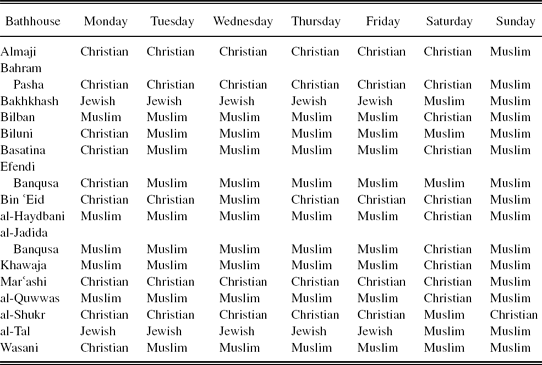
In 18th-century Aleppo, rather than being subjected to clothing and towel regulations, non-Muslim women were physically ordered and separated from Muslim women through bathing schedules. The first bathhouse schedule, registered in 1726, allotted most bathing days to religious minorities in parts of the city where they constituted a majority; however, later rulings gradually granted Muslim women more time in bathhouses located in predominately dhimmī neighborhoods (see Table 1).Footnote 56 In addition, the court often prohibited Christian and Jewish women from bathing together, or granted them only minimal overlap. All remaining days were allocated to Muslim women, thus enforcing Muslim women's superiority in the Ottoman social hierarchy over dhimmī women, who were superior only to slaves.
1726 Women's bathhouse schedule

Source: Aleppo shariʿa court registers (see Note 8).
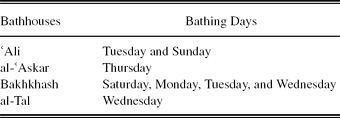
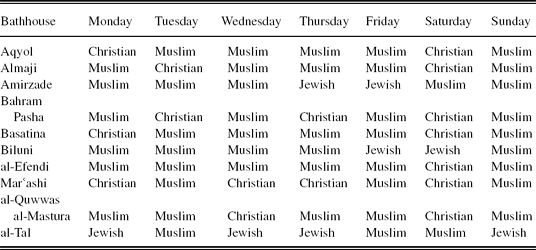
Two more entries segregating female bathing times for Christians and Jews were penned in consecutive order in the court register on 26 and 27 March 1752; both were agreements made with the heads of the respective Christian and Jewish millets.Footnote 57 The first was between the representatives of the Christian community and the bathkeepers’ guild (see Table 2).Footnote 58 According to the record, one representative (wakīl) spoke in court for each of the officially recognized Christian denominations (Greek Orthodox, Armenian Orthodox, Assyrian Orthodox, and Maronite Christian). The agreement was made between these Christian representatives and the chief representative (shaykh) of the Aleppo bathkeepers’ guild, Hajj Ahmad ibn Hajj Muhammad, and specified bathing days for Christian women in selected bathhouses. One day after the entry of the Christian women's bath schedule, a more abbreviated entry mandating specific bathhouses as well as designated bathing times for Jewish women was entered into the court register. Yusuf walad Natan, representative of Aleppo's Jewish community, agreed with Hajj Ahmad that Jewish women would bathe according to the schedule (see Table 3).Footnote 59
1752 Christian women's bathing schedule

Source: Aleppo shariʿa court registers (see Note 8).
1752 Jewish women's bathing schedule
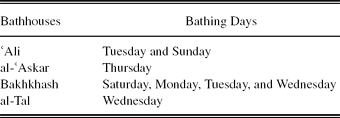
Source: Aleppo shariʿa court registers (see Note 8).
Analysis of these two schedules indicates some overlap for Christian and Jewish women in two bathhouses; both groups were allowed to bathe in Hammam al-Tal, located in the Jewish neighborhood of Bahsita, albeit on separate bathing days. Bathing was also allowed for both Jewish and Christian women on Saturdays at the al-Bakhkhash bathhouse, indicating a less rigid segregation policy. Jewish women were given only one day a week to visit Hammam al-Tal despite its location within the Jewish quarter, while Christian women living in nearby neighborhoods were given two days of use. This marks a departure from the earlier 1726 schedule that only allowed one dhimmī group to bathe in any given bathhouse on the assigned day, as shown in Table 1.Footnote 60 The remaining four bathing days in Hammam al-Tal were reserved for Muslim women.
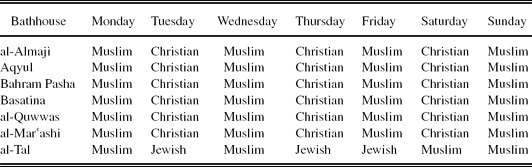
A closer examination of the bathhouse schedules shows an attempt to regulate the physical proximity of Muslim and non-Muslim women, especially in bathhouses located within areas heavily populated by Christians and Jews.Footnote 61Table 1 shows that the bathhouses for Christian women were located in the Christian district near Bab al-Nasr, in north-central Aleppo, while the Hammam al-Tal, located in the Jewish neighborhood of Bahsita, was situated near the quarter's entrance.Footnote 62 Some bathhouses, such as al-Jadida in Banqusa (northeast Aleppo), were located outside the predominantly non-Muslim neighborhoods, yet may have been listed in order to accommodate minority populations living there. The schedules also regularize bathing days. An order from 1794 offers no times for Christian women to bathe on Fridays and Sundays in the selected bathhouses (see Table 4). Jewish women are given little to no opportunity to bathe on their Sabbath days, as shown in Tables 1–4. The schedules presume that Christian and Jewish women would not want to bathe on Sabbath since it would interfere with religious activities; in contrast, the schedules work from the assumption that Muslim women will bathe on their religious days.
1794 Women's bathhouse schedule

Source: Aleppo shariʿa court registers (see Note 8).
It is difficult to assess exactly how restrictive these schedules were for female residents, since the chart agreed upon by the bathkeepers was not a complete listing of Aleppo's forty-nine bathhouses (thirty-two of which were located inside the city walls). The schedules only apply to ten to sixteen bathhouses, most located near Bab al-Nasr and thus the ones that Jews and Christians were most likely to use.Footnote 63 By late century, the policies drastically limit the bathing options for non-Muslim women in their own neighborhoods, so as to minimize the presence of impure dhimmī women and make the spaces more suitable for Muslim women's usage.
In 1726, Jewish women were given five days a week to bathe in Hammam al-Tal; in the 1752 schedule they were allotted only one day a week to bathe. In 1794, the court returned to a larger allocation, awarding Jewish women four days to bathe; however, a year later the court reduced this allotment to three days a week. Similarly, an examination of the Bahram Pasha schedule shows the court gradually limiting Christian women's access to that bathhouse, a public building constructed by the Ottomans in 1583 specifically to service the Christian community. In 1726, the judge ordered six bathing days for Christian women at Bahram Pasha; by 1752 it had been reduced to two days a week.Footnote 64 By the end of the century, the court reinstated one bathing day, providing three days a week to Christian women in the last two bathing schedules of the century. This neighborhood bathhouse was in a quarter that remained 93 percent Christian into the 20th century.Footnote 65
The restriction of access to public baths may have had a larger impact on Jewish women. Judaism, like Islam, placed the burden of purity on women more than men. Studies have found that Jewish women contravened the rules in practice due to the difficulty they faced when trying to fulfill purity requirements; therefore, it may not have been unusual for Jewish women to bathe with their Christian and Muslim counterparts or to use public baths in contravention of rabbinic law. Bathhouses like Hammam al-Kharab (Hammam al-Yahud) in Damascus accommodated Jewish women by providing a miqvah basin for the required ritual cleanse.Footnote 66 It is worth considering how restricted access to bathing—a ritual requirement prior to sex and after menstruation in Halakhic law—was more disruptive for Jewish than for Christian women in 18th-century Aleppo.
Strict proscriptions against intercommunal bathing continued in the last years of the 18th century; lengthy agreements appeared in 1794 and 1795. The judge made a list of bathing times for women according to their religious denominations. The 1794 ruling in Table 4 is by far the most extensive set of regulations identified in the court registers, though the schedule provided more time to dhimmī women than previous ones. A final order appeared one year later and slightly reduced dhimmī women's access (see Table 5) on the eve of state reforms that sought to Ottomanize imperial subjects. Yet, importantly, the final schedule in the series standardized and streamlined women's bathing times to allow access to each community every other day.Footnote 67
1795 Women's bathhouse schedule
Source: Aleppo shariʿa court registers (see Note 8).
RATIONALIZING REGULATION
The puzzling shifts in the numbers of days allocated to each community from one bathing schedule to the next may be understood in two ways. First, the most severe restrictions issued in 1752 correlate with changing imperial attitudes toward non-Muslims, as the empire sought to restrict non-Muslim dress and conduct in a period that witnessed what Madeline Zilfi has referred to as the “clothing wars.”Footnote 68 In this sense, the bathhouse schedules provide a provincial mirror of the policies directed at dhimmīs from the imperial capital. Second, the shifts in bathing times allotted to non-Muslim women over time may have a relationship with the changing demographic composition of Aleppo. Studying population numbers for Ottoman cities can be difficult because the primary sources, jizya (poll tax) records, counted only married non-Muslim males by household, and did not factor in the many non-Muslims who obtained tax-exempt status through foreign nationality. Tracking population is further complicated by the impossibility of tracing conversion to Islam statistically. Bruce Masters’ careful analysis of the 17th- and 18th-century jizya records indicates that the Christian population was growing during most of this period, but dropped off as immigration decreased toward the end of the 18th century.Footnote 69 Population shifts could, in part, explain some of the fluctuations in days assigned dhimmī women in the bathhouse schedules throughout the century, yet cannot fully explain the court's facilitation of Muslim hegemony in quarters where Christians and Jews comprised a clear majority.
Organizing religious denominations (ṭāʾifā) as recognized communities had long been a principle of Ottoman rule. While both Islamic and Ottoman law generally lumped non-Muslims together as generic Other—dhimmīs or, worse, kuffār (infidels or disbelievers)—Ottoman legal and social administration, as well as the state's taxation system, classified these communities along recognized religious lines. The documents registering the bathing times for Christian and Jewish women in 1752 were agreed upon by the same Christian and Jewish representatives who were charged with tax collection. Such specificity in separating Christian from Jew suggests that the documents reflect a particular 18th-century Ottoman view of social hierarchy, the classification schema of which was anything but generic.
Overall, the schedules registered at court affirm the positional superiority of Muslim women even in neighborhoods where they constituted a minority. This occurred at a time when the city was undergoing a trend toward “confessional crystalization,” as the religious character of quarters became gradually more pronounced.Footnote 70 The confluence of several ideological currents—Kadızadeli traditionalism, the consolidation of the Ottoman millets, and modernization—enhanced confessional divisions at the time these bathing schedules were instituted. In this light, the schedules are suggestive of a new way of thinking, a more heavy-handed form of regulation that is absent in earlier records, as new imperial and local forms of organization appeared within Aleppo's urban quarters.Footnote 71 Furthermore, the records suggest increasing standardization that attempted to discipline women's bathing habits; Jewish and Christian women were prohibited from bathing on their respective Sabbath days whereas Muslim women were allowed to bathe on Fridays, with the underlying assumption that they would not be attending mosque. The schedules, in turn, reify categories of Jewish, Christian, and Muslim women by compartmentalizing time and space within Aleppo's bathhouses.
NUDITY, PURITY, AND THE DHIMMĪ WOMAN
Although court orders rationalized the segregation of Muslim and non-Muslim women bathers in order “to prevent violating Muslim women's sanctity” (al-nisāʾ al-muslimīn dafʿān li-l-ḥurma) within the city's bathhouses, the sources rarely expound upon the juridical reasoning behind such rulings.Footnote 72 However, one unique document, the 1762 ruling mentioned in the introduction of this article, offers the clearest legal arguments for such separation.Footnote 73 Unlike other agreements, the judge presiding over the case, Hajj Ahmad ibn Hasan, included juridical citations to justify segregated bathing, thereby explicating why mixed bathing of Muslim and dhimmī women should be legally prohibited. Approximating footnotes, the judge's citations begin with Hanafi jurist Shams al-Din al-Timurtashi's (d. 1595) classic text Tanwir al-Absar that justifies segregating Muslim and dhimmī women through analogic reasoning: “Because the infidel woman with respect to the Muslim woman is like a man [al-marʾa al-kāfira bi-l-nisbat ilā al-marʾa al-muslima ka-l-rajul] and the comingling of women with unrelated [ajānib] men is forbidden, [therefore] it too is forbidden with infidel women [al-nisāʾ al-kuffār] and Muslim women.” The document quoted unnamed jurists (fuqahāʾ) who agree that “the dhimmī woman is like an unrelated man (ka-l-rajul al-ajnabī) and it is [therefore] most correct that she should not gaze upon any part of a Muslim woman's body.” Finally, the document cites an extreme ruling that “it is forbidden for a dhimmī woman to look at a Muslim woman's body parts, even after that body part has been severed.”Footnote 74 This graphic image makes clear that Muslim women were to be covered before non-Muslim women as they would be before unrelated men in all circumstances, even in the unlikely event of dismemberment. This ruling, paired with other citations and references, supported the judge's argument that a non-Muslim woman is gendered male when she casts her gaze upon a nude Muslim woman. In order to better understand how the judge may have understood nudity and the liminal status of the dhimmī woman as she oscillates between genders, we must turn to arguments about nudity and purity in Islamic ethics.
As a concept, purity moves beyond the cleanliness required in Islamic ethics to include the proper covering of Muslim bodies.Footnote 75 Besides mandating that dhimmī bathers distinguish themselves while bathing, the rulings ethically summon Muslim men and women to be modest at all times by covering their nudity. Qurʾan 24:30–31 calls upon women in particular to “not display their beauty [ʿawrat al-nisāʾ]”; the term ʿawra carries multiple meanings, including “blemish,” “genitals,” and “nudity.”Footnote 76 Classical works of Islamic exegesis and jurisprudence discuss at length acceptable perimeters of nudity and appropriate modesty, which change based on the degree of relationship between the individuals viewing one another. The ʿawra is usually defined for both men and women in Islam as the space between the navel and the knees; it is therefore required to cover that area at all times, even in front of other Muslims.Footnote 77 The parts of the body considered ʿawra sometimes shift depending on the social context and the relationship between the individuals in question. In the presence of unmarriageable male relatives, Hanafi interpretation upheld the position that the ʿawra of a woman consists of the area extending from the navel to the knees.Footnote 78 Ibn ʿAbidin (d. 1836) described female nudity as follows: “the chest and the area parallel to it from the back are not included in the ʿawra. The breasts are also not included in the ʿawra. There is no doubt that it is permitted to look upon the chest and breasts of a maḥram woman.”Footnote 79 In the jurist's estimation, the breasts of unmarriageable females were not sexualized in the same way as genitalia, perhaps due to the practical needs of nursing in the private spaces of the home, where a maḥram man could legally cohabit with his female kin.
Although female modesty was often the primary focus of legal debate, men were also featured in discussions about modesty requirements, since Qurʾanic requirements applied to both sexes. Damascene jurist Ibn ʿAbidin, in his commentary on al-Haskafi (d. 1677), argues that there are eight parts to a man that are considered ʿawra: his penis and the area around it, his testicles, his backside, his two buttocks, his two thighs and knees, and the area around the belly button.Footnote 80 These areas are to be covered at all times, regardless of the status of persons in one's company. In Aleppo, one court case focused exclusively on male modesty, without reference to religious status, illustrating how the court dealt more uniformly with the subject of male nudity. On 16 September 1768, guild master Sayyid Hasan Chalabi ibn Hajj Qasim and eight members of the bathhouse keepers’ guild appeared in court along with Sayyid ʿAli ibn Muhammad, a towel maker. The guildsmen insisted that men use towels that completely covered their privates and that “the towels being used were too short and narrow in width to cover people's genitals [lā yusturu ʿawrat al-nās].” The towel maker was brought to court in order to register an agreement to lengthen the towels bathers wore around the waist, echoing a court ruling from six years earlier when bathkeepers vowed to provide larger coverings for patrons.Footnote 81 Both documents, recorded in the same decade, depict the court's uniform application of modesty requirements for Muslim and non-Muslim men, in stark contrast to its segregation policy toward women.
The judge's argument concerning Muslim women's modesty before dhimmī women was derived from juridical interpretations of Qurʾan 24:30–31. The verses require women to veil in front of all persons except unmarriageable male kin, closely related female kin, children, and slaves, including male slaves who were presumably castrated; all of these were viewed as persons free of sexual desire.Footnote 82 Jurists disagreed about the status of the dhimmī woman in the framework of these verses. For example, Iraqi exegete Imam Shihab al-Din al-Alusi (d. 1854) noted in his Ruh al-Maʿani that the nature of contemporary friendships made it so that “a Muslim woman can hardly conceal herself from non-Muslim women” at all times.Footnote 83 However, to many jurists, dhimmī women posed a particular kind of moral threat to Muslim women. They argued that the threat to a Muslim woman's modesty was removed with the enslaved dhimmī woman because in that state she was free of sexual desire, specifically attraction to women, as were children and eunuchs. Although no direct reference to the dhimmī woman as a homoerotic danger to the Muslim woman was located in this study, the dhimmī woman has been linked discursively to male desire in juridical writings.Footnote 84
In his analysis, Ibn ʿAbidin affirmed the earlier interpretation of al-Haskafi that Muslim women should not expose themselves to non-Muslim women, writing that “it is impermissible for a Muslim woman to uncover in front of a Jewish, Christian or atheist woman except if she is her slave.” He followed this statement by noting: “it is also disliked that a corrupt woman [fāsiqa] sees the body of a pious woman, for she may describe her to men, thus she should avoid taking off her outer garment [jilbāb] or scarf [khimār].”Footnote 85 Ibn ʿAbidin's fear that a morally corrupt woman could describe a Muslim woman's body to men offers the clearest explanation for the court's repeated prohibition of mixed bathing and the disrobing of Muslim women in front of non-Muslim women in its bathhouses. Non-Muslim women appear to have been associated discursively with the figure of the “corrupt woman” referenced in Ibn ʿAbidin's commentary. Empirical analysis of 18th-century shariʿa court records from Aleppo and Damascus shows that rulings in cases of zinā (illicit sex)—specifically prostitution and fornication—adopted variations of the term fāsiqa to describe acts of illicit sex, making its use in analogical arguments about the dhimmī woman particularly prejudicial.Footnote 86 Yet, such associations were not isolated; the 18th-century mufti of Aydin, Haci Emirzade, similarly cited early Islamic traditions barring women's co-confessional bathing, including the ruling of classical jurist Muhi al-Din al-Nawawi that Muslim women should not bathe with adulteresses or prostitutes (imraʾa fājira) “because she will describe them to men,” thereby violating modesty.Footnote 87 Ottoman jurists in the 18th century thus discursively linked the dhimmī woman with moral corruption and illicit sexual behavior, an argument that exposes the juridical scaffolding of the Aleppo bathing schedules.Footnote 88
Jurists from earlier periods distinguished the morality of Muslim women by pointing to the modesty requirement found in the Qurʾanic verses cited above as well as a prophetic tradition that specifically instructed Muslim women to not describe the bodies of other “women to [their] husband as if he laid eyes upon her [lā tubāshiru al-marʾatu al-marʾata fa-tanʿatuhā ilā zawjihā ka-annahu yanẓuru ilayhā].”Footnote 89 This injunction is contrasted with an understanding that Jewish and Christian women were not explicitly forbidden to do the same and were therefore susceptible to breaching the modesty of Muslim women. In fact, the authors assume that non-Muslim women will report what they have seen. Yet, there is a contradiction within these modesty requirements, since many jurists permitted a Muslim woman to breach the modesty of another to describe her appearance—for example, hair color and body shape—to an unrelated man who intends to marry her.
Like modesty requirements in Islamic ethics, the 1762 ruling makes a clear reference to the ritual impurity of dhimmīs by ordering bathhouse keepers to assure the purity of the bathing water, isolating it from possible contamination. The proviso requires that: “A lock is [to be] put on the door of the hot water tank [khazzāna] nightly [in case] someone enters into the water before washing so that it becomes used. Continue with this agreement and do not break it for any reason.”Footnote 90 This regulation, along with the rigor of the surrounding guidelines in the same document, links notions of purity to efforts to distinguish and separate non-Muslims from the community of believers.
The religious symbolism of water in relation to ritual purity is one that cannot be ignored. Prohibitive regulations and purity laws work to define social order by delineating the sacred from the profane. Co-confessional contact in this sense pollutes and endangers the sacred community. Purity laws that work to frame communal boundaries are relevant to Islamic rules of purity, in which women, like dirt, constitute “matter out of place,” to use Mary Douglas’ terminology, and therefore must be ordered and purified.Footnote 91 The impulse to separate the pure from the profane is attested in early Islamic sources that describe the impurity (najāsa) of unbelievers (mushrikūn) and the need to bar them from pure spaces like mosques.Footnote 92 An early hadith tradition of Caliph ʿUmar ibn Khattab barred polytheist (ahl al-shirk) women from entering bath areas with Muslim women. Yet, polytheists and non-Muslims were not always distinguished from one another even in different versions of the same tradition.Footnote 93Mushrikūn in this context are clearly polytheists, but historian Janina Safran argues that Muslim writers often applied these prohibitive verses more broadly to encompass Jews and Christians (ahl al-kitāb).Footnote 94 Although the Hanafi school, the adoptive school of the Ottoman Empire, did not invoke such prohibitions, some Ottoman elites, especially during periods of heightened religious conservatism, clearly disapproved of non-Muslims attending bathhouses. For example, 17th-century Ottoman traveler Evliya Çelebi praised Cairo's bathhouses as the cleanest because they forbade entry to non-Muslims, suggesting a fear of contamination.Footnote 95
There is no evidence that the shariʿa court was addressing concerns from within the Christian and Jewish communities with these bathhouse orders. All agreements were initiated by Muslim male plaintiffs and Aleppo's bathhouse agreements were framed in terms of protecting Muslim women from non-Muslim women, specifically barring Muslim women entrance when non-Muslims were present. Muslim women were clearly elevated as categorically pure in this discourse and were increasingly provided the greatest access to bathhouses. There is also little evidence that the courts were considering Christian and Jewish religious practices in their rulings.
ILLEGIBLE WOMEN: A POSTSCRIPT
All of the orders analyzed for this study involved Aleppo's shariʿa courts and the bathhouse keepers' guild, without a single female plaintiff or witness. Such omission is worth reflection. While the regulations show how the Ottomans defined appropriate non-Muslim conduct within the larger moral order, they also suggest, in their repetition, that the population may have resisted those definitions and that the categories themselves lacked stability. This may have been especially true for the category of the non-Muslim woman. Perhaps the schedules defied the bathhouse keepers’ sensibilities about gender segregation and good business. After all, dhimmī men were allowed to bathe with Muslim men, so from a layperson's perspective, why would it be different for women? Some records show that guildsmen occasionally breached protocol, as in the case of Sayyid Qasim ibn Sayyid ʿAli, the renter of al-Zamr bathhouse, who was brought to court in 1776, not by guildsmen but by Ottoman officials bearing important titles, for allowing Muslim and non-Muslim women to bathe at the same time. The court described this breach as harmful to the public good, yet it was not a punishable offense; thus, he was released after he agreed to enforce segregation between the groups.Footnote 96
Women frequented the court for all sorts of legal matters, yet they are conspicuously absent in the bathhouse orders, where their interests are represented by notable Muslim men, the bathkeepers’ guild, and, to a lesser extent, the representative of their own religious communities. In this sense, the voiceless women in the court documents comprise what James Scott has called the “hidden transcript,” and it is here that women's agency might be located.Footnote 97 The illegible aspects of the court orders suggest that women, absent as legal protagonists, may have openly contested the state's—and, by extension, the guild's and the millet’s—attempts to discipline time, space, and popular leisure practices that lay just beyond its reach. The functionality of bathhouses made it possible for women to cross the divide between public and private space and thereby claim some of the public for themselves in contestation of the official discourse.Footnote 98 The repeated attempts of the state to control and regulate women in public spaces, and the disapproval of Muslim and Christian moralists who viewed the bathhouse space as one filled with debauchery, might explain why these groups repeatedly came together in court and agreed on a separation between women to uphold boundaries of purity.
In practice, women of different denominations may have bathed together out of convenience, such as when they were assigned bathing times in bathhouses outside their immediate neighborhood. The spatial discrimination ordered by the court may have defied common sense for some women as it restricted access to bathhouses located within their own quarters. Perhaps women failed to conform to the schedules because of the challenges all women faced while navigating public space. They may have been inconveniently forced to travel into unfamiliar neighborhoods in a period when neighborhood insularity offered security and comfort.Footnote 99 One might also wonder to what extent court orders reflected popular attitudes toward non-Muslims, since Muslim women were apparently willing to bathe with women of different faiths despite repeated objections of the court. The repetition of these schedules through the remaking of contracts between men suggests that the values they sought to instill may not have been shared by women bathers.Footnote 100
In conclusion, with the rise of religious conservatism, the formation of the millet system, and the attempts of the state to reinstate dissipating boundaries, women and minorities were a focal point of 18th-century Ottoman regulation. Bathhouse orders collected from Aleppo's courts reveal that elite men and local guilds sought to combat locally the blurring of boundaries between Muslims and non-Muslims during a period of intensified consumption. Bathing schedules were applied to women and discursively solidified the boundaries between the communities, yet within the schedules lay an internal contradiction. The dhimmī woman, who theoretically should have constituted the lowest rung of the social ladder, was at times gendered male and, as awkward as it seems, this gave her a status that confounded jurists and prompted tighter regulation.
Non-Muslim women were considered to have adopted a number of customs that constituted harmful innovations within the Muslim community; religious puritans and, to a lesser extent, the millet leadership had a heightened compulsion to define these corrupt practices in the 17th and 18th centuries.Footnote 101 At the same time, popular traditions described women as deficient in the area of religious understanding and, in that context, the dhimmī woman posed a specific kind of moral threat that needed to be checked by Muslim male authorities. Syrian jurist Ibn ʿAbidin's fear that dhimmī women, who in his conception lacked the standards of morality held by Muslims, would describe the shape of a Muslim woman's body to men, thereby violating her modesty, was consistent with broader popular stereotypes about the dhimmī woman. In this view, the non-Muslim woman is gendered male at the moment she sees a Muslim woman nude because she serves as a conduit for male desire.
For this reason, the dhimmī female figure takes on the characteristics of a “liminal being.” The uncategorized liminal being lacks a stable identity, which can help explain the contradictory gendering of the dhimmī female figure as she oscillates discursively between male and female. As a facilitator of pollution, she presents a danger to the purity of the Muslim community.Footnote 102 In this case, the pollution is the impure gaze of the dhimmī woman, which works as a conduit for the male gaze. At that moment, a Muslim woman's modesty is violated because the dominant stereotype assures that her body will be described by the liminal dhimmī woman to the outside male community. Therefore, the bathhouse orders, by designating the dhimmī woman the sexualized Other, adapted an older way of thinking about the impure dhimmī woman to a modern sensibility that sought to regulate and legislate her movement as she crossed the threshold from the public bathhouse exterior into its interior, where she was most likely to encounter Muslim women in a state of immodesty. Overall, this new construction of the dhimmī woman category reified the normative and “pure” Muslim female category. Similarly, truth claims about Muslim female purity were filtered through earlier discourses on religion, particularly discourses about the dhimmī Other embodied in the corrupt dhimmī woman figure. In this way, the discourse on confessional bathing is suggestive of modern trends to come, including the crystallization of communal identities and the regulation of desire, which construct rigid boundaries around categories of female and non-Muslim personhood.