Introduction
The stability of the ossicular chain is maintained only by muscles and ligaments in the middle ear. The ossicular chain is prone to dislocation or fracture under the impact of external force to the head. Hearing loss caused by traumatic damage, direct or indirect, to the ossicular chain may be persistent. This type of damage was described as early as the nineteenth century.Reference Iurato and Quaranta1 With the development of ear microscopy in the 1950s, this type of damage was reported frequently.Reference Hough and Stuart2, Reference Cremin3
We reviewed the cases treated with both facial nerve decompression surgery and ossicular chain reconstruction procedures at the same time. We compared the outcomes of surgery in terms of hearing improvement post-operatively, and evaluated the effect of the two different materials (titanium or autologous ossicles) on the reconstruction of the ossicular chain.
Materials and methods
A total of 42 patients, treated between 2013 and 2015, were included in the study. These patients had indirect traumatic damage to the ossicular chain with facial nerve paralysis due to temporal bone fracture. All patients had House–Brackmann grade VI facial nerve palsy.
Medical records on cases using a titanium partial ossicular reconstruction prosthesis (PORP) or autologous ossicles were collected and reviewed. The information collected included: pre- and post-operative (within 6–12 months; average of 9.6 months) auditory data (obtained using a Madsen Conera® audiometer); types of intra-operative ossicular chain damage; and the number of cases that had a titanium PORP or autologous ossicles.
All patients claimed to have normal hearing before the head injury, with no history of otitis media or middle-ear surgery.
Consent and ethics approval
Consent and ethics approval was obtained from the Institutional Ethical Committee for Research on Human Subjects. Written consent was obtained from all research subjects. The standard consent form approved by the ethical committee was used.
Surgical methods
A cortical mastoidectomy was performed via a post-aural approach, as well as a posterior tympanotomy. All operations were carried out by the same surgeon.
For cases of incus dislocation and incudostapedial joint dislocation, titanium PORP or autologous ossicular reconstruction (depending on whether the patient could afford the cost of the titanium PORP) was performed.
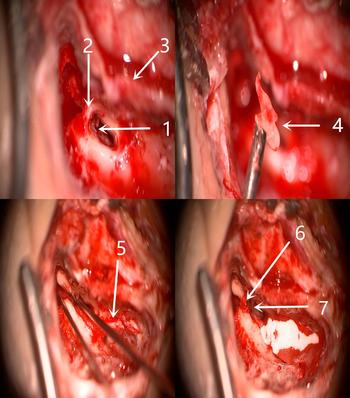
In the patients who underwent autologous incus restoration after incus dislocation or incudostapedial joint dislocation, small pieces of temporalis fascia were used to cover the area between the long process and the stapes, and a gelatine sponge and bone powder were used for the short process and the remaining incus buttress (Figure 1). The reason for choosing the thin bone slices is the convenient access to the mastoid path. If cartilage was chosen, a new incision would have been required. In addition, the placing of bone slices is more convenient than using cartilage.
Images showing autologous incus restoration after incus dislocation or incudostapedial joint dislocation. 1 = incudostapedial joint dislocation; 2 = incus buttress; 3 = posterior wall of external auditory canal; 4 = autologous incus; 5 = facial nerve; 6 = short process of the incus; 7 = reset incudostapedial joint

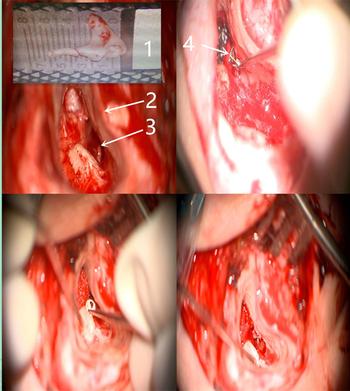
For patients with a fracture of the long process of the incus, it was directly replaced with a titanium PORP. The ossicular chain was reconstructed by placing a titanium PORP with one end connecting to the tympanic membrane (with a thin layer of mastoid cortical bone between the tympanic membrane and temporalis fascia), and the other end connecting to the stapes chain (Figure 2).
Images showing a fracture of the long process of the incus replaced with a titanium partial ossicular reconstruction prosthesis (PORP). 1 = fracture of long process of the incus; 2 = external auditory canal posterior wall; 3 = stapes; 4 = titanium PORP

Statistical analysis
In line with the Committee on Hearing and Equilibrium of the American Academy of Otolaryngology – Head and Neck Surgery guideline, a mean air–bone gap of less than 20 dB, at frequencies of 0.5, 1, 2 and 4 kHz, was accepted as a successful hearing result. In order to measure the success of surgery, all data were analysed using SPSS® version 15 statistical software for Windows. The paired t-test was used to analyse the pre- and post-operative (6–12 months) air conduction thresholds. The mean air–bone gap at 0.5, 1, 2 and 4 kHz was recorded.
Results
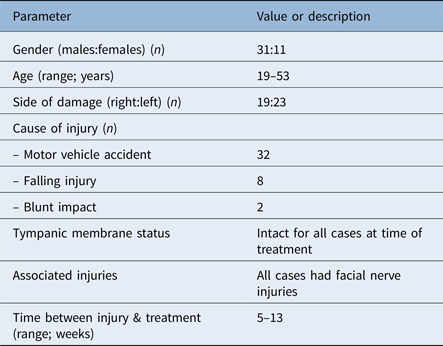
A total of 42 patients with ossicular chain damage and facial nerve paralysis were included in the study, of which 26 patients underwent ossicular chain reconstruction with a titanium PORP and 16 with autologous ossicles. The basic characteristics of the patients are shown in Table 1.
Patients’ basic characteristics

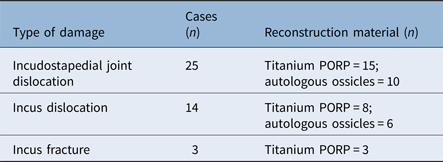
Among the cases of incus injury, there were 25 cases (59.5 per cent) of incudostapedial joint dislocation, 14 cases (33.3 per cent) of incus dislocation and 3 cases (7.1 per cent) of long process of the incus fractures. For the cases of incudostapedial joint dislocation and incus dislocation, the reconstruction of the ossicular chain utilised a titanium PORP in 23 cases or autologous ossicles in 16 cases, based on whether or not the patient accepted the associated costs, and the 3 cases of long process of the incus fracture were repaired using the titanium PORP, resulting in 3 groups. Table 2 summarises the distribution of the different reconstruction materials used for ossicular chain reconstruction according to type of damage.
Distribution of reconstruction materials used for ossicular chain reconstruction

PORP = partial ossicular reconstruction prosthesis
Pre-operatively, the average bone conduction audiometry threshold for the titanium PORP was 15.3 ± 6.1 dB, the average air conduction audiometry threshold was 45.5 ± 9.8 dB and the average air–bone gap was 32.3 ± 5.3 dB. Post-operatively, the average air conduction audiometry threshold was 23.5 ± 7.4 dB and the average air–bone gap was 12.8 ± 5.3 dB. The reduction in the average air–bone gap is statistically significant (p < 0.05).
For the group in which autologous auditory ossicles were used for reconstruction, pre-operatively the average bone conduction audiometry threshold was 14.5 ± 5.8 dB, the average air conduction audiometry threshold was 46.3 ± 8.2 dB and the average air–bone gap was 33.4 ± 4.5 dB. Post-operatively, the average air conduction audiometry threshold was 24.6 ± 7.4 dB and the average air–bone gap was 17.8 ± 7.8 dB. The reduction in the average air–bone gap is statistically significant (p < 0.05). Table 3 compares the average pre- and post-operative air–bone gaps for both the titanium PORP and autologous ossicle groups.
Pre- and post-operative average air–bone gaps for titanium PORP and autologous ossicle groups

PORP = partial ossicular reconstruction prosthesis; ABG = air–bone gap
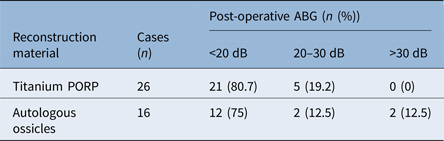
In the titanium PORP group, the post-operative average air–bone gap was reduced to within 20 dB in 21 cases (80.7 per cent) and was over 20 dB in 5 cases (19.2 per cent). In the autologous ossicles group, 12 cases (75 per cent) were within 20 dB, 2 cases (12.5 per cent) were 20–30 dB and another 2 cases (12.5 per cent) were over 30 dB. Table 4 shows the distribution of categories of post-operative average air–bone gaps for the titanium PORP and autologous ossicle groups.
Distribution of categories of post-operative average air–bone gaps for titanium PORP and autologous ossicle groups

PORP = partial ossicular reconstruction prosthesis; ABG = air–bone gap
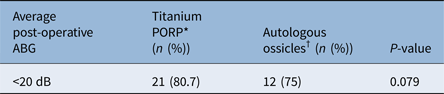
Table 5 compares the statistics for the post-operative average air–bone gap results of less than 20 dB between the titanium PORP and autologous ossicle groups, and indicates that there was no statistical difference between the two. A mean air–bone gap of less than 20 dB at frequencies of 0.5, 1, 2 and 4 kHz was accepted as a successful hearing result. The results show that repair with either the titanium PORP or autologous ossicles can improve hearing in patients who had an ossicular chain injury with facial nerve paralysis caused by a temporal bone fracture.
Statistics for post-operative average air–bone gap of less than 20 dB for titanium PORP and autologous ossicle groups

*n = 26; †n = 16. PORP = partial ossicular reconstruction prosthesis; ABG = air–bone gap
Discussion
There are five main types of ossicular chain injuries reported in the literature: incudostapedial joint dislocation, incudomalleal joint dislocation, incus dislocation, complex incudomalleal joint dislocation and stapes vestibular dislocation. In addition, rare fractures of the malleus, incus or stapes have been reported. Hammond analysed 202 cases of traumatic ossicular chain injuries, of which 73.2 per cent involved incus injury, 15.7 per cent involved malleus injury and 28.7 per cent involved stapes injury.Reference Hammond4 The most common joint dislocation was incudostapedial joint dislocation.Reference Hammond4 In children with temporal bone fractures, incudostapedial joint dislocation was also found to be the most common ossicular chain injury.Reference McGuirt and Stool5 Meriot et al. reported two reasons why the incudostapedial joint was the most likely to dislocate.Reference Meriot, Veillon, Garcia, Nonent, Jezequel and Bourjat6 Firstly, the incus is suspended between the more stable malleus and stapes, but the stability of the suspension is poor. Secondly, the incudostapedial joint itself is a fragile enarthrosis, vulnerable to dislocation if impacted by an external force.Reference Meriot, Veillon, Garcia, Nonent, Jezequel and Bourjat6
The majority of ossiculoplasty case reports reviewed relate to injuries to the ossicular chain only, so the operation path was mainly through the external auditory canal–tympanum.Reference Ghonim, Shabana, Ashraf and Salem7 The cases in our study had facial nerve paralysis in addition to ossicular chain injury, and therefore facial nerve decompression surgery was the first stage of treatment. The mastoid process path was then followed, exposing the upper tympanum, opening the facial recess, and removing the incus buttress to reveal the mesotympanum. This enabled us to clearly observe the relationship between the malleus, incus and stapes, as well as a section of the tympanic membrane. Compared with the external auditory canal path, the visual field in the space through the mastoid–facial recess was wider, which made it easier to operate on the ossicular chain. Because our team mainly perform facial nerve decompression surgery, the patients we receive are mostly those with facial nerve paralysis. We rarely receive any cases of ossicular chain injury without facial paralysis. Occasionally, when we receive such cases, the ossicular chain is repaired via the external auditory canal rather than the mastoid.
There has yet to be proposed a unified standard for the surgical timing in ossicular chain damage. Wennmo and Spandow believe that if the air–bone gap in conductive deafness cases is still greater than 30 dB after seven weeks, a timely surgical procedure should be carried out if ossicular chain damage is suspected.Reference Wennmo and Spandow8 According to Johnson et al., if ossicular chain damage is suspected and the hearing has not recovered after three to four months, surgical procedures should be considered.Reference Johnson, Semaan and Megerian9 However, Grant et al. believe that the normal hearing threshold can recover within six months in some cases.Reference Grant, Arganbright and Friedland10
When considering surgery for the treatment of ossicular chain injury, in addition to hearing assessment, we also need to take into account the following two factors: computed tomography (CT) findings on the shape of the ossicular chain and whether there are other co-morbidities requiring surgical exploration.
Regarding the shape of the ossicular chain, if a CT scan reveals that the incus has been dislocated or fractured, the possibility of later hearing recovery is very low, and so surgery should be performed. Among the cases in our study, 38 cases had an ossicular chain abnormality clearly identifiable by CT before surgery, which strongly suggested that preparations for ossicular chain reconstruction should be made.
Regarding other co-morbidities that required surgical exploration, Darrouzet et al. suggested that if patients who need to go through facial nerve decompression or cerebrospinal fluid leakage repair surgery have conductive deafness, the ossicular chain damage should be explored and dealt with at the same time.Reference Darrouzet, Duclos, Liguoro, Turilhe, De Bonfils and Bebear11 The cases in this study had both facial nerve paralysis and conductive deafness, and the temporal bone CT scan showed signs of fracture near the facial nerve, as well as ossicular chain abnormalities. These factors are an important basis for active surgery. Haemotympanum after temporal bone fracture was considered reversible in most cases. Tos stated that the haemorrhage in the tympanic cavity would be drained in three weeks.Reference Tos12 However, in our cases, there were blood clot residues found in the tympanum in various conditions, of which 10 cases had fibrous tissue wrapping around the ossicles. It was found that the long-term existence of these tissues in the tympanum also impacted on hearing.
Ossicular chain reconstruction using artificial ossicles is a recently reported technology. Some scholars believe that hearing recovery using artificial ossicles (titanium PORP) is better than with autologous ossicles.Reference Zenner, Stegmaier, Lehner, Baumann and Zimmermann13 There are also reports of good hearing recovery by remodelling autologous ossicles for ossicular chain repair.Reference Wu, Shu and Yang14 The hearing recovery of our patients using artificial ossicles for ossicular chain reconstruction has been satisfactory. There has been no prolapse of the artificial ossicles after surgery. We believe that this is because, when compared with the chronic suppurative otitis media cavity, the mastoid, tympanic cavity mucous membrane and Eustachian tube functions in a healthy person after temporal bone fracture are all normal, and thus post-operative recovery of the middle-ear cavity is more promising.
• Temporal bone fractures are common after craniocerebral trauma, but there are fewer cases of ossicular chain fractures.
• There are no rules about whether ossicular chain surgery is needed after temporal bone fracture or when surgery is best performed
• Ossicular chain reconstruction (and facial nerve decompression) is described in patients with facial nerve palsy secondary to temporal bone fracture
• Ossicular chain repairs utilised artificial or autologous ossicles; procedures were detailed and post-operative hearing outcomes recorded
In our cases of artificial reconstruction of the ossicular chain, we did not use the incus re-shaping method. Rather, we directly reset the morphologically intact incus, and used small pieces of fascia for reinforcement at the incudostapedial and incudomalleal joints. We considered it simply as a dislocation of the incus, so there was no damage to the articular surface compared to those suffering from otitis media.
The patients were required to rest in bed for 72 hours after the surgery. Post-operative hearing recovery was ideal for most patients. There were two patients with four-frequency air–bone gaps of over 30 dB, considered to be the cause of incus dislocation.
Conclusion
Air conduction improvement and air–bone gap gain generally demonstrate good functional outcomes of ossicular chain reconstruction treatment. The techniques and materials used in the repair play a role in hearing improvement. The results of this study suggest that repair with either titanium PORP or autologous ossicles can improve hearing after ossicular chain injury with facial nerve paralysis caused by a temporal bone fracture.
Competing interests
None declared