LITERATURE REVIEW
Languages differ in the way they use pitch variations (F0: fundamental frequency) in their prosodic systems for communication. Some use pitch variations at the word level as lexical tone contrasts that distinguish meanings between otherwise segmentally identical words; other languages use pitch variations more broadly—that is, at the word, phrase, or sentence level (intonationally), without changing the lexical meaning of individual word(s). How are these pitch properties perceived when native speakers from these different language types come into contact? For example, how does a person from an intonational type of language perceive the pitch differences that can convert the meaning of a target word in the connected speech of a lexical tone type of language? Recent studies suggest that listeners make use of the tonal patterns of their native language prosodic systems (i.e., tone, pitch accent, and intonational systems) when perceiving the tonal categories of isolated words in another language that uses pitch variations differently (i.e., tone languages). As we describe in the next few subsections, the pattern of perceptual results largely supports the claims of the perceptual assimilation model of crosslanguage speech perception (PAM; Best, Reference Best and Strange1995; Best & Tyler, Reference Best, Tyler, Bohn and Munro2007) as it has been extended to suprasegmentals (So, Reference So2010, Reference So, Stolz, Nau and Stroh2012; So & Best, Reference So and Best2008, Reference So and Best2010a, Reference So and Best2010b, Reference So and Best2013). The current study investigated two previously unexplored questions regarding the perception of nonnative lexical tones: (a) how do native listeners of nontone (intonational) languages perceive nonnative lexical tones when they occur in connected speech, and (b) how may the lexical stress properties of listeners’ native languages contribute to their perception of those nonnative lexical tones? To address these questions, we examined how native speakers of English and French, two nontonal languages with different lexical stress properties, perceived Mandarin lexical tones presented within a sentence frame.
Prosodic Classification of Languages
One way of classifying prosodic typologies of the languages of the world is to divide them into tonal and nontonal languages, depending on their tonality use. Do they use pitch variations (e.g., high vs. low or level vs. contour: rising or falling) for distinguishing otherwise segmentally identical lexical items or only for distinguishing broader features of spoken words and phrases? Languages that use pitch variations as lexical tones on segmentally constant word forms for signifying lexical distinctions are called tone languages; these include Cantonese, Mandarin, and Thai. Footnote 1 The languages that use pitch variations as sentence- or phrase-level or focus-oriented intonation patterns, but not as lexical tones, are called nontone languages; English and French are two examples.
Nontone languages also differ, however, in their accent systems (see Beckman, Reference Beckman1986), which include lexical-level distinctions, usually as accent patterns over two or more syllables. As these patterns usually involve pitch differences to at least some extent, the accent systems of nontone languages could contribute to their native speakers’ perception of nonnative lexical tones. Languages such as Japanese and Swedish use pitch accents in defining the phonological shape of words. Recent studies have shown that native pitch accents can influence the perception of nonnative lexical tones (e.g., by Japanese listeners; So, Reference So2010, Reference So, Stolz, Nau and Stroh2012; So & Best, Reference So and Best2010a, Reference So and Best2013). Other languages use lexical stress, or alternations between stressed and unstressed syllables, to define the phonological structure of words. In some stress-accented languages, such as Italian and Spanish, stressed syllables differ from unstressed syllables primarily in pitch and loudness but differ minimally in vowel quality and syllable duration. These languages, as well as some lexical tone languages such as Cantonese and Mandarin, are often described as having syllable-timed rhythmic qualities to their connected utterances—that is, with roughly constant syllable durations (although this is disputed by some researchers) at a given speech rate (see Arvaniti, Reference Arvaniti2009; Crystal, Reference Crystal1997; Fox, Reference Fox2000; Lai, Reference Lai2008; Van Santen & Shih, Reference Van Santen and Shih2000). In other stress-accented languages, such as English (American, British, and Australian) and German, stressed syllables differ from unstressed syllables not only in pitch and loudness but also in duration and vowel quality (i.e., unstressed vowels are reduced, or softer and more schwalike). Such languages are often described as stress-timed languages, in which stressed syllables reoccur at roughly constant time intervals across connected speech, regardless of the number of intervening unstressed syllables (Avery & Ehrlich, Reference Avery and Ehrlich2004; Beckman, Reference Beckman1986; Crystal, Reference Crystal1997; Fletcher, Reference Fletcher, Hardcastle, Laver and Gibbon2013; Frawley, Reference Frawley2003; Pearce, Reference Pearce2007; E. W. Schneider, Reference Schneider, Kortmann and Schneider2004). Finally, languages such as French lack lexical-level stress or pitch-accent distinctions, using pitch variations only at supralexical levels. French is generally considered a syllable-timed language (Fletcher, Reference Fletcher1991; Hardison, Reference Hardison2004; Wenk & Wioland, Reference Wenk and Wioland1982).
Considering the accent systems of languages could be especially useful for a more detailed understanding of how nontone language listeners perceive the unfamiliar tonal distinctions of a lexical tone language. The core question of the present study, therefore, was how nonnative Mandarin lexical tones may be perceived by naive listeners of nontone languages in terms of their basic native sentence-level intonation categories (i-Categories) and how those judgments might be influenced by the presence (English) versus absence (French) of stress accent in the listeners’ native language. To address these questions, we considered the issues primarily within the theoretical framework that has guided our prior research on nonnative listeners’ perception of Mandarin lexical tones and distinctions: the perceptual assimilation model for suprasegmentals (PAM-S; So, Reference So2010, Reference So, Stolz, Nau and Stroh2012; So & Best, Reference So and Best2008, Reference So and Best2010a, Reference So and Best2011, Reference So and Best2013). Other existing models of nonnative speech perception, such as the speech learning model (Flege, Reference Flege and Strange1995) and the native language magnet model (Kuhl, Reference Kuhl1994, Reference Kuhl2007), have not made clear predictions about the issues addressed in the present study.
Perceptual Assimilation Model for Suprasegmentals (PAM-S)
The PAM-S (So, Reference So2010, Reference So, Stolz, Nau and Stroh2012; So & Best, Reference So and Best2008, Reference So and Best2010a, Reference So and Best2010b, Reference So and Best2011, Reference So and Best2013) is an extension of the PAM (Best, Reference Best and Strange1995) and the PAM-L2 (i.e., the PAM for second language learners; Best & Tyler, Reference Best, Tyler, Bohn and Munro2007), which were developed to account for listeners’ perceptual assimilation of nonnative segments (consonants and vowels) into their first language (L1) phonological categories and contrasts and to predict discrimination of nonnative contrasts according to those perceptual assimilation patterns. In the PAM-S, native speakers of both tone and nontone languages assimilate foreign second language (L2) prosodic categories (i.e., Mandarin tonal categories, in this study) into their native prosodic categories (e.g., tonal, pitch-accent, and intonational categories), and those assimilation patterns are posited to predict discrimination performance for specific tonal contrasts (So, Reference So2010, Reference So, Stolz, Nau and Stroh2012; So & Best, Reference So and Best2008, Reference So and Best2010a, Reference So and Best2010b, Reference So and Best2011, Reference So and Best2013). Findings to date suggest that naive listeners’ assimilations reflect the phonological and phonetic properties of their native prosodic systems, such as lexical tone, pitch accent, and intonation, for Cantonese, Japanese, and English and French, respectively (So, Reference So2010, Reference So, Stolz, Nau and Stroh2012; So & Best, Reference So and Best2008, Reference So and Best2010a, Reference So and Best2010b, Reference So and Best2011, Reference So and Best2013).
In particular, recent studies (So, Reference So2010, Reference So, Stolz, Nau and Stroh2012; So & Best, Reference So and Best2013) provided evidence that Cantonese, Japanese, and Australian English listener groups assimilated nonnative lexical tones (Mandarin) to their native prosodic categories (lexical tone, pitch accent, and stress-accented-intonational, for the respective listener groups) in a categorization task. The listeners’ discrimination abilities, irrespective of their native languages, were generally consistent with the extension of the original PAM predictions for segmental-level assimilations (Best, Reference Best and Strange1995; Best & Tyler, Reference Best, Tyler, Bohn and Munro2007) to suprasegmental (prosodic) categories.
According to the PAM-S, a nonnative prosodic category (tone, pitch accent, or intonation) may be perceptually assimilated as either a categorized or an uncategorized prosodic category of listeners’ L1 systems. A nonnative prosodic category is categorized when listeners perceive it as an exemplar of some L1 prosodic category. For example, Cantonese listeners perceptually assimilated Mandarin Tone 4[51] (the high-falling tone) mainly as Cantonese Tone 1[55]/[53] (the high-level/high-falling tone), Japanese listeners perceptually assimilated it as their high-low (HL) pitch accent, and English listeners perceptually assimilated this Mandarin tone as their Statement [finality] i-Category (So, Reference So2010, Reference So, Stolz, Nau and Stroh2012; So & Best, Reference So and Best2008, Reference So and Best2010b, Reference So and Best2013). However, a nonnative prosodic category is uncategorized when listeners perceive its core phonetic features that fall somewhere in between two or more native prosodic categories. For example, Cantonese listeners perceptually assimilated Mandarin Tone 3[214] (the falling-rising tone) as Cantonese Tone 2[25] (the high-rising tone), Tone 5[23] (the low-rising tone), and Tone 4[21] (the low-falling tone), compatible with the fact that the rising and falling features of Mandarin Tone 3 are also shared among the three Cantonese tones at the tonal onset or the offset of the tonal contours. Japanese listeners perceived Mandarin Tone 3 as an uncategorized prosodic category. Some assimilated this tone as their LH pitch accent, but others could not categorize it into any pitch accent (they selected the Unknown option). Similarly, English listeners perceptually assimilated this Mandarin tone as uncategorized, split between their i-Categories Uncertainty and Question [yes-no] (So, Reference So, Stolz, Nau and Stroh2012; So & Best, Reference So and Best2008, Reference So and Best2013).
For the PAM-S, the common assimilation types within the original PAM framework are extended from the segmental level to the suprasegmental level. The PAM-S focuses on the prosodic categories rather than phones at the segmental level. Accordingly, two-category (TC) assimilation occurs when two nonnative prosodic categories (e.g., tone, pitch accent, or i-Category) assimilate to two separate native prosodic categories. Discrimination of the nonnative contrast in these cases is expected to be excellent. Single-category (SC) assimilation occurs when two nonnative prosodic categories assimilate equally well or poorly to a single native prosodic category. Poor discrimination is predicted. When both nonnative prosodic categories assimilate to a single native prosodic category, however, one often assimilates better than the other. This is called category goodness (CG) difference in assimilation, for which discrimination is moderate to very good. Uncategorized-categorized (UC) assimilation arises when one nonnative prosodic category is assimilated to a native prosodic category, and the other is uncategorized. Discrimination is expected to be good if there is little to no category overlap between the prosodic categories that were split across the uncategorized assimilation and the categorized prosodic categories, but discrimination may be rather poor if there is much category overlap between them; a similar picture arises for uncategorized-uncategorized (UU) assimilations (Bohn, Best, Avesani, & Vayra, Reference Bohn, Best, Avesani and Vayra2011; So, Reference So, Stolz, Nau and Stroh2012; So & Best, Reference So and Best2010a; Tyler, Reference Tyler2007). Recently this hypothesis was further elucidated, predicting that UU pairs that involve categorizations to the same set of native categories (UU-s) will be difficult to discriminate, whereas those whose assimilation sets show no overlap (UU-no) will be discriminated much better; those with partially overlapping assimilation sets (UU-o) will show intermediate discrimination. Similar principles should apply to UC-s versus UC-no versus UC-o assimilations (Bohn et al., Reference Bohn, Best, Avesani and Vayra2011; So & Best, Reference So and Best2013; Tyler, Reference Tyler2007).
The Present Study
The PAM-S claims that naive listeners will perceive nonnative lexical tones according to the phonological and phonetic properties of their L1 prosodic categories (tone, pitch accent, and intonation). However, prior studies of nonnative lexical tone perception have almost all presented isolated lexical items in citation form for listener judgments. It is important to ask, as we do in the present study, how listeners perceive foreign tones embedded in a sentential environment. Connected speech contexts are more naturalistic and may be more informative about, for example, L2 learning, in which learners quite often must try to decipher novel L2 phonemes or tonemes (for tone languages) from within phrases and sentences they hear in the classroom or immersion environment. Additionally, it is important and of theoretical interest to know whether there is any difference in the perceptual assimilations between native speakers of nontonal languages with different lexical-level accent systems, as we argued earlier. Although categorization and discrimination of nonnative vowels has been examined in sentence contexts (Levy & Strange, Reference Levy and Strange2008), to our knowledge, nonnative lexical tone perception has not been investigated in sentence context, and certainly the interaction of sentence context and L1 accent system effects has not been examined previously.
To address these issues, we examined how native speakers of Australian English, a stress-accent language (Beckman, Reference Beckman1986), and French, a language without an accent system (Beckman, Reference Beckman1986; Crystal, Reference Crystal1997; Fox, Reference Fox2000; E. W. Schneider, Reference Schneider, Kortmann and Schneider2004), categorized and discriminated the Mandarin tones of target words presented within a Mandarin declarative sentence environment (i.e., finality statement context). Because lexical tone features are not phonologically contrastive in the two nontonal languages of our listener groups (English and French), and also because only English has a lexical-level accent system, we compared the listener groups’ perception of the lexical tones with respect to basic sentence-modality intonation types (i.e., i-Categories), such as Question versus Statement intonation, which do exist in both languages and could possibly serve as native intonational reference categories for their perception of nonnative lexical tones. English sentence intonation is affected by lexical stress alternations, whereas French sentence intonation is not. We asked whether this accent difference between the two languages could affect the listeners’ assimilation of the lexical tones of the Mandarin target words to native sentence intonation types as well as whether it also could affect discrimination of lexical tone contrasts. This possibility is compatible with prior findings that native French listeners have difficulty perceiving lexical stress patterns, even if they have become fluent L2 speakers of a stress-accent language (e.g., Spanish or English; Dupoux, Pallier, Sebastian, & Mehler, Reference Dupoux, Pallier, Sebastian and Mehler1997; Dupoux & Peperkamp, Reference Dupoux, Peperkamp, Laks and Durand2002; Dupoux, Peperkamp, & Sebastian-Galles, Reference Dupoux, Peperkamp and Sebastian-Galles2010; Peperkamp & Dupoux, Reference Peperkamp, Dupoux, Gussenhoven and Warner2002).
METHOD
Participants
Thirty Australian English speakers (18–24 years of age) and 30 native French speakers (21–37 years of age) were recruited as participants. The French participants were all natives of France, had lived in Australia for less than a year, and had learned English in France beginning around the age of 10. Footnote 2 All participants were either undergraduate students at the University of Western Sydney who received course credits after they completed the experiment or residents living in Sydney at the time of the experiment who received AUD 40 for their participation. None of the participants had learned Mandarin or received formal musical training, as previous studies have shown that listeners with musical training outperform those without such training in both production and perception tasks with nonnative tones (Burnham & Brooker, Reference Burnham, Brooker, Hansen and Pellom2002; Deguchi et al., Reference Deguchi, Boureux, Sarlo, Besson, Grassi, Schön and Colombo2012; Lee & Hung, Reference Lee and Hung2008). Before they performed the experiment, they all passed a pure-tone hearing screening (250–8,000 Hz at 25 dB HL).
Stimuli
The stimuli for this study were produced by three native Mandarin speakers (M age = 24 years). Four root-word syllables, zhi, zha, zhu, and fu (respectively, /tʂi/, /tʂa/, /tʂu/, and /fu/), were used, as each of them can be produced with any of the four Mandarin tones as real words. The pitch patterns of the four Mandarin tones in citation form are standardly described as follows: Tone 1 (T1) is a high-level tone, Tone 2 (T2) is a high-rising tone, Tone 3 (T3) is the so-called dipping tone (i.e., falling-rising), and Tone 4 (T4) is a high-falling tone (Chen, Reference Chen2004; Tao, Reference Tao1996).
The speakers produced each target word within a fixed declarative sentence frame, shown here in Chinese Pinyin: xia4 yi1 ge4 shi4 X zi4, in which the number indicates the tone on the word, and X indicates the target word. The meaning of this frame is “the next one is the X word.” This places the target word in the penultimate position and gives it an informational focus, which, to nontone listeners, may sound like a sentence contour on the focus word, against the background of the carrier sentence. Our use of all T4 words in the carrier sentence, except for the second word, is consistent with the carrier sentence that Ho (Reference Ho1977) used to study Mandarin lexical tone production of information-focus target words in declarative, interrogative, and exclamatory sentence modalities. Ho found that the tonal contours of the target words in the declarative sentence context were similar to se in their citation form (Ho, Reference Ho1977). Similarly, Shih (Reference Shih1988) found that the pitch contours of the four lexical tones on the root word fu in a set of disyllabic tonal combinations (fu + a T4 word, ji4) were also comparable to their own pitch contours in citation form (Shih, Reference Shih1988).
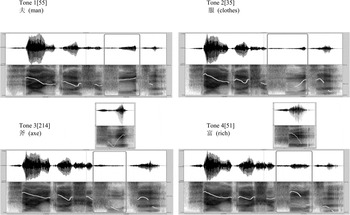
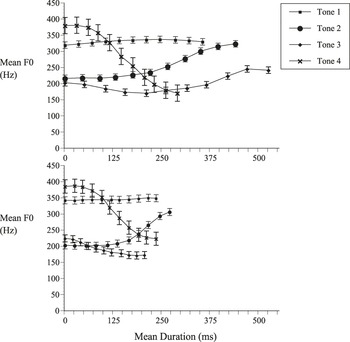
We note, nonetheless, that tones in sentence context can be affected by tone coarticulation, reflecting phonetic-level influences (Xu, Reference Xu1994, Reference Xu1997) and tone sandhi rules, a phonological-level influence that also affects the pitch contour shape of some tones in specific contexts (Chen, Reference Chen2004; Shen, Reference Shen1992). Sandhi primarily affects the production of T3 when it is followed by another T3 word; our carrier sentence was not subject to this sandhi rule. However, Mandarin tone sandhi also affects the production of T3 when it is followed by any other tone (i.e., in connected speech). This is more relevant to our study, causing the target T3 in the carrier sentence to be produced as a short, low-falling contour (Figure 1). This differs from T3 in citation form, which has a falling-rising pitch contour and the longest duration of all four Mandarin tones (see Figures 1 and 2).
Samples of the four Mandarin stimuli: Tone 1 (upper left), Tone 2 (upper right), Tone 3 (lower left), and Tone 4 (lower right). In each cell, the upper row shows the pitch contour of the target tone in citation form (for comparison) with the meaning of the target word. The bottom row shows the pitch contour of the target tone in the sentential environment used in the present study: xia4 yi1 ge4 shi4 X zi4 (“the next one is the X word”). The rectangular boxes highlight the target tones.

Mean F0 contours of the four Mandarin tones. Acoustic measures for each tone were obtained from the 72 final target stimuli for the perceptual tests, which had been produced in citation form (top) and in sentential form (bottom) by three native female Mandarin speakers.

The first three target syllable types, zhi, zha, and zhu, were used in the discrimination task. The last one, fu, was used in the categorization task because its pronunciation is close to that for the English word fool and the French word fou “crazy.” Each target type was produced with five tokens for each tone. From these samples, three tokens per tone per root-word syllable per speaker were selected as the test stimuli (3 × 4 × 4 × 3 = 144 stimulus tokens). These stimuli were screened by another three native Mandarin speakers (M age = 27.7 years), who independently verified that all selected tokens displayed the correct tone.
Procedure
Participants were asked to perform an AXB discrimination task and a categorization and rating task in a fixed presentation order. The tasks were presented via a laptop, using the presentation program E-Prime (Version 2.0; W. Schneider, Eschman, & Zuccolotto, Reference Schneider, Eschman and Zuccolotto2007). The AXB discrimination task assessed listeners’ ability to distinguish pairs of target tone categories in sentence contexts, using multiple natural exemplars produced by three native Mandarin talkers. The categorization and rating task evaluated how listeners of the two groups perceived Mandarin tones of the target word in the sentence in terms of their native English and French prosodic categories (i.e., basic sentence intonation types, for this study). The discrimination task was given first to avoid having categorization responses influence discrimination performance.
The AXB discrimination task consisted of a total of 216 trials in three different experimental blocks corresponding to the three target words (syllables) zhi, zhu, zha (i.e., 72 trials per block, blocked by syllable type in random order). Each block was made up of the combinations of six tone contrasts on the target word (T1-T2, T1-T3, T1-T4, T2-T3, T2-T4, and T3-T4) and three repetitions of each of four trial formats (AAB, ABB, BAA, BBA). The symbols A and B represent two contrastive stimuli (tone categories) of the target word in the sentence, and the four trial formats refer to the order of A and B. In each trial, three sentences containing the target words were presented to the participants, each produced by different speakers. Listeners were asked to determine whether the tone of the target word in the second sentence (X) was same as the tone of the target word in the first sentence or the third sentence. They pressed one of two preset keys on the keyboard to indicate their corresponding answers.
For the categorization task, participants were asked to categorize the tone on the /fu/ word of each stimulus sentence into the four basic English or French i-Categories: Flat-pitch (i.e., monotone; a level pitch without movement), Question (a rising pitch contour, as for a yes-no question), Statement (a declarative sentence, with a falling contour), and Exclamation (a more steeply falling pitch contour).
Although there is no simple one-to-one correspondence between intonation and linguistic meaning (i.e., there are often multiple possible interpretations of an intonational pattern), the patterns used in this study are typical or unmarked pitch patterns for basic sentence-modality i-Categories with a relatively clear pragmatic intention, such as a rising pitch pattern for the English yes-no Question category (see also Ladd, Reference Ladd1996, Chapter 3). The Flat-pitch category had also been used in our previous studies for stimuli in citation form (So, Reference So, Stolz, Nau and Stroh2012; So & Best, Reference So and Best2008, Reference So and Best2010b, Reference So and Best2013), as there is no basic sentence-modality category associated with a level pitch pattern. Moreover, the listeners seemed to understand the category, as they assimilated Mandarin T1 to the Flat-pitch category significantly more often than to the other answer options. Nonetheless, as can be seen in the next section, we did not make any predictions related to this category. As for the Statement category, although English statements in general can express either finality (falling pitch contour) or continuation (final rise in pitch) in Australian and other English varieties, it is more likely that participants would consider it to refer to finality than to continuation, especially given that Question [yes-no] was one of the other i-Category choices. Indeed, their tone-related selections of this i-Category are more consistent with an interpretation of finality fall than of continuation rise.
Altogether, 72 trials of these stimulus sentences (3 speakers × 4 tones × 3 tokens per tone × 2 repetitions) were randomized separately for each participant. The same i-Categories were provided to the English and French groups because these i-Categories are common to both languages and share similar pitch contours (Di Cristo, Reference Di Cristo, Hirst and Di Cristo1998; Hardison, Reference Hardison2004; Ladd, Reference Ladd1996). Recall that our interest was in whether the lexical-level accent difference between French and English would systematically influence the two groups’ choices of sentence-modality i-Categories.
During the experiment, the stimulus sentences were presented individually from a laptop computer. The laptop screen displayed five buttons that were labeled for use as answer keys (by mouse click); four buttons corresponded to the four i-Categories, and a fifth button was labeled Unknown. Listeners were instructed to select Unknown only when they could not place the tone of the target word into any i-Category. All labels were in English because the French listeners were living in Australia, and all were fluent in English; however, they were instructed to make their selections relative to French sentence intonations. Careful instructions and a practice trial block with eight samples were first given to both listener groups before the experiment to ensure they all understood the task.
Then, after they chose an answer category for the target word in a given stimulus sentence, the participants rated goodness of fit by judging how well the target Mandarin tone matched the native i-Category they had just chosen for that token. The rating was based on a 7-point Likert scale, from 1 = “very bad example” to 7 = “very good example.” Once the participant had clicked on a goodness rating, a new trial was presented automatically.
Predictions
Our predictions assumed that the two groups’ categorizations should be based on the contextual phonetic similarities they perceived between the pitch contours of the Mandarin target-word lexical tones within the context of penultimate, information-focus position in the fixed carrier sentence environment, and their native sentence-level i-Categories. Thus, it was predicted that both listener groups would perceive T1 (high level) on the target word more often as Statement than as Flat-pitch (unlike our previous studies with citation-form tones: So, Reference So, Stolz, Nau and Stroh2012; So & Best, Reference So and Best2008, Reference So and Best2013), because this level tone might be perceived in this sentence context (followed by a final high-falling T4 word) as a tone with a slight falling movement. We expected T2 (rising) to be categorized primarily as Question, T3 (a low-falling/low tone in sentence context) primarily as Statement, and T4 as Exclamation (a high-falling tone with a steeper slope) rather than Statement. However, we also anticipated that the presence of stress accent in English but not in French might result in listener group differences in the strength of assimilations of at least some Mandarin tones to native i-Categories.
The actual obtained tonal assimilation patterns of the English and French groups from the categorization task were then used to predict their discrimination task performance, as described in the PAM. Therefore, we anticipated greater difficulties discriminating the T1-T3 pair (both tones were expected to be categorized as Statement) than other tone pairs. We also expected to find some variations in predicted discrimination between the English and French groups, dependent on differences in the way the two groups assimilated the target tones to their native i-Categories.
RESULTS
Tonal Categorization
We present results for each group separately, describing the categorization results first, as they form the basis for predictions about discrimination performance for each group on each tone pair. In this study, we followed the steps of determining the status of categorization of the nonnative target tones (categorized or uncategorized) that we developed in our previous studies (So, Reference So2010, Reference So, Stolz, Nau and Stroh2012; So & Best, Reference So and Best2008, Reference So and Best2010b, Reference So and Best2011, Reference So and Best2013). In that approach, to be considered categorized, the listeners’ judgments on a given nonnative item had to meet two criteria: (a) a given native category must have been selected significantly more than chance level for the set of native options presented to the listeners (here, both French and English listeners were given four i-Category options plus Unknown; thus chance level was 20%), and (b) the assimilation percent for that choice had to be significantly higher than for any of the other choices. When two or more native categories are selected for the same Mandarin lexical tone significantly above the chance level but their mean differences are not significant, assimilation of that lexical tone is considered uncategorized (e.g., dual and multiple categorizations). There are two advantages of using these steps for determining tonal categorizations: (a) they can be used for any language, regardless of the number of native i-Categories in the listeners’ language, and (b) this method provides a fair basis of comparison among listener languages, as the assimilation percent for a category is compared with the chance level for that language. Although some published studies of crosslanguage vowel or consonant perception have used a criterion of 50% or 70% choice of one native category for a given nonnative segment to be considered categorized (Antoniou, Tyler, & Best, Reference Antoniou, Tyler and Best2012; Bundgaard-Nielsen, Best, Kroos, & Tyler, Reference Bundgaard-Nielsen, Best, Kroos and Tyler2011; Bundgaard-Nielsen, Best, & Tyler, Reference Bundgaard-Nielsen, Best, Kroos and Tyler2011), we believe the current approach is more appropriate for determining assimilations of the prosodic categories (i.e., dynamic pitch patterns of lexical tones in this study).
Native English Speakers
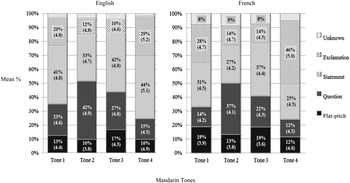
For native English listeners, assimilation percent and corresponding mean goodness-of-fit ratings to English i-Categories for each tone are presented in Figure 3 (left panel). Individual t tests were carried out to test mean percent choice of each i-Category for each target tone against chance level (20%). The results confirmed that the following i-Category choices per target tone were all significantly above chance level (alpha level was set at p = .01 after Bonferroni correction for multiple t tests): Statement for T1, t(29) = 7.880, p < .001; Question, t(29) = 5.799, p < .001, and Statement, t(28) = 4.950, p < .001, for T2; Question and Statement for T3, t(28) = 2.738 and 6.538, p < .001 for both; and Statement and Exclamation for T4, t(28) = 9.029 and 4.194, p < .001 for both. A chi-square test revealed a significant association between tones and i-Categories, χ2(12) = 165.794, p < .001; this was further examined in a two-way repeated-measures ANOVA (Tone × i-Category), Footnote 3 which found no significant main effect of tone, F(3, 9) = 0.1295, p = .943, but did find a significant effect of i-Category, F(3, 389) = 51.952, p < .001, on listeners’ mean assimilations. The Tone × i-Category interaction was also significant, F(9, 389) = 7.722, p < .001.
The English (left) and French (right) listeners’ tonal categorization percentage for each tone and its goodness rating in brackets. The total number of responses for each tone category was 540. Categories that were used 5% or less are not labeled.

Individual one-way ANOVAs on the percentage of i-Category choices for each tone target were carried out to investigate the interaction. The i-Category effect was significant for each tone: T1, F(3, 105) = 21.615, p < .001; T2, F(3, 92) = 13.077, p < .001; T3, F(3, 95) = 13.65, p < .001; and T4, F(3, 97) = 30.005, p < .001. Post hoc HSD Tukey tests yielded the following results: For T1, the mean percentage of Statement assimilations (41%) was significantly greater than those for Question (23%; p < .001), Exclamation (20%; p < .001), and Flat-pitch (13%; p < .001) assimilations. For T2, the mean percentage of Question assimilations (42%) was significantly greater than those for Flat-pitch (10%; p < .001) and Exclamation (12%; p < .001) but did not differ significantly from that for Statement (33%; p = 1.00), which was selected significantly more often than Flat-pitch (p < .001) and Exclamation (p < .001). For T3, the mean percentage of Statement assimilations (42%) was significantly greater than those for Question (27%; p < .001), Flat-pitch (17%; p < .001), and Exclamation (10%; p < .001). Additionally, the mean percentage of Question assimilations was significantly greater than that for Exclamation (p = .05). For T4, the mean percentage of Statement assimilations (44%) was significantly greater than those for Exclamation (29%; p = .006), Question (15%; p < .001), and Flat-pitch (10%; p < .001). The mean percentage of Exclamation assimilations was significantly greater than those for Flat-pitch and Question (p < .001).
Native French Speakers
For native French listeners, the assimilation percent and corresponding mean goodness-of-fit ratings to native i-Categories for each tone are presented in Figure 3 (right panel). Individual t tests were again carried out to test each i-Category mean for each target tone. The means of the following i-Categories were all significantly above chance: Exclamation, t(27) = 3.691, p < .001, and Statement, t(29) = 4.198, p < .001, for T1; Question, t(29) = 4.286, p < .001, and Statement, t(28) = 3.270, p < .001, for T2; Statement for T3, t(29) = 4.957, p < .001; and Statement, t(26) = 3.463, p < .001, and Exclamation, t(29) = 6.461, p < .001, for T4. As for the English group, a chi-square test found the relation between tones and i-Categories differed significantly from chance, χ Footnote 2 (12) = 262.22, p < .001. Also, as with the English listeners, the follow-up ANOVA (Tone × i-Category) Footnote 4 found no significant main effect of tone, F(3, 9) = 0.362, p = .781, but did find a significant effect of i-Category, F(3, 403) = 13.045, p < .001, and a significant Tone × i-Category interaction, F(3,403) = 10.176, p < .001.
Individual one-way ANOVAs were carried out, as was done for the English listeners’ data. The i-Category effect was again significant for T1, F(3, 102) = 5.037, p < .001; T2, F(3, 102) = 10.327, p < .001; T3, F(3, 102) = 7.132, p < .001; and T4, F(3, 95) = 20.742, p < .001. Post hoc HSD Tukey tests found the following: For T1, Statement assimilations (31%) significantly exceeded Flat-pitch (19%; p = .05) and Question (14%; p = .009) assimilations, and Exclamation assimilations (28%) were significantly greater than Question assimilations (p = .05). For T2, Question assimilations (37%) were significantly higher than those of Flat-pitch (13%; p < .001) and Exclamation (14%; p < .001) but did not differ significantly from Statement assimilations (27%; p = .209). The Statement assimilations were significantly higher than the Flat-pitch assimilations (p = .05). For T3, Statement assimilations (37%) were significantly higher than those of Question (22%; p < .001), Flat-pitch (19%; p = .003), and Exclamation (14%; p = .024). For T4, Exclamation assimilations (46%) were significantly higher than those of Statement (25%; p = .001), Flat-pitch (12%; p < .001), and Question (12%; p < .001), and Statement assimilations were also significantly higher than Flat-pitch assimilations (p = .019).
Listeners’ Overall Tonal Categorization
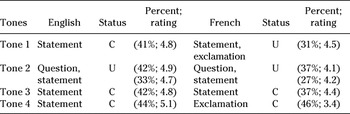
Listeners’ tonal assimilation results, as predicted by extending PAM principles to the suprasegmental domain (So, Reference So2010, Reference So, Stolz, Nau and Stroh2012; So & Best, Reference So and Best2010b, Reference So and Best2011, Reference So and Best2013), confirmed that both English and French listeners perceptually assimilated Mandarin tones on words with information focus within declarative carrier sentences into their native sentence-modality i-Categories. According to the statistical analyses and examination of the corresponding mean goodness ratings, we determined the status of assimilation for each Mandarin target tone (categorized vs. uncategorized), as summarized in Table 1.
Summary of the categorizations of the four Mandarin tones by the Australian English and French listener groups. Assimilation percent and mean rating score are listed for each i-Category that met the categorization criteria

Note. C = categorized; U = uncategorized. Tone 2 was considered uncategorized, as there was a dual categorization pattern in both listener groups. Similarly, Tone 1 and Tone 2 for the French group were also considered as uncategorized.
The English listeners’ categorizations appear to have been based primarily on the similarities between the phonetic properties of Mandarin tones (e.g., pitch patterns) and those of the most similar English i-Categories. Mandarin T1 was categorized as Statement (41%; 4.8 rating) more so than any of the other choice categories; T2 was categorized as both Question (42%; 4.9) and Statement (33%; 4.7); T3 was categorized as Statement (42%; 4.8), as its percent selection was significantly higher than that of Question (27%; 4.8); and T4 was categorized as Statement (44%; 5.1), as its percent selection was significantly higher than that of Exclamation (29%; 5.25), rather than being primarily assimilated to Exclamation as we had predicted. Thus, these results supported the predictions laid out for T1 and T3. However, T2 was not reliably categorized as the single predicted category, Question, but instead its categorization was split between the expected Question category and the Statement category (a dual categorization pattern). Therefore, according to the criteria for categorization status that we defined earlier, T2 is considered as uncategorized for the English listeners.
For the French group, the categorizations of Mandarin tones were also based on the phonetic similarities between the Mandarin tones in sentence context and the French i-Categories. Mandarin T1 was categorized as both Statement (31%; 4.5) and Exclamation (28%; 4.7); T2 was categorized as both Question (37%; 4.1) and Statement (27%; 4.2). Because of these dual categorization patterns, T1 and T2 were considered uncategorized for this listener group. T3 was categorized as Statement (37%; 4.4), and T4 was categorized as Exclamation (46%; 3.4), as its percent selection was significantly higher than that of Statement (25%; 4.5). Thus, the French assimilation results were more closely in line with our predictions of primarily Statement assimilations for T1 and T3, Question assimilations for T2, and Exclamation assimilations for T4.
Using the groups’ categorization patterns of Mandarin tones (Table 1), we further determined the possible tone assimilation types for each listener language and predicted their nonnative Mandarin tone discrimination performance for each tone contrast (T1-T2, T1-T3, T1-T4, T2-T3, T2-T4, and T3-T4) according to the principles outlined earlier for the PAM-S (So, Reference So2010, Reference So, Stolz, Nau and Stroh2012; So & Best, Reference So and Best2008, Reference So and Best2010a, Reference So and Best2010b, Reference So and Best2011, Reference So and Best2013). The resulting assimilation patterns and discrimination predictions are summarized in Table 2.
Summary of the assimilation patterns and corresponding predictions for discrimination performance by the Australian English and French listener groups (Tone 2 is uncategorized for both; Tone 1 is uncategorized for French listeners)

Note. TC = two-category assimilation; SC = single-category assimilation; UC = uncategorized-categorized assimilation; UU = uncategorized-uncategorized assimilation. The addition of -o for the UU and UC assimilations indicates that both Mandarin tones received overlapping i-Category assimilations but did not display the same primary i-Category choice.
As can be seen in Table 2, the English listeners’ assimilations of the Mandarin tone contrasts included three UC-o (T1-T2, T2-T3, and T2-T4) and three SC (T1-T3, T1-T4, and T3-T4) assimilation pairs. According to the PAM’s predictions of assimilation pairs, this listener group should have the greatest difficulty discriminating the SC pairs, whereas their discrimination for the UC-o pairs was expected to be good. In the present study, because the English listeners categorized Mandarin T1, T3, and T4 into their Statement category, additional t tests of the mean goodness ratings for Statement assimilations in each pair involving these tones further revealed that they were perceived as equally good tokens of the Statement category (p > .05); that is, they constitute SC assimilations rather than CG assimilations. It was predicted that (a) the English listeners’ discrimination for the UC-o pairs would be better that of the SC pairs, and (b) discrimination performance would be comparable when assimilation pairs were from the same type.
As for the French group, their tonal assimilations resulted in one UU-o pair (T1-T2), four UC-o pairs (T1-T3, T1-T4, T2-T3, and T2-T4), and one TC pair (T3-T4). The discriminations of the TC, UC-o, and UU-o pairs were expected to be excellent, good, and fair to good, respectively. Accordingly, it was predicted that (a) French listeners’ discrimination for the TC pair would be better than for the UC-o pairs, which would be better than the UU-o pair, and (b) discrimination performance would be comparable when assimilation pairs were from the same type.
Tonal Discrimination
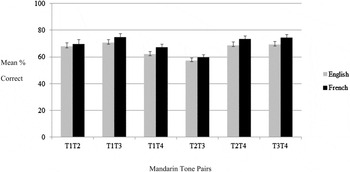
The discrimination data (mean percent correct) for the native listeners of English and French were submitted to a mixed-factor ANOVA with group as the between-subjects factor and tone pair as the within-subjects factor. The results showed a significant effect of group, F(1, 348) = 7.121, p < .001. The French listeners’ mean percent correct (70%) was modestly yet significantly higher than that of the English listeners (66%) overall; see Figure 4. The results also showed a significant effect of tone pair, F(5, 348) = 9.506, p < .001, but the Group × Tone Pair interaction was not significant, F(5, 348) = 0.179, p = .970 (see Figure 4).
The mean percent correct discrimination (in %) for each tone pair by the English and French listeners. The error bars show the standard errors.

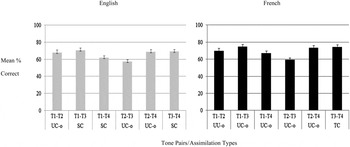
To determine how well native speakers of each language group discriminated among the six Mandarin tone pairs (i.e., the tone pair effect within each group), individual one-way ANOVAs for each language group were also performed on the tone pairs. The results for the English and French listener groups are presented in Figure 5.
The mean percent correct for each tone pair by the English (left) and French (right) listeners, with the contrast assimilation pattern as determined by the group’s assimilation results, are shown below each tone pair on the x-axis. The error bars show the standard errors.

Native English Speakers
The ANOVA for the English group showed a main effect of tone pair in that the mean percent correct for some tone pairs was significantly lower than that of the others, F(5, 14) = 4.556, p < .001. Post hoc t tests with Bonferroni correction for multiple t tests further revealed that the mean percent correct for the SC-assimilated T1-T4 (62%) and UC-o T2-T3 (57%) pairs was significantly lower than that of the other tone pairs, p < .001, and the mean for T2-T3 (UC-o) was also significantly lower than that of T1-T4 (SC; p < .001; see Figure 5, left panel).
Native French Speakers
Similarly, the ANOVA for the French listeners showed a significant main effect of tone pair in that the mean percent correct of some tone pairs was significantly different than others, F(5, 174) = 5.092, p < .001. Post hoc t tests with Bonferroni correction further revealed that the mean percent correct for UC-o pairs T1-T4 (67%) and T2-T3 (60%) was significantly lower than that of the other tone pairs, p < .001, for all, and the mean for T2-T3 (UC-o) was also significantly lower than that of T1-T4 (p < .001; see Figure 5, right panel).
DISCUSSION
Tonal Categorization
Both the French and English listeners assimilated the Mandarin target-word lexical tones into their basic sentence-modality i-Categories, consistent with the assumptions of the PAM-S. However, the categorization and discrimination patterns differed in several respects between the two listener groups. French listeners were better able than English listeners to perceive some of the finer details of the lexical tones. In particular, they were better able to distinguish T4 from T3. Footnote 5 Although the English listeners were sensitive to the falling pitch movement of both T3 and T4, they did not as clearly perceive the difference in the rate or extent of F0 decline for these tones, both of which they assimilated mainly to Statement.
Listeners’ categorizations of the Mandarin tones in a sentence environment appear to have been affected both by the overall descending pitch of the declarative carrier sentence frame and by the contextually varying tonal phonetic characteristics (e.g., rising and falling pitch contours) of the target word within the sentences. The descending pitch of the whole sentence may have exerted some perceptual influence on both the English and the French listeners, who sometimes categorized T2, the rising tone, to their Statement category (English: 33%; French: 27%), though not as often as they categorized it, as expected, to Question (English: 43%; French: 37%). Both groups also perceived T1 (high level) as their Statement category in this sentence context, rather than as Flat-pitch. These perceptual patterns may reflect the contextual effects on the target-word tones, including both anticipatory and carry-over tonal coarticulation effects (Xu, Reference Xu1994, Reference Xu1997). For example, both groups sometimes perceived T3 as Question (English listeners: 27%; French: 22%) despite the fact that this tone is generally produced with a low-level or falling pitch contour in a sentence environment. The production of the word following the target, zi4, involves a higher pitch at its onset because it has a high-falling tone (T4). It is possible that anticipatory coarticulation of zi4 might have been perceived by these nonnative listeners as a rising pitch pattern at the end of the target word. A tonal coarticulation explanation may also apply to the English listeners’ perception of T1, which 23% of the time was perceived to be part of the Question category.
It is important to note that the lexical stress differences between the two listener languages also appear to have differentially affected their perception of the nonnative target-word tones. Native speakers of French (a language that lacks lexical stress) perceived some finer grained phonetic features of the target-word tones within the sentence context better than did the native speakers of English (a stress-accent language). The lack of native lexical stress might have actually simplified the French listeners’ task of identifying the pitch contour of the informational focus target word against the background of the Mandarin carrier sentence. This may be why the French categorizations were closer to our predictions (see Table 1). By comparison, the English listeners may instead have perceived the target-word contours as conveying both lexical stress and sentencelike intonation. Indeed, English listeners’ assimilations of Mandarin tones in our prior studies with citation-form stimuli had been more differentiated and more in line with the PAM-S predictions for the citation-form words (So, Reference So, Stolz, Nau and Stroh2012; So & Best, Reference So and Best2008, Reference So and Best2013) than for the tones within the carrier sentence in the present study (also see So & Best, Reference So and Best2011).
The categorization results thus suggest that for listeners of nontonal languages, both the broader phonetic environment of the stimuli and the lexical stress characteristics of their native language can affect categorizations of target-word tones in connected speech.
Tonal Discrimination
The result of the tonal discrimination analysis similarly indicated that the French listeners performed better than did the English listeners, suggesting that the lexical stress differences between English and French played a role in the two groups’ discrimination of nonnative lexical tone contrasts. Both listener groups’ difficulties in discriminating the T1-T4 and T2-T3 contrasts are consistent with previous studies with citation-form tones (So, Reference So2006, Reference So, Stolz, Nau and Stroh2012; So & Best, Reference So and Best2010a, Reference So and Best2013), as were the significant differences in discrimination of tone pairs within the same assimilation types. More generally, however, the discrimination results were not well aligned with our predictions about the relationship between tone assimilations and discrimination performance levels, except for the fact that the French listeners discriminated the TC pair T3-T4 better than the UC-o pairs T1-T4 and T2-T3, which is consistent with our predictions. For the English group, the SC pair T1-T4 was more difficult to discriminate than were the SC pairs T1-T3 and T3-T4, which was not predicted by the PAM-S. Similarly deviating from the predictions, the UC-o pair T2-T3 was more difficult for the English listeners to discriminate than the UC-o pairs T1-T2 and T2-T4, and the French listeners had more difficulty discriminating two of the UC-o pairs (T1-T4 and T2-T3) than two other UC-o pairs (T1-T3 and T2-T4).
For this study, because tone target words were in information-focus position within a carrier sentence, phonetic tonal coarticulation effects (Xu, Reference Xu1994, Reference Xu1997), the strength of categorization (So, Reference So, Stolz, Nau and Stroh2012; So & Best, Reference So and Best2013), and phonetic overlaps in category choices (see Bohn et al., Reference Bohn, Best, Avesani and Vayra2011; So, Reference So, Stolz, Nau and Stroh2012; So & Best, Reference So and Best2013; Tyler, Reference Tyler2007) may offer some insights into these otherwise seemingly inconsistent results. Footnote 6
Tonal coarticulation effects, both anticipatory and carry-over types (Xu, Reference Xu1994, Reference Xu1997), as well as sandhi rules, affect lexical tones in connected speech. Just as the English and French listeners’ tonal categorizations were based on the contextually varying phonetic characteristics of the tones of the target words within the sentences, their discrimination could have been influenced by those contextually varying effects on the target tones in the sentence context.
Strength of categorization (So, Reference So, Stolz, Nau and Stroh2012) may also help explain discrimination performance patterns relative to the listeners’ categorizations, even beyond the predictions from their assimilation patterns. Both categorization consistency and mean goodness-of-fit ratings can reflect how well listeners perceived the Mandarin tones to fit their native prosodic categories. Categorization consistency can be calculated by dividing each language group’s above-chance native prosodic category choices for each Mandarin tone into three ranges: weak, moderate, or strong consistency in choosing a specific prosodic category (see also So, Reference So, Stolz, Nau and Stroh2012; So & Best, Reference So and Best2013). For both the English and French groups, the three evenly spaced ranges of categorization strength given their five answer choices are as follows: weak (20% < X < 46.6%), moderate (46.7% < X < 73.2%), and strong (73.3% < X < 100%). Similarly, goodness ratings for all above-chance category choices can be stratified into three even ranges along the 7-point Likert rating scale: poor fit (1 < X < 2.99), moderate fit (3 < X < 4.99), and very good fit (5 < X < 7).
As can be seen in Table 1, the listeners’ tonal categorizations in the sentence context were generally weak (falling between 37–46%), and across the two listener groups, three tones were uncategorized. Yet the mean goodness of fit for the categorized tones ranged from moderate to very good (see Table 1). The weak categorizations may be partly due to the influence of tonal coarticulation effects (Xu, Reference Xu1994, Reference Xu1997). In any case, the weakness of the categorizations of target-word tones in sentence context may at least partially explain why the discrimination predictions from the assimilation analyses did not work as well as expected in this study.
Phonetic (feature) overlap in suprasegmentals may also help to explain why both the English and French listeners exhibited different degrees of discrimination among tone pairs that displayed the same assimilation type. In particular, both groups’ discrimination for the T1-T4 and T2-T3 pairs was significantly lower than for the other pairs in the same assimilation type (i.e., SC or UC-o). As can be seen in Figure 1, there are substantial phonetic similarities between the tones in the T1-T4 and T2-T3 pairs. For the T1-T4 pair, T1 and T4 both start with a high pitch onset. But T1 maintains the high pitch to its offset and then falls to the lower pitch of the next word, whereas T4 starts with a high onset and falling pitch toward the offset, where it further falls to the lower pitch of the next word. For the T2-T3 pair, both tones start with a falling pitch onset and then rise upward to their offsets and continue to rise into the tone of the next word. For instance, there were three SC assimilation pairs (T1-T3, T1-T4, and T3-T4) for the English listeners. However, the phonetic differences between T3 and T1 and between T3 and T4 were apparently more noticeable to them in the discrimination task than were those between T1 and T4. This was possibly due to the surrounding phonetic context of the target tone, the tonal onset and offset, and the direction of the tone contour.
Limitations and Future Directions
This study compared perception of Mandarin lexical tones by naive listeners of two nontone languages that differ in whether they use lexical stress (English) or lack a lexical stress system (French). The listeners were asked to categorize the tonal patterns of the four Mandarin lexical tones in target words according to their common basic native sentence-modality i-Categories (Question [yes-no], Statement [finality], Exclamation, and Flat-pitch [monotone]). Unlike previous studies of nonnative tone perception that presented listeners with tone words in citation form (So, Reference So, Stolz, Nau and Stroh2012; So & Best, Reference So and Best2008, Reference So and Best2010a, Reference So and Best2013), we presented the target items in connected speech, spoken with information focus in a fixed declarative carrier sentence. This design allowed us to observe how influences from the contextual effects of the phonetic environment on the tones, as well as influences from the lexical stress properties of the listeners’ native languages, affect nonnative tone perception. Presenting the target tones within sentence context was an important advance for gaining deeper insights into how naive nontone listeners perceive lexical tones under more typical language learning conditions than isolated citation-form words, which is of both theoretical and practical significance (e.g., nontone language speakers learning tone languages often have substantial difficulty learning to reliably perceive and produce the lexical tones correctly). However, this study was just a first step in that direction and, as such, was necessarily limited in scope. Further studies will be needed to examine whether and how other aspects of listeners’ native language intonation systems may impact their perception of lexical tones in context. For example, it would be useful to include a larger set of native sentence-modality i-Categories, such as comparing different statement or question types with differing intonation contours (e.g., statements expressing finality vs. statements expressing continuation or yes-no vs. wh-questions). It would also be important (a) to investigate listeners of other nontone languages that differ in their lexical accent systems and in various aspects of phrase-level intonation patterns, and (b) to examine the perception of other tone languages with different lexical tone systems as well as the interactions between tones and their sandhi rules in connected speech (e.g., Cantonese has a more complex tone system that includes more contextual changes in tone shape, whereas certain African languages have simpler tone systems that lack any contour tones). These future investigations will provide additional information about the perception of tone by listeners from various language backgrounds and about how their native languages affect their perception or learning of nonnative tones.