I. INTRODUCTION
Nanostructured (NS) and ultrafine-grained (UFG) materials have recently received considerable attention because of their extraordinarily high strength and hardness compared with that of their counterparts.Reference Valiev and Langdon1, Reference Meyers, Mishra and Benson2 Disappointingly, the introduction of profuse artifacts and saturation of defects during preparation deteriorates their ability to accumulate dislocations, which results in the inadequate ductility of these high-strength materials. This shortcoming has become an essential bottleneck keeping them far from practical utility.Reference Koch, Morris, Lu and Inoue3 Of several strategies proposed to improve their ductility,Reference Lu, Shen, Chen, Qian and Lu4–Reference Tsuji, Ito, Saito and Minamino8 an appropriate thermal annealing treatment can conveniently and effectively optimize the mechanical properties of NS/UFG metals.Reference Wang, Chen, Zhou and Ma5, Reference Huang, Hansen and Tsuji6 A superior combination of high strength and good ductility is achieved in the NS/UFG metals with a “bimodal” microstructure (NS matrix grains and micrometer-sized recrystallized grains) induced by thermal annealing. Thus, this toughening strategy has been used to experimentally improve the mechanical properties of NS/UFG metals with different crystallographic structures including face-centered cubic (fcc), body-centered cubic (bcc), and hexagonal close-packed (hcp) crystals.Reference Huang, Hansen and Tsuji6, Reference Tsuji, Ito, Saito and Minamino8–Reference Srinivasarao, Oh-ishi, Ohkubo, Mukai and Hono11
In these close-packed structures, stacking fault energy (SFE) plays crucial roles in the microstructures and mechanical behaviors during not only plastic deformation but also thermal annealing in metallic materials.Reference Meyers and Chawla12–Reference Humphreys and Hatherly14 Recently, bulk NS Cu–Al alloys with different SFEs were synthesized using equal channel angular pressing (ECAP), and the grain refinement mechanism, microstructures, and mechanical properties are markedly influenced by tailoring the SFE of the Cu–Al alloys.Reference Qu, An, Yang, Huang, Yang, Zang, Wang, Wu and Zhang15–Reference Wu, An, Han, Qu and Zhang18 Although the overall mechanical properties were improved with decreasing the SFE of alloys, the uniform elongation was still limited. Therefore, the purpose of the present study is to apply a thermal annealing treatment to upgrade the mechanical properties of NS Cu–Al alloys; meanwhile, regarding the significance of SFE, it is crucial to decode the effects of SFE on the thermal stability and strength–ductility combination of these alloys during annealing.
II. EXPERIMENTAL PROCEDURE
Two NS Cu–Al alloys with different SFEs (Cu–5at.%Al: 28 mJ/m2, Cu–8at.%Al: 17 mJ/m2) were processed via four passes of ECAP. The ECAP procedure was performed using a die fabricated from tool steel with two channels intersecting at inner angle of 90° and outer angle of 30°, accordingly, yielding an effective strain of ~1 for each pass. All the rods with 45 mm length and 8 mm diameter, coated with a MoS2 lubricant, were pressed at room temperature (RT) with a pressing speed of 9 mm/min. The alloys were processed for four passes with route BC (90° clockwise rotation around the sample axis between the pass), which is the most effective route for the grain refinement.Reference Zhu and Langdon19 With the reduction in the SFE of Cu–Al alloys, the grain refinement was gradually transformed from dislocation subdivision mechanism into twin fragmentation mechanism.Reference Qu, An, Yang, Huang, Yang, Zang, Wang, Wu and Zhang15 Meanwhile, the role of shear bands in refining the original coarse grains is increasingly significant, which introduced more microstructure heterogeneities in NS Cu–8at.%Al.Reference Qu, An, Yang, Huang, Yang, Zang, Wang, Wu and Zhang15–Reference Wu, An, Han, Qu and Zhang18
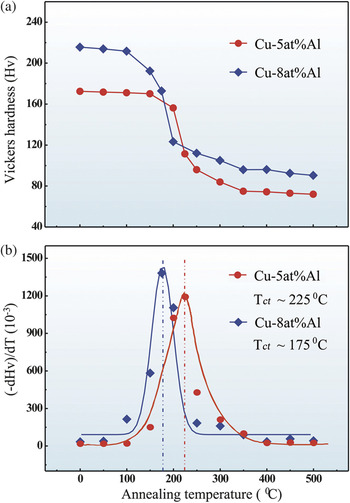
These prepared samples were annealed isochronally in vacuum at intervals of 50 °C for 1 h to evaluate the variation of Vickers hardness (H V) with temperatures, and smaller intervals of 25 °C were used to carefully check the transition from recovery to recrystallization as exhibited in Fig. 1. The Vickers hardness was measured with loads of 9.8 N for these alloys applied for 10 s, and each hardness value is the mean of 30 indentations. Moreover, microstructural features of annealed samples were characterized by electron backscatter diffraction (EBSD) and at least three maps were scanned in the various regions of samples to confirm the microstructure representability. The EBSD system is provided by HKL Company (Hobro, Denmark) with the acquisition software of Channel 5, which is an attachment of LEO SUPRA35 scanning electron microscope (SEM). The detailed fundamental and applications of EBSD have been reviewed by Humphreys.Reference Humphreys20 In this method, the Kikuchi patterns can be obtained automatically at a step of 50 and 100 nm for different annealing temperatures, and we define that the high-angle grain boundary (HAGB) has misorientation larger than 15° and the low-angle grain boundary (LAGB) has misorientation between 2 and 15° in the EBSD maps. Also, the average grain size and the relative fraction of “recrystallized” and “deformed” microstructures were evaluated by EBSD pattern measurements using Channel 5 software.Reference Humphreys20, Reference Yang, Xu, Seki, Nesterenko and Meyers21 Furthermore, the tensile specimens with dog-bone shape were cut into a gauge length of 8 mm, width of 2 mm, and thickness of 1 mm from the billets, and at least two tensile tests were carried out at RT with an Instron 8871 testing machine (Norwood, MA) operating at a strain rate of 5 × 10⁻⁴ s−1 for all specimens to substantiate the reproducibility of the stress–strain curves.
(a) Evolution of Vickers hardness and (b) the slope of Vickers hardness with annealing temperature of Cu–5at.%Al and Cu–8at.%Al alloys.

III. RESULTS AND DISCUSSION
The hardness evolution of Cu–5at.%Al and Cu–8at.%Al alloys after annealing at different temperatures is illustrated in Fig. 1(a). No apparent decrease in hardness was detected in the Cu–5at.%Al and Cu–8at.%Al alloys when the annealing temperatures are below 200 and 150 °C, respectively. It implies that recovery mainly dominates these thermoprocesses, which are considered low-temperature annealing. Moreover, beyond the two temperatures, the significant drop in the hardness must be closely related to the initiation of recrystallization. Although the stored energy in as-processed Cu–Al alloys can be measured using differential scanning calorimetry (DSC), heating in DSC involves the formation of short-range order due to the diffusion of Al atoms aided by the vacancies, which makes the analysis of recovery and recrystallization more complicated.Reference Rohatgi and Vecchio22 Thus, the slope [−d(H V)/dT] was calculated to simply evaluate the change of the hardness with annealing temperatures, as demonstrated in Fig. 1(b). The trend of slope may reveal the transition from recovery-dominated to recrystallization-dominated processes with increasing annealing temperatures and critical temperatures (T ct) for this transition of the Cu–5at.%Al and Cu–8at.%Al are approximately 225 and 175 °C, respectively. The higher temperatures both for the initiation of recrystallization and for the critical transition can reveal that the thermal stability of NS Cu–5at.%Al is relatively better than that of NS Cu–8at.%Al, which can be substantiated by the following microstructure characterizations. Since the microstructures of two alloys after four passes of the ECAP process show very weak texture (i.e., no large orientation spread),Reference Qu, An, Yang, Huang, Yang, Zang, Wang, Wu and Zhang15 lower thermal stability of NS Cu–8at.%Al may largely originate from the remarkably heterogeneous deformation microstructures resulting from strain localization. It is well established that shear bands, as the regions where highly plastic localization happened, are the preferred sites for the nucleation of recrystallization due to the high orientation gradients between the shear bands and the matrix.Reference Paul, Driver and Jasieński23 Thus, nucleation of recrystallization may be relatively easier in the NS Cu–8at.%Al with lower SFE resulting in its relatively low thermal stability, since the roles of shear banding in accommodating plastic deformation and refining grains are increasingly crucial with decreasing SFE.Reference Humphreys and Hatherly14–Reference Wu, An, Han, Qu and Zhang18
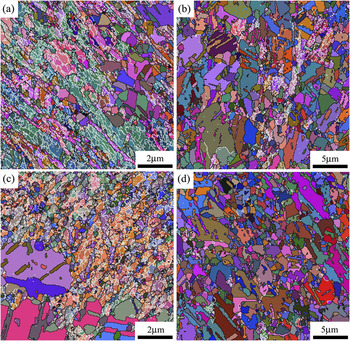
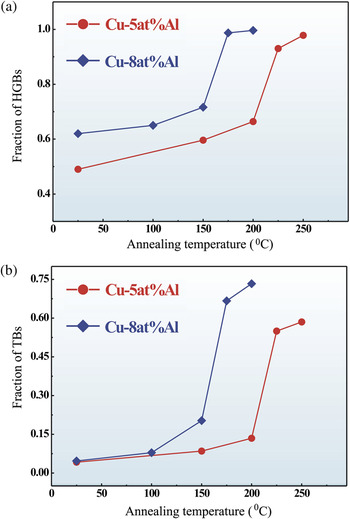
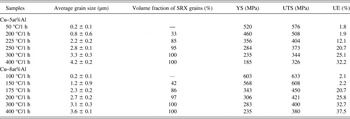
The typical microstructures of Cu–5at.%Al and Cu–8at.%Al after annealing at different temperatures are exhibited in Fig. 2, the data of average grain size and HGBs volume fraction are presented in Table I, and the evolutions of HAGBs and twin boundaries (TBs) fraction are illustrated in Figs. 3 and 4, respectively. After low-temperature annealing, recovery predominates the evolution of substructures and mainly changes dislocation configuration.Reference Humphreys and Hatherly14, Reference Humphreys24–Reference Huang, Humphreys and Ferry26 Then, although the fraction of LAGBs, i.e., the dislocation density, is lower than those processed by the four passes of ECAP, the main microstructure characteristics of the two Cu–Al alloys are similar. However, the extent of recovery, judged from the recovered fraction of HAGBs, is significantly less for NS Cu–8at.%Al with lower SFE, as shown in Fig. 4(a), since the restriction of dislocations dissociation slows the rate of dislocation climb and cross slip.Reference Meyers and Chawla12–Reference Qu, An, Yang, Huang, Yang, Zang, Wang, Wu and Zhang15 Essentially different from the recovery process, as exhibited in Fig. 2, recrystallization involves the formation of new strain-free grains (without LAGBs in the grains), as marked by “R,” in some regions and the subsequent growth to consume the deformed or recovered microstructures. In line with the hardness evolution, the static recrystallization (SRX) occurred at ~200 °C for NS Cu–5at.%Al alloy, and the corresponding volume fraction of SRX was approximately 33% with average SRX grain size of 1.3 ± 0.1 μm; the initiation of SRX happened at ~150 °C for NS Cu–8at.%Al alloy, and the volume fraction of SRX is about 42% with average size of 2.2 ± 0.3 μm. Therefore, both the volume fraction and grain size of SRX in the Cu–8at.%Al with lower SFE, closely related to the original deformation microstructures, are remarkably larger than those in the Cu–5at.%Al at the early stage of SRX. However, the average grain size of Cu–8at.%Al alloy is similar to that of Cu–5at.%Al alloy, as shown in Table I, which can be ascribed to its finer grain size obtained by ECAP. Meanwhile, the error bars of average grain sizes in these alloys annealed at these corresponding temperatures are significantly larger than those obtained at other annealing temperatures, which can be due to the onset of the static recrystallization resulting in the bimodal distribution of grain sizes.
EBSD maps concerning microstructures of Cu–Al alloys after annealing at: (a) 200 °C and (b) 225 °C for Cu–5at.%Al, and at (c) 150 °C and (d) 175 °C for Cu–8at.%Al (“R” implies recrystallization, and the white lines mean the LAGBs formed by dislocation activities; the black lines mean the HAGBs).

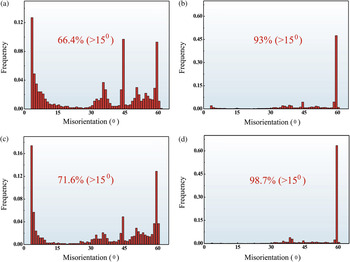
Fraction of HAGBs after annealing at: (a) 200 °C and (b) 225 °C for NC Cu–5at.%Al; (c) 150 °C and (d) 175 °C for Cu–8at.%Al.

(a) HAGBs fraction evolution of two Cu–Al alloys with annealing temperatures. (b) TBs fraction evolution with annealing temperatures (the boundaries with misorientation of 58 to 62° are regarded as TBs).

Microstructure characterization results and tensile properties of NS Cu–5at.%Al and Cu–8at.%Al samples with different annealing temperatures (the average grain size and volume fraction of SRX grains were measured by the acquisition software of Channel 5).

It is well known that the nature of plastic deformation gives rise to the variation not only in microstructure heterogeneities but also in stored energy, both of which are responsible for the nucleation and growth processes of recrystallization.Reference Humphreys and Hatherly14 As mentioned previously, shear bands, playing increasingly essential roles in the formation of nanostructures with decreasing SFE, will result in local heterogeneous regions of large orientation gradient compared with the surroundings.Reference Humphreys and Hatherly14, Reference An, Lin, Qu, Yang, Wu and Zhang16, Reference Paul, Driver and Jasieński23 Although the orientation gradient induced by shear bands cannot be precisely determined because of the fine microstructures of the two NS Cu–Al alloys and the limitation of EBSD resolution,Reference Qu, An, Yang, Huang, Yang, Zang, Wang, Wu and Zhang15, Reference Humphreys20 it is reasonable to realize that the nucleation of recrystallization is relatively easier in Cu–8at.%Al alloy with lower SFE because of its large orientation gradient originating from the high heterogeneity in microstructure induced by ECAP.Reference Humphreys and Hatherly14 Meanwhile, the spatial distribution and the properties of the boundaries also have great influence on the nucleation of recrystallized grains.Reference Humphreys and Hatherly14, Reference Wu, Wang, Jiang, Li, Alexandrov and Valiev27 Exhibiting characteristics different from previous investigations, the HGABs originating from severe plastic deformation are nonequilibrium and have high energy, which was characterized by high density of extrinsic dislocations and lattice distortion near boundaries.Reference Huang, Zhu, Jiang and Lowe28 As a result of the special properties in the NS Cu prepared by ECAP, recrystallization can occur during cyclic deformation at RT.Reference Wu, Wang, Jiang, Li, Alexandrov and Valiev27 Moreover, the growth of the new nucleus is significantly determined by the stored energy. It is obvious that the Cu–8at.%Al alloy with higher solution of Al achieves a higher flow stress at the end of plastic deformation via the Taylor equation (Fig. 1), which provides a higher driving force. Meanwhile, in terms of the microstructure analysis, the stored energy in the deformed microstructure should originate from the interactions of dislocations and as boundary energy in HAGBs presents in the initial structure and introduced during deformation. These stored energies will significantly influence the growth of SRX grains at the early stage of recrystallization.Reference Meyers and Chawla12, Reference Humphreys and Hatherly14, Reference Paul, Driver and Jasieński23–Reference Huang, Humphreys and Ferry26, Reference Hurley and Humphreys29 On one hand, the energy stored as elastic strain in the dislocation structure is also increased with lowering SFE of materialsReference An, Lin, Qu, Yang, Wu and Zhang16; on the other hand, the smaller crystal size and higher HAGBs fraction of NS Cu–8at.%Al than those of NS Cu–5at.%Al can reflect their difference of the stored energy as boundary energy in the HAGBs after the ECAP process.Reference Humphreys and Hatherly14, Reference Qu, An, Yang, Huang, Yang, Zang, Wang, Wu and Zhang15 Furthermore, solutes by pinning dislocations may result in a higher stored energy.Reference Humphreys and Hatherly14 As a result, there are more nucleation sites and higher driving force for growth of SRX grains in the low-SFE alloys, leading to the higher volume fraction and larger size of SRX grains.
The characterization of microstructures after annealing at the corresponding T ct for the two alloys, as illustrated in Figs. 2(b) and 2(d), reveals no significant variation not only in the volume fraction of ~85% but also in the average size of SRX grain of ~2.4 μm, and the fraction of HGBs exceeds 90% as shown in Figs. 3(b) and 3(d). Although the microstructures of the Cu–5at.%Al and Cu–8at.%Al alloys are similar after annealing at their T ct, growth rate of recrystallized grains significantly diminishes with decreasing SFE at the later stage of recrystallization, as listed in Table I. In the present investigations, Cu–Al alloys, after annealing at or above their T ct, might have low internal energy due to the release of most stored energy; therefore the driving force for growth of grains is relatively low at the later stage of recrystallization. Meanwhile the high formation rate of annealing twins in the low-SFE materials may also play significant roles in the decreased growth rate of grains.Reference Humphreys and Hatherly14 As shown in Fig. 4(b), the fraction of TBs in the Cu–8at.%Al is significantly larger than that in the Cu–5at.%Al during annealing. Compared with conventional HAGBs, coherent TBs are more stable as the excess energy of coherent TBs is one order of magnitude lower than that of HAGBs.Reference Lu, Shen, Chen, Qian and Lu4, Reference Meyers and Chawla12, Reference Humphreys and Hatherly14 Consequently, these TBs can, to some extent, inhibit boundary migration and then delay the growth of newly formed grains.Reference Humphreys and Hatherly14
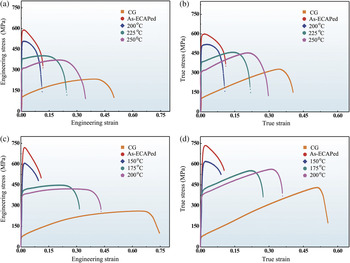
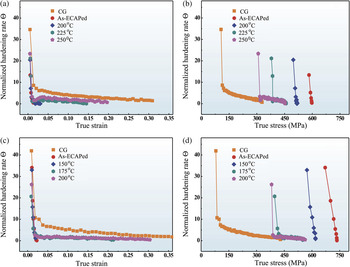
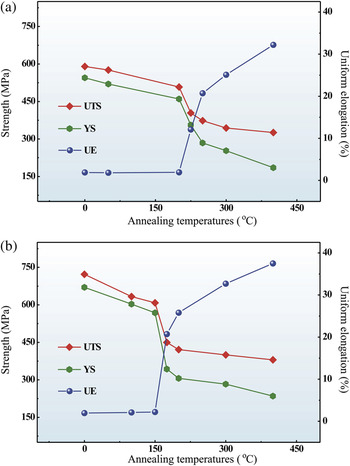
Typical tensile engineering/true stress–strain curves and the normalized strain hardening rate Θ [ , where σ and ε are true stress and strain, respectively] of two Cu–Al alloys annealed at different temperatures are presented in Figs. 5 and 6, respectively. The mechanical properties including yield stress (YS), ultimate tensile stress (UTS), and uniform elongation (UE), as a function of the annealing temperatures, are summarized in Fig. 7 and Table I. The mechanical properties of the Cu–Al alloys exhibit a similar trend, which is consistent with the evolution of hardness and previous investigations.Reference Wang, Chen, Zhou and Ma5, Reference Huang, Hansen and Tsuji6, Reference Tsuji, Ito, Saito and Minamino8–Reference Srinivasarao, Oh-ishi, Ohkubo, Mukai and Hono11 The slight drop in the strength and increase in the ductility are identifiable when the samples were annealed below T ct, while significantly improved uniform tensile elongation and decreased strength can be detected after the thermotreatments operated at or beyond T ct. Markedly distinguished from the suggestion that an apparent enhancement in the uniform elongation can be achieved if the SRX grains exceeded ~25 vol%,Reference Wang, Chen, Zhou and Ma5 tensile ductility of the two Cu–Al alloys was remarkably meliorated when the volume fraction of SRX grains exceeded ~80%, which is in line with the results provided in Ref. Reference Li, Zhang, Tao and Lu9. This large difference may stem from the specific microstructures processed by various deformation modes and conditions.
Tensile stress–strain (SS) curves of two Cu–Al alloys with different annealing conditions: (a) engineering SS curves and (b) true SS curves of Cu–5at.%Al; (c) engineering SS curves and (d) true SS curves of Cu–8at.%Al.

Normalized strain hardening rate of two Cu–Al alloys with different annealing conditions: (a, b) Cu–5at.%Al; (c, d) Cu–8at.%Al.

Mechanical properties of two Cu–Al alloys with different annealing conditions: (a) Cu–5at.%Al; (b) Cu–8at.%Al (The uniform elongation was obtained from the Consideré criterion).

It has been widely acknowledged that the ductility of metallic materials is controlled by strain hardening. In macroscale, the Consideré criterion governs the onset of localized deformation in tension

where σ is true stress, ε is true strain and  is strain hardening rate. According to Consideré criterion, in principle, plastic instability starts to happen at the UTS, which can determine the UE during tensile plastic deformation, when the increment in strength of the materials is less than the decrease in the load-bearing ability.Reference Meyers and Chawla12 Therefore, necking cannot occur as long as the Θ value keeps positive with increasing the plastic strain, as shown in Figs. 6(a) and 6(c). Thus, the higher Θ value with increasing annealing temperatures is the main reason for the improvement of ductility. When the annealing temperatures are below T ct, the improvement of the value Θ is very limited; however, above T ct, the value Θ is largely meliorated because of the microstructures change, as shown in Figs. 6(b) and 6(d). In terms of microstructures described previously, the strain hardening rate is mainly influenced by several factors including grain size, grain-boundary characteristics, and misorientation.Reference Valiev and Langdon1, Reference Zhao, Bingert, Zhu, Liao, Valiev, Horita, Langdon, Zhou and Lavernia7, Reference Valiev, Sergueeva and Mukherjee10 Thus, the pronounced amelioration in the uniform elongation of the two Cu–Al alloys stems from the growth of grain size, more stable grain boundaries and large misorientation, which remarkably rehabilitates the ability of strain hardening to upgrade the ductility.Reference Zhao, Bingert, Zhu, Liao, Valiev, Horita, Langdon, Zhou and Lavernia7, Reference Valiev, Sergueeva and Mukherjee10
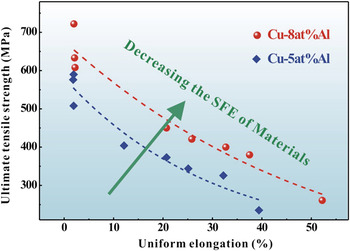
More crucially, compared with the Cu–5at.%Al, the Cu–8at.%Al with lower SFE exhibits a better strength–ductility combination after different annealing treatments, as illustrated in Fig. 8. The increment in strength with lowering SFE can be readily ascribed to the finer grain size and several anisotropic structures including stacking faults, deformation twins, more effectively blocking the dislocation propagation, and decreasing the slip barrier spacing.Reference Qu, An, Yang, Huang, Yang, Zang, Wang, Wu and Zhang15–Reference Wu, An, Han, Qu and Zhang18 Meanwhile, from the tensile test and hardness evaluation of the CG materials, the solid solution of atoms does play roles in enhancing the strength, which may be 8 to 10 MPa larger for the Cu–8at.%Al than that for the Cu–5at.%Al. Unlike the improvement in strength, the enhancement in ductility originates from the increase of the strain hardening rate with reducing the SFE,Reference Qu, An, Yang, Huang, Yang, Zang, Wang, Wu and Zhang15, Reference An, Han, Huang, Zhang, Yang, Wu and Zhang17 as shown in Fig. 6. Below the T ct, the microstructures are quite similar to those after ECAP processing. Therefore, the formation of profuse stacking faults and twins are mainly responsible for the higher strain hardening rate by offering ample room for dislocation storage and hindering the annihilation of dislocation through the suppression of dynamic recovery in the Cu–8at.%Al alloy.Reference Qu, An, Yang, Huang, Yang, Zang, Wang, Wu and Zhang15, Reference An, Han, Huang, Zhang, Yang, Wu and Zhang17, Reference Li, Tao and Lu30–Reference Zhao, Zhu, Liao, Horita and Langdon32 However, the uniform tensile elongation of the two Cu–Al alloys are markedly improved after annealing at or beyond T ct and the grain sizes are relatively large; both properties can present different mechanisms of enhancing strain hardening rate. In the classical crystal plasticity theory, the low SFE can effectively restrict the dislocation activities due to the large width of the stacking fault.Reference Meyers and Chawla12 As a result, cross slip, as an essential dynamic recovery mechanism, is more difficult in low-SFE metals, which makes the strain hardening of metals more rapid.Reference Meyers and Chawla12 Therefore, the localized deformation or plastic instability can be delayed, and the ductility is meliorated with the decrease in the SFE not only in the UFG/NS range but also in the coarse-grain range.
Relationship between UTS and UE of Cu–Al alloys after different processing conditions, showing the effect of decreasing SFE on the strength–ductility combination.

IV. CONCLUDING REMARKS
NS Cu–8at.%Al exhibits a relatively lower thermal stability compared with NS Cu–5at.%Al with higher SFE due to the large microstructure heterogeneities, facilitating the nucleation of recrystallization, induced by ECAP. Moreover, with increasing the annealing temperatures, both of the Cu–Al alloys present a similar trend of decreased strength and improved ductility. Meanwhile, the remarkable enhancement of uniform elongation is achieved when the volume fraction of SRX grains exceeds ~80%. More crucially, with the reduction in the SFE, Cu–8at.%Al presents better strength–ductility combination compared with Cu–5at.%Al. Thus, decoding the roles of SFE in the microstructures and mechanical properties during thermal annealing not only profoundly extends our understanding of the structure–properties relationship of UFG/NS materials, but also presents an efficient pathway to prepare materials with superior mechanical properties for technological utilizations.
ACKNOWLEDGMENTS
This work is supported by the Innovation Fund for Graduate students of IMR, CAS and National Natural Science Foundation of China (NSFC) under Grant Nos. 50841024, 50890173, and 50931005. Z.F. Zhang would like to acknowledge the financial support by the National Outstanding Young Scientist Foundation under Grant No. 50625103 and the National Basic Research Program of China under Grant No. 2010CB631006.