Introduction
Multiform glioblastoma (MG) is the most frequent primary intracranial tumour in adults,Reference Almeida, Chaichana, Rincon-Torroella and Quiñones-Hinojosa1 representing 60–70% of all gliomas.Reference Wen and Kesari2 The incidence of these neoplasms has increased especially in elderly patients, with half of the patients older than 65 years and 20% older than 75 years.Reference Sulman, Ismaila and Armstrong3, Reference Huang, Samson and Perkins4 These patients generally present with a poor prognosis and a mean overall survival (OS) rate of 12–18·2 monthsReference Almeida, Chaichana, Rincon-Torroella and Quiñones-Hinojosa1, Reference Wen and Kesari2, Reference Stupp, Mason and van den Bent5, Reference Alifieris and Trafalis6 for which an aggressive multimodal approach is required, encompassing maximum resection and concomitant radiotherapy with temozolomide. Older adults have means survival from 4 to 9 monthsReference Babu, Komisarow and Agarwal7 and present with multiple co-morbidities and a low physiological reserve, which increases the surgical risk and they are less likely to receive aggressive treatment.
There is also the added concern regarding the toxicity of the temozolomide, so shorter courses of radiotherapy has been adopted to reduce the dose and duration of treatment to lower the possible combined toxic effects of treatment. This also reduces the number of hospital visits, when compared with the standard treatment, providing an improved quality of life in the elderly without an impact on OS rates, or disease-free survival (DFS).
Currently among the hypofractioned regimens adopted, one is tested in the Nordic study by Malmstrom et al., in which a comparison of 34 Gy in 10 fractions versus temozolomide monotherapy versus conventional radiotherapy of 60 Gy in 30 fractions, in patients older than 65 years. The findings reported an increase in survival in the hypofractionated arm and temozolomide alone with higher treatment interruption rates in the standard radiotherapy scheme.Reference Malmstrom, Gronberg and Marosi8 In contrast the NOA-08 study by Roa et al. found survival means of 5·1 months versus 5·6 months with doses of 60 Gy in 30 fractions and 40 Gy in 15 fractions, respectively, as well as a greater possibility of completing radiotherapy treatment.Reference Roa, Brasher and Bauman9
Another study that promotes the use of hypofractionation is that of the International Atomic Energy Agency (IAEA) in 2015; this study compared 25 Gy in 5 fractions versus 40 Gy in 15 fractions and concluded that there is no difference in survival (average global survival of 7·9 months and 6·4 months, respectively, p = 0·988) or in progression-free survival with a mean of 4·2 months in both arms.Reference Roa, Kepka and Kumar10 This is corroborated by a phase III study by de Castro et al., in 2017, that compared the same regimens as in the IAEA study, and found no difference in the mean of overall survival (6·8 months and 6·2 months, p = 0·936) or in the average progression-free survival (4·3 and 3·2 months, p = 0·706) concluding that the shortened regimen is not inferior and is a good alternative, particularly in elderly patients, or for those with poor functional status or contra-indications for systemic management.Reference de Castro, Matiello and Roa11
In this retrospective study, we sought to describe OS and DFS in adults over 70 years of age with a diagnosis of MG who received radiotherapy, both conventional and hypofractionated in our hospital.
Materials and Methods
The study received endorsement from the research and bioethics committee of the unit. A retrospective review of the records of all patients older than 70 years diagnosed with the MG and treated in the period from 2013 to 2016 was performed. The inclusion criteria were: patients with confirmed diagnosis of MG by a histopathological report or conclusive image study, age over 70 years, patients who had received treatment with radiotherapy. Patients were assessed for functional status, according to the scale of Eastern Cooperative Oncology Group (ECOG).Reference Oken, Creech and Tormey12
The OS and DFS of patients treated with the 60 Gy scheme in 30 fractions and the hypofractioned scheme 45 Gy in 15 fractions were compared. For the analysis of results, descriptive statistics were applied; using measures of central tendency, for qualitative variables frequencies and percentages were used. In the survival analysis we used the Mann–Whitney U method and Student’s t-test according to the distribution of the sample and the respective Kaplan–Meier curves; for the analysis of qualitative variables the Chi square test was applied.
Results
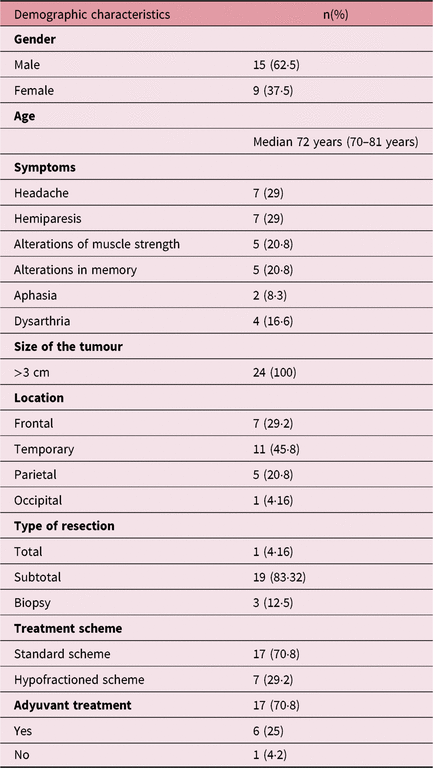
From January 2013 to December 2016 there were 24 patients who met the inclusion criteria (Table 1), of whom 62·5% were women and 37·5% men; the median age was 72 years (range 70–81 years). The main comorbidity found in the sample was systemic hypertension in 37·5% of the population, followed by type 2 diabetes mellitus in 25% of the population; benign prostatic hypertrophy was found in 12·5% of the population.
Demographic characteristics of the population

The most frequent clinical manifestations in the population were headache in seven patients, hemiparesis in seven patients, memory alterations in five patients and nonspecific alterations in muscle strength in five patients. The locations of tumour presentation were the temporal lobe in 46% of the patients, followed by the frontal lobe in 29% and the parietal lobe in 21%.
A total of 83% of patients underwent subtotal resection; about 12·5% of patients were candidates only for biopsy, while one of the patients underwent macroscopically complete resection. Regardless of the extent of the resection, 71% of patients older than 70 years received standard radiotherapy treatment of 60 Gy in 30 fractions and 29% received a hypofractionated scheme of 40 Gy in 15 fractions.
In the relationship between functional status and type of treatment selected, there was a tendency to use the standard regimen in patients with ECOG equal to or less than 1 (88·2%), and only 11·6% of patients in the 60 Gy in 30 fraction regimen had a higher ECOG or equal to 2, while in the hypofractionated treatment group all patients were found to have functional status of 2 and 3 in 57 and 43%, respectively.
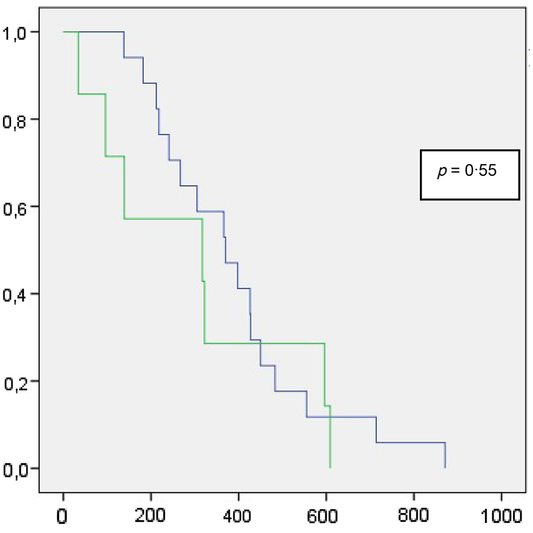
The median OS in the 24 patients in this study was 344 days; in patients who received hypofractionated treatment the median overall survival was 317 days; and the median OS was 370 days in those who received a standard regimen without being statistically significant (p = 0·55) as presented in Figure 1.
Kaplan–Meier curve OS for the standard scheme and the hypofractioned one.

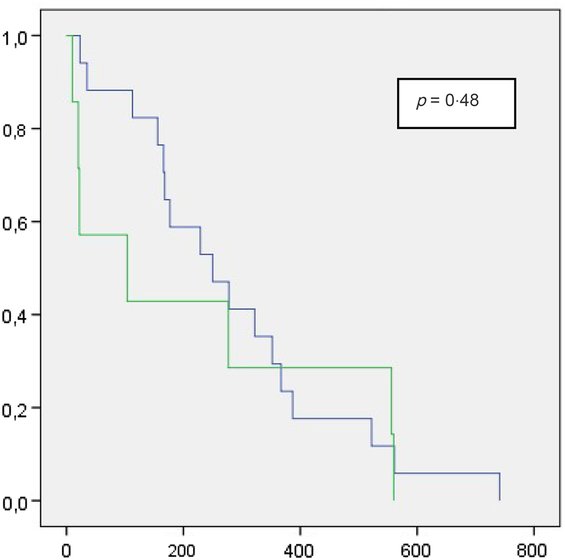
The DFS in patients who received the standard regimen was 250 days and 104 days in the hypofractionated arm. As shown in Figure 2, no statistically significant difference was found between standard and hypofractioned treatment (p = 0·48).
Kaplan–Meier curve DFS for the standard scheme and the hypofractioned one.

After radiotherapy treatment, it was observed that regarding the ECOG, the patients who received treatment with the hypofractioned scheme, the ECOG was maintained or improved in 42·5% of the patients and deteriorated the ECOG in 57·3%, without having statistical significance (p = 0·147), while in the standard fractionation 17·6% of patients maintained their ECOG and 82·3% showed deterioration of their general conditions, being statistically significant (p = 0·002); however, when comparing the final functional status of both radiotherapy schemes, there was no statistical significance (p = 0·272).
Discussion
In the analysed sample, the number of patients undergoing subtotal resection was 83% and 12% for biopsy, with percentages significantly higher than reported in several international studies where the percentage of subtotal resection is 23–52 and 42% and 66% for biopsy.Reference Roa, Brasher and Bauman9, Reference Bracci, Laigle-Donadey and Hitchcock13 Currently shortened fractionations are comparable in disease control and survival to conventional schemes. In the present study, it was observed that patients with functional status higher than 2 on the ECOG scale were included in the hypofractionated treatment and those with ECOG less than 2 were chosen to the conventional scheme.
During the follow-up of the patients, it was found that in the arm of the standard fractionation they present greater deterioration using the ECOG and quality of life scale, found in 82·3% of the patients (p = 0·002); therefore, the longer treatment worsens the quality of the life of the patient.
One of the objectives of this study was to report on OS in elderly population of 70 years treated with both radiotherapy regimens, finding a median survival of 10·42 months for hypofractionation and 12·16 months for the standard scheme (p = 0·55), which agrees with what is reported worldwide.Reference Malmstrom, Gronberg and Marosi8–Reference Arvold, Tanguturi and Aizer17
The median DFS in the hypofraction arm was of 3·41 months and 8·21 months for the standard treatment fractionation (p = 0·48); these results agree with the different studies published. In a range of 4·2–6·3 months and 4·2–8·2 months, respectively.Reference Keime-Guibert, Chinot and Taillandier14, Reference Minniti, DeSanctis and Muni16, Reference Minniti, Scaringi and Lanzetta18
Although this was a retrospective study and included a relatively small sample of patients, it opens the door to new research questions. Authors suggest prospective studies to research the effects of adding temozolomide to the hypofractioned regimen, in order to determine its impact on survival and adverse effects in patients older than 70 years, using a detailed analysis of their functional status during and after treatment.
Conclusions
In this study we found that the use of hypofractionation radiotherapy had been prescribed in 29% of patients with MG over the age of 70 years, treated in our radiotherapy unit from 2013 to 2016.
We found no significant statistical difference in OS and DFS in the conventional or hypofractionated radiotherapy treatment.
The therapeutic decision must be considered and made by a multidisciplinary team because there is the opportunity to adopt the hypofractionated regimen in order to reduce hospital visits and treatment time, benefiting both the patient and the health service.
Author ORCIDs
Alejandro Olmos Guzmán 0000-0002-8237-4166
Acknowledgements
To the Radiotherapy service of the National Medical Center XXI Century, to the Radiotherapy service of the National Medical Center Bajio of the Mexican Social Security Institute.