Introduction
A number of well validated tools are used to measure poor voice quality.Reference Webb, Carding, Deary, MacKenzie, Steen and Wilson1 However, laryngologists frequently encounter non-voice-related throat symptoms; patients complain of symptoms such as frequent throat-clearing, obstruction, altered sensation and/or discomfort. Over the past 15 years, different symptom scoring tools have been developed in an attempt to assess these non-voice-related symptoms. In 1995, Deary et al. Reference Deary, Wilson, Harris and MacDougall2 described the Glasgow and Edinburgh Throat Scale, a 10-item questionnaire designed to assess and monitor the response of symptoms in patients treated for globus pharyngeus (Appendix 1). This questionnaire has been used as an assessment tool in a number of studies.Reference Dumper, Mechor, Chau and Allegretto3–Reference Park, Choi, Kwon, Yoon and Kim6
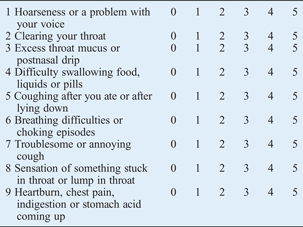
A few years later, an independent North American groupReference Belafsky, Postma and Koufman7 reported the validity of a questionnaire assessing laryngopharyngeal reflux symptoms in patients presenting with voice disorders. The nine-item Reflux Symptom Index (Appendix 2), validated for patients with supra-oesophageal reflux confirmed by dual-probe pH monitoring, is now a widely used outcome tool.
Although Deary's group have reported extensively on the psychological correlations of globus, most recently in Vietnam war veterans,Reference Gale, Wilson and Deary8 others remain convinced that globus is itself reflux-related. Given this lack of clarity regarding symptom attribution, and a noted overlap of items between two putative ‘disease-specific’ assessment tools, it has been unclear to what extent the Reflux Symptom Index and the Glasgow and Edinburgh Throat Scale assess similar phenomena.
The original description of the Glasgow and Edinburgh Throat Scale included a factor analysis with a three-factor solution. In other words, this questionnaire appeared to assess three different sets of symptoms. To date, there has been no factor analysis published for the Reflux Symptom Index.
The principal aim of the current study was to employ factor analysis to explore the underlying elements assessed by the Glasgow and Edinburgh Throat Scale and the Reflux Symptom Index, both individually and as a combined throat-assessment tool, in a substantial number of subjects. A secondary aim was to assess the reliability of each of these tools through their internal consistency.
Materials and methods
Setting and subject selection
This study was conducted in three hospital out-patient departments in England. Participants were pooled from four cohorts: consecutive patients attending an ophthalmology clinic; patients attending a chest clinic; patients attending a voice clinic; and patients attending an ENT clinic with a non-voice-related throat symptom (chronic catarrh). Therefore, our subjects comprised a mix of patients with problematic throat symptoms and patients with few or ‘incidental’ throat symptoms.
Exclusions
Twenty-three patients who scored zero on their completed questionnaire(s) (i.e. who had no analysable symptoms) were excluded from analysis.
Questionnaires
Consenting participants completed either the Reflux Symptom Index, the Glasgow and Edinburgh Throat Scale or both, whilst awaiting their out-patient consultation. Basic patient demographics were also recorded.
Statistical analysis
Data were stored and analysed using the Statistical Package for the Social Sciences software program (SPSS Inc, Chicago, Illinois, USA). Factor analyses utilised principal component analysis with oblimin rotation and Kaiser normalisation. Oblimin rotation was employed because we expected the resultant factors to show some degree of correlation between themselves, due to the generally non-specific nature of throat symptoms (e.g. a factor pertaining to throat-clearing symptoms is unlikely to be independent of a factor pertaining to symptoms based around the accumulation of pharyngeal phlegm). Factor solution was estimated using Cattell scree slope plots of eigenvalues. Exploratory factor analysis was employed rather than confirmatory factor analysis. This was because no previous factor analysis has been published for the Reflux Symptom Index, and we thus had no a priori theory upon which to apply a confirmatory analysis, while Deary et al. had performed a previous factor analysis on the Glasgow and Edinburgh Throat Scale; therefore, direct comparison of the two scales was facilitated by analysing them using the same means. Such an approach would also have the potential to confirm the reproducibility of Deary and colleagues’ initial factor analysis.
The internal consistency of each research instrument was assessed using Cronbach's α coefficient, calculated for both the single instrument and the individual factors.
Ethical approval
Ethical approval for data collection was granted by the local ethics and research councils of the hospitals involved.
Results
Three hundred and thirty-four subjects completed one or both questionnaires: 134 chronic catarrh patients (age range 18–84 years) completed both questionnaires; a further 168 ophthalmology patients (age range 24–90 years) completed the Glasgow and Edinburgh Throat Scale only; and 32 chronic pulmonary disease patients (age range 46–80 years) and 61 voice clinic patients (age range 18–80 years) completed the Reflux Symptom Index only.
Some of the resulting raw data relating to two of the symptom-specific cohorts have been published elsewhere;Reference Ali and Wilson9, Reference Cathcart, Karagama, Henderson and Wilson10 this information related to those patients who completed only one or other of the two questionnaires. The mean and range of questionnaire scores for each patient cohort are given in Table I.
Questionnaire scores by patient cohort

n = *134, †168, ‡32 and **61. GETS = Glasgow and Edinburgh Throat Scale; RSI = Reflux Symptom Index
Reflux Symptom Index factor analysis
The Reflux Symptom Index was completed by 227 individuals in all. The overall Cronbach's α coefficient for all items was 0.75, implying good internal consistency and thus reliability. A scree plot of eigenvalues was derived from principal component analysis. There were three principal components with eigenvalues greater than one, although the scree slope seemed to suggest that a two-factor solution may be more suitable. Indeed, upon oblimin rotation, a two-factor solution was found to fit far more neatly than a three-factor solution (Table II). In the two-factor solution, component one consisted of: ‘breathing difficulties or choking’, ‘coughing after eating or lying’, ‘troublesome cough’, ‘difficulty in swallowing’ and ‘heartburn or indigestion’ (Cronbach's α = 0.75). The second factor included: ‘throat clearing’, ‘globus’, ‘postnasal drip’ and, more weakly, ‘hoarseness or voice disorder’ (Cronbach's α = 0.57). With the weakly loading item ‘hoarseness’ removed, the overall reliability of the Reflux Symptom Index increased to 0.77.
Reflux Symptom Index: principal component analysis*

* Pattern matrix after oblimin rotation. Loadings of less than 0.25 have been omitted for clarity. PND = postnasal drip
Glasgow and Edinburgh Throat Scale factor analysis
The Glasgow and Edinburgh Throat Scale was completed by 302 subjects. Cronbach's α coefficient for this questionnaire as a single instrument was 0.81, again implying good internal consistency. The pair-wise correlation coefficients between each item are shown in Table III. Again, there were three eigenvalues greater than one; based on an examination of the scree plot, we decided to investigate two-, three- and four-factor solutions. After oblimin rotation, a three-factor solution was found to fit best, with those three factors accounting for over 70 per cent of the total variance (Table IV). The first rotated component accounted for 49 per cent of variance and had five highly loading items: ‘catarrh or postnasal drip’, ‘want to swallow all the time’, ‘can't empty throat’, ‘feeling something stuck in the throat’ and ‘discomfort or irritation in the throat’ (Cronbach's α = 0.77). These items appeared to imply a relatively specific factor relating to globus-type symptoms. The second component (12 per cent of variance) had three highly loading items which related to obstructive symptoms: ‘difficulty in swallowing food’, ‘food sticking when swallowing’ and ‘throat closing off’ (Cronbach's α = 0.8). The third component was a two-item factor relating to pain and swelling in the throat (Cronbach's α = 0.6).
Individual Glasgow and Edinburgh Throat Scale items: pair-wise correlation coefficients

Glasgow & Edinburgh Throat Scale: principal component analysis*

* Pattern matrix after oblimin rotation. Loadings of less than 0.25 have been omitted for clarity.
Combined questionnaire factor analysis
Using data from the 134 subjects who completed both the Reflux Symptom Index and the Glasgow and Edinburgh Throat Scale, the individual items of each questionnaire were united and a factor analysis performed on the combined throat instrument (Table V). A scree plot demonstrated five components with eigenvalues of more than one, although no clear factor structure was evident from the shape of the slope. From the varimax rotation matrix, a two-factor solution appeared to provide an optimal fit. The first rotated factor consisted of items alluding to blockage and coughing: ‘difficulty in swallowing food’, ‘difficulty swallowing’, ‘food sticking when swallowing’, ‘throat closing off’, ‘breathing difficulties or choking’, ‘swelling in throat’, ‘pain in throat’ and ‘coughing after eating or lying down’. The second factor had high loadings from items relating to globus, catarrh and/or throat-clearing: ‘want to swallow all the time’, ‘catarrh down throat’, ‘clearing throat’, ‘discomfort or irritation in throat’, ‘feeling something stuck in throat’, ‘excess mucus or postnasal drip’, ‘can't empty throat’ and ‘something stuck in throat’. Three items (all from the Reflux Symptom Index) did not load onto either of the first two factors very heavily – these were ‘troublesome cough’, ‘heartburn or reflux or indigestion’ and, once again, ‘hoarseness or voice problem’.
Combined-item instrument: principal component analysis*
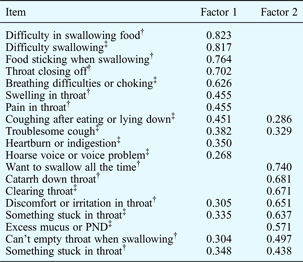
* Pattern matrix after oblimin rotation; loadings of less than 0.25 have been omitted for clarity. †From Glasgow and Edinburgh Throat Scale; ‡from Reflux Symptom Index. PND = postnasal drip
Discussion
Both the Reflux Symptom Index and the Glasgow and Edinburgh Throat Scale have emerged as reliable tools with which to assess the intensity of throat symptoms, with good overall internal consistency. But what do these tools actually indicate? Although the second Reflux Symptom Index factor (catarrh or globus) was somewhat less consistent, both the Reflux Symptom Index and the Glasgow and Edinburgh Throat Scale could be regarded as generating principal domains reflecting (1) cough and blockage, and (2) globus or postnasal drip or throat-clearing.
In other words, we have shown by statistical methods that the Reflux Symptom Index and the Glasgow and Edinburgh Throat Scale both appear to identify similar symptom clusters. This novel observation must bring into question these questionnaires’ ability to differentiate throat patients into diagnostic groups. Can symptomatic supra-oesophageal reflux really be clarified from the clinical history? Given the similar underlying factor structure between the two instruments, it is likely that reflux patients would score highly on the Glasgow and Edinburgh Throat Scale, and it has previously been shown that globus patients score highly on the Reflux Symptom Index.Reference Park, Choi, Kwon, Yoon and Kim11 Little specific aetiological inference is thus possible, which may help to explain recent reports of suboptimal Reflux Symptom Index predictive validityReference Dauer, Thompson, Zinsmeister, Dierkhising, Harris and Zais12 and specificity.Reference Park, Choi, Kwon, Yoon and Kim11
Although we have shown that the Reflux Symptom Index and the Glasgow and Edinburgh Throat Scale can be deconstructed into two or three primary components, the purpose of identifying the underlying factors in the instruments was to allow their direct comparison, and we do not propose that these tools be currently either amalgamated or contracted. Indeed, the magnitude of the eigenvalue of the first component in the Glasgow and Edinburgh Throat Scale analysisReference Millichap, Lee and Pring5 suggests that this instrument probably serves best when used as a single-score outcome measure.
As part of their initial validation of the Glasgow and Edinburgh Throat Scale, Deary et al. Reference Deary, Wilson, Harris and MacDougall2 performed a factor analysis of this questionnaire's items, as scored by their selected cohort of globus patients. From this a three-factor solution was proposed, with symptom groups of ‘feeling something stuck in throat’, ‘discomfort or irritation in throat’ and ‘want to swallow all the time’. The factors generated by our analysis of the Glasgow and Edinburgh Throat Scale bear close resemblance to those of Deary et al., confirming that the factor structure holds even when the majority of subjects are ‘non-throat’ patients.
It is of particular interest that the Reflux Symptom Index's single explicit ‘reflux’ item – i.e. ‘heartburn, chest pain, indigestion or stomach acid coming up’ – did not load to any great extent onto either of the factors generated by the combined throat symptom analysis. The optimum assessment of supra-oesophageal reflux symptoms remains unclear, but it is unlikely that a single item such as heartburn can accurately indicate the apparently very heterogeneous nature of extra-oesophageal symptoms.Reference Papakonstantinou, Leslie, Gray, Chadwick, Hudson and Wilson13
Clinical applicability
Our findings indicate a need to revisit the clinical classification of throat symptoms, which traditionally may have been artificially and over-simplistically divided into separate ‘conditions’ merely on the basis of the precise nature of the leading symptom perceived and reported by the patient on initial presentation. The implication is that these throat conditions are not mutually exclusive but in fact share many similar features and, perhaps, similar aetiologies. If one seeks to assess throat symptoms, either clinically or as an outcome measure, then either the Glasgow and Edinburgh Throat Scale or the Reflux Symptom Index may be used, with each showing good overall internal consistency. The symptom of ‘heartburn or indigestion’ does not correlate well with throat symptoms; this may be contrary to common expectations.
Study strengths and weaknesses
To the best of our knowledge, the current study reports the first factor analysis of the Reflux Symptom Index, and it has the advantage of including data from large numbers of ‘throat’ and ‘non-throat’ patients.
In this study, we employed a heuristic approach to factor analysis rather than an absolute approach – that is to say, we did not attempt to account for the data completely by way of underlying factors, but instead attempted simply to identify the predominant factors which accounted for the majority of the variance encountered. We consider this approach reasonable; however, we were not attempting to generate new theory but rather to enable comparison of the two symptom assessment instruments.
The Glasgow and Edinburgh Throat Scale and the Reflux Symptom Index have differing item-scoring scales (the Glasgow and Edinburgh Throat Scale uses 0 to 7 and the Reflux Symptom Index 0 to 5). Whilst it could be argued that this may have some impact on the magnitude of the correlations seen between items, we felt it necessary to keep each instrument in its original validated form, and to accept that the direction of correlation would at least be the same whatever the scoring scale used.
• Patterns of throat symptoms are currently used to differentiate between non-voice-related throat conditions
• Separate, disease-specific symptom scoring tools have been developed to assess these individual conditions
• These tools’ reliability, and the degree of overlap between what they assess, are currently unknown
• This study found that both the Reflux Symptom Index and the Glasgow and Edinburgh Throat Score were reliable discriminators of throat symptom severity, but that their underlying factor structures appeared to be similar, implying that they assessed largely the same thing
• These results suggest that, considered alone, non-voice-related throat symptoms cannot be used to indicate a specific diagnosis
• Heartburn correlated poorly with pharyngeal symptoms
Acknowledgement
We would like to acknowledge and thank Ms Karen McInally for her contribution to the data collection.
Appendix 1. Glasgow and Edinburgh Throat Scale
Do you have any of the following throat sensations?
Please indicate by circling the figure which best describes how much you are affected.
0 = no problem, 7 = unbearable problem

Appendix 2. Reflux Symptom Index
Within the last month, how did the following affect you?
0 = no problem, 5 = severe problem